How to Care for Air Plants (Tillandsia): Watering, Drying, Light, and Soft Bases
How to care for air plants, the tillandsias that grow without soil: soaking times, upside-down drying, the right light, and what to do if the base turns soft.
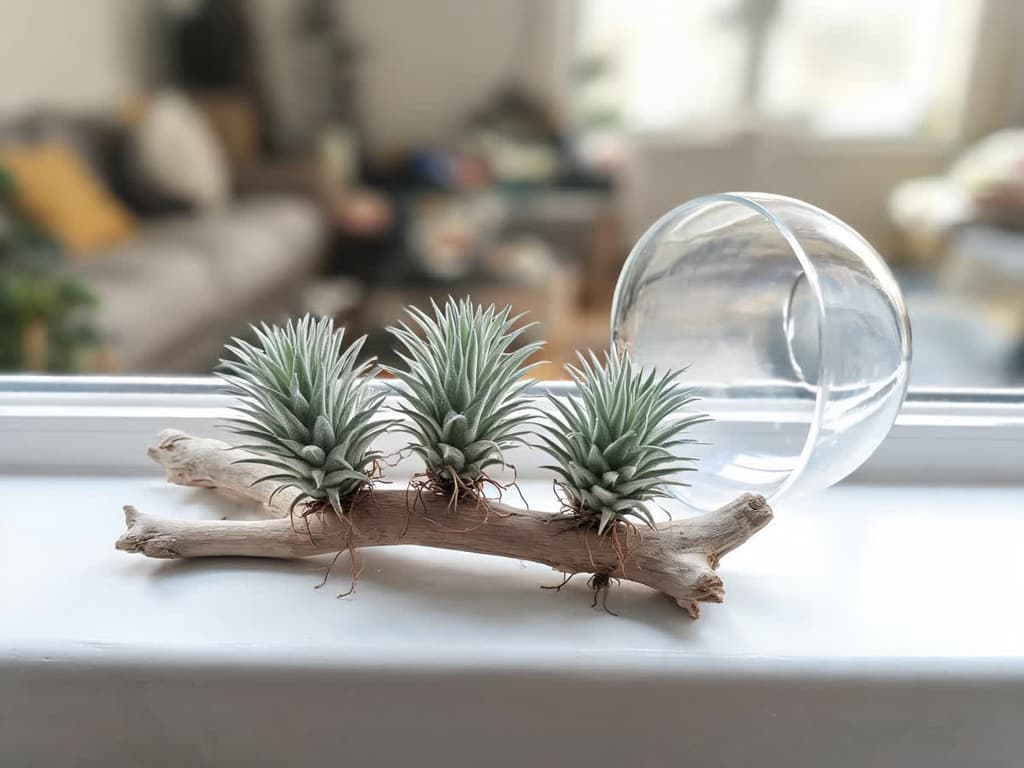
To care for air plants (tillandsia), soak the entire plant in water for 20 to 30 minutes once a week. Afterward, shake it off, turn it upside down, and let it dry in a spot with circulating air within 4 hours. Keep the plant near a bright window, protected from intense direct sun for most of the day. Never plant it in soil, and never let standing water pool between the central leaves.
If the tips of your tillandsia turn dry and brown, it is thirsty. Soak the plant in water, because misting alone does not provide enough moisture. If the center turns mushy and the leaves pull away easily when you tug gently, the mother plant rarely recovers. In that case, you can still save the pups growing from the base.
The figures in this guide come from university extension services in the United States, which publish research-based advice for home growers. The main sources include Penn State, the University of Vermont (UVM), Clemson, and UF/IFAS (University of Florida). Recommendations also come from the Royal Horticultural Society (RHS) and the New York Botanical Garden (NYBG). Because these sources originate in the Northern Hemisphere, the window directions have already been adapted for Brazil.
Quick summary:
Watering: soak for 20 to 30 minutes once a week; soak more often during hot, dry weather, and less often during cool, humid conditions.
Drying: shake off excess water, turn upside down, and let dry within 4 hours in circulating air.
Light: bright, indirect light; silver tillandsias tolerate more sun than green varieties.
Temperature: 18 to 32 °C during the day and above 13 °C at night.
Fertilizer: optional; use bromeliad fertilizer diluted to 1/4 strength, once a month.
Never: soil, moss, closed glass globes, or standing water in the crown.
Care | What to do |
|---|---|
Watering | Soak for 20 to 30 minutes weekly; 10 to 20 minutes for green varieties |
Drying | Upside down, drying completely within 4 hours in a well-ventilated spot |
Light | Bright, indirect light; direct sun only for silver varieties, and filtered behind glass with a sheer curtain |
Temperature | 18 to 32 °C during the day; above 13 °C at night |
Fertilizer | Bromeliad fertilizer at 1/4 strength, once a month (optional) |
Size | 5 to 23 cm tall for most varieties sold for the home (UVM) |
Flowering | Once in a lifetime; afterward, the mother plant produces pups and dies slowly |
What is tillandsia and why does it live without soil?
Tillandsia (Tillandsia, also spelled tilândsia) is a genus, meaning a group of related species, in the bromeliad family. It is called an air plant because it grows attached to branches, rocks, and wires, without soil. It is an epiphyte: it uses another surface only for support, taking nothing from it, according to Iowa State. The roots serve to hold the plant in place, not to take up water.
The trichomes, tiny cup-shaped scales that cover the leaves, are what absorb water. They give the foliage its grayish or velvety look. Penn State explains that the trichomes trap moisture and dust, and the plant draws water and nutrients from that moisture and dust. That is why tillandsia does not live "on air": it needs real, regular watering.
Brazil has native tillandsias. Flora e Funga do Brasil records Tillandsia usneoides, Spanish moss, which hangs from branches in gray strands. It also records Tillandsia aeranthos, T. stricta, T. tenuifolia, and T. recurvata. In São Paulo, Spanish moss has been used to measure pollution. A 2007 study found zinc and barium accumulated in plants exposed near heavy-traffic avenues. The guide for tillandsia (air plant) lists the symptoms and diseases that appear most often in the genus.
Green vs. silver tillandsia: how to identify yours
Tillandsias fall into two groups, which require different care. The green ones are mesic, from humid climates. They come from forests and have greener, smoother leaves that curve slightly inward, with smaller trichomes. The silver ones are xeric, from dry climates: many grow on rocks and have so many trichomes that the leaves appear gray or fuzzy. This classification comes from Penn State.
Green (mesic) | Silver (xeric) | |
|---|---|---|
Leaf | Green, smooth, sparse fuzz | Gray or silver, velvety |
Origin | Humid forest, shaded by trees | Dry climate, on rocks |
Watering | More frequent; soak for 10 to 20 minutes | Less frequent; a quick dunk is enough |
Light | More filtered | Brighter, tolerates some direct sun |
The watering and light rows in the table follow the NYBG. It advises watering xeric plants less frequently and giving them stronger light. NDSU (North Dakota State University) describes the same pattern. According to NDSU, gray varieties require high light and infrequent watering, while green varieties need less light and frequent watering. For beginners, Cornell Extension states that silver varieties are the easiest because they better tolerate watering mistakes.
If your plant arrived without a label and you are unsure of the species, Bloom (available for iOS) identifies it from a single photo. Knowing the species reveals whether it belongs to the green or silver group, which directly determines the required soaking time.
How to water tillandsia: soaking, rinsing, or misting
Submerging your tillandsia in water is the most reliable way to hydrate it. Fill a bowl with room-temperature or lukewarm water—never icy water—and submerge the entire plant. Extension guidelines suggest slightly different soaking times:
Clemson: 20 to 30 minutes, once a week (HGIC 1515).
University of Illinois: 30 minutes in lukewarm water.
UVM: 30 to 60 minutes, once a week (University of Vermont).
Penn State: rinse under running water twice a week, or soak for 20 minutes to 1 hour weekly.
NYBG: 10 to 20 minutes for green varieties; a quick dunk for silver varieties.
Start with 20 to 30 minutes a week. If the tips dry out, soak more frequently; if the center gets soft, improve drying. The frequency changes with the environment: the RHS instructs watering more often in hot weather with dry air and less often in cold weather with humid air. The RHS reaches an average of 2 to 3 soakings a week from spring to fall in the UK climate. Iowa State indicates once a week in a warm, bright environment and every 2 weeks in a cool, dark environment. Near an air conditioner or heater the plant dries quickly, and Penn State instructs moving it away from there.
Sources disagree on misting. UF/IFAS recommends only weekly misting, until water runs off the plant. Clemson and UVM accept misting as an alternative to soaking. The RHS and Iowa State say misting does not wet enough and does not replace soaking. No source measured both methods side by side. This guide uses soaking as the primary watering method, as it is the safest option for the plant. The RHS warns that misting alone does not provide sufficient moisture. Misting serves only as a supplement between soakings when the air is dry.
Expert sources also differ regarding the best type of water. UVM recommends rainwater, spring water, or tap water set out overnight so chlorine can dissipate. The university warns against using filtered or distilled water due to their lack of trace minerals. It also advises avoiding softened water (treated to remove hardness), as added sodium harms the plant. The NYBG prefers distilled water because municipal tap salts accumulate on foliage, though it recommends adding a small amount of fertilizer. The RHS recommends rainwater and advises avoiding tap water, especially in hard-water areas with heavy limescale. This guide follows UVM, as a university extension service: use rainwater or tap water rested overnight. If your tap water is hard, stick with rainwater.
Tillandsias do not store water in their centers, unlike tank bromeliads, which maintain an internal water reservoir among their leaves. If you grow both plants, never duplicate bromeliad watering habits on your air plant. In tillandsias, standing water in the crown rots the base. When your plant is in flower, wet only the leaves and take care to keep the flower dry: UVM warns that wetting blooms makes them turn mushy and rot.
Upside-down drying: the 4-hour window that prevents a rotted base
After soaking, gently shake your tillandsia and place it upside down on a clean towel. Clemson explains that water readily collects between the leaves surrounding the crown. Inverting the plant lets trapped water drain away rather than sitting until the base decays. The RHS directly links rot to standing water in the center combined with stagnant air.
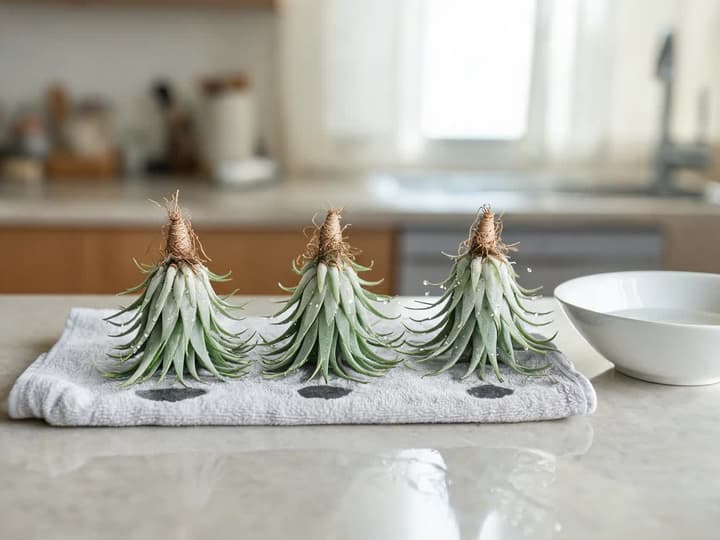
The 4-hour rule appears in two distinct contexts, and both apply simultaneously:
Dry within 4 hours: the NYBG guide instructs you to dry the plant in a well-ventilated spot where it dries within 4 hours. If the plant remains wet after 4 hours, find a location with more circulating air.
Stay out of the glass for at least 4 hours: Penn State recommends waiting 4 hours or more before returning the plant to the globe.
If the plant soaked for 1 hour and, days later, the center became soft, the soak time is unlikely to be the cause. One hour is within UVM's 30- to 60-minute range. The most likely cause is water trapped in the center after the soak.
Common advice suggests watering only in the morning because tillandsia "breathes at night." Tillandsia uses CAM photosynthesis, opening leaf pores and taking in carbon dioxide at night. A study on Spanish moss (Martin and Siedow, 1981) showed that wet leaves lose carbon dioxide at any time, day or night. The study does not point to a better time to water. Because wet tissue does not take in carbon dioxide, what matters is drying the plant soon after soaking.
Light requirements for tillandsia
Tillandsias need bright, indirect light near a window. Penn State suggests east- or west-facing windows. In Brazil, north-facing windows receive the most sun. For these, the RHS recommends a sheer curtain between the plant and the glass. Cornell Extension notes that the plant rarely does well in the window with the least light (in Brazil, south-facing windows). A windowless room will not work either.
Sources disagree on direct sun. NC State states that most species can handle full sun in nature. According to NC State, the sunniest window in the house is not too much sun. UVM, Clemson, UF/IFAS, and the RHS instruct you to avoid direct sun. This guide follows the majority: bright light without intense sun all day long. Only silver varieties get some direct sun, because the NYBG states that they tolerate more. A brown or bleached leaf after sitting behind glass in the sun is sunburn, according to the RHS.
In an office or dim room, artificial lights can replace natural window light. The NYBG recommends 12 hours of fluorescent light per day, placed no more than 60 cm from the plant. It notes that plants grown under artificial lights consume more water. To trigger blooms, NC State and Penn State emphasize that tillandsias require strong lighting.
Temperature and air circulation
Tillandsias thrive in daytime temperatures between 18 and 32 °C, with night temperatures staying above 13 °C, according to Penn State. Minimum tolerances vary among sources: 4 °C from the NYBG, 10 °C from UVM, and 12 °C from the RHS. This guide uses 13 °C, the highest and safest threshold for plant health. Cornell adds that cold temperatures stunt growth and accelerate rot. The RHS advises skipping watering whenever temperatures drop to 12 °C, because foliage remains wet for too long. In Southern Brazil, this caution applies during cold winter nights, particularly near drafty window glass: postpone soaking until warmer conditions return.
Stagnant air creates an equal hazard. The RHS points out that tillandsias evolved in naturally breezy environments and depend on moving air to stay healthy. Clemson explains that circulating air helps plants dry properly between waterings and prevents disease.
Growing tillandsia in glass globes or terrariums
A glass globe works well as long as it has a large opening and you only return the plant inside once it is fully dry. The NYBG warns against keeping tillandsias in sealed containers with no openings and recommends removing the plant immediately if water pools in the bottom of the glass. Penn State recommends waiting at least 4 hours after watering before placing the plant back inside its globe.
Keep glass containers away from direct sunlight. The NYBG and the RHS warn that glass magnifies heat, scorching foliage. An open globe benefits green varieties: the NYBG explains that it helps retain ambient humidity, which suits rainforest species. Always remove the plant completely for watering, ensuring no moisture gathers inside the glass container.
Mounting your tillandsia
Mount tillandsias on any surface that dries quickly and does not retain moisture: tree bark, cork, dry driftwood, stone, or sea shells. Clemson and UF/IFAS emphasize this rule. For mounting, UF/IFAS approves craft adhesive, wire ties secured to the mount, or hot glue. When using hot glue, let the glue cool slightly before applying it to the base of the plant.
Never mount a tillandsia on sphagnum moss or any water-retentive material: the NYBG warns that it will cause rot. The RHS recommends positioning the plant angled slightly downward so excess water naturally runs out of the crown. Because your plant needs regular soaking, pick a mounting setup that lets you detach the plant easily, or select a compact mount that fits directly into your soaking bowl.
Fertilizing tillandsia
Fertilizing is completely optional. Clemson notes that light feeding improves plant vigor, while UVM states that plants grow fine without any fertilizer. If you choose to fertilize, use liquid bromeliad fertilizer diluted to 1/4 of the label strength once a month, mixed directly into the soaking water. This matches the exact recommendation from Clemson and Penn State. This guide adopts this ratio because two university extension programs agree on it.
The NYBG guide recommends 1/4 strength twice a month. It advises avoiding fertilizers containing boron, copper, or zinc, which harm the plant. The same guide notes that overfertilization is one of the most common problems. In Brazil, a study on Tillandsia kautskyi, a threatened Brazilian species, tested foliar fertilizer every 30 days. The plants were grown in pots with coconut fiber. The dosage was 0.5 g per liter of NPK 14-7-28 mineral fertilizer (nitrogen, phosphorus, and potassium) with magnesium. Plants fertilized this way grew taller and developed longer roots than unfertilized plants.
Dry tips and curled leaves: signs of underwatering
Dry brown tips, curling leaves, and faded coloration signal dehydration. This description comes from Clemson, while Cornell, UF/IFAS, and NDSU report the same curling symptoms. The RHS attributes dried-out foliage to a combination of infrequent watering, high temperatures, and dry air. The RHS adds that prolonged use of hard water (water with high mineral content) also causes dehydration.
Iowa State identifies another cause for brown leaf tips: chlorine in un-rested tap water. If you soak your plant every week and the tips continue to brown, check two variables. First, examine the air: high heat, low humidity, and air conditioning call for more frequent soaking sessions. Second, check your water: switch to rainwater or tap water left out overnight.
For a very dry plant, the NYBG suggests soaking for 1 to 2 hours, at most once a week. The RHS notes that the plant sometimes recovers after soaking overnight. However, the RHS itself warns that tillandsias do not tolerate staying in water for long periods. That is why this guide uses the 1 to 2 hours. Afterward, the rule to dry the plant upside down still applies. None of the consulted extension services recommend cutting off dry tips. UVM only mentions trimming damaged or dead leaves, and the RHS states that, aside from the dead mother plant, pruning is not necessary. The page on dry tips on tillandsia lists causes beyond lack of water and chlorine.
Black or mushy bases: can a tillandsia be saved?
In most cases, no. Ask Extension, a question service from the extension network in the United States, states that a tillandsia with a rotted base very rarely recovers. To check for rot, squeeze the base and gently pull a center leaf:
What you see | What it means | What to do |
|---|---|---|
Firm base, attached leaves, dry tips or curling foliage | Dehydration | A single 1- to 2-hour soak; then continue weekly soakings, increasing frequency in hot, dry air |
Firm base, only lowest leaves shedding | Environmental stress from relocation or watering shifts (RHS), or early rot | Check drying habits and squeeze the base gently after each soak |
Mushy or slimy base, central leaves pulling free effortlessly, foul odor | Rot (Ask Extension) | Separate healthy pups and improve drying routine |
Brown or black center | Rot from standing water in the crown and poor ventilation (RHS) | Separate healthy pups |
The RHS states that rot results from water pooling in the heart of the plant alongside insufficient airflow. Ask Extension highlights an additional trigger: sudden temperature drops, including cold drafts, chilling against winter windows, or watering with frigid water. Decay that attacks the crown (the basal point where leaf bases join) is known as crown rot.
If the mother plant has rotted but supports pups with firm bases, separate the pups with a gentle twist and pull (the UVM method). Care for each offset as an independent tillandsia: one soak per week followed by inverted drying in a breezy space. No research specifies whether offsets smaller than 1/3 of the parent's size can survive on their own. Once the mother plant's base turns mushy, detaching the offset is the safest course of action, as Ask Extension notes that rotted mother plants rarely recover. If the entire plant has turned soft and has no pups, you cannot save it.
Tillandsia flowering and pups
A tillandsia flowers only once in its life cycle. The RHS classifies this as a monocarpic habit: the plant matures, blooms, produces seeds, and slowly dies, but produces basal pups before dying. UF/IFAS notes that the mother plant declines gradually following bloom, while its attached offsets expand. Indoors, not every tillandsia flowers, and blossoms can last anywhere from a few days to several months, according to UF/IFAS.
Separate the pup when it reaches at least 1/3 the size of the mother plant. This measurement comes from UVM, Penn State, and the RHS. UVM instructs loosening the pup with a gentle twist and pull. Penn State points out that you can also leave the pups attached to the mother, and the plant will form a cluster. The RHS notes that most bromeliads also produce pups from the base before dying. Waiting for the pup to grow applies equally to bromeliad offsets.
To encourage blooming, Penn State recommends giving the plant the maximum amount of light it can safely tolerate, consistent moisture, and fertilizer. Once the mother plant dries up entirely, the RHS confirms you can cut it away, leaving the pups to grow in place.
Frequently asked questions about tillandsia
Do air plants need soil?
No. Tillandsias should never be planted in potting soil or anchored in moisture-retaining materials, which trigger rot according to the NYBG. Their roots function solely to anchor them to branches or rocks. Foliar trichomes absorb all required moisture and nutrients during weekly soakings. You can keep them resting freely in a shallow dish, nestled in a seashell, or tied to a piece of dry driftwood.
How long do air plants live?
Tillandsias grow slowly, according to UVM and the NYBG, and none of the consulted extension services provides a set lifespan in years. Their natural life cycle follows a clear pattern: the plant grows, flowers once, and dies slowly while producing offsets. By separating these pups or allowing them to form a multi-plant clump, the plant lineage continues in your home, with each generation replacing the one before it.
How can you tell if an air plant is dead?
Gently press the base and tug lightly on a central leaf. According to Ask Extension, a mushy or slimy base, central leaves that pull out without resistance, and an unpleasant odor indicate rot. A tillandsia very rarely recovers from this kind of decay. In contrast, dry tips on a firm base point to thirst. The plant can often recover with a 1- to 2-hour soak, performed at most once a week (NYBG).
Are tillandsias toxic to cats and dogs?
There is no record of tillandsia being toxic or safe for cats and dogs. It does not appear on the toxic and non-toxic plant list from the ASPCA, the American animal protection association. Absence from the list means the plant was not registered, not that it was tested and cleared. If your cat or dog chews on the plant and shows any symptoms, consult a veterinarian.
Week-by-week tillandsia care
Once a week, submerge your tillandsia for 20 to 30 minutes in rainwater or rested tap water. Shake off excess moisture, turn the plant upside down, and ensure it dries completely within 4 hours. Once a month, optionally add bromeliad fertilizer at 1/4 strength to the bath. Between soakings, monitor the tips and the base. Crispy tips call for more frequent soaking, while a softening base demands complete drying, no standing water in the crown, and better air circulation.
Related articles

How to Care for Hibiscus: Sun, Watering, Fertilizer, and Pruning for Flowers
How to care for hibiscus: 6 hours of direct sun, evenly moist soil without waterlogging, half-strength fertilizer in spring and summer, and pruning in early spring. Find out why the flower lasts one day and why buds drop before opening.

Do Ferns Like Sun or Shade? It Depends on the Type
Ferns prefer bright shade: plenty of light, but no direct sun on their fronds. Tuberous sword fern is the exception that handles sun. Here is the ideal light for each type, where to place pots, and how fronds show too much or too little light.

African Violet Yellow Leaves: Causes and What to Do
Yellow leaves on an African violet usually stem from overwatering, and the first place to check is the center of the plant. Losing one lower leaf at a time is normal. Identify whether age, watering, cold water, sunlight, cold drafts, or fertilizer is the culprit based on the yellowing pattern, and see what to do today.