How to Keep Petunias Blooming Nonstop: Deadheading, Fertilizer, and Pruning
Petunias bloom continuously with full sun, fertilizer (once a month in garden beds), and spent blooms removed along with the seed pod. When they get leggy and stop flowering, the right pruning depends on the plant's condition: see how much to cut and how long sources say it takes to bounce back.
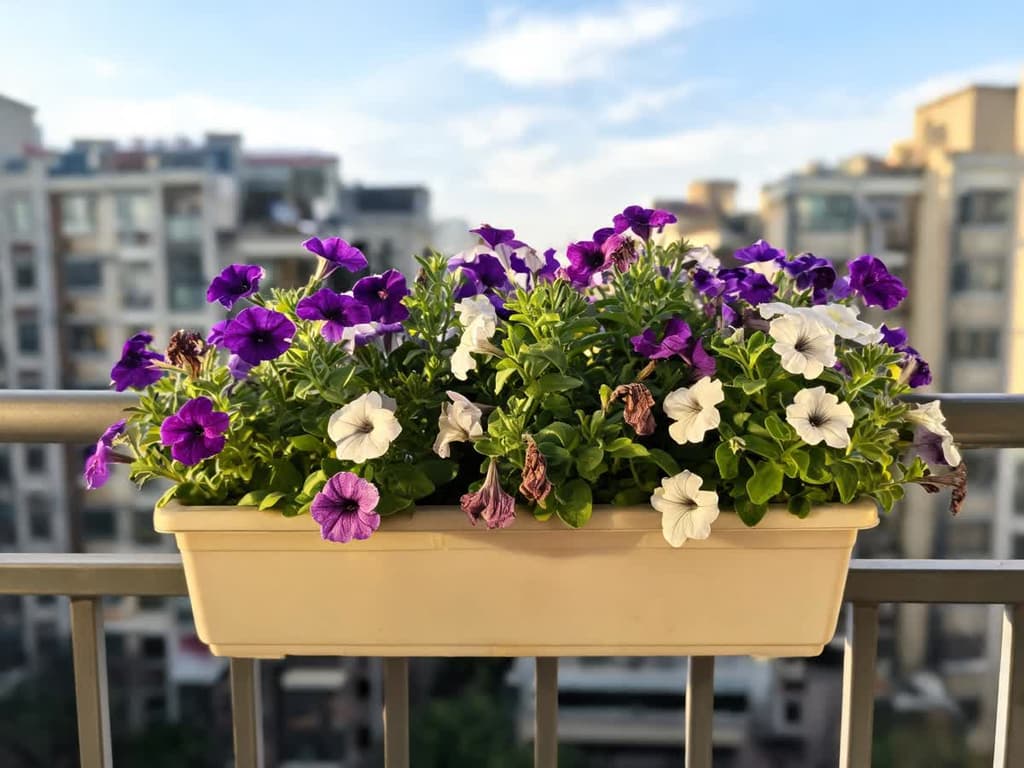
To keep petunias blooming nonstop, place the plant in full sun: about 6 hours of direct sun per day. Fertilize once a month in garden beds or every 3 waterings in pots and baskets. Remove faded flowers each week if they stay on the plant. Cut the flower along with the small stem (the thin stalk connecting the flower to the stem), because the seed forms at the base of the flower. Leggy petunias have long stems, almost no leaves at the base, and flowers only at the tips. When the plant stops flowering, cut each stem back by half at a point that leaves foliage, and fertilize. Clemson Extension, an outreach service of Clemson University (USA) that provides guidance to plant growers, recommends this cutback for petunias that have stretched or stopped blooming.
Sunlight provides the energy for the plant to form buds. Fertilizer replenishes the nutrients consumed by blooming. Removing spent flowers prevents the plant from expending nutrients on seeds.
Quick summary:
Sun: about 6 hours of direct sun per day. In shade, petunias get leggy and produce few flowers.
Deadheading: remove spent blooms once a week, along with the stem and the green seed pod beneath the flower.
Fertilizer: balanced fertilizer once a month in garden beds and every 3 waterings in pots and hanging baskets. In containers, watering leaches fertilizer through the drainage hole.
Long stems without flowers: cut each stem back by half, at a point that leaves foliage, and fertilize. With cuts ranging from 20% to two-thirds, sources cite 1 to 4 weeks before blooming resumes. None measured cutting back by half.
Intense heat and short days reduced blooming in growth chamber and greenhouse trials, even with proper care.
Most numbers come from US university extensions (university services that provide guidance to plant growers). The others come from two published studies and two South American universities. When data comes solely from a company, magazine, or blog, the text names the source. Most sources are located in the Northern Hemisphere, which is why the guide describes timing by environmental conditions (intense heat, short days) rather than by month. The petunia care guide covers the plant and its most common issues.
Why petunias stop blooming
Petunias stop blooming due to a lack of sun, a lack of fertilizer, or because they are producing seed. Leggy stems, intense heat, and underwatering also stall flowering. Each cause leaves a distinct sign on the plant.
What you see on the petunia | Probable cause | What to do |
|---|---|---|
Thin, elongated stems, pale leaves, few flowers, less than 6 hours of sun | Insufficient sun | Move the plant to a spot with 6 hours of direct sun |
Plant in full sun that stopped blooming like it used to | Lack of fertilizer (small, weak, yellowing plant) or excess nitrogen (deep green foliage and few flowers) | Apply balanced fertilizer once a month in garden beds or every 3 waterings in pots and hanging baskets. If the plant is lush green without blooms, switch away from high-nitrogen fertilizer |
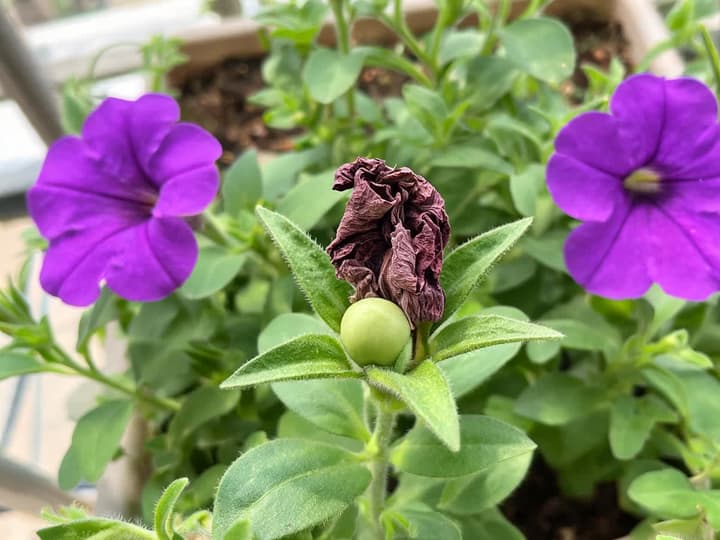
Wilted flowers clinging to the plant with green spheres underneath them | Developing seeds | Remove spent flowers along with the stem |
Long stems, bare at the base, with flowers only at the tips | Leggy plant | Cut stems back by half and fertilize |
Plant wilting every late afternoon with dry soil, in a small pot or hanging basket | Underwatering | Water thoroughly until it drains out the bottom; if it wilts despite morning watering, repot into a larger container |
Smaller flowers during peak summer heat | Intense heat | Maintain regular watering and wait for temperatures to cool down |
Flowers turning into a brown mush with gray powder after rainy days | Gray mold | Remove diseased flowers and keep water off the petals |
Buds with holes or failing to open, with tiny black specks (caterpillar droppings) | Caterpillars, according to OSU Extension Master Gardeners | Look for the caterpillar inside the bud and remove it |
Proven Winners is the company that breeds the Supertunia series. They note that a petunia in full sun that stops blooming as before likely needs fertilizer. Without adequate sun, fertilizer will not solve the issue, so check light levels first. If the plant grows slowly despite sun and fertilizer, the guide on slow growth in petunias lists other causes.
Deadhead petunias by removing the seed pod too
Deadheading petunias means cutting or pinching the flower stem at the base, where the developing seed is located. The Mississippi State University Extension explains that pulling off only the wilted petal leaves the seed on the plant. The seed sits beneath the flower, so the entire stem must come off.
The same extension recommends deadheading once a week. This task extends the blooming period. A plant setting seed directs nutrients toward seeds rather than new blooms, according to the Old Farmer's Almanac guide.
To deadhead petunias:
Look for flowers that are closed, shriveled, or drooping over the leaves.
Trace the flower stem down to where it connects to the main stem.
Pinch or snip the flower stem at that junction using your fingernails or clean pruners.
Check that the small green seed pod under the flower came off with it.
Which petunias need deadheading
Large-flowered and double-flowered petunias require deadheading; many small-flowered types are self-cleaning. UF/IFAS, the University of Florida Extension, and Clemson state this. "Self-cleaning" means the spent flower drops from the plant on its own.
Petunia type | Needs deadheading? | Source |
|---|---|---|
Large-flowered (Grandiflora) | Yes | UF/IFAS, Clemson |
Double-flowered (multiple layers of petals) | Yes | UF/IFAS, Clemson |
Small flower (Multiflora) | Many do not | UF/IFAS, Clemson |
Supertunia | No, according to the breeder (no independent measurements; when in doubt, use the clinging bloom test below) | Proven Winners |
Wave | No data: the source only states that Wave blooms all summer without pruning. When in doubt, perform the attached bloom test below | University of Missouri |
When you do not know your petunia variety, inspect the plant 2 or 3 days after a bloom fades. This timeframe is a practical rule of thumb, not drawn from a published source. If the faded bloom remains attached to the stem, your petunia is not self-cleaning: remove it. Calibrachoa, sometimes sold as "million bells" or "mini petunia," belongs to a different genus (a distinct plant group, Calibrachoa), and this guide does not cover it.
Fertilizer to keep petunias blooming
To keep petunias flowering, apply a balanced fertilizer once a month in garden beds and every 3 waterings in pots and baskets. Balanced fertilizer features equal or similar NPK numbers (nitrogen, phosphorus, and potassium) on the label, such as 10-10-10. Clemson and UF/IFAS recommend monthly feeding. In place of monthly fertilizer, UF/IFAS notes that a slow-release fertilizer can be incorporated into the soil at planting. This product releases nutrients gradually over several months.
In pots and baskets, watering washes part of the fertilizer away through the drainage hole, according to Proven Winners. For Supertunias in pots, the company recommends water-soluble fertilizer every 3 waterings. The consulted extension services do not provide a specific frequency for pots. This guide follows Proven Winners for pots and baskets, always at the label rate, because they explain the loss through the drainage hole.
Excess nitrogen hinders blooming. The Faculty of Agronomy at the University of the Republic in Uruguay advises against over-fertilizing, particularly with nitrogen. Garden Design magazine notes that nitrogen, the first number on the fertilizer label, promotes foliage growth at the expense of blossoms. A lack of fertilizer leaves the plant stunted, weak, and yellowing, according to the same faculty.
How much sun petunias need to bloom
Petunias require about 6 hours of direct sun per day to flower profusely. Clemson states that in shade, plants stretch and yield few blooms. A study from the Federal University of Paraíba (UFPB) describes shade-grown petunias as having elongated, spindly stems and pale flowers.
A spot that had sun at planting can become shaded months later. Garden Design magazine gives the example of a tree that leafs out and begins to shade the pot. In Brazil, the window and balcony with the most sun face north. Indoors, away from the window, the petunia stretches and flowers sparsely for the same reason: lack of light.
Leggy petunias that stopped blooming: how much to cut back
On leggy petunias that have stopped flowering, cut stems back by half their length, ensure foliage remains on every stem, and fertilize immediately afterward. Leggy petunias feature elongated stems that are bare near the base with blooms restricted to the tips. Clemson recommends cutting back by half and notes you can trim down to a few inches from the base as long as leaves remain.
Sources provide five different guidelines for this pruning:
Proven Winners (company): no more than 20% of the plant, applied to Supertunias that are still relatively full.
Garden Design (magazine): up to one-third of the plant's overall volume.
Clemson (extension) and Old Farmer's Almanac: cut stems back by half.
Garden Lady (gardening blog): two-thirds of the stems, done all at once or one-third every 7 to 10 days.
University of Missouri (extension): a few inches from the base, on severely stretched plants that have stopped blooming.
Each source outlines pruning for a distinct scenario, using different metrics (overall plant, volume, length, or stem count). This guide follows university extensions for plants that have already stopped blooming, as their recommendations carry more empirical backing than companies, magazines, or blogs. The light pruning recommended by breeders applies specifically to plants that remain full, as described in their materials. The recovery intervals in the table come from separate sources; cutting back by two-thirds, the most severe prune, takes the longest to rebloom.
Petunia condition | How much to cut | Time until reblooming |
|---|---|---|
Full and flowering, with a few overgrown stems | Up to 20% of the plant, trimming only the longest stems | 1 week to 10 days with a 20% trim (Proven Winners) |
Leggy, with sparse flowers only at the tips | Half the length of each stem, leaving green leaves | About 1 week with a one-third cut (Garden Design); no source gave the timeframe for half |
Very leggy, sparse base foliage, practically no blooms | Down to a few inches from the base, at a point that retains leaves | 3 to 4 weeks with a two-thirds cutback (Garden Lady); no source gave the timeframe for cutting down to the base |
To avoid leaving the plant completely bare of flowers, prune in stages. Garden Design suggests trimming a few stems each week, while Garden Lady recommends cutting back one-third of the stems every 7 to 10 days. Following any prune, fertilize and water thoroughly: the University of Missouri recommends fertilizing right after a hard cutback.
On young transplants, pinch back the tips before stems begin to stretch. UF/IFAS recommends removing the top inch (2.5 cm) of each stem to promote branching. Better-branched plants form more branch tips, and petunias produce flower buds at the tips of their stems.
Heat, rain, and short days also reduce flowering
Intense heat diminishes petunia flowering even when light, water, and fertilizer needs are met. A 2018 study by Hoang and Kim evaluated 'Madness Red' petunias under 80% relative humidity. The trial took place in a growth chamber, an enclosed room with strict temperature control. At 30 °C (86 °F), plants displayed the highest ornamental value based on flower count and longevity. At 35 °C (95 °F), growth declined sharply and foliage exhibited heat stress damage.
The Faculty of Agronomy in Uruguay notes that high daytime heat can reduce flower size. The University of Missouri reports that older petunia varieties declined during midsummer heat. Those varieties were cut back hard to encourage fresh blooming once cooler weather arrived. No sources have evaluated pruning during Brazilian summer heat. The safest course is maintaining consistent moisture and waiting for extreme heat to subside. Prune only if stems have already stretched out, following the amounts in the pruning table.
Day length also matters, because the petunia is a long-day plant. Under long days, it blooms earlier, and some varieties do not bloom at all under short days. In an experiment by Erik Runkle of Michigan State University, 'Wave Purple' petunias under a 9-hour day of light did not flower in 10 weeks. Under long days, 60% to 100% of the plants flowered. The trial took place in a greenhouse and evaluated only one variety. In Brazil, days are shorter in winter, from June to August. No sources have measured petunia flowering during the Brazilian winter.
Prolonged periods of rain, accompanied by overcast and humid conditions, encourage gray mold on aging blossoms, according to the Connecticut Agricultural Experiment Station. During these stretches, remove spent blooms promptly and avoid wetting the petals when watering.
Pots and baskets: wilting petunias stop blooming
Petunias that wilt from underwatering pause active growth and flower production until soil moisture is restored, according to Proven Winners. Pots, window boxes, and hanging baskets dry out significantly faster than garden beds. In a separate resource, the breeder notes that heat, direct sun, wind, and pot size all increase water demand.
In pots and baskets, water petunias using the soil test, not by the calendar. Insert your finger into the soil up to the first knuckle (about 1 inch / 2.5 cm); if it feels dry, water until it drains from the hole. If the plant wilts when the soil is waterlogged, the cause is different: see the section on brown bases and rot. Garden Design magazine notes that, in summer, potted petunias can require watering every day, and sometimes twice a day. In garden beds, Clemson recommends 1 to 2 inches (2.5 to 5 cm) of water every 7 to 10 days once the plant is established.
If a hanging basket wilts every late afternoon despite morning watering, repot the petunia into a larger container. Proven Winners lists container size among the factors that raise a plant's water demands. A larger container holds more soil volume and retains moisture longer between waterings.
Mushy brown blooms and sticky stems on petunias
A petunia flower turning into a brown mass, covered with gray powder, is a sign of gray mold (Botrytis), a fungus. The Connecticut Agricultural Experiment Station describes the diseased flower with whitish spots. Then it turns brown and dry, paper-like, and becomes covered with gray powder. Old flowers are attacked most, especially during cloudy, humid, and rainy weather.
Removing spent flowers every week also prevents gray mold. The same extension service directs you to remove diseased parts when they are dry and throw them in the trash. It also instructs you not to wet the flowers during watering and to leave space between plants. NC State Extension explains that the fungus enters the plant through dead flowers.
A sticky stem is not necessarily a sign of pests. According to NC State Extension, sticky glandular hairs are a normal botanical characteristic of petunias. In contrast, shiny, sticky foliage coated with black soot points to pest activity. Aphids and whiteflies excrete sugary honeydew, which serves as a growing medium for black sooty mold. The page on aphids on petunias details insect identification and treatment.
A soft, brown stem base paired with soggy soil indicates rot. Stem or crown rot involves tissue decay right at the soil line. NC State Extension notes that crown rot can cause petunias to wilt suddenly and collapse. Water only when the top layer of soil dries, and consult the guide on rot in petunias to distinguish the types. When you cannot tell whether a blemish is fungal or pest-related, turn to the Bloom app (available for iOS). The photo diagnostic tool on the Premium plan analyzes symptom images against reference databases.
Frequently asked questions
What happens if you do not deadhead petunias?
Petunias that are not self-cleaning will divert energy toward seed production within faded blossoms, resulting in fewer flowers. Mississippi State University Extension confirms that deadheading lengthens the blooming season. On small-flowered petunias that are self-cleaning, such as many Multiflora cultivars, spent flowers drop naturally and blooming continues uninterrupted. To determine if your petunia self-cleans, check the plant 2 or 3 days after a blossom fades. This interval serves as a practical guideline rather than a cited metric.
How long do petunias stay in bloom?
With sun, fertilizer, and deadheading, petunias bloom from planting until frost. In places with very cold winters, the blooming period lasts about 12 weeks, according to Proven Winners. In warm locations, it lasts 2 to 3 times as long. Where it does not frost in Brazil, the petunia survives the winter alive; no source has measured flowering during that season.
Can petunias bloom indoors?
Indoors, petunias bloom poorly because they receive less direct sun than they need. Clemson notes that, in the shade, they stretch and produce few flowers. They need about 6 hours of direct sun per day. On a balcony or in a north-facing window, in Brazil, they receive more direct sun.
Are petunias toxic to dogs and cats?
Petunias are not toxic to dogs, cats, or horses, according to the ASPCA, the American Society for the Prevention of Cruelty to Animals. The list applies to the genus Petunia and does not include calibrachoa. If your pet ate a plant and became sick, see a veterinarian and bring the name of the plant.
Routine to keep petunias blooming nonstop
Weekly: remove spent flowers that cling to the plant, snipping the stem to include the green seed pod.
Before every watering: insert your finger into the soil up to the first knuckle and water only if the soil feels dry.
Monthly in beds, or every 3 waterings in containers: feed at the label rate with a balanced fertilizer.
When stems stretch and blooms diminish: cut stems back by half, preserve healthy leaves, and fertilize.
During extreme summer heat: maintain adequate soil moisture and allow plants to resume heavy flowering once weather cools.
Sources
Petunia, Clemson Home & Garden Information Center, HGIC 1171
How to Deadhead Petunias, Mississippi State University Extension
Petunia: Better Than Ever, University of Missouri IPM (2012)
Botrytis Blight of Greenhouse Ornamentals, NC State Extension
Phytophthora Blight and Root Rot on Annuals and Herbaceous Perennials, NC State Extension
Petunia, Plant Pest Handbook, Connecticut Agricultural Experiment Station
Petunia x hybrida, Facultad de Agronomía, Universidad de la República
Battle of the blossom: tobacco budworm, OSU Extension, Douglas County Master Gardeners
Succeeding with Supertunias: How to Keep Petunias Blooming, Proven Winners
How to Keep Petunias Blooming All Summer, Garden Design (2022)
Related articles
How to Care for Hibiscus: Sun, Watering, Fertilizer, and Pruning for Flowers
How to care for hibiscus: 6 hours of direct sun, evenly moist soil without waterlogging, half-strength fertilizer in spring and summer, and pruning in early spring. Find out why the flower lasts one day and why buds drop before opening.

Do Ferns Like Sun or Shade? It Depends on the Type
Ferns prefer bright shade: plenty of light, but no direct sun on their fronds. Tuberous sword fern is the exception that handles sun. Here is the ideal light for each type, where to place pots, and how fronds show too much or too little light.

African Violet Yellow Leaves: Causes and What to Do
Yellow leaves on an African violet usually stem from overwatering, and the first place to check is the center of the plant. Losing one lower leaf at a time is normal. Identify whether age, watering, cold water, sunlight, cold drafts, or fertilizer is the culprit based on the yellowing pattern, and see what to do today.