Can Petunias Tolerate Cold? Petunia Winter Care Guide
Petunias do not tolerate frost: in a laboratory test, foliage suffered severe damage at −1.4 °C (29.5 °F). Learn when to leave them outdoors, how to protect them on freezing nights, how to overwinter indoors, and why cold, wet soil rots roots.
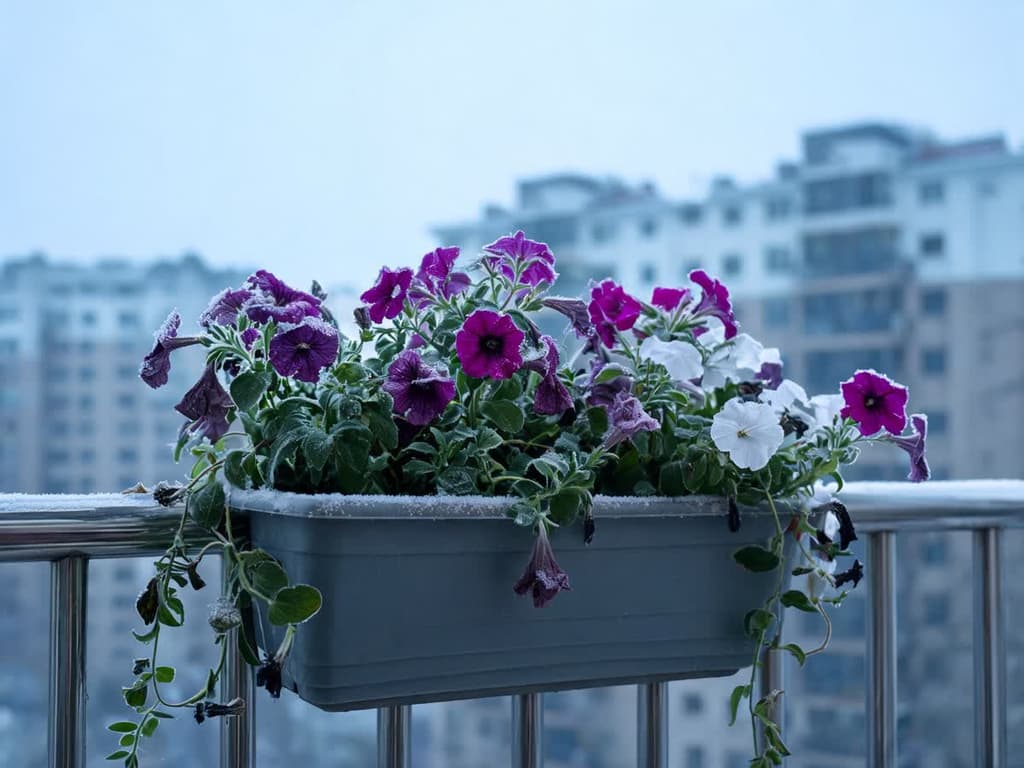
Petunias tolerate cold, but they do not tolerate frost: they are not hardy plants (plants that spend the winter outdoors where it freezes). In a test by Michigan State University, petunia leaves suffered severe damage at −1.4 °C. NC State Extension classifies the garden petunia as a perennial (a plant that lives for several years) only where winters rarely freeze. Everywhere else, it is grown as an annual: it lives for one season and is replanted the following year.
Where winter brings heavy frost, as in Germany, petunias are discarded in the fall or overwintered indoors, pruned, in a bright and cool spot. In Brazil, winter runs from June to August. Where it does not freeze, petunias stay in place all year round. Where it freezes, as in the southern highlands, protect the plant on frosty nights or bring the pot indoors. In Brazil, October is spring and the time to plant petunias.
Quick summary:
Petunia leaves suffer severe damage at −1.4 °C (29.5 °F); after weeks of gradual cold exposure, leaves only suffered severe damage at −6.5 °C (20 °F) in the laboratory.
The first frost following warm days is the most dangerous, because it catches the plant unprepared.
Where it does not freeze, leave the petunia in place and reduce watering in winter.
Where frost is rare, cover the plant overnight with a sheet extending down to the ground, and remove the fabric in the morning.
Where frost is hard and frequent, move the pruned petunia to a bright spot kept above 4 °C (39.2 °F), or keep rooted cuttings.
What temperatures petunias can tolerate
Unacclimated petunias suffer severe cell damage in the foliage at −1.4 °C (29.5 °F). That number comes from a laboratory test conducted by Ryan Warner of Michigan State University, published in 2010 by the American Floral Endowment (a US floral research foundation). The test measures leaf cell leakage when tissue freezes.
Petunia condition | Temperature of severe leaf damage | Source |
|---|---|---|
'Mitchell' petunia (research line), unacclimated to cold | −1.4 °C (29.5 °F) | Warner, Michigan State University, 2010 |
'Mitchell' petunia, after 2.5 weeks of gradual cold acclimation | −6.5 °C (20 °F) | Warner, Michigan State University, 2010 |
Wild petunia species, unacclimated | around −2 °C (28.4 °F) | Warner, Michigan State University, 2010 |
Where petunias are perennial | zones 10a to 11b on the USDA (United States Department of Agriculture) plant hardiness zone map, where the coldest temperature of the year stays, on average, above −1.1 °C (30 °F) | NC State Extension; USDA |
Acclimation is the plant's preparation for the cold: a petunia that spends weeks in low temperatures without freezing withstands colder conditions. In Warner's test, the plants spent one week at 15 °C, one week at 10 °C, and three days at 3 °C. After that, the leaf suffered severe damage only at −6.5 °C.
These numbers come from laboratory-tested leaves: none of the sources for this guide measured the whole petunia plant in a garden setting. Use −1.4 °C (29.5 °F) as a warning sign: when the forecast predicts an overnight low near 0 °C (32 °F), protect your petunia.
Because of acclimation, the first frost of the year is the most dangerous. In a study with data from 2003 to 2018 in Rio Grande do Sul, Tazzo and colleagues showed that early frost, the autumn frost, was more frequent than late frost, the spring frost, in almost all cities. An older study, cited by the same authors, had found the opposite. This guide follows the 2003 to 2018 study, because it uses more recent data from each city. The autumn frost catches the petunia while it is still accustomed to the heat.
Petunias in the Brazilian winter: leave outdoors, protect, or bring inside
The decision depends on two questions: does frost reach your balcony or your garden bed? Does the soil become waterlogged in the winter? In Brazil, frost appears from April to September, peaking in strength in June and July. According to the study by Tazzo and colleagues, the risk increases in higher-altitude cities and those located further south.
Your winter condition | What to do with the petunia |
|---|---|
No frost and well-draining soil | Leave the petunia in place, reduce watering, and remove dead flowers |
Rare and light frost | Leave in place and cover the plant on nights when the forecast predicts lows near 0 °C (32 °F) |
Hard and frequent frost | Bring the pruned container indoors, or keep rooted cuttings |
No frost, but waterlogged soil | Move the petunia to a container with drainage holes or to a well-drained bed |
Frost and waterlogged soil | First move the plant to a container with drainage holes or a well-drained bed; then protect or bring indoors depending on your frost levels |
Where winters are mild, petunias continue to bloom. The University of Florida (UF/IFAS) treats petunias as winter-flowering plants, planted in October and November in the Northern Hemisphere. In the colder parts of Florida, the same guide advises protecting the plant from frost.
Heavy frost is common high in the southern mountains. In Bom Jesus (RS), at an altitude of 1,048 m, the study by Tazzo and colleagues counted 360 frosts from 2003 to 2018. In these places, petunias left outdoors without protection do not survive the winter.
How to protect petunias on a frosty night
Protect the petunia on the afternoon when the forecast predicts a low near 0 °C (32 °F). The instructions below come from the UF/IFAS cold protection guide:
Cover the plant with a bedsheet, blanket, or dedicated frost fabric supported by stakes. The fabric should extend all the way down to the ground to trap heat radiating from the soil, while stakes keep the cloth off the foliage.
Anchor the edges of the fabric with rocks or bricks if it is windy.
Remove the fabric in the morning once temperatures rise. If using plastic instead of fabric, remove or vent the plastic on sunny days.
Group potted plants and window boxes together against the house wall before the frost arrives. UF/IFAS explains that clustered containers lose less heat through their sides. Move containers apart again shortly after the frost, because plants packed tightly together for extended periods can suffer damage.
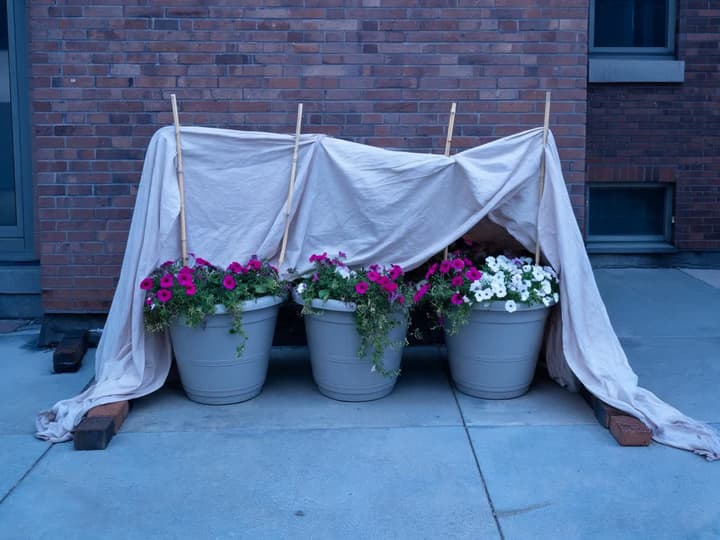
Plant covers protect against frost, but not against extreme cold, warns UF/IFAS. If the forecast calls for several consecutive nights below 0 °C (32 °F), bring the container indoors.
Cold, wet conditions: summer watering rots roots
In winter, the petunia absorbs less water, and summer watering leaves the soil wet for days. Cold, waterlogged soil promotes root-rotting fungi. The University of Wisconsin-Madison explains that most of these fungi prefer wet soil.
A plant with root rot wilts even with wet soil. The root turns soft, brown, and sometimes smells bad, according to the same source. In petunias, the University of Minnesota describes black root rot: yellow and wilting leaves, stunted plant growth, and sunken black spots on the root.
Water the petunia in winter only when the top 2 cm (about 1 inch) of the soil is dry to the touch. Use a pot with a drainage hole at the bottom and empty the saucer after 30 minutes. The University of Wisconsin-Madison advises against placing stones or gravel at the bottom of the pot, because they hinder drainage. An experiment published in PLOS ONE in 2025 measured the opposite in a test without plants. Since the question remains unresolved, rely on the pot's drainage hole, not on stones. The root rot fact sheet shows the signs and treatment:
If the petunia wilted with wet soil, check the signs of petunia rot before watering again.
How to overwinter petunias indoors
Bring the petunia indoors before the first frost if you live where frost is hard and frequent. Bring in only healthy plants: the German magazine Bild der Frau recommends leaving outside petunias with fungus or pests.
Cut back the stems before bringing the plant indoors. Two German guides, Plantura and Bild der Frau, cut the stems back to 15 cm. Clemson University accepts cutting back to within a few inches of the base, but asks to leave some foliage on the plant. This guide follows both: cut the stems to 15 cm from the soil and leave leaves on each stem.
Choose a bright and cool spot. The Royal Horticultural Society (RHS), the British horticultural society, defines a frost-free place as one with a minimum night temperature of 4 °C (39 °F). Three of the four German guides consulted for this article call for 5 °C to 10 °C (41 °F to 50 °F). Choose a room between 5 °C and 10 °C, never below 4 °C. In Brazil, a north-facing window receives the most sun in winter: place the petunia there.
Water sparingly. Water only when the top 2 cm (about 0.8 in) of soil feels dry to the touch. The RHS keeps stored tender plants only slightly moist in a cool, frost-free location.
Do not fertilize while the plant is resting indoors. UF/IFAS explains that late autumn fertilizing stimulates tender new growth that is more sensitive to cold.
Inspect the plant with each watering. Check for aphids (small insects that stay on new shoots) and gray mold (gray fuzz on leaves and flowers). Plantura notes that aphids attack stored petunias.
A hot, dark room ruins overwintering petunias. Clemson explains that petunias kept in shade produce leggy growth and few flowers. Bild der Frau notes that heater warmth prompts the plant to sprout prematurely in winter, forming thin, pale stems. If a warm room is your only option, place the petunia in your brightest window and trim away leggy growth in spring.
Petunia cuttings: the safest way to preserve your plants
A cutting is a piece of stem that grows roots and turns into a new plant. A rooted cutting takes up less space than an entire plant and spends the winter in a small pot. The RHS lists petunias among the plants propagated from softwood cuttings. Use the soft, flexible tip of new growth, which roots easily according to the RHS.
Take petunia cuttings in spring or summer, as the RHS recommends. In Brazil, spring runs from September to November and summer from December to February. The RHS warns that winter is too late to take cuttings. Cuttings taken in late summer spend the winter in a bright, sheltered spot and move outdoors in spring.
Store the rooted cuttings in barely moist soil, in a bright and frost-free place at around 7 °C (45 °F), as the RHS recommends. The same page notes that gray mold and damping off appear when the space lacks ventilation. Damping off is the disease that rots the base of the cutting's stem, causing the seedling to collapse:
Open the window on frost-free days to maintain air circulation around the cuttings.
Frost-damaged petunias: are they dead?
Petunia foliage that turns limp, mushy, and blackened after a frost, as if water-soaked or cooked, has died. The stems and root system may still be alive. Do not discard the plant before inspecting the stems.
UF/IFAS advises waiting for new spring growth before pruning freeze-damaged plants, preventing accidental removal of live wood. To check a stem, scrape the bark with your fingernail: green tissue underneath indicates live growth, while brown or black indicates dead tissue, according to UF/IFAS. UF/IFAS outlines this test for woody stems: on petunias, scrape the lower base where older stems are firmer. None of the sources for this guide tested this method specifically on petunias or provided a timeline for reshooting.
Once new shoots emerge, cut back dead stems just above the first green sprout. If the scraped base is brown and the stem feels soft, the petunia is dead. Foliage also wilts from underwatering or root disease: check the guide on petunias with wilting leaves to distinguish frost damage from those issues.
Rejuvenation pruning in late winter
Renewal pruning encourages overwintered petunias to produce new shoots and bloom again. Prune in late winter, after the last frost in your area. In Brazil, where it does not freeze, prune in August.
Clemson recommends cutting back leggy stems by half. If the plant is severely overgrown and spindly, cut back to within a few inches of the base, always leaving some foliage intact. Following pruning, Clemson advises feeding with a liquid fertilizer and watering thoroughly to promote fresh growth.
Plantura advises repeating the cut in spring for plants overwintered indoors, since shoots that developed over winter remain weak. Plantura also repots at this stage using fresh potting mix. Acclimate the plant outdoors gradually: set the container outside for a few hours initially and extend the time daily, following Clemson's hardening-off guidelines for transplants.
Dahlias overwinter differently, storing their roots beneath the soil: see how to care for dahlias in winter. Winter chrysanthemum care also requires distinct handling: hardy garden chrysanthemums remain in the garden bed with their old stems left intact.
Frequently asked questions
Do petunias come back on their own in spring?
Where freezing temperatures do not occur, petunias remain alive and keep blooming through winter. If plants become leggy with sparse flowers, rejuvenation pruning in late winter revitalizes them. Where hard frosts occur, plants left outdoors will die. NC State notes that petunias behave as perennials only in warm winter zones. Overwintered specimens often become leggy and bloom less: rejuvenation pruning resolves this, or you can replace them with new starts.
Are petunias toxic to dogs and cats?
No. The ASPCA, an American animal protection organization, lists petunias as non-toxic to dogs, cats, and horses. If your pet ate many leaves and became sick, call the veterinarian.
Can calibrachoas (million bells) tolerate more cold?
Calibrachoa (Calibrachoa x hybrida) belongs to a different genus, meaning an entirely separate group of related plants. NC State lists it among plants commonly confused with petunias. The cold tolerance trials at Michigan State University tested petunias, and none of the sources for this guide measured the precise cold limits of calibrachoas. For safety, protect calibrachoas from frost just like petunias.
Are there winter-hardy petunias?
None of the sources consulted for this guide tested petunias marketed as "winter-hardy." In the Michigan State University trials, even cold-acclimated petunias suffered severe damage at −6.5 °C (20 °F). Warner identified a wild petunia species as a potential genetic source to breed hardier varieties in the future.
Can I plant petunias in the fall?
You can, where it does not freeze. In Florida, UF/IFAS plants petunias in October and November, the Northern Hemisphere autumn, to bloom in winter. In Brazil, autumn runs from March to May. Where frost occurs, plant in spring, after the last frost.
Winter petunia care: what to do now
The petunia cannot tolerate frost: leaves suffer severe damage at −1.4 °C (29.5 °F). Where it does not freeze, leave it in place and water less. Where frost is rare, cover the plant on cold nights. Where frost is severe, move the pruned plant to a bright, cool spot or save cuttings. In October, in Brazil, it is time to plant petunias in a spot with direct sun for most of the day.
The Bloom app (available for iOS) checks photos of your petunia against known plant diseases, with photo-based diagnosis included in the Premium plan.
Sources
Warner, R. M. Genetic Approaches to Improve Cold Tolerance of Petunia. Special Research Report 306, American Floral Endowment, Apr. 2010 (Michigan State University).
Tazzo, I. F.; Trentin, G.; Cardoso, L. S.; Junges, A. H. Spatial and temporal distribution of frosts in Rio Grande do Sul between 2003-2018. Caminhos de Geografia, v. 25, n. 101, Oct. 2024.
USDA. Plant Hardiness Zone Map. United States Department of Agriculture, 2023.
NC State Extension. Petunia x hybrida. North Carolina Extension Gardener Plant Toolbox.
UF/IFAS Extension. Petunias. Gardening Solutions.
Park-Brown, S. Cold Protection of Landscape Plants. UF/IFAS Extension, EDIS.
Russ, K.; Polomski, R. F. Petunia. Clemson Cooperative Extension, HGIC 1171, rev. 2007.
Rowe, A. Effect of drainage layers on water retention of potting media in containers. PLOS ONE, v. 20, no. 2, 2025.
Royal Horticultural Society. Overwintering tender plants: lifting or mulching.
Royal Horticultural Society. Tender perennials: cuttings.
Hudelson, B.; Jull, L. Root rots of houseplants. University of Wisconsin-Madison Extension, rev. 2024.
University of Minnesota Extension. Petunia: leaves wilt and die.
ASPCA. Petunia. Toxic and Non-Toxic Plants.
Related articles
How to Care for Hibiscus: Sun, Watering, Fertilizer, and Pruning for Flowers
How to care for hibiscus: 6 hours of direct sun, evenly moist soil without waterlogging, half-strength fertilizer in spring and summer, and pruning in early spring. Find out why the flower lasts one day and why buds drop before opening.

Do Ferns Like Sun or Shade? It Depends on the Type
Ferns prefer bright shade: plenty of light, but no direct sun on their fronds. Tuberous sword fern is the exception that handles sun. Here is the ideal light for each type, where to place pots, and how fronds show too much or too little light.

African Violet Yellow Leaves: Causes and What to Do
Yellow leaves on an African violet usually stem from overwatering, and the first place to check is the center of the plant. Losing one lower leaf at a time is normal. Identify whether age, watering, cold water, sunlight, cold drafts, or fertilizer is the culprit based on the yellowing pattern, and see what to do today.