Petunias with Yellow Leaves: Causes and What to Do
Yellow new growth with green veins on a petunia usually signals an iron deficiency caused by high substrate pH. Yellowing that starts on lower leaves stems from water, nitrogen, or root issues. Learn what to check first and how to respond in each case.
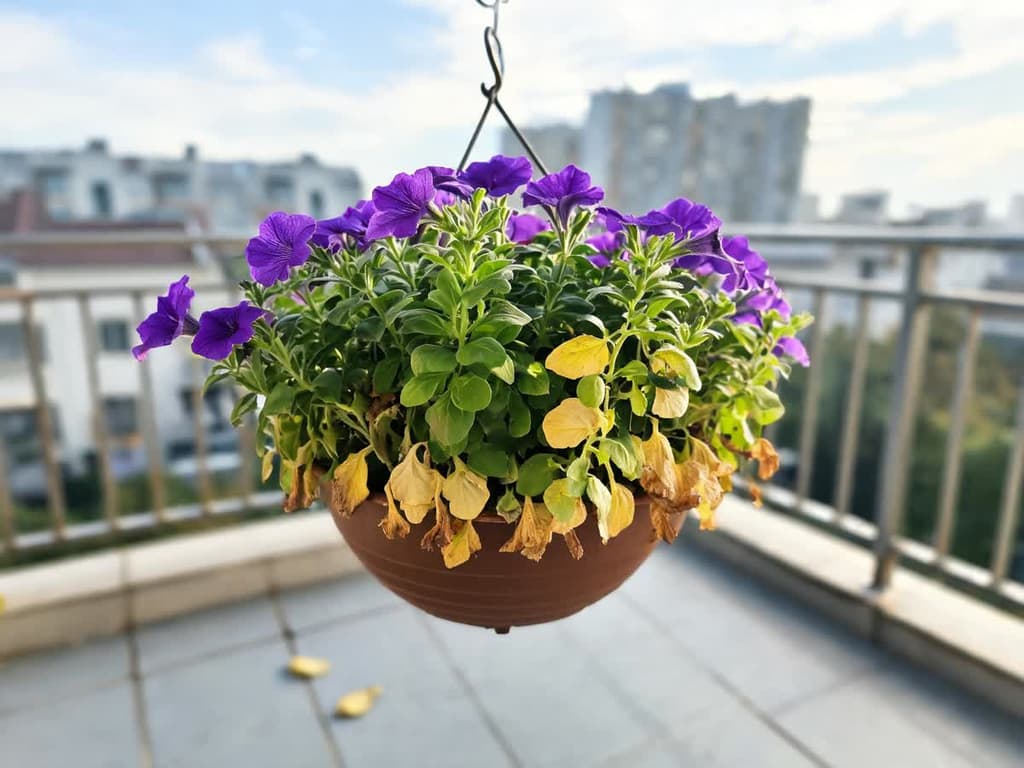
In petunias with yellow leaves, the most typical cause is an iron deficiency in the new leaves at the stem tips. The leaf turns yellow between the veins, while the veins remain green. According to Purdue University Extension, a service from the American university that guides plant growers, petunia roots absorb iron poorly. High-pH soil (low acidity) worsens the problem.
When yellowing starts on lower leaves, the causes are different: underwatering, overwatering, nitrogen deficiency, or diseased roots. For this reason, do not pull up the plant or cut everything back before checking three factors: the soil, where the yellowing started, and the roots.
Quick summary:
Yellow new growth with green veins: iron deficiency, generally from high-pH soil, but also from waterlogged soil or cold temperatures.
Yellow lower leaves with dry soil: underwatering. Water until liquid runs through the pot drainage hole.
Yellow lower leaves with constantly wet soil: take the plant out of the pot and inspect the roots.
Light stippling and fine webbing on leaf undersides: spider mites.
Yellow petunia leaves: where the color change begins
Where the yellowing starts divides petunia problems into two distinct categories. Yellow new leaves point toward iron or manganese. Older, lower leaves point toward water issues, nitrogen shortage, or root problems.
What you see | Where it starts | The soil is | Likely cause | What to do |
|---|---|---|---|---|
Yellow between the veins, green veins | new leaves, at stem tips | normal (if constantly wet, check the roots first) | iron deficiency (high pH) | apply iron chelate (iron fertilizer) to the soil and test pH |
Yellow between the veins, with brown specks | new leaves | normal | manganese deficiency | run a soil test before applying more iron |
Entire leaf light green to yellow, pale plant | lower leaves, then spreading upward | normal | nitrogen deficiency | apply a balanced fertilizer |
Yellow or dropping lower leaves, persistent wilting | lower leaves | dry | underwatering | water until it drains out the bottom |
Yellow lower leaves, stunted growth | lower leaves | constantly wet | root rot or black root rot | inspect the roots |
Light stippling, fine webbing | any leaf | any condition | spider mites | wash the undersides of the leaves |
Yellow, sticky leaves, insects on undersides | new leaves | any condition | aphids or whiteflies | wash the plant and treat the pests |
Light green and dark green mottled patches, crinkled leaves | any leaf | any condition | mosaic virus | discard the plant |
Step 1: check the soil before changing watering habits
The soil shows whether the issue is water before you run any other test. Push your finger about an inch (2.5 cm) deep. Dry soil at that depth with a wilted plant points to underwatering. Damp or saturated soil that has stayed wet for days along with yellow leaves is your cue to check the roots.
Do not swing back and forth between watering less and watering more without testing the soil first. Saturated roots and parched roots both turn lower leaves yellow in the exact same way, and shifting your watering routine blind makes one of the two worse. The guide on yellow leaves on any plant covers soil testing for other species.
Yellow new leaves with green veins: iron and pH
Yellow new leaves with green veins show interveinal chlorosis, yellowing that appears exclusively between the leaf veins. In petunias, this symptom usually signals an iron deficiency. Purdue explains that the plant cannot move iron from old leaves to new ones, so the newest leaves display the shortage first. Over time, the new foliage turns almost white.
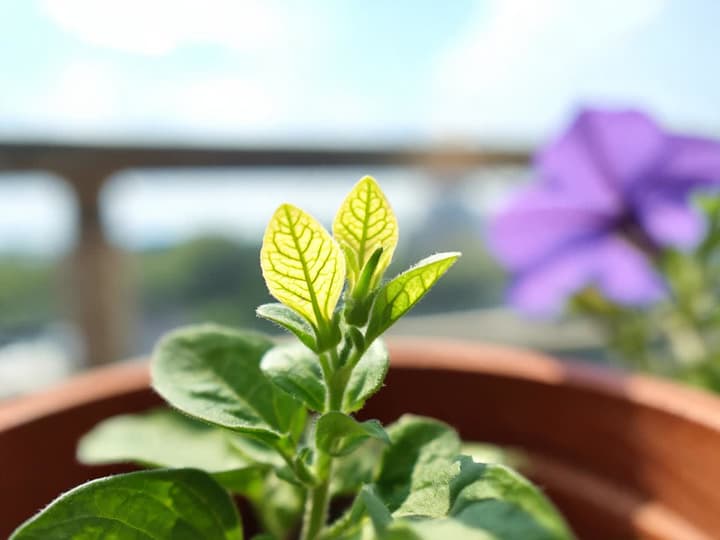
According to Purdue, petunia roots take up iron poorly. That is why petunias turn yellow in soil where other plants stay green. NC State researchers Patrick Veazie and Brian Whipker identify this yellowing on upper foliage as a frequent production issue in petunias.
Iron can be in the soil and still not reach the leaf. The Iowa State University Extension lists three situations that lock up iron:
high pH, meaning the soil is not acidic enough;
waterlogged soil;
cold temperatures.
Soil pH for petunias
Soil pH measures substrate acidity: the lower the number, the more acidic the medium. For potted petunias, Purdue recommends a pH of 5.4 to 6.2. That range suits plants that absorb iron inefficiently. Within this window, iron and manganese shortages are much less likely.
Potting soil pH rises over time. The Pacific Northwest plant disease handbook (PNW Handbook) warns that the petunia itself tends to raise soil pH over time. Purdue points to hard irrigation water, containing high levels of dissolved limestone, as the most common cause of high pH in pots.
How to fix iron deficiency in petunias
Water the soil with iron chelate at the label rate. Iron chelate is an iron fertilizer formulated to remain available to the roots even at higher pH levels. PT Horticulture, a Canadian growing media company, states that chelate resolves yellowing in most cases: new leaves begin to emerge green.
Measure your soil pH using a test kit from a garden center. If the pH climbs above 6.2, replace the container medium with fresh potting mix during the next repotting. Leaves that have already yellowed usually stay yellow; the sign of recovery is healthy green new growth.
When iron does not help: manganese deficiency
Manganese deficiency causes the same interveinal yellowing on new leaves. Iowa State notes two distinguishing features: with manganese, even the finest veins remain green like a network, and small brown, dry spots (dead tissue) develop on the foliage.
PT Horticulture describes what happens when the two deficiencies are confused. Applying iron chelate to a petunia lacking manganese improves leaf color for a few days before the yellowing worsens again. If the foliage improves briefly and then deteriorates, or if new growth does not emerge green, submit a soil sample for lab analysis before applying additional iron.
Yellow lower leaves on petunias: underwatering, nitrogen, or natural aging
Yellow lower foliage on potted or hanging basket petunias comes down to three common causes. Checking the soil separates the first cause from the other two.
Dried-out petunias: dry soil and yellow lower leaves
A petunia left unwatered for days, such as during a trip, yellows from the bottom up. The NC State Beaufort County Extension lists four signs of underwatering: wilting that lasts into the next morning, foliage that feels dry to the touch, lower leaves turning yellow or dropping, and dry soil below the surface.
Water until moisture drains from the bottom hole. If the soil dried out so much that water runs down the sides without soaking the center, set the pot in a basin of water. Iowa State Extension recommends soaking the hanging basket for 1 to 2 hours, never more than 2 hours. Leaves that turned yellow will not turn green again, but the plant puts out new growth if the stems stay green and pliable.
Nitrogen deficiency: overall plant pale
With nitrogen deficiency, the old lower leaves turn light green and then yellow. Iowa State explains that the plant pulls nitrogen from older leaves to feed new ones. Over time, the entire plant turns pale, growth slows, and stems become thin.
During nitrogen deficiency, the entire leaf turns yellow, including the veins, rather than showing yellowing only between the veins like iron chlorosis. Apply a balanced fertilizer with similar NPK values (nitrogen, phosphorus, potassium), such as 10-10-10, following the label dosage and interval. For potted plants and hanging baskets, do not stretch fertilization intervals past label guidelines, because watering flushes nutrients out through drainage holes with each application.
Aging lower leaves
An occasional lower leaf slowly turning yellow while the rest of the plant remains vigorous and flowering may simply be an aging leaf dying off. None of the consulted university extensions describe this natural senescence specifically for petunias. The safest guideline applies when only a few bottom leaves yellow while the soil and upper new growth look normal. In that scenario, pluck the yellow leaves and monitor for one week to see if more appear.
Saturated soil and yellow foliage: inspect petunia roots
A petunia displaying yellow leaves alongside continuously wet soil may suffer from root disease, which only direct root inspection can verify. Gently slip the plant out of its pot, loosen the soil, and check the roots:
White, firm roots: healthy root system. Look for the issue in the foliage.
Brown, soft roots that fall apart when pulled: root rot, common in overwatered soil.
Black, firm roots with black streaking throughout: black root rot, a fungal disease residing in the soil.
Black root rot: the disease that looks like a nutrient deficiency
Black root rot is caused by the fungus Berkeleyomyces basicola, formerly called Thielaviopsis basicola. The University of Connecticut Extension notes that, at first, the diseased plant turns yellow and looks like it has a nitrogen deficiency. Petunias and calibrachoa (a plant similar to petunias, with smaller flowers) are among the most frequently attacked plants.
The same elevated pH that locks up iron also encourages black root rot. According to the University of Connecticut, disease severity drops in soils with a pH of 5.5 or lower. Aim for the Purdue target range of 5.4 to 6.2 recommended for petunias: it stays beneath the 6.5 threshold that accelerates black root rot while capturing the 5.5 level that suppresses the fungus. The PNW Handbook lists the conditions that favor this pathogen:
pH above 6.5;
overly wet soil;
cool soil temperatures between 55 and 70 °F (13 and 21 °C).
In Brazil, from May to August during the winter months, container soil can stay in this temperature range. Petunias that overwinter in pots are exposed during these exact months. For this reason, check the roots before buying iron chelate: chelate does not treat diseased roots.
Managing diseased roots
If almost the entire root system is black or mushy, discard the plant and the soil. NC State recommends removing and discarding petunias with root and crown rot (the base of the stem right at the soil line).
If the bulk of the root system remains white and firm, none of the consulted extensions have documented reliable recovery rates for petunias. The safest protocol is:
Trim away mushy or blackened roots with sterilized shears.
Repot into a clean container with drainage holes and fresh potting soil.
Water only when the top inch (2.5 cm) of soil dries out.
Do not reuse the old soil. Disinfect the container with a 10% bleach solution before replanting, as recommended by the University of Connecticut. The page covering root rot in petunias displays photos of these symptoms.
Check leaf undersides: spider mites, whiteflies, and aphids
Sap-sucking pests also cause petunia leaves to yellow, almost always concentrating on the undersides. Check the undersides of several leaves before adjusting your water or fertilizer routine.
Spider mites leave leaves covered in light stippling, which later turns greenish-yellow and finally bronze. Iowa State describes a very fine webbing in heavy infestations. To confirm, shake a branch over a sheet of white paper: the mites appear as tiny specks moving slowly. The guide on spider mites explains how to control the pest.
Whiteflies stay on the undersides of the newest leaves and fly up when you disturb the plant. According to Iowa State, infested leaves can stay small, turn yellow, and drop prematurely. NC State lists whiteflies and aphids among common petunia pests.
Aphids and whiteflies excrete a sweet, sticky liquid called honeydew. According to NC State, a black fungus, sooty mold, grows on this honeydew. Yellow, sticky leaves or foliage coated in black powder call for pest control; the sooty mold goes away on its own afterward. The guide on aphids on plants explains control step by step.
Light green and dark green patches: mosaic virus
Wrinkled leaves with light green and dark green patches in a mosaic pattern can indicate a virus. The Connecticut Agricultural Experiment Station plant pest handbook cites tobacco mosaic virus in petunias. The pattern differs from an iron deficiency: with the virus, the patches are irregular, while with iron deficiency, the yellowing stays between the veins, which remain green.
Viral infections have no cure. The same source advises immediate removal and disposal of infected plants. Tomatoes, potatoes, peppers, eggplants, and tobacco fall prey to the same viruses, so keep infected petunias far away from them. The reference page on mosaic virus in petunias includes reference photos of the condition.
Should I cut off yellow petunia leaves or discard the whole plant?
After checking the soil, root system, and leaf undersides, trim off yellow leaves and spent blooms. The Connecticut Agricultural Experiment Station recommends pruning dead foliage and spent blossoms to lower fungal disease risks. Yellow leaves will not turn green again, and removing them makes it much easier to monitor new growth.
Discard the entire petunia in only two scenarios: if most roots are black or decayed, or if the plant has mosaic virus. In all other situations, correct the underlying cause and watch the emerging leaves, which show whether your fix worked.
The petunia care guide covers general growing requirements, and the guide on petunias with yellow leaves catalogs pests and diseases linked to this symptom.
Frequently asked questions
Can a yellow petunia leaf turn green again?
In most situations, no. Foliage that yellowed from moisture stress, damaged roots, or age stays yellow. With iron deficiency, PT Horticulture explains that chelated iron resolves the issue for the plant overall: emerging leaves grow in green, while previously yellowed leaves usually remain discolored. Healthy green leaves emerging at stem tips confirm the fix worked.
Does calibrachoa turn yellow from the same causes?
Yes, specifically for two issues: iron deficiency and black root rot. Purdue groups calibrachoa alongside petunias as crops with inefficient iron uptake, sharing the same 5.4 to 6.2 target pH range. UConn lists both plants among the primary targets of black root rot. Calibrachoa is a distinct botanical genus with blooms resembling miniature petunias. If you are unsure which plant grows in your basket, Bloom (available for iOS) identifies it from a single photo.
Can I add eggshells or wood ash to petunia soil?
None of the consulted university sources have tested crushed eggshells or wood ash on petunias. Wood ash and eggshells lower soil acidity, raising substrate pH. Because petunias require an acidic pH between 5.4 and 6.2 to take up iron, avoiding both amendments is the safest approach.
Are petunias toxic to dogs and cats?
No. The ASPCA, an American animal welfare organization, classifies petunias as non-toxic to dogs, cats, and horses.
What to do today for a petunia with yellow leaves
Check soil moisture by hand, locate where yellowing starts, and inspect the undersides of a few leaves. New yellow leaves with green veins in damp soil call for iron chelate and a pH test. Yellow lower leaves with bone-dry soil need deep watering until water escapes the drain hole. With wet soil, inspect the roots. Fresh leaves emerging after your adjustments will confirm whether your solution worked.
Other plants for sunny balconies and garden beds:
Sources
Alkalinity Management in Soilless Substrates, HO-242-W, Purdue Extension (Lopez and Mickelbart)
Identifying Plant Nutrient Deficiencies: Iron, Iowa State University Extension
Identifying Plant Nutrient Deficiencies: Manganese, Iowa State University Extension
Identifying Plant Nutrient Deficiencies: Nitrogen, Iowa State University Extension
Fertility Trends: Petunias Yellow? It May Not Be Iron Deficiency, PT Horticulture
Petunia Production Pointers (Veazie and Whipker, NC State), Greenhouse Grower
Petunia: Black Root Rot, PNW Plant Disease Management Handbook
Petunia, Plant Pest Handbook, Connecticut Agricultural Experiment Station
What "Wilting" Really Means: Heat Stress vs. Water Needs, NC State Extension, Beaufort County
Phytophthora Blight and Root Rot on Annuals and Herbaceous Perennials, NC State Extension
How Often Should I Water Plants in Hanging Baskets?, Iowa State University Extension
Related articles

How to Care for Hibiscus: Sun, Watering, Fertilizer, and Pruning for Flowers
How to care for hibiscus: 6 hours of direct sun, evenly moist soil without waterlogging, half-strength fertilizer in spring and summer, and pruning in early spring. Find out why the flower lasts one day and why buds drop before opening.

Do Ferns Like Sun or Shade? It Depends on the Type
Ferns prefer bright shade: plenty of light, but no direct sun on their fronds. Tuberous sword fern is the exception that handles sun. Here is the ideal light for each type, where to place pots, and how fronds show too much or too little light.

African Violet Yellow Leaves: Causes and What to Do
Yellow leaves on an African violet usually stem from overwatering, and the first place to check is the center of the plant. Losing one lower leaf at a time is normal. Identify whether age, watering, cold water, sunlight, cold drafts, or fertilizer is the culprit based on the yellowing pattern, and see what to do today.