How to Take Care of Petunias: Sun, Water, Feeding, Pruning and Deadheading
How to take care of petunias: how much sun and water they need, when to fertilize, how to deadhead, how to prune leggy stems, and what to do with sticky leaves, brown flowers, and dry plants.
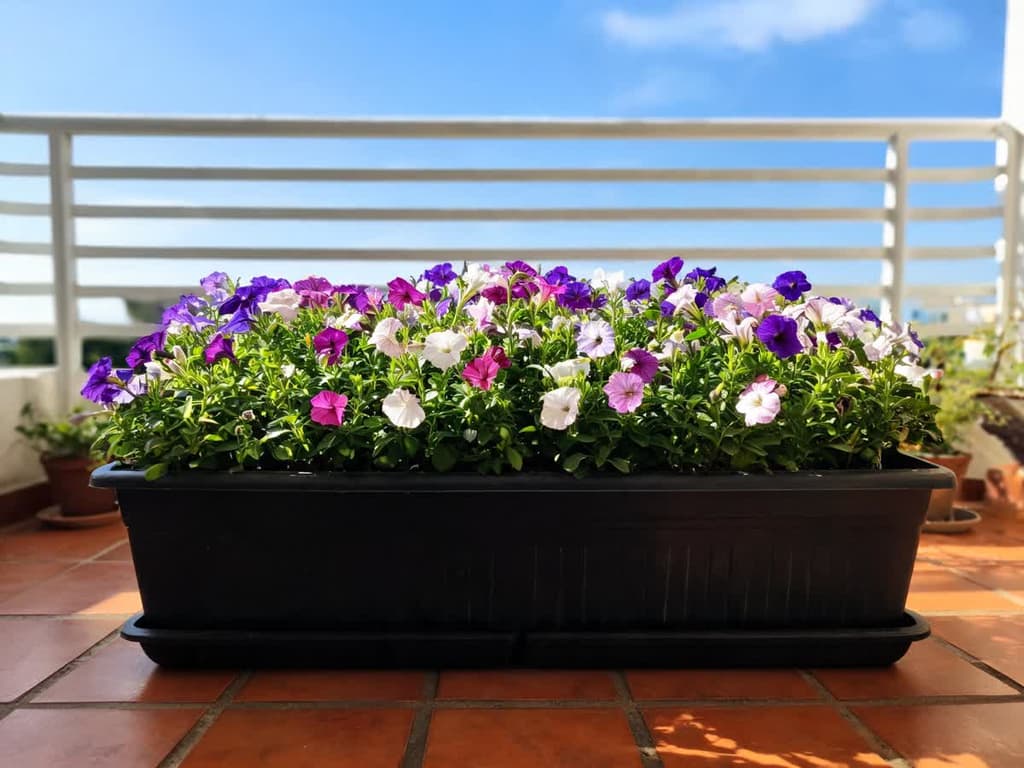
To take care of petunias, keep the plant in full sun, with about 6 hours of direct sunlight per day. Water when the soil dries down to the first knuckle of your finger, the one closest to the tip. Fertilize once a month in garden beds, and more frequently in pots and hanging baskets. Remove spent flowers every week. When the stems become leggy and leafless at the base, cut each one back by half of its length, leaving some leaves on each stem. In frost-free areas of Brazil, you do not need to throw the petunia away once blooming ends: this pruning prompts the plant to produce new shoots and bloom again.
This guide also addresses four common problems: sticky foliage (which can be normal or a sign of pests), flowers with brown spots, yellow leaves, and dried-out petunias in baskets or pots.
The figures come from United States university extensions, services provided by universities that guide plant growers. When data comes solely from a company, such as Proven Winners regarding Supertunia, the text mentions its name. The primary sources are NC State, Clemson, the University of Florida (UF/IFAS), the University of Missouri, and Mississippi State. Information also comes from the Connecticut Agricultural Experiment Station and a study by the Universidade Federal da Paraíba (UFPB). The Faculty of Agronomy at the Universidad de la República, in Uruguay, completes the list. The foreign sources are from the Northern Hemisphere, which is why the seasons have already been converted for Brazil. The petunia profile shows the plant and its most common issues.
Quick summary:
Sun: full sun, about 6 hours of direct sunlight per day. In shade, petunias stretch out and produce few flowers.
Water: when the soil dries down to the first knuckle of your finger; in garden beds, 2.5 to 5 cm (1 to 2 inches) of water every 7 to 10 days.
Fertilizer: balanced fertilizer (with the three NPK numbers on the label similar, like 10-10-10) once a month; pots and baskets require more.
Spent flowers: remove once a week, along with the base of the flower where seeds form.
Leggy stems: cut each stem in half, leave leaves, and fertilize right after; the plant blooms again.
Cold: does not tolerate frost. Where it does not freeze, it lives year-round.
What is a petunia
The garden petunia (Petunia × atkinsiana, also called Petunia × hybrida) is a hybrid belonging to the tomato and tobacco family. UFPB and HortFlora state that it originated from the cross of two wild species, Petunia axillaris and Petunia integrifolia. The University of Missouri cites three (P. axillaris, P. inflata, and P. violacea). These wild species are native to South America (Brazil, Argentina, and Uruguay), according to the UFPB study. The genus name comes from the Brazilian word for tobacco, says NC State.
Commercially, it appears in groups with slightly different care requirements. Large-flowered types (Grandiflora) and double-flowered varieties require more deadheading. Small-flowered types (Multiflora) better resist petal spotting caused by rain, according to Clemson. Branded series, such as Wave and Supertunia, grow more vigorously and spread. Calibrachoa (Calibrachoa) belongs to a different genus, and this guide does not cover it.
How much sun petunias need
Petunias need full sun to bloom well. Clemson notes that, in the shade, they become leggy and produce few flowers. The UFPB study describes the same effect. In the shade, the plant becomes etiolated (with thin, elongated stems searching for light) and displays pale leaves and flowers.
Proven Winners, the company that developed the Supertunia series, recommends 6 hours of direct sunlight per day, mostly in the afternoon. The company also states that the plant grows with 4 to 6 hours, especially in hot climates. NC State accepts full sun to partial shade, but warns that flowering suffers in deep shade. This guide follows Clemson and UFPB, which call for full sun: in both, shade reduces blooms.
No cited source has tested petunias indoors, but a lack of sun produces the same effect there: without direct sun, the plant stretches out and yields few blooms. NC State only recommends keeping the plant indoors to overwinter where it freezes, in a bright spot away from heaters. Other plants for sunny balconies require the same direct sun, such as basil, which needs 6 to 8 hours per day, and dahlia, which needs at least 6 hours.
How to water petunias using the soil test
Water petunias when the soil dries down to the first knuckle of your finger. This is the test Proven Winners recommends: poke your finger into the soil and, if it feels dry at that depth, water until moisture drains out of the pot's drainage hole.
In garden beds, Clemson and UF/IFAS recommend at least 2.5 to 5 cm (1 to 2 inches) of water every 7 to 10 days. This guideline applies once the plant has established roots. Both institutions advise against light, frequent waterings, which encourage shallow root systems. The University of Missouri increases this to about 4 cm (1.5 inches) per week during hot, dry weather.
Pots, window boxes, and hanging baskets dry out much faster than garden beds, according to Proven Winners. Heat, sun, wind, and small pots increase the plant's need for water. Because of this, during hot weather, do the finger test every day in hanging baskets and small pots instead of following a fixed watering schedule. Too much water is also harmful. The University of Missouri states that root rots and gray mold worsen with rainy weather and overwatering. The guide on how to water petunias details watering for each type of container.
Fertilizer for petunias during blooming
Clemson and UF/IFAS recommend a balanced fertilizer once a month. UF/IFAS also accepts a slow-release fertilizer (which releases nutrients gradually over several months) mixed into the soil at planting. A balanced fertilizer has similar values for the three numbers on the NPK label (nitrogen, phosphorus, and potassium), such as 10-10-10.
Pots and baskets need fertilizer more frequently than garden beds. Proven Winners explains that, with every watering, a portion of the nutrients leaches out through the pot's drainage hole. For Supertunia in containers, it recommends water-soluble fertilizer every three waterings or once a week. The consulted university extensions do not specify an application frequency for pots. This guide follows Proven Winners for pots and baskets, because watering washes fertilizer away, always following the label rate. The University of Missouri states that cutting-propagated petunias, such as Supertunia, generally require more fertilizer than seed-grown types.
Excess fertilizer also causes problems, especially too much nitrogen, according to the Faculty of Agronomy of Uruguay. The University of Missouri states that plant vigor serves as a good gauge for fertilizer needs. The Faculty of Agronomy of Uruguay describes nutrient deficiency: plants remain small, weak, and yellowed.
How to deadhead petunias
Remove spent petunia flowers once a week, as recommended by Mississippi State. Seeds develop right beneath the flower. Because of this, pinch the stem at the base of the flower with your fingers, not just the petals, to remove the seed capsule along with it. Without seeds to develop, the plant blooms for a longer period, says Mississippi State.
Sources disagree on which petunias require deadheading. Clemson and UF/IFAS state that large-flowered and double-flowered varieties need it. Many small-flowered types are self-cleaning, meaning they drop their spent blooms naturally. The University of Illinois refers to petunias as entirely "self-cleaning," while Proven Winners states that Supertunia does not require deadheading. This guide follows the two extension services that distinguish by flower type. If spent blooms remain stuck to the plant, it is not self-cleaning: remove them.
Deadheading also prevents disease. The Connecticut Agricultural Experiment Station states that fading flowers are the most susceptible to gray mold.
How to prune leggy petunias
When petunias develop long stems, lose their lower foliage, and only bloom at the tips, cut the stems back by half. Clemson recommends cutting stems back by half when a plant becomes leggy or stops blooming. If necessary, it allows cutting back to within a few inches of the base, provided some leaves remain on each stem.
Sources provide different guidelines for this pruning:
University of Missouri: cut back to within a few inches of the base when the plant has stretched too much and stopped blooming, fertilizing immediately afterward.
Clemson: cut back by half or close to the base, always leaving foliage, and follow with liquid fertilizer and a thorough watering.
Proven Winners: on Supertunia, trim no more than 20% of the plant at a time; it will resume blooming within a week to ten days.
This guide follows the two university extensions, which carry more weight than a commercial company's recommendation: cut back by half, leave leaves, and fertilize. For a Supertunia that is still dense with leaves, the brand's light trim (at most 20%) is sufficient. Leggy petunias that have stopped blooming can recover with this rejuvenating prune, a hard cutback of the stems. That is what the University of Missouri and Clemson advise.
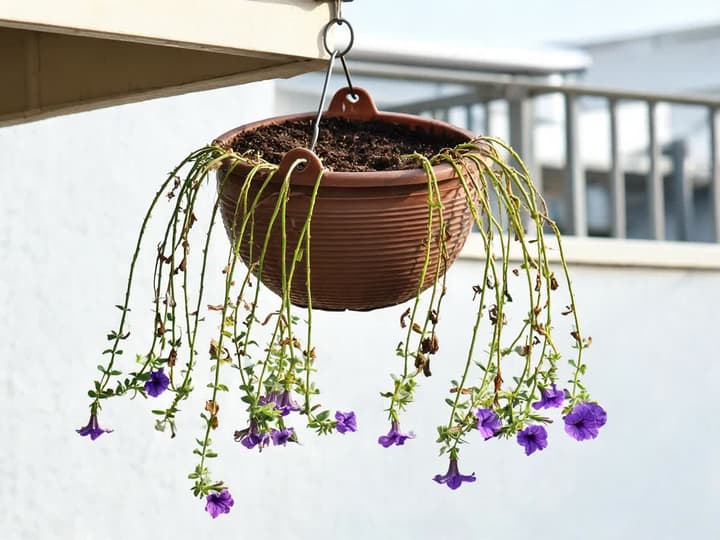
To encourage bushy growth from the start, pinch off the top 2.5 cm (1 inch) of each stem with your fingers at planting time. This is recommended by Clemson and UF/IFAS.
Petunias in pots, window boxes, baskets, or garden beds
Petunias grow well in pots, window boxes, hanging baskets, and garden beds, provided the soil drains freely. In pots and baskets, use a lightweight potting mix, and make sure there are drainage holes at the bottom. According to Clemson, the best soil is light, well-draining, and moderately fertile. The ideal pH (soil acidity measure) ranges from 6.0 to 7.0 according to Clemson, and 6.0 to 6.5 according to the University of Missouri. This guide follows Missouri, because above 6.5, black root rot and iron deficiency become more common.
In garden beds, the University of Missouri describes a drainage test. Dig a hole 25 to 30 cm (10 to 12 inches) deep and fill it with water. The next day, fill it again: if the water drains within 8 to 10 hours, the soil has good drainage. If it takes longer, the University of Missouri recommends amending the soil with organic matter, such as compost. Clemson and NC State suggest using a raised bed.
For ground cover, Clemson and UF/IFAS recommend spacing plants 30 to 45 cm (12 to 18 inches) apart. Adequate spacing also promotes air circulation, which helps prevent gray mold.
Why petunias feel sticky
Petunias are naturally sticky. NC State notes the sticky hairs covering the leaves and stems as an identifying characteristic of the plant. HortFlora, the cultivated plant flora of the Royal Botanic Gardens Victoria, describes "stems with sticky hairs." If the entire petunia feels slightly tacky and there are no insects or leaf spots, the plant is completely normal.
Sticky foliage becomes an issue when the substance forms a shiny, glossy coating over the leaves. This sheen is honeydew, a sugary liquid secreted by aphids and whiteflies as they feed on sap. Honeydew frequently leads to sooty mold, a dark fungus that grows over the sticky residue. NC State explains that sooty mold does not directly attack plant tissue and that the primary step is controlling the insects producing the honeydew.
To identify the source of the honeydew, inspect the undersides of leaves and new growth tips:
Aphids: tiny, soft-bodied insects clustered on tender new shoots and buds.
Whiteflies: tiny white insects that flutter up when you disturb the foliage.
Budworms: holes chewed through petals and buds, accompanied by small black droppings. An extension column from Oregon State notes that petunias are among the preferred hosts of the tobacco budworm (Heliothis virescens). Attacked plants can also feel somewhat sticky.
To control aphids and whiteflies, the gardening website Hunker suggests starting with a strong spray of water and applying insecticidal soap if they persist. The guide to aphids on plants provides step-by-step treatment details. Against budworms, the same column recommends products containing Bacillus thuringiensis (Bt), a bacterium used as a biological insecticide. These treatments only work if the caterpillar ingests the sprayed foliage or flower.
Whiteflies are another common source of honeydew on petunias:
Petunia flowers with brown spots: gray mold
Petunia blossoms with brown spots that subsequently develop fuzzy gray mold are infected with gray mold, caused by the fungus Botrytis cinerea. The Connecticut Agricultural Experiment Station describes the progression: water-soaked, whitish spots, papery brown blossoms, and finally, a dusty gray fungal mass. Fading blooms are the most vulnerable to infection.
The disease appears during overcast, humid, and rainy weather lasting several days. NC State reports that the fungus develops most readily between 16 and 21 °C (60 and 70 °F), with relative humidity exceeding 85%. In hotter or drier conditions, it fails to thrive. The University of Missouri also links gray mold to overwatering, but reducing watering alone will not cure brown flowers. The fungus depends on moisture lingering on blooms; practical control involves deadheading fading flowers, keeping petals dry, and providing good air circulation.
Recommended actions from the Connecticut Agricultural Experiment Station:
clip off affected blooms and leaves when the foliage is dry and discard them in the trash, not back into the container;
deadhead spent blossoms weekly (following the Mississippi State schedule), before the fungus can colonize them;
water the soil directly without wetting the blossoms;
space containers farther apart to improve air movement between plants.
Petunias with yellow leaves
Yellow leaves on petunias typically stem from three causes, and leaf placement helps identify which one. Yellowing and wilting lower leaves in perpetually soggy soil point toward root rot. Black root rot is one such condition. According to the PNW Handbook, a plant disease manual for the Pacific Northwest, overly saturated soil favors black root rot. Soil pH above 6.5 and cool soil temperatures also contribute.
A plant turning entirely yellow in a container with high-pH soil may be suffering from iron deficiency. A study in the journal Horticultural Science (Šrámek and Dubský, 2009) documented severe yellowing in petunias grown in high-pH substrates. The chlorotic leaves contained low concentrations of iron and manganese. The PNW Handbook warns that petunias tend to drive up potting soil pH over time. In the study, regular applications of a dilute fertilizer solution containing iron and manganese significantly decreased chlorosis.
The third cause is general nutrient deficiency: the Faculty of Agronomy of Uruguay notes that underfed plants stay small, stunted, and pale yellow. The page on petunias with yellow leaves catalogs these and other causes.
How to revive a dried-out petunia
Check the soil before watering to distinguish between drought stress and root rot. If the soil is completely dry and the plant has wilted, water thoroughly until moisture runs out of the drainage hole, then cut the stems back by half, making sure to leave some leaves. No cited source has measured recovery rates for a completely dried-out petunia; this approach is the safest route, using the same technique as rejuvenation pruning. Clemson instructs gardeners to fertilize and water well after this cutback to stimulate new shoots and blooms.
If the plant wilts while the soil remains wet, another issue is responsible. The crown is the base of the stem at the soil line. NC State notes that crown rot caused by the fungus Phytophthora causes petunias to wilt suddenly and collapse. In this scenario, NC State recommends removing and discarding the affected plant, then improving drainage before planting in that spot again.
A hanging basket with bare lower stems but green tips can often be saved. While the lower portion has dropped its foliage, the green tips indicate living stems. Cut these stems back by half, preserve leaves on each branch, water, and fertilize, just as Clemson directs. The page on petunias with wilted leaves lists other causes of wilting.
Petunias in winter: annual or perennial in Brazil?
The petunia is a perennial (it lives for several years), but it cannot withstand frost. NC State classifies it as a tender perennial. It survives winter only in zones 10 and 11 of the United States hardiness zone map, where frost is rare. Proven Winners also includes zone 9; this guide follows NC State, which is a university extension. In colder places, it dies with the first frost and becomes an annual plant, replanted every year.
In much of Brazil it does not freeze, and there petunias can last through the year. The work from UFPB states that, in tropical and subtropical climates, they are kept as perennials, but suffer from intense heat, humidity, and diseases. Renewal pruning helps the plant produce new shoots and bloom again, but no source has measured how many years a petunia lasts in Brazil.
The optimal growing season varies by climate:
Where frost occurs in winter (Southern Brazil and mountainous regions, from June to August): petunias bloom throughout spring and summer. This matches the cycle outlined by the Faculty of Agronomy of Uruguay. Take cuttings before the first freeze or bring the plant indoors.
Where summers are hot and rainy: high heat and afternoon rains degrade plant quality, according to Proven Winners. In Florida, which shares hot, rainy summers, UF/IFAS treats the petunia as a cool-season annual, planted once peak summer temperatures subside. In comparable climates, planting during the cooler months of the year is the safest choice.
Where it freezes, NC State recommends bringing the plant indoors to a bright spot away from heaters until the cold passes. The guide on petunia winter care explains how to get through the cold months in each region.
How to propagate petunias from cuttings
Petunias root readily from stem cuttings, which are clipped stem pieces used to start new plants. The gardening website Gardener's Path recommends cutting 15 cm (6 inches) or more of stem and stripping the leaves from the lower half. Insert this section into well-draining potting soil and keep the medium damp without overwatering. Where freezing temperatures occur, take your cuttings before the first frost arrives.
Planting the seeds produced by the plant does not yield the exact same petunia. Clemson states that self-sown seedlings in the bed revert to a mix of small white, lilac, and pink flowers. The guide on how to propagate petunias provides the step-by-step process.
Frequently asked questions
Are petunias toxic to dogs and cats?
The ASPCA (American Society for the Prevention of Cruelty to Animals) lists petunias (genus Petunia) as non-toxic to dogs, cats, and horses. Their listing does not include calibrachoa, which belongs to a distinct genus. If an animal ingests any plant and exhibits signs of illness, consult a veterinarian and provide the plant's name.
How long do petunias last in pots?
Where frost does not occur, potted petunias stay alive after blooming, but no one has measured how long they last in Brazil. The work from UFPB states that, in tropical and subtropical climates, it is maintained as a perennial, punished by heat and humidity. Cutting back by half when the stems stretch, fertilizing, and taking cuttings are the safest options to renew the pot.
Do petunias come back every year?
Where frost does not occur, the same plant survives and regrows after pruning. In freezing climates, it dies from frost and does not return. Dropped seeds in the bed may sprout, but Clemson notes that they will not come true to the parent plant: they revert to a mixed assortment of small white, lavender, and pink blooms.
Can you grow petunias indoors?
No cited source has evaluated petunias as indoor houseplants. Without direct sun, they stretch out and produce few blooms, matching the symptoms Clemson and UFPB describe for shaded plants. The best approach is keeping them on a balcony or on your sunniest windowsill. NC State recommends bringing the plant indoors strictly to overwinter where freezing temperatures occur, placed in a well-lit location away from heat sources.
How to care for petunias: key takeaways
Caring for petunias means providing full sun, watering via the finger test, fertilizing monthly (more frequently in containers and baskets), and deadheading spent blooms weekly. When stems stretch out, cut them back by half and fertilize: the plant will regenerate. In frost-free areas of Brazil, the same petunia stays alive and can flower again following this cutback.
When an unfamiliar spot or insect appears, a quick photo can guide your next step. Bloom (available for iOS) identifies plants from pictures and, with Premium, compares symptoms against recognized plant pests and diseases.
Other plants for sunny balconies and gardens:
Sources
Petunia: Better Than Ever, University of Missouri IPM (2012)
How to Deadhead Petunias, Mississippi State University Extension
Petunia, Plant Pest Handbook, Connecticut Agricultural Experiment Station
Botrytis Blight of Greenhouse Ornamentals, NC State Extension
Phytophthora Blight and Root Rot on Annuals and Herbaceous Perennials, NC State Extension
Petunia: Black Root Rot, PNW Plant Disease Management Handbook
Battle of the blossom: tobacco budworm, OSU Extension, Douglas County Master Gardeners
Petunia x hybrida, Facultad de Agronomía, Universidad de la República
Your Complete Guide to Overwintering Petunias, Gardener's Path
Related articles

How to Care for Hibiscus: Sun, Watering, Fertilizer, and Pruning for Flowers
How to care for hibiscus: 6 hours of direct sun, evenly moist soil without waterlogging, half-strength fertilizer in spring and summer, and pruning in early spring. Find out why the flower lasts one day and why buds drop before opening.

Do Ferns Like Sun or Shade? It Depends on the Type
Ferns prefer bright shade: plenty of light, but no direct sun on their fronds. Tuberous sword fern is the exception that handles sun. Here is the ideal light for each type, where to place pots, and how fronds show too much or too little light.

African Violet Yellow Leaves: Causes and What to Do
Yellow leaves on an African violet usually stem from overwatering, and the first place to check is the center of the plant. Losing one lower leaf at a time is normal. Identify whether age, watering, cold water, sunlight, cold drafts, or fertilizer is the culprit based on the yellowing pattern, and see what to do today.