How to Fertilize Ponytail Palm: When, How Much, and Which Fertilizer
Ponytail palms need very little fertilizer: half strength every 2 months, from September to March in Brazil. Learn which fertilizer to use, when not to feed, and how to save an overfertilized plant.
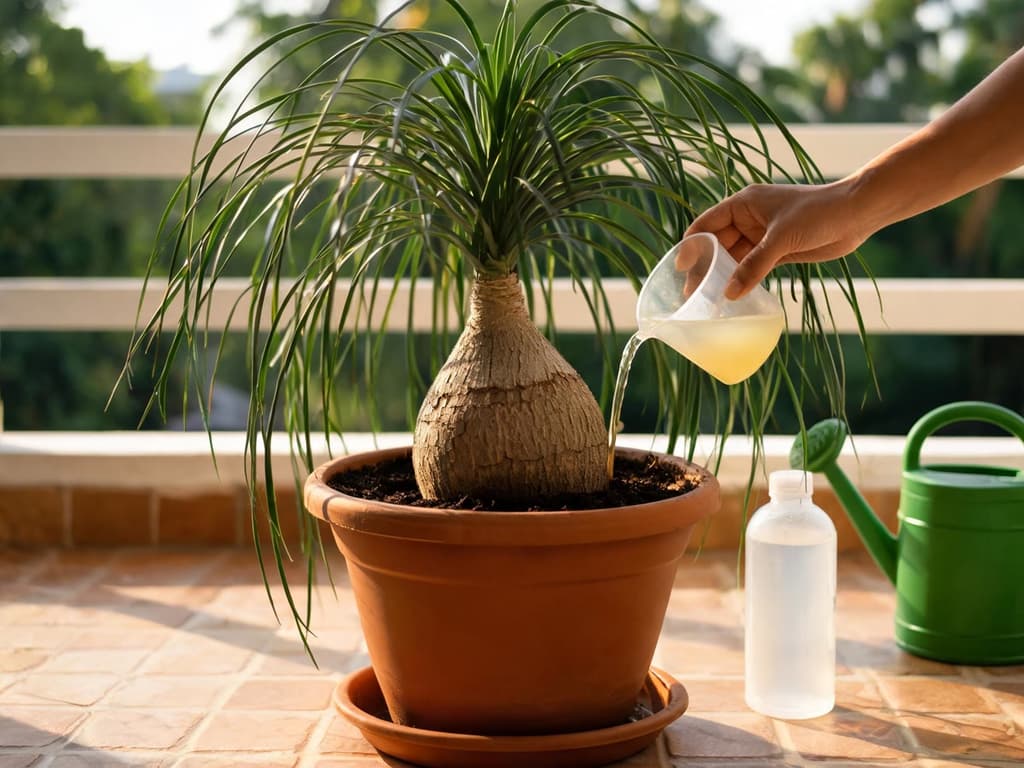
To fertilize a ponytail palm, use a half-strength dose of liquid cactus fertilizer or houseplant fertilizer every 2 months. Fertilize only in spring and summer, which run from September to March in Brazil. From April to August, do not fertilize.
Do not fertilize a plant with brown tips or a soft base, because fertilizer treats neither problem. A newly repotted plant should also wait. The right light, watering, and pot matter far more than fertilizer, and you can find them in the ponytail palm care guide.
Quick summary:
Timing: September, November, January, and March, in Brazil. That is 4 applications per year, one every 2 months, which is the New York Botanical Garden's interval.
Dose: half of what the fertilizer label directs (Iowa State University).
Fertilizer: liquid cactus and succulent fertilizer, or general houseplant fertilizer (New York Botanical Garden).
Before fertilizing: water. NC State (North Carolina State University Extension, the public guidance service) directs never to apply fertilizer to dry soil.
Do not fertilize: wilted plants, newly repotted plants, rootless cuttings, and dormant winter plants (University of Nebraska).
Ponytail palm with brown tips, yellow leaves, or a soft base: do not fertilize
Do not fertilize a sick plant. The University of Nebraska notes that wilted, newly repotted, or winter-dormant plants should not receive fertilizer. Fix the underlying watering, light, or cold issues first.
Lack of fertilizer does not appear among the causes of brown tips on ponytail palms. The New York Botanical Garden (NYBG) lists irregular watering, low light, cold, nearby air conditioning, and fertilizer salt buildup in the soil. University of Wisconsin Extension cites too much or too little water, excess fertilizer, and accumulated salt. All fertilizer is a type of salt (mineral salts absorbed by the plant, unlike table salt), notes University of Arkansas Extension. If salt is already causing the brown tips, fertilizing adds even more salt.
A soft base can stem from rotting roots and stem or salt buildup (University of Maryland), and fertilizer fixes neither. The causes of brown tips for this species are listed, one by one, on the ponytail palm brown tips page. Resume fertilizing only when the plant puts out new growth from the center, and only during feeding months (September, November, January, and March). University of New Hampshire Extension explains that the plant only uses fertilizer while actively producing new leaves and roots.
Why ponytail palms need very little fertilizer
The ponytail palm (Beaucarnea recurvata, formerly called Nolina recurvata) is native to Mexico. There it grows in rocky, nutrient-poor soil in low deciduous forests. The source is NC State, North Carolina State University Extension. It grows slowly. In a pot, it grows even slower than in the ground, and stays small if the container is small (University of Wisconsin).
A plant that grows slowly uses little fertilizer. The fertilizer that roots do not take up remains in the potting soil and accumulates as salt. The University of Nebraska calls this salt buildup harmful. In their view, root rot is one of the most common problems tied to excess salt.
When to fertilize the ponytail palm in Brazil
Fertilize only in spring and summer, which run from September to March in Brazil. The NYBG recommends fertilizer "only in spring and summer" and a drier winter rest for the plant. There, in the Northern Hemisphere, this rest period runs from November to February; in Brazil, it corresponds to the period from May to August.
Fertilize in September, November, January, and March. From April to August, do not fertilize the ponytail palm, even if kept in a pot indoors. In any region of Brazil, inspect the plant before each feeding: if no new leaf is emerging from the center, skip that month's feeding.
How much fertilizer and how often to feed a ponytail palm
Use half the label dose every 2 months during spring and summer. Care sheets for the species agree on fertilizing lightly and only during the growing season, but provide varying numbers:
Source | How often per growing season | Dose |
|---|---|---|
University of Wisconsin-Madison Extension | 1 or 2 times, total | Does not state |
New York Botanical Garden (NYBG) | Every 2 months, roughly 3 to 4 times | "Lightly", with cactus fertilizer or balanced fertilizer |
Iowa State University Extension | 1 or 2 times per month, roughly 6 to 12 times | "Dilute solution", without a specific number |
From the University of Wisconsin to Iowa State University, recommendations range from 1 or 2 up to 6 to 12 feedings in the same season. This guide follows the NYBG interval. Every 2 months is also what the University of Nebraska recommends for soluble fertilizer on actively growing houseplants. The University of Minnesota recommends 3 to 4 times per season for succulents. Excess fertilizer is a known cause of brown tips on this plant. Lack of fertilizer does not appear on any of the care sheets.
No species care sheet gives a specific number for the dose. For potted succulents, Iowa State University recommends one-half to one-fourth the label rate. Use half. If the label calls for 2 capfuls of fertilizer per liter of water, use 1 capful per liter. With 4 half-dose feedings, the plant receives the equivalent of 2 full doses per year.
Which fertilizer to use: cactus or houseplant
Both work. NYBG recommends cactus fertilizer or balanced houseplant fertilizer, without favoring one over the other. NPK is the three-number sequence on the fertilizer label showing its proportions of nitrogen (N), phosphorus (P), and potassium (K). A balanced fertilizer features equal numbers, such as 10-10-10.
In Brazil, cactus fertilizer appears in stores as "fertilizer for cacti and succulents," in liquid form or as a water-soluble powder. University of Minnesota Extension recommends, for cacti, a fertilizer with the middle NPK number higher than the first. NYBG accepts both types for the ponytail palm, and this guide follows NYBG because it is the reference sheet for the species. Choose the liquid form, because it allows you to measure half strength with each application.
Other potted succulents also require little fertilizer, but the dose varies from species to species. The succulent fertilizer guide shows the dilution for thick-leaved varieties. The desert rose, another plant with a swollen base, has a measured dose in a published study, which is why desert rose fertilizer follows its own numbers. For the ponytail palm, no dosage study was found.
How to apply liquid fertilizer to a ponytail palm
Fertilize on watering day, when the soil has already dried out. NC State Extension recommends never applying fertilizer to dry soil, and advises watering first if it is not moist.
Check the month: September, November, January, or March, in Brazil.
Check the plant: it needs active new growth at the center, a firm base, and no recent repotting.
Water thoroughly with plain water until liquid drains through the pot's drainage hole.
Dissolve the fertilizer in water at half the label dose.
Pour the fertilizer solution over the moist soil, around the base of the plant.
Empty the saucer once draining stops. The base of a ponytail palm will rot if left sitting in waterlogged soil.
After repotting and on new cuttings
Do not fertilize a plant that has just been repotted. The University of Nebraska lists newly repotted plants among those that should not receive fertilizer. If the fresh potting mix already contains fertilizer, hold off on feeding for the first few months, as the soil itself feeds the plant during that period (Iowa State University, which does not specify an exact number of months). Read the potting soil label: one brand cited by the University of Nebraska claims to feed for up to 6 months.
NYBG recommends unfertilized cactus mix for ponytail palms. With this potting soil, wait until the plant sends out new leaves before applying the first fertilizer.
A cutting that has not yet rooted should also not receive fertilizer, according to the University of Nebraska. For ponytail palm propagation, seeds are the most reliable method, and shoots removed from the base do not always form roots.
Signs of overfertilizing a ponytail palm
University of Maryland Extension lists these symptoms of excess fertilizer in potted plants:
brown or scorched leaf tips and margins;
stunted growth;
lower leaves dropping;
dead root tips (visible only when taking the plant out of its pot);
wilting;
a white crust on the soil surface or around the pot rim;
the stem collapsing right at the soil line.
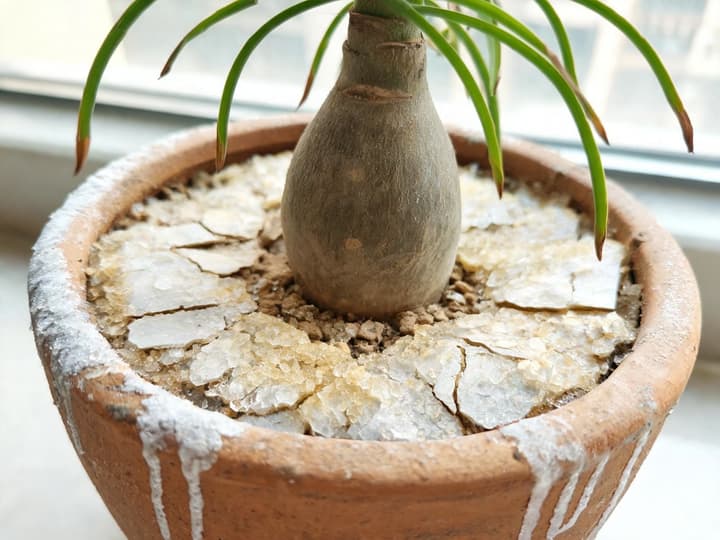
Brown tips caused by overfertilizing look identical to those caused by improper watering. What separates the two is the white or yellowish crust on the soil and along the pot rim. Reviewing your fertilizing habits over the past few months also helps. In terracotta pots, the University of Nebraska advises checking for a white salt ring around the rim and the drainage hole.
The University of Nebraska highlights root rot as one of the most common issues tied to excess soil salts:
How to save an overfertilized ponytail palm
Stop fertilizing and flush accumulated salts from the soil with plain water, using the amounts outlined in the steps below. Perform the flush on a day when the soil is already dry and due for watering.
Scrape off the white crust on the surface, removing no more than 0.6 cm (1/4 inch) of topsoil (University of Nebraska).
Pour plain water slowly through the soil, using double the pot's volume, letting it run freely out the drainage hole. University of Maryland recommends 1 to 3 times the volume; this guide adopts the 2x volume from the University of Nebraska, which provides a worked example. A 15 cm (6-inch) pot holds about 1.2 liters, so use about 2.4 liters (University of Nebraska).
Allow all water to drain through and empty the saucer.
Let the soil dry out completely again before watering next. The ponytail palm watering guide covers testing the soil and base to determine when to water.
Resume fertilizing only when the next scheduled feeding month arrives (September, November, January, or March), using a half dose.
In small pots or cases with heavy crusting, replace all the potting mix (University of Maryland). Use unfertilized cactus mix, as recommended by NYBG. Even without dosing mistakes, the University of Nebraska recommends leaching houseplant soil every 4 to 6 months.
Old plants that have never been fertilized
There is no rush to fertilize an older ponytail palm that has never been fed. Start in the next fertilizing month (September, November, January, or March), using a half dose, and only if the plant is producing new foliage at the center.
First, examine the potting soil. Iowa State University notes that if household water is heavily softened, salts build up faster in plants that are rarely repotted. If a white crust is present, flush the soil as described in the previous section. If the swollen base is pressing against the rim of the pot, repot in spring as directed by NYBG. Then, wait until the plant resumes active growth before applying any fertilizer.
Outdoor ponytail palms in the garden
None of the reviewed reference sheets recommend fertilizing ponytail palms planted in the ground. UF/IFAS, University of Florida Extension, discusses outdoor garden specimens solely regarding well-drained soil and irrigation during the dry season. Without published recommendations, the safest choice is to leave healthy garden plants unfertilized.
Coffee grounds and homemade fertilizers on ponytail palms
Do not use coffee grounds in a ponytail palm pot. Two German gardening websites selling fertilizer recommend coffee grounds for this plant without citing research. Washington State University Extension states that fresh coffee grounds are demonstrably toxic to several plants. They advise against incorporating coffee grounds into the soil or using them as mulch.
New Mexico State University Extension points out that published research on using coffee grounds in indoor potted plants is scarce, and their safety cannot be guaranteed. That is why this guide excludes coffee grounds: WSU documented toxicity in other plants, and NMSU cannot verify safety in pots. The safest route is commercial fertilizer with a label. We found no technical sources supporting eggshells or other homemade remedies. Stick to labeled fertilizer, which lets you measure an accurate half dose.
Frequently asked questions
How often should you fertilize a ponytail palm?
Every 2 months, only in spring and summer: in Brazil, in September, November, January, and March. Use half the label dose. This is the interval from the New York Botanical Garden. Other fact sheets range from 1 fertilization per season to 2 per month, and none list lack of fertilizer as a problem for the plant.
Can I fertilize a ponytail palm in winter?
No. Ponytail palms rest from May to August, a span that covers winter in Brazil (June to August), and dormant plants do not use fertilizer. The University of Nebraska notes that fertilizing dormant plants can cause harmful salt accumulation in the soil. Stop in April and resume in September at half strength, and only if new leaves are emerging from the center.
Can you use slow-release fertilizer on a ponytail palm?
It works, if applied at the beginning of the growing season. Iowa State University accepts slow-release fertilizer for succulents at this time, which is September in Brazil. The granule releases fertilizer gradually, and no consulted source mentions adding liquid fertilizer to it. The safest option is to use only one of the two.
Can I use standard balanced NPK fertilizer on a ponytail palm?
Yes, diluted. NYBG accepts balanced houseplant fertilizer, such as 10-10-10 NPK. Iowa State University accepts general-purpose fertilizer for succulents at one-half to one-fourth strength. Use half the label dose, every 2 months, from September to March in Brazil.
How to fertilize a ponytail palm: what to do today
Check the calendar. If it is September, November, January, or March, and your plant has new central growth and a firm base, feed it at half strength on its next watering day. If the plant shows brown tips or a soft trunk base, hold off on fertilizer: check the soil for a white crust and review your light and watering routine.
If leaf tips are turning brown and you cannot tell whether water, light, or fertilizer is to blame, check with Bloom (available for iOS). It evaluates your plant photo against known symptoms. Photo diagnosis is included in the Premium plan.
Sources
New York Botanical Garden (NYBG), Ponytail Palm (Beaucarnea recurvata): Houseplant care (libguides.nybg.org/ponytail): cactus fertilizer or balanced fertilizer, every 2 months, only in spring and summer; winter rest; unfertilized cactus potting soil; repotting; causes of brown tips.
University of Wisconsin-Madison Extension, Ponytail palm (Beaucarnea recurvata): 1 or 2 fertilizations during the growing season; fertilizer and salt buildup as causes of brown tips; slow growth in pots.
Iowa State University Extension, How do I care for a ponytail palm?: 1 or 2 feedings per month, diluted, in spring and summer. Growing Succulents Indoors: half to a quarter of the dose, slow-release fertilizer at the start of the season. How to Care for Houseplants: fresh potting soil already contains fertilizer; salt builds up in plants that are not repotted.
University of Minnesota Extension, Cacti and succulents: fertilizer with more phosphorus than nitrogen, at half strength.
NC State Extension, Beaucarnea recurvata (Plant Toolbox): rocky, poor soil, slow growth. How to Fertilize House Plants (Union County): do not fertilize dry soil; fertilizer salt burns roots.
University of Nebraska-Lincoln Extension, Success With Houseplants: Fertilization (lancaster.unl.edu): when not to fertilize, salt crust, leaching with twice the pot volume, salt and root rot.
University of Maryland Extension, Fertilizer Toxicity or High Soluble Salts in Indoor Plants and Mineral and Fertilizer Salt Deposits on Indoor Plants: symptoms of excess fertilizer, leaching, and soil replacement.
University of Arkansas Division of Agriculture, Houseplants: Fertilizing: fertilizer is salt.
University of New Hampshire Extension, Fertilizing Houseplants: fertilize only when the plant is actively growing.
UF/IFAS Gardening Solutions, Ponytail "Palm": garden plant, drainage, and watering during the dry season.
Washington State University Extension, Using Coffee Grounds in Gardens and Landscapes (FS207E): fresh coffee grounds are toxic to plants.
New Mexico State University Extension, Compost Spent Coffee Grounds Before Using Them on Your Soil: no published research on coffee grounds in pots.
Related articles
How to Care for Hibiscus: Sun, Watering, Fertilizer, and Pruning for Flowers
How to care for hibiscus: 6 hours of direct sun, evenly moist soil without waterlogging, half-strength fertilizer in spring and summer, and pruning in early spring. Find out why the flower lasts one day and why buds drop before opening.
Do Ferns Like Sun or Shade? It Depends on the Type
Ferns prefer bright shade: plenty of light, but no direct sun on their fronds. Tuberous sword fern is the exception that handles sun. Here is the ideal light for each type, where to place pots, and how fronds show too much or too little light.
African Violet Yellow Leaves: Causes and What to Do
Yellow leaves on an African violet usually stem from overwatering, and the first place to check is the center of the plant. Losing one lower leaf at a time is normal. Identify whether age, watering, cold water, sunlight, cold drafts, or fertilizer is the culprit based on the yellowing pattern, and see what to do today.