Does a Peace Lily Need Sun or Shade? The Best Spot for Your Plant
A peace lily can survive in the shade, but it won't bloom there. Learn which window to use, how far back to place the pot, and how to measure light using your phone.

A peace lily needs bright, indirect light. Think of the bright glow near a window, but without any direct sun rays touching the leaves. It can tolerate actual shade and survive for years in a dark corner, but it will never bloom there. Tolerating low light and blooming in low light are two completely different things. Confusing the two is why so many of these plants turn into a clump of plain green leaves that never flower again.
This guide is for anyone who brought home a beautiful blooming plant, put it in a dark corner because they heard "it grows in the shade," and then watched the white flowers dry up, never to return. Most of the time, the issue isn't a disease or watering, it's just the location.
Quick summary:
Surviving and blooming require different light levels. The species can survive in as little as 215 lux, "but at this level, it will probably not flower," according to the University of Arkansas Cooperative Extension. To bloom, it needs 1,600 to 3,200 lux. Lux is the unit of brightness that a light meter app on your phone measures, and Bloom has this built-in light meter in its Premium version. It is the best tool for deciding where to place your pot.
The right window depends on which hemisphere you live in. The gentlest light always comes from the window facing the nearest pole. This means a south window in the Southern Hemisphere and a north window in the Northern Hemisphere. Plant guides written on one side of the planet often send readers on the other side to the worst possible window.
Pale, washed-out leaves do not mean your plant needs fertilizer. Too much light bleaches the leaves, and the resulting color "is frequently confused with nutritional deficiency," notes the University of Florida Extension. Adding fertilizer at this point just trades one problem for another.
Does a peace lily like sun or shade?
The peace lily is an indirect-light plant, not a sun-loving or deep-shade plant. In nature, it grows on the tropical forest floor beneath the tree canopy, receiving filtered light all day and never any direct sun. Indoors, the equivalent is bright light near a window. The sun should hit the walls or the floor of the room, but never the leaves.
What this means for your plant right now:
No direct sun on the leaves. It will burn them, and those scorch marks are permanent.
No dark hallway corners. The plant will survive, but it will stop blooming.
Yes to bright light near a window. Which window and how close depends on the direction, which we will break down next.
Warning: a peace lily is not a true lily
The common name is misleading, and following instructions meant for true lilies will burn your plant. True lilies (Lilium, from the Liliaceae family) grow from bulbs, are outdoor garden plants, and love full sun. Peace lilies (Spathiphyllum wallisii, from the Araceae family) do not have bulbs, grow in clumps, and scorch in direct sun.
They share a common name but belong to different families with opposite light needs. If you are unsure, look at the base of the plant: a clump of leaves growing straight out of the soil is a peace lily, while a single stem growing from a bulb is a true lily.
Tolerating low light is not the same as blooming in low light
The peace lily has two different light thresholds: the level it needs to stay alive, and the level it needs to produce flowers. Confusing these two is the most common mistake growers make.
The University of Arkansas Extension measured both. According to it, the peace lily "tolerates very low light, down to 20 foot-candles, but at these levels it will probably not flower" (University of Arkansas Cooperative Extension).
Foot-candles are an older unit still used by agricultural extensions to measure light intensity. Converting them is simple: 1 foot-candle is roughly 10.8 lux. Therefore, the 20 foot-candle survival limit is about 215 lux. That is less light than a hallway illuminated by a single bulb at night.
To test if there is enough light for blooming without a device, the same extension suggests a simple trick: place the plant "in a location bright enough to read a newspaper." This means a spot where you can read comfortably for half an hour without straining your eyes.
Clemson University reaches the same conclusion through another path. The plant "tolerates low light, but grows best in bright, indirect light." The absence of flowers usually happens "when plants are less than a year old or are in insufficient light." The source is Clemson HGIC 1512, revised in February 2022.
Commercial production of Spathiphyllum grows the species under 1,500 to 2,500 foot-candles. This equals somewhere between 16,000 and 27,000 lux, with 75% to 80% shading (UF/IFAS Extension, ENH958). This is greenhouse light, far above any living room.
The plant arrives perfect from the store because it spent months at this level, and then it goes to 300 lux in a corner of the bookshelf. It does not get sick, it just slows down and stops blooming.
Where to place your pot, window by window
The best spot for a peace lily is near an east-facing window, which gets gentle morning sun. Keep the pot within 3 feet (1 meter) of the glass. The second-best spot is right against a window that never gets direct sun.
Which window that is depends entirely on where you live, which is where most indoor plant guides fall short. Writers in the Northern Hemisphere will tell you to use a north or east window, which is correct for their readers because north-facing windows there never get direct sun.
In the Southern Hemisphere, the opposite is true. The sun crosses the sky tilted toward the north. Because of this, the north face receives direct solar radiation, especially in the cold months (ProjetEEE, from UFSC with the Ministry of Mines and Energy). The window with weak and constant light, there, is the south one.
The golden rule: the gentlest window is always the one that points toward your nearest pole. East and west windows work the same way in both hemispheres. If you live very close to the equator, both sides will get direct sun at different times of the year, so it is better to measure the light instead of relying on a compass.
The distances in this table come from the intensity ranges of the University of Illinois Extension, converted to meters:
The Window | In the Southern Hemisphere | In the Northern Hemisphere | What It Delivers | Where to Place the Pot |
|---|---|---|---|---|
No direct sun | south | north | diffuse light all year round | right by the glass, or up to 3 feet (1 meter) away |
Morning sun | east | east | weak, angled sun early on, bright shade the rest of the day | right by the glass, or up to 3 feet (1 meter) away |
Midday sun | north | south | direct sun at its highest, strongest in winter | 3 to 10 feet (1 to 3 meters) back, or by the glass with a sheer curtain |
Afternoon sun | west | west | the hottest, most damaging sun for leaves | 6 to 10 feet (2 to 3 meters) back, or by the glass with a sheer curtain |
An east window is ideal because it gives you the best of both worlds. Early in the morning, the sun is weak and angled, so the leaves can take it without burning. For the rest of the day, the plant receives bright, indirect light.
How much light is enough, by the numbers
You have probably read "bright, indirect light" on your plant's care tag. That advice does not help you choose between your living room table and the hallway. Here are the actual numbers based on the University of Illinois Extension guidelines, which list Spathiphyllum as having a low minimum light requirement (minimum, not ideal):
Light Level | Foot-candles | Approximate Lux | What Happens to Your Peace Lily |
|---|---|---|---|
Survival limit | 20 fc | 215 lux | survives but will not bloom |
Low light | 75 fc | 800 lux | leaves stay healthy, blooms are rare |
Medium light | 150 fc | 1,600 lux | grows well and blooms |
Bright indirect light | 300 fc | 3,200 lux | the best range for blooming |
Direct sun | 1,500 fc or more | 16,000 lux or more | scorches the leaves |
To measure this, you need a light meter, which you already have in your pocket. Bloom has a built-in lux light meter in its Premium plan, though any light meter app will work. Note that our app is currently only available for iPhone.
To get an accurate reading, place your phone exactly where the leaves are, with the screen facing the same direction as the foliage. Read the number in the middle of a bright, clear afternoon.
Phone sensors are only approximate, so do not worry about a difference of 50 lux. What matters is the general range. A reading of 300 lux and 3,000 lux represent two completely different light environments, and that is what the numbers show you that your eyes cannot see.
Without an app, you can use the shadow test. Place your hand over the spot where the plant sits. A sharp, well-defined shadow means direct sun is hitting that spot, and the leaves will burn. A soft, blurry shadow is exactly the kind of light your plant wants. No shadow at all means the spot is too dark for blooming.
Too much light: the warning signs
Direct sun on peace lily leaves causes three symptoms in this order:
Dry, bleached spots in the middle of the leaf blade, always on the side facing the window. This is sunburn, and the damaged tissue cannot recover.
Overall faded leaves, turning from dark green to pale, washed-out yellow.
White flowers that quickly turn beige or brown and wither early.

The second sign is the most misleading because many growers misinterpret it. The UF/IFAS Extension notes that "excess light bleaches leaves and the resulting pale color is frequently confused with nutritional deficiency."
When people see pale leaves, they assume the plant needs fertilizer. However, the mineral salts from the fertilizer then build up in the soil, causing brown leaf tips within a few weeks. Now you have two problems instead of one.
You can tell the difference by looking at the location of the damage. Nutrient deficiencies show up first on older, lower leaves and affect the whole plant fairly evenly. Light bleaching only happens on the side facing the window and on the most exposed leaves, while the shaded leaves behind them stay dark green. If you are dealing with yellowing rather than bleaching, you can find a full diagnosis in our guide on yellow leaves on houseplants.
Fixing this is simple but takes time. Move the pot further from the window or hang a sheer curtain, cut the burnt leaves off at the base, and wait for new growth. Do not move the plant directly from full sun into a dark hallway all at once. Move it back gradually over two weeks.
Not enough light: the warning signs
A lack of light does not produce dramatic symptoms. The four main signs develop slowly and quietly, which is why they often go unnoticed for months:
No flowers for over a year, even though the rest of the plant looks healthy. This is the main clue.
Long, weak, leggy stems with widely spaced leaves leaning toward the window. This is called etiolation, as the plant stretches toward the light.
New leaves that are smaller and darker than the older ones. Very dark green leaves mean the plant is producing extra chlorophyll to make the most of the limited light.
Stagnant growth, with no new leaves for an entire season.
The plant will not wilt, turn yellow, or rot. It just looks perfectly fine but completely frozen in time, which is why it can take a year before you realize it needs more light.
The fix is to move the pot to a brighter spot, but the results will not be instant. Expect to wait two to three months for the first blooms to appear, and try to make the move in the spring. Rotate the pot a quarter turn every two weeks so the plant grows upright instead of leaning toward the glass.
How light changes from summer to winter
The exact same spot in your home will receive different levels of light throughout the year due to two main factors.
The first is the sun's path. The sun sits higher in the sky during the summer and lower in the winter. This changes how much light enters through your windows and how far the sunbeams reach into the room. A midday window that is safe in the summer might let in direct, burning sun during the winter.
The second is everything that exists between the sky and the leaf. Dirty glass blocks up to 50% of light, according to the New York Botanical Garden.
Add to that any extra barriers: glass-enclosed balconies, window tints, insect screens, or security grilles. Every layer reduces the light, and these drops add up quickly.
Because of this, simply placing a plant "near a window" does not tell the whole story. A plant sitting 20 inches (50 cm) from an afternoon window with a screen and tint might actually receive very little light. Meanwhile, a plant 6 feet (2 meters) from a clean morning window might get much more.
Moving your plant also changes its watering needs, though many people overlook this connection. The more light a plant gets, the faster its soil dries out. A peace lily that only needed water every 10 days in a dark hallway might need water every 5 days when moved to a bright morning window.
Once you move your pot, go back to checking the soil with your finger rather than watering on a strict schedule. You can learn more about this in our guide on how often to water a peace lily.
Two good habits to build: clean your window glass at the start of winter, and move the pot closer to the window during the cold months, then slide it back to its summer spot in the spring. If your room gets very cold, remember that peace lilies struggle below 55°F (13°C), so do not keep them too close to freezing glass. For more seasonal tips, see our complete peace lily care guide.
Do you need a grow light?
In most cases, no. Before buying any equipment, measure your light first. If you have a spot in your home that gets 1,600 lux or more, simply moving the pot there will solve the problem for free.
Grow lights are only necessary in two specific situations:
Rooms with no windows or windows facing dark lightwells. In these spots, there is no natural bright light available, so moving the plant will not help.
Winters at high latitudes, where short, overcast days drop light levels too low for weeks at a time.
If you do use a grow light, focus on duration rather than high intensity. The University of Illinois Extension recommends 14 to 16 hours of light per day in low-light environments. They also advise not exceeding 16 hours, as plants need a period of darkness to rest.
A simple, low-power, full-spectrum LED bulb is more than enough. This species does not have high light demands and is classified in the low-light range. You can skip the heavy-duty greenhouse panels for a living room plant.
Be skeptical of hourly recommendations from companies that sell grow lights. Two different manufacturers consulted for this article gave completely contradictory advice: one recommended 2 to 4 hours of light per day, while the other suggested 8 to 12. Neither provided a source for their numbers.
Frequently Asked Questions
Where is the best place to put a peace lily?
Place it within 3 feet (1 meter) of an east-facing window, where it can enjoy gentle morning sun and bright, indirect light for the rest of the day. The next best spot is right against a window that never gets direct sun: south-facing in the Southern Hemisphere, or north-facing in the Northern Hemisphere. Avoid west-facing windows without a curtain.
Can a peace lily be in the sun?
No, direct sun will burn the leaves, leaving permanent bleached marks. The only exception is very early morning sun (before 9:00 AM), which is weak and angled enough for the plant to tolerate. Midday and afternoon sun will scorch the leaves in just a few hours.
Can a peace lily survive in a windowless room?
It can survive, but it will not bloom. It tolerates light levels as low as 215 lux (the brightness of a lit hallway), but at this level, it will only maintain its leaves without producing flowers. In an office with fluorescent lights on for 8 hours a day, it will stay green for years but will never grow a white bloom.
How many hours of light does a peace lily need?
With natural light, the brightness of the spot matters much more than the number of hours. It needs between 1,600 and 3,200 lux during the day to bloom. If you are using a grow light to make up for a lack of windows, aim for 14 to 16 hours of light per day, and do not exceed 16 hours.
Is it safe to sleep with a peace lily in your bedroom?
Yes, it is perfectly safe. Like all plants, it consumes a tiny amount of oxygen at night, but far less than a human sleeping in the same room. The only real safety concern is toxicity: the leaves contain calcium oxalate crystals that can burn the mouth and throat if chewed. Keep the pot out of reach of children and pets.
Conclusion
Your peace lily wants 1,600 lux or more of indirect light, without any direct sun hitting its foliage. In most homes, this means placing it within 3 feet (1 meter) of an east window, or right next to a window that never gets direct sun. It can tolerate shade, but that tolerance is often what keeps it from blooming.
Take one simple step today: measure the light in your plant's current spot. Use the light meter in the Bloom app or any other light meter app on your phone. If the reading is below 800 lux, you have just found the reason why your plant isn't flowering.
Related articles
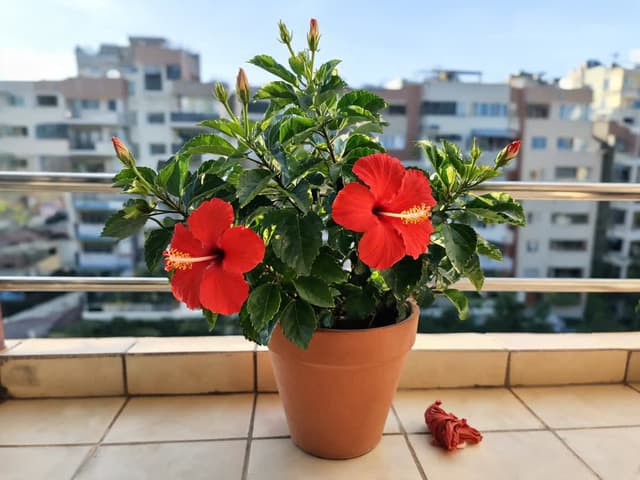
How to Care for Hibiscus: Sun, Watering, Fertilizer, and Pruning for Flowers
How to care for hibiscus: 6 hours of direct sun, evenly moist soil without waterlogging, half-strength fertilizer in spring and summer, and pruning in early spring. Find out why the flower lasts one day and why buds drop before opening.
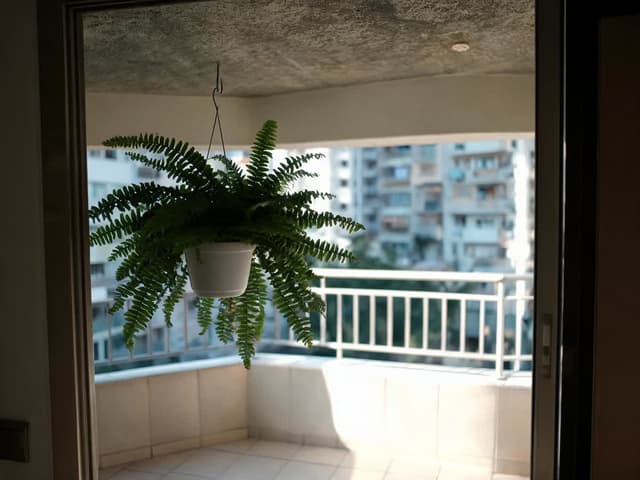
Do Ferns Like Sun or Shade? It Depends on the Type
Ferns prefer bright shade: plenty of light, but no direct sun on their fronds. Tuberous sword fern is the exception that handles sun. Here is the ideal light for each type, where to place pots, and how fronds show too much or too little light.
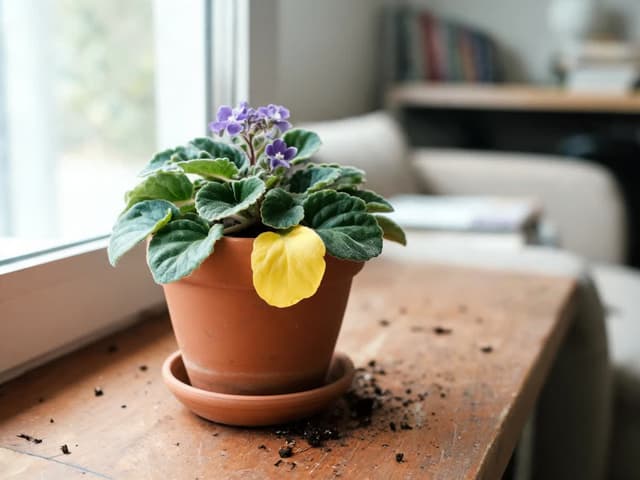
African Violet Yellow Leaves: Causes and What to Do
Yellow leaves on an African violet usually stem from overwatering, and the first place to check is the center of the plant. Losing one lower leaf at a time is normal. Identify whether age, watering, cold water, sunlight, cold drafts, or fertilizer is the culprit based on the yellowing pattern, and see what to do today.