Philodendron Yellow Leaves (Silver Sword Too): Read the Cause from Where the Yellow Shows
One lower leaf yellowing at a time, with new growth emerging at the top, is simply your philodendron shedding an old leaf. Soft leaves with wet soil, a washed-out plant, or specks on the underside point to something else. Here is how to test each cause, including on silver sword.
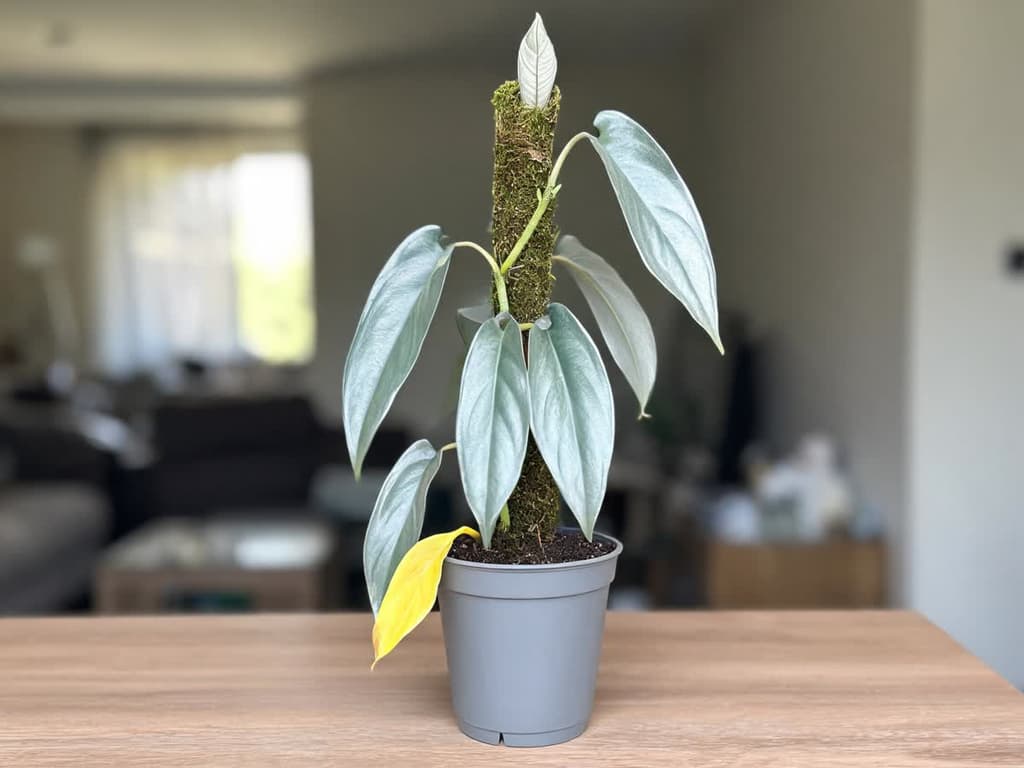
A philodendron with yellow leaves is not always sick. If only the lowest leaf turns yellow, one at a time, the plant is simply shedding an old leaf. The sign that everything is fine is new, green growth emerging at the top. Several leaves yellowing in the same week, soft yellow leaves with wet soil, an entirely washed-out plant, or specks and spots on the leaves require action.
Where the yellowing appears points to the cause: which leaf, which part of the leaf, and what other symptoms accompany it. This applies to heartleaf philodendron, tree philodendron, and silver sword.
Quick summary:
A few old leaves dropping from an otherwise healthy plant is normal: "leaves do not live forever" (Iowa State Extension).
A yellow lower leaf with soggy soil is a sign of too much water. A yellow lower leaf in a dark corner is a sign of too little light (Clemson HGIC).
Yellow lower leaves after a cold night come from the chill: a few hours between 0.5 and 4.5 °C are enough (UF/IFAS EP150).
A V-shaped yellowing extending from the base of the old leaf, with the central vein remaining green, is a magnesium deficiency (UF/IFAS EP150).
Cut the leaf once it turns completely yellow or gets soft. Yellow leaves will not turn green again.
Is your philodendron actually a philodendron?
Philodendron (Philodendron) is the name of a genus with about 250 species, divided into three groups: vining, rosette, and upright tree-like (UF/IFAS EP150). Three are common in homes. The heartleaf philodendron (Philodendron hederaceum) has heart-shaped leaves and trailing stems. The horsehead philodendron (Philodendron bipinnatifidum) has large, deeply split leaves. The third is the silver sword (Philodendron hastatum).
Silver sword is the common trade name for Philodendron hastatum, a climbing vine native to southeastern Brazil (NC State Extension). It has long, spearhead-shaped leaves with a silvery sheen. Golden pothos (Epipremnum) and monstera (Monstera) look like philodendrons, but they belong to different genera and have their own care requirements.
If your plant arrived without a label, confirm the species before adjusting your watering. The Bloom app identifies plants from a photo of a leaf.
Diagnosing yellow leaves on a philodendron at a glance
Check first which leaf turned yellow, then look at the pattern of the yellowing, and only then adjust watering, lighting, or fertilizer.
What you see | Where it appears | One-minute test | Likely cause | What to do |
|---|---|---|---|---|
One leaf turning completely yellow at a time | Oldest leaf at the base | Is there new, firm green growth emerging at the top? | Natural leaf shedding (normal) | Nothing. Cut it once it turns completely yellow |
Yellow, soft leaves and a wilting plant | Lower leaves first, then upper leaves | Is the soil damp 1 inch (2.5 cm) below the surface? Are the roots dark and mushy? | Overwatering and root rot | Unpot the plant and inspect the roots |
Yellow, dry, curling leaves | Oldest leaves | Does the pot feel light, with the soil dry all the way down? | Underwatering | Water thoroughly until water drains from the bottom |
Yellow lower leaves, leggy stems with widely spaced leaves | Base of the plant | Is the pot in a dark corner, far from a window? | Low light | Move it closer to a window, out of direct sun |
Entire plant looks faded and washed out | Leaves facing the window | Does it receive direct sun at any time of day? Has it been months without fertilizer? | Too much light or too little fertilizer | Move out of direct sun; fertilize during the growing season |
V-shaped yellowing spreading from the stem outward, with a green central vein | Old leaves | Has it been months without fertilizer? | Magnesium deficiency | Apply a complete fertilizer that includes magnesium |
Yellow leaves and smaller new leaves | Entire plant | Is new growth emerging smaller than the previous leaf? | Nitrogen deficiency | Apply a complete fertilizer during the growing season |
Lower leaves turning yellow a few days after a cold night | Lower leaves | Was the plant sitting near an open window or an air conditioner overnight? | Cold damage | Move away from cold drafts |
Leaves stippled with tiny pale specks | Any leaf | When you tap the leaf over a white sheet of paper, do tiny crawling specks fall off? | Spider mites | Wash the foliage and treat the pest |
White cottony tufts and sticky leaves | Leaf axils and undersides | Is there white wax where the leaf meets the stem? | Mealybugs | Treat the pest |
Small, water-soaked spot that grows and darkens | Any leaf | Does the spot have a foul odor? | Bacterial leaf spot | Isolate the plant and prune affected leaves |
Cold, magnesium, nitrogen, and faded color come from Table 3 of publication EP150 from the University of Florida (UF/IFAS). EP150 was written for potted philodendron growers (UF/IFAS EP150). Spider mites and mealybugs come from Iowa State's houseplant pest guide (Iowa State Extension). Bacterial leaf spot and foul odor come from the Connecticut agricultural station's philodendron pest handbook (CAES).
For symptoms that recur on any plant, the guide to yellow leaves has the three questions that work for any potted plant.
Lower leaves yellowing one by one: normal
An old leaf turning yellow, while the rest of the plant is fine, is the philodendron shedding a leaf. Iowa State says: if only a few old leaves drop on a healthy plant, do not worry, because "leaves do not live forever" (Iowa State Extension).
On the silver sword, the yellow leaf usually detaches along with the stem, and the stem also yellows before dropping off. The specialized guide Ourhouseplants considers "a handful a year" of lower leaves yellowing to be normal (Ourhouseplants).
Leaf shedding stops being normal in three situations:
more than one leaf turns yellow per week;
new leaves emerge smaller than earlier ones;
the yellow leaf appears in the middle or at the tip of a stem rather than at the base.
In these cases, use the table above to pinpoint the cause.
Yellow, limp philodendron with wet soil: check the roots
A soft, yellow leaf, along with a wilting plant and moist soil, is the classic sign of overwatering. In waterlogged soil, roots lack air and rot. Rotted roots do not transport water to the leaves, which is why the plant wilts even when the pot is wet (Iowa State Extension).
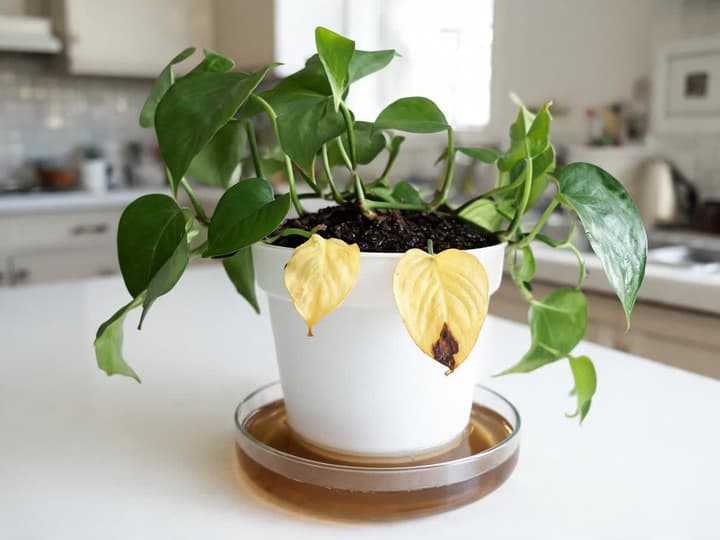
Root rot starts with the lower leaves and moves up the plant (CAES). To confirm, run the check in this order:
Stick your finger about an inch into the soil. If it is still moist, the plant did not need water (UF/IFAS Gardening Solutions).
Check the saucer beneath the pot. Standing water in the saucer keeps the bottom of the pot waterlogged.
Take the plant out of the pot and inspect the roots. Healthy roots are firm and light-colored. Rotted roots are dark, mushy, and fall apart between your fingers (Iowa State Extension).
If most of the root system is firm, trim off the soft parts with clean scissors. Repot in fresh soil, in a pot with drainage holes, and only water when the top inch (2.5 cm) dries out. Do not leave standing water in the saucer after watering (Iowa State Extension).
If nearly all the roots have rotted, Iowa State notes that the plant rarely recovers. In that case, take a healthy stem cutting with two nodes and root it in water as a new plant.
Yellow, dry leaf with parched soil: underwatering
An old yellow leaf that is dry and curling, with the soil dry all the way to the bottom of the pot, indicates underwatering. Blogger Brittany Goldwyn mentions that her silver sword would lose old, yellow, curling leaves because she let the soil dry out too much (Brittany Goldwyn).
This issue often happens when growers hear about overwatering and switch to a very airy potting mix with perlite and bark. An airy mix dries out quickly, especially in a pot that is small relative to the root system. With coarse mixes, the bottom of the pot can dry out almost as fast as the surface. Once the top 2 inches (5 cm) dry, the entire pot might already be bone dry.
Use the lift test. Pick up the pot right after watering and again before your next planned watering. A light pot is a dry pot.
To rehydrate, water slowly until water runs out of the drainage hole and all the soil in the pot is wet. Iowa State recommends a cycle: soak the entire root ball and only water again when it dries, before the plant wilts (Iowa State Extension). If the soil still dries out in two or three days, the roots have filled the pot: Iowa State recommends moving to a pot just one size larger, with fresh soil (Iowa State Extension).
Silver sword with yellow leaves: how it differs
The silver sword is the most demanding of the three. It comes from the humid rainforest of southeastern Brazil. According to NC State, it prefers bright light without direct sun, warm temperatures, humid air, and a support to climb (NC State Extension). The recommended temperature range is 18 to 29 °C, away from cold drafts and sudden drops in temperature.
On a silver sword, three changes in color and leaf shape are completely normal:
New leaves emerge in a different color. According to NC State, new leaves emerge with a reddish-orange hue. As they mature, they shift to a bluish-green tone with a silvery sheen. An orange-tinted new leaf at the top of the plant is not a yellowing leaf.
The color shifts between silver and silvery green. The same plant profile describes the foliage as silver, silvery blue, or silvery green.
The leaf shape changes. Juvenile foliage is arrow-shaped. Mature leaves grow longer and can develop three lobes.
Light alters the sheen. Ourhouseplants states that poor lighting dulls the color and slows the growth of silver sword. This observation comes from a single guide; no university research has measured the direct link between light levels and silver leaf sheen. NC State warns that direct sun scorches the leaves.
If the leaf appears dull but remains firm and grayish green, it lacks adequate light rather than turning yellow. Move the pot closer to a window, keeping direct sun off the foliage. Truly yellow leaves, from lemon to straw-colored, follow the diagnostic table above.
Pale or faded leaves: too much light or too little fertilizer
When the entire plant appears washed-out, UF/IFAS points to two causes: too much light or too little fertilizer (UF/IFAS EP150). To tell them apart, look at where the leaf faded.
Faded more on the side facing the window: it is light. Direct sun also fades the leaves of the heartleaf philodendron (UF/IFAS FP472). In Brazil, a north-facing window receives strong sun for most of the day. Move the pot out of the direct sunbeam or put a sheer curtain on the window.
Uniformly washed-out and the new leaf emerges smaller: this is a nitrogen deficiency. UF/IFAS links this deficiency to yellow leaves and smaller leaves (UF/IFAS EP150).
A yellow V-pattern on older leaves, with a green midrib: this is magnesium deficiency, according to the same chart. The V starts at the leaf stem and spreads toward the edge.
For both nutrient deficiencies, use a complete foliage plant fertilizer with magnesium in the formula, at the label rate. Fertilize only during the growing season, from September to March in Brazil. The frequency is every 3 to 4 months, as UF/IFAS recommends for the heartleaf philodendron (UF/IFAS Gardening Solutions). Iowa State suggests a light fertilizer once or twice a month. The lower frequency from UF/IFAS applies here, because the same source notes that excess fertilizer leaves the leaf tips brown and curled.
The opposite route also causes yellow leaves. In low light, the plant yellows its lower leaves, puts out leggy growth, and spaces its leaves far apart (Clemson HGIC). UF/IFAS notes that most philodendrons survive on 75 foot-candles of light (about 800 lux). To maintain leaf color and size, they need double that: 150 foot-candles, about 1,600 lux (UF/IFAS EP150). The guide to low-light plants shows how to find the brightest spot in a room without any equipment.
Yellowing lower leaves after a cold night
Lower leaves turning yellow a few days after a cold night are cold damage. UF/IFAS records that a few hours between 33 and 40 °F turn lower philodendron leaves yellow (UF/IFAS EP150). For heartleaf philodendron, the same university states that below 50 °F is already too cold (UF/IFAS Gardening Solutions).
In Brazil, the risk runs from June to August, especially in the South and in the mountain ranges of the Southeast. Indoors, cold air reaches the plant in two ways: open windows at night and direct air conditioning drafts. Move the pot away from both.
Leaves yellowed by cold damage will not turn green again. If subsequent new leaves emerge healthy, the plant has recovered.
Specks, cottony tufts, or dark spots: pests or bacteria
When yellowing appears as specks or patches rather than across the entire leaf blade, pests or bacteria are usually responsible. Turn the leaf over and inspect the underside under bright light.
Spider mites. The leaf becomes speckled with light dots. Spider mites are tiny and live on the underside of the leaf. To find them, tap the leaf over a sheet of white paper. If moving specks drop off, they are spider mites. With a heavy infestation, fine webbing appears between the leaf and stem (Iowa State Extension). They thrive in dry air. The full treatment is covered in spider mites.
Thrips. Ourhouseplants highlights thrips, tiny sap-sucking insects, as common pests on silver sword and other philodendron varieties. Look for yellowing leaves with irregular blotches accompanied by dark markings on the leaf undersides. The guide notes that insecticidal soap and neem oil do not always break the insect's life cycle.
Mealybugs. Mealybugs appear as white cottony tufts in the leaf axils and on the undersides of the leaves. Mealybugs excrete a sugary liquid that leaves the foliage below sticky (Iowa State Extension). See how to remove them in mealybugs.
Bacterial leaf spot. It starts as small, water-soaked areas on the leaf that grow and turn light brown to black. When the bacteria reach the petiole, the leaf wilts and drops. The infection spreads quickly and the plant can develop a fishy smell (CAES). Isolate the pot, cut off affected leaves, and water only the soil without wetting the leaves: wet foliage promotes spots, according to Iowa State (Iowa State Extension).
If more than one pest appears at the same time, the guide to houseplant pests helps distinguish each one.
Should I cut off yellow philodendron leaves?
Yes, once the leaf turns completely yellow or becomes soft. Yellow leaves will not turn green again, and removing them does not harm the plant.
Cut close to the main stem, removing the entire petiole with clean pruning shears. Wipe the blades with rubbing alcohol before moving on to another plant, particularly if bacterial leaf spot is present. Do not trim off green leaves "preventively": green foliage still feeds the plant.
Trimming does not fix the cause. If the leaf turned yellow from overwatering, the next one will also turn yellow until the root system is treated. Anthuriums belong to the same family as philodendrons. In anthurium yellow leaves, a lower leaf yellowing one at a time is also normal leaf shedding.
Frequently asked questions
Will a yellow philodendron leaf turn green again?
No. Adjusting your watering, lighting, or fertilizing protects new leaves, but foliage that has already turned yellow stays yellow. Prune that leaf off once it yellows completely. The clear sign that your adjustments worked is the new growth: it must emerge green and at least as large as the previous leaf.
What does an overwatered philodendron look like?
The lower leaves turn yellow and limp, and the plant wilts even though the soil is wet. At the root level, rotting roots look dark, feel mushy, and fall apart when handled. The rot starts at the bottom leaves and moves upward. The fix is trimming away mushy roots and only watering once the top inch (2.5 cm) dries out.
Does Epsom salt fix yellow leaves on philodendrons?
Only if the cause is a magnesium deficiency. Epsom salt is magnesium sulfate. The symptom of this deficiency is a V-shaped yellowing pattern on older leaves, starting at the petiole and spreading to the leaf margins, while the central vein remains green. Soft yellow leaves with soggy soil have a different cause. A complete fertilizer containing magnesium corrects the exact same deficiency.
Can you save a philodendron that is losing all its leaves?
In most cases, yes, as long as the main stem stays firm. Unpot the plant and inspect the roots. If the roots are firm and light-colored, correct your watering, lighting, and exposure to cold, then watch the next new leaf. If almost the entire root system has rotted, take a cutting from a healthy section of vine with two nodes and root it in water.
Your first step with your philodendron
Start with where the yellowing appears. A lower leaf, one at a time, with new growth at the top: leave the plant alone. Soft leaves with wet soil: check the roots today. Faded plant: adjust the light before fertilizing. Specks or cotton: flip the leaf over and look for pests. Potted palms also shed one lower frond at a time. The guide to yellow palm leaves uses frond position to pinpoint the cause. If you do not know what is affecting your plant, the guide on what's wrong with my plant organizes symptoms for any potted plant.
Related articles
How to Care for a Maidenhair Fern: Light, Water, and Revival Tips
Learn how to care for a maidenhair fern indoors: bright indirect light, consistently moist soil, high humidity, and how to revive it if it dries out completely.
How to Propagate Spider Plants: Root the Pup Before Cutting
The safest spider plant cutting comes from a pup still attached to the mother plant: rest the plantlet on soil in a small pot, wait for roots to establish, and only then cut the stolon. Learn when the pup is ready, whether rooting in water is worth it, how to divide the clump, and why plants fail to produce babies.
Banana plant fertilizer: fertilizing potted and backyard plants
Banana plant fertilizer needs more potassium than nitrogen, in a 3-1-6 ratio. For a potted plant on a balcony, use the label dose in spring and summer. In the backyard, fertilize every 2 months, adjusting the amount by mat age. Learn the formula, timing in Brazil, and signs of deficiency or excess.