How to Revive Completely Dried Petunias: The Stem Test and What to Do
Did your petunia dry out completely? Scratch the stem near the base with your fingernail. Green and flexible underneath means it can be saved; brown and brittle down to the base means it cannot. Here is how to rehydrate the pot, how much to cut back, how long to wait, and when to let go.
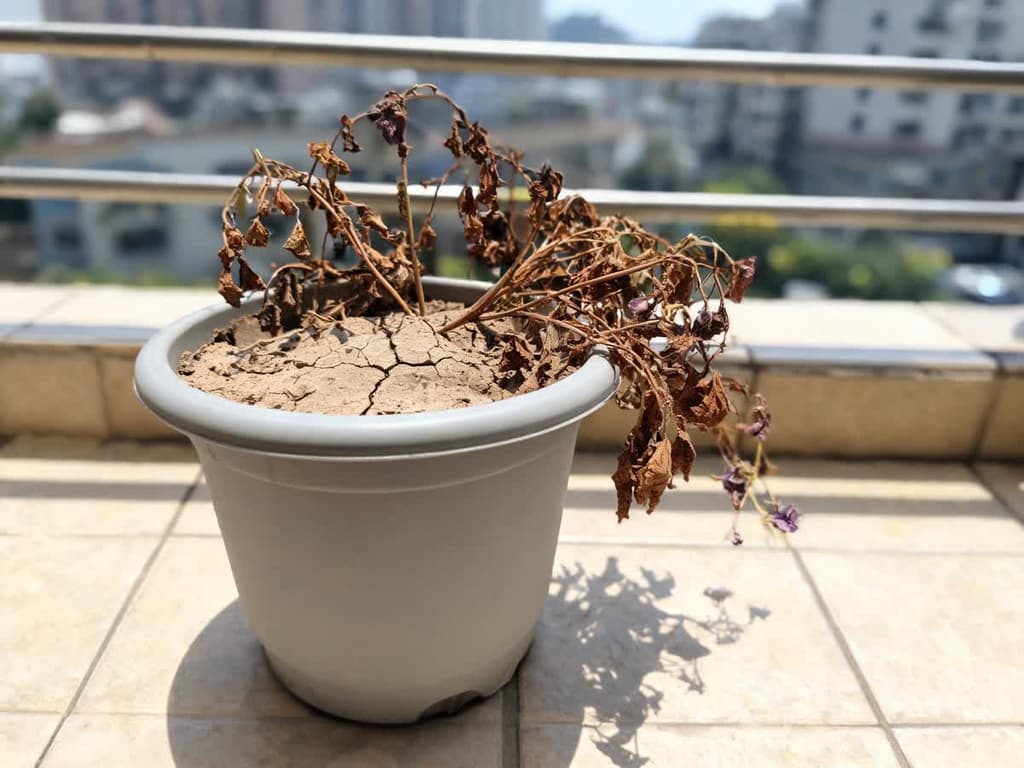
Scratch the petunia stem with your fingernail near the base, or bend a branch. If green shows underneath and the branch bends without snapping, the plant is alive and you can save it. If the stem is brown inside and snaps easily all the way to the base, the petunia has dried out completely. Crispy leaves will not turn green again and dried flowers will not reopen, even with water; only the living stem can sprout anew.
This guide shows how to revive completely dried petunias that dried out from underwatering. The pot missed waterings while you were away on a trip, or a heatwave scorched the plant on your porch. First, check if the stem is alive. Then bottom-water the pot, cut away what died, and wait for new growth.
Quick summary:
Scratch a 5 mm strip of the stem, 2 to 3 cm above the soil: green underneath means living tissue.
Soak the pot in a basin with water for 20 to 30 minutes; soak a hanging basket for 1 to 2 hours, never more than 2 hours.
After soaking, trim only the dead parts and leave every leaf that is still green.
How to tell if a dried-out petunia is still alive
Perform the test on 3 or 4 different stems, working from top to bottom. Lightly scratch the outer layer of the stem with your fingernail or the tip of a key along a strip of about 5 mm. The University of Illinois Extension teaches this test for trees, shrubs, and garden perennials. If green shows, the stem is alive. If it is entirely brown and snaps easily, it is dead. University extension is a service from a university that guides plant growers based on research.
No source has published this test for petunias. Here it follows the same principle: a living stem is green inside and a dead stem is brown. Start at the tip of the branch and work down. The tip may be dead while the base is still alive, so scratch down to 2 or 3 cm from the soil before drawing a conclusion. It only takes one stem with green at the base for the plant to have a chance.
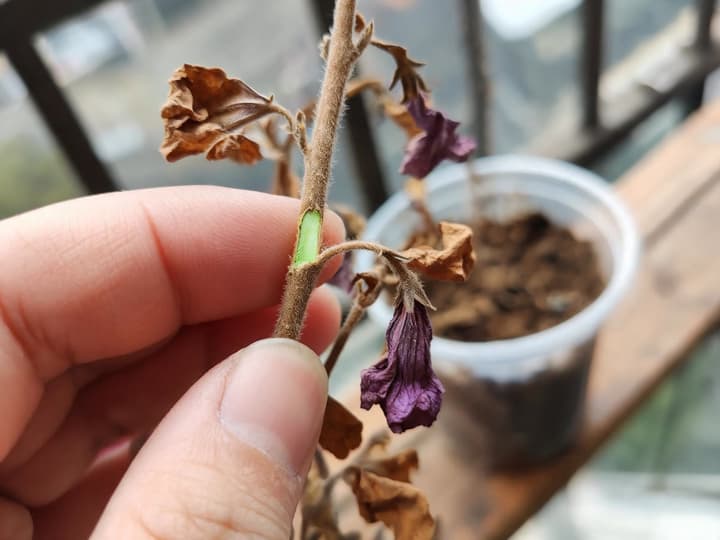
The bend test confirms the scratch test. Gently bend a branch near the base. A living stem bends without breaking. A dead stem snaps easily and looks brown inside, as the Illinois extension notes. To tell whether the petunia is still alive, the sign is always green tissue in the stem. If no stem shows green down to the base, it died.
Dried out or rotting: check the soil before taking action
Stick your finger into the potting mix before watering a wilting petunia. Dry soil, stiff stems, and crispy leaves point to a lack of water, which is the scenario covered in this guide. Wet soil paired with a wilting plant can indicate the opposite problem: roots and the stem base rotting from overwatering.
The North Carolina State University extension says that, in petunias, crown rot (the base of the stem, right at the soil line) can cause the plant to wilt quickly and collapse. Overwatering for an extended period, pots without drainage, and standing water promote this disease, according to the same extension.
When in doubt, remove the plant from the pot and inspect the roots. Healthy roots are white and well-branched, according to the University of Connecticut extension. With root rot, the outer layer turns brown and strips away when you pull it with your fingers, leaving only a thin core in the center. The Pennsylvania State University extension describes the same sign.
A petunia with rotted roots cannot be saved with more water. Other reasons for wilting are listed on the page about petunias with wilting leaves.
How to revive a dried-out petunia, step by step
Follow this order only if the stem scratch test revealed green and the soil is dry. Soak the pot first and prune afterward.
Move the pot out of harsh sunlight. Carry out the rescue in bright shade, away from the afternoon sun.
Water the pot from below. Place the pot in a basin, bucket, or sink with water and let the soil absorb the water through the drainage holes.
Respect the soaking time. The Iowa State University Extension recommends 20 to 30 minutes for a pot that has dried out completely. For a hanging basket, the same extension recommends 1 to 2 hours and warns that more than 2 hours in water can rot the roots.
Let it drain. Take the pot out of the basin and wait until water stops dripping from the drainage hole before hanging it up or setting it on a saucer.
Trim only what is dead. Cut back each stem just above the point where the test revealed green. Keep every leaf on the stem that remains green. If not a single leaf stayed green, preserve the living stem along with its nodes, the points where leaves were attached, because that is where new shoots emerge.
Return the petunia to the sun gradually. Keep it in bright shade until the first shoots appear. Then move it into the sun, which the petunia needs to sprout anew and bloom.
Bottom watering works better than top watering for a pot that has dried out. Peat-based soilless potting mix shrinks and pulls away from the pot wall when it dries out too much, according to the Illinois extension. Water from irrigation runs down this gap and drains out the hole, leaving the soil dry inside. Peat moss, the base of many potting mixes, repels water when dry, explains the Purdue University extension.
Sources differ on how much to cut back a petunia. The Clemson University extension instructs cutting the stems back by half and accepts cutting down to a few centimeters from the base, as long as leaves remain. The Pennsylvania extension, for annuals in general, leaves 7 to 12 cm of stem. On a dried-out petunia, the scratch test determines the cut height: cut above the green and keep the living leaves, as Clemson advises.
Clemson recommends watering thoroughly after pruning to force new shoots and blooms. Here, the pot was just soaked: do not water again until the top 2.5 cm of soil dries out. The post-rescue watering routine by container type is detailed in the guide on how often to water a petunia.
How long to wait for a petunia to grow back
No source has measured how long a completely dried-out petunia takes to sprout again. The closest number comes from the North Carolina extension in Richmond County. After a light pruning, which removes about 20% of the size, the petunia takes 1 to 2 weeks to flower again. A dried-out plant lost much more than 20%, so expect it to take longer.
Check on new growth with the stem test. Two weeks after the rescue, scratch the stems that previously tested green once more. If green remains and tiny shoots appear where the leaf joins the stem (the leaf axil) or at the base, the plant bounced back. If the green turned brown and no shoots appeared, the petunia failed to respond: rely on the cutting (a piece of green stem that forms roots) taken on rescue day. If the green remains and there are still no shoots, wait another week and scratch again.
Dried-out petunias in hanging baskets
A hanging basket dries out faster than a pot on the ground. It holds little soil, catches sun and wind from all sides, and often contains multiple plants crowded together. That is why a basket requires a longer soak: 1 to 2 hours in a basin, as directed by the Iowa extension, and never longer than that.
Run the stem test on every individual plant in the basket, because one might be alive while the one beside it is dead. Cut stems flush with the soil on plants showing no green at all, letting the surviving ones fill the space.
An inherited basket plant left behind by a former resident might not even be a petunia. Fuchsias, geraniums, and calibrachoas are also sold in hanging baskets with pink blooms. Bloom (available for iOS) identifies plants from a photo, and reviving a different species might call for different soaking times and pruning cuts.
When a petunia cannot be saved
In four situations, watering and pruning will not suffice, making a cutting or a fresh plant the only path forward:
Stems are brown and brittle right to the soil across all branches. With no living tissue, the plant has nowhere to sprout from.
Wilting with wet soil and brown roots that pull apart. This is root rot, and the NC State Extension advises removing and discarding the diseased plant.
End of cycle in the heat. In hot weather, a petunia can become "exhausted" by midsummer, according to Ohio State University. It produces few flowers, thin stems, and small, yellowish leaves. In Brazil, midsummer runs from December to February. The same source says heavy pruning, fertilizer, and watering restore vigor, but no one has tested this on an exhausted plant that also dried out. The safest option is to take cuttings and try to rescue the potted plant at the same time.
Light spots on the leaves before drying out. This is a sign of the twospotted spider mite, a tiny mite that sucks the leaf. It multiplies in hot, dry weather, according to the University of Florida Extension. Water will not solve it: check the underside of the leaves and, if you find the mite, take a cutting from a stem without spots.
A petunia that darkened and wilted after a cold night suffers from another issue entirely, not a lack of water. Cold thresholds and next steps are covered in the guide on petunias in winter.
Plan B: propagate a cutting from surviving green stems
A branch tip that is still green can become an entirely new petunia, even if the rest of the plant has died. Snip a 5 to 7.5 cm piece from the green tip, remove the lower leaves, and place it in water or moist soil. Cutting size, choosing between water and soil, and rooting times are detailed in the guide on how to propagate petunias.
If any branch still carries a green tip, take the cutting on the day of the rescue, before you know whether the mother plant will pull through. If the original plant recovers, you end up with two.
Frequently asked questions
Will a wilted petunia bounce back with water?
A petunia that is merely wilted, with limp leaves that are still green, usually recovers once watered, according to the NC State Extension. Leaves that are dry, crispy, and brown will not come back. In that situation, the stem determines whether the plant survives: green tissue under the scratched bark indicates it can send out new growth from that stem.
How long should you soak a petunia pot?
Soak for 20 to 30 minutes for a container that dried out completely, and 1 to 2 hours for a hanging basket, according to the Iowa State University Extension. Do not exceed 2 hours: roots left waterlogged too long can rot. Remove the pot from the basin and let it drain thoroughly before hanging it up.
Will a dried-out petunia flower again?
Yes, as long as the stem is still green at the base and the plant produces new growth. After light pruning, a petunia takes 1 to 2 weeks to bloom again, according to the NC State Extension. A plant that dried out will likely take longer, though no source has measured the exact timeframe.
What should you do with a petunia at the end of the season?
Where frost does not occur, a petunia can survive year-round because it is a tender perennial, according to the NC State Extension. Cut back long stems by half while keeping leaves intact, as Clemson instructs. Where freezing temperatures occur, petunias will not survive winter and grow strictly as annuals, as in North Carolina itself.
Reviving a dried-out petunia: your first step today
Scratch the stem near the base before doing anything else. If it is green underneath, soak the pot for 20 to 30 minutes, trim only what has dried up, and check again in 2 weeks. If it is brown down to the soil across every branch, the plant died and your best route is starting with a new one. The sunlight, watering, and pruning routines that prevent future dry-outs can be found in our guide on how to care for petunias.
Sources
Illinois Extension. Wait-n-See Spring. 2014.
Illinois Extension. Container Gardens: Watering.
Iowa State University Extension. Care of Plants Growing in Containers.
Iowa State University Extension. How often should I water plants in hanging baskets?
Clemson Cooperative Extension, HGIC. Petunia.
Penn State Extension. Pruning Herbaceous Plants.
Penn State Extension. Pythium.
UConn IPM. Root Rot Diseases of Greenhouse Crops.
NC State Extension. Phytophthora Blight and Root Rot on Annuals and Herbaceous Perennials.
NC State Extension, Richmond County Center. Secrets to Petunias Lasting All Season Long.
NC State Extension. Petunia x hybrida, Plant Toolbox.
Ohio State University. PlantFacts: Petunia x hybrida.
Purdue Extension. HO-255-W: Evaluating Container Substrates and Their Components.
UF/IFAS. Twospotted Spider Mite.
Related articles

How to Care for Hibiscus: Sun, Watering, Fertilizer, and Pruning for Flowers
How to care for hibiscus: 6 hours of direct sun, evenly moist soil without waterlogging, half-strength fertilizer in spring and summer, and pruning in early spring. Find out why the flower lasts one day and why buds drop before opening.

Do Ferns Like Sun or Shade? It Depends on the Type
Ferns prefer bright shade: plenty of light, but no direct sun on their fronds. Tuberous sword fern is the exception that handles sun. Here is the ideal light for each type, where to place pots, and how fronds show too much or too little light.

African Violet Yellow Leaves: Causes and What to Do
Yellow leaves on an African violet usually stem from overwatering, and the first place to check is the center of the plant. Losing one lower leaf at a time is normal. Identify whether age, watering, cold water, sunlight, cold drafts, or fertilizer is the culprit based on the yellowing pattern, and see what to do today.