2752 Easy Easy Care | 2026 Guide - Page 2
Find 2752 easy easy care. Complete guide for your garden.
2752 Easy Care with easy level
Showing 37-72 of 2752
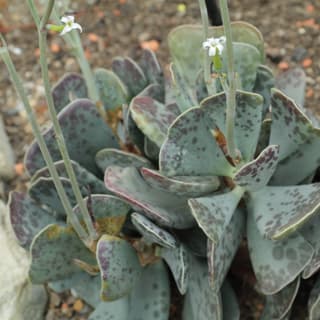
Adromischus triflorus
Adromischus triflorus
Adromischus triflorus is a small succulent from the Western Cape of South Africa, mainly the Little Karoo, where it grows among gravel and in rock crevices in intense heat with little rain. Its stems creep along the ground with upturned tips, and the plant stays about 10 cm tall. The thick, almost heart-shaped leaves are covered in reddish-brown spots and have a hard edge near the tip. In Afrikaans it is called "eendevoet", duck's foot. In summer it sends up as many as three spikes, up to 35 cm, with small tubular white to pink flowers, often in threes.
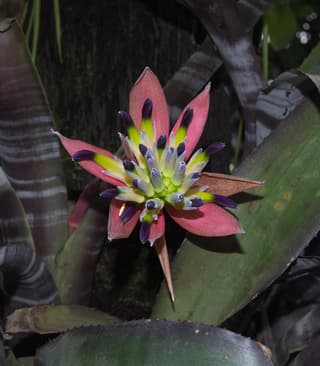
Urn Plant
Aechmea
Aechmea is a genus of approximately 250 epiphytic bromeliads native to the tropical and subtropical Americas. Their distinctive tank-shaped rosettes form a central cup that holds water — a remarkable adaptation to life in the forest canopy. The most popular houseplant species, Aechmea fasciata (Silver Vase or Urn Plant), is celebrated for its long-lasting pink bracts and small violet flowers.
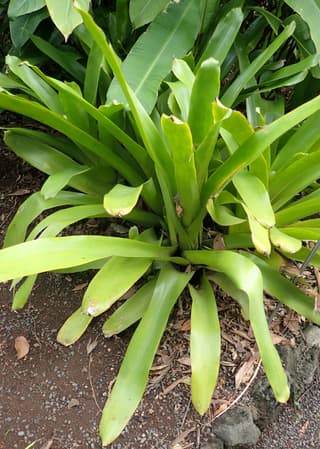
Orange Bromeliad
Aechmea blanchetiana
Aechmea blanchetiana, commonly known as the Orange Bromeliad, is a stunning tropical bromeliad native to the restinga coastal forests of Brazil's Atlantic Forest. Its stiff, linear leaves form a classic vase-shaped rosette that can hold up to one liter of water in the central cup. When grown in full sun, the foliage transforms into brilliant shades of orange, red, and apricot, making it one of the most striking bromeliads for tropical and subtropical landscapes. After flowering, the mother plant produces offsets that ensure continuity of growth.
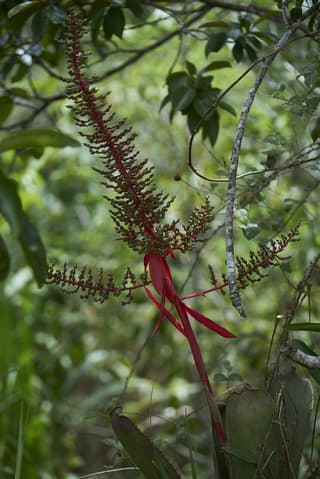
Teata Bromeliad
Aechmea bracteata
The Teata Bromeliad (Aechmea bracteata) is an epiphytic bromeliad native to Central America, belonging to the Bromeliaceae family. It forms a rosette of rigid, spiny leaves that create a central "tank" for water collection. Its inflorescence is striking, with bracts in shades of pink, orange, and green.
Wax Mallow Bromeliad
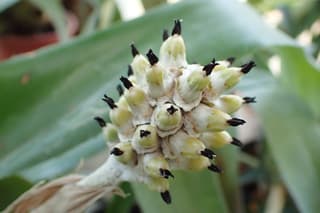
Aechmea bromeliifolia
Aechmea bromeliifolia, commonly called Wax Mallow Bromeliad, is a terrestrial bromeliad native to the tropical regions of South and Central America. It forms a striking rosette of stiff, spine-edged leaves and produces a showy inflorescence with colorful bracts. It is one of the most widespread Aechmea species, found in gallery forests, cerrado, and open scrublands.
Urn Plant
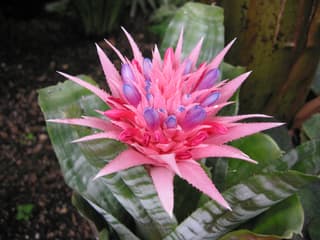
Aechmea fasciata
Aechmea fasciata is an epiphytic bromeliad native to southeastern Brazil, renowned for its striking silver-banded leaves and spectacular pink inflorescence with tiny blue-violet flowers. It is one of the most popular bromeliads for indoor cultivation, valued for its exotic beauty and ease of care.
Nakedstem Bromeliad
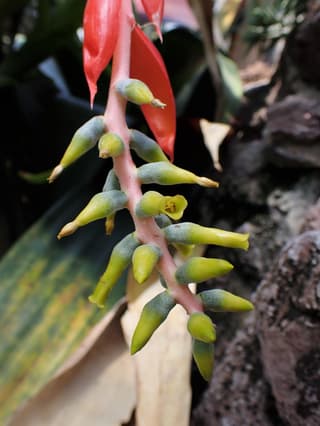
Aechmea nudicaulis
Aechmea nudicaulis, commonly known as the Nakedstem Bromeliad or Naked-stemmed Living Vase, is a stunning epiphytic and terrestrial bromeliad native to Brazil's Atlantic Forest, with distribution extending through the Caribbean and northern South America. It forms a rosette of stiff, dark green, strap-like leaves with serrated margins, from which emerges a striking inflorescence: a bright red spike bearing greenish-yellow flowers tipped with blue-purple, appearing in summer through fall. The plant is prized for its architectural beauty, low maintenance requirements, and resilience. After flowering — a once-in-a-lifetime event — the mother plant produces offsets (pups) that carry on the colony. Its central tank collects rainwater, creating a vital microhabitat for wildlife in its native forest.
Marimo Moss Ball
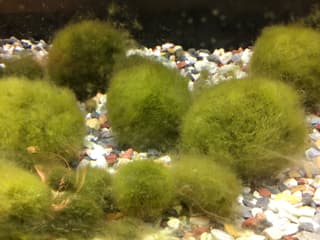
Aegagropila linnaei
Aegagropila linnaei, known as the Marimo moss ball, is not a true moss but a rare form of filamentous green algae that grows into spherical colonies. Native to cold, alkaline lakes in Japan, Iceland, and Estonia, its round shape develops naturally due to wave action and periodic rotation on the lake bed. At Lake Akan in Japan, it is protected as a special natural monument.
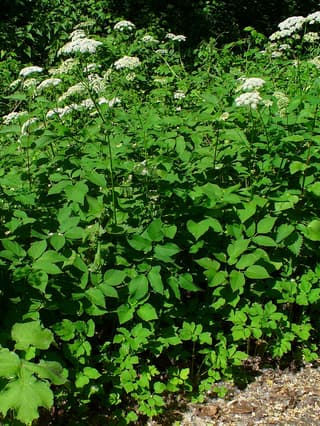
Ground elder
Aegopodium podagraria
Ground elder (Aegopodium podagraria) is a perennial herbaceous plant in the carrot family (Apiaceae), native to Europe and Asia. It is known for its extremely rapid growth and spread via rhizomes, making it one of the most hardy and invasive ground covers in temperate regions. The plant forms dense carpets of light green, ternate leaves and bears white umbels (flower clusters) from May to June. It thrives in shade to partial shade and tolerates most soil types. Historically, it was cultivated as a food and medicinal plant during the Middle Ages.
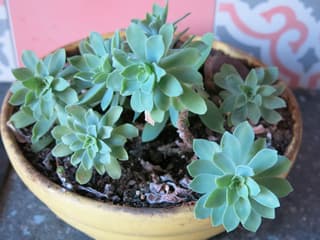
Aeonium
Aeonium
Aeonium is a genus of succulents with approximately 35 species, primarily native to the Canary Islands. Unlike most succulents, Aeonium grows actively in the fall and winter, entering dormancy during the hot summer. Its perfect rosettes of glossy leaves form stunning ornamental colonies, making it one of the most elegant succulents for Mediterranean gardens and pots.
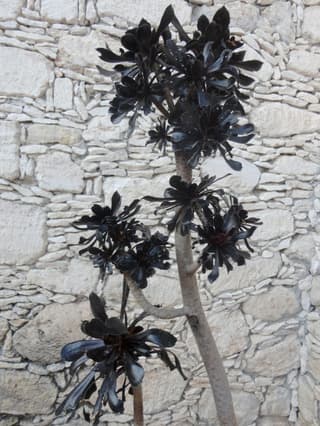
Black Rose
Aeonium 'Zwartkop'
Aeonium 'Zwartkop' is a striking succulent shrub prized for its near-black, burgundy-purple rosettes that sit atop slender, woody stems. A cultivar of Aeonium arboreum, native to the Canary Islands, it forms an architectural, sculptural silhouette in gardens and containers alike. The dark foliage deepens to almost jet black in full sun and softens to green-purple in shade, making it a dramatic focal point in succulent arrangements. In spring, mature rosettes can send up conical clusters of bright yellow star-shaped flowers, though the flowering rosette dies back afterward while the rest of the plant continues to grow.
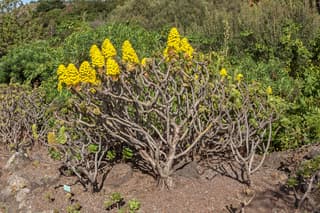
Tree Aeonium
Aeonium arboreum
Aeonium arboreum is a woody-stemmed succulent native to the Canary Islands and North Africa, renowned for its striking rosettes of fleshy leaves atop branching stems. The dark-purple cultivar 'Schwarzkopf' (also spelled 'Zwartkop') is one of the most popular ornamental succulents worldwide.

Giant Velvet Rose
Aeonium canariense
Aeonium canariense, commonly known as the Giant Velvet Rose or Canary Island Aeonium, is a perennial succulent endemic to the Canary Islands and native to the laurel forest edges and high-mountain scrub of the archipelago. It forms large, velvety rosettes of spirally arranged leaves that can reach 15 to 30 cm across. In spring and early summer, mature rosettes send up a tall flowering stalk, up to 1 meter high, topped with clusters of small, star-shaped yellow flowers. The species is monocarpic: each rosette dies after flowering, though the plant persists through offsets produced at its base.
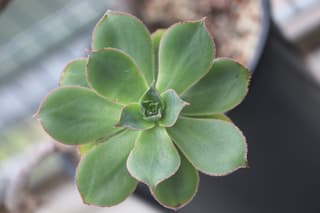
Green Pinwheel
Aeonium decorum
Aeonium decorum is a compact, multi-branched succulent from the Canary Islands, forming rosettes of pale green, spoon-shaped leaves often edged in red. Its architectural pinwheel shape makes it a popular ornamental succulent for pots and rock gardens.
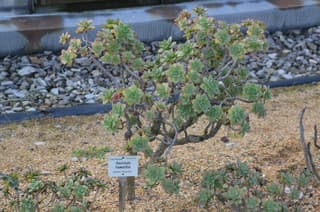
Pinwheel Aeonium
Aeonium haworthii
Aeonium haworthii is a branching succulent shrub native to the Canary Islands, prized for its rosettes of blue-green leaves edged in red, arranged like the blades of a pinwheel. It grows into a low, multi-stemmed shrub and produces star-shaped white to pale yellow flowers in spring.
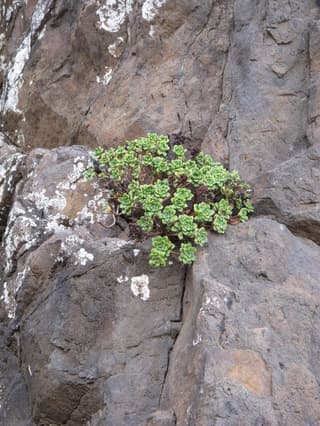
Lindley's Aeonium
Aeonium lindleyi
Lindley's aeonium (Aeonium lindleyi) is a succulent in the stonecrop family (Crassulaceae) endemic to the Canary Islands: subspecies lindleyi grows on Tenerife and subspecies viscatum on La Gomera, on sunny cliffs and rocks from the coast up to about 700 m. It is a subshrub branching from the base, 20-50 cm tall, with small rosettes of thick, hairy, very sticky leaves that are green or turn reddish-yellow in strong sun. In summer (July to September in the wild) it bears clusters of golden-yellow, star-shaped flowers. Canary Islanders traditionally used the leaf juice against burns from spurge latex.

Sim's Aeonium
Aeonium simsii
Aeonium simsii is a compact, mat-forming succulent endemic to the rocky highlands of Gran Canaria in the Canary Islands, where it grows on cliffs and outcrops between 500 and 1,900 meters elevation. It forms dense clumps of short, branching stems tipped with cup-shaped rosettes of yellowish-green leaves marked with brownish longitudinal stripes on their undersides. Unusually for the genus, individual rosettes of A. simsii can flower repeatedly and survive, unlike almost all other Aeonium species, whose rosettes die after a single bloom.
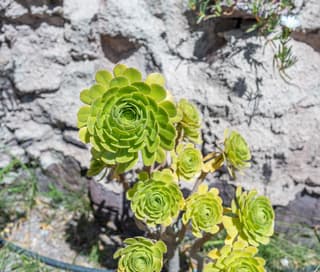
Stalked Aeonium
Aeonium undulatum
Aeonium undulatum is a striking succulent subshrub native to the Canary Islands, specifically Gran Canaria. Known for its large rosettes of bright, glossy, wavy-edged green leaves, it can grow over 2 meters tall on a single unbranched stem, making it one of the tallest species in the Aeonium genus. It is monocarpic, producing stunning pyramidal panicles of yellow star-shaped flowers after approximately 5 years.
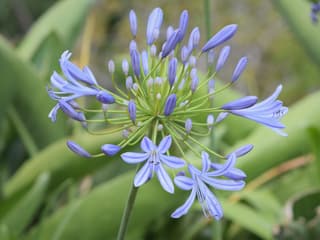
Lily of the Nile
Agapanthus africanus
Lily of the Nile (Agapanthus africanus) is a perennial plant native to the Western Cape region of South Africa. It forms compact clumps of long, strap-like evergreen leaves, from which sturdy flower stalks emerge, topped with dense umbels of trumpet-shaped flowers ranging from blue to violet. It is widely used in gardens, borders, and containers, prized for its striking summer blooms and toughness.
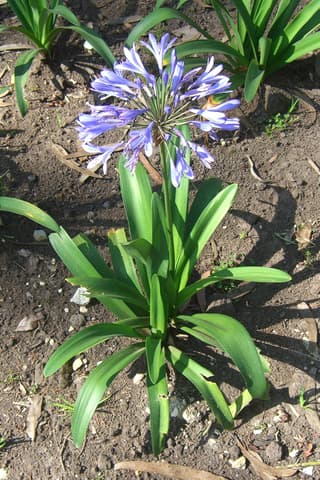
Oriental Agapanthus
Agapanthus orientalis
Agapanthus orientalis is an evergreen, clump-forming perennial native to South Africa, prized for its tall, sturdy flower stalks topped with large spherical umbels of trumpet-shaped blooms in blue, lavender, purple, or white. Its strap-like, glossy dark-green leaves form a dense mound at the base, making it a popular border and container plant in warm climates.
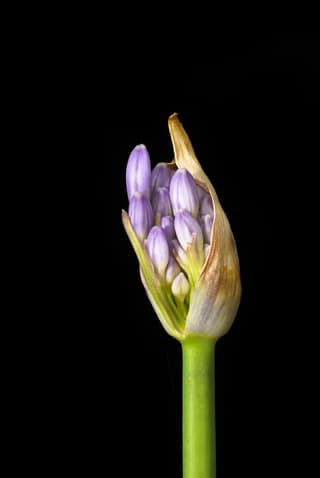
African Lily
Agapanthus praecox
Agapanthus praecox is an evergreen perennial plant native to South Africa. It is characterized by its long, strap-like green leaves and spectacular globular umbels of blue or white flowers that rise on tall, sturdy stems. It is an extremely hardy species and popular in Mediterranean landscaping.
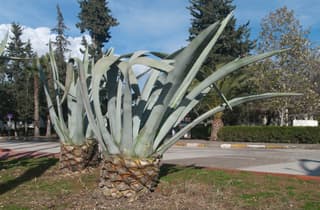
Century Plant (genus)
Agave
Agave is a large genus of monocarpic succulents native to the Americas, particularly Mexico. Their stiff, spine-tipped leaves form striking rosettes. The plant blooms only once in its lifetime, sending up a towering flower spike before dying.
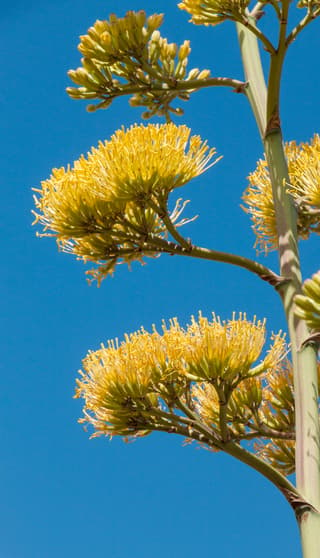
Century Plant
Agave americana
Agave americana, commonly known as the Century Plant, is a large succulent native to Mexico and the southern United States. Its striking blue-gray leaves are long, rigid, and tipped with sharp spines. It is monocarpic — blooming only once in its lifetime after 10 to 30 years, producing a spectacular flower stalk up to 25 feet tall, then dying. Before dying, it produces numerous basal pups that ensure the species' continuation.
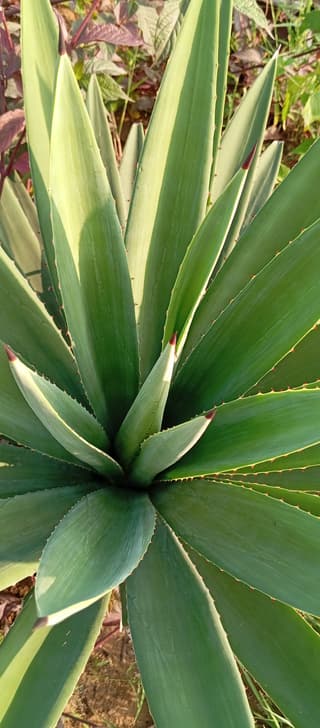
Caribbean Agave
Agave angustifolia
Caribbean Agave (Agave angustifolia) is a perennial succulent in the Asparagaceae family, native to Mexico and Central America. It forms dramatic rosettes of long, rigid, sword-shaped leaves in greyish-green to bluish-grey tones, with serrated margins and sharp terminal spines. A monocarpic plant, it blooms only once in its lifetime — after 10 to 30 years — producing a towering flower spike up to 16 ft (5 m) tall with greenish-yellow flowers, then dies. It leaves behind offsets (pups) that continue the colony. Prized both as an ornamental landscape specimen and historically for mezcal and textile fiber production.
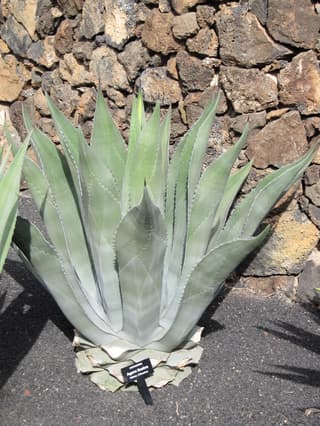
Rough Agave
Agave asperrima
Agave asperrima is a stemless, evergreen succulent native to the arid scrublands of southern Texas and central-northern Mexico. It forms a dense rosette of 30-40 broad, gray-green leaves edged with sharp marginal teeth and tipped with a stout terminal spine, reaching roughly 1 meter tall and up to 2 meters across. After 7 to 15 or more years of slow growth, a mature rosette sends up a tall flowering stalk 4-7 meters high bearing yellow blooms, then dies - but not before producing offsets (pups) around its base that carry the plant forward. In its native Mexico it is a traditional source for mezcal-style spirits distilled from the roasted, fermented core.
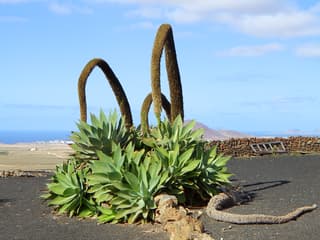
Foxtail Agave
Agave attenuata
Agave attenuata is a sculptural perennial succulent, famous for its rosettes of wide, soft, light-green leaves that lack the sharp spines typical of other agaves. Native to Mexico, it develops a thick trunk and, when mature, produces a long, curved inflorescence resembling a swan's neck, which gives it one of its common names.
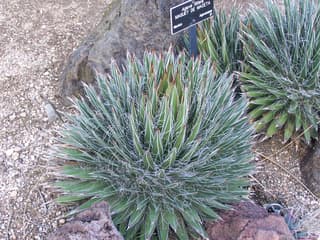
Thread-leaf Agave
Agave filifera
Agave filifera is a compact, slow-growing succulent native to central Mexico, prized for the distinctive white threads or filaments that curl away from the edges of its dark green leaves. It forms a tight, symmetrical rosette and is an excellent choice for sunny gardens, rock gardens, or bright indoor spaces. Highly drought-tolerant and low-maintenance.
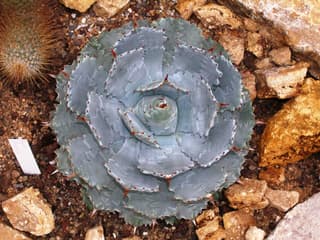
Dwarf Butterfly Agave
Agave isthmensis
Agave isthmensis is a dwarf agave endemic to the Isthmus of Tehuantepec, on the southern coast of Oaxaca and Chiapas in Mexico, where it grows among rocks from near sea level to about 875 m. It forms compact rosettes 12-30 cm across, with short, broad, powdery blue-grey leaves edged with dark reddish to black teeth and tipped with a black spine 3-4 cm long. For a long time it was confused with Agave potatorum, which grows alongside it, until it was described as a separate species in the 1990s for its smaller size and flowers. It flowers only once, in summer, on a 1.5-2 m stalk of yellow flowers flushed red, and then the rosette dies, usually after producing plenty of pups.

Parry's agave
Agave parryi
Agave parryi, Parry's agave, is a hardy rosette-forming succulent native to the southwestern United States and Mexico. It makes a compact, symmetrical rosette of blue-grey leaves tipped with dark spines and is prized in dry gardens for its exceptional cold tolerance.
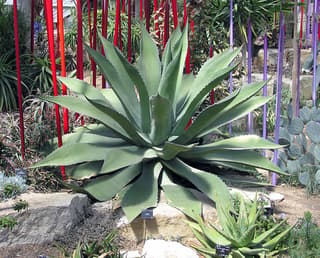
Butterfly Agave
Agave potatorum
Agave potatorum, commonly known as Butterfly Agave or Tobala, is a compact rosette succulent native to the highlands of Oaxaca and Puebla, Mexico. Slow-growing and small in stature, its gray-green leaves with terminal spines form an elegant rosette up to 1.2 m tall and 1.5 m wide. It is monocarpic — flowering only once in its lifetime, producing a towering 4–6 m flower spike, then dying and leaving offsets as its legacy.
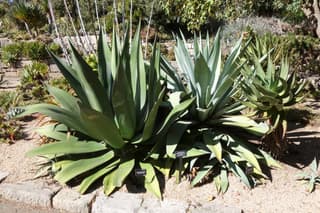
Pulque Agave
Agave salmiana
Agave salmiana, commonly known as Pulque Agave or Giant Agave, is one of the largest and most impressive agaves native to central Mexico. Its massive succulent leaves can reach up to 2 meters in length, armed with sharp spines. This species is the primary source of aguamiel (sap) used to produce pulque, a fermented beverage consumed in Mexico for thousands of years. It is monocarpic — flowering only once after 15–25 years, producing a spectacular flowering stalk up to 12 meters tall.
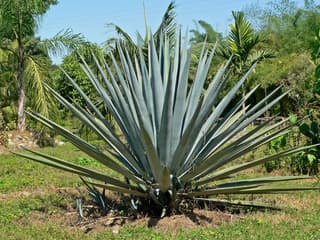
Blue Agave
Agave tequilana
Agave tequilana, commonly known as Blue Agave, is a striking succulent native to the highlands of Jalisco, Mexico. Its thick, blue-gray leaves form a dramatic rosette that can reach up to 2.4 m across, tipped with sharp spines along the margins and tip. Best known as the sole legal source of tequila, this drought-tolerant succulent grows slowly for years before sending up a towering flower stalk once in its lifetime, then setting offsets (pups) at its base to continue the cycle.
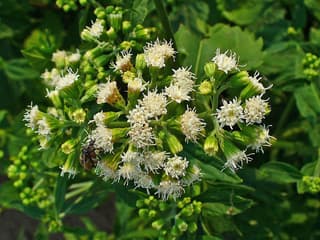
white snakeroot
Ageratina altissima
White snakeroot is a shade-tolerant, clump-forming herbaceous perennial native to woodlands and forest edges across eastern North America. It grows two to five feet tall on smooth, branching stems with opposite, heart-shaped, coarsely toothed leaves, and from late summer into fall it produces flat-topped clusters of small, fluffy white flowers that draw bees, butterflies, and other pollinators. Every part of the plant contains the toxin tremetol, making it dangerous to livestock, pets, and people if ingested.
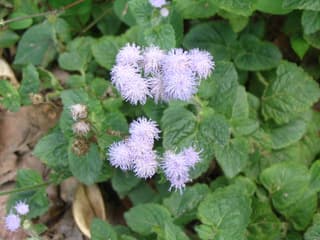
Billygoat Weed
Ageratum conyzoides
Billygoat weed (Ageratum conyzoides) is a fast-growing annual herb in the daisy family (Asteraceae), native to tropical America and now naturalized throughout tropical and subtropical regions worldwide. It has softly hairy stems and oval, serrated leaves with a distinctive musky scent when crushed. Small blue-lavender to white flower heads cluster in terminal clusters, attracting bees and butterflies. Common in gardens, roadsides, and disturbed ground, it is regarded by many growers as a weed but is also widely valued in traditional medicine.
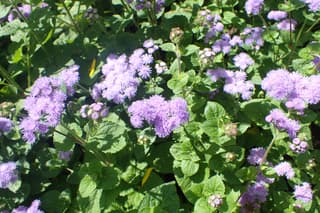
Floss Flower
Ageratum houstonianum
Ageratum houstonianum, commonly known as Floss Flower, is a frost-tender annual native to Central America (Guatemala, Belize, and adjacent Mexico), prized for its dense, fluffy, pom-pom-like flower clusters in shades of blue, purple, pink, and white. Growing 15–90 cm tall, it features soft, ovate to triangular, slightly hairy leaves and blooms continuously from late spring until frost. A favorite in summer bedding, borders, and containers, it reliably attracts butterflies and other pollinators throughout its long flowering season.
Anyamanee Chinese Evergreen
Aglaonema 'Anyamanee'
Aglaonema 'Anyamanee' is a hybrid Chinese evergreen bred in Thailand, part of the Aglaonema rotundum breeding line that produced the red and pink aglaonemas. It forms a compact, upright clump of broad, glossy leaves in reddish pink to magenta, edged and blotched dark green, on pale stalks. A slow-growing houseplant in the arum family (Araceae), it is grown for its colorful foliage.
Easy Care Easy Care
Our selection of 2752 easy easy care combines the characteristics of this category with reduced care needs. Perfect for beginners who love this category.
Why Choose Easy Easy Care?
Combining the beauty of easy care with easy difficulty level lets you enjoy this category without excessive maintenance worries. Each plant was selected to offer the best characteristics of the category at the care level you are looking for.