1161 Medium Easy Care | 2026 Guide - Page 12
Find 1161 medium easy care. Complete guide for your garden.
1161 Easy Care with medium level
Showing 397-432 of 1161

Elephant's Foot
Dioscorea elephantipes
Elephant's Foot (Dioscorea elephantipes) is a slow-growing caudiciform from South Africa, prized for its huge, corky, cracked caudex that resembles an elephant's foot or a tortoise shell. From the caudex, slender twining vines with heart-shaped leaves emerge in the growing season and die back during dormancy. It is a long-lived collector's succulent that can live for decades.
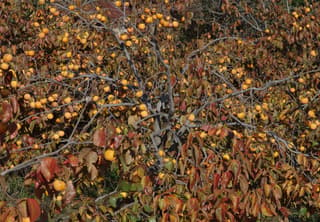
Japanese Persimmon
Diospyros kaki
The Japanese persimmon (Diospyros kaki) is a deciduous fruit tree native to China and Japan, widely cultivated across temperate regions worldwide. Belonging to the family Ebenaceae, it can grow up to 9 meters tall and is prized for its spectacular autumn foliage in shades of gold, orange, red and burgundy, as well as its glossy orange-red fruits that cling to the bare branches well into winter. The persimmon fruit, with its honeyed, floral flavor reminiscent of mango and apricot, is one of the oldest cultivated fruits in East Asia, with records of its cultivation dating back over 2,000 years.

Mandevilla
Dipladenia sanderi
Mandevilla (Dipladenia sanderi, synonym Mandevilla sanderi) is an ornamental climbing vine from the Apocynaceae family, native to Brazil. It is widely cultivated in pots, trellises, and planters for its showy trumpet-shaped flowers, which bloom abundantly from spring to fall in shades of pink, red, white, or yellow. Its leaves are dark green, glossy, and slightly leathery in texture. It is a vigorous, fast-growing plant when well-cared for, frequently used to cover fences, pergolas, and trellises in warm climates.
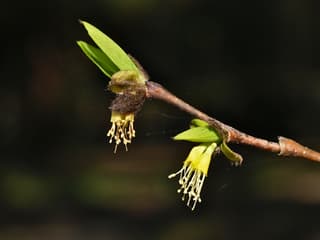
Eastern Leatherwood
Dirca palustris
Dirca palustris, commonly known as Eastern Leatherwood, is a slow-growing native deciduous shrub of eastern North America. It reaches about 6 feet tall and wide, producing delicate pale yellow bell-shaped flowers in early spring before leaf emergence. Its bark is extraordinarily pliable and strong, historically used by Native Americans for rope, baskets, and bowstrings.
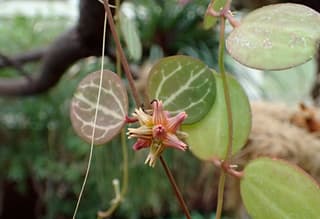
Watermelon Dischidia
Dischidia ovata
Dischidia ovata is a charming epiphytic vine native to New Guinea and Queensland, Australia, known for its small fleshy leaves patterned like watermelon rind. It thrives in bright indirect light with excellent drainage.
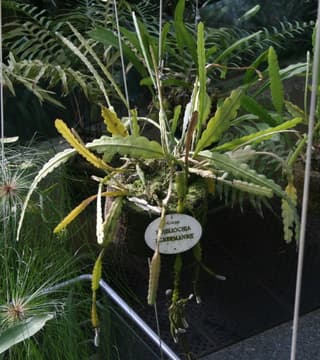
Orchid Cactus
Disocactus
Disocactus is a genus of epiphytic cacti native to the tropical forests of Mexico and Central America, prized for their flattened, leaf-like stems and spectacular funnel-shaped flowers in shades of red, pink, and white. Unlike desert cacti, Disocactus species grow on trees in humid, shaded environments, making them a striking choice for hanging baskets indoors.
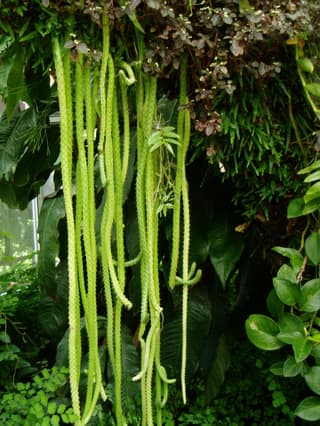
Rat Tail Cactus
Disocactus flagelliformis
Disocactus flagelliformis, commonly known as the Rat Tail Cactus, is an epiphytic cactus native to Mexico. Its long, trailing cylindrical stems can reach up to 2 meters in length and are covered in fine spines. It is prized for its spectacular magenta to bright red flowers that bloom in spring, making it a popular choice for hanging baskets.
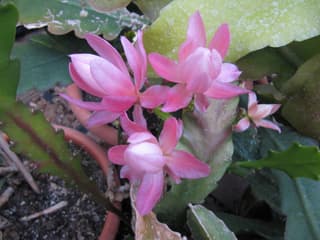
German Empress
Disocactus phyllanthoides
Disocactus phyllanthoides, commonly called the German Empress, is an epiphytic cactus native to the cloud forests of Puebla and Veracruz, Mexico. It has flattened, leaf-like stems and produces funnel-shaped rose-pink flowers in late winter to spring. Unlike desert cacti, it thrives in filtered shade and moderate humidity, often growing on trees or rocks in its native habitat.
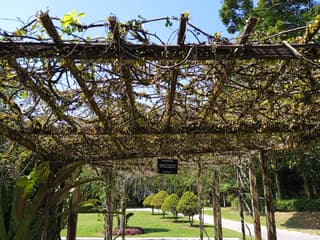
Cat's Claw Vine
Dolichandra unguis-cati
Dolichandra unguis-cati, popularly known as Cat's Claw Vine, is an extremely vigorous woody climber native to the Americas. It is famous for its three-pronged tendrils that resemble cat claws, allowing the plant to easily scale walls, trees, and rocks. During spring, it produces a spectacular display of yellow trumpet-shaped flowers.
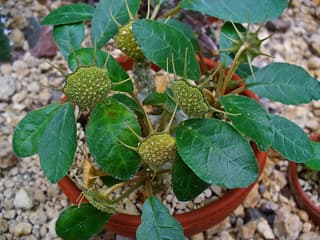
Shield Flower
Dorstenia
Dorstenia is a captivating genus of caudiciform succulents in the Moraceae family — the same family as figs and breadfruit. Native to arid regions of East Africa and the Arabian Peninsula, including Ethiopia, Somalia, Kenya, Tanzania, Saudi Arabia, Yemen, and Oman, it is prized by collectors for its swollen water-storing caudex and uniquely bizarre hypanthodium inflorescences — flat, disc- or shield-shaped structures that serve as composite flower heads. Despite its exotic appearance, Dorstenia is relatively easy to grow indoors when given bright light and well-draining soil.
Lemon Lime Corn Plant
Dracaena fragrans 'Lemon Lime'
Tropical houseplant with distinctive lime-yellow and green striped foliage. Slow-growing, upright shrub with glossy lance-shaped leaves and fragrant seasonal flowers. Popular ornamental valued for low-maintenance care and air-purifying properties.
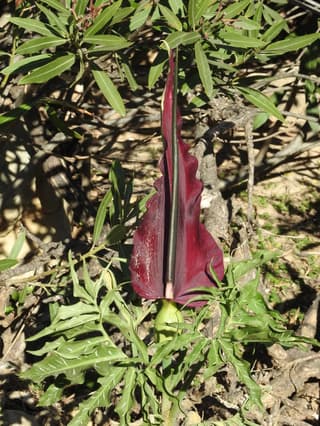
Dragon Lily
Dracunculus vulgaris
Dracunculus vulgaris, commonly known as Dragon Lily or Voodoo Lily, is a spectacular bulbous plant native to the Balkans and eastern Mediterranean. Its purple-spotted stems support a dramatic dark maroon spathe up to 50 cm long surrounding a near-black spadix. The plant emits a powerful rotting-flesh odor during bloom to attract fly and beetle pollinators. All parts contain calcium oxalate crystals and are toxic to humans, cats, and dogs.

Sea Squill
Drimia maritima
Sea Squill (Drimia maritima) is a large Mediterranean bulb that survives hot, dry summers dormant underground. In autumn it sends up a dramatic spike, up to 2 m tall, packed with small white star-shaped flowers, before a rosette of broad green leaves appears through winter and spring. The huge bulb can weigh around a kilogram. All parts are highly poisonous - the source of the rodenticide scilliroside.
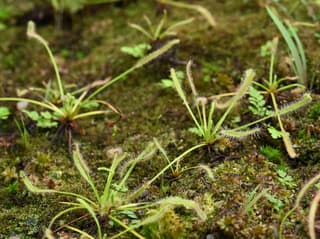
Sundew (genus)
Drosera
Drosera, commonly known as sundews, is one of the largest genera of carnivorous plants, with over 190 species found on every continent except Antarctica. They trap insects using sticky, glistening tentacles tipped with mucilaginous glands that resemble dewdrops in sunlight.
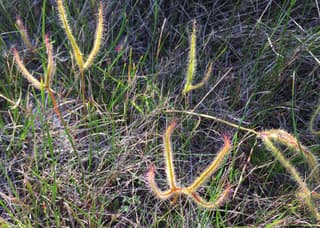
Fork-leaved Sundew
Drosera binata
Drosera binata, known as the fork-leaved or forked sundew, is a carnivorous perennial in the family Droseraceae, native to boggy heathlands and wetlands of southeastern Australia and New Zealand. Its narrow leaves repeatedly split into Y- or fork-shaped segments, each covered in red glandular hairs that secrete glistening, sticky mucilage to trap and digest small insects. In spring and summer it sends up tall flower stalks topped with clusters of small white blooms, held well above the sticky foliage so pollinators are not caught.
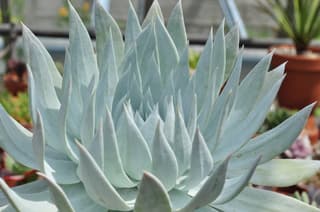
Liveforever
Dudleya
Dudleya is a genus of rosette-forming succulents native to the coastal bluffs, cliffs, and rocky outcrops of California, Arizona, Baja California, and Guadalupe Island. Often called liveforevers for their remarkable longevity, the roughly 70 species and countless cultivars share a striking feature: a powdery white coating called farina that covers the leaves like natural sunscreen, protecting the plant from intense coastal sun and reducing water loss. Species such as D. brittonii and D. pulverulenta form dramatic silver-white rosettes up to 30-50 cm across, sometimes held on short woody stems. Unlike many other succulents, Dudleya cannot be propagated from a single leaf; plants grow from offsets, division, or seed. Their most distinctive habit is summer dormancy: in their native Mediterranean climate, Dudleya grow actively through the cool, wet winter and spring, then rest through the hot, dry summer, when they should receive little to no water. Handling the leaves removes the farina permanently, leaving unsightly marks and exposing tissue to sunburn, so these plants are best admired without touching.
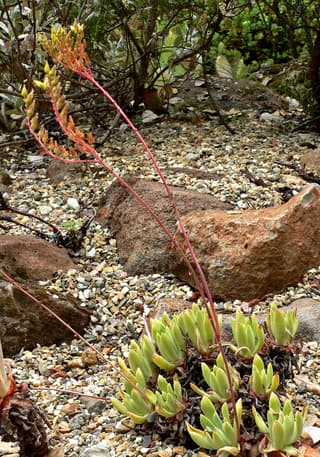
Greene's Liveforever
Dudleya greenei
Dudleya greenei, commonly known as Greene's Liveforever or Greene's Dudleya, is a rare succulent endemic to the Channel Islands of California. It forms striking silvery-white powdery rosettes that grow close to the ground, giving it the nickname "chalk lettuce." This slow-growing evergreen is threatened in the wild due to habitat loss and illegal collection, making it a protected species. Its fleshy, glaucous leaves are coated in a natural white powder (farina) that reflects harsh sunlight and helps retain moisture.

Chalk Dudleya
Dudleya pulverulenta
Chalk Dudleya (Dudleya pulverulenta) is a striking rosette succulent native to Southern California and Baja California. Its broad silvery-white leaves are coated in a chalky wax (farina) that reflects intense sun, and in spring tall arching red stalks carry tubular red-to-yellow flowers loved by hummingbirds. Rosettes can reach 30 cm or more across.
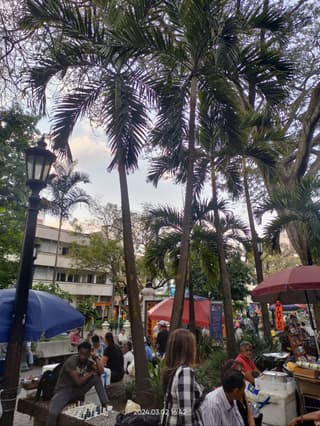
Dypsis Palm
Dypsis
Dypsis is a large genus of feather palms native almost entirely to Madagascar, comprising more than 150 species that range from small understory clustering palms to towering forest giants. The best-known member, Dypsis lutescens (the areca palm), is one of the world's most popular houseplants thanks to its graceful, arching, multi-caned fronds and easygoing nature indoors. As a genus, Dypsis palms share a preference for warm, humid, well-lit conditions reminiscent of their tropical Madagascan origins.
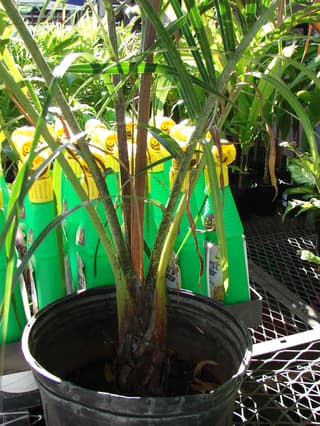
Triangle Palm
Dypsis decaryi
Dypsis decaryi, the Triangle Palm, is a striking palm endemic to southern Madagascar. Its leaves emerge from three distinct sides of the trunk, creating a perfect triangular silhouette that makes it one of the most architecturally distinctive palms in the world.
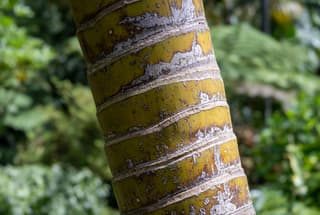
Areca Palm
Dypsis lutescens
Dypsis lutescens, commonly known as Areca Palm or Butterfly Palm, is a palm species native to Madagascar. It features multiple golden-yellow stems resembling bamboo and elegant bright green fronds with feather-like leaflets. It is one of the most popular indoor plants due to its tropical beauty and proven air-purifying capabilities, listed in the NASA Clean Air Study as effective in removing formaldehyde, xylene, and toluene from indoor air.
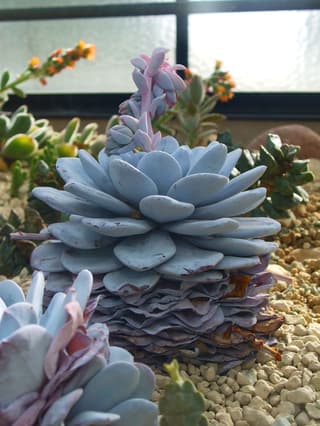
Lau's Echeveria
Echeveria laui
Echeveria laui is a slow-growing succulent native to Oaxaca, Mexico, prized for its compact rosettes covered in a thick, powdery blue-white farina that gives the leaves a frosted, icing-sugar appearance. The plump, spoon-shaped leaves form a tight rosette rarely taller than a few centimeters, and mature plants produce coral-pink, bell-shaped flowers on tall stalks in summer.
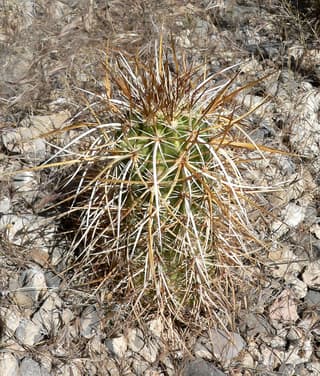
Engelmann's Hedgehog Cactus
Echinocereus engelmannii
Echinocereus engelmannii is a clustering cylindrical cactus native to the deserts of the southwestern United States and northern Mexico, prized for its dense, colorful spines and vivid magenta-to-pink funnel-shaped flowers that bloom in spring.
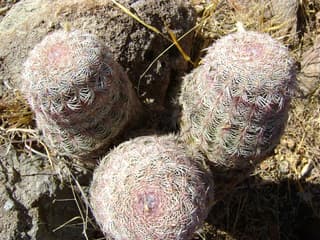
Rainbow Hedgehog Cactus
Echinocereus pectinatus
Echinocereus pectinatus is a small, solitary, cylindrical cactus native to the Chihuahuan Desert of northern Mexico and the Trans-Pecos region of Texas. Its ribs are lined with dense, comb-like spines banded in white and pink, giving rise to its common name. In late spring, it produces large, funnel-shaped magenta flowers that open in daylight and last several days.
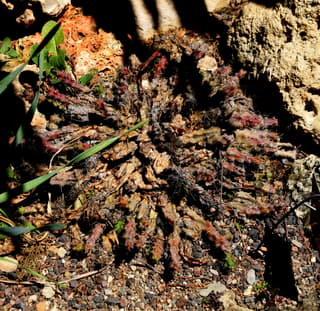
Ladyfinger Cactus
Echinocereus pentalophus
Echinocereus pentalophus, known as the ladyfinger cactus, is a low-growing, clustering cactus native to southern Texas and northeastern Mexico. Its slender, finger-like stems trail and branch to form dense mats up to a meter wide, and in late spring the plant produces large, funnel-shaped flowers in vivid pink to magenta with a pale throat that can nearly cover the entire clump for a brief but spectacular bloom.
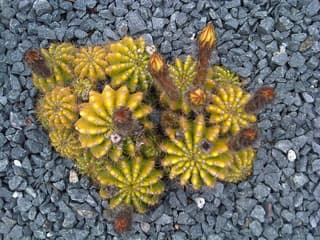
Green Ball Cactus
Echinopsis calochlora
The Green Ball Cactus (Echinopsis calochlora) is a small globose clustering cactus native to Brazil and Paraguay. Over time it forms dense clumps of bright green spheres adorned with spines, and produces large, fragrant white flowers that open at night during spring and summer.
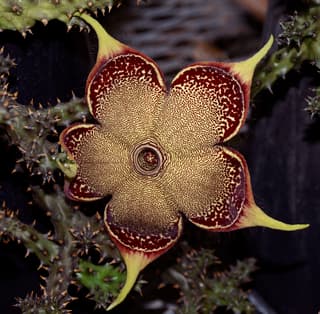
Persian Carpet Flower
Edithcolea grandis
Edithcolea grandis, known as the Persian Carpet Flower, is an extraordinary creeping succulent native to the arid regions of East Africa. Its stems are branched, spiny, and range in color from grayish-green to brown. The highlight of this species is its magnificent flowers, which can reach up to 13 cm in diameter, displaying complex geometric patterns and vibrant colors reminiscent of a Persian carpet weave. It is a highly sought-after plant for collectors but requires precise care due to its sensitivity to overwatering.
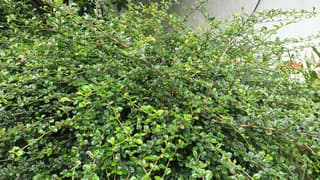
Fukien tea tree
Ehretia microphylla
The Fukien tea tree (Ehretia microphylla, synonym Carmona retusa) is an evergreen shrub in the borage family (Boraginaceae), native to South and Southeast Asia, ranging from India through China and Japan to northern Australia. Its small, shiny, dark green, and rough-textured leaves are 1.5–4 cm long; it produces tiny, star-shaped white flowers year-round, followed by reddish-orange, pea-sized berries. In nature, it can grow up to 4 meters tall, but due to its branching habit and trunk that thickens over time, it has become one of the most popular indoor bonsai species in Western bonsai culture—its name refers to the Fujian (formerly Fukien) province of China, from where it entered the bonsai trade. In the Philippines, a decoction made from its leaves was traditionally used to treat coughs, diarrhea, and stomach complaints.
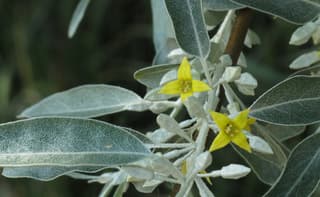
Russian Olive
Elaeagnus angustifolia
Elaeagnus angustifolia, commonly known as Russian Olive or Oleaster, is a deciduous tree or large shrub native to Western Asia and Southeast Europe. It is prized for its striking silvery-gray foliage, fragrant creamy-yellow flowers and small edible olive-like fruits. Exceptionally hardy, it tolerates extreme cold, drought, poor soils, and saline conditions. It is widely used in windbreaks, shelterbelts, and ornamental landscaping. Note: it is considered invasive in many regions, particularly across the western United States.
goosegrass
Eleusine indica
A small annual grass widely distributed in warm regions worldwide to approximately 50 degrees latitude. Characterized by rapid growth, forming dense tufts reaching 15-90 cm tall. Leaf blades are linear-lanceolate, 5-30 cm long, mostly glabrous and keeled with a distinctive white or silvery base. Develops a particularly tough and fibrous root system resistant to removal. Seeds are small, black to brown in color, produced abundantly—up to 120,000 per plant—and easily dispersed by wind and water. Requires full sunlight and cannot tolerate shade, preferring well-drained soil. Performs C4 photosynthesis, enabling growth in hot climates. Flowering occurs July to August with greenish-yellow flowers; seeds mature August to October. Found in disturbed areas, grasslands, and cultivated fields.
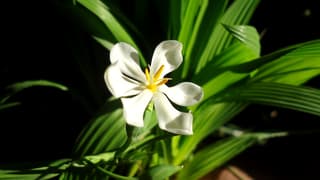
Tears of the Virgin
Eleutherine bulbosa
The Tears of the Virgin (Eleutherine bulbosa, syn. Eleutherine plicata) is a stemless, bulbous, and rhizomatous herb native to the Amazon and widely distributed from southern Mexico to tropical South America. It forms clumps 20 to 30 cm tall, featuring reddish-scaled bulbs similar to red onions, simple lanceolate leaves with longitudinal pleats, and star-shaped white or pinkish flowers that open at dusk. It is one of the most traditional medicinal plants of Amazonian indigenous peoples, with bulbs rich in naphthoquinones, anthraquinones, and flavonoids.
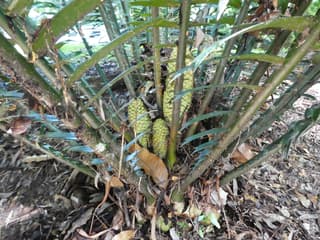
Bread Palm
Encephalartos
Encephalartos is a genus of African cycads commonly called "bread palms," a name derived from the starchy stem pith historically processed into a bread-like food by indigenous peoples of southern and eastern Africa. Despite the common name, they are not true palms but ancient gymnosperms — living fossils that predate the dinosaurs. They form a rosette of stiff, pinnate leaves, sometimes blue-tinted or heavily armed with spines, atop a thick woody stem or trunk. Plants are dioecious, producing large male and female cones. Growth is extremely slow, and individuals can live for centuries. Nearly all species are listed on CITES Appendix I due to severe poaching pressure.

Fragrant Encyclia
Encyclia fragrans
The Fragrant Encyclia (Encyclia fragrans, syn. Prosthechea fragrans) is a sympodial epiphytic orchid native to tropical forests and cloud forests of Mexico, Central America, the Caribbean (Jamaica, Puerto Rico), and northern South America (Brazil, Ecuador, Costa Rica). It forms compact oval pseudobulbs, each with a single leathery, upright leaf, and produces stems with fragrant greenish-white to cream flowers, featuring a white lip streaked with purple stripes. The flowers exude a sweet aroma reminiscent of honey and vanilla, which is most intense at night.
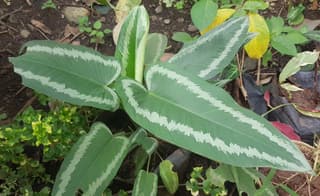
Engler's False Arum
Englerarum hypnosum
Englerarum hypnosum is a rare monotypic tropical aroid native to limestone karst forests of Southwest China, Laos, and Thailand. Formerly classified under Alocasia, it was segregated into its own genus Englerarum following molecular phylogenetic studies. It grows as a lithophyte on humid limestone ledges at 800–1000 m elevation, spreading by rhizomes to form colonies. Its large, deep-green leaves with silvery-green patterning make it a striking ornamental houseplant.
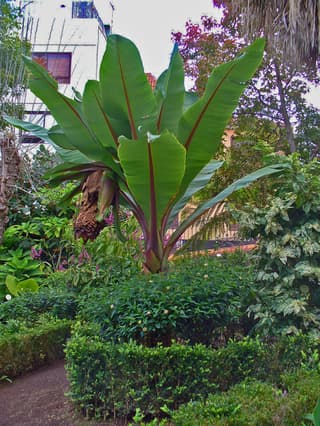
Abyssinian Banana
Ensete ventricosum
Ensete ventricosum, commonly known as the Abyssinian Banana or False Banana, is a dramatic tropical plant in the Musaceae family, native to the highlands of East Africa and Ethiopia. It produces enormous paddle-like leaves up to 6 metres long with a distinctive reddish midrib, making it one of the most striking specimen plants for large gardens and conservatories. Unlike true bananas, its fruits are inedible; instead, the pseudostem, corm, and inflorescence provide a fermented starch staple called kocho, feeding approximately 20 million Ethiopians for over 10,000 years.
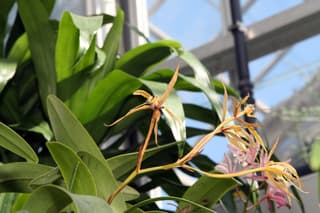
Fringed Star Orchid
Epidendrum ciliare
Epidendrum ciliare, commonly known as the Fringed Star Orchid, is a stunning epiphytic orchid native to Mexico, Central America, the Caribbean, and northern South America. It grows on trees and rocky outcrops in humid forests at elevations of 500–1000 metres. The plant produces elongated cylindrical pseudobulbs 10–20 cm long, topped with 1–2 glossy, oblong leaves. Its star-shaped flowers are renowned for their finely fringed white labellum and elegant greenish-yellow sepals and petals, blooming typically in winter. This long-cultivated species is a favourite among orchid enthusiasts for its dramatic, fragrant blooms and relative ease of care.
Medium Care Easy Care
Our selection of 1161 medium easy care combines the characteristics of this category with moderate care needs. Ideal for those with basic experience.
Why Choose Medium Easy Care?
Combining the beauty of easy care with medium difficulty level lets you enjoy this category with a balanced care commitment. Each plant was selected to offer the best characteristics of the category at the care level you are looking for.