Complete Plant Guide
Explore plants by difficulty, season and more. Find the perfect plant for you.
Difficulty
Categories
Plants by City
🗺️ Plants by City3994 plants found
Showing 181-216 of 3994
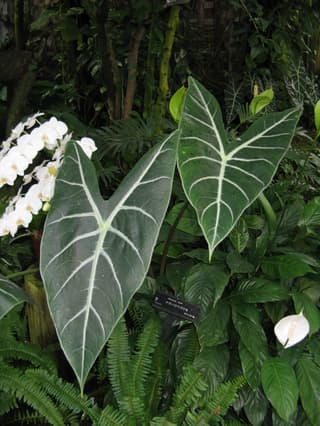
Alocasia lowii
Alocasia lowii
Alocasia lowii is an elephant ear with large, arrowhead-shaped leaves that are dark green on top, often with silvery or whitish veins, and light green or purple underneath. The leaf stalks are brown and mottled. Botanists now treat it as a synonym of Alocasia longiloba, a species of moist forests from southern China to Southeast Asia, but the houseplant trade still uses the name "lowii" for this form. In the wild it reaches 1.5 m; in a pot it usually stays around 60 to 70 cm with a few large leaves. Its flowers are a greenish to white spathe, followed by small orange fruits. It is one of the parents of the hybrid Alocasia × mortfontanensis.
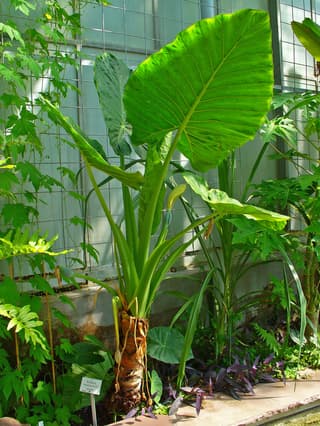
Giant Taro
Alocasia macrorrhizos
Alocasia macrorrhizos is a spectacular tropical perennial from Southeast Asia, prized for its enormous upright arrow-shaped leaves that can reach up to 1.5 meters in length. Known as Giant Elephant's Ear, this fast-growing plant makes a bold architectural statement both indoors and in tropical gardens. It belongs to the Araceae family and features thick, prominently veined, glossy green leaves on sturdy upright stems.
Rugose Alocasia
Alocasia melo
Alocasia melo, commonly called the rugose alocasia, is a compact jewel Alocasia endemic to the ultramafic slopes of Sabah, Malaysian Borneo. It forms a low rosette of thick, nearly circular leaves with a deeply bumpy, wrinkled surface that resembles the rind of a cantaloupe melon, giving the species its name. The upper leaf surface is a deep bluish-green while the underside is pale and smooth. Unlike many thin-leaved aroids, its stiff, rugged foliage resists tearing and physical damage, but the short, fleshy corm beneath the soil is highly sensitive to overwatering and cold, soggy conditions. Grown as a houseplant for its sculptural texture, it demands bright indirect light, high humidity, and a chunky, fast-draining aroid mix to thrive.
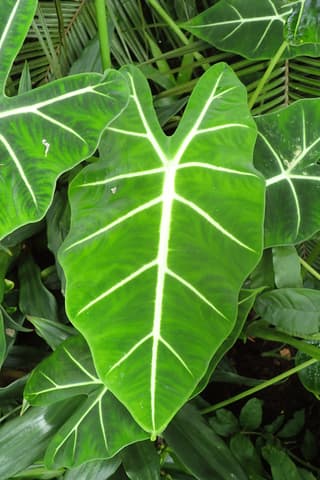
Green Velvet Alocasia
Alocasia micholitziana
Alocasia micholitziana, commonly known as the Green Velvet Alocasia or Frydek, is a striking tropical houseplant native to the Philippines. It is prized for its velvety dark green leaves with dramatically contrasting white veins and a deeply ribbed texture. A member of the Araceae family, it thrives as an indoor plant in warm, humid environments and can be a stunning focal point in any home.
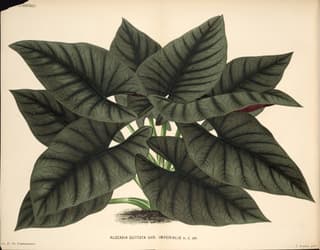
Alocasia Nebula
Alocasia nebula
Alocasia nebula is a highly coveted jewel aroid prized for its velvety, deeply corrugated leaves marked with silvery, cloud-like ('nebula') veining against a dark green backdrop. Part of the Alocasia longiloba complex from the tropical rainforests of Southeast Asia, it forms a compact clumping rosette from an underground corm, rarely exceeding 90 cm in cultivation. Its dramatic foliage and collector status make it a centerpiece for humidity-controlled terrariums and greenhouse cabinets.
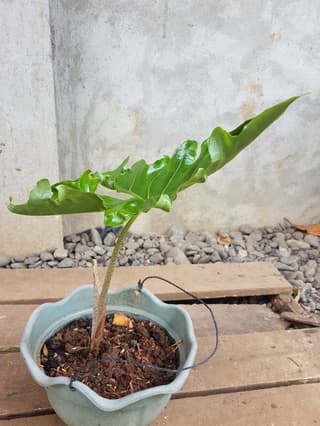
Batwing Alocasia
Alocasia nycteris
Alocasia nycteris, commonly called the Batwing Alocasia, is a rare aroid endemic to lowland forests of Panay Island in the Philippines. It is prized by collectors for its dark, glossy, arrow-shaped leaves whose rear lobes flare outward at nearly a right angle, evoking the outstretched wings of a bat. First displayed publicly in 2003 by Filipino hobbyist Antonio Advincula, it was formally described as a new species in 2007. In its native habitat it grows on rocky, shaded slopes and forest edges at very low elevation, and indoors it forms a wide, horizontal clump up to about 1.5 m tall.
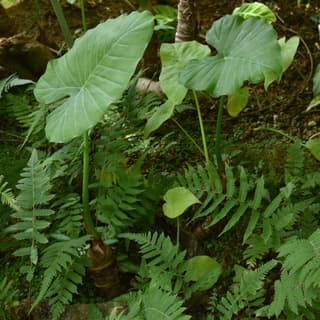
Night-Scented Lily
Alocasia odora
Alocasia odora, commonly known as the Night-Scented Lily or Asian Taro, is a striking tropical plant from the Araceae family, native to East and Southeast Asia. Its large arrow-shaped leaves can reach up to 60 cm in length, and the plant can grow to 2.4 meters tall. It produces fragrant cream-to-pale-peach flowers on a spadix during spring and summer, notably scented at night. WARNING: Toxic to humans, cats, and dogs when ingested raw due to calcium oxalate crystals.
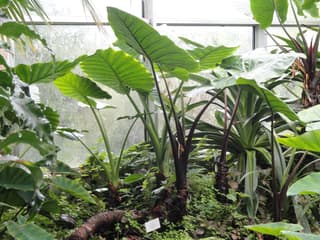
Black Metallic Taro
Alocasia plumbea
Alocasia plumbea, commonly known as the Black Metallic Taro, is a robust rhizomatous aroid native to tropical Southeast Asia. It is prized for its large, heart-shaped leaves with a striking metallic sheen ranging from olive-green to near-black purple, accented by contrasting veins and dark petioles. In cultivation it can reach up to 1.5 m (5 ft) tall. Its inflorescence -- a typical aroid spathe and spadix -- is inconspicuous and rarely appears indoors.
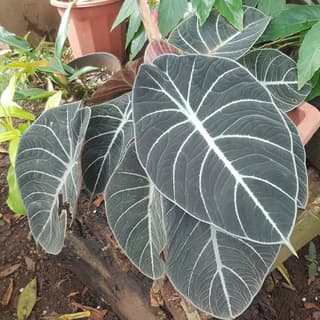
Black Velvet Alocasia
Alocasia reginula
Alocasia reginula, commonly known as Black Velvet Alocasia, is a striking compact tropical plant native to the rainforests of Borneo. It is prized for its deep, near-black velvety leaves adorned with contrasting silvery-white veins. Unlike larger Alocasia species, this jewel alocasia stays small and manageable, making it an ideal statement houseplant. Its thick, succulent-like rhizomes store water, giving it some drought tolerance but also making it highly susceptible to root rot if overwatered.
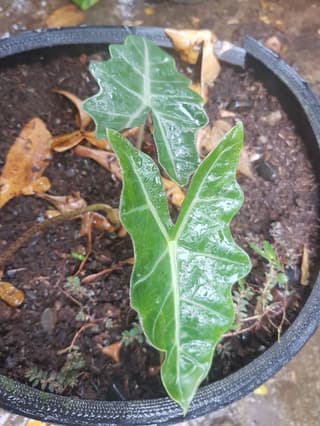
Kris Plant
Alocasia sanderiana
Alocasia sanderiana, commonly known as the Kris Plant or Sander's Alocasia, is a stunning tropical foliage plant native to the Philippines. It features dramatic arrow-shaped dark green leaves with silvery-white veins and wavy, serrated edges that resemble the blade of a Kris dagger — hence its popular name. Critically endangered in its natural rainforest habitat, it is prized as a collector's houseplant worldwide.
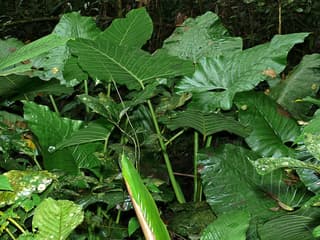
Yucatan Princess
Alocasia sarawakensis
Alocasia sarawakensis, popularly sold as 'Yucatan Princess', is a large tropical aroid from the swamp forests of Borneo. It forms a dramatic clump of glossy, arrow-shaped, dark green leaves with wavy edges and reddish-purple undersides, rising from sturdy reddish-brown stems. In the wild it can reach up to 2.4 m (8 ft) tall, though potted specimens usually stay more compact.
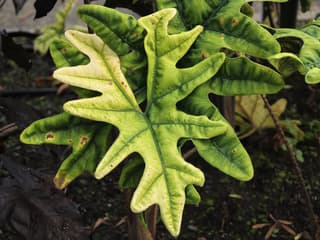
Alocasia Jacklyn
Alocasia tandurusa
Alocasia Jacklyn (Alocasia tandurusa) is a rare and spectacular tropical plant native to the humid rainforests of Sulawesi, Indonesia. Its enormous arrow-shaped leaves with prominent venation and deep green coloration make it one of the most sought-after alocasias among plant collectors worldwide. When grown indoors, it can reach up to 4 feet in height, becoming a stunning focal point in any space.
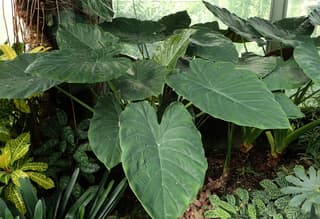
New Guinea Shield
Alocasia wentii
Alocasia wentii, commonly called the New Guinea Shield or Hardy Elephant Ear, is a robust aroid prized for its large, glossy, arrow-shaped leaves with a bronze-green sheen and dark purple undersides. Native to the highlands of New Guinea, most plants sold under this name in the houseplant trade are believed to be vigorous hybrids rather than the true wild species. It forms a dense clump of upright leaves on sturdy petioles and tolerates a wider range of indoor conditions than many other Alocasia varieties.
Zebra Plant
Alocasia zebrina
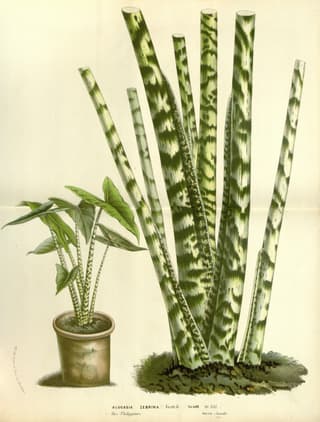
Alocasia zebrina is a striking tropical plant native to the Philippines, famous for its distinctive zebra-striped petioles (stems) that give it its common name. The plant features large, arrow-shaped green leaves held aloft on tall, dramatically patterned stems with dark green and cream-colored stripes. Unlike many Alocasias grown for their leaf patterns, A. zebrina is prized primarily for its unique stem markings. In its native habitat, it grows as an understory plant in tropical rainforests.
Aloe
Aloe
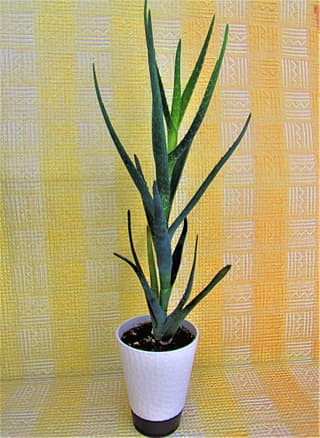
Aloe is a genus of over 500 species of succulent flowering plants native primarily to Africa, Madagascar, and the Indian Ocean islands. These robust plants form rosettes of thick, fleshy, water-storing leaves often with serrated margins. They are widely cultivated worldwide as ornamental and medicinal plants.
Krantz Aloe
Aloe arborescens
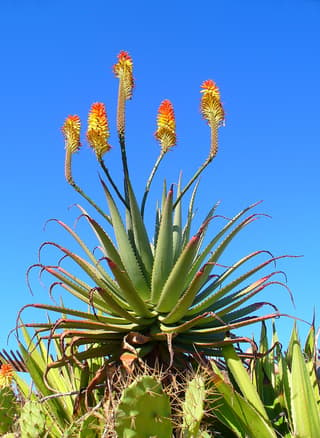
Aloe arborescens, commonly known as Krantz Aloe or Candelabra Aloe, is a large succulent shrub native to South Africa. It forms dense clumps of blue-green leaves arranged in rosettes, with edges serrated by small teeth. In winter, it produces spectacular flower spikes with tubular orange or red flowers that are extremely rich in nectar, attracting various pollinators such as hummingbirds.
Short-Leaved Aloe
Aloe brevifolia
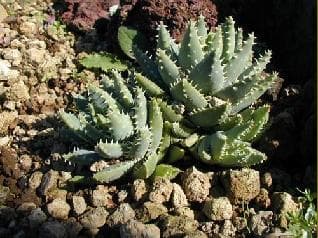
Aloe brevifolia is a compact, clump-forming succulent native to the Western Cape of South Africa. It forms dense rosettes of short, broadly triangular, blue-green fleshy leaves edged with soft white teeth. In late spring, mature clumps send up tall spikes topped with tubular orange-red flowers that attract pollinators. Slow-growing and drought tolerant, it is a popular choice for rock gardens, succulent borders, and container displays.
Jewelled Aloe
Aloe distans
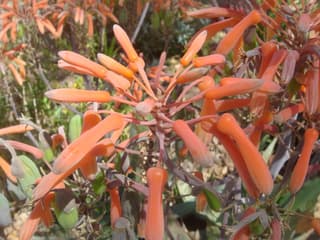
Aloe distans is a creeping, evergreen succulent from the West Coast of South Africa. Its sprawling stems carry tight rosettes of blue-green, toothed leaves that blush reddish in sun and drought. In summer and autumn it bears dense clusters of dull scarlet flowers on tall stalks. It makes a tough ground cover or container plant.
Bitter Aloe
Aloe ferox
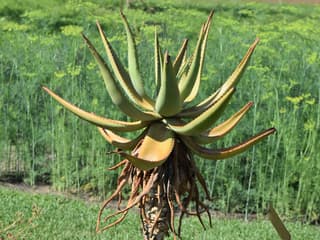
Aloe ferox, commonly known as bitter aloe or Cape aloe, is a tree-like succulent native to South Africa, forming a single rosette of spiny, grey-green leaves atop an unbranched stem that can reach up to 3 meters tall. It is renowned for its tall flower spikes bearing tubular orange-red blooms in winter, which attract sunbirds and bees.

Haworthia-leaved Aloe
Aloe haworthioides
Aloe haworthioides is a miniature succulent endemic to the central highlands of Madagascar, where it grows nestled in quartz rock crevices. It forms compact and prolific rosettes 3 to 5 cm in diameter that cluster into dense mats, featuring dark green lanceolate leaves covered in soft white spines and pustules that give it an appearance similar to the Haworthia genus (hence its name). In late summer and fall, it produces striking, fragrant, tubular flowers ranging from orange to pale pink on tall, slender stalks up to 30 cm. It is a slow-growing species, reaching barely 10 cm in height in cultivation, and is listed in CITES Appendix I due to its conservation status.
Spider Aloe
Aloe humilis
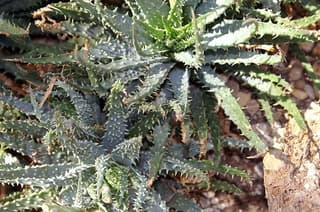
Aloe humilis, the spider aloe, is a small clumping succulent from South Africa forming tight rosettes of blue-green, upcurved leaves edged with soft white teeth. In late winter and spring it sends up tall stalks of tubular orange to coral-red flowers loved by pollinators.
Tiger Tooth Aloe
Aloe juvenna
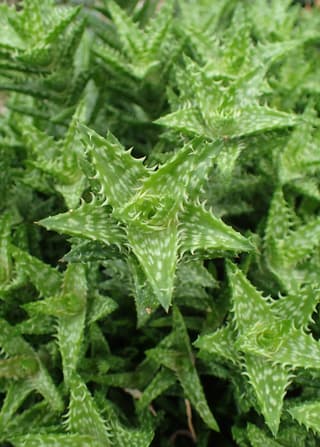
Aloe juvenna, popularly known as Tiger Tooth Aloe, is a charming succulent native to Kenya. It grows in compact, stacked rosettes with short, triangular, vibrant green leaves speckled with white spots. Its margins are adorned with small, harmless white teeth that resemble a tiger's jaw. When exposed to intense sunlight, the plant can develop a very attractive bronze or reddish hue.
Soap Aloe
Aloe maculata
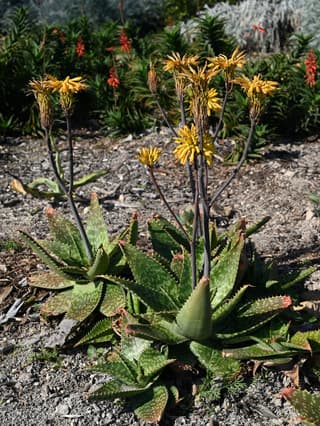
Aloe maculata, commonly known as Soap Aloe or Zebra Aloe, is a drought-tolerant succulent native to South Africa. It forms rosettes of fleshy, green leaves marked with distinctive white spots in irregular transverse rows. In late winter and spring, it produces striking coral-orange tubular flowers on branched stalks, attracting birds and pollinators. It is virtually disease-free and thrives in hot, dry conditions.
Massawa Aloe
Aloe massawana
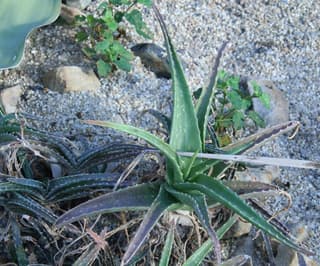
Aloe massawana, commonly known as the Massawa Aloe, is a stemless to short-stemmed succulent native to coastal East Africa — southern Kenya, northern Tanzania, Mozambique, and Eritrea. It suckers freely to form dense clumps that can spread up to 3 meters (10 ft) across in the wild. Its thick, gray-green rosette leaves, edged with small teeth, store water to endure long dry seasons, and it sends up flower spikes with tubular red-orange blooms, typically in fall.
Mitre Aloe
Aloe mitriformis
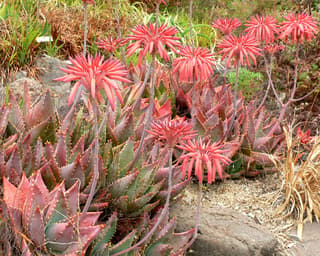
Mitre Aloe is a succulent plant from the Asphodelaceae family, native to the mountainous regions of the Western and Northern Cape in South Africa, where it grows among sandstone rocks at altitudes of 1200 – 1500 m. It forms creeping stems up to 2 m long, at the ends of which are dense rosettes of fleshy, grayish-green leaves with sharp teeth along the edges. In summer, branched flower stalks with dense clusters of dark red to bright red flowers emerge from the plant. It is a low-maintenance, fast-growing, and resilient plant that can survive long periods without watering and even mild frosts.
Mitre Aloe
Aloe perfoliata
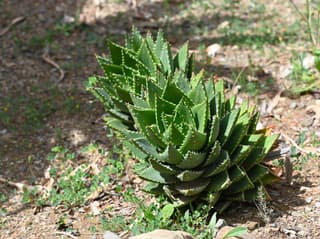
Aloe perfoliata, commonly known as Mitre Aloe, is a low-growing, mat-forming succulent native to the arid rocky slopes of South Africa. Its thick, blue-green leaves are edged with sharp white teeth and often flushed with red or pink under stress from sun or drought. In summer, tall flower spikes emerge bearing clusters of tubular red or orange blooms that attract sunbirds and bees. This tough, drought-tolerant aloe is prized by succulent collectors for its architectural form and minimal care requirements.
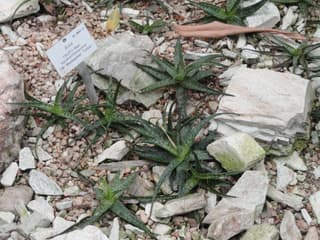
Snowflake Aloe
Aloe rauhii
Aloe rauhii is a miniature succulent endemic to Madagascar, forming compact rosettes up to 15 cm tall. Its grey-green leaves feature white oval spots and tiny white marginal teeth resembling snowflakes. Under strong sun, foliage flushes purplish or bronze. It produces bloom stalks with tubular pink-scarlet flowers, mainly in winter and spring.
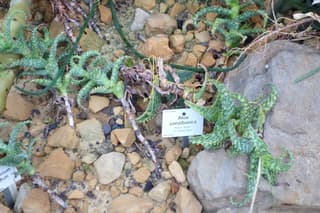
Zanzibar Aloe
Aloe squarrosa
Aloe squarrosa is a small, slow-growing succulent endemic to the island of Socotra, Yemen. It forms dense rosettes of narrow, recurved leaves covered in soft white teeth along the margins, giving it a distinctive tiger-tooth appearance. Rare in cultivation, it is prized by succulent collectors for its compact size and striking silhouette.
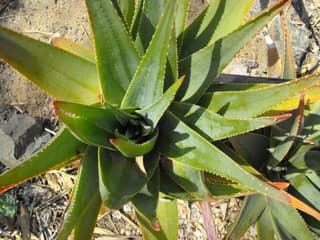
Fynbos Aloe
Aloe succotrina
Aloe succotrina is a clump-forming succulent shrub native to the rocky, quartzitic sandstone slopes of South Africa's Cape Fold Mountains, from the Cape Peninsula to Hermanus. Stiff grey-green leaves form dense rosettes, with older outer leaves turning a distinctive purplish hue — a key identification trait. In winter it produces striking spikes of dark orange-red, green-tipped tubular flowers that attract sunbirds. Reaching up to 1.5 m tall, it thrives in full sun to semi-shade and well-drained sandy soil, tolerating drought but not frost or waterlogged roots.
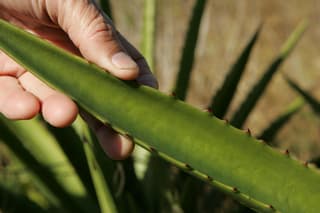
Aloe Vera
Aloe vera
Aloe vera is a succulent plant species native to the Arabian Peninsula. Known for its thick, fleshy leaves filled with a soothing gel, it has been used for centuries in traditional medicine and skincare. This hardy plant is perfect for beginners and makes an excellent houseplant.
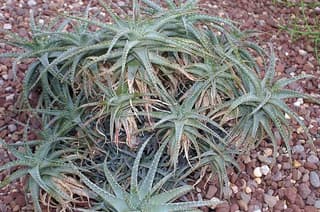
Spider Aloe
Aloe x spinosissima
The Spider Aloe (Aloe x spinosissima) is a succulent hybrid resulting from the cross between Aloe humilis (Hedgehog Aloe) and Aloe arborescens (Krantz Aloe). It forms compact, dense clumps of light green to bluish-green rosettes, with fleshy leaves covered in soft, yellowish spines on both surfaces. It multiplies rapidly through lateral offsets, forming clusters that can reach 24 to 36 inches in height and width. In well-established plants, flower stalks up to 18 inches tall emerge in late winter and early spring, displaying highly ornamental coral-red tubular flowers.
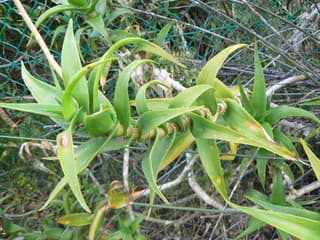
Climbing Aloe
Aloiampelos ciliaris
Aloiampelos ciliaris, known as the common climbing aloe, is a fast-growing succulent native to the dense thickets of the Eastern Cape Province, South Africa. Unlike most rosette-shaped aloe species, it develops long, thin, and flexible stems that scramble through surrounding bushes, reaching heights of up to 10 meters in its natural habitat. The succulent, deep green leaves have margins lined with fine, eyelash-like hairs (cilia), from which the species name is derived. It blooms almost continuously from fall to spring, producing long racemes of tubular orange-red flowers, which are highly favored by sunbirds in its native habitat.
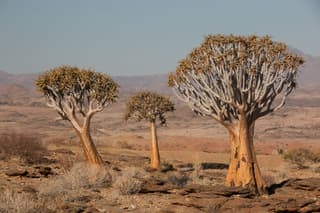
Tree Aloe
Aloidendron
Aloidendron is a genus of spectacular arborescent (tree-forming) succulents native to southern and eastern Africa, belonging to the family Asphodelaceae. The genus comprises six accepted species, including the iconic Quiver Tree (A. dichotomum) and the Giant Tree Aloe (A. barberae), Africa's largest succulent tree reaching up to 20 metres tall. These majestic plants develop thick, fibrous trunks topped with dense rosettes of blue-green or bright-green succulent leaves, producing dramatic tubular flower spikes in shades of yellow, pink, orange, or red during late autumn and winter. Long-lived and drought-adapted, tree aloes are celebrated as focal specimens in xeriscape, Mediterranean, and South African-style gardens.
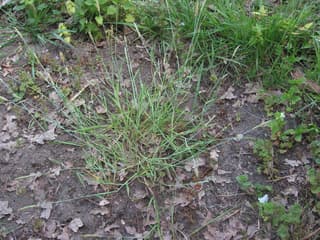
Water Foxtail
Alopecurus geniculatus
Alopecurus geniculatus, commonly known as water foxtail or marsh foxtail, is a perennial grass native to Eurasia. It forms compact tufts with erect or geniculate stems reaching up to 60 cm tall, thriving in waterlogged soils, pond margins, ditches, and seasonally flooded meadows. Its dense, cylindrical flower spikes adorned with pale yellow-orange anthers make it a subtle ornamental accent in water gardens.
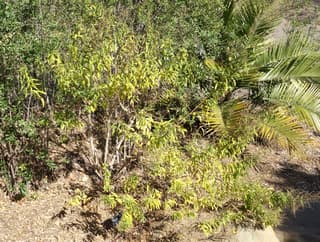
Lemon verbena
Aloysia citrodora
An aromatic perennial shrub native to South America (Argentina, Chile, Peru, and Bolivia), belonging to the Verbenaceae family. The lanceolate leaves, 5-8 cm long, release an intense lemon scent when rubbed. It blooms between summer and early autumn with small white or purplish flowers gathered in spikes. Introduced to Europe in the 17th century by Spanish and Portuguese sailors, it is now cultivated primarily for culinary use, herbal medicine, and as an aromatic ornamental balcony plant.
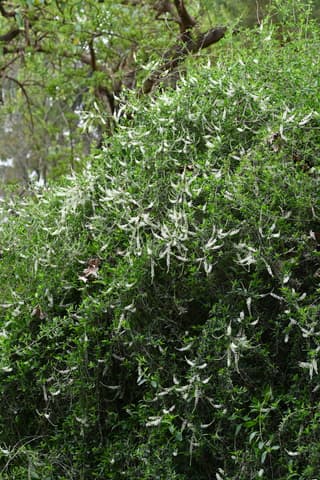
Sweet almond verbena
Aloysia gratissima
Aloysia gratissima, popularly known as sweet almond verbena, bee bush, or almond verbena, is an aromatic shrub from the Verbenaceae family, native to the temperate and subtropical regions of South America (Argentina, Paraguay, Uruguay, southern Brazil) and also found in Mexico and the southern United States. It reaches between 2 and 3.5 meters in height, with slender, flexible branches covered in small, grayish-green opposite leaves. Between spring and autumn, especially after warm rains, it is covered in tiny white flowers with an intense vanilla perfume that attract bees and other pollinators, which is why it is also known as the "bee bush." It is a very drought-resistant and low-maintenance species, ideal for xeriscape gardens, living fences, and pollinator spaces.
Find the Perfect Plant
Our plant guide helps you find ideal species for your experience level and time of year.
Browse by Difficulty, Season & More
Use the filters below to narrow this catalog by care difficulty, season, environment, or search directly by name. Each filter leads to a focused list tailored to your specific growing conditions.