Complete Plant Guide
Explore plants by difficulty, season and more. Find the perfect plant for you.
Difficulty
Categories
Plants by City
🗺️ Plants by City3966 plants found
Showing 217-252 of 3966
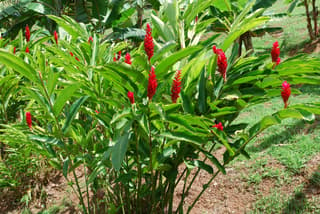
Red Ginger
Alpinia purpurata
Red Ginger (Alpinia purpurata) is a stunning tropical plant native to the South Pacific, celebrated for its dramatic crimson-red flower spikes rising above glossy lance-shaped foliage. A member of the Zingiberaceae family, it is widely cultivated as an ornamental in tropical and subtropical gardens and as a potted plant in warm interiors. Its long-lasting blooms make it highly prized for floral arrangements, leis, and landscape use.
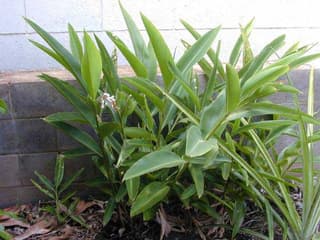
Shell Ginger
Alpinia zerumbet
Alpinia zerumbet, commonly known as Shell Ginger, is a magnificent tropical perennial native to East Asia (Japan and China). Belonging to the Zingiberaceae family, it produces large, lush, lance-shaped evergreen leaves and spectacular arching clusters of waxy, shell-shaped flowers in white and pink with yellow accents. It is widely cultivated as an ornamental plant in tropical and subtropical gardens worldwide and can also be grown indoors in bright conditions.
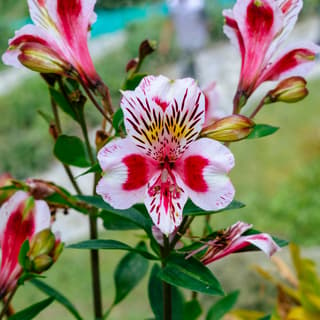
Peruvian Lily
Alstroemeria
The Peruvian Lily, scientifically known as Alstroemeria, is a popular ornamental plant prized for its vibrant and long-lasting flowers. Native to South America, it grows from rhizomes and produces upright stems with lanceolate leaves. The flowers, which come in a wide range of colors and patterns, are often bicolor and have distinct petals, with the lower ones usually marked. It is an excellent choice for flower beds, borders, and as a cut flower due to its long vase life.
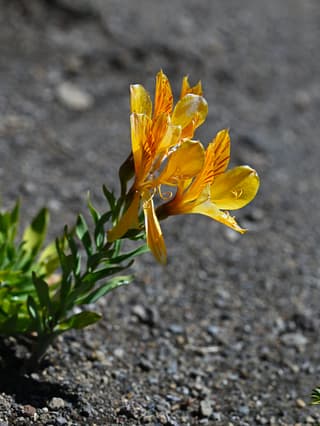
Golden Inca Lily
Alstroemeria aurea
Alstroemeria aurea, commonly known as the Golden Inca Lily or Peruvian Lily, is a hardy perennial native to the slopes of Chile and Argentina (Patagonia). It produces striking flowers in shades of yellow, orange, and gold — often streaked or spotted — from spring through fall. It is prized as both a garden ornamental and a long-lasting cut flower.
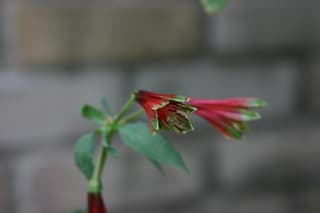
Parrot Lily
Alstroemeria psittacina
Parrot Lily (Alstroemeria psittacina) is a rhizomatous perennial native to Brazil and Argentina, celebrated for its striking red and green flowers reminiscent of parrot plumage. It blooms from summer to fall and is prized both as a garden plant and as a long-lasting cut flower. The sap may cause mild skin irritation.
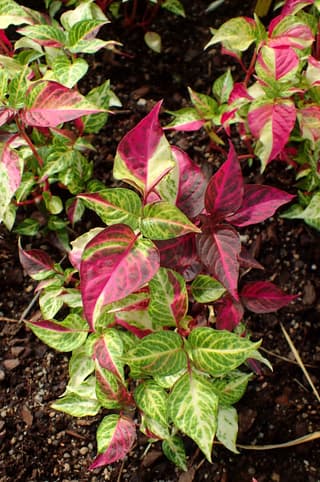
Alternanthera
Alternanthera
Alternanthera is a genus of about 100 species in the amaranth family (Amaranthaceae), most of them native to the tropical and subtropical Americas, with others in Asia, Africa and Australia. In gardens and pots, what people grow are the colorful foliage types sold as Joseph's coat, joyweed or calico plant: A. ficoidea, A. bettzickiana, A. dentata, A. brasiliana and hybrids such as 'Party Time', 'Red Threads' and 'Purple Knight'. They are soft-stemmed perennials that form low mounds or creep along the ground, with small opposite leaves in green, red, pink, purple, cream or yellow, often splashed together. The flowers are tiny white pompoms tucked in the leaf axils and are easy to miss. They cannot take frost, so outside the tropics they are grown as summer annuals or as houseplants. Some species in the genus are weeds, such as A. philoxeroides (alligator weed), which forms mats on rivers and ponds.
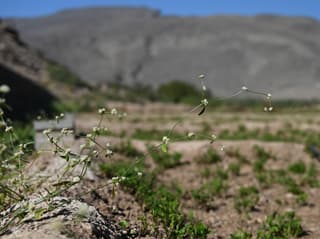
Calico Plant
Alternanthera bettzickiana
Alternanthera bettzickiana, commonly known as Calico Plant or Joseph's Coat, is a compact ornamental herb native to Brazil. It is prized for its vibrant multicolored foliage in shades of red, yellow, green, and pink. Widely used in tropical and subtropical gardens for borders, carpet bedding, and living patterns.
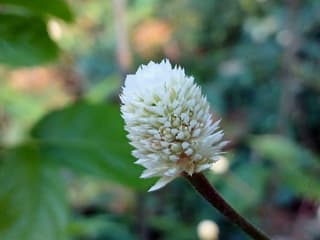
Brazilian Joyweed
Alternanthera brasiliana
Alternanthera brasiliana is a perennial herbaceous plant native to Brazil, famous for its vibrant purple foliage. It is widely used in landscaping to create color contrasts in borders and mass plantings. Its leaves are opposite and oval, and the plant produces small white flowers clustered in globose inflorescences. It is a hardy species with vigorous growth.
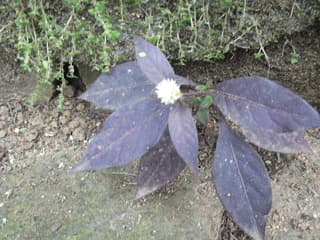
Joseph's Coat
Alternanthera dentata
Alternanthera dentata is a tropical perennial prized for its vibrant burgundy-to-purple foliage. Native to South America, it forms dense mounds and works beautifully as ground cover or border plant. The leaves retain their rich color best in full sun.
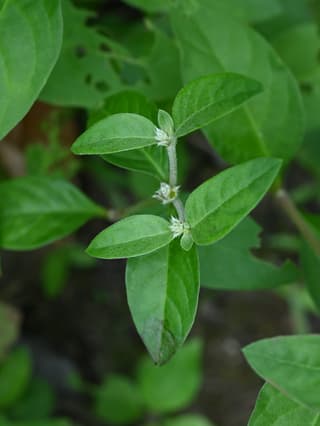
Joyweed
Alternanthera ficoidea
Joyweed (Alternanthera ficoidea) is a colorful ornamental groundcover native to South America, particularly Brazil. Celebrated for its vibrant foliage in shades of red, purple, orange, and green, it is widely used in tropical and subtropical gardens for edging, carpet bedding, and living tapestry designs.
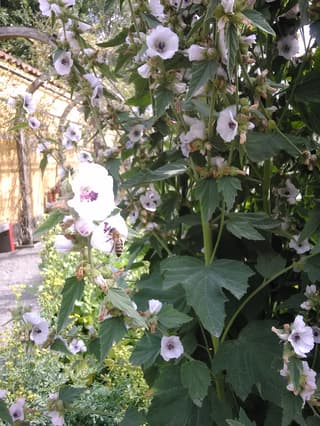
Marshmallow
Althaea officinalis
Althaea officinalis, commonly known as marshmallow, is a perennial herbaceous medicinal plant in the family Malvaceae, native to Europe and western Asia. It produces delicate white-pink flowers in summer and has been valued for its therapeutic properties for millennia, particularly for soothing respiratory and digestive irritations.
Black Gem Aloe
Alworthia 'Black Gem'
Alworthia 'Black Gem' is a striking bigeneric succulent hybrid, a cross between Aloe speciosa and Haworthia cymbiformis, placing it in the Asphodelaceae family alongside both parents. It forms a compact, stemless rosette of thick, fleshy, triangular leaves that deepen from dark green to bronze or reddish-purple under strong light, with pale tubercles scattered across the upper leaf surface for a jewel-like, textured look. Slow-growing and clump-forming, mature plants readily produce offsets around the base, eventually forming dense clusters. Flowering is uncommon in cultivation but when it occurs, slender stalks carry small tubular blooms in late spring to summer. Hardy, compact and easy to care for, it is a popular choice for windowsills and succulent collections alike.

Mountain Alyssum
Alyssum montanum
Alyssum montanum, commonly known as mountain alyssum or mountain madwort, is a low-growing evergreen perennial in the mustard family (Brassicaceae), native to the mountainous regions of Central and Southern Europe. It forms dense, mat-like cushions of small grey-green leaves and bursts into a profusion of fragrant, bright yellow flowers from late spring through early summer. Prized for rock gardens, alpine troughs, and sunny border edges, it thrives in poor, well-drained soil and tolerates drought once established, making it an easy, low-maintenance choice for sunny, exposed sites.
Yellow Patches
Amanita flavoconia
Amanita flavoconia, commonly known as Yellow Patches, is a mycorrhizal fungus characterized by its bright orange to yellow cap covered in small, yellow warty remnants of the universal veil. It is frequently found in broadleaf and coniferous forests across North America. Unlike plants, it lacks chlorophyll and lives in a symbiotic relationship with tree roots.
The Blusher
Amanita rubescens
Amanita rubescens, known as The Blusher, is a mycorrhizal fungus characterized by its flesh, which turns reddish or pinkish when damaged. The cap is typically reddish-brown to pale brown with small, grayish warts. It lives in symbiosis with both deciduous and coniferous trees.
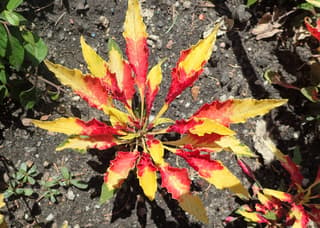
Pigweed / Amaranth (genus)
Amaranthus
Large genus of annual and perennial herbs in the Amaranthaceae family, distributed worldwide. Includes ornamental, edible, and weedy species known for heat and drought tolerance.
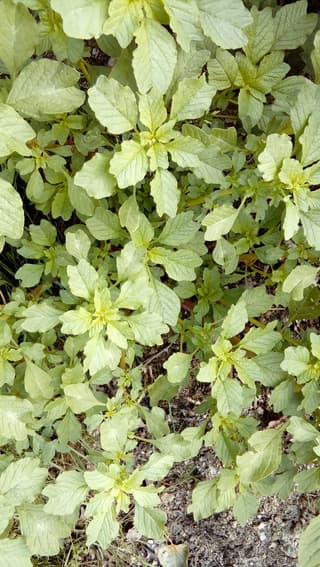
Purple Amaranth
Amaranthus blitum
Amaranthus blitum, commonly known as Purple Amaranth or Livid Amaranth, is an annual herbaceous plant in the Amaranthaceae family, native to the Mediterranean region and Southwest Asia. Widely naturalized across tropical and subtropical zones, it is valued as an edible leafy vegetable and traditional medicinal plant.

Love-Lies-Bleeding
Amaranthus caudatus
Amaranthus caudatus is a fast-growing annual herb in the amaranth family (Amaranthaceae), prized for its long, rope-like tassels of tiny crimson-red flowers that cascade up to 60 cm (2 ft) from the top of the plant. Native to South America, most likely the Andean highlands, it has been cultivated for millennia both as an ornamental garden plant and as a grain and leaf crop -- its tiny seeds are one of the ancient "pseudocereals" still eaten today, and its young leaves are cooked as a nutritious green vegetable. The stiff, upright stems can reach 1 to 1.5 m tall and are clothed in oval, sometimes reddish-tinged leaves. In the garden it makes a dramatic, old-fashioned border or cutting-garden plant, equally at home in cottage borders and modern prairie-style plantings.
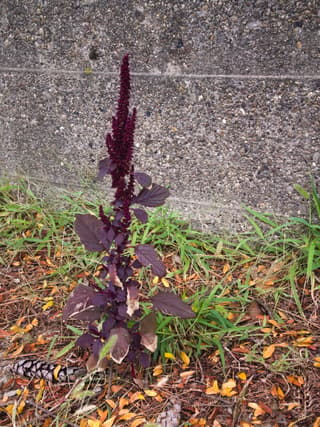
Red Amaranth
Amaranthus cruentus
Amaranthus cruentus, commonly known as Red Amaranth or Blood Amaranth, is a fast-growing annual plant native to Central America and Mexico. Its dramatic feathery plumes in shades of red, purple, and magenta make it a striking ornamental, while its leaves and protein-rich seeds have been used as food and medicine for thousands of years.
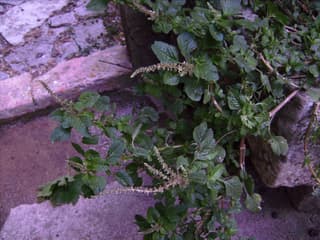
Low Amaranth
Amaranthus deflexus
Low Amaranth (Amaranthus deflexus) is a short-lived perennial or annual herb native to South America, now naturalized worldwide in warm and temperate regions. A highly adaptable and resilient weed-edible, its leaves and seeds are protein-rich and edible. Commonly found in disturbed soils, roadsides, and gardens.
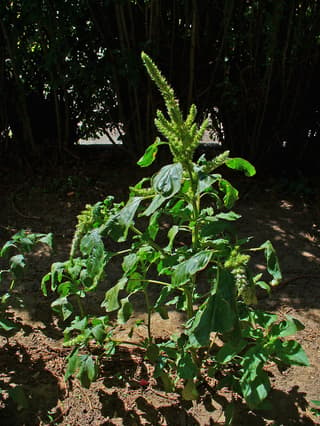
Smooth Amaranth
Amaranthus hybridus
Amaranthus hybridus, commonly known as smooth amaranth or slim amaranth, is a fast-growing annual plant native to the tropical and subtropical Americas. Belonging to the Amaranthaceae family, it is valued as both a food and medicinal plant. Its green leaves and nutritious seeds are consumed in many cultures around the world. The plant produces dense inflorescences in shades of red, green, or purple during summer and fall.

Prince's Feather
Amaranthus hypochondriacus
Amaranthus hypochondriacus, commonly known as Prince's Feather, is an annual herbaceous plant in the Amaranthaceae family, native to Mexico and Central America. It can grow up to 2 meters tall, with lanceolate leaves and dense, erect flower spikes in shades of red and burgundy that stand out from summer through fall. It is grown both as an ornamental plant and as a protein-rich edible grain.
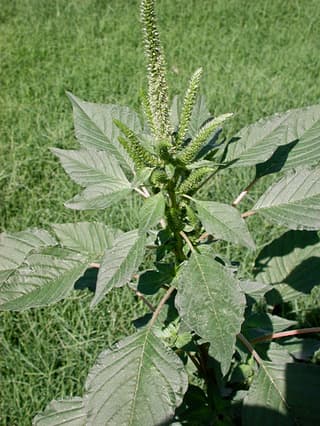
Palmer amaranth
Amaranthus palmeri
Palmer amaranth (Amaranthus palmeri) is a fast-growing, dioecious annual weed native to the desert regions of the southwestern United States and northern Mexico. It is one of the most aggressive agricultural weeds in North America, capable of growing several inches per day and reaching 6-10 feet tall. It thrives in full sun, disturbed soils, and hot, dry conditions, and has developed resistance to multiple herbicide classes.
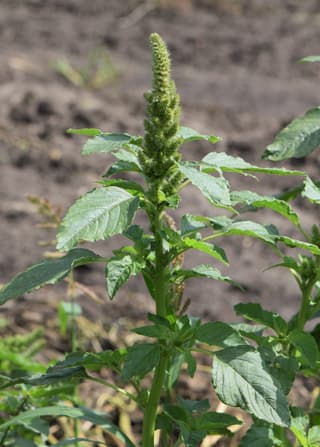
Redroot Pigweed
Amaranthus retroflexus
Redroot Pigweed (Amaranthus retroflexus) is an annual herb native to tropical Americas, now naturalized worldwide. It grows up to 2 m tall with dense gray-green flower spikes. Leaves are nutritious — rich in iron, calcium, vitamins A and C — and have long been used as food and medicine. CAUTION: leaves must always be cooked before consumption to neutralize oxalates; the plant can accumulate nitrates making it toxic to livestock in large quantities.
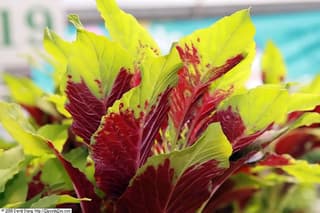
Joseph's Coat
Amaranthus tricolor
Amaranthus tricolor, commonly known as Joseph's Coat or Tampala, is a striking annual plant native to South and Southeast Asia. Celebrated for its brilliantly colored foliage of red, yellow, and green, it is cultivated worldwide as both an ornamental garden plant and a nutritious leaf vegetable. Its vivid tricolor leaves make it a standout in summer borders and tropical garden designs.
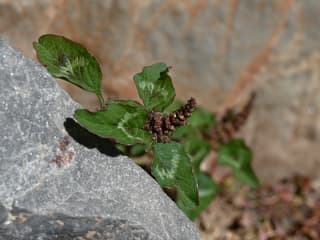
Slender amaranth
Amaranthus viridis
Slender amaranth (Amaranthus viridis) is an annual herb in the Amaranthaceae family, native to the tropical Americas and now naturalized as a cosmopolitan weed worldwide. It grows upright, 60-80 cm tall, with branching stems from the base, ovate leaves 3-6 cm long, and small green flowers borne in terminal panicles. It is both a leafy vegetable, cooked and eaten like spinach in many tropical cuisines, and a common agricultural weed.
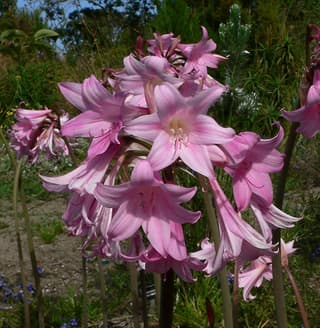
Belladonna Lily
Amaryllis belladonna
A perennial bulbous plant native to South Africa, famous for its fragrant trumpet-shaped flowers that emerge on naked stems before the leaves appear. Its flowers range from pale pink to white and exude a sweet fragrance.
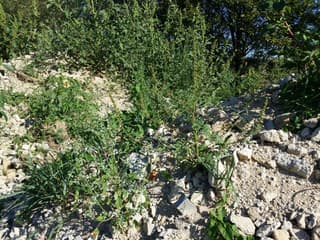
Ragweed
Ambrosia
Ambrosia is a genus of roughly 40 weedy annual and perennial species in the daisy family (Asteraceae), native to the Americas and now naturalized across Europe, Asia, and beyond. The best-known species, Ambrosia artemisiifolia (common or annual ragweed), is a fast-growing, deeply lobed-leaved plant that colonizes disturbed soil -- roadsides, fields, construction sites, and waste ground. It is not cultivated as an ornamental; rather, it is notorious as one of the most significant sources of allergenic pollen in the world, triggering hay fever (allergic rhinitis) in millions of people during late summer and fall.
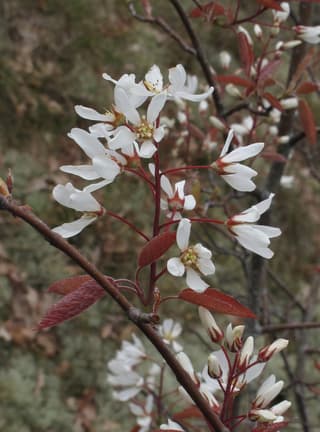
Serviceberry
Amelanchier
Amelanchier, commonly known as serviceberry or juneberry, is a genus of deciduous shrubs and small trees in the rose family (Rosaceae), native mainly to North America. It is prized for its clouds of white spring flowers, sweet edible summer berries, and fiery orange-red fall foliage.
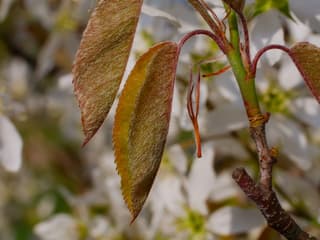
Juneberry
Amelanchier × lamarckii
Amelanchier × lamarckii is a naturally occurring hybrid serviceberry, most likely a cross between Allegheny serviceberry (A. laevis) and downy serviceberry (A. arborea), first recognized in the early 20th century and now widely planted as an ornamental garden tree. This deciduous, multi-stemmed large shrub or small tree grows 15-25 ft (roughly 4.5-7.5 m) tall, with an open, rounded crown. In spring, before or as the bronze-tinted young leaves unfurl, it is covered in drooping clusters of star-shaped white flowers. These are followed in early summer by small, round, purple-black pome fruits ("juneberries") that resemble blueberries and are sweet and edible, attracting birds. Fall brings vivid orange-to-red foliage color, making this a four-season interest plant.
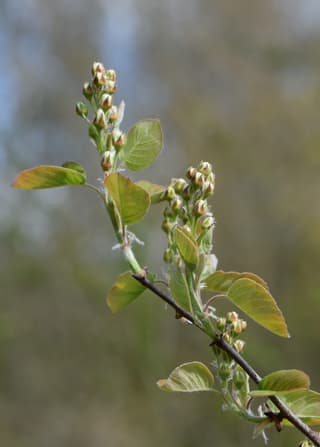
Saskatoon Serviceberry
Amelanchier alnifolia
Amelanchier alnifolia, the Saskatoon serviceberry, is a long-lived deciduous shrub or small tree native to western North America, ranging from Alaska south to California and east to the Great Plains. One of the most cold-hardy woody fruiting plants in cultivation, it thrives in USDA zones 2a through 7b and tolerates temperatures as low as -45°C. Each spring it erupts in clusters of fragrant, star-shaped white flowers before the leaves fully expand—an early-season spectacle cherished by pollinators and gardeners alike. By midsummer, branches bow under generous crops of sweet, blueberry-like purple berries that have sustained Indigenous peoples for millennia, eaten fresh, dried into pemmican, or baked into pies. Come autumn, the foliage transforms to brilliant golds, oranges, and reds, extending its ornamental value through the season. Highly drought-tolerant once established, it asks for little beyond full sun, well-drained loamy soil, and occasional pruning to keep its suckering growth in check.
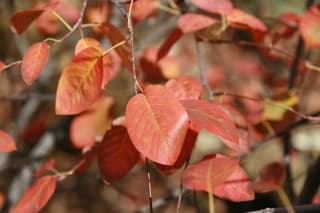
Serviceberry
Amelanchier canadensis
A deciduous, multi-stemmed shrub or small tree native to eastern North America, prized for its clouds of white star-shaped flowers that open in early spring before the leaves unfurl. By early summer the blooms give way to sweet, blueberry-like purple-black berries, and in autumn the foliage turns brilliant shades of orange and red. Its early bloom time made it a folk calendar marker for the shad fish runs, hence the name shadbush.
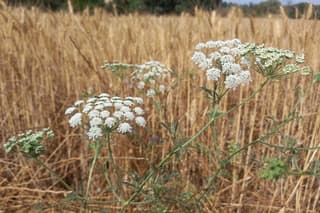
Bishop's Flower
Ammi majus
Ammi majus is an upright annual (occasionally biennial) herb in the carrot family (Apiaceae), native to the Nile Valley, North Africa and the Mediterranean basin. It produces finely divided, feathery foliage and 5-10cm lacy white umbels similar to Queen Anne's lace, held on branching stems up to 1.5m tall. Popular with cut-flower growers and pollinators alike, the species carries an important caveat: its sap contains furanocoumarins (bergapten and xanthotoxin) that sensitize skin to UV light, so handle it with gloves and long sleeves.
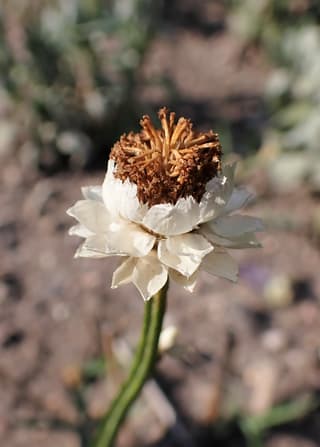
Winged Everlasting
Ammobium alatum
The Winged Everlasting is an Australian, long-lasting ornamental plant belonging to the aster family (Asteraceae). It is known for its white, papery dry flowers with a bright yellow center. The plant requires plenty of sun and is very drought-tolerant, making it an ideal choice for dry gardens and dried flower arrangements.
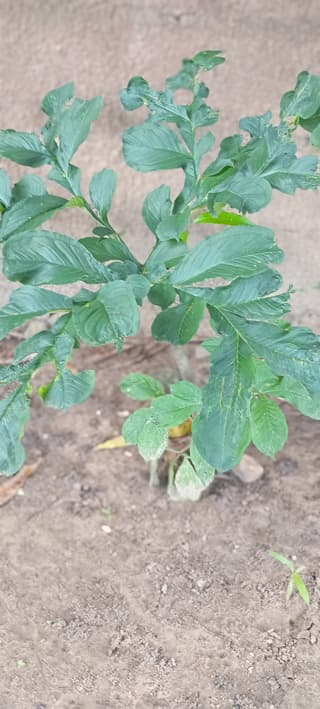
Voodoo Lily
Amorphophallus
Amorphophallus is a captivating genus of approximately 200 tropical and subtropical tuberous herbaceous plants in the family Araceae, native to Asia, Africa, and Australasia. They are renowned for their spectacular inflorescences — some of the largest in the plant kingdom — which emit powerful odors to attract pollinators. A. konjac is cultivated for its glucomannan-rich corms used in Asian cuisine. A. titanum, the "corpse flower," produces the world's largest unbranched inflorescence.
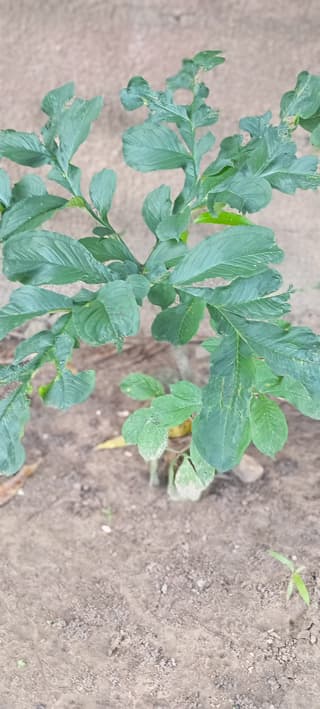
Konjac
Amorphophallus konjac
Amorphophallus konjac is an exotic tuberous plant native to Southeast Asia. It is famous for producing a single giant leaf that resembles a small tree and a spectacular dark purple inflorescence that emits a strong odor to attract pollinators. Its underground tuber is widely used in Asian cuisine for the production of konjac flour and jelly.
Find the Perfect Plant
Our plant guide helps you find ideal species for your experience level and time of year.
Browse by Difficulty, Season & More
Use the filters below to narrow this catalog by care difficulty, season, environment, or search directly by name. Each filter leads to a focused list tailored to your specific growing conditions.