How to fertilize aloe vera without harming the plant
Aloe vera thrives with little to no fertilizer. If you want to fertilize, use half to one-quarter of the label strength every 3 to 4 waterings, from September to March in Brazil. Learn what fertilizer cannot fix and how to save an overfertilized plant.
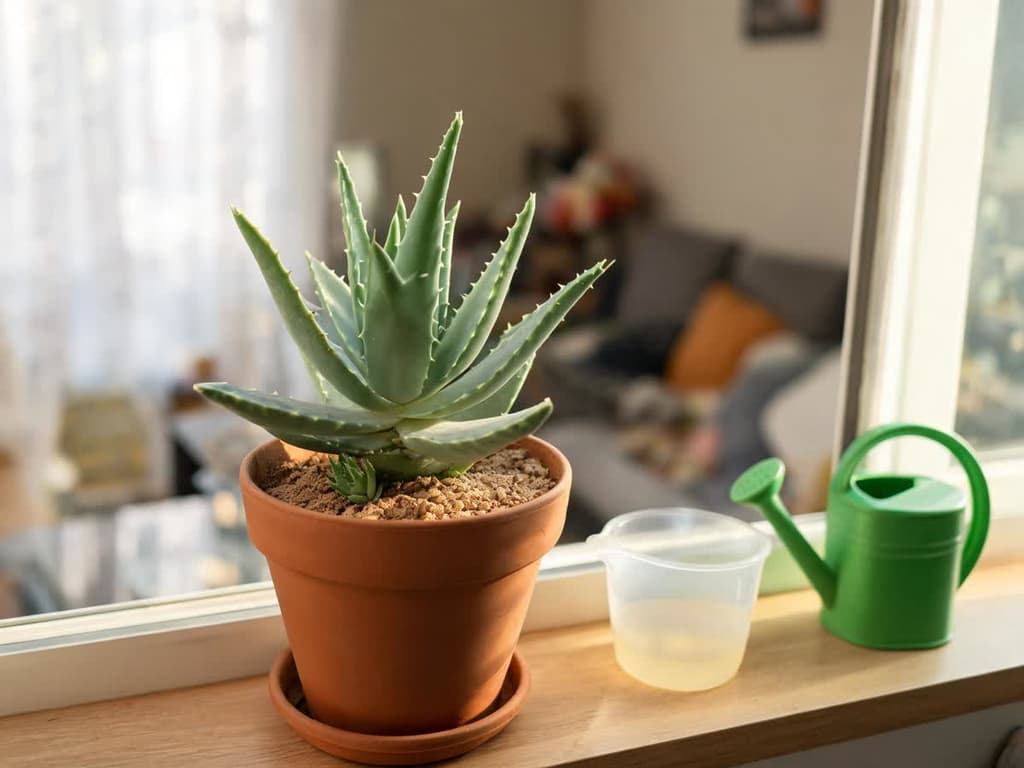
To fertilize aloe vera, use little or nothing. Aloe vera grows in poor soil and lives for years in a pot without fertilizer. If you want to fertilize, dilute cactus and succulent fertilizer to one-half or one-quarter of the label rate. The label rate is the amount the package tells you to mix with water. Apply every 3 or 4 waterings, from September to March in Brazil, and do not fertilize from April to August.
Fertilizer will not fix thin and pale leaves, brown tips, or a soft base. These three signs stem from low light, fertilizer salt (residue left in the soil), or waterlogged soil. Too much fertilizer worsens the first two. Light, watering, and the pot matter more than any fertilizer, and you can find them in the aloe vera care guide.
Quick summary:
Strength: one-half to one-quarter of what the label directs, according to Iowa State University.
Frequency: every 3 or 4 waterings, only while the plant is actively growing. Another option is 1 application of slow-release fertilizer (granules that release nutrients gradually) in September in Brazil.
Timing in Brazil: from September to March. From April to August, no fertilizer.
Fertilizer: liquid cactus and succulent fertilizer, or standard houseplant fertilizer, always diluted.
Do not fertilize: wilted aloe, soft at the base, recently repotted, or dormant in winter.
Unhealthy aloe vera: does fertilizer help?
In most cases, no. This table connects each sign to its most probable cause and tells you whether fertilizer helps.
What you see | Most probable cause | Does fertilizer help? |
|---|---|---|
Thin, pale leaves stretching toward the window | Low light | No. Too much fertilizer makes the plant stretch even more |
Brown, dry tips | Fertilizer salts or irregular watering | No. If it is salt, fertilizer makes it worse |
White crust on the soil or the rim of the pot | Accumulated salts | No. Flush the soil first |
Soft, dark base, falling leaves | Rot from standing water | No. Remove from the pot and cut away the rot |
Stop from April to August in Brazil | Fall and winter dormancy | No. Wait until September |
Outer leaf turning yellow, one at a time | Old leaf dying naturally | No. It is normal |
No growth in summer, old soil, unfertilized for several months | Nutrient deficiency | Yes, 1 light dose |
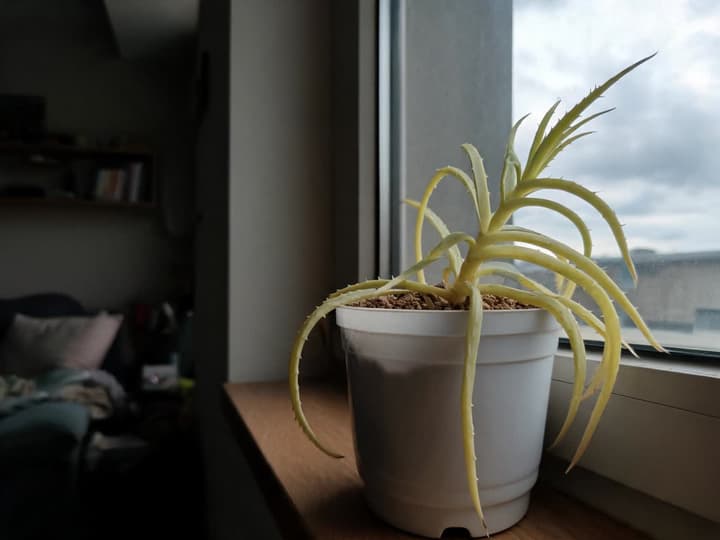
An aloe vera that gets too little light grows etiolated: it becomes long, floppy, and pale, stretching toward the window. Extension is the service through which a university guides the public on plants. University of Maryland Extension notes that the plant makes its own food using light, and that fertilizer does not replace light. Iowa State University states that too much fertilizer also makes houseplants leggy and weak. It produces the same look as a lack of light.
A thick, spiky plant is not always an aloe vera. Agaves and certain other aloes look similar and require different care. If you inherited the plant and do not know its name, Bloom (available for iOS) identifies the species from a photo. Yellow lower leaves have their own specific causes, sorted one by one in the guide on aloe vera with yellow leaves.
Does aloe vera need fertilizer?
It needs very little, and many survive without any at all. South Dakota State University Extension notes that aloe vera (Aloe vera) does not typically need fertilizer to stay healthy. The same factsheet states that in nature, aloe vera grows in nutrient-poor soil. The University of Florida (UF/IFAS) also notes that it performs well in poor soils.
University extension services disagree on how much fertilizer to apply. This table compares what each source recommends for aloe vera, succulents, or houseplants:
Source | Target plant | Recommendation |
|---|---|---|
South Dakota (SDSU) | Aloe vera | Fertilizer is usually not needed |
Maryland (UMD) | Aloe vera | 1 light dose, only if the plant has gone unfertilized for several months |
Montana State | Succulents | 1 or 2 times in spring and summer, low-nitrogen fertilizer |
Iowa State | Succulents | Half to one-quarter strength, every 3 to 4 waterings, in spring and summer |
Nebraska (UNL) | Houseplants | Every 2 months while the plant is actively growing |
Royal Horticultural Society (RHS) | Aloe vera | Monthly, from May to August, in the United Kingdom |
Illinois | Succulents | Monthly during the growing season |
This guide follows Iowa State. It is the only source in the table that pairs a fraction of the label strength with a specific frequency. It falls right between "no fertilizer" and "every month." The RHS advises fertilizing every month, but does not state what strength to use.
The ponytail palm is another plant native to poor soils that requires little fertilizer. For it, the recommendation is half strength every 2 months, as detailed in the guide on how to fertilize a ponytail palm. The jaboticaba is a fruit tree and follows a completely different routine. The guide on fertilizer for jaboticaba discusses manure and annual dosing, things that a potted aloe vera does not use.
How much fertilizer to use on aloe vera and how often
To fertilize aloe vera, use one-half to one-quarter of the label rate in the watering water. Do this every 3 or 4 waterings, only from September to March, in Brazil. This is the Iowa State University recommendation for potted indoor succulents.
Here is an example calculation: if the label directs 10 ml of fertilizer per liter of water, use 2.5 to 5 ml per liter. Water as usual until moisture drains from the bottom hole, and empty the drip tray afterward.
The number of waterings per month varies depending on your home, sunlight, and pot. An aloe vera watered every 2 weeks receives fertilizer every 6 to 8 weeks. This calculation is ours, based on the Iowa State guideline. You can find the exact number of days between waterings for your plant using the chopstick test. Insert a wooden skewer all the way to the bottom of the soil and water only if it comes out clean and dry, as explained in the guide on how often to water aloe vera.
Slow-release fertilizer is the other option. It comes in granules that release nutrients gradually with every watering. Iowa State accepts a single application at the beginning of the growing season. In Brazil, this means 1 application in September and no liquid fertilizer for the rest of the year. No source gives a fraction for this type of fertilizer: use the lowest dose the label recommends for houseplants.
When to fertilize aloe vera in Brazil
Fertilize only in spring and summer, which run from September to March in Brazil. Iowa State advises fertilizing succulents in spring and summer and avoiding winter, when they do not grow. The University of Nebraska explains why: the fertilizer that an idle plant does not use stays in the soil and accumulates as salt.
From April to August, aloe vera grows less and does not receive fertilizer. In Brazil, winter runs from June to August. An aloe vera that does not grow during these months is dormant and does not need new nutrients. Resume fertilizing in September, when it puts out a new leaf in the center.
Northern hemisphere sources give other months, such as "from May to August" from the RHS. There, these months cover late spring and summer. For those living in Brazil, the season matters, not the month: fertilize during the warm period of the year.
Which fertilizer to use on aloe vera
Use liquid cactus and succulent fertilizer, or a standard houseplant fertilizer. Iowa State endorses both. For cactus and succulent fertilizer, Iowa State offers two options: dilute it just like standard fertilizer or follow the package instructions. This guide dilutes both to one-half or one-quarter of the label rate, which is the safest choice for the roots.
The three numbers on the label represent NPK: nitrogen (N), phosphorus (P), and potassium (K), in that order. Sources disagree on which number should be highest for succulents. Montana State and Clemson Extension favor low nitrogen, such as a 5-10-5 formula. The RHS prefers high potassium, similar to a tomato fertilizer. The University of Maryland states that for aloe vera, the formula "does not matter much," though it suggests nitrogen as the highest number.
When in doubt, choose a low dose over a specific formula. The total quantity matters more than the ratio, because it is excess salt that burns the roots. Phosphorus, the middle number in NPK, does not force a desert rose to bloom, and the guide on desert rose fertilizer explains why.
Fertilizing after repotting aloe vera
A freshly repotted aloe vera should not receive fertilizer. The University of Nebraska states that newly repotted plants lacking established roots, wilted plants, or dormant plants should not be fertilized. Clemson Extension also warns against fertilizing repotted cacti.
Many potting mixes come pre-fertilized, as noted by Penn State and the Brooklyn Botanic Garden. Read the bag before adding any fertilizer. If it specifies how long the built-in fertilizer lasts, wait out that period. NC State notes that these nutrients last only a few weeks, while Nebraska cites a mix promising up to 6 months. If the bag does not state a timeframe, none of the cited sources provide a specific number for aloe vera.
Wait for the roots to establish before the first fertilization. Gently push the base: if the plant does not wobble, the roots are already established. Even with established roots, fertilize only between September and March in Brazil.
Signs of too much fertilizer on aloe vera
Excess fertilizer leaves clear signs on the foliage, the soil, and the pot. The University of Maryland and Iowa State list the following:
brown, dry leaf tips and edges;
leggy, thin, and weak growth;
multiple lower leaves dropping all at once, accompanied by brown tips or crust (a single older leaf turning yellow at a time is completely normal);
a white crust on the soil surface, the saucer, or the exterior of a terracotta pot;
a wilted plant, caused by root damage;
a soft stem that collapses right at the soil line.
These same symptoms can stem from other problems, Nebraska cautions. Brown tips also occur with irregular watering. Because of this, inspect the soil: a white crust alongside recent fertilizing points directly to salt buildup.
When the crust is light and the plant remains sturdy, flush the potting soil. Water slowly with clean water until twice the pot's volume drains through the bottom hole (for a 1-liter pot, use 2 liters of water). The University of Nebraska recommends this volume. Empty the drainage saucer and let the soil dry out completely to the bottom before watering again. Step-by-step instructions for flushing appear in the guide on how to water aloe vera. For small pots with heavy salt accumulation, Maryland recommends replacing the soil instead of flushing.
Aloe vera soft at the base after fertilizing
An aloe vera that has bent over and turned soft at the base must come out of its pot today. The University of Maryland explains that fertilizer salts can cause the stem to collapse right at the soil line. Root rot from standing water leads to the exact same collapse. In both situations, removing the old potting soil is what saves the plant.
Follow these steps:
Remove the aloe vera from its pot and shake off the old soil.
Trim away dark, soft roots and any rotted tissue at the base using a clean knife.
Let the cut surfaces callous over in a shaded spot for 1 to 2 days.
Repot into fresh, dry cactus mix in a container with drainage holes.
Wait 1 full week before giving it its first watering, and do not fertilize.
Fresh potting mix also eliminates the salts: Nebraska points to soil replacement as an effective way to remove excess fertilizer. If the center of the plant, where the leaves join in a rosette, is soft and black, the mother plant will not recover. Any firm offsets at the base can become new plants: pot each one in its own container with cactus mix.
Root rot has its own dedicated page covering symptoms and treatment:
Coffee grounds, banana peels, and eggshells on aloe vera
Do not apply coffee grounds to aloe vera soil. Washington State University (WSU) explains that fresh grounds are toxic to several plants. The same factsheet advises against mixing fresh grounds into the soil or using them as mulch. Coffee grounds are fine and compact, and they hinder the movement of water and air through the soil, according to WSU.
Research on how coffee grounds affect potted plants is hard to find. New Mexico State University notes that published studies on using coffee grounds for houseplants are scarce. Most available studies focus on outdoor gardens and composting. Aloe vera requires the soil to dry out between waterings, and grounds interfere with that drying process. The safest choice is to send your coffee grounds to the compost bin.
Banana peels also lack supporting research. University of Maryland Extension specialists on the Ask Extension platform state that they know of no scientific studies validating banana peels as fertilizer. They do contain substantial potassium, but that provides no benefit if the soil already has enough. As for eggshells and cooking water (from eggs or vegetables) on aloe vera, none of the consulted sources report any testing. In the absence of data, the safest approach is a commercial fertilizer diluted according to the label, where the nutrient concentration is known.
Does fertilizer increase gel in aloe vera?
No one has measured the effect of fertilizer on gel production in potted aloe vera. What does exist is research on commercial field farming, which evaluated total leaf weight. A 2020 study in the journal Heliyon tested nitrogen applications on field-grown aloe vera. Leaf yield increased by 18% to 139% compared to unfertilized plants, depending on the type and rate of fertilizer applied.
The application rates in that study reflect agricultural fields, measured in kilograms per hectare (1 hectare equals 10,000 m²), and cannot be converted into pot doses. Indoors, excess fertilizer makes leaves leggy and weak, as Iowa State notes. Furthermore, the University of Maryland points out that fertilizer never compensates for poor light.
Aloe vera planted in the garden
For aloe vera growing directly in the ground, none of the consulted sources recommend fertilizing. UF/IFAS in Florida notes that garden-grown aloe vera only needs supplemental watering until it establishes its root system. Afterwards, it can survive on rainfall alone. South Dakota's factsheet reminds growers that the plant naturally inhabits poor soils. In the garden, its primary requirements are ample sun and sharp-draining soil.
Frequently asked questions
How often should you fertilize aloe vera?
Every 3 to 4 waterings, from September to March in Brazil, at one-half to one-quarter of the label dose. This is the Iowa State University rule for succulents. Another option is 1 application of slow-release fertilizer in September. Many aloe vera plants live well without any fertilizer: the South Dakota extension says that it is usually not necessary.
Can I fertilize aloe vera in winter?
No. In Brazil, winter runs from June to August, and aloe vera grows little from April to August. A dormant plant does not use fertilizer, and what remains builds up in the soil as salt, according to the University of Nebraska. Starting in September, resume fertilizing when a new leaf appears in the center of the plant, where the leaves emerge.
Is 10-10-10 NPK fertilizer good for aloe vera?
It works, provided you dilute it. Montana State and Clemson prefer lower nitrogen levels, but Maryland points out that the specific formula matters little. Iowa State University approves general-purpose succulent fertilizers diluted to one-half or one-quarter strength. University of Maryland Extension states that for aloe vera, the nutrient ratio is not critical. What truly damages the plant is excessive quantity: too much fertilizer scorches root systems and leaf tips.
Does an aloe vera that was never fertilized need fertilizer?
Only if it fails to grow during summer, sits in old soil, and both light and watering needs are already met. For an aloe vera unfertilized for several months, University of Maryland suggests 1 dose, at most 2. Use one-half to one-quarter of the label strength, adhering to the Iowa State rule. According to Penn State, repotting every 2 years refreshes the substrate and relieves rootbound conditions.
The aloe vera fertilizer calendar
In Brazil, from September to March, if you want to fertilize, use one-half to one-quarter of the label rate every 3 or 4 waterings. From April to August, do not fertilize. Wilted aloe vera, a soft base, or a newly repotted plant gets no fertilizer in any month. Thin and pale leaves need light, and brown tips with a white crust call for flushing the soil.
Sources
Iowa State University Extension, Growing Succulents Indoors (yardandgarden.extension.iastate.edu): half to one-quarter of the label rate, every 3 to 4 waterings, spring and summer, slow-release at the beginning of the season, cactus fertilizer at the package rate. Diagnosing Houseplant Problems Related to Poor Culture: signs of too much fertilizer, leggy and weak growth.
South Dakota State University Extension, Aloe Vera: Houseplant How-To (extension.sdstate.edu): fertilizer is usually not necessary; poor soil in nature.
University of Maryland Extension, Q&A: What causes aloe leaves to turn yellow?: light dose for aloe vera unfertilized for months; formula hardly matters; fertilizer does not replace light. Fertilizer Toxicity or High Soluble Salts in Indoor Plants (extension.umd.edu): salt symptoms, stem collapse, leaching, and soil replacement.
University of Nebraska-Lincoln Extension, Success With Houseplants: Fertilization (lancaster.unl.edu): every 2 months; when not to fertilize; pre-fertilized potting soil; leaching with twice the volume of the pot; changing the soil.
Royal Horticultural Society, Aloe vera (rhs.org.uk): liquid fertilizer every month in summer. Cacti and succulents: houseplants growing guide: fertilizer rich in potassium.
Montana State University Extension, Growing Succulents: 1 or 2 times, low nitrogen.
University of Illinois Extension, Growing succulents: beyond the basics: every month during the growing season.
Clemson Cooperative Extension, Indoor Cacti: low nitrogen (5-10-5); do not fertilize repotted cacti or in winter.
NC State Extension, Extension Gardener Handbook, ch. 18: fertilizer in potting mix lasts only a few weeks.
Penn State Extension, Repotting Houseplants; Brooklyn Botanic Garden, When, Why and How to Repot Your Houseplants: potting soil already contains fertilizer.
UF/IFAS Gardening Solutions, Aloe Vera; UF/IFAS Charlotte County, One of the most popular houseplants: Aloe, easy-going growing: poor soil; in the garden, only rainwater.
Washington State University Extension, Using Coffee Grounds in Gardens and Landscapes (FS207E): fresh coffee grounds are toxic to plants, not recommended as fertilizer or mulch.
New Mexico State University Extension, Compost Spent Coffee Grounds Before Using Them on Your Soil: no published research on coffee grounds in houseplants.
Ask Extension (University of Maryland), Banana Peel Tea (#722597): no scientific studies on banana peel as fertilizer.
Chowdhury et al. (2020), Nitrogen use efficiency and critical leaf N concentration of Aloe vera in urea and DAP amended soil, Heliyon (doi.org/10.1016/j.heliyon.2020.e05718): leaf production with nitrogen, in the field.
Related articles

How to Care for Hibiscus: Sun, Watering, Fertilizer, and Pruning for Flowers
How to care for hibiscus: 6 hours of direct sun, evenly moist soil without waterlogging, half-strength fertilizer in spring and summer, and pruning in early spring. Find out why the flower lasts one day and why buds drop before opening.

Do Ferns Like Sun or Shade? It Depends on the Type
Ferns prefer bright shade: plenty of light, but no direct sun on their fronds. Tuberous sword fern is the exception that handles sun. Here is the ideal light for each type, where to place pots, and how fronds show too much or too little light.

African Violet Yellow Leaves: Causes and What to Do
Yellow leaves on an African violet usually stem from overwatering, and the first place to check is the center of the plant. Losing one lower leaf at a time is normal. Identify whether age, watering, cold water, sunlight, cold drafts, or fertilizer is the culprit based on the yellowing pattern, and see what to do today.