Lily leaves turning yellow: when it is normal and when the bulb is rotting
A lily with yellow leaves after blooming is storing reserves in the bulb, and the leaves should not be cut. See how to tell this normal yellowing apart from bulb rot, fungus, and virus.
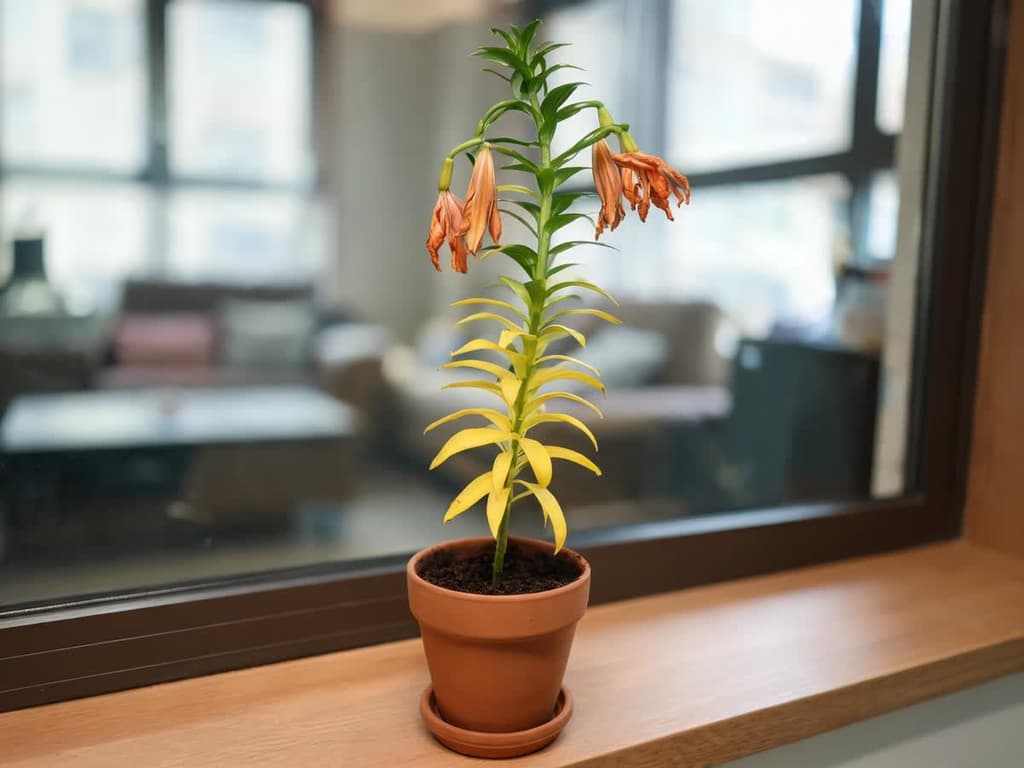
A lily with yellow leaves after blooming is at the normal end of its cycle. The bottom leaves turn yellow first, and the yellowing moves slowly up the stem over several weeks. The plant is sending reserves from the leaves back into the bulb before resting. Do not cut these leaves. If the yellowing appeared before or during flowering, or spread rapidly while the soil stayed constantly wet, check the bulb. Bulb rot is the most common cause at that point.
This guide covers true bulb lilies in the genus Lilium: Asiatic lilies, Oriental lilies, and Easter lilies. The peace lily is a completely different plant without a bulb and with broad leaves, and its yellowing comes from other causes. For that plant, see how to care for a peace lily.
Quick summary:
Yellowing from the bottom up, weeks after the last bloom: this is the normal end of the cycle. Iowa State University Extension notes that the plant dries down a few weeks after flowering.
Yellowing before or during bloom: the usual cause is bulb rot caused by the fungus Fusarium. This comes from the Pacific Northwest Plant Disease Management Handbook.
Teardrop-shaped brown spots, yellow streaks, or just burnt tips are three other causes, each with its own fix.
How to figure out why your lily has yellow leaves
Check three things before touching the plant: when the yellowing started, where it started, and what the soil feels like.
When it appeared | What the leaf looks like | Soil and bulb | Probable cause | What to do |
|---|---|---|---|---|
Weeks after the last bloom | Entire leaf turns yellow, from the bottom up, slowly | Moist soil, no odor; firm stem | Normal end of the cycle | Leave the leaves on the stem until they dry up |
Before or during bloom | Yellowing that advances quickly and a stalled plant | Constantly wet soil; soft bulb | Bulb rot | Take the bulb out of the pot and gently squeeze it |
After days without water | Wilted, yellow leaves from the bottom up | Dry soil and a light pot | Underwatering | Water until it drains freely from the drainage hole |
While the potted lily is in bloom | Only the tip turns yellow, then turns brown | Soil wet for many days | Tip burn | Water only when the surface of the soil dries out |
After cool, humid days | Teardrop-shaped brown spots surrounded by yellow halos | Leaves that stayed wet for hours | Botrytis blight (gray mold) | Remove spotted leaves and water only the soil |
At any growth stage | Yellow streaks and distorted, twisted leaf | Normal soil | Virus | Discard the plant and bulb |
On new upper leaves | Light green or yellow, while the plant keeps growing | Normal soil, low light | Lack of light or nutrients | Provide more light and fertilizer |
If your plant does not match any row, the general guide on yellow leaves breaks down causes by leaf position on the plant.
Make sure your plant is actually a true lily
A true lily (Lilium) has a single, straight stem lined with narrow green leaves and large flowers at the top. This description comes from the Royal Horticultural Society (RHS), the UK's gardening charity. Underground sits a bulb made of fleshy scales: thick, overlapping segments that separate one by one. This scaly bulb is described by the North Carolina State University Extension (NC State).
If the leaves emerge directly from the soil without a central stem, it is a different plant. Large blooms in a gift pot can also be amaryllis, clivia, or hibiscus, and each turns yellow for different reasons. If you received the plant as a gift and no one told you its name, Bloom identifies the species from a single photo.
Yellow leaves after blooming: it is the bulb's natural cycle
Yellowing that starts on the lower leaves weeks after the last bloom means the lily is entering dormancy. Dormancy is the period when the bulb rests underground, alive, until the next growing cycle. Iowa State notes that the plant dies back a few weeks after flowering and recommends cutting the stem down to the soil line only after it completely dries out.
As long as a leaf stays green, it produces energy that gets stored in the bulb. For this reason, University of Illinois Extension advises against cutting off any green tissue after flowering. Cutting off yellowing leaves too early deprives the bulb of energy reserves needed to flower again.
Three signs show that the yellowing is simply the end of the cycle:
The plant has already finished flowering.
The yellowing affects the entire leaf, starts at the bottom, and moves upward slowly over weeks.
The stem remains firm, and its base is neither soft nor dark.
US retailer Sunshine Grow Shop describes bottom-up yellowing as a sign of nitrogen deficiency. That reading makes sense during active vegetative growth, before flowering. After blooming, this guide follows the Iowa State and Illinois extensions, which treat this yellowing as the natural end of the cycle. The RHS itself recommends fertilizing potted lilies every two weeks only until the leaves begin to yellow.
A lily bought or received already blooming in a pot is the most common scenario. Typically, it was forced into bloom in a greenhouse, and yellowing arrives just a few weeks after the last flowers fade. What to do with the bulb afterward so it blooms again is detailed in our guide on how to care for lilies. The chilling period the bulb requires was measured in a study by the Federal University of Santa Maria.
Yellowing before or during bloom: check the bulb
When a lily turns yellow mid-season, before or during flowering, the usual cause is bulb rot from the fungus Fusarium oxysporum. This information comes from the Pacific Northwest Plant Disease Management Handbook, published by the universities of Oregon, Washington, and Idaho. The handbook also lists stunted growth and buds that wither without opening.
According to the RHS, the fungus typically invades through the basal plate, where roots emerge. The handbook recommends improving soil drainage. Illinois Extension warns that overwatering leaves the bulb soft and mushy.
To check the bulb:
Turn the pot on its side and slide the plant out with its root ball, holding it by the base of the stem.
Gently tease soil away from the bulb with your fingers.
Squeeze the bulb gently. A healthy bulb is firm, with white or yellowish scales.
Inspect the base. On a diseased bulb, the handbook describes a chocolate-brown or blue-gray rot creeping upward from the basal plate into the scales.
Smell the base of the bulb. The Connecticut Agricultural Experiment Station describes soft bulbs with a sour odor in other lily rots.
If the bulb is soft or dark at the base, discard both the bulb and the potting soil as soon as the symptom appears. This is what the RHS recommends. It also notes that the fungus contaminates the soil for at least 3 years. Wash the pot before using it again.
If the bulb is firm and white, rot is not the issue. Repot the plant into fresh, free-draining soil and review your watering practices in the section below.
Is the lily overwatered or underwatered?
Poke your finger 1 inch (2.5 cm) into the soil before watering. The University of Minnesota recommends letting the top inch dry slightly between waterings. Soil that feels wet at that depth, days after the last watering, indicates overwatering.
University of Wisconsin–Madison Extension sums up the boundary on both sides. The pot must not sit in standing water, nor should it sit completely dry for more than one or two days. A lily pot requires a bottom drainage hole. A decorative cachepot without drainage holes used on the outside collects standing water at the bottom where you cannot see it.
Returning from a trip to dry soil and a light pot signals underwatering. Water thoroughly until water drains from the hole, as advised by Iowa State, and discard any runoff left in the saucer. Leaves that have already turned yellow will not turn green again. Watch the top leaves over the following days to monitor recovery.
Yellow tip turning brown: tip burn
Tip burn begins when the tip of the leaf turns yellow, then dries and turns brown. The Connecticut Agricultural Experiment Station describes this non-pathogenic physiological disorder. It typically starts on lower leaves and works its way up the stem.
According to the same station, tip burn is common in lilies forced in greenhouses and kept in waterlogged soil. In garden-planted lilies, it is rare. The solution lies in adjusting watering and fertilizing: water only when the soil surface dries out, and never apply more fertilizer than the package label specifies. A burnt leaf tip will not spread to neighboring plants.
Teardrop-shaped brown spots: Botrytis blight
Botrytis blight is caused by the fungus Botrytis. The Pacific Northwest Plant Disease Management Handbook describes water-soaked, teardrop- or boat-shaped brown spots. Yellow margins develop around these lesions. Lower leaves are usually struck first. In humid weather, the dead tissue becomes carpeted in fuzzy gray mold.
Infection occurs when leaves stay wet for 6 to 12 hours at temperatures between 50 °F and 64 °F (10 °C to 18 °C), according to the same handbook. That is why Botrytis blight flares up after cool, humid periods or when plants are watered from above onto their foliage.
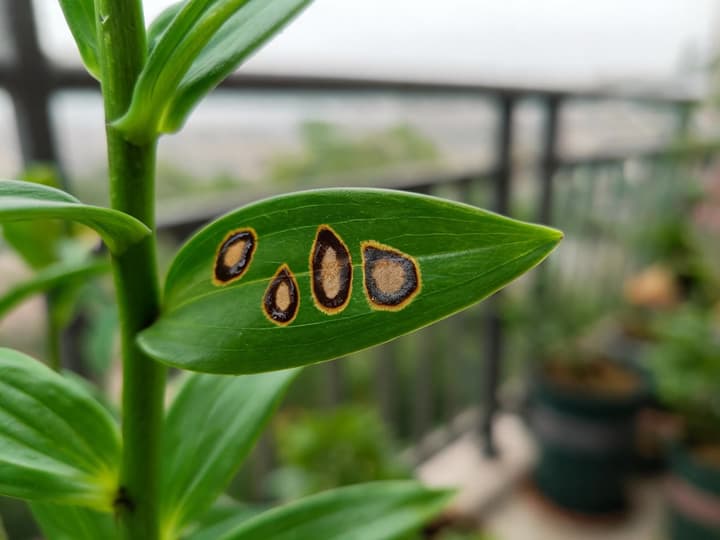
The Pacific Northwest handbook lists commercial fungicides for wholesale growers. The RHS notes that there are no recommended chemical controls for lily diseases in the home garden. This guide follows the RHS, as it addresses home growers directly:
Snip off spotted leaves and discard them in the trash, away from compost bins.
Water directly at soil level, keeping the leaves completely dry.
Space the pot away from other plants so air circulates freely between leaves.
The Bloom factsheet on gray mold in Asiatic lilies shows how the disease establishes and how to prevent it:
Yellow streaks and distorted foliage: virus
A viral infection in a lily presents as yellow streaks along the leaf, twisted or malformed foliage, and sparse flowers that may fail to open. The RHS describes this pattern with tulip breaking virus, spread from plant to plant by aphids. Because the virus infects both tulips and lilies, the RHS advises against growing them side by side.
Plant viruses have no cure. The US Ask Extension service directs growers to dig up and destroy infected lilies. Discard the plant along with its bulb so aphids cannot spread the virus to neighboring pots.
Aphids cluster on the undersides of leaves as colonies of soft-bodied insects. The Connecticut Agricultural Experiment Station recommends insecticidal soap or horticultural oil applied at labeled rates. Bloom's plant issue guide on Asiatic lily leaves turning yellow lists aphids among the causes of yellowing for this species.
New upper leaves turning yellow: light and nutrition
Pale green or yellow leaves near the top of a lily while the plant is actively growing indicate chlorosis. Chlorosis is yellowing that develops when foliage cannot synthesize chlorophyll due to a lack of nutrients or light. The Manitoba Regional Lily Society, a Canadian growers' organization, links lily chlorosis most frequently to iron deficiency. The society also notes that extended low-light conditions cause new shoots to turn pale yellow.
The fix is light and fertilizer. During the vegetative stage, lilies need direct sun on their foliage; NC State recommends full sun on the leaves with shade over the root zone. Oriental lilies require acidic soil and cannot tolerate alkaline conditions, according to NC State.
Epsom salts (magnesium sulfate) will not cure yellow lily leaves. The Elisabeth C. Miller Library at the University of Washington Botanic Gardens cites researcher Linda Chalker-Scott from Washington State University, who cautions against using Epsom salts in home gardens and landscapes. It only helps when a verified magnesium deficiency exists, which is typical of intensive agriculture rather than home pots.
The scarlet lily beetle is not a risk in Brazil
The scarlet lily beetle (Lilioceris lilii) appears in many American texts about lilies. Utah State University Extension describes it as a pest from Europe and Asia that arrived in North America. It chews holes and notches in the leaves, which is another symptom, distinct from yellowing.
GBIF, the global species database, had 74,430 records for this beetle as of September 22, 2026. None came from South America. In Brazil, the pest to look for on lilies is the aphid.
Lilies are toxic to cats
All parts of the lily are toxic to cats, including the pollen and the vase water. The FDA is the health agency of the United States. It states that a small piece of a leaf can cause kidney failure in less than 3 days. A yellow leaf that fell on the floor counts too.
The ASPCA notes that cats are the only known species to develop this acute kidney damage. If your cat chewed on the plant, call a veterinarian immediately without waiting for symptoms to appear. The Asiatic lily profile in Bloom details its toxicity profile:
Frequently asked questions
Should I cut off yellow lily leaves?
Not after blooming. Leaves yellowing from the base upward are actively transferring stored food to the bulb. Iowa State recommends cutting the stem down to the ground only after it dries out completely. The exception is a leaf infected with Botrytis blight. Prune it off and throw it in the trash, as recommended by the RHS, to keep fungal spores from spreading.
Can yellow lily leaves turn green again?
Leaves that turn yellow at the end of the seasonal cycle will not recover, as the entire top growth dies down a few weeks after blooming. Pale green leaves caused by chlorosis can darken back up: the Manitoba Regional Lily Society notes that improved light, warmth, and fertilizer usually correct this pale yellowing. In both situations, emerging growth shows whether your fix worked.
How often should I water an Asiatic lily?
Water your lily whenever the surface of the soil feels dry to the touch, adding water until it drains from the bottom hole, as Iowa State outlines. Go by soil moisture, not by the calendar. In hot weather with the pot in the sun, soil dries far faster than in a cool indoor room. Sticking to a rigid calendar can leave soil soaked or bone dry.
Can a lily with yellow leaves be saved?
In most cases, yes, and your next step depends on timing. If yellowing started after flowering, the plant is in no danger: it is simply completing its life cycle while the bulb stays alive. If it started before bloom, squeeze the bulb. A firm bulb will bounce back with adjusted watering. A soft bulb with a dark, mushy base cannot be saved and belongs in the trash along with its soil.
What to do today with a yellowing lily
If the final bloom has already dropped, leave the foliage on the stem and move the pot to a bright spot where the leaves receive sun. Water whenever the soil surface dries out. If the lily is still in bloom or carrying unopened buds, unpot the plant and squeeze the bulb before trying anything else. In calatheas with yellow leaves and crotons with yellow leaves, yellowing is also diagnosed by where the leaf sits and when it appeared. For symptoms not covered here, see how to diagnose your plant issues in three questions.
Sources
Iowa State University Extension: Selection and Care of the Easter Lily (revised March 2024).
University of Illinois Extension: Easter Lily Care (May 2021).
University of Minnesota Extension: Easter lily care (March 2026).
University of Wisconsin–Madison Extension: Easter Lily, Lilium longiflorum.
Pacific Northwest Plant Disease Management Handbook: Lily, Basal Rot and Botrytis Blight (reviewed in March 2026).
Royal Horticultural Society: Lily diseases; How to grow lilies.
Connecticut Agricultural Experiment Station: Lily, Easter or Garden (Lilium).
NC State Extension Plant Toolbox: Lilium; Lilium Oriental Hybrids.
Ask Extension: Oriental Lily Turning Yellow (No. 461699).
Manitoba Regional Lily Society: Chlorosis.
Elisabeth C. Miller Library, University of Washington Botanic Gardens: On the use of Epsom salts in the garden.
Utah State University Extension: Lily Leaf Beetle (September 2021).
GBIF: Lilioceris lilii, records by country, accessed on 09/22/2026.
FDA: Lovely Lilies and Curious Cats (September 2021); ASPCA: Lily.
Related articles
How to Care for a Goldfish Plant: Light, Watering, and Blooms
How to care for a goldfish plant: bright light without strong sun, water when the soil surface dries, and humid air. Learn how to tell a Nematanthus from a Columnea, why it drops leaves, and how to get it to bloom again.
Lavender Leaves Turning Yellow: Where the Yellowing Starts Shows the Cause
Lower leaves turning yellow with moist soil means overwatered roots, the most common cause. Old leaves drying one by one on woody stems is normal. Take the stem and root test, see if your plant can still be saved, and find out what to do today.
How to Propagate Lavender: Where to Cut and Why Cuttings Rot
A lavender cutting comes from a non-flowering branch tip, about 4 inches long, planted in sandy soil that never stays soggy. Learn where to cut, rooting times, seasonality in Brazil, and what to do if the base turns black.