How to propagate succulents: the right method for every type
An entire leaf turns into a cutting in sedum, graptopetalum, jade, and kalanchoe. Echeveria and aeonium take better from a stem-cut rosette, and haworthia from offsets. See how many days to callus, what soil to use, and when to water the cutting.
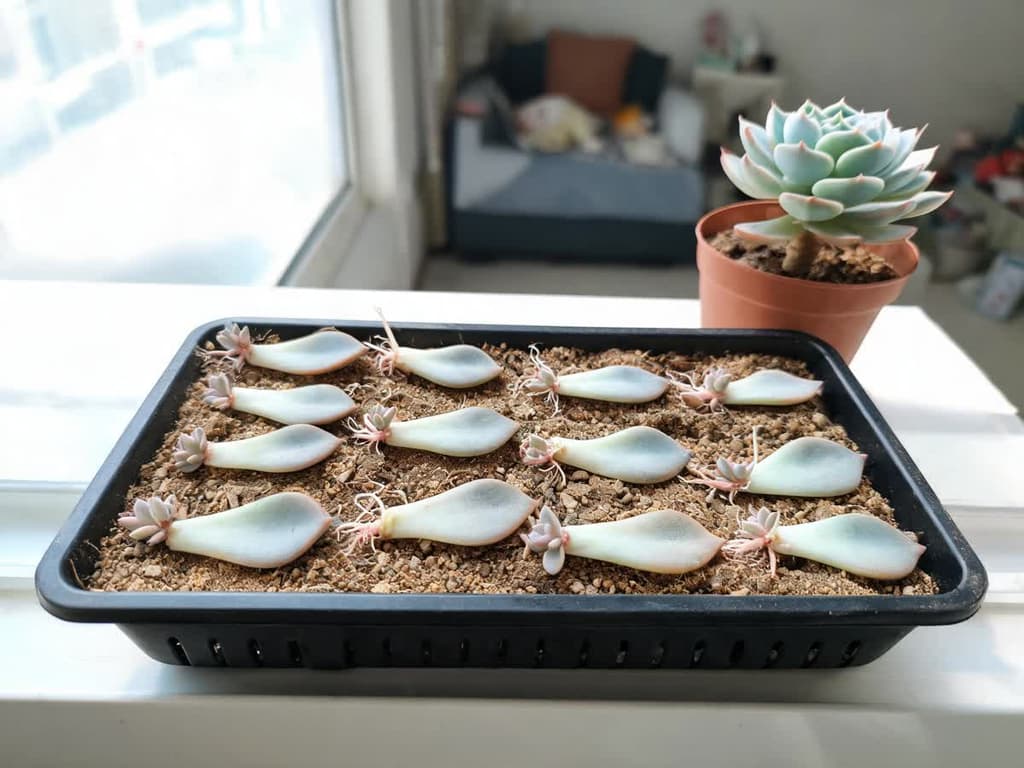
To propagate succulents, take a whole leaf or cut a piece of stem. Let the cut dry for 4 to 7 days. Afterward, lay the leaf on light, barely moist soil, or bury the base of the stem in this soil. The method changes depending on the succulent type. An individual leaf becomes a new plant in sedum, graptopetalum, jade, and kalanchoe, according to Iowa State University Extension. Echeveria and aeonium take better from the rosette (the flower-shaped cluster of leaves at the top of the plant), cut with a piece of stem.
Succulents that grow in rosette clusters, such as haworthia and sempervivum, multiply through the offsets at the base. In Brazil, the best time runs from September to December, in spring and early summer.
Quick summary:
Leaf: remove the whole leaf, along with the base attached to the stem. A leaf fragment will not root.
Stem: cut 3 to 6 inches (7.5 to 15 cm) and strip the leaves from the bottom half.
Callus: let the cut dry for 4 to 7 days, until the end is dry and closed over.
Soil: a light mix that drains water, only moist at the surface, never soggy.
Light: a bright spot, shielded from direct sun, until the cutting establishes roots.
Which propagation method works on each type of succulent
"Succulent" is a group with thousands of plants from different families, and each genus has an easier way to propagate. Iowa State University publishes a table dividing the most common genera by method: leaf, stem cutting, or offset. The offset is the small plant that sprouts attached to the base of the mother plant, already with its own roots.
Succulent type | Best-working method | Note |
|---|---|---|
Sedum (burro's tail), graptopetalum, pachyphytum | Leaf and stem cutting | The leaf detaches easily and roots on its own |
Jade and other crassulas | Leaf and stem cutting | A broken branch becomes a cutting |
Kalanchoe (flaming Katy) | Leaf and stem cutting | A stem cutting yields a larger plant faster |
Echeveria | Stem cutting and stem-cut rosette | Leaves also root, but take longer |
Aeonium | Stem cutting and stem-cut rosette | The rosette that blooms dies in most species |
String of pearls (Senecio rowleyanus) | Stem cutting | Does not appear on the leaf list |
Haworthia, sempervivum, aloe vera, agave, lithops | Offsets and division | Separate the offset with roots |
Mother of thousands | Plantlets along the leaf margins | It already drops ready-to-grow plantlets |
The Iowa State table shows the easiest method, not the only possible one. On echeveria, sources diverge. Iowa State lists only stem cuttings. The echeveria profile on NC State Extension and the Royal Horticultural Society (RHS) leaf cutting guide state that the leaf also forms a new plant. The RHS names echeveria, kalanchoe, and jade among succulents that root very well from leaves. This guide follows both: an echeveria leaf roots, and a stem cutting grows into a good-sized plant faster.
According to NC State Extension, in most species of aeonium the flowering rosette dies after setting seed. In branching species, the rest of the plant keeps growing; in unbranched species, the whole plant reproduces only by seed. Therefore, take your aeonium cutting while the rosette has not yet bloomed.
If you do not know the name of your succulent, flower shape helps separate the genera. See how to identify succulents by their flower. Another path is photographing the plant in the Bloom app, which identifies the species from the photo and displays its care method.
How to propagate succulents from leaves
Leaf propagation works with sedum, graptopetalum, pachyphytum, crassula, and kalanchoe, according to Iowa State. The process has four steps: remove the whole leaf, let it dry, lay it on the soil, and keep the surface moist. A leaf cutting takes longer to become a plant than a stem cutting.
Remove the entire leaf, with its base
Grip the leaf close to the stem and wiggle it gently from side to side until it releases. The leaf must come off whole, along with the base that was attached to the stem. According to Iowa State, the cells at this base contain the tissue that forms roots and new growth. A torn leaf, or one ripped at the base, will not root.
Choose firm, plump, green leaves from the middle of the plant. West Virginia University (WVU) Extension recommends using a fleshy, green, healthy leaf from an actively growing part of the plant.
Let the leaf callus before putting it on soil
To callus is to let the cut end of the leaf air-dry until a dry skin forms over the wound. This film, called a callus, reduces the risk of the leaf rotting in damp soil. Place the leaves on a plate, in the shade, in a well-ventilated spot.
Waiting times vary between sources. The RHS mentions 1 to 2 days for succulent leaves. University of Illinois Extension and WVU recommend 4 to 7 days, for both leaves and stem cuttings. None of the three compare the timeframes. This guide follows 4 to 7 days, because two university extensions agree on that timeline. Plant when the end is dry and closed over, rather than wet or shiny.
Lay the leaf on the soil without burying it
Lay the leaf on lightly moist soil, with the base touching the surface. Iowa State advises against covering the base with soil. WVU directs you to insert the leaf tip shallowly into the soil. This guide follows Iowa State, which covers leaves separately and explains that the roots and rosette emerge from this base. The roots push down into the soil on their own, and the new rosette sprouts beside the base.
A shallow tray with drainage holes in the bottom holds several leaves at once. Lay the leaves down without touching one another, so each rosette has room.
Keep the surface moist, not wet
During rooting, the soil surface should stay moist, not wet. Iowa State suggests a spray bottle to moisten only the top layer without soaking the rest. Mist whenever the surface feels dry to the touch.
Roots and new leaves appear in a few weeks, according to Iowa State. The mother leaf gradually shrivels and eventually dries up, according to the University of Illinois. Leave that leaf in place until it withers away completely.
How to propagate succulents from stems or rosettes
A stem cutting is the fastest method to get a good-sized plant, according to University of Illinois Extension. It works for echeveria, aeonium, jade, kalanchoe, sedum, string of pearls, and desert rose, among others. A cutting is the piece of stem severed to become a new plant.
Cut a 3- to 6-inch (7.5 to 15 cm) stem segment using clean, sharp pruners.
Strip the leaves off the bottom half of the stem.
Let the cut dry in the shade until it forms a callus.
Bury the bare section in lightly moist soil, inserting 1 or 2 nodes (the spots where leaves used to grow) beneath the surface.
Keep it in a bright spot without direct sun, maintaining the soil only slightly moist.
Rooting hormone, a product sold in garden centers to stimulate root growth, is optional. According to Iowa State and the University of Illinois, most succulents root well without it.
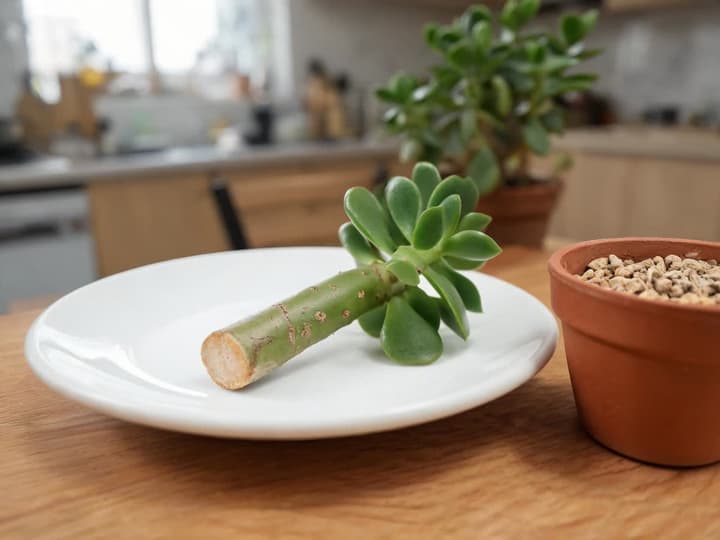
A broken succulent branch turns into a cutting
A broken branch can become another plant using the same stem-cutting method. The jade plant takes both stem cuttings and leaves, according to Iowa State. Clean up the broken end with a straight cut, remove the lower leaves, and let the wound callus before planting.
If the branch is long, you can make more than one cutting from the same piece. Each cutting needs a few leaves at the top and bare stem at the bottom to bury.
Stretched rosette: cut the top and replant
Succulents stretch and open up spaces between their leaves when they get too little light. Iowa State gives the example of echeveria, which stretches and develops thin, elongated growth in low light. The top rosette of this stretched plant can become a new, compact plant.
Decapitating the rosette means cutting off the entire rosette with 1 to 2 inches (2.5 to 5 cm) of stem. Let the cut callus and plant the rosette like a stem cutting. According to Iowa State, the remaining stump in the pot often sprouts several new rosettes along its sides. To keep the new plant from stretching again, check how much light succulents need.
Rotting stem: save the top portion
A soft, black stem at the base points to rot, almost always caused by too much water in the soil. Iowa State explains that when rot is advanced, the solution is to discard the plant or take cuttings from the sections that remain healthy. It is worth trying if firm, green, unblemished stem remains above the darkened area.
Cut the stem above the dark section. Inspect the cut: the interior must be pale and firm. If any dark discoloration remains across the cut, cut again higher up. Let the healthy piece callus and plant it in light, slightly moist soil, just like a stem cutting.
Offsets and clump division
Haworthia, sempervivum, aloe vera, agave, and lithops produce offsets at their base and propagate best this way, according to Iowa State. Gently pull or cut the offset away so it comes with its own leaves and roots. Plant it in light soil within a container that has drainage holes, and water sparingly. The offset establishes itself within a few weeks.
WVU Extension suggests a simple check: give the offset a gentle tug. If you feel resistance, it already has roots and can go straight into a pot. An offset that detached with no roots must callus before planting, like a stem cutting.
Mother of thousands develops plantlets along the edges of its leaves, and Iowa State classifies it among succulents that propagate by offsets. It is a kalanchoe, and the step-by-step instructions for other kalanchoes appear in the guide on how to propagate kalanchoe.
Soil, light, and watering for succulent cuttings
The rooting medium must drain water rapidly. The University of Illinois uses 1 part potting soil and 1 part perlite (lightweight white grains of volcanic rock that loosen soil). WVU also recommends 3 parts potting soil, 2 parts coarse sand, and 1 part perlite.
Choose small individual pots with drainage holes at the bottom. According to the University of Illinois and WVU, a small pot prevents the cutting from staying too moist.
Keep the cutting in a bright spot, protected from direct sun. The RHS recommends good light without strong sun. Iowa State says most succulents do best with bright, indirect light. In Brazil, a north-facing window receives the most sun throughout the day. If sun from this window hits the cutting directly, move the cutting away from the glass until it is in bright light without direct sun, or use an east-facing window.
For stem cuttings, water the soil when the surface dries and keep the medium lightly moist, never saturated. WVU warns that excess water rots the cutting. Once the cutting takes root, switch to adult plant watering: soak thoroughly and wait for the soil to dry completely. Step-by-step guidance is in the article on how to water succulents.
How long succulent cuttings take to root
WVU notes that a stem cutting takes at least 1 month to establish an adequate root system. Leaves take longer: the University of Illinois reports a small plantlet forming at the base of the leaf after 1 to 2 months. The RHS points to spring and early summer as the best window for leaf cuttings.
To tell whether a cutting has rooted, give it a gentle tug. If the cutting offers resistance, roots have formed. When the roots hold all the soil together as you lift the cutting, it is ready for a new container. The University of Illinois recommends a pot that is 1 to 2 inches (2.5 to 5 cm) wider.
A succulent cutting does not need fertilizer while developing roots. Fertilizer comes in once it is actively growing in its permanent pot, as detailed in the guide on how to fertilize succulents.
Does propagating succulents in water work?
Most succulents do not root well in a glass of water, according to Iowa State. The extension recommends rooting cuttings in well-draining media, such as a cactus mix or perlite. Light, barely moist soil remains the safest route for both leaves and stems.
Mistakes that cause succulent cuttings to rot or dry up
Leaf broken at the base. Without the base, the leaf will not grow roots or a shoot.
Planting without a callus. A fresh cut touching damp soil rots much more easily.
Burying the leaf. The base rests right on the surface, without soil piled over it.
Waterlogged soil. Moisten only the surface for leaf cuttings and water stem cuttings lightly.
Direct sun on the cutting. A rootless cutting loses water faster than it can replenish it.
Waiting for an aeonium flower. The blooming rosette dies in most species, so take the stem cutting beforehand.
Loose leaves on a propagation tray sit within reach of dogs and cats for weeks. The ASPCA, an American animal protection organization, classifies jade and kalanchoes as toxic to dogs and cats.
Keep the propagation tray up high, well out of reach of pets.
Frequently asked questions
What is the best time of year to propagate succulents?
In Brazil, from September to December, in spring and early summer. The RHS indicates spring and early summer as the best time for leaf cuttings. From June to August, in the Brazilian winter, the timing is not the best, but the RHS says some succulents take at any time of year. Care for this phase is in the guide to succulents in winter.
How can I make succulents root faster?
Use stem cuttings instead of leaves, take cuttings in spring or summer, and plant only after a callus has formed. Stems grow into a good-sized plant faster, according to the University of Illinois. Rooting hormone can speed things up, but Iowa State and WVU note that it is not necessary.
Can I put multiple succulent leaves in the same pot?
Yes, in a tray or shallow dish with drainage holes, spacing the leaves so they do not touch. Once the new rosette has its own root system and the mother leaf dries out, move each cutting into its own container. According to the University of Illinois, a small individual pot keeps the cutting from sitting in excess moisture.
Do succulent cuttings need direct sun?
They need bright light, but keep them out of direct sunlight until roots establish. The RHS advises protecting leaf cuttings from strong sun, and Iowa State recommends bright, indirect light for most succulents. Once the cutting takes, acclimate the plant to direct sun gradually, adding more sun exposure each day.
Next step
Pick the method suited to your succulent type and let the cut form a callus. Then, set up your tray in a bright spot without direct sun. Once the cutting is firmly established in its pot, switch to the adult plant routine described in the guide on how to care for succulents.
To find out which succulent you have and which method to use, Bloom identifies the plant from a photo. The app is for iPhone.
Sources
Iowa State University Extension and Outreach. How to propagate succulents.
Iowa State University Extension and Outreach. Common and popular succulent species.
Iowa State University Extension and Outreach. Common problems and issues of succulents.
University of Illinois Extension. Propagating succulents and cacti.
West Virginia University Extension. Succulents 101.
Royal Horticultural Society (RHS). Leaf cuttings.
NC State Extension. Echeveria, Aeonium, Crassula ovata, and Sedum morganianum.
ASPCA. Jade plant and Kalanchoe.
Related articles
How to Care for a Goldfish Plant: Light, Watering, and Blooms
How to care for a goldfish plant: bright light without strong sun, water when the soil surface dries, and humid air. Learn how to tell a Nematanthus from a Columnea, why it drops leaves, and how to get it to bloom again.
Lavender Leaves Turning Yellow: Where the Yellowing Starts Shows the Cause
Lower leaves turning yellow with moist soil means overwatered roots, the most common cause. Old leaves drying one by one on woody stems is normal. Take the stem and root test, see if your plant can still be saved, and find out what to do today.
How to Propagate Lavender: Where to Cut and Why Cuttings Rot
A lavender cutting comes from a non-flowering branch tip, about 4 inches long, planted in sandy soil that never stays soggy. Learn where to cut, rooting times, seasonality in Brazil, and what to do if the base turns black.