Flowering Succulents: Identify the Species and See if Your Plant Will Die
A succulent's flower identifies the species much more accurately than its leaves. It also answers a critical question: will this rosette die after blooming? The first detail to look for isn't the petal color, but where the stalk is coming from.

Your succulent is growing a flower stalk. You want to know two things: what kind of plant is this, and is this bloom a good sign or the beginning of the end? The flower answers both questions.
With rosette-shaped succulents, the first detail to look for isn't the petal color, but where the stalk is growing from. A rosette is simply the shape: leaves growing in a circular, overlapping pattern like an open rose. If the stalk grows from the very center of this rosette, and the center stops producing new leaves, that rosette will die after setting seed. If the stalk grows from the side, out from between the leaves, leaving the center intact, the plant will live and bloom again next year.
This single detail separates the most commonly confused genera at the garden center. It also determines whether you are watching a plant die or watching it reach maturity.
Quick summary:
Stalk from the center, rosette stops growing leaves: Sempervivum, Aeonium, and Agave. That specific rosette will die. The offsets around it will survive.
Stalk from the side, center remains intact: Echeveria, Graptopetalum, Haworthia, and Aloe. The plant is perfectly safe.
Shrubby plants without rosettes: jade plants, kalanchoes, and Sedum bloom at the tips of their stems and never die because of it.
Count the petals. Four petals in dense clusters mean it is a kalanchoe. Five white petals with red spots mean ghost plant. Anywhere from 7 to 20 petals on a thick stalk means Sempervivum.
Blooming comes with maturity. Aloe plants only bloom when they are at least 3 years old. Aeonium takes 3 to 5 years.
"Bloom booster" fertilizer does not force flowers. Phosphorus is a mineral, not a hormone.
Where the stalk grows tells you if your succulent will die
In rosette succulents, the position of the flower stalk predicts the plant's fate. A stalk sprouting from the center consumes the growth point, which is the very middle where new leaves form. That rosette spends all its energy to produce seed and dies afterward. A stalk sprouting from the side leaves the center intact, allowing the plant to bloom again in future seasons.
The three scenarios that cover almost everything you will find in a home:
The stalk sprouts | What happens to the plant | Most common genera |
|---|---|---|
From the center of the rosette, which stops making new leaves | That rosette dies after producing seed. The side offsets survive | Sempervivum, Aeonium, Agave |
From the side, between the leaves, with the center intact | Nothing. The plant blooms again the following year | Echeveria, Graptopetalum, Haworthia, Aloe |
At the tip of the branches of a shrubby plant | Nothing. There is no rosette to be compromised | Crassula, Kalanchoe, Sedum |
The North Carolina State University Extension is explicit on both extremes. Regarding Sempervivum: "each individual rosette dies after flowering" (NC State Extension). Regarding Echeveria: "once a year, rosettes produce one or more flower stalks that rise above the rosette" (NC State Extension). And the plant remains there.

How to identify your succulent genus by its flower
Once you make that first distinction, the flower reveals the genus. Below are the features you can see with the naked eye, listed in the order you are most likely to find these plants at home.
Before we begin, a quick calendar note. American university extension sources base their bloom dates on the Northern Hemisphere. The season translates, but the month does not. Where a source says "June to August," read "summer": in the Southern Hemisphere, this period runs from December to March.
Echeveria: side stalk with tubular pink flowers
The stalk is long and thin, often arching, and grows from between the lower leaves. The flowers are tubular with 4 to 5 petals, deep pink to salmon, sometimes with yellow markings inside.
They hang in a loose cluster at the tip of the stalk. Echeveria blooms in spring and summer, once a year. The rosette is not harmed by this process.
Sempervivum (hens and chicks): thick stalk in the center of the rosette
The stalk is thick, grows from the center, and reaches 8 to 12 inches (20 to 30 cm) tall. It carries star-shaped flowers with 7 to 20 petals in yellow, pink, or deep red.
If you confuse Sempervivum with Echeveria by their leaves, you won't confuse them by their flowers. Sempervivum sends up a central stalk and dies afterward. Echeveria sends out a side stalk and keeps living.
Kalanchoe blossfeldiana (flaming Katy): flower clusters with four petals
The florist kalanchoe does not form a rosette. It produces dense, rounded clusters above the foliage, with dozens of tiny, four-petaled flowers in red, orange, pink, yellow, or white. The leaves are thick with scalloped edges. The University of Illinois Extension notes that the flowers last six weeks or more (Emily Swihart, December 2025).
The same source points out an important detail for pet owners. The ASPCA lists this kalanchoe as toxic to dogs and cats due to compounds that affect the heart, which are present throughout the entire plant. Its profile combines watering, light, and safety warnings in one place:
Sedum: star-shaped flowers with twice as many stamens
Sedum produces flat, dense clusters of small, star-shaped flowers with 4 to 6 petals. Under a magnifying glass, the mark that separates it from almost everything else appears. The number of stamens is usually twice the number of petals (NC State Extension). A stamen is the thread that supports the pollen in the center of the flower.
Sedum blooms from spring to fall, depending on the species, and the plant never dies because of it.
Crassula ovata (jade plant): white clusters appearing in winter
The jade plant produces tight, rounded clusters of star-shaped flowers, white or pale pink, under 0.4 inches (1 cm) wide, with a faint sweet scent. They bloom at the tips of the branches in winter, almost exclusively on older plants.
NC State notes that the jade plant "rarely flowers as an indoor plant." If yours bloomed, it is because it experienced a cool, dry, and dark winter, which is a testament to your care.
Graptopetalum paraguayense (ghost plant): white stars with red spots
The flowers are star-shaped with 5 petals, white with tiny red spots, gathered in clusters in early spring. No other common rosette genus has this spotted pattern.
If you have a grayish rosette trailing over the side of your pot and the flower is spotted, there is no doubt.
Aloe (aloe vera): tall cluster of tubular orange flowers
Aloe vera produces a tall, cylindrical cluster of tubular orange or yellow flowers. The stalk reaches close to 1 m (3 feet) and the flowers open from the bottom up.
Aloe vera only blooms on a mature plant, at least 3 years old, and repeats the flowering several times throughout its life (NC State Extension).
Haworthia (zebra plant): thin, long stalk with white flowers
The stalk is thin, upright, and disproportionately long for the size of the plant. It carries small, tubular white flowers, sometimes with pinkish stripes, which are widely spaced.
The flowers are quite inconspicuous, which is exactly what makes them easy to recognize. They appear in late spring and summer.
Aeonium: branched cluster at the top of the stem, and the rosette dies afterward
Aeonium produces a large, branched cluster at the top of the stem, with dozens of small, star-shaped flowers in cream, yellow, or pink. The blooming rosette dies.
In branching species, the rest of the plant continues. In non-branching ones, the plant ends there. Aeonium takes 3 to 5 years until its first bloom (NC State Extension).
Curio rowleyanus (string of pearls): daisy flower with a cinnamon scent
The flowers are white and round like a pompom, half a centimeter (0.2 inches) in size. Red and yellow stamens emerge from them, and they smell like cinnamon.
It is a little daisy. The string of pearls does not belong to the Crassulaceae family, but rather to the sunflower family. Its scientific name is no longer Senecio (NC State Extension). If you saw this flower in a hanging pot, the plant is not a Sedum.
Agave: a stalk of several meters, only once in a lifetime
The Agave produces a stalk that exceeds several meters, emerging from the center of the rosette, with tubular flowers of 6 petals. This takes from 5 to 60 years to happen, and it is only once.
Most species die the following season, after the flowers produce seeds.
The species mentioned in this guide, along with photos and care sheets for each:
Succulents that bloom once and die
Some succulents bloom only once in their lifetime and then die. This is a reproductive strategy, not a sign of disease. The plant accumulates reserves for years and spends them all at once on a massive bloom to produce plenty of seeds.
The technical term is monocarpic. Sempervivum, Aeonium, and Agave belong to this group.
You do not lose the plant. Sempervivum spends its entire life producing offsets around itself before blooming. This is why it is commonly called hens and chicks.
NC State describes the arrangement: "the original rosette is called the hen; the offsets of this rosette are called chicks." And it adds: "plants spread by offsets to form colonies" (NC State Extension). When the mother rosette blooms and dries up, what remains in the pot is her colony.

Let the blooming happen. Once the mother rosette dries up, remove it along with the entire stalk and let the offsets fill the space. If the pot is crowded, this is the perfect time to separate the chicks and repot them.
The same logic applies to Aeonium, with one exception. If your plant has a branched stem with several heads, only the branch that bloomed will die. If the plant is a single stem with one rosette on top, it will die completely. Taking stem cuttings before it blooms is your only way to propagate it.
Should you cut the stalk after blooming?
The answer depends on the group. For succulents that survive blooming, cutting the stalk is optional: the choice is aesthetic and helps prevent pests, rather than being a health requirement. For monocarpic succulents, cutting the stalk will not save the rosette because the growth point has already turned into a flower, which is irreversible.
For those that do not die (Echeveria, Graptopetalum, Haworthia, Aloe, Sedum, jade plant, and kalanchoe), blooming consumes energy, but not enough to compromise a healthy plant. Two practical reasons to cut: dry stalks can become a haven for mealybugs, and some Echeveria species produce stalks so long they can tip the pot over. Cut close to the base with clean shears after the last flowers fade.
For monocarpic plants, cutting the stalk simply hastens the end without preventing it. It also robs you of the chance to collect seeds. Let them bloom and focus on caring for the offsets.
There is one practical exception. If the plant is weak, with few leaves and many offsets relying on it, cutting the stalk can redirect some energy back to the pups. This is the only scenario where shears will help.
Why your succulent isn't blooming
Succulents bloom based on maturity combined with the season, not from any product you apply. Three conditions must align.
First, the plant must be old enough to have stored reserves. Second, it needs an entire season of bright light to build those reserves. Third, for several genera, a cool, dry rest period is what triggers the flower buds. You cannot rush two of these three.
Age. Aloe only blooms on mature plants that are at least 3 years old. Aeonium takes 3 to 5 years. Agave takes 5 to 60 years. That 2-inch (5 cm) rosette you bought eight months ago is not going to bloom yet, and there is nothing wrong with it.
Months of bright light. To bloom, the plant must have stored energy over an entire growing season of high light. Succulents in low light will survive and stretch, but they cannot build up enough reserves to produce flowers. If you are not sure if your plant gets enough light, check quantas horas de sol a suculenta precisa.
A cool, dry rest period. In several genera, this period is what triggers the flower buds, and there is a specific method for it. For jade plants, the University of Wisconsin-Madison Extension recommends withholding water in autumn.
The plant must be kept around 13 °C (55 °F), especially at night, and away from artificial light. The flowers respond to long nights. After several weeks of cold, drought, and darkness, resume watering normally (Susan Mahr, revised in April 2025).
Kalanchoes are even more sensitive to light cycles. The University of Illinois Extension notes that buds form after six weeks of nights that are at least 14 hours long. Leaving a living room lamp on late at night is enough to disrupt this process.
The "bloom booster" fertilizer trap. Phosphorus is a mineral, not a growth regulator. Unless there is a deficiency, adding more will not produce any effect. Washington State University explains where this myth comes from. When a missing nutrient is restored to the potting soil, the plant returns to its normal growth rate.
Fertilizer manufacturers and landscapers read this recovery as stimulation (Linda Chalker-Scott, WSU Puyallup). The same publication notes that excess phosphorus harms mycorrhizal fungi, which are the root-associated fungi that expand its reach. In a young succulent, which is not yet old enough to bloom, the plant wastes energy without producing flowers.
What proper fertilization actually does is support the growing season that precedes the bloom. You can read about this in adubo para suculentas.
Frequently Asked Questions
How do I know which succulent I have?
Start with the overall shape (rosetta, shrubby, or trailing), then look at the leaves. If there is a flower, use it: it is the most reliable feature to determine the genus. Count the petals, look at where the stalk grows, and note the season it appeared. Only then should you look for the species within that genus.
Which succulents grow flowers?
All succulents bloom because they are all flowering plants. What changes is how easily they do it. Kalanchoe, Sedum, Graptopetalum, and Echeveria bloom early and regularly indoors. Aloe, jade plants, and Agave require years of maturity and specific conditions, which is why they are often mistaken for non-flowering plants.
Which succulent looks like a flower?
The most common confusion is not with an actual bloom. The rosettes of Echeveria and Sempervivum have leaves arranged in a spiral that look like an open rose, but this is foliage. The actual flowers appear later on a separate stalk. When people buy a "flower succulent," they are almost always buying the rosette shape, not a blooming plant.
Can you identify a succulent from a photo?
Yes, and a photo of the flower works much better than a photo of the leaves, because succulent leaves change color and shape based on light and temperature. Photograph the entire plant and then get a close-up of the open flower in natural light with a neutral background. You can check your results against our list of apps para identificar suculentas.
Is there a plant identification app with a free version?
Several apps offer free tiers with varying limits. Bloom, for example, has a free mode with 2 identifications per month and a watering schedule. Unlimited identifications and disease diagnostics are part of the paid plan. It is available for iOS.
What to do next with your succulent
If your succulent's stalk grew from the center of the rosette, that rosette will eventually dry up. A colony of offsets is already prepared to take its place. If the stalk grew from the side, your plant has simply reached maturity.
In both cases, what determines the next bloom is the upcoming season of bright light, followed by a cool, dry rest. The basic care that supports this entire cycle can be found in como cuidar de suculentas.
If even the flower didn't solve your identification mystery, photograph the whole plant and then take a close-up of the open bloom. Use natural light and a neutral background. This is how photo identification gets the genus right.
Related articles
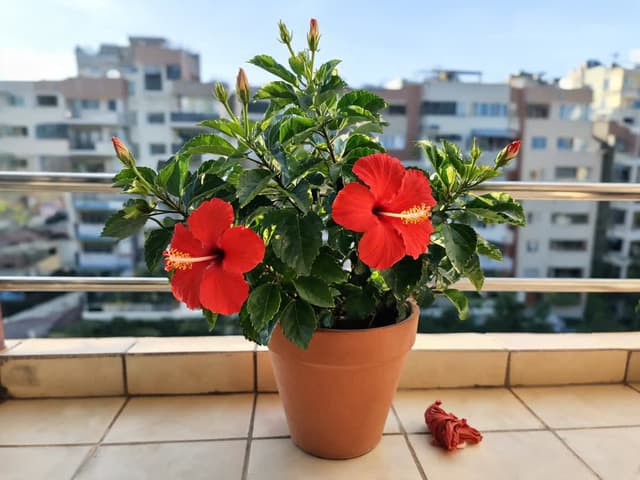
How to Care for Hibiscus: Sun, Watering, Fertilizer, and Pruning for Flowers
How to care for hibiscus: 6 hours of direct sun, evenly moist soil without waterlogging, half-strength fertilizer in spring and summer, and pruning in early spring. Find out why the flower lasts one day and why buds drop before opening.
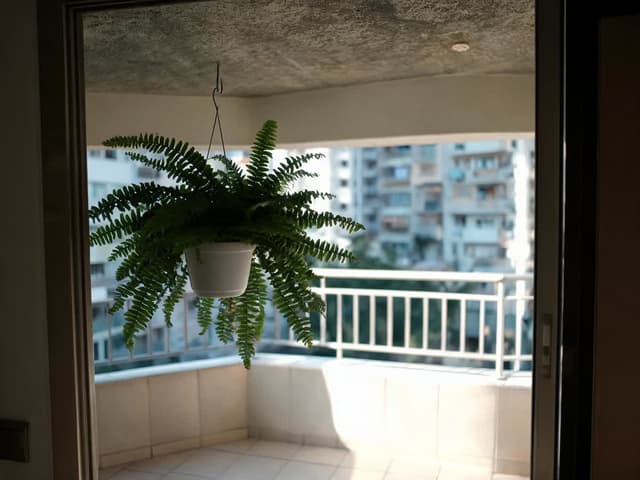
Do Ferns Like Sun or Shade? It Depends on the Type
Ferns prefer bright shade: plenty of light, but no direct sun on their fronds. Tuberous sword fern is the exception that handles sun. Here is the ideal light for each type, where to place pots, and how fronds show too much or too little light.
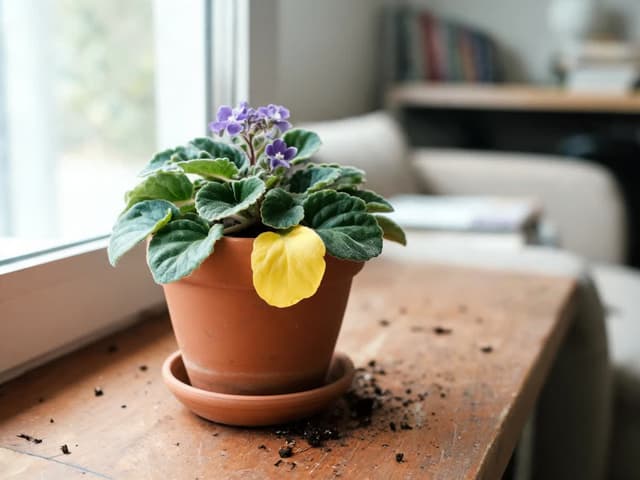
African Violet Yellow Leaves: Causes and What to Do
Yellow leaves on an African violet usually stem from overwatering, and the first place to check is the center of the plant. Losing one lower leaf at a time is normal. Identify whether age, watering, cold water, sunlight, cold drafts, or fertilizer is the culprit based on the yellowing pattern, and see what to do today.