Low-Light Office Plants: 7 That Survive
An office desk gets around 50 foot-candles (540 lux) of overhead light, which shuts off at night and over the weekend. Discover 7 low-light office plants, why they work, and how to manage AC and weekend watering.
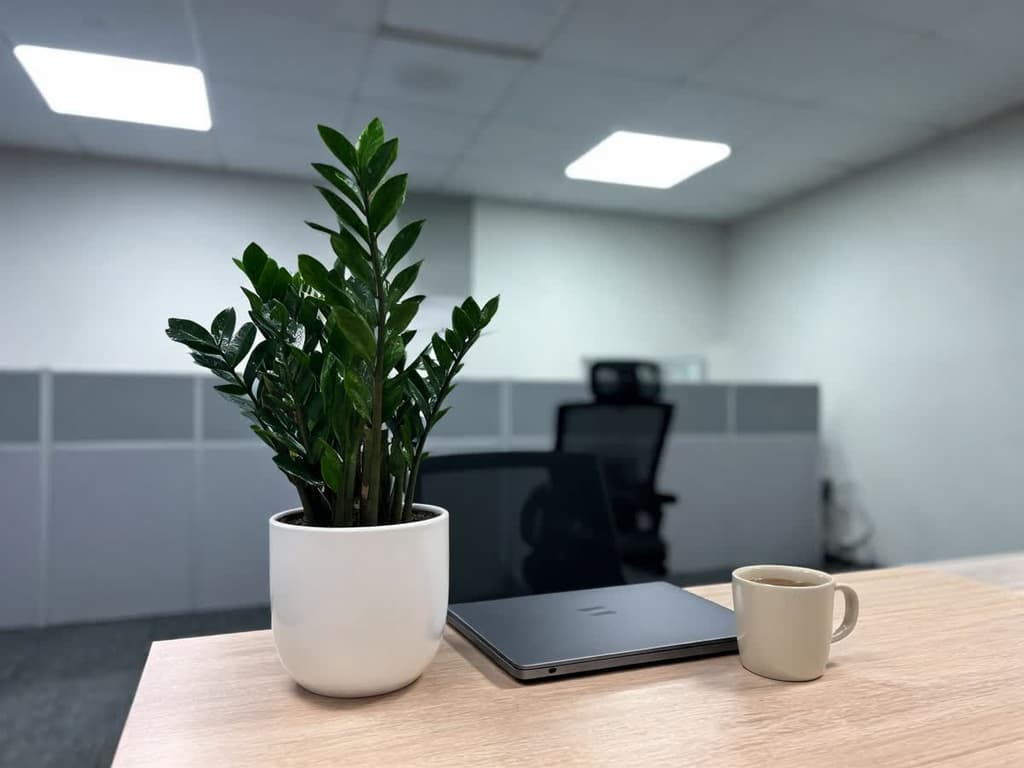
The best low-light office plants are the ZZ plant, snake plant, cast-iron plant, dracaena, aglaonema, heartleaf philodendron, and pothos. All seven can live entirely on light from overhead ceiling fixtures, provided you keep them on a desk rather than the floor. Two of them, the ZZ plant and snake plant, can also survive two weeks without water.
An office features three conditions your living room does not. The light comes almost entirely from artificial bulbs and shuts off at night and over the weekend. The air conditioner blows cold air constantly in the same direction. And nobody waters the plant between Friday and Monday.
Quick summary:
A typical office receives around 50 foot-candles (540 lux) of light, according to NC State. For a plant, this already qualifies as low light.
With lights turned off at night and over the weekend, a desk gets only about one-third of the weekly light that an average houseplant requires.
Fluorescent bulbs are sufficient for foliage plants (those grown for their leaves rather than their flowers), according to NC State. Flowering plants, such as the peace lily, require more light than this.
Damage from the air conditioner comes from the direct stream of cold air and from the system shutting off over the weekend, rather than from dry air alone.
Yellow, soft leaves accompanied by damp soil point to overwatering. Under low light, potting soil takes longer to dry out.
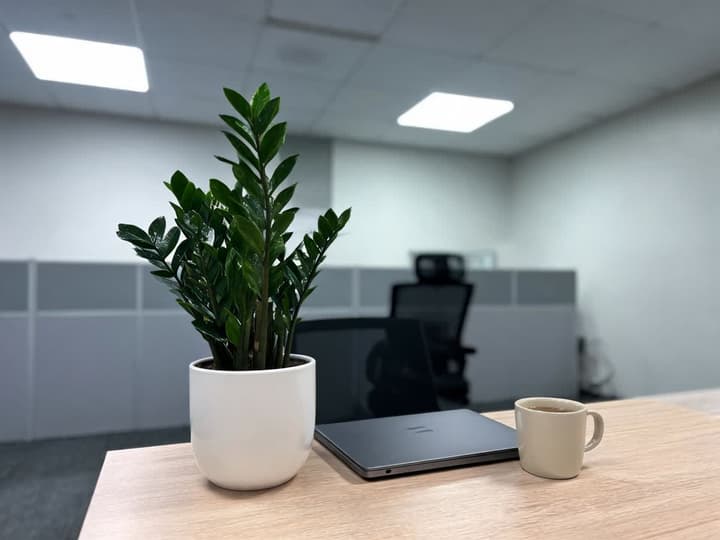
An office desk is already low light
For the University of Georgia (UGA) Extension, low light is the range of 25 to 75 foot-candles received for 8 hours a day. The foot-candle is the unit of light used in American gardening sources, and each foot-candle equals about 10.8 lux. In lux, the unit that phone apps show, the range goes from about 270 to 810 lux.
The NC State environmental light table puts offices at 50 foot-candles, or around 540 lux. The same table gives 20 foot-candles for libraries and classrooms and 100 for supermarkets. A work desk seems bright to someone reading and typing, but for a plant it falls right in the middle of the low-light range.
The second challenge is duration. NC State estimates that the average indoor plant requires around 85 foot-candles for 12 hours a day. With that light, it maintains its appearance for a year. The same source notes that for some species, longer hours of exposure can compensate for weaker light levels.
The calculation below multiplies the light intensity by the hours the fixtures stay on each week, resulting in foot-candle-hours. It is our own estimate based on two assumptions: 50 foot-candles at desk height, and lights running 10 hours per workday while remaining off over the weekend.
Situation | Calculation | Foot-candle-hours per week |
|---|---|---|
NC State baseline | 85 × 12 h × 7 days | 7,140 |
Office desk | 50 × 10 h × 5 days | 2,500 |
UGA low-light range | 25 to 75 × 8 h × 7 days | 1,400 to 4,200 |
The desk receives about 35% of the baseline's weekly light, placing it squarely within the low-light range. That is why the species on this list are the same ones that tolerate dark corners at home. The table showing how many months each plant stays attractive in low light applies to the office as well.
To measure your desk, run a light meter app on your phone, holding the device at leaf level. NC State accepts smartphone apps as an alternative to handheld light meters. Below 270 lux, the safest choice is a dracaena, which maintains its appearance for 30 months at 15 to 20 foot-candles.
Can plants survive on artificial light alone?
They can, as long as they are foliage plants. NC State notes that fluorescent lighting is the most widely used source in offices, banks, and stores, and foliage plants grow well beneath it. The same source classifies environments that receive only artificial lighting as low-light situations rather than zero-light settings.
Flowering plants are the exception. Standard fluorescent tubes emit high levels of blue light and very little red, and red light is what triggers flowering, according to NC State. That is why flowering plants are excluded from this list, including the peace lily, which NC State classifies as a medium-to-high light plant.
NC State describes LED fixtures as cooler-running and longer-lasting than conventional options, but it has not published LED measurement data for indoor plants. The rule for LEDs is the same as for fluorescents: what matters is the volume of light reaching the leaf surface.
Plants also need darkness. NC State recommends never leaving a plant under light 24 hours a day. In an office, this happens naturally because the lights go out at night.
On the desk or on the floor: where to put the pot
Place the pot on the desk, as close to an overhead fixture as possible. Artificial light drops sharply with distance. NC State measured a 40 W fluorescent tube: 120 foot-candles at 12 inches from the bulb and just 75 foot-candles at 24 inches.
A floor corner far from the lights is the worst location in an office. Underneath the desk is even worse, because the desktop casts a shadow. If a large floor plant must stay on the carpet, place it directly beneath a ceiling fixture.
A desk lamp fitted with an LED bulb solves the problem for a dim desk. Keep the bulb about 12 to 24 inches from the foliage. Switch it on when you arrive and turn it off when you leave.
If the office has a window, place the plant by it before trying any other solution. In Brazil, north-facing windows receive the most light, and south-facing windows receive the least.
7 low-light office plants
This list is ordered from the plant most forgiving of missed waterings to the one requiring the most attention to light and airflow. Each profile details its office advantage and how its care shifts in a workspace. Expected longevity (how long the plant keeps its attractive appearance under that light) comes from the NC State table.
1. ZZ plant (Zamioculcas zamiifolia)
Office advantage: it tolerates two weeks without water. Its rhizomes, thick underground stems, store moisture. NC State notes that it appears frequently in commercial interior landscape designs.
The ZZ plant is not in NC State's months table. Clemson states that it survives in low light, with very slow growth. Water once to twice a month, only after the potting soil dries out completely, as recommended by Clemson. The complete guide is on the ZZ plant page.
2. Snake plant (Dracaena trifasciata)
Office advantage: it has documented performance at the lowest light tier in the study and barely needs watering. It is one of the few species tested at NC State's lowest benchmark: 12 months of attractive appearance at 15 to 20 foot-candles, or about 160 to 215 lux.
NC State warns that excess water rots the root system. Water only when the potting mix is dry all the way through, and reduce watering further during the coldest months of the year. Variegated yellow-edged varieties lose their yellow borders in low light. The complete guide is on the snake plant page.
3. Cast-iron plant (Aspidistra elatior)
Office advantage: it tolerates the cooler conditions of air conditioning. UGA lists the cast-iron plant among those that grow best at lower temperatures, around 72 °F (22 °C). In the NC State study, it stays attractive for 24 months at 25 to 50 foot-candles. At 50 to 75 foot-candles, it lasts up to 36 months.
Its main drawback is slow growth: under low light, it produces very few new leaves. Let the potting mix dry out thoroughly between waterings. The complete guide is on the cast-iron plant page.
4. Dracaena (Dracaena fragrans)
Office advantage: it tolerates the dimmest light for the longest time. At 15 to 20 foot-candles, dracaena remains attractive for 30 months, the highest rating in the NC State table at that light level. At 25 to 50 foot-candles, it reaches 36 months. The 'Janet Craig' cultivar features shorter leaves and a more compact stem, according to NC State, taking up less desk space.
NC State notes that dracaena is sensitive to fluoride as well as fertilizer and water salts that accumulate in the potting mix. If leaf tips turn brown, water with fluoride-free water, such as rainwater or distilled water. Fluoride precautions and tips for lower leaf drop appear in how to care for dracaena. The profile for the species, also known as corn plant, is on the corn plant page.
5. Chinese evergreen (Aglaonema commutatum)
Office advantage: it matches dracaena's rating, the highest in the study for typical office desk light levels. At 25 to 50 foot-candles as well as 50 to 75, it stays attractive for 36 months.
The Chinese evergreen is the most sensitive plant on this list to air conditioning. NC State notes that leaves turn dark in very dry air or in drafty spots. UGA warns that it suffers chilling injury below 50 °F (10 °C). Keep the pot away from cold air vents. NC State also advises against watering Chinese evergreen with cold water. The complete guide is on the silver queen aglaonema page.
6. Heartleaf philodendron (Philodendron hederaceum)
Office advantage: it tolerates dry air and can trail over the edge of a shelf. NC State notes that it tolerates dry air, though it prefers moderate humidity. In the study, it stays attractive for 30 months at 25 to 50 foot-candles. At 50 to 75 foot-candles, it reaches 36 months.
Under low light, the vines stretch out and the leaves grow farther apart. Prune long stems right above a leaf node to encourage branching near the base. Water when the soil surface dries out, and reduce frequency during the coldest months of the year. The complete guide is on the heartleaf philodendron page.
7. Pothos (Epipremnum aureum)
Office advantage: it is simple to propagate, because stem cuttings root easily in a glass of water. Pothos only appears in the NC State table starting at 50 foot-candles. At 50 to 75 foot-candles, it remains attractive for 30 months. At 75 to 100 foot-candles, it reaches 36 months. It requires a spot on a desk directly under an overhead light, never on the floor in a corner.
NC State notes that low light causes pothos to lose its cream or yellow leaf variegation. Excess water rots roots and turns leaf margins dark. Let the potting mix dry out between waterings. The complete guide is on the pothos page.
Peace lilies, spider plants, and calatheas did not make the list, as they require more light than a standard desk provides. All three are rated for medium or high light in the NC State and UGA tables. The species-by-species breakdown is in plants for low light.
Air conditioning: cold drafts and weekend shutdowns
Dry air from air conditioning does less harm than it seems. In Brazil, ANVISA's Resolution RE No. 9 of 2003 recommends a relative humidity of 40% to 65% in climate-controlled spaces for public use. UGA classifies 40% to 50% humidity as medium humidity for indoor plants. An air-conditioned office within this range is not dry for the plants on this list.
The real problem is the direct stream of cold air. A plant positioned beneath or directly in front of an AC vent receives a continuous cold draft. NC State notes that sudden temperature shifts cause leaves to yellow and drop. Symptoms can appear weeks later. Move the pot out of the airflow path.
The second issue is the weekend shutdown. UGA observes that turning off the air conditioning at night or over the weekend makes indoor nights warmer than ideal. NC State explains why this matters: heat accelerates the plant's consumption of stored energy reserves, while low light means the plant produces very few reserves to begin with.
NC State offers the solution when you cannot increase light: water less, fertilize less, and keep temperatures a few degrees cooler. You cannot control the office thermostat, but you do control watering and fertilizer. Fertilize less often than you would at home, and apply it only to plants actively putting out new leaves.
Weekends, holidays, and vacations without plant sitters
For watering, a regular weekend causes no harm. Under low light, plants transpire less and the potting mix dries much more slowly. A plant watered on Thursday or Friday, and only if the soil is dry, will easily cruise through Saturday and Sunday without trouble.
Before a long weekend, check the soil with your finger the day before you leave. Push your finger about 1 inch into the potting mix, as UGA recommends. If it feels dry at that depth, water until moisture drains from the bottom hole, then empty the saucer. This is the UGA standard for most houseplants. For water-storing species like the ZZ plant and snake plant, follow Clemson and NC State: wait until the soil dries out completely.
For vacations, your approach depends on the plant. ZZ plants and snake plants easily go two weeks without water. The other five species need a pot with a water reservoir. NC State describes self-watering containers: a bottom reservoir paired with a wick or soil column that draws water upward. The soil never becomes waterlogged. NC State recommends them for travelers.
For trips lasting longer than three weeks, setups using terracotta watering spikes or inverted bottles appear in easy-care houseplants. If a coworker waters for you, leave written instructions: "push your finger 1 inch into the soil and water only if it feels dry; for the ZZ plant and snake plant, water only when the mix is dry all the way down."
Leaves dropping on an inherited desk plant
The most likely culprit is the change in light, and the plant will generally recover. UGA calls this process acclimatization: every time a plant moves to a new location, it goes through an adjustment period, and shedding leaves is the most common symptom. If leaf drop slows down after a few weeks, the plant has adjusted to its new environment.
A plant left behind in a windowless corner gets far less light than it received on its previous desk. It drops the leaves it can no longer support. The best solution is moving the pot onto your desk, right beneath a light fixture. It is a second relocation, but the desk provides more light than the corner. Make the move once and leave it there.
During this adjustment, avoid watering more to compensate. Dropping leaves when the potting mix is already moist will only get worse with extra water. Hold off on repotting or fertilizing for four weeks: the scenario of a ficus losing all its foliage in two weeks is detailed in easy-care houseplants.
If the plant came without a label, identify the species before choosing its spot. A pothos tolerates the light on a windowless desk, whereas a calathea will not. The Bloom app (available for iOS) identifies plants from a photo and shows care requirements for each species.
Soft, yellow leaves: signs of overwatering
Yellow, limp leaves with damp soil point straight to overwatering. Office potting soil dries slowly under low light, setting the stage for excess moisture. Watering on the same schedule as a sunny windowsill plant drowns root systems.
Signs of overwatering in an office setting include:
soil remains damp 1 inch below the surface days after watering;
yellowing starts on the lowest leaves;
yellow leaves turn soft and mushy, rather than dry and crisp;
the soil or root system smells foul.
If cutting back on watering does not help, the roots may already be rotting. Slide the plant from its container and inspect the root system. UGA describes diseased roots as brown or black, often with a foul odor. Healthy roots are typically pale and firm. Dracaena roots are naturally a different color, so compare them against healthy dracaena root systems.
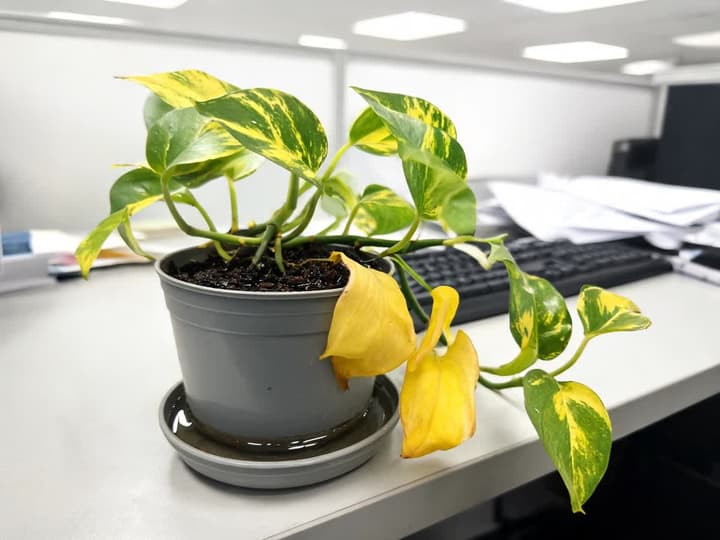
If part of the root system has rotted, trim away the mushy sections with clean shears and repot into fresh, dry potting soil inside a container with drainage holes. If most of the roots are lost, propagate the plant from cuttings as described in the next section. For pothos, additional causes of yellow leaves and how to diagnose each one are covered in pothos with yellow leaves.
Root rot is the disease that stems from this mix of low light and soggy soil:
How to propagate from cuttings
A cutting is a stem section that forms roots on its own, either in water or in soil. NC State recommends stem cuttings as the best way to propagate pothos, heartleaf philodendron, and dracaena. For the ZZ plant, it recommends clump division (splitting the plant into two or more rooted sections) or leaf cuttings.
For pothos and heartleaf philodendron, cut the stem about 1 inch below a leaf node. The node is the spot on the stem where the leaf and aerial roots emerge. Place the cutting in a glass of water on your desk near the light fixture, and change the water once a week.
Roots develop in 3 to 4 weeks, taking longer in cold weather. Once roots have formed, pot the cutting into a container with drainage holes using fresh potting mix. Which node produces the fastest-growing start is detailed in how to propagate pothos.
Office plant pests and problems
Office plants deal with the same pests that trouble houseplants at home. UGA identifies mealybugs as the primary pest on indoor plants, followed by spider mites as the second most common.
Mealybugs: white cottony patches in leaf axils and along stem tips, accompanied by sticky residue on lower foliage. UGA recommends removing mild infestations with a cotton swab dipped in rubbing alcohol. Effective alcohol concentrations appear in getting rid of mealybugs on plants.
Spider mites: tiny light speckles across leaf surfaces and fine webbing underneath. UGA notes that spider mites thrive in hot, dry conditions, such as a closed office with the air conditioning shut off over the weekend. The white paper test is explained in spider mites on plants.
Fungus gnats: tiny black flies emerging from the potting mix. They breed in soil that stays wet for prolonged periods, making them a clear signal of overwatering. Treatment steps are detailed in fungus gnats.
Brown leaf tips on dracaena and Chinese evergreen are not caused by pests. On dracaena, NC State links them to fluoride in tap water and accumulated fertilizer salts. On Chinese evergreen, dry air and cold drafts are the culprits.
Do office plants purify the air?
Not in any amount you would notice in a real room. That reputation comes from a 1989 NASA study conducted inside sealed chambers smaller than 35 cubic feet (1 m³). In 2019, researchers at Drexel University reviewed 12 similar chamber studies. They calculated that you would need between 10 and 1,000 plants per square meter of floor space to match the air exchange rate of a standard office building.
A building's HVAC ventilation system swaps out office air far faster than plants can scrub it. The NASA study tracked pollutant removal in airtight boxes without air circulation. The math on how many plants your office would need is in air-purifying plants.
Are there pets in your office?
If the office welcomes dogs or cats, check the plant first. The ASPCA, an animal poison control center in the United States, lists as toxic to dogs and cats pothos, the snake plant, dracaena, aglaonema, and the heartleaf philodendron. Clemson classifies the ZZ plant as unsafe for pets.
The ASPCA does not list the cast-iron plant as toxic to dogs, cats, and horses. The absence of a record is not a guarantee: any chewed leaf can cause vomiting, and in the event of ingestion, the veterinarian makes the call. The severity of each case is detailed in toxic plants.
Frequently asked questions
Which plants can survive in a windowless office?
Dracaena and Chinese evergreen are the most resilient. A windowless office gets around 50 foot-candles (540 lux) of artificial light, and NC State classifies artificial-only lighting as low light. At 25 to 50 foot-candles, both species maintain an attractive appearance for 36 months. At 15 to 20 foot-candles, dracaena still lasts 30 months.
Can plants survive under LED or fluorescent lights?
Yes, provided they are foliage plants. NC State notes that foliage plants grow well beneath the standard fluorescent fixtures used in offices. Flowering plants need more red light to form blooms. What matters is the light hitting the foliage, which drops with distance: a 40 W fluorescent tube yields 120 foot-candles at 12 inches and 75 foot-candles at 24 inches.
How often should you water office plants?
Only when the soil dries out. Insert your finger about 1 inch into the potting mix and water only if it feels dry. Under low light, soil dries much more slowly than on a sunny windowsill at home. The ZZ plant needs water just once or twice a month, according to Clemson.
What is the easiest plant for an office desk?
The ZZ plant is the top pick if you tend to forget watering. Its underground rhizomes store water, it can go two weeks without a drink, and it grows slowly enough to stay desk-friendly. If you tend to overwater, choose the snake plant, provided you let the soil dry out completely between waterings.
Summary
An office desk receives low light (around 540 lux of artificial lighting), and only during work hours. The seven plants on this list can handle it if you keep them on the desk near a light fixture, away from direct AC drafts, and water only when the top inch of soil feels dry. Start with a ZZ plant or snake plant if your plant will be left on its own during vacations.
Related articles
How to Care for Hibiscus: Sun, Watering, Fertilizer, and Pruning for Flowers
How to care for hibiscus: 6 hours of direct sun, evenly moist soil without waterlogging, half-strength fertilizer in spring and summer, and pruning in early spring. Find out why the flower lasts one day and why buds drop before opening.

Do Ferns Like Sun or Shade? It Depends on the Type
Ferns prefer bright shade: plenty of light, but no direct sun on their fronds. Tuberous sword fern is the exception that handles sun. Here is the ideal light for each type, where to place pots, and how fronds show too much or too little light.

African Violet Yellow Leaves: Causes and What to Do
Yellow leaves on an African violet usually stem from overwatering, and the first place to check is the center of the plant. Losing one lower leaf at a time is normal. Identify whether age, watering, cold water, sunlight, cold drafts, or fertilizer is the culprit based on the yellowing pattern, and see what to do today.