Slug-Repellent Plants: What Slugs Won't Eat and How to Control Them
No study shows that any plant repels slugs from neighboring plants. Learn which plants slugs eat less, how to spot damage, and how to control them safely for pets.
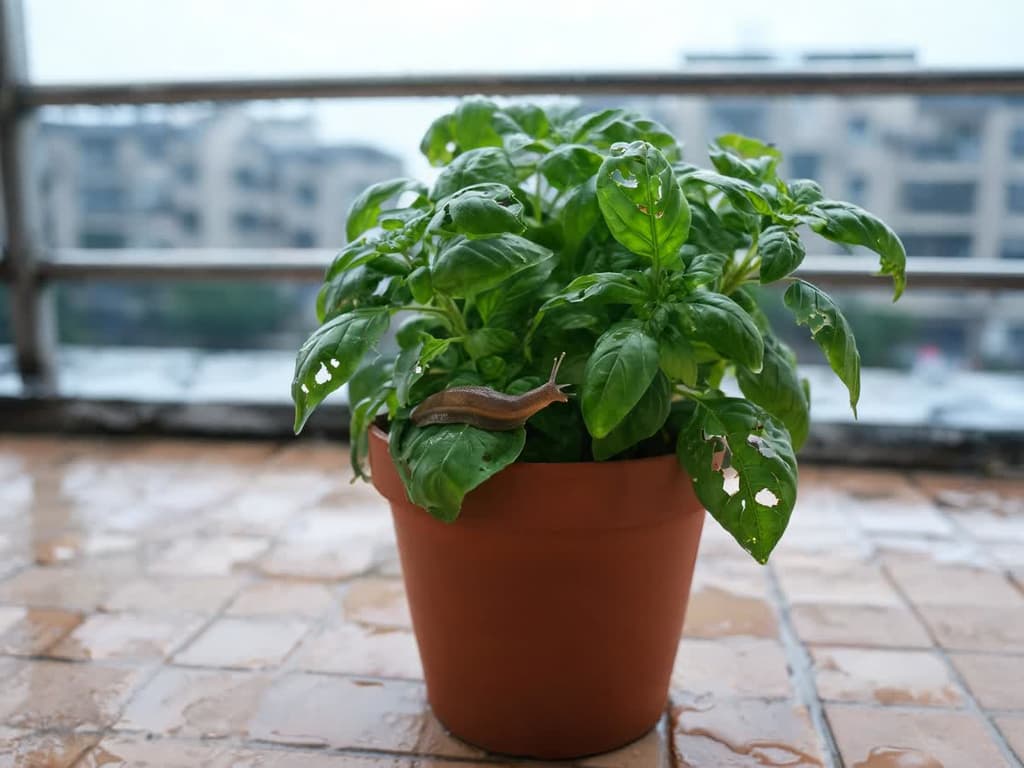
No published study shows that any plant repels slugs from neighboring plants. The slug-repellent plants that actually work are simply those slugs eat less: plants with tough, thick, or strongly scented leaves, such as geraniums, nasturtiums, and rosemary. Even these can lose young seedlings, and basil, which has a strong scent, was eaten by all slugs tested in a laboratory study.
To protect your container or garden bed, what works is reducing the slug population. Handpick slugs at night with a flashlight. Set up a shelter trap using a board where slugs hide during the day. If necessary, scatter iron phosphate bait, an iron compound sold as slug bait, across the soil and never in piles. Salt, coffee grounds, and eggshells lack evidence supporting their use.
Quick summary:
Plants that repel slugs: there are no studies. Some plants are eaten less by slugs, and the list varies depending on the slug species.
Signs of slug damage: irregular holes with smooth edges in the middle and along the margins of leaves, accompanied by a shiny, silvery trail. The damage appears in the morning after a damp night.
Handpicking at night: every day until the slug population drops, then once a week.
Bait: scattered iron phosphate. If you have dogs or cats at home, do not use metaldehyde bait, a poison that is highly toxic to dogs and cats.
Homemade barriers: in a field trial with 108 lettuce plants, copper, eggshells, wool, and gravel did not reduce damage.
Do slug-repellent plants really exist?
No study shows that any plant protects its neighbors from slugs. The idea of a "repellent plant" mixes up two different things: plants that slugs rarely eat, and plant extracts applied directly to leaves or soil.
Plants that slugs rarely eat do exist, and were measured in a laboratory. A 1998 Swiss study offered 78 plants to the slug Arion lusitanicus. More than two-thirds were rarely eaten. Annuals (plants that live for only one year) were preferred over perennials (plants that last several years) (Briner and Frank, Annals of Applied Biology). A plant that slugs rarely eat does not stop a slug from crawling past it to eat the lettuce next to it.
A strong scent does not guarantee protection. In a 2008 Polish test with 19 herbs, basil and cilantro were eaten by all three slug species tested (Kozłowski, Journal of Plant Protection Research). The same study concluded that acceptance of the other herbs varied from one slug species to another.
Extracts also fail to confirm the popular list. Oregano, sage, and thyme extracts, applied to oilseed rape seedlings (the canola plant), did not significantly reduce how much slugs ate. Only soapwort and corn salad (Valerianella locusta) extracts reduced feeding (Barone and Frank, 1999). Garlic killed slugs as a refined extract in a Newcastle University laboratory test, not as a plant in the garden bed (ScienceDaily, 2003). Spearmint oil shows an effect in testing, but above 1% the oil can burn the plant (Oregon State Extension).
Plants that slugs eat less
The RHS (Royal Horticultural Society in the United Kingdom) and the University of California publish lists of plants less frequently eaten by slugs and snails. Both lists serve as general recommendations without cited studies: the University of California notes that these plants "may be less appetizing." Use this list to choose what to plant where slugs are common, not as a physical barrier.
Plant | Source | Does it do well in balcony containers? | For dogs and cats (ASPCA) |
|---|---|---|---|
Geranium (Pelargonium) | RHS and Univ. of California | Yes, with full sun | Toxic |
Nasturtium (Tropaeolum majus) | RHS and Univ. of California | Yes, with full sun | Non-toxic |
Lantana (Lantana camara) | Univ. of California | Yes, with full sun | Toxic |
Rosemary | Univ. of California | Yes, with full sun | Non-toxic |
Sage (Salvia officinalis) | Univ. of California | Yes, with full sun | Non-toxic |
Lavender | Univ. of California | Yes, with full sun | Toxic |
Hydrangea | Univ. of California | Large container, partial shade | Toxic |
Cyclamen | Univ. of California | Yes, without direct sun | Toxic |
Houseleek (Sempervivum) and sedum | RHS | Yes, with full sun | No verified entry |
Foxglove (Digitalis purpurea) | RHS | Best in garden beds | Toxic |
The pet column comes from the ASPCA (American Society for the Prevention of Cruelty to Animals) profiles for each species. If you have a dog or cat at home, choose nasturtium, rosemary, or sage: the ASPCA lists them as non-toxic to dogs and cats. Geranium, lantana, lavender, hydrangea, cyclamen, and foxglove are toxic.
These sources list these plants based on leaf texture. The RHS cites shrubs and other plants with woody stems, as well as plants with thick or wax-coated leaves; the University of California cites tough leaves and strong scents. Freshly planted seedlings suffer more, even among the species in the table: the RHS warns that young seedlings and highly palatable plants sustain severe damage.
Plants that slugs eat the most
The University of California lists the plants that slugs damage most frequently: basil, beans, cabbage, dahlias, larkspur (Delphinium), hostas, lettuce, marigolds, and strawberries (UC IPM, Pest Notes 7427). Embrapa recorded cabbage and basil with leaves riddled with holes by snails in Brazilian vegetable gardens.
On basil, slugs share the damage with other leaf-chewing pests, and the type of hole shows which one is responsible: check out basil pests. On dahlias, shoots just emerging from the soil are the most vulnerable. The guide on how to care for dahlias recommends applying bait 2 weeks after planting or as soon as shoots appear.
German nursery shop Pflanzmich recommends planting marigolds as a trap crop to concentrate slugs away from the vegetable garden. I found no published trials testing this technique. What the University of California records is that marigolds are heavily eaten; whether they draw slugs from afar remains unmeasured.
How to tell if the damage is from slugs
Slug damage exhibits three signs together: holes, trails, and timing.
Irregular, smooth-edged holes. The slug rasps the leaf with a rough tongue, leaving a smooth edge around the hole (UC IPM). Holes appear both in the middle and along the edge of the leaf (University of Florida, UF/IFAS).
Silvery trails. Dried mucus leaves a shiny trail across leaves, containers, and the ground. This trail separates slugs from caterpillars and earwigs, which make similar holes.
Damage in the morning, invisible pest by day. Slugs feed at night and on cloudy days. During the day, they hide under containers, stones, fallen leaves, and mulch or bark spread over the soil (Iowa State).
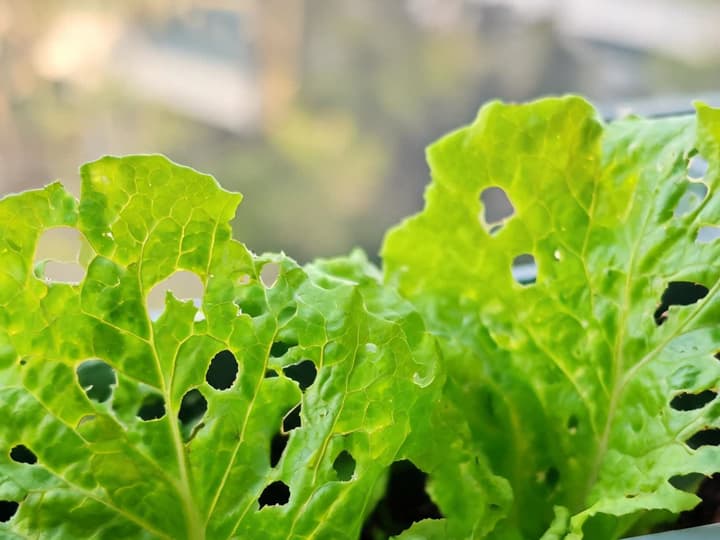
Other pests leave their own distinct signs. Similar holes without any trail might come from caterpillars or earwigs, according to the University of California. Leaves with pale stippling, curling, or sticky residue point to sap-sucking pests like aphids and scale insects. Slugs are pests of balconies, backyards, and gardens; indoor plant pests are different.
The slug and snail profile summarizes symptoms and the most targeted plants:
If your attacked plant came without a tag, Bloom (available for iOS) identifies the species from a photo. With the right name, you can check whether it appears on the list of most targeted plants.
Slugs, garden snails, or giant African snails
Slugs do not have a shell; land snails and aquatic snails do. In Brazilian vegetable gardens, Embrapa cites the slug Vaginula langsdorffi. It has a flattened, moist body, a light brown color, and measures 5 to 7 cm in length, and it is more common during rainy seasons (Embrapa Hortaliças, Technical Communication 118). Small garden snails (Bradybaena similaris) also feed at night.
The giant African snail (Achatina fulica) is the large snail with a tall shell that appears in yards after rainy periods. The Ministry of Health classifies it as an agricultural pest and as a possible carrier (host) of worms of the genus Angiostrongylus, parasites that live inside the snail. These worms can cause disease in humans, with few recorded cases in Brazil (Technical Note 30/2022). The transmission cited by the Ministry is the ingestion of snail mucus on poorly washed vegetables and fruit.
To collect giant African land snails, follow the Paraná Department of Health:
wear rubber gloves or place a plastic bag over your hand, and also gather any half-buried eggs;
crush the snails and eggs, cover them with quicklime, and bury them far from wells or cisterns;
without quicklime, follow the Brazilian Ministry of Health: soak crushed snails for 24 hours in 3 parts water to 1 part bleach;
do not discard live snails in the trash or into rivers or ponds;
if mucus touches your skin, wash with soap and water.
How to control slugs in containers and garden beds
The control strategy recommended by university extensions focuses on lowering the slug population on site: handpick, set up shelters, and use bait as a final step.
Water in the morning. The RHS recommends watering early in the day rather than at dusk, when slugs emerge to feed.
Handpick at night with a flashlight. On handpicking days, water the area in the late afternoon to draw slugs out; on other days, water in the morning. Search after dark and collect them wearing gloves into a sealed plastic bag (UC IPM). Handpick every day until the numbers drop; after that, once a week is enough.
Set up a shelter trap. Leave a 12 × 15-inch (30 × 38 cm) board resting on two 1-inch (2.5 cm) wooden runners near attacked plants. In the morning, lift the board and collect the slugs hiding underneath. On a balcony, a piece of damp cardboard on the floor does the same job (UF/IFAS).
Use beer traps as a supplement. Bury a shallow cup and leave the rim 1 cm above the soil. Fill it with beer (Iowa State). Beer attracts only slugs within a few steps of the cup, and the liquid must be replaced every few days.
If slugs persist, use iron phosphate bait. After eating the bait, slugs stop feeding and die in 3 to 6 days. Reapply when the bait is gone or every 2 weeks (Embrapa). Scatter late in the afternoon, on moist soil, and use only registered products, following the label.
Bait is the final step because no bait works alone: the University of California notes that bait used by itself does not manage slugs for long. The RHS goes further, advising against any bait, even iron phosphate, due to impacts on other garden wildlife. I follow Embrapa and US university extensions, which accept iron phosphate as the safest bait. Precautions follow in the next section.
Slug bait when you have dogs or cats at home
If you have pets at home, do not use metaldehyde bait. The ASPCA animal poison control center records the dose of metaldehyde that kills half of tested animals: 100 mg per kilogram of body weight in dogs and 207 mg per kilogram in cats. The bran mixed into the bait attracts dogs (ASPCA Pro). Signs of poisoning, such as tremors, vomiting, and high fever, begin anywhere from a few minutes to 3 hours after a dog eats the bait.
Iron phosphate is less dangerous, but it is not harmless. The NPIC (the United States national pesticide information center) records dogs that fell ill after eating iron phosphate bait. Many formulas include an additive that increases iron absorption by the body (NPIC). Signs include vomiting, lethargy, abdominal pain, and diarrhea, and they can appear only days later.
To use iron phosphate safely around pets at home:
scatter the granules across the ground without leaving piles;
keep dogs and cats away from the area until the granules break down with watering;
if your pet consumes bait of any kind, bring them to the vet along with the packaging.
Salt, coffee grounds, eggshells, and copper: what the trials showed
The RHS tested homemade barriers in the field in 2018. They monitored 108 lettuces in pots and garden beds for 6 weeks, and no barrier reduced damage compared to unprotected lettuces (RHS).
Remedy | Was it tested? | What sources report |
|---|---|---|
Salt | Not needed: the damage to the soil is well known | Kills slugs, but salts the soil and harms the plant. Embrapa, the University of California, and UF/IFAS advise against it. |
Coffee grounds | No | Pure caffeine in a 1% to 2% solution drove 100% of slugs from treated soil (Hollingsworth, 2003). Coffee grounds are a different story: the University of California states that they showed no effect. |
Eggshells | Yes, in the field (RHS) | No difference in damage. |
Copper tape | Yes, in the field (RHS) and in the laboratory | In the field, no difference. The University of California says copper repels while it is clean and shiny, and loses its effect as it tarnishes over time; UF/IFAS says that in the Florida heat it oxidizes quickly. |
Wool, pine bark, gravel | Yes, in the field (RHS) | No difference in damage. |
Diatomaceous earth | No | Fossilized algae powder used as a barrier: loses its effect when wet, according to the University of California. |
Beer | No quantified efficacy data | Attracts only nearby slugs and must be replaced every few days. |
Copper remains the exception dividing sources: the RHS field trial found no effect, while the University of California states the tape works. The RHS itself did not entirely rule out copper, as lab tests demonstrated an effect. The field trial mirrors your balcony most closely: treat copper tape as an optional extra along the container rim and rely on handpicking.
When slugs appear in Brazil
In Brazil, slugs and snails appear more during the rainy season and immediately after it. The Ministry of Health notes that snail populations increase during the rainy period and recommends collecting them before and after rains. Embrapa notes that garden slugs are more common during rainy periods and small snails are inactive in winter and during dry spells.
Extension services in the United States and the United Kingdom point to cool, wet springs and late summers. That is the climate of the northern hemisphere. In Brazil, the sign to start picking them off is a stretch of rainy days, in any month.
Frequently asked questions
What can I plant so slugs don't show up?
No plant keeps slugs from appearing. According to the RHS and the University of California, plants with tough or thick foliage are eaten less, as are certain strongly scented ones. Scent alone is not enough: basil has a strong scent yet ranks among the most heavily eaten plants. Examples include geraniums, nasturtiums, rosemary, and sage. They reduce damage to that specific pot, but slugs will still arrive for softer plants nearby.
How can I keep slugs off basil?
Basil is among the most heavily damaged plants, and its scent does not deter slugs. Protect your container by handpicking at night with a flashlight, doing so daily until the slug population drops, combined with a board or damp piece of cardboard alongside as a shelter trap.
Does a plant in a garden bed protect other plants from slugs?
No study shows that one plant shields its neighbors. A self-sown herb in a bed can stay if it does not crowd out others, but do not rely on it to defend your vegetables. Reducing damage requires handpicking slugs at night and setting up shelter traps.
Do coffee grounds keep slugs away?
There are no trials testing spent coffee grounds. What researchers tested was pure caffeine in a 1% to 2% solution applied to soil, which repelled slugs. Kitchen coffee grounds have not been measured, and the University of California notes they showed no effect against slugs and snails.
Are garden slugs bad for your health?
The risk cited by the Ministry of Health comes from the giant African snail, which can carry worms that cause disease in humans, with few recorded cases in Brazil. Pick up snails and slugs using gloves or a plastic bag over your hand, and thoroughly wash vegetables and fruits from the garden. If mucus touches your skin, wash it with soap and water.
Conclusion
Slug-repellent plants reduce damage, but they do not scare slugs away. For your most vulnerable containers, choose nasturtiums, rosemary, sage, or geraniums, which are toxic to dogs and cats. Protect seedlings and tender leaves. Tonight, after dark, search for slugs with a flashlight and leave a board or damp cardboard beside damaged plants.
Related articles
How to Care for Hibiscus: Sun, Watering, Fertilizer, and Pruning for Flowers
How to care for hibiscus: 6 hours of direct sun, evenly moist soil without waterlogging, half-strength fertilizer in spring and summer, and pruning in early spring. Find out why the flower lasts one day and why buds drop before opening.

Do Ferns Like Sun or Shade? It Depends on the Type
Ferns prefer bright shade: plenty of light, but no direct sun on their fronds. Tuberous sword fern is the exception that handles sun. Here is the ideal light for each type, where to place pots, and how fronds show too much or too little light.

African Violet Yellow Leaves: Causes and What to Do
Yellow leaves on an African violet usually stem from overwatering, and the first place to check is the center of the plant. Losing one lower leaf at a time is normal. Identify whether age, watering, cold water, sunlight, cold drafts, or fertilizer is the culprit based on the yellowing pattern, and see what to do today.