How to take care of dahlias: planting, sun, watering, staking and winter tubers
How to care for dahlias in Brazil: when to plant the tuber in each region, sunlight and water requirements, pinching, staking, and what to do with the tuber once the plant dies back.
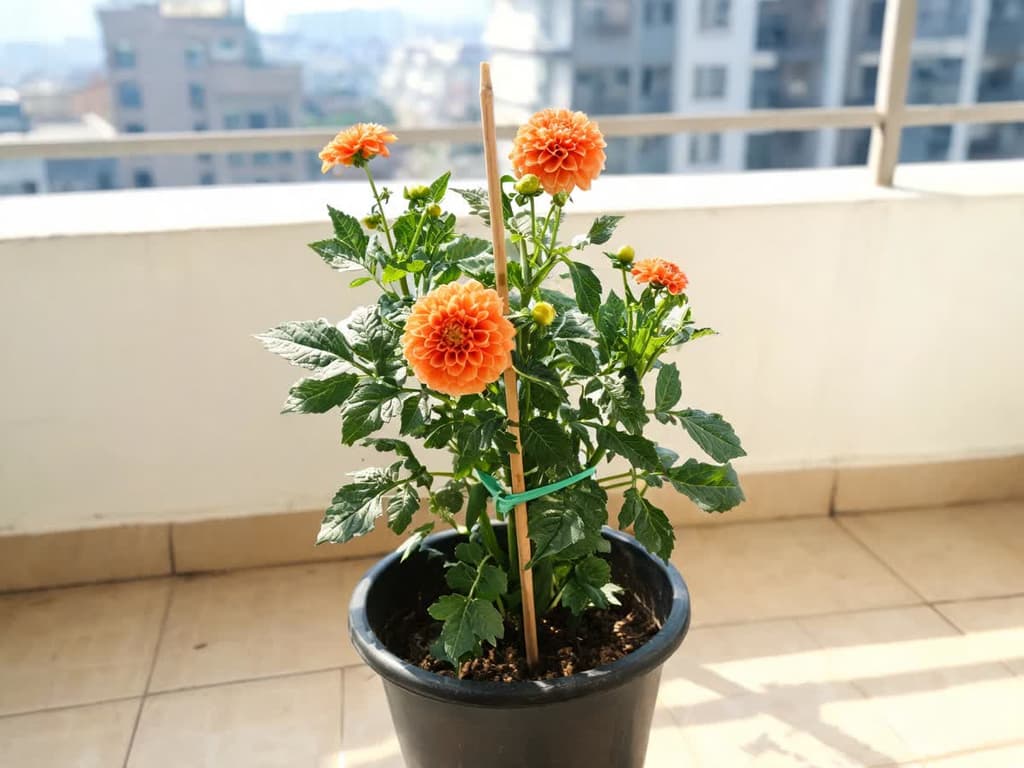
To care for dahlias, plant the tuber (the dahlia's thick root) in spring with the eye (the bud that produces the stem) facing up, in a spot that gets at least 6 hours of direct sun. Do not water until the plant sprouts. Afterward, keep the soil moist without waterlogging it. If the variety grows over 90 cm tall, drive a stake into the ground on planting day. Pinch the tip of the stem when the plant is 30 to 40 cm tall, and deadhead spent blooms every week. When the foliage dies back at the end of the season, the tuber stays alive underground.
This guide also addresses three common scenarios. The first is when dahlias flop over under the weight of their blooms. The second is when a potted dahlia bought in bloom has drooping flower heads and yellow lower leaves. The third is when foliage turns black after a frost and you wonder if the tuber died.
The numbers in this guide come from US university extension services, which advise plant growers. The main sources are the extensions of Oregon State, Washington State, NC State, the University of Georgia, and the University of Florida (UF/IFAS). Others include the Royal Horticultural Society (RHS) and field studies conducted on dahlias in Rio Grande do Sul. Embrapa, the Brazilian agricultural research corporation, rounds out the list. The foreign sources come from the Northern Hemisphere, so months and seasons have been adjusted for Brazil. The dahlia profile introduces the plant and its most common issues.
Quick summary:
Planting: in spring, when soil is around 15 °C, lay the tuber flat 10–15 cm deep with the sprout facing up.
Sunlight: at least 6 hours of direct sun; provide light afternoon shade in very hot areas.
Watering: none until it sprouts; after that, water deeply when the soil feels dry down to your second knuckle.
Staking: stake varieties that exceed 90 cm on the day you plant them.
Flowering: pinch the tip of the stem at 30–40 cm and remove spent blooms every week.
Fertilizer: low-nitrogen formulas (the first number on the NPK label), such as 5-10-10, every 3 to 4 weeks.
End of cycle: the top growth dies back; dig up the tuber only where the soil freezes or the bed becomes waterlogged.
Care | What to do |
|---|---|
Light | At least 6 hours of direct sun; light afternoon shade in areas with very hot summers |
Planting | Spring, soil around 15 °C, 10–15 cm deep, 60 cm between plants |
Watering | None until it sprouts; after that, water deeply when the soil is dry to the second knuckle |
Soil | Loose, rich in organic matter, well-draining; pH between 6.5 and 7.0 |
Fertilizer | Low-nitrogen NPK (5-10-10 or 10-20-20), starting 30 days after planting |
Staking | Varieties over 90 cm; dwarf types up to 60 cm do not need staking |
Containers | 30 to 45 cm wide and deep, with drainage holes; dwarf dahlias are best |
Cold | Leaf and bud damage occurs near 0 °C in the air; tubers rot if the soil freezes |
Heat | Buds and flowers scorch when air temperatures reach 35 °C and above |
Dogs and cats | Mildly toxic to dogs, cats, and horses, according to the ASPCA |
What dahlias are and how the tuber cycle works
The dahlia is a flowering plant native to the mountains of Mexico. It grows from a tuber, a thick root that stores food reserves. Garden dahlias are hybrids (plants produced by crossing species), according to NC State. The plant sprouts in spring, blooms from summer to fall, and dies back at the end of the season, while the tuber rests underground.
In botany, this tuber is called a tuberous root. It only sprouts if it has an "eye," the bud that produces the new stem. The eyes sit on the crown, the point where the tubers join the previous year's stem, explains Oregon State. A loose tuber without a piece of the crown will not produce a plant.
The RHS separates dahlias into two groups by size. Dwarf dahlias, up to 60 cm tall, work well in pots and at the front of borders. Most others reach 1.2 m and need staking, according to the RHS guide.
When to plant dahlias in Brazil
Plant dahlias in spring, after the last local frost, when the soil reaches about 15 °C (60 °F). That is the rule from Oregon State and Rutgers. In Brazil, spring runs from September to December.
This guide did not find, either at Embrapa or at Brazilian universities, a dahlia planting calendar by region. The table below applies the sources' rules to each region's climate. There are three rules. The soil needs to be warm for planting. Cold near 0 °C burns the top growth. Heat of 35 °C burns buds and flowers.
Region | When to plant | Main care | The tuber at the end of the cycle (RHS rule) |
|---|---|---|---|
South, São Paulo, and southern Minas Gerais (where frost occurs) | Spring, after the last frost | Frost burns leaves and buds near 0 °C | Dig them up if the ground freezes or the garden bed gets waterlogged in winter; in soil that drains well and does not freeze, they can stay with a leaf mulch layer. |
Southeast and Central-West without frost | Spring, once the soil has already warmed | Heat starting at 35 °C scorches buds and flowers | It can stay in the ground if the soil does not get waterlogged |
Northeast Brazil and places with very hot summers | To bloom during the coolest time of the year | Light afternoon shade and consistently moist soil | It can stay in the ground if the soil does not get waterlogged |
Frost is the formation of ice on plants when the temperature reaches 0 °C. In Brazil, it occurs frequently south of latitude 19° S, from southern Minas Gerais to Rio Grande do Sul. Frost is stronger in the South Region, according to Embrapa. In Rio Grande do Sul, two consecutive nights at 0.1 °C and 0.2 °C caused severe damage to dahlia leaves, buds, and flowers. The lethal temperature for the plant remained close to 0 °C in the tested cultivars, a 2025 study showed.
Heat also limits dahlias. In Rio Grande do Sul, buds and flowers of open-field dahlias suffer irreversible damage when air temperatures reach 35 °C, according to a 2023 study. In Florida, winters are mild and summers are very hot. UF/IFAS notes that dahlias there are typically planted in the Northern Hemisphere's fall to bloom during Florida's winter and spring. No one has measured the best planting time for dahlias in the Northeast. UFSM, in Rio Grande do Sul, prefers growing cut dahlias in the summer because the heat helps the plant develop for harvest. The 2023 study measures something else: the damage that begins at 35 °C. Where summers are very hot, the safest option is to plant so that dahlias bloom during the cooler season.
How to plant dahlia tubers
Plant the tuber horizontally, with the eye facing up, at the bottom of a hole 10–15 cm (4–6 inches) deep. This is the measurement from Oregon State, Washington State, and the University of Georgia. First cover it with about 5 cm of soil and fill in the hole gradually as the sprout grows, advises Washington State.
Choose a firm tuber that has at least one eye on the crown.
Dig the hole in a sunny bed, blending 1 part organic matter (compost) with 2 parts excavated soil.
If the variety grows taller than 90 cm, insert the stake before placing the tuber, positioning it on the side toward which the eye will grow. That keeps you from piercing the tuber later.
Lay the tuber flat at the bottom with the eye facing upward, and cover it with 5 cm of soil.
Space plants 60 cm apart; for dwarf varieties, 30 to 45 cm is plenty.
Hold off on watering until the shoot breaks the surface.
Sources differ on planting depth. NC State recommends 7.5 cm (3 inches), while the RHS keeps the top of the tuber just below the soil surface. This guide uses the 10–15 cm range because three extension services recommend it, and you fill the hole as the plant develops.
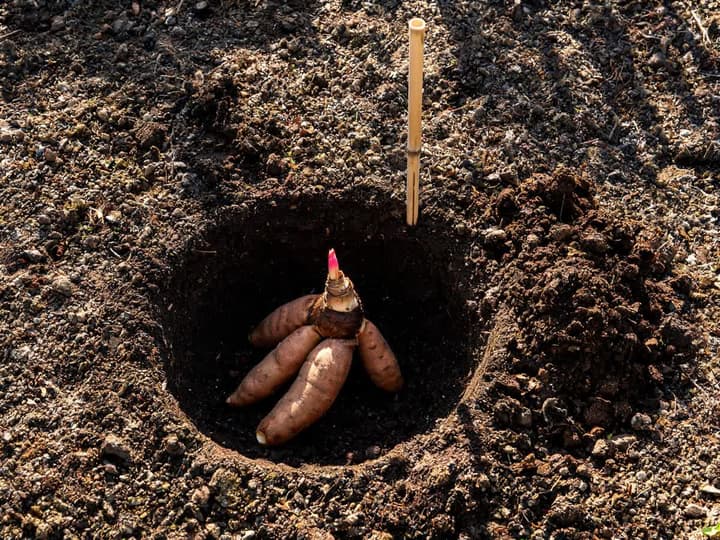
Newly planted tubers rot easily in soggy soil. Oregon State advises waiting until the first two leaves emerge before starting to water. Rutgers and Washington State tell growers to wait until shoots appear above ground, and the RHS advises light watering once shoots emerge. Extension services agree: do not water before the sprout appears. Arid climates are the exception: in Utah, the local extension notes that once tubers sprout, underwatering becomes a bigger concern than overwatering.
How much sunlight dahlias need
Dahlias need at least 6 hours of direct sunlight every day to bloom well. Washington State and Rutgers recommend 6 to 8 hours, and Washington State adds that morning sun is best. With less sun, stems stretch and produce fewer blooms.
In places with very hot summers, a little afternoon shade helps. This is the guidance from UF/IFAS for Florida, which also recommends choosing heat-tolerant varieties. Dahlias are not indoor plants: they need a garden bed or a balcony with direct sun. The camellia, another garden flower, requires less sun: partial shade, with 2 to 6 hours of direct sun, according to NC State.
How to water dahlias
Water your dahlias when the soil calls for it, not on a set calendar schedule. Insert your finger into the soil down to the second knuckle: if it feels dry at that depth, water thoroughly until the root zone is soaked. Oregon State recommends keeping the soil consistently moist, without waterlogging or letting it dry out completely. Do not water before sprouts emerge.
Sources suggest varying watering intervals. Rutgers recommends deep watering 2 to 3 times a week once sprouts appear. The University of Georgia suggests one thorough watering per week. A commercial dahlia supplier in the US recommends watering 3 to 4 times a week for more than 60 minutes each session. This guide uses the finger test, since heat, rainfall, and soil type dictate how much moisture a garden bed needs.
Water at the base of the plant. Wetting the blooms makes flower heads heavy, causing stems to bend or snap, warns Oregon State. Potted dahlias dry out faster than in-ground plantings, according to the RHS. Check container plants with the finger test more frequently.
Soil and fertilizer for dahlias: why low nitrogen matters
Dahlias need loose, fertile, well-draining soil with a pH between 6.5 and 7.0, according to Oregon State. Where water stands, dahlias do not grow well, warns the University of Georgia. Organic matter mixed into the soil helps hold water, air, and nutrients, says Oregon State.
Use a low-nitrogen fertilizer (the "N" in the NPK ratio). Oregon State recommends formulas like 5-10-10 or 10-20-20. Washington State summarizes the guideline: the first number should be half the value of the other two. Excess nitrogen produces weak stems, small flowers or none at all, and makes tubers rot or shrivel in winter storage, according to Oregon State. To interpret fertilizer labels, see how to read NPK values.
Start fertilizing 30 days after planting and repeat every 3 to 4 weeks. Stop fertilizing at the end of summer (March, in Brazil) so the tuber can mature before dormancy. For potted dahlias, Oregon State fertilizes every 2 weeks.
Sources do not all agree. A 2024 Utah study found that higher nitrogen rates produced more cut stems. The University of Georgia suggests a balanced fertilizer like 8-8-8. This guide recommends a low-nitrogen formula, which is what most extension services advise for home gardens. The Utah study focused on commercial cut-flower production, not tubers stored for replanting the next year.
Pinching, staking, and deadheading: more blooms and upright stems
Pinching involves trimming the growing tip of the main stem to encourage branching. Do this when the dahlia stands 30 to 40 cm tall and has at least 4 pairs of leaves. Cut directly above the top set of leaves, as Oregon State and the RHS advise. Washington State notes that two new lateral branches will sprout from the nodes right below the cut.
Pinching slightly delays the first flower, but it increases the overall number of blooming stems, according to Utah State University Extension. Oregon State adds that it also creates a sturdier, bushier plant. Recommended heights vary: Washington State and Rutgers pinch at 45–50 cm. This guide uses the 30–40 cm range from Oregon State and the RHS, with 4 leaf pairs, which is close to the 3 to 4 pairs suggested by the University of Georgia.
Tall dahlias will flop over without support. Oregon State recommends staking varieties that grow over 90 cm (36 inches) tall. Dwarf dahlias, which stay under 60 cm, do not need stakes. When the plant reaches about 30 cm, tie the main stem to the stake with soft twine or strips of cloth, as recommended by the University of Georgia. Add ties as the plant grows taller.
Deadhead spent blooms weekly. That redirects the plant's energy into producing new flowers instead of seed heads, explains the RHS. Cut each spent flower back to a leaf axil further down the stem. To avoid accidentally snipping an unopened bud, check its shape: spent flowers become pointed and cone-shaped, while new buds remain rounded, according to Oregon State.
Garden chrysanthemums also benefit from pinching, which keeps plants compact and well-branched; see our guide on chrysanthemum care.
Caring for potted dahlias: dwarf varieties and nursery plants
Stick to dwarf varieties when growing dahlias in containers. The pot should measure 30 to 45 cm (12 to 18 inches) wide and deep, with drainage holes at the bottom, according to Oregon State. The RHS suggests a 50 cm pot for a standard-sized dahlia, or for up to three dwarf plants. Use a quality potting mix, as the RHS recommends, rather than garden soil.
Potted dahlias require more frequent watering and feeding than garden beds. Potting mix dries out much faster. Check moisture using the finger test. Apply a high-potassium liquid feed, such as tomato fertilizer, every 2 weeks during bloom, as the RHS does.
Why nursery dahlias droop and turn yellow
Underwatered soil is the most common reason potted dahlias wilt, according to Oregon State. A slight droop during intense midday heat is normal. If the plant remains limp by late afternoon, check the soil with your finger: dry soil is likely the culprit. Small nursery pots hold little soil and dry out quickly. In addition, blooming dahlias become top-heavy, particularly after rain, notes the RHS.
If the potting mix feels waterlogged and lower leaves turn yellow, overwatering is the likely problem. Saturated soil rots the root system and crown, causing dahlias to wilt, yellow, and stop growing, according to Utah State University Extension. If that happens, let the soil dry out to your second knuckle before watering again, and check that drainage holes are open.
What to do right away with a blooming nursery dahlia:
Check the soil with your finger: if dry, water thoroughly until it drains from the bottom; if waterlogged, let it dry out.
Empty cachepots and saucers where standing water collects.
Move the plant to a spot with at least 6 hours of direct sun.
Trim spent blooms and broken stems back to a lower leaf axil.
To repot, move the plant into a 30 cm container or into the garden, planting it at the same depth it sat in its nursery pot. The RHS advises planting container-bought dahlias without delay.
On mature plants, Oregon State also removes the bottom 2 or 3 pairs of leaves to improve air circulation.
Yellow leaves on dahlias
Yellowing dahlia leaves generally stem from three causes. The first is waterlogged soil leading to root rot. The second is a viral infection, which causes yellow streaking or mottling on the foliage and stunts plant growth, according to Oregon State. The third is leafhopper feeding, an insect issue that causes leaf margins to turn yellow, according to UF/IFAS.
At the end of the growing cycle, yellowing is normal as the plant prepares for dormancy. Our guide to yellow leaves on dahlias helps identify the cause based on specific symptoms.
Dahlia pests and diseases
Slugs and snails feed on young dahlia sprouts at night, warns Oregon State. The extension recommends applying slug bait two weeks after planting or as soon as shoots emerge. The RHS also advises protecting young plants early on, since new growth is especially tender and susceptible to slug and snail damage.
Aphids form colonies on new growth, says the RHS, and can be removed with insecticidal soap, according to Oregon State. To identify aphids and treat other plants, see aphids on plants. Thrips are very small, yellowish-brown insects that leave tiny dots or white spots on the plant, according to the Utah extension. They also transmit viruses to dahlias, according to the Connecticut Agricultural Experiment Station. Two-spotted spider mites attack in warm weather, according to Washington State. The sign is a fine web under the leaf, as explained in the article on spider mites on plants.
Powdery mildew is a fungal disease that coats foliage in a white or gray powdery film. It worsens toward the end of the season, causing infected leaves to distort and drop, according to UF/IFAS. The RHS notes that powdery mildew takes hold in dry conditions and advises keeping plants well-watered, while Washington State associates it with humid environments. Because moisture conditions are viewed differently across sources, this guide follows Rutgers: space plants well to ensure good air circulation.
Does powdery mildew spread to the tuber? The University of Washington Botanic Gardens found no evidence that powdery mildew affects the tuber. An experienced grower they consulted said you can store and replant the tuber if you discard all diseased foliage. The fungus survives on infected foliage and returns to the new leaves. Therefore, cut back and discard stems and leaves at the end of the season, without leaving them in the garden bed.
Dahlias face two other common diseases. Gray mold (botrytis blight), caused by the fungus Botrytis cinerea, is cited by both the University of Georgia and the Connecticut Station; our botrytis blight on dahlias guide covers identification. Mosaic virus causes mottled leaves with pale green banding along the veins, according to UF/IFAS. It has no cure. Oregon State advises removing and destroying virus-infected plants immediately to prevent spreading it to healthy ones; see our page on mosaic virus on dahlias.
If you cannot identify a spot or bug, Bloom (available for iOS) diagnoses plant diseases from a photo of the symptom with a Premium subscription. Bloom also identifies plant species from a photo.
Dormancy: handling dahlia tubers in cold weather
Dormancy is the tuber's rest period after the top of the plant dies back. Blackened foliage after a frost does not mean the tuber is dead. Frost kills the foliage and flowers, but roots continue to mature through a light frost, the University of Kentucky explains. What kills the tuber is frozen or waterlogged soil.
The tuber rots if the ground freezes, says Oregon State, and suffers damage below −4 °C (25 °F), according to NC State. US extension services leave the tuber in the ground where winters are mild, but they disagree on the limit. They measure cold using the zones on the plant hardiness map from the USDA, the US Department of Agriculture. NC State and Oregon State accept zone 7; UF/IFAS accepts only zones 9 and 10. No source has studied dahlias left in the ground in Brazil's climate.
Waterlogged soil is the other risk. In light soil that drains well, dahlias survive winter in the ground better, says the RHS. In heavy soil, colder and waterlogged in winter, the RHS says to dig them up. This guide follows that rule for Brazil, because it does not depend on the American zone map. Dig them up where the ground freezes or the flowerbed becomes waterlogged during the cold season; in other places, the tuber can stay in the ground.
If leaving tubers in the ground:
After the foliage dies back, cut the stems down to about 10 cm from the ground, as the University of California extension does.
Ensure rainwater drains freely and does not pool in the bed.
Spread a layer of dry leaves or straw at least 10 cm deep over the crown, following Oregon State's guidelines.
Every 3 years, dig up and divide the clump of tubers to keep it from becoming overcrowded.
If lifting tubers for storage:
Once the foliage dies back, cut stems back to 15 cm (6 inches) above the ground and wait one week before lifting, as Washington State recommends. Oregon State suggests waiting 3 to 7 days. This waiting period makes the eyes easier to see.
Dig carefully around the clump with generous clearance, lifting it gently from underneath rather than tugging on the stems.
Allow the clump to air-dry for one day before packing it away, following University of Georgia guidelines.
Store in a dark place that never freezes, in vermiculite, coco coir, or wood shavings, in an open bag, as Oregon State does. Oregon State calls for 1 °C to 4 °C (34 °F to 40 °F), the University of Georgia accepts 2 °C to 10 °C (35 °F to 50 °F), and UF/IFAS stores at 10 °C (50 °F). This guide suggests 2 °C to 10 °C, because the sources only agree on one point: the tuber must not freeze.
Inspect stored tubers periodically and discard any that feel soft or show signs of mold.
When dividing the clump, each division needs a piece of the crown with one or two eyes, advises Rutgers. Amaryllis has a similar bulb resting cycle; see how to make amaryllis rebloom.
Frequently asked questions
Do dahlias come back every year?
Yes, dahlias return every year as long as the tuber survives its dormant period. Top growth dies back at the end of the season, and the tuber sprouts again in spring. In areas where the soil drains well and never freezes, you can leave it in the ground. Oregon State recommends lifting and dividing the clump every 3 years.
Why is my dahlia growing only leaves and no flowers?
The most common causes are too little sunlight, excessive nitrogen fertilizer, and extreme heat. Dahlias need at least 6 hours of direct sun. Excess nitrogen triggers lush foliage at the expense of blooms, causing flowers to stay small or fail to form, says Oregon State. In temperatures of 35 °C and above, buds and flowers scorch. Deadhead spent blooms weekly to encourage new flower buds.
Are dahlias toxic to dogs and cats?
Yes. The ASPCA lists dahlias as toxic to dogs, cats, and horses. The reported signs are mild: stomach and intestinal (gastrointestinal) upset and skin irritation (dermatitis). The responsible substance is unknown. Keep leaves, flowers, and tubers out of reach of pets that tend to chew on plants.
What makes a good companion plant for dahlias?
The RHS suggests combining dahlias with other late-blooming plants, such as salvias and ornamental grasses. In pots, dwarf dahlias provide summer color. Single-flowered dahlias, with an exposed center, are best for pollinators like bees, according to the RHS.
Conclusion
Caring for dahlias comes down to working with the tuber's natural cycle. Plant in spring with the eye facing up and provide at least 6 hours of direct sunlight. Once shoots emerge, water when the soil feels dry down to your second knuckle, and pinch the main stem. Stake taller varieties early, and deadhead spent flowers every week. At the end of the cycle, consider your garden conditions: lift tubers where soil freezes or remains soggy, but let them rest in the ground if your soil drains well and stays frost-free. If you are growing dahlias right now, test the soil moisture with your finger today. If your dahlia exceeds 90 cm and lacks support, add a stake carefully to avoid damaging the buried tuber.
Related articles

How to Care for Hibiscus: Sun, Watering, Fertilizer, and Pruning for Flowers
How to care for hibiscus: 6 hours of direct sun, evenly moist soil without waterlogging, half-strength fertilizer in spring and summer, and pruning in early spring. Find out why the flower lasts one day and why buds drop before opening.

Do Ferns Like Sun or Shade? It Depends on the Type
Ferns prefer bright shade: plenty of light, but no direct sun on their fronds. Tuberous sword fern is the exception that handles sun. Here is the ideal light for each type, where to place pots, and how fronds show too much or too little light.

African Violet Yellow Leaves: Causes and What to Do
Yellow leaves on an African violet usually stem from overwatering, and the first place to check is the center of the plant. Losing one lower leaf at a time is normal. Identify whether age, watering, cold water, sunlight, cold drafts, or fertilizer is the culprit based on the yellowing pattern, and see what to do today.