78 Medium Orchids | 2026 Guide - Page 2
Find 78 medium orchids. Complete guide for your garden.
78 Orchids with medium level
Showing 37-72 of 78
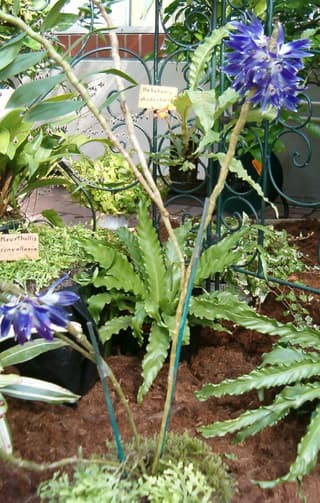
Queen Victoria's Dendrobium
Dendrobium victoriae-reginae
Dendrobium victoriae-reginae, known as Queen Victoria's dendrobium, is a striking epiphytic orchid endemic to the high-elevation cloud forests of the Philippines, found on Luzon, Mindanao, Mindoro, Negros, and Camiguin. It grows among oaks, rhododendrons, and azaleas at 1,300 to 2,700 meters elevation, where cool temperatures and near-constant moisture prevail. Its pendulous, cane-like stems are basally branching and swollen at the nodes, bearing papery, lance-shaped leaves. Short, erect racemes carry one to three flowers in variable shades of lilac to deep violet-blue, among the most prized colors in the genus.
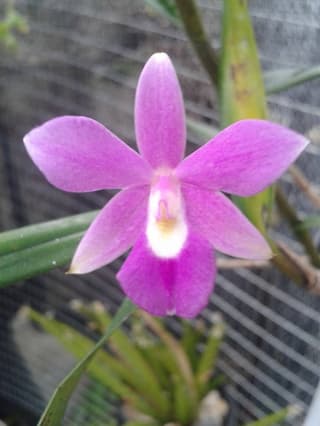
Pink Butterfly Orchid
Dimerandra emarginata
Dimerandra emarginata is a medium-sized epiphytic orchid native to the rainforests of Central America, northern South America, and the Caribbean, from Mexico south to Brazil. It grows on tree bark or rocks, producing slender, cane-like stems with leathery, notch-tipped leaves. From summer through fall, it bears clusters of small but vivid pink flowers with a white-and-pink lip, blooming successively over weeks. Commonly called the Pink Butterfly Orchid, it thrives mounted or in open, well-draining bark mixes that mimic its natural epiphytic habitat.

Fragrant Encyclia
Encyclia fragrans
The Fragrant Encyclia (Encyclia fragrans, syn. Prosthechea fragrans) is a sympodial epiphytic orchid native to tropical forests and cloud forests of Mexico, Central America, the Caribbean (Jamaica, Puerto Rico), and northern South America (Brazil, Ecuador, Costa Rica). It forms compact oval pseudobulbs, each with a single leathery, upright leaf, and produces stems with fragrant greenish-white to cream flowers, featuring a white lip streaked with purple stripes. The flowers exude a sweet aroma reminiscent of honey and vanilla, which is most intense at night.
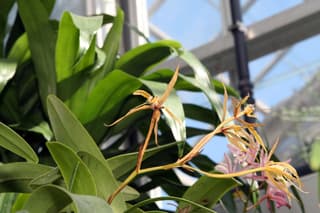
Fringed Star Orchid
Epidendrum ciliare
Epidendrum ciliare, commonly known as the Fringed Star Orchid, is a stunning epiphytic orchid native to Mexico, Central America, the Caribbean, and northern South America. It grows on trees and rocky outcrops in humid forests at elevations of 500–1000 metres. The plant produces elongated cylindrical pseudobulbs 10–20 cm long, topped with 1–2 glossy, oblong leaves. Its star-shaped flowers are renowned for their finely fringed white labellum and elegant greenish-yellow sepals and petals, blooming typically in winter. This long-cultivated species is a favourite among orchid enthusiasts for its dramatic, fragrant blooms and relative ease of care.
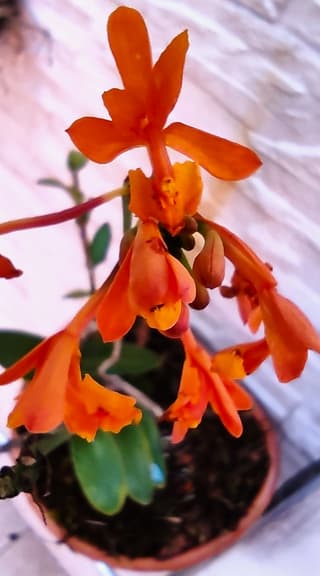
Beach Crucifix Orchid
Epidendrum fulgens
Epidendrum fulgens is a terrestrial crucifix orchid native to the restinga (coastal scrubland) of southern and southeastern Brazil, from Rio de Janeiro to Rio Grande do Sul. It forms robust clumps of cane-like pseudobulbs and produces upright flower spikes bearing dozens of brilliant orange-yellow, non-resupinate flowers with red spots on the lip. The species is remarkably tolerant of full sun, strong coastal winds, and salt spray.
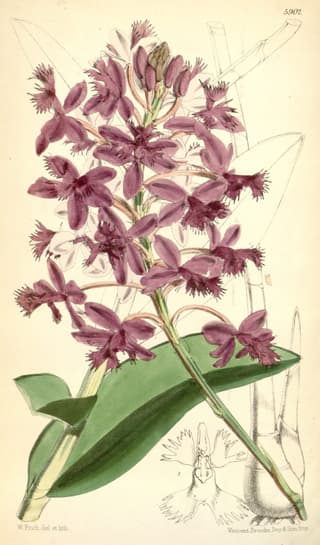
Jamieson's Epidendrum
Epidendrum jamiesonis
Epidendrum jamiesonis is a large, reed-stemmed terrestrial-to-epiphytic orchid native to the cool cloud forests of Colombia and Ecuador, found on trees and slopes between 1,700 and 3,500 meters elevation. Its sturdy cane-like stems carry evergreen leaves and terminate in showy inflorescences packed with numerous small, star-shaped flowers roughly 2.5 cm across. Unlike many orchids tied to a single bloom season, it can flower at almost any time of year given consistent moisture and bright light. First described by Reichenbach in 1856 and named for the Scottish botanist William Jamieson, who collected extensively in Ecuador, the species is now considered vulnerable in the wild due to habitat loss, making cultivated specimens valuable for ex-situ conservation.
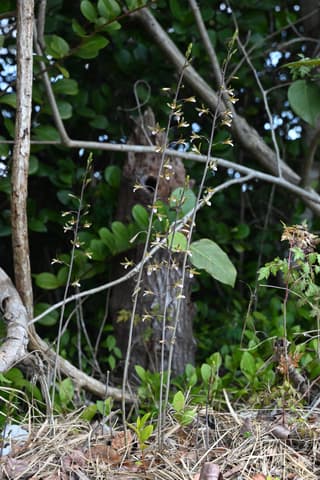
Chinese Crown Orchid
Eulophia graminea
Eulophia graminea, commonly known as Chinese Crown Orchid or Grass-leaf Eulophia, is a terrestrial orchid native to South and Southeast Asia. It produces grass-like leaves from pseudobulbs and sends up tall flower spikes bearing small green and brownish-purple blooms in spring. Though elegant in its native habitat, this species has become invasive in Florida, spreading rapidly through diverse ecosystems via dust-like seeds and wood chip mulch.
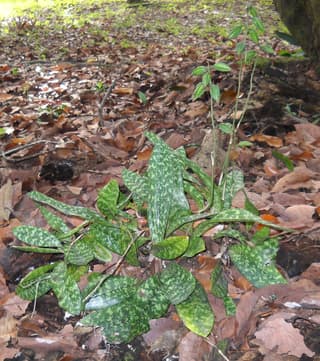
Spotted Eulophia
Eulophia maculata
Eulophia maculata, widely known by its synonym Oeceoclades maculata, is a terrestrial orchid native to tropical Africa, including Madagascar and Mauritius. Commonly called the Spotted Eulophia or Monk Orchid, it is one of the most successfully naturalized orchids in the world, now found throughout the Neotropics, Caribbean, and Florida. It grows in leaf litter and rocky scrub slopes up to 1200m elevation, producing mottled evergreen leaves and delicate white to pink flowers in late summer and fall.
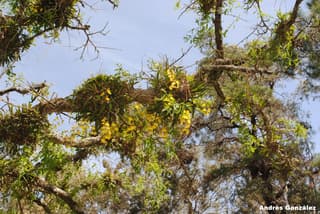
Dancing-lady orchid
Gomesa bifolia
Gomesa bifolia (synonym Oncidium bifolium) is a small epiphytic orchid native to riparian forests and high-altitude woodlands of southern Brazil (Paraná, Santa Catarina, and Rio Grande do Sul), as well as Bolivia, Uruguay, and Argentina, occurring at altitudes between 100 and 1,300 m. It forms clustered ovoid pseudobulbs, from which usually a single linear-elongated leaf grows (rarely two). Between late winter and early spring, it produces arched flower spikes up to 35 cm long with several small flowers (2 to 2.5 cm), featuring yellow sepals and petals spotted with brown and a smooth, showy yellow lip, which are sometimes fragrant.
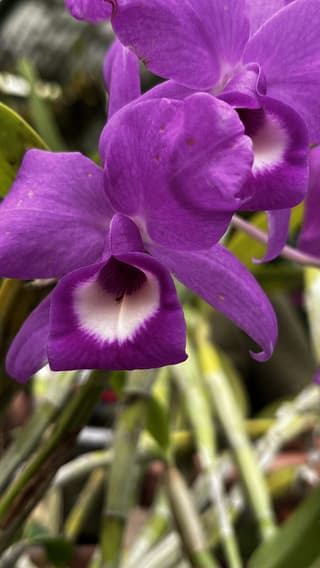
Guaria
Guarianthe
Guarianthe is a small genus of epiphytic orchids in the Orchidaceae family, with four species (G. aurantiaca, G. bowringiana, G. patinii and G. skinneri) plus natural hybrids, native to wet forests of Mexico, Central America, Colombia, Venezuela and Trinidad at 30 to 2,300 m. It was split from the bifoliate Cattleya species in 2003 based on DNA studies. Two-leaved pseudobulbs carry clusters of lavender, purple, orange, white or pink flowers.
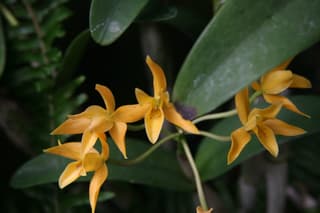
Orange Cattleya
Guarianthe aurantiaca
Guarianthe aurantiaca, commonly known as the Orange Cattleya, is a compact epiphytic orchid native to the tropical and montane forests of Mexico, Guatemala, Honduras, El Salvador, Nicaragua, and Costa Rica. It forms clumps of slender cane-like pseudobulbs topped with a pair of leathery, evergreen leaves, and produces clusters of two to eleven small, vividly orange (occasionally yellow) flowers from late winter through spring. Once classified as a Cattleya, this species is now placed in the genus Guarianthe alongside close relatives such as G. skinneri and G. bowringiana.
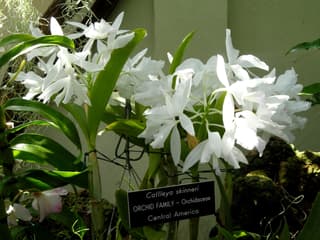
Purple Guaria
Guarianthe skinneri
Purple guaria (Guarianthe skinneri) is an epiphytic orchid from southern Mexico and Central America, growing on trees and rocks in humid forests. It is the national flower of Costa Rica, where it is called guaria morada. Each spindle-shaped pseudobulb carries two leaves, and from late winter into spring it sends up clusters of 4 to 15 pink-purple flowers with a white or cream throat. A well-grown plant can be smothered in bloom.
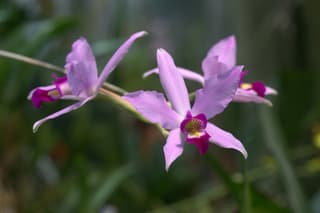
Laelia Orchid
Laelia
Laelia is a genus of epiphytic orchids in the family Orchidaceae, native to Mexico, Central America and the mountainous highlands of Brazil. Species form elongated pseudobulbs that store water and nutrients, each bearing one to a few leathery leaves and an upright spike of showy pink, purple or white flowers. Closely related to Cattleya, Laelia orchids are prized by growers for their toughness and spectacular blooms.
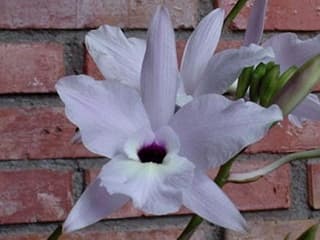
Rosy Tinted Laelia
Laelia rubescens
Laelia rubescens is an epiphytic or lithophytic orchid native to Mexico and Central America, found in seasonally dry deciduous forests at elevations between 100 and 1700 meters. It produces compact pseudobulbs and delicate flowers in shades of white, pink, and lavender with a red-brown blotch on the lip, blooming primarily in autumn and winter.
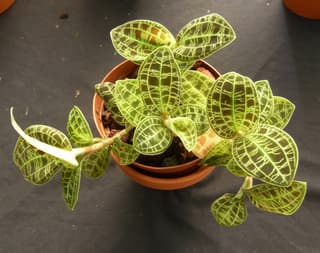
Jewel Orchid
Macodes petola
Macodes petola, known as the jewel orchid, is a terrestrial orchid native to the tropical rainforests of Southeast Asia—including Java, Malaysia, Sumatra, Borneo, the Philippines, and the Ryukyu Islands. Unlike most orchids, it does not grow epiphytically on trees but directly on the moist soil of shaded swampy forests and riverbanks. Its leaves are dark green to velvety, featuring a striking network of gold and silver veins that resemble lightning bolts or veins of precious metal—hence its nickname 'jewel orchid.' The flowers are small, reddish-brown with a white lip, and appear rarely, usually in late fall or winter; however, the plant's primary attraction remains its foliage pattern rather than its blooms.
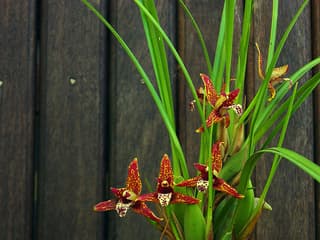
Maxillaria (genus)
Maxillaria
Maxillaria is a large genus of epiphytic Neotropical orchids in the family Orchidaceae, comprising hundreds of species from Mexico to South America. Prized for their solitary, often fragrant flowers, they grow naturally on tree trunks and branches in humid tropical forests.
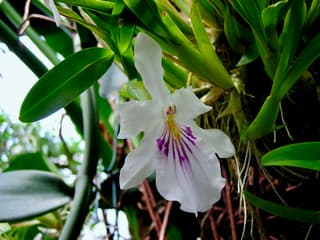
Miltonia Orchid (genus)
Miltonia
Miltonia is a genus of Neotropical epiphytic orchids in the family Orchidaceae, native to the tropical rainforests of Brazil and surrounding regions. Unlike the closely related Miltoniopsis, true Miltonia orchids are warmer-growing and thrive in USDA zones 10–12. They produce spectacular blooms on arching spikes during spring and summer.
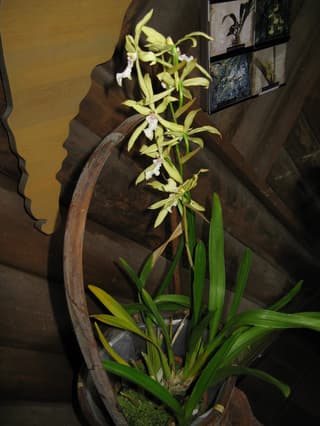
Miltonia flavescens
Miltonia flavescens
Miltonia flavescens is a Brazilian orchid with pale yellow, star-shaped flowers and a white lip streaked with reddish purple at the base. It grows along Brazil's east coast south to Rio Grande do Sul, and in Paraguay and northeastern Argentina. In the wild it lives on trees, and the plant reaches about 17 in (43 cm). The flower spike is far longer, close to 39 in (1 m), and carries 7 to 15 fragrant flowers about 3 in (7.5 cm) across in spring and summer.
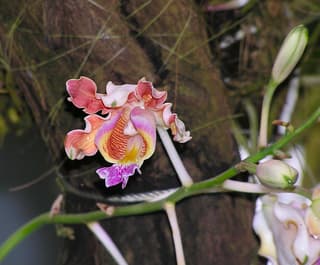
Cow Horn Orchid
Myrmecophila tibicinis
Myrmecophila tibicinis is a large epiphytic orchid native to seasonally dry tropical forests from Mexico through northern South America. Its hollow, cylindrical pseudobulbs — up to 45 cm tall — are colonized by ants in the wild in a mutualistic relationship that provides extra nutrients to the plant. Flowers are spectacular: magenta sepals and petals with bronze-orange tips, a large white lip with intense magenta veining, and a bright yellow central callus. The flower spike can exceed 1.5 m and bear up to 15 blooms.
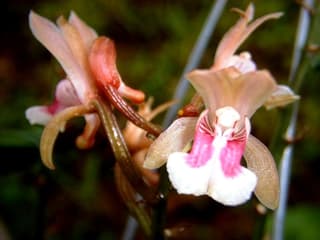
Monk Orchid
Oeceoclades maculata
Oeceoclades maculata, commonly known as the monk orchid or African spotted orchid, is a terrestrial orchid in the family Orchidaceae native to tropical Africa and Madagascar. It grows from small, clustered pseudobulbs, each topped with a single mottled, dark-green leaf marked with pale spots. In spring it sends up slender flower spikes bearing small white-and-pink blooms. Remarkably adaptable, the species has naturalized widely across the Neotropics -- from Brazil and the Caribbean to Florida -- since the 19th century, and is now considered one of the most successful invasive orchids outside its native range.
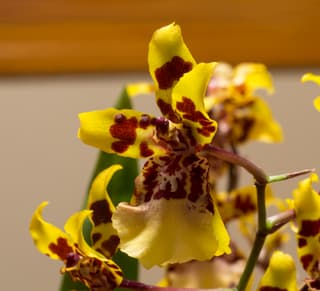
Dancing Lady Orchid (genus)
Oncidium
Oncidium is a large genus of epiphytic Neotropical orchids renowned for their abundant yellow, butterfly-like flowers that sway gracefully in the breeze. Native from Central America to South America, the genus encompasses hundreds of species widely grown as ornamentals.
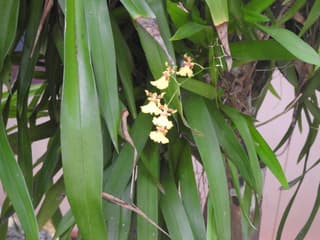
Tall Oncidium
Oncidium altissimum
Oncidium altissimum is a large epiphytic orchid native to the Caribbean islands of Cuba, Hispaniola, Puerto Rico, and the Lesser Antilles. It produces dramatically tall, branching flower spikes reaching 5–6 feet (150–180 cm) in length, adorned with hundreds of small yellow and brown flowers. This majestic species blooms in spring and fall, making it a spectacular addition to any orchid collection. Like all epiphytes, it thrives when its roots can breathe freely in well-draining bark-based media.
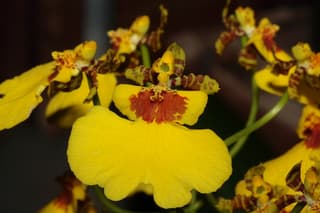
Dancing Lady Orchid
Oncidium Celtic Sun x Burgundian
The Oncidium Celtic Sun x Burgundian is a captivating sympodial orchid hybrid known for its 'Dancing Lady' appearance. It produces branched sprays of numerous small flowers that feature a large, ruffled labellum, typically in shades of golden yellow with intricate burgundy or reddish-brown markings. The plant grows from pseudobulbs that store water, with long, strap-like evergreen leaves.

Dancing Doll Orchid
Oncidium flexuosum
Oncidium flexuosum, commonly known as the Dancing Doll Orchid or Bent Oncidium, is an epiphytic orchid native to eastern and southern Brazil, extending into northern Argentina, Paraguay and Uruguay. It forms compact clumps of oval pseudobulbs bearing narrow, glossy leaves. From fall through winter it produces long, arching, branched flower spikes—up to 1.5 m (5 ft)—carrying dozens of small golden-yellow flowers marked with reddish-brown blotches at the base and lip, which flutter in the breeze and give the plant its playful common name.
Dancing Lady Orchid
Oncidium leleui
Oncidium leleui is an epiphytic orchid native to southwestern Mexico, found across the states of Nayarit, Jalisco, Colima, Michoacán, Oaxaca, and Guerrero in seasonally dry tropical forests at elevations of 250 to 950 meters. It produces spectacular arching flower spikes that can exceed two meters in length, bearing over 270 small yellow and brown flowers resembling graceful dancing figures. It is a slow-growing species prized by orchid collectors for its extraordinary floral displays each spring.
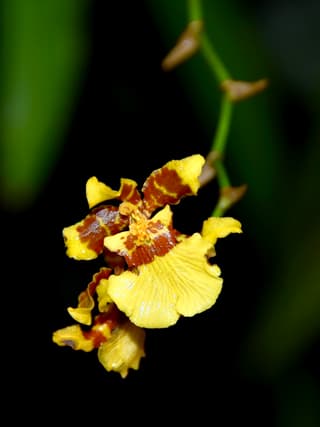
Golden Shower Orchid
Oncidium sphacelatum
Oncidium sphacelatum, commonly known as the Golden Shower Orchid, is a large epiphytic orchid native to Mexico and Central America. It produces spectacular arching flower spikes up to 1.5 meters long, adorned with masses of bright yellow and brown flowers. A vigorous grower, it forms impressive clumps over time and is considered one of the easiest oncidiums to cultivate.
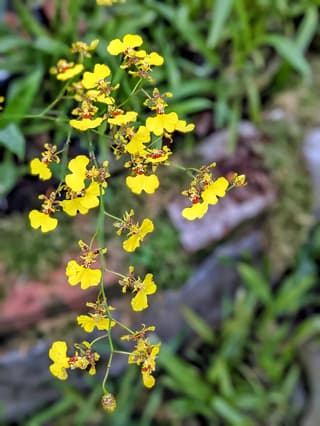
Golden Shower Orchid
Oncidium varicosum
Epiphytic orchid native to Brazil, known for its long sprays of small yellow flowers resembling a cascade of gold. Features pseudobulbs for water and nutrient storage, typical of orchids. One of the most popular orchids in Brazil due to its exuberant blooming and relatively easy cultivation.
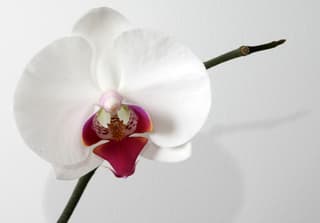
Orchid
Orchidaceae
Orchidaceae is one of the largest families of flowering plants, with over 25,000 species of mostly epiphytic and terrestrial perennials prized for their intricate, long-lasting blooms. The Phalaenopsis, or moth orchid, is the most widely grown houseplant representative of the family, valued for its arching sprays of waxy flowers that can stay open for months. Most cultivated orchids are epiphytes native to tropical and subtropical forests, where they cling to tree bark and absorb moisture and nutrients through thick, exposed aerial roots rather than soil.
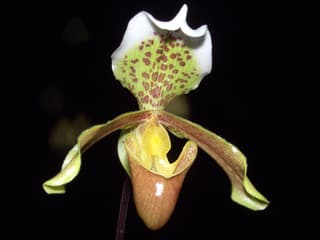
Lady Slipper Orchid
Paphiopedilum insigne
Paphiopedilum insigne is a stunning terrestrial orchid native to the misty forests of Southeast Asia and the Himalayas. Known for its distinctive pouch-shaped lip that resembles a delicate slipper, this cool-growing orchid produces elegant flowers in shades of green, yellow, and brown with characteristic spotted patterns. It is the type species of the Paphiopedilum genus and has been cultivated since the 19th century, prized for its long-lasting blooms that can persist for 6-8 weeks.
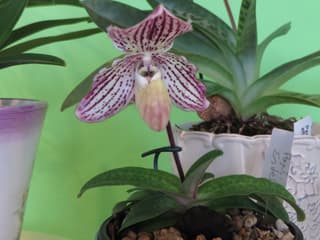
Lady Slipper Orchid
Paphiopedilum sp
Paphiopedilum, commonly known as the Lady Slipper Orchid, is a genus of terrestrial orchids native to the humid forests of Southeast Asia. Distinguished by their unique pouch-shaped lip (the "slipper"), these orchids produce long-lasting, exotic blooms in a wide range of colors. Unlike most orchids, they are true ground-dwellers, growing in leaf litter and mossy forest floors.
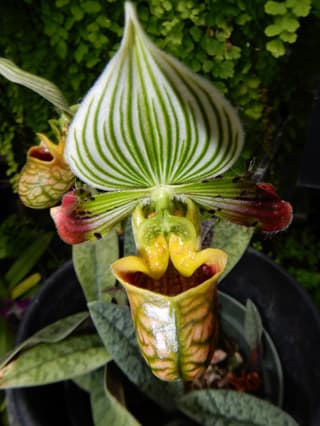
Charming Paphiopedilum
Paphiopedilum venustum
A ground-growing orchid from the eastern Himalaya: Nepal, north-east India, Bhutan, Bangladesh and southern China. It grows between 1,000 and 1,500 m at the foot of cliffs and in damp undergrowth near streams. The leaves, up to 25 cm long, are mottled dark and pale green on top and purple underneath, so it looks good even out of flower. From winter into spring it sends up a stem with a single flower about 8 cm across: a white top sepal striped green, green petals tipped rose-red with dark spots, and a green-veined pouch. Each flower can last up to six weeks.
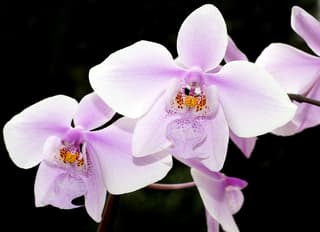
Schiller's Moth Orchid
Phalaenopsis schilleriana
Phalaenopsis schilleriana is an epiphytic moth orchid endemic to the Philippines, prized for its handsome foliage as much as its flowers. The leathery leaves are marked with alternating bars of silver-grey and dark green on top, with a purple flush underneath, remaining attractive year-round. In late winter to spring, arching, often branching sprays carry dozens of fragrant, rose-pink flowers with a spotted lip. Cooler autumn nights help trigger the bloom spike.
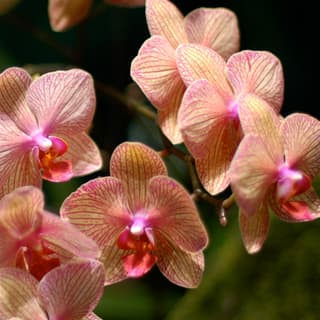
Phalaenopsis Hybrid Orchid
Phalaenopsis x hybridus
The Phalaenopsis Hybrid Orchid (Phalaenopsis x hybridus) is one of the world's most popular flowering houseplants, celebrated for its elegant arching flower spikes bearing large, flat blooms in a spectacular range of colors including white, pink, purple, yellow, and red. Native to the tropical forests of Southeast Asia, this epiphytic orchid thrives indoors with proper care, producing flowers that last months at a time. As a hybrid group derived from dozens of wild Phalaenopsis species, these orchids have been bred for extended bloom time, vibrant color, and adaptability to home environments.
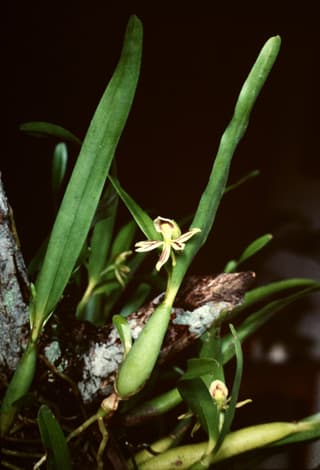
Prosthechea calamaria
Prosthechea calamaria
Prosthechea calamaria is a small epiphytic orchid in the Orchidaceae family, native to Colombia, Venezuela, Bolivia and Brazil, where it grows from 220 to 1,400 m. It forms mats on thick branches and tree trunks, and has also been found on rocks in the mountains of Rio de Janeiro. The pseudobulbs are spindle-shaped, glossy green and slightly flattened, each with 2 or 3 narrow, strap-shaped leaves. A short spike of 2 to 4 cm comes from the top of a mature pseudobulb and carries 4 to 7 flowers about 3 cm across, held close to the leaves. Like other cockleshell orchids, the flowers are upside down, with the lip on top. They are whitish green, and the white lip is striped wine-purple. In Brazil it blooms in autumn. It has been known under several older names, such as Epidendrum calamarium and Encyclia calamaria.
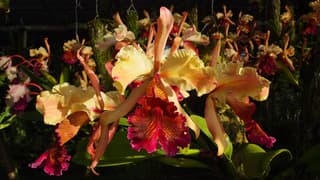
Jiminy Cricket Cattleya Orchid
Rhyncovola Jiminy Cricket x Cattleya dowiana
A Cattleya-alliance orchid hybrid combining the grex Rhyncovola Jiminy Cricket with the species Cattleya dowiana, prized for large, fragrant flowers with a velvety lip streaked in gold. Like other Cattleyas, it is an epiphytic orchid with sympodial growth, thick pseudobulbs, and leathery evergreen leaves, thriving in bright light with strong air movement and a dry-between-waterings routine.
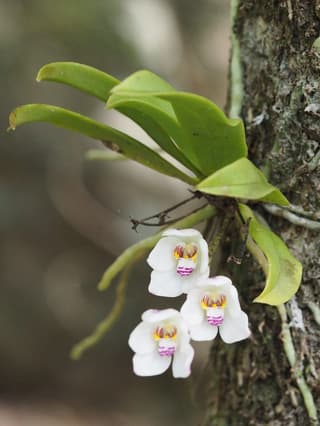
Orange blossom orchid
Sarcochilus falcatus
Sarcochilus falcatus is a small orchid from eastern Australia, found from Queensland to New South Wales and the far east of Victoria. It grows on trunks and branches, sometimes on rocks, in airy spots in or near moist forest, from the coast up to about 1,200 m. The stem is only 4-8 cm long and carries 3-8 thick, sickle-shaped leaves 6-16 cm long. From winter into spring it sends out arching stems with 3-12 fragrant white to cream flowers, 2-3 cm across, the lip marked with orange, yellow and purple. Its common name comes from the scent and shape, which recall orange blossom.
Medium Care Orchids
Our selection of 78 medium orchids combines the characteristics of this category with moderate care needs. Ideal for those with basic experience.
Why Choose Medium Orchids?
Combining the beauty of orchids with medium difficulty level lets you enjoy this category with a balanced care commitment. Each plant was selected to offer the best characteristics of the category at the care level you are looking for.