Complete Plant Guide
Explore plants by difficulty, season and more. Find the perfect plant for you.
Difficulty
Categories
Plants by City
🗺️ Plants by City4366 plants found
Showing 4285-4320 of 4366
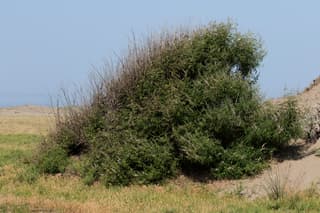
Chaste Tree
Vitex agnus-castus
Vitex agnus-castus, commonly known as chaste tree or monk's pepper, is a deciduous Mediterranean shrub in the Lamiaceae family. It produces fragrant spikes of lavender-blue flowers throughout summer and fall, attracting butterflies and pollinators. Highly drought-tolerant and adaptable, it has centuries of history as a medicinal herb.
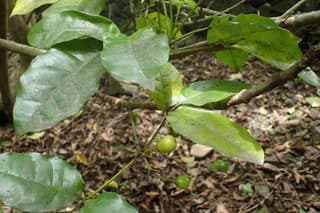
Puriri
Vitex lucens
Puriri (Vitex lucens) is a majestic evergreen tree endemic to northern New Zealand. It can reach up to 20 metres tall with a massive spreading canopy, glossy palmate leaves, and tubular pink-to-red flowers that bloom year-round. It is one of New Zealand's most iconic native trees, providing critical food and habitat for native birds such as the kererū (native pigeon).
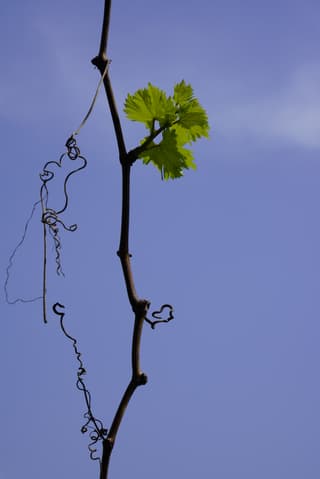
Grapevine
Vitis
Vitis, commonly known as the grapevine, is a woody climbing plant of great historical and economic importance. Its stems, called canes, attach to supports using tendrils. It is famous for producing grapes, which grow in clusters and are the foundation of the wine industry, in addition to being consumed fresh or dried. Its leaves are large, lobed, and deciduous, providing dense foliage ideal for pergolas.
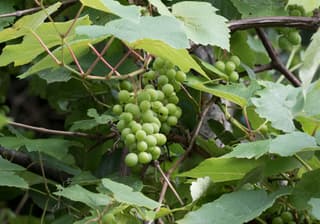
Fox Grape
Vitis labrusca
Vitis labrusca, commonly known as the Fox Grape or Northern Fox Grape, is a vigorous deciduous climbing vine native to eastern North America. It is the parent species of many beloved American grape cultivars, most notably the Concord grape, widely used in juices, jellies, and wines. This fast-growing vine climbs by tendrils and can reach 15–20 feet in length, producing clusters of dark blue-black grapes with a characteristic "foxy" musky aroma. Its large, three-lobed leaves turn attractive shades in autumn, and fragrant greenish-yellow flowers bloom in spring to early summer. A hardy, adaptable plant suited to USDA zones 5–8, it thrives in full sun and well-drained loamy soil.
Riverbank Grape
Vitis riparia
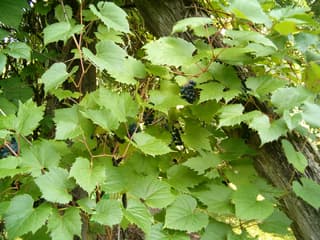
Vitis riparia, commonly known as Riverbank Grape or Frost Grape, is a vigorous deciduous climbing vine native to North America, ranging from Canada through the central United States. It thrives along riverbanks, forest edges, and rocky slopes, climbing trees and structures to heights exceeding 20 metres. In autumn, its heart-shaped lobed leaves turn golden-yellow, while its clusters of small, dark-blue berries — sweetened after the first frost — provide vital food for wildlife and are used by foragers for juices, jellies, and wine.
Muscadine Grape
Vitis rotundifolia
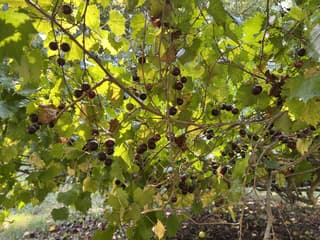
Muscadine grape (Vitis rotundifolia, also classified as Muscadinia rotundifolia) is a deciduous woody vine native to the southeastern United States. It climbs with simple, unbranched tendrils and has glossy, nearly round leaves with coarse teeth that turn golden yellow in fall. Small greenish-white flowers open in short clusters in late spring, followed by large, thick-skinned bronze or dark purple berries that ripen from late summer into fall. Many vines are female and need a perfect-flowered variety nearby to set fruit; cultivars such as 'Carlos', 'Noble' and 'Triumph' are self-fertile. It resists Pierce's disease and phylloxera, so it thrives in hot, humid climates where European grapes struggle.
Common Grapevine
Vitis vinifera
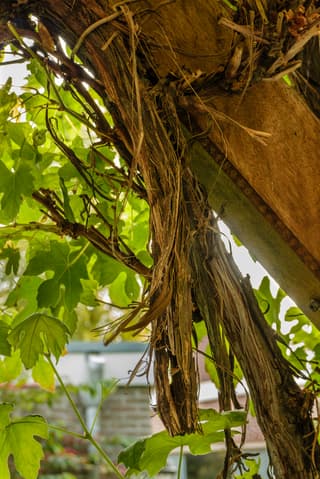
The Common Grapevine (Vitis vinifera) is one of the oldest cultivated plants in human history, originating from the Mediterranean basin and western Asia. A vigorous deciduous climber, it produces the famous grape clusters used for wine, fresh consumption, and raisins. Its lobed leaves are ornamental and provide pleasant shade on pergolas and trellises.
Tubular Knapweed
Volutaria tubuliflora
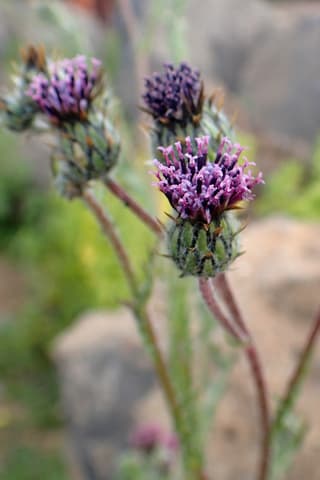
Tubular Knapweed (Volutaria tubuliflora) is an annual herb in the Asteraceae family, native to North Africa and the Mediterranean Basin. Recognized by its pink-purple tubular flowers and deeply lobed hairy leaves, it thrives in sandy, arid to semi-arid environments. It is considered an invasive species in California, USA, where it poses a threat to native desert ecosystems, producing up to 2,500 seeds per plant.
Stubble Rosegill
Volvariella gloiocephala
Volvariella gloiocephala, also known as the Stubble Rosegill, is a saprobic fungus characterized by its large, slimy, whitish to grey cap and the prominent volva at the base of the stem. It often grows on nutrient-rich soils, arable fields, or compost heaps.
Vriesea
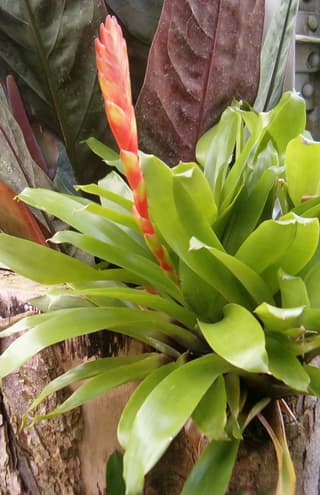
Vriesea
Vriesea is a genus of approximately 250 epiphytic bromeliads native to the Americas, particularly Central and South America. They form tank-shaped rosettes with long, often ornamentally banded or spotted leaves. The dramatic, flat flower spikes display vibrant bracts in shades of red, yellow, orange, and pink that last for weeks.
Lobster Claws Bromeliad
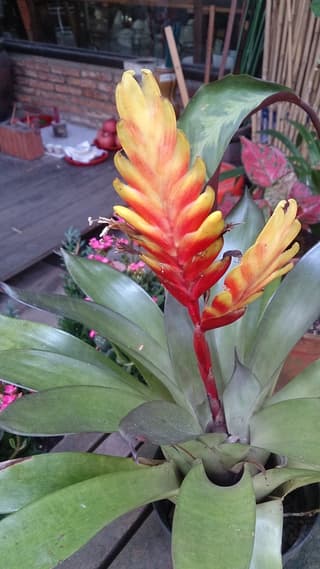
Vriesea carinata
Vriesea carinata, commonly known as Lobster Claws Bromeliad or Painted Feather, is an epiphytic bromeliad native to the Atlantic Forest of Brazil. It is prized for its stunning red and yellow flower bracts that resemble lobster claws. A compact, low-maintenance plant ideal for indoor tropical settings.

Giant Vriesea
Vriesea gigantea
The Giant Vriesea (Vriesea gigantea) is a large epiphytic bromeliad native to Brazil's Atlantic Forest. It is prized for its broad, strap-shaped leaves marked with an intricate netted (tessellated) pattern in pale green and yellowish tones reminiscent of snakeskin. The plant forms a substantial rosette that can exceed 70 cm across, eventually sending up a tall flower spike from its center at maturity. In the wild it grows attached to tree trunks and branches, drawing water and nutrients mainly through the central "cup" or "tank" formed by its overlapping leaf bases.
King of Bromeliads
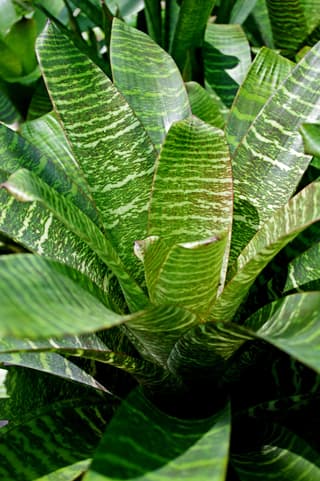
Vriesea hieroglyphica
Tank bromeliad with distinctive banded green leaves featuring dark cross-banding and recurved tips, resembling hieroglyphic markings. Produces branching yellow, cream, or white flowers on tall inflorescences. Endemic to southeastern Brazil, thriving in humid conditions beneath tree shade.
Vriesea incurvata
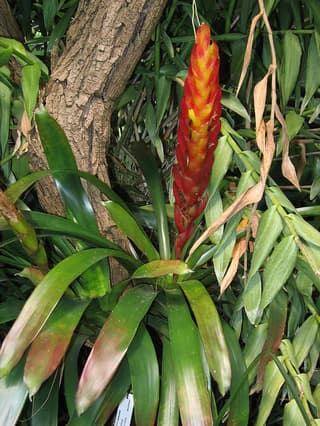
Vriesea incurvata
Vriesea incurvata is an epiphytic bromeliad endemic to the Atlantic Forest of south-eastern and southern Brazil, where it grows on trunks and branches inside humid forest. It forms a rosette of smooth green leaves that holds water in its centre. The flattened flower spike has red floral bracts and yellow flowers, and is larger and carries more flowers than that of its close relative Vriesea carinata.
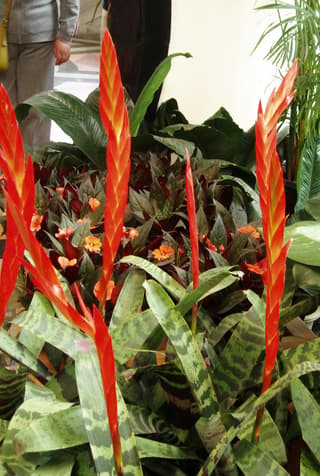
Flaming Sword
Vriesea splendens
Vriesea splendens, commonly known as the Flaming Sword, is a stunning tropical bromeliad native to Trinidad and Venezuela. It produces a dramatic, sword-like red inflorescence spike that can last for months, making it one of the most striking indoor plants available. Its dark green leaves are banded with horizontal purple-brown stripes, creating a beautiful architectural form even without flowers.
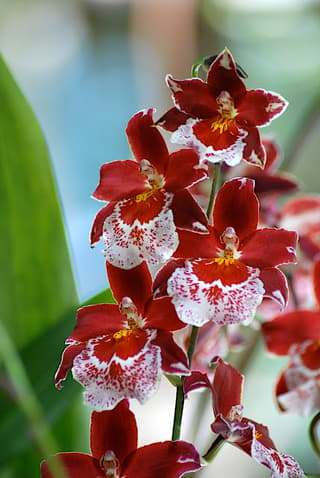
Cambria orchid
Vuylstekeara
Vuylstekeara is an artificially created orchid nothogenus (a cross between Cochlioda × Miltonia × Odontoglossum), most commonly known in the trade as "Cambria," primarily through the popular cultivar Vuylstekeara Cambria 'Plush'. This hybrid combines the best traits of its parent species: it offers long-lasting, colorful inflorescences and is relatively easy to maintain, making it a frequent recommendation for beginner orchid enthusiasts. Ribbon-like leaves grow from its fleshy pseudobulbs, and its flowers appear with contrastingly patterned petals in a wide range of colors from yellow to burgundy.
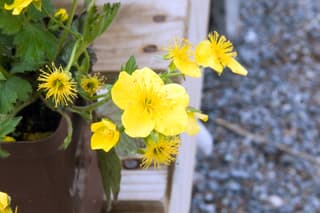
Barren Strawberry
Waldsteinia ternata
Barren strawberry (Waldsteinia ternata) is a low-growing, semi-evergreen perennial groundcover belonging to the Rosaceae family. It is native to a region spanning from Central Europe to Siberia and Japan. Its trifoliate, dark green leaves form a dense mat that effectively covers the ground throughout the growing season. The foliage remains green under the snow and recovers quickly in the spring. In May, the plant bursts into yellow blooms that resemble strawberry flowers. Barren strawberry is very low-maintenance and is an excellent choice for a groundcover in semi-shaded gardens.
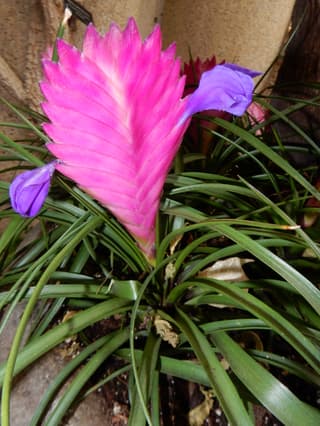
Pink quill
Wallisia cyanea
Wallisia cyanea (formerly Tillandsia cyanea), known as the pink quill, is an epiphytic bromeliad native to the tropical forests of Ecuador. It forms a dense rosette of narrow, grass-like leaves from which a flattened, vibrant pink spike resembling a quill emerges. From this spike, short-lived violet-blue flowers appear sequentially over several months. It is a slow-growing plant that does not require soil, primarily cultivated for its spectacular, long-lasting colorful inflorescence.
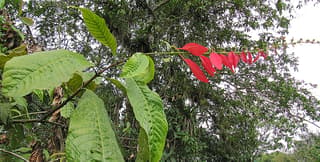
Chaconia
Warszewiczia
Warszewiczia is a genus of evergreen tropical trees and shrubs in the Rubiaceae (coffee) family, native to Central America, the Caribbean, and northern South America. Its best-known and most widely cultivated species, W. coccinea -- the chaconia or wild poinsettia -- is the national flower of Trinidad and Tobago. The plant is prized for its striking flower clusters: long, upright spikes bearing dozens of small, inconspicuous yellow flowers, each subtended by one flame-red, enlarged sepal (bract) that gives the inflorescence its brilliant color. It grows as a large shrub or small tree, typically 4-8 m tall in cultivation (up to 12 m in the wild), with big, glossy, leathery leaves.
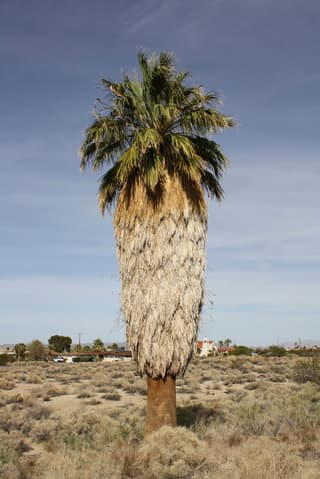
California Fan Palm
Washingtonia filifera
Washingtonia filifera, the California fan palm (also called desert fan palm), is a massive, single-trunked palm native to desert oases of the southwestern United States. It is the only palm species native to the western United States and forms dense groves around natural springs in the Colorado and Mojave deserts. Mature palms develop a thick, fibrous gray-brown trunk topped with a crown of large, fan-shaped (palmate) leaves that can reach 1.5-2 m across, each armed with curling filaments along the leaf margins that give the species its epithet "filifera" (thread-bearing). Older, uncultivated specimens often retain a skirt of dead fronds hanging down the trunk, earning it the nickname "petticoat palm."
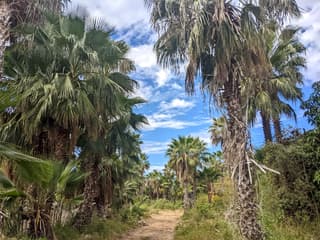
Mexican Fan Palm
Washingtonia robusta
Washingtonia robusta, commonly known as the Mexican Fan Palm or Skyduster, is a fast-growing palm native to Baja California and Sonora, Mexico. Prized for its slender towering trunk and large fan-shaped fronds, it can reach up to 30 meters tall and is widely planted along boulevards, in parks, and in warm-climate gardens worldwide.
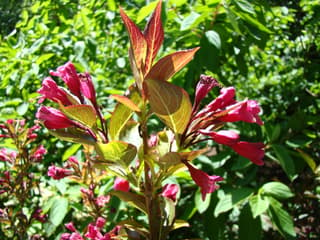
Old Fashioned Weigela
Weigela florida
Weigela florida, commonly known as Old Fashioned Weigela, is a deciduous flowering shrub native to northern China and Korea. It is celebrated for its profuse, trumpet-shaped blooms in shades of pink, red, and white that emerge in late spring and early summer, making it a beloved choice for garden borders and foundation plantings. Its arching branches create an elegant silhouette, and modern cultivars offer a wide range of foliage colors from deep burgundy to variegated cream.
Coastal Rosemary
Westringia fruticosa
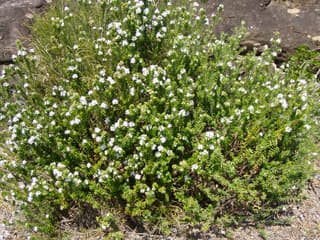
Westringia fruticosa, commonly known as Coastal Rosemary, is a hardy evergreen shrub native to coastal areas of southeastern Australia. Despite its common name and rosemary-like foliage, it is not related to true rosemary but belongs to the mint family (Lamiaceae). It produces an abundance of small white to lavender flowers almost year-round, making it a popular ornamental shrub in Australian and Mediterranean-style gardens.
Caracas Wigandia
Wigandia urens
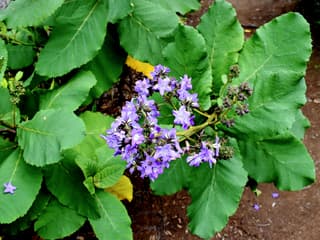
Wigandia urens is a fast-growing large shrub or small tree native to Mexico and Central/South America, prized for its enormous textured leaves that can reach 30 cm long. The entire plant is covered in bristly stinging hairs that produce severe contact dermatitis, making it one of the most hazardous ornamentals to handle. In summer, it produces striking clusters of deep purple flowers with a white throat, attracting pollinators. It thrives in full sun outdoors and is highly drought tolerant once established.
Silky Wisteria
Wisteria brachybotrys
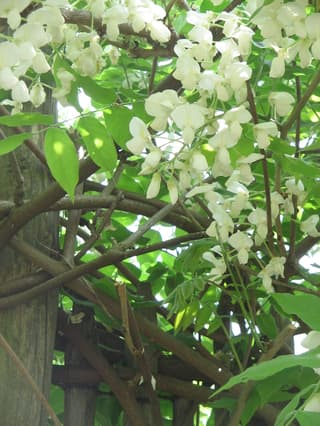
Silky wisteria is a deciduous woody climber from Japan, where it grows wild in mountain woods in western Honshu, Shikoku and Kyushu. It twines anticlockwise around its support and can reach 9 metres or more. The name comes from the leaves, which are covered in soft hairs that feel like silk, with up to 13 leaflets each. In late spring, as the new leaves open, it hangs short, chunky clusters up to 15 cm long of very fragrant pea-like flowers, pale violet or white with a yellow blotch. That is what brachybotrys means: short clusters. The flowers are followed by velvety green pods. In Japan the white forms, such as 'Shiro-kapitan', are grown more than the violet ones.
Japanese Wisteria
Wisteria floribunda
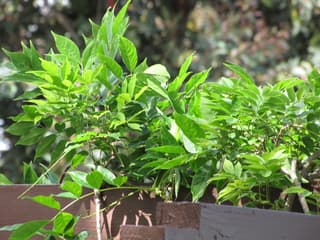
Japanese Wisteria is a vigorous, woody deciduous climber native to Japan, prized for its long, fragrant, drooping flower clusters that cascade over trellises and pergolas in spring. Its stems twine clockwise around supports, thickening into gnarled trunks over the years.
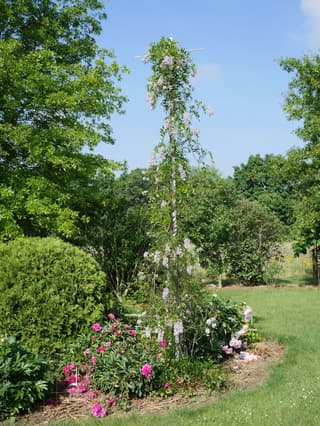
Kentucky wisteria
Wisteria macrostachya
Wisteria macrostachya (often classified as Wisteria frutescens var. macrostachya) is a deciduous woody vine native to the South and Southeast United States, where it grows in moist forests and along the banks of rivers and streams. It climbs by twining counter-clockwise and reaches heights of 20 to 30 feet. The leaves are pinnately compound. From late spring to early summer, after the leaves have emerged, it produces drooping clusters 6 to 12 inches long with bluish-purple to lilac flowers (the 'Clara Mack' cultivar is white); it sometimes blooms again more lightly in summer. Velvety pods remain after flowering. It is less aggressive than Asian wisterias and blooms sooner after planting. It serves as an excellent substitute for Chinese and Japanese wisteria, which have become invasive in some areas.
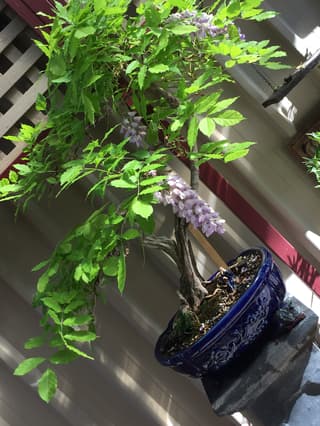
Chinese Wisteria
Wisteria sinensis
Chinese Wisteria (Wisteria sinensis) is a vigorous, woody deciduous climber native to China, belonging to the Fabaceae family. Widely grown on pergolas, arbors, and walls for its spectacular cascading racemes of fragrant flowers — up to 30 cm long, in shades of purple, violet, and lavender — that appear in spring before the leaves emerge. Fast-growing and twining, it can reach many meters if left unchecked, so training it on sturdy structures is essential. Every part of the plant, especially the seeds and pods, is toxic to humans, dogs, and cats, potentially causing nausea, vomiting, and abdominal pain if ingested.
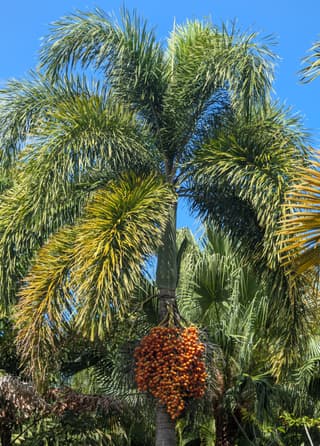
foxtail palm
Wodyetia
The foxtail palm (Wodyetia bifurcata) is a monotypic palm species native to the Cape Melville Peninsula in far north Queensland, Australia. Its common name derives from the distinctive plumose fronds, where leaflets radiate in all directions around the rachis, creating a full, bushy appearance reminiscent of a fox's tail. The solitary, self-cleaning trunk is grey and prominently ringed, reaching up to 10 metres in height. Widely cultivated across tropical and subtropical regions worldwide, the foxtail palm is prized as a landscape ornamental in gardens, parks, and streetscapes.
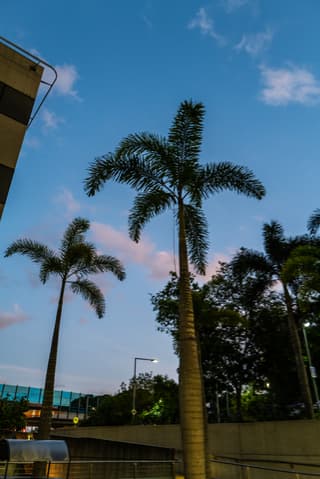
Foxtail Palm
Wodyetia bifurcata
Wodyetia bifurcata, commonly known as the Foxtail Palm, is a stunning single-trunked palm native to the rainforests and open woodlands of the Cape Melville region in Queensland, Australia. Its distinctive arching fronds, with leaflets radiating in all directions like a fox's bushy tail, make it one of the most ornamental palms in tropical and subtropical landscapes worldwide.
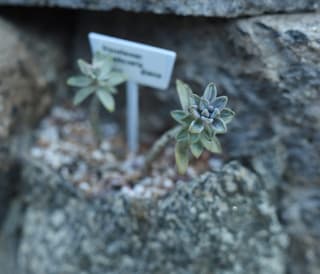
Little Jewel
x Pachyveria glauca
x Pachyveria 'Glauca' (Little Jewel) is a hybrid succulent from the Crassulaceae family, resulting from a cross between the Pachyphytum and Echeveria genera. It forms a compact, spiky rosette of thick, fleshy, cylindrical leaves with a dusty blue-gray coloration and tips that take on red and violet tones under intense sun. It is a plant of exclusively horticultural origin (does not occur in nature), very popular in rock gardens, shallow pot compositions, and succulent collections for its hardiness and understated beauty. In winter and early spring, it can produce small flowers in shades of pink and peach.
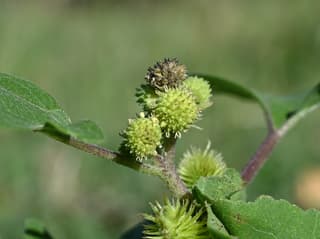
Cocklebur
Xanthium
Xanthium is a genus of annual herbaceous weeds in the family Asteraceae, native to the Americas and eastern Asia. It is best known for its spiny bur fruits that cling to clothing and animal fur, aiding seed dispersal. Plants grow in disturbed soils, roadsides, and open fields, reaching up to 120 cm tall.
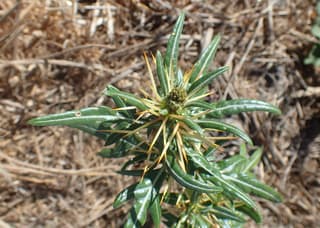
Spiny Cocklebur
Xanthium spinosum
Xanthium spinosum, commonly known as Spiny Cocklebur or Bathurst Burr, is an annual invasive herb in the Asteraceae family, presumed native to South America. It is characterized by long yellowish three-pronged spines at leaf bases and spiny burs that cling readily to animal fur and clothing. It is considered a serious agricultural weed and is highly toxic to livestock and humans.
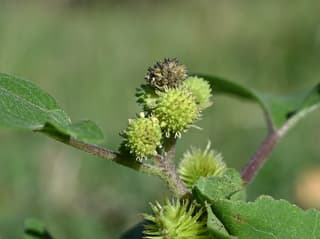
Rough Cocklebur
Xanthium strumarium
Xanthium strumarium, known as Rough Cocklebur, is an annual herbaceous weed belonging to the Asteraceae family. It is a cosmopolitan invasive species found on all continents except Antarctica, thriving in disturbed soils, floodplains, roadsides, and agricultural fields. It is best known for its hard, spiny burs that cling to animal fur and clothing — a property that inspired the invention of velcro. The plant is highly toxic, particularly in the seedling and cotyledon stages, where it contains carboxyatractyloside, a diterpenoid glycoside fatal to livestock and potentially to humans.
Maritime sunburst lichen
Xanthoria parietina
Xanthoria parietina, commonly known as the maritime sunburst lichen or common orange lichen, is a highly resilient lichen species often seen on rocks, walls, and tree bark. Its characteristic bright yellow or orange color is provided by a pigment called parietin, which protects the cells from intense UV radiation. This species lives in symbiosis, with its body composed of a fungus and an alga. It is an excellent bioindicator, as it tolerates nitrogen-rich environments well but remains sensitive to certain types of air pollution.
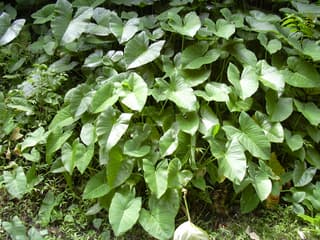
Giant Elephant Ear
Xanthosoma robustum
The giant elephant ear (Xanthosoma robustum) is a tropical aroid native to Mexico and Central America, prized for its massive shield-shaped leaves in deep emerald green with striking white veining. It can reach up to 3.6 m tall under ideal conditions, forming an imposing clump in tropical gardens or large containers.
Find the Perfect Plant
Our plant guide helps you find ideal species for your experience level and time of year.
Browse by Difficulty, Season & More
Use the filters below to narrow this catalog by care difficulty, season, environment, or search directly by name. Each filter leads to a focused list tailored to your specific growing conditions.