Hydrangea Pests: How to Identify and Treat Them
Hydrangea pests are recognized by the signs they leave behind. White cotton on the stem is scale, sticky leaves are honeydew from aphids or scale, and fine webbing is spider mites. See how to treat each one and why neem oil sometimes falls short.
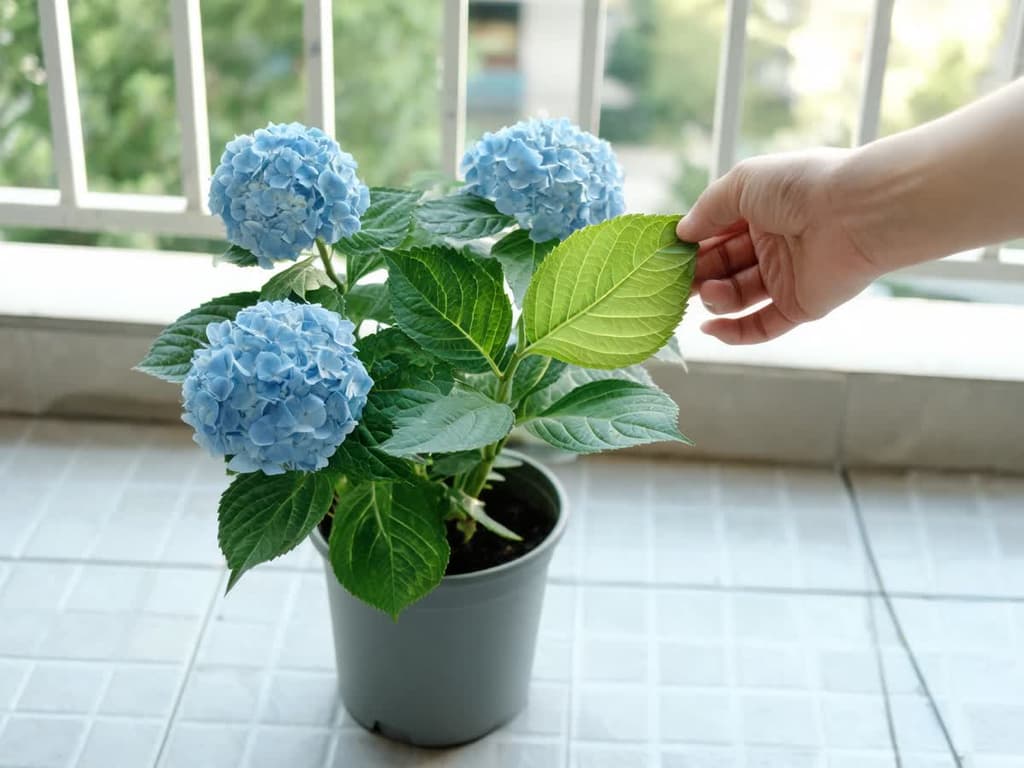
You can identify hydrangea pests by the signs they leave and where those signs appear: new growth, leaf undersides, stems, or leaf edges. Most of them cause cosmetic damage and do not kill the plant. The University of Connecticut (UConn) Home & Garden Education Center notes that hydrangeas have few serious pest and disease problems.
Sticky leaves, white specks, and fine webbing do not call for pulling up the shrub or cutting everything back. Honeydew comes from aphids or scale insects, and webbing comes from spider mites. All three pests are treated branch by branch, using water, your hands, and, if necessary, insecticidal soap or horticultural oil (oil formulated for plants that suffocates insects), which are sold at garden centers.
The sources in this guide describe the common bigleaf mophead hydrangea, Hydrangea macrophylla. When a source refers to another hydrangea species, the text points it out.
Quick summary:
Green or dark bugs clustered on fresh growth, with curled, sticky new leaves: aphids. Rub them off with your fingers or wash them away with a hose spray.
Oval white cottony patches on stems or leaf undersides, with a brown shell attached: hydrangea scale. Scrape the patches off.
Light stippling on the upper leaf surface and fine webbing on the underside during hot, dry weather: two-spotted spider mites. Wash the underside of the foliage with water.
Leaf edge notched in a half-moon: adult black vine weevil, a European beetle with no record in Brazil according to EPPO. Irregular hole with a shiny trail: slug or snail.
White powder that wipes off when you rub it with a finger: powdery mildew, a fungus, not a pest.
Soaps and oils only kill the insects they coat directly and provide no lasting effect once dry. Do not apply them above 32 °C, in direct sun, or to a thirsty plant.
Diagnostic triage table: hydrangea signs and pests
What you see | Where it appears | Likely cause | First step |
|---|---|---|---|
Clustered green, black, or brown bugs, curled new leaves | Branch tips, buds, undersides of new leaves | Aphids | Rub with your fingers or spray with a hose |
Sticky, glossy foliage, sometimes topped with black powder | Upper surface of lower leaves | Honeydew from aphids or scale insects | Search for insects on the leaves and branches directly above the sticky foliage |
Oval white patch measuring 3–4 mm with an attached brown shell | Stems and leaf undersides | Hydrangea scale | Scrape off the patch |
White cottony tufts in leaf axils on indoor plants | Leaf axils, right where leaf meets stem | Mealybugs | Isolate the pot from other plants |
Fine light stippling, webbing underneath | Foliage, starting from the lower leaves | Two-spotted spider mites | Wash leaf undersides with water |
Silvery foliage dotted with tiny black flecks | Leaf surface and petals | Thrips | Shake the branch over a sheet of white paper |
Notched leaf edges with clean half-moon cuts | Edges of thicker leaves | Adult black vine weevil (no record in Brazil in the EPPO) | Handpick at night with a flashlight |
Irregular holes and shiny slime trails | Lower leaves and blossoms | Slugs or snails | Handpick at night during damp weather |
White powder that rubs off with a finger | Upper leaf surface | Powdery mildew (fungus) | Collect fallen foliage and water at the base without wetting leaves |
Sticky leaves on hydrangeas: aphids or scale insects
Sticky leaves mean honeydew, the sugary fluid sucking insects excrete after feeding on sap. Both aphids and scale insects produce honeydew, which drips down onto the foliage below. That is why a sticky leaf is rarely the leaf carrying the pest: check the foliage and stems immediately above it.
Sooty mold, a black fungus that looks like soot, grows on top of honeydew. The RHS, the Royal Horticultural Society of the United Kingdom, explains that sooty mold does not attack the plant and wipes off with a damp cloth. Ants climbing up the shrub also point to aphids: the RHS notes that ants protect aphids in exchange for honeydew.
Where the pest gathers tells the two apart. Aphids crowd around fresh tips and flower buds, crawling when touched. Scale insects stay stationary on stems and leaf undersides, cemented in place like a shell, and hydrangea scale comes with cottony white egg sacs.
Green bugs on fresh shoots: aphids
Green, black, or brown bugs crowded at branch tips and on flower buds are aphids. According to UConn, aphids can form large populations on new hydrangea growth. Heavy aphid infestations cause new leaves to yellow and distort.
The RHS notes that aphids very rarely kill a plant. A small colony can stay, because ladybugs and lacewing larvae (a green insect with transparent wings) eat aphids. If the colony grows, follow Clemson Extension, in this order:
Rub colonies with your fingers or a damp cloth. Clemson notes that this method works with small numbers of aphids, early in an infestation.
Wash branch tips with a garden hose using enough pressure to dislodge the aphids. A pressure washer is far too powerful and will injure the plant.
If the colony returns, apply commercial insecticidal soap, following the rules outlined in the soap and oil section below.
Before reapplying soap, touch the aphids with the tip of a pencil: any that do not move are already dead. Clemson advises spraying again only if live aphids remain, because dead aphids stay stuck to the leaf.
Do not prune off a branch just because of aphids. The infested tip resumes clean growth once the colony disappears. The RHS notes green, black, yellow, and pink aphids, depending on the species. The aphid guide explains how to spot each one.
White patches on stems: hydrangea scale
Oval, white cottony patches attached to the stems and leaf undersides are almost always hydrangea scale (Pulvinaria hydrangeae). Each patch is an egg mass covered in waxy threads, and at its tip sits the adult scale insect, an oval, brown shell. The RHS describes the patch as 3 to 4 mm long and the adult as about 3 mm.
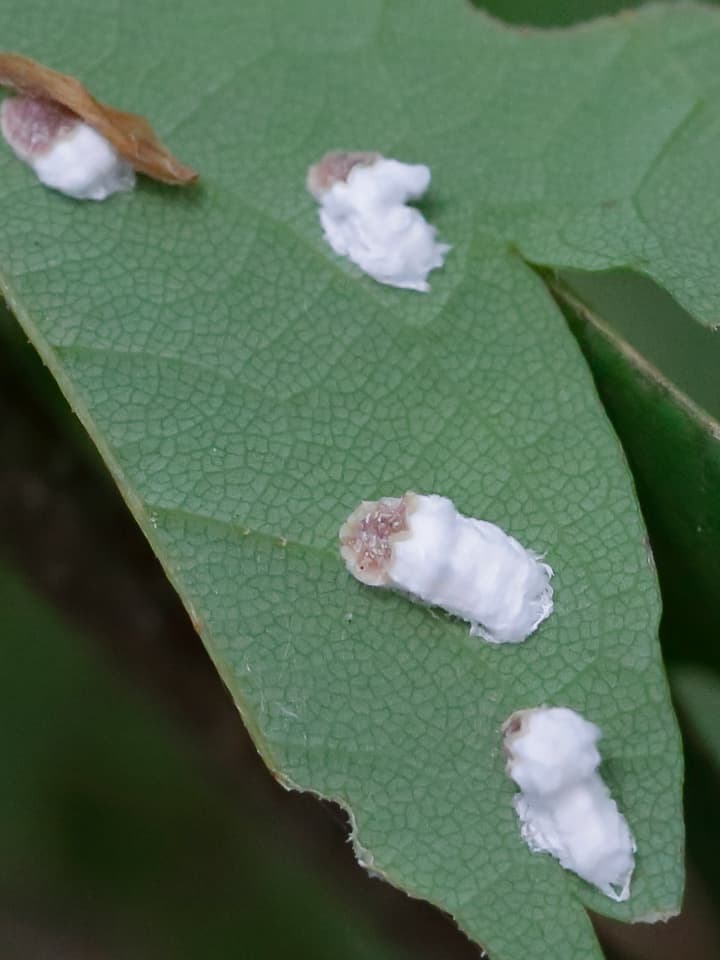
The waxy sac stays on the plant long after the eggs have hatched, according to the RHS. Because of that, the white cotton does not vanish after treatment, and its presence does not mean your control failed. Crawlers emerging from the mass measure under 1 mm, appear pale yellow, and drift to surrounding plants on the wind.
The RHS describes one generation per year. Below, the cycle stages described by the RHS in the United Kingdom are converted to Brazilian calendar months:
In early summer, the adult lays eggs under the white scale. In Brazil, this falls in November and December.
In midsummer, the young hatch and suck the undersides of the leaves. In Brazil, in December and January.
In late summer (February and March in Brazil), the nymphs move down to the stems and overwinter there.
By late the following spring (November, in Brazil), they become adults and the cycle begins again.
Severely infested hydrangeas lose vigor and can drop leaves, according to the RHS. If your hydrangea drops leaves rapidly while the stems are coated in white patches, hydrangea scale is the likely culprit. The RHS advises treating as follows:
Scrape off adults and egg masses with your fingernail or a cloth as soon as they appear. Throw what you scrape off into the trash, away from the plant.
Let ladybugs, tiny parasitic wasps, and birds do their work: they eat scale insects.
Tolerate small populations. A healthy, well-tended plant handles a few scales without needing chemical treatment.
If the plant is overwhelmed and weak, the RHS accepts digging it up and planting another in the fall (March to May in Brazil).
Neem oil and insecticidal soap catch little of the scale insect. Clemson Extension recommends neem for immature scale crawlers, not adults. The adult stays protected by its shell, and the eggs sit under wax. The product only works on the insect it wets and leaves no effect once dry. Because of this, spraying a plant covered in scale patches barely changes the population.
The effective window for neem or soap is right after the eggs hatch, when the crawlers move across the leaves (December and January in Brazil). Before that, scraping off the scales removes the eggs with them. The scale insect guide covers the other scale insect species found on houseplants.
Mealybug is another pest. It forms cottony tufts in the leaf axils, where the leaf meets the stem, and lays orange or pink eggs under the cotton. The RHS describes mealybugs on greenhouse and indoor plants, noting that they rarely appear outdoors in the UK climate. On potted indoor hydrangeas, isolate the pot from other plants. The RHS recommends keeping new plants separate for at least 1 month. The RHS explains that mealybugs move little and arrive on newly purchased plants, and indoor plant pests enter the same way.
Light stippling and fine webbing: two-spotted spider mites
Very fine light stippling on the upper leaf surface, paired with webbing underneath, points to the two-spotted spider mite (Tetranychus urticae), also called the spider mite. The mite is a relative of spiders and measures less than 1 mm. Each light speck is a feeding bite, UConn explains, and the mite appears more frequently in hot, dry weather.
The undersides of infested leaves host yellow-green mites with two dark body spots, alongside white shed skins. The RHS recommends a 10x hand lens to spot them. Under heavy feeding, leaves lose their green color, dry up, and drop.
Wash the undersides of the leaves with water, paying attention to the lower leaves. Repeat whenever the hand lens shows mites moving around. The RHS records that wetting the plant and keeping the air humid reduces mites, but does not eliminate them on its own.
Keep hydrangeas well watered through dry spells. UConn notes that well-hydrated plants tolerate mite feeding without showing visible damage.
Avoid broad-spectrum insecticides for other pests. UConn notes that mite flare-ups often trail behind broad-spectrum chemical sprays that kill off natural mite predators.
If webbing covers the stems or mites return after washing, apply insecticidal soap or horticultural oil, targeting the undersides of the leaves.
The RHS notes that spider mites are one of the most stubborn problems in greenhouses and indoor settings, flourishing in dry heat. On potted indoor hydrangeas, check leaf undersides every week. The RHS notes that two-spotted spider mites feed on such a broad host list that few plants are truly safe. The spider mite guide explains how to inspect leaf undersides on other houseplants.
Silvery foliage with black specks: thrips
Leaves with silvery patches and small black specks, which are the insect's droppings, indicate thrips. Adult thrips are slender and measure up to 2 mm, according to the RHS. On flowers, they leave petals with white streaks and buds that fail to open.
To verify, tap a branch over a sheet of white paper and inspect the fallout with a hand lens. Clemson recommends insecticidal soap and neem oil against thrips, adhering to the precautions in the soap and oil section.
Holes and notched margins: slugs, caterpillars, and black vine weevils
Chewed foliage points to chewing pests, and the shape of the damage reveals who did it. Ragged holes, through the center or along the margin, accompanied by a glossy trail across pot or leaf, point to slugs or snails. Foliage tied together with silken webbing, housing a caterpillar inside, means leaftiers.
Slugs and snails feed at night during wet weather, according to the RHS. Search with a flashlight on mild, damp nights and pick them off by hand. Water in the morning rather than in the afternoon: wet soil at night makes it easier for them to come out.
Hydrangea leaftier ties a few leaves together with silk, like a tent, and eats the inside surface and the flower bud. UConn notes that the moth of this caterpillar lays eggs at the tips of branches on all types of hydrangeas, and that the caterpillar has little effect on the plant's health, but reduces the number of flowers. Open the tied leaves and remove the caterpillar by hand.
The vine weevil (Otiorhynchus sulcatus) is a common beetle in Europe. The RHS describes the adult as dull black, about 9 mm long, and notes that it cannot fly. At night, it notches the leaf margins into semi-circles. Adult beetle damage is cosmetic. The larva, white, C-shaped, legless, and up to 10 mm long, eats the roots. The plant can wilt and die, and potted plants are the most affected.
Against vine weevils, the RHS advises:
Pick off the beetles at night with a flashlight, shaking the shrub over a cloth.
Repot infested containers with fresh potting mix and pick the grubs out of root systems.
Apply entomopathogenic nematodes (microscopic worms that parasitize the grubs), available from biological control suppliers. Species in the genus Steinernema only work when soil temperatures sit between 5 and 20 °C.
EPPO, the European plant protection organization, does not record the black vine weevil in Brazil. The EPPO database lists the beetle in the Americas only in Argentina, Chile, Colombia, Canada, and the United States. Holes in hydrangeas in Brazil point first to slugs, snails, and caterpillars.
Looks like a pest, but it is disease: powdery mildew, Cercospora leaf spot, and gray mold
Three fungal diseases of hydrangeas are often confused with pests. Fungus does not move, does not make webbing, and does not leave honeydew. Clemson Extension recommends watering without wetting the leaves to reduce hydrangea leaf fungi.
Powdery mildew. A white coating on the leaves that rubs off with your finger, sometimes backed by yellow or purple blotches. UConn notes that powdery mildew attacks all hydrangeas and causes the most trouble on Hydrangea macrophylla growing in crowded, shady spots. Rake up fallen foliage, as old leaves harbor fungal spores (the units that spread the disease).
Cercospora leaf spot. Brown to gray spots with dark purple borders, in late summer. The University of Maryland Extension notes that the spot rarely calls for treatment and does not kill the plant. It appears more often on newly purchased plants that grew crowded together in the nursery.
Gray mold. Water-soaked lesions on flower petals that develop into brown rots covered in fuzzy gray mold. UConn reports that gray mold favors cool, humid, rainy weather. The RHS advises bagging affected flowers before clipping them away, as the spores disperse very easily on the breeze.
Yellow leaves on hydrangeas: pests or nutrient deficiency?
Nutrient yellowing has no bugs, webbing, or honeydew. Leaves turning yellow between the veins while the veins stay green point to soil with a high pH, meaning it is not acidic enough. The University of Illinois Extension explains that above pH 6.5, the iron in the soil takes on a form the plant cannot absorb. Pest yellowing comes with the sign of the pest: fine stippling from mites, curled and sticky new leaves from aphids, white crusts from scale insects.
Flip 3 or 4 yellow leaves over and check the undersides under bright light. If there are no bugs, no webbing, and no sticky residue, pests are not the cause, and no insecticide will help. If the discoloration sits between green veins, check your soil pH with a test kit before buying any treatment products.
From gentlest to strongest: water, hands, soaps, and oils
Treatment should always begin with the mildest option, stepping up to stronger methods only if pests bounce back:
Water. A strong hose spray directed at leaf undersides and branch tips knocks off aphids and spider mites.
Hands. Rubbing off aphids, scraping away scale, and handpicking slugs, caterpillars, and weevils.
Insecticidal soap or horticultural oil. For aphids, spider mites, thrips, and scale crawlers that reappear after washing and manual removal.
Removing the plant. Reserved strictly for shrubs overwhelmed by scale and drained of vigor, as accepted by the RHS.
Clemson Extension gives the rules for soap and oil to work without burning the foliage:
The product only kills the pests it wets directly. Ensure thorough coverage on branch tips and leaf undersides.
Once dry, the spray offers no continued barrier. Reapply if the pest population rebounds.
Do not spray above 32 °C, in full sun, or on water-stressed plants. Water the shrub thoroughly the day before.
Apply early in the morning or late in the afternoon so spray droplets dry slowly.
Dilute horticultural oils to 1–2%, never spraying when rain is forecast within 24 hours or if temperatures dip below 7 °C.
Clemson advises against homemade dish soaps, as they cause more foliage scorch than commercial insecticidal soaps.
Two German gardening guides recommend homemade recipes. One advises blending 1 part canola oil with 4 parts water, creating a 20% oil concentration, far higher than Clemson's 1–2% recommendation. Another suggests pairing dish soap with paraffin oil. This guide follows Clemson university extension guidance: rely on commercial formulations, mix to label rates, and spray under the environmental conditions above.
Does pruning infested branches harm hydrangeas?
Cutting off only the tip or an attacked leaf does not ruin the hydrangea. What costs you blooms is pruning entire branches at the wrong time of year. Hydrangea macrophylla forms next year's buds on existing branches. Pruning takes place right after flowering, in January and February in Brazil.
Aphids and spider mites do not require any cutting: water sprays and hand removal handle them. Leaves spotted by fungus can come off at any point. A branch coated in scale can be removed during post-bloom pruning, when cuts will not strip off next year's flower buds.
Are hydrangeas toxic to cats and dogs?
Yes, to a low degree. The ASPCA, an American animal poison control center, lists vomiting, depression, and diarrhea in dogs, cats, and horses. NC State Extension classifies the toxicity of Hydrangea macrophylla as low.
With a cat in the house, stick to water sprays, manual picking, and scraping, using insecticidal soaps or horticultural oils only strictly according to the product label. Keep cats away from treated hydrangeas until the leaves dry completely.
Frequently asked questions
I scraped off hydrangea scale, but the white cotton is still there. Did treatment fail?
Not necessarily. The white waxy egg sac of hydrangea scale clings to plant bark long after the eggs have hatched, according to the RHS. It remains behind as an empty shell and does not indicate an active pest presence. Check the undersides of the leaves: pale yellow crawlers smaller than 1 mm, or fresh brown adult shells, show whether the scale population is still active.
Do hydrangea pests spread to other plants?
Yes. Aphids, spider mites, and scale feed on many other species, and wind can blow hydrangea scale crawlers onto neighboring plants, according to the RHS. Separate an infested potted hydrangea from other plants the same day you detect the pests. Inspect the undersides of leaves on neighboring containers every week for 1 month, matching the quarantine window the RHS recommends for new plant arrivals.
Why didn't neem oil resolve my hydrangea pest problem?
Neem oil only kills the insects it directly covers and leaves no residual control once dry, according to Clemson Extension. On scale insects, it targets active young crawlers, failing to penetrate the adult shell or the waxy egg sac. Scrape off existing egg masses first, then spray neem right after eggs hatch, once crawlers begin wandering across leaf undersides.
When does it make sense to discard a hydrangea because of pests?
Almost never. Aphids, mites, thrips, and slugs can be managed without losing the shrub. The RHS endorses replacing a hydrangea only when severe scale infestations have stripped its vigor and caused heavy leaf drop. On potted hydrangeas, root-chewing weevil grubs can kill a plant. In that situation, bare-root the plant, repot into fresh mix, and discard the larvae, as directed by the RHS.
When in doubt between two pests, photograph the symptom
Take a close-up photo of the branch and an affected leaf underside in bright light. Bloom (available for iOS) diagnoses plant issues from photos on its Premium plan.
Sources
RHS (Royal Horticultural Society): Hydrangea scale, Scale insects, Mealybug, Aphids, Glasshouse red spider mite, Thrips, Vine weevil, Slugs and snails, Grey mould.
UConn Home & Garden Education Center: Hydrangea Diseases and Pests.
University of Maryland Extension: Hydrangea: Identify and Manage Problems.
University of Illinois Extension: Chlorosis.
Clemson Cooperative Extension, Home & Garden Information Center: Hydrangea, Less Toxic Insecticides, Integrated Pest Management for Aphids.
EPPO Global Database: distribution of Otiorhynchus sulcatus, accessed on 10/16/2026.
ASPCA Animal Poison Control: Hydrangea.
NC State Extension, Gardener Plant Toolbox: Hydrangea macrophylla.
Related articles
How to Care for Hibiscus: Sun, Watering, Fertilizer, and Pruning for Flowers
How to care for hibiscus: 6 hours of direct sun, evenly moist soil without waterlogging, half-strength fertilizer in spring and summer, and pruning in early spring. Find out why the flower lasts one day and why buds drop before opening.
Do Ferns Like Sun or Shade? It Depends on the Type
Ferns prefer bright shade: plenty of light, but no direct sun on their fronds. Tuberous sword fern is the exception that handles sun. Here is the ideal light for each type, where to place pots, and how fronds show too much or too little light.
African Violet Yellow Leaves: Causes and What to Do
Yellow leaves on an African violet usually stem from overwatering, and the first place to check is the center of the plant. Losing one lower leaf at a time is normal. Identify whether age, watering, cold water, sunlight, cold drafts, or fertilizer is the culprit based on the yellowing pattern, and see what to do today.