What's wrong with my money tree? The 5 causes, in the order they happen
Yellow leaves, leaf drop, or a soft trunk on a money tree almost always have the same origin. Learn how to find the right cause in three checks and what to do in each case.

Most of the time, your money tree is overwatered. It is the number one cause of yellow leaves, leaf drop, and a soft trunk in this species, while the other four causes (moving to a new spot, incorrect lighting, dry air, and pests) appear far less often. The diagnosis comes from looking at the symptom along with the soil moisture and trunk firmness, never from the symptom alone.
This guide is for anyone who has a potted money tree at home, with or without a braided trunk, and is not sure if they are watering too much, watering too little, or dealing with a pest infestation.
Quick summary:
Wet soil and yellowing leaves: overwatering. Dry soil and a light pot: underwatering. The same symptom can come from both extremes.
The swollen trunk of the money tree is a water reservoir. A soft trunk at the base is an emergency; a single loose yellow leaf is not.
Three different plants are sold as money plants, and caring for one the wrong way can kill another.
The ideal temperature range is 18–24 °C, in indirect light. Direct sunlight burns the leaves.
Before diagnosing: is it urgent?
Two situations require action today, not over the weekend:
A soft trunk at the base, dark in color, with a sour smell coming from the soil. This is advanced root rot. Every day you wait costs you living roots.
A wilted plant with soggy soil. It looks like thirst, but it is not. The rotted roots have stopped absorbing water, so the leaves wilt even though the pot is full of water.
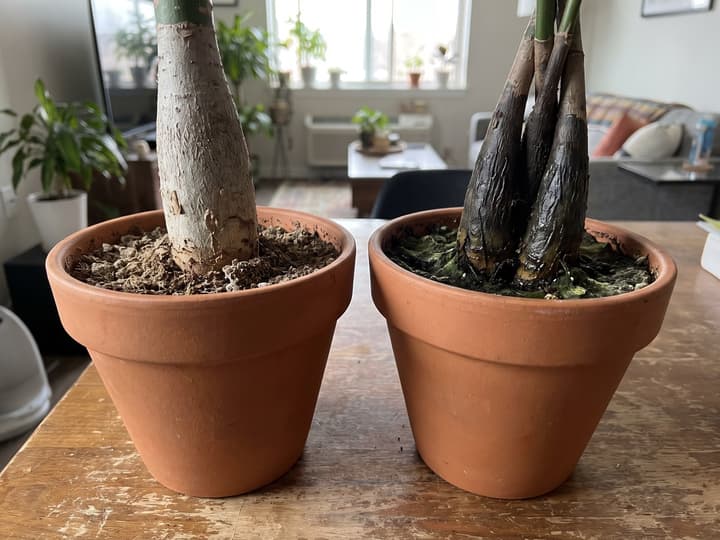
The rest can wait a few days without harm: an isolated yellow leaf, leaves falling after a recent move, brown tips, or a localized pest.
Question 0: is it actually a money tree?
It is worth taking thirty seconds before any watering advice, because three unrelated species are sold under the name money plant, and the NC State Extension Plant Toolbox lists all three with this common name:
What you have | Species | What the leaf looks like | What it wants |
|---|---|---|---|
Money tree | Pachira aquatica | compound, 5 to 9 leaflets opening from a single point, like a hand | wetland tree: moisture yes, standing water no |
Jade plant | Crassula ovata | succulent, oval, thick, stores water in the leaf itself | succulent: only water when the soil has dried out |
Chinese money plant | Pilea peperomioides | round, coin-like, stem attached to the middle of the leaf | middle ground, and absolutely no waterlogging |
This confusion has practical consequences in both directions. If you treat a jade plant like a money tree, it will rot. If you treat a money tree like a succulent, it will dehydrate. And the answer regarding pets in the home is also reversed between the two: the money tree is non-toxic to dogs and cats, while the jade plant is toxic.
If you are still in doubt, a photo solves it faster than a description: Bloom (iOS) identifies the species using your camera, and the identification engine behind it is Plant.id, by Kindwise, whose accuracy measured by independent universities is 93%. This is the accuracy of the recognition engine, not the entire app. If you prefer to compare options before installing anything, the blog has a list of apps that diagnose sick plants.
Money tree quick facts
Two numbers from the factsheet explain almost everything that goes wrong indoors: the temperature range of 18–24 °C and the requirement for indirect light. The NC State Extension adds a third practical detail: below 7 °C the plant needs to come inside, and direct sun on the leaves causes sunburn.
Two expectations that are worth adjusting now, as they save you a scare: the money tree does not bloom indoors, and it will never bloom if it is braided. And the braid is not natural. It originated in Taiwan in the 1980s, when flexible young trunks began to be braided as a nursery practice.
Why the money tree drowns so easily
That swollen base of the trunk has a name: a caudex. The NC State describes it as the tree's water reservoir. The plant stores water in there, which means it arrives in your pot already stocked and can handle much longer periods without watering than most foliage plants.
That is where the problem comes from. Anyone who waters a money tree as often as they water a fern is adding water to a tank that is already full. And the same caudex that stores water rots from the inside out when there is too much of it, which is why a soft trunk is a much more serious sign than a yellow leaf.
In nature, it is a wetland tree. The Flora e Funga do Brasil, from the Rio de Janeiro Botanical Garden, records Pachira aquatica as native to Brazil, from the Amazon domain, with the common names munguba, mamorana, and castanha-do-Maranhão. It spends part of the year with its feet in river water, and this confuses many people: it is not that it likes a waterlogged pot, but rather that in the wetlands, the water flows. In a pot without drainage holes, the water sits stagnant, and that is when the roots die.
Diagnostic table: symptom, two suspects, and the test that separates them
Each row purposefully has two possible causes. The symptom alone almost never decides; the test in the third column does.
What you see | Suspect 1 | Suspect 2 | The test that separates them |
|---|---|---|---|
Lower leaves yellow, wet soil | overwatering | nutrient deficiency | pull it from the pot: dark, mushy roots mean rot; white, firm roots mean fertilizer |
Old and new leaves yellowing together | overwatering | sudden change of place | finger 3 cm deep: wet soil confirms suspect 1 |
Brown, crispy tips and edges, firm leaf | dry air | overfertilizing | look for a whitish crust on the soil surface |
Leaves falling without yellowing first | acclimation | cold draft | count the weeks since it arrived or moved |
Wilted plant, soggy soil | root rot | pot with no drainage | squeeze the base of the trunk: soft means rot |
Wilted plant, dry soil, light pot | underwatering | root-bound pot | water thoroughly and observe for 24 h |
Soft, dark trunk at the base, sour smell | advanced rot | (no second suspect) | emergency: treat today as overwatering with root rot |
Leggy stems, spaced-out leaves, leaning toward the window | lack of light | (no second suspect) | measure the distance to the window |
Pale or bleached spots, only on exposed leaves | sunburn | (no second suspect) | is it only on the side facing the window? |
Tiny spots, fine webbing, white cotton, sticky leaves | pests | (no second suspect) | magnifying glass on the undersides of leaves and in the folds of the braid |
Yellow leaf on a braided money tree, and none of the above causes fit | buried nursery tape | (no second suspect) | gently brush away 2 cm of soil at the base of the trunk |
1. Overwatering and root rot
This is the most common cause and the only one that kills quickly. The NC State is direct: the money tree does not tolerate standing water, and standing water leads to root rot.
How to confirm, in order: stick your finger 3 cm into the soil (if it comes out wet, it did not need water); lift the pot (a heavy pot and a wilted plant is a sign of roots that have stopped functioning); smell the soil (a sour smell means decay); and squeeze the base of the trunk, which should be hard as wood.
The fix, when the roots are already compromised:
Remove the plant from the pot and wash the roots under warm running water until you can see their color.
Cut away any dark, mushy, or stringy roots with clean scissors. Healthy roots are firm and light-colored. Being rigorous here is what decides the outcome.
Also cut back some of the foliage, about one-third. The remaining roots cannot support the entire canopy.
Repot in fresh, well-draining soil, in a pot with drainage holes. Discard the old soil.
Water sparingly and only water again when the top 3 cm of soil are dry.
If the leaves turned yellow but the roots are healthy, the likely cause is different, and the path forward is in our guide on yellow leaves on plants, which also covers neighboring species.
And stop watering on a schedule. "Every Sunday" works in the summer and drowns the plant in the winter, because in a cold room, the soil takes much longer to dry out.
2. It moved to a new spot (or just arrived)
Leaf drop shortly after a move is almost always environmental shock, not disease. The plant came from a greenhouse with stable light, humidity, and temperature, and landed in your living room. It drops leaves to reduce water loss while it adjusts.
The right thing to do here is nothing. Choose a spot with good indirect light, away from doors and air vents, and leave it there. Moving it again "to help" restarts the process. Two to three weeks is the normal timeframe for it to stabilize.
Only investigate further if the leaf drop continues after that, or if it is accompanied by a soft trunk.
3. Light: too little and too much
These are two opposite scenarios, and the shape of the plant tells you which is which.
Too little light makes the stems leggy, with long spaces between leaves, and the entire plant leaning toward the window. New leaves grow smaller than the old ones. The fix is to move it closer to the window, without putting it in direct sun, and rotate the pot a quarter turn every two weeks so the growth does not become crooked.
Too much light does the opposite: pale, bleached, or yellow spots, only on the leaves that get direct sun, usually those on the side facing the window. The NC State records leaf scorch from direct exposure. Here, the fix is to move the plant back a few steps or filter the light with a sheer curtain.
4. Dry air, and where not to put your money tree
Brown, crispy leaf tips and edges, with the rest of the leaf remaining firm and green, is usually dry air, not thirst. The NC State links yellow leaves to low humidity in this species.
The places that consistently ruin a healthy money tree:
On top of or next to a heater or an air conditioning vent. This is the worst place in the house for it.
Between the curtain and the glass of a cold window, where the nighttime draft is much colder than the rest of the room.
Near a door that opens to the outside in winter.
To raise the humidity around it, group the money tree with other plants or rest the pot on a tray with pebbles and water, keeping the bottom of the pot above the water line. Misting helps very little and only for a short time.
5. Pests
The money tree gets the usual houseplant pests. The NC State lists aphids, mealybugs, scale, and fungus gnats as things to monitor.
What appears | Likely pest |
|---|---|
White cottony clumps in the folds and leaf joints | |
Fine webbing between leaves and pale spots on the blade | |
Tiny black flies buzzing around when you water | |
Sticky, shiny leaves, tiny green bugs on new growth | aphids |
The braid is a hiding spot: look inside the folds where the trunks cross, which is where mealybugs settle first and where nobody looks. The overview of identification and treatment is in our guide on indoor plant pests.
The 30-second check: the buried tape on the trunk
If your money tree is braided and none of the five causes fit, brush away two centimeters of soil at the base of the trunk and look.
Nurseries often secure the braid with tape or a rubber band while the plant is growing, and the material is sometimes left there, buried, after repotting. As the trunk thickens, the tape tightens and strangles the flow of sap, and the result in the canopy is yellow leaves with no apparent cause. If you find it, cut it with a utility knife, being careful not to damage the bark.
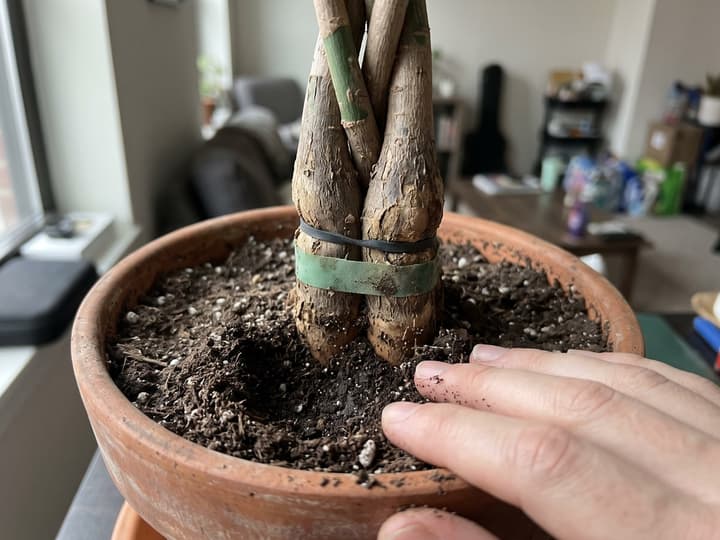
It is worth noting where this comes from: owner reports and nursery practice, not published studies. That is why it is included here as a last check, and not as a first suspect. It is also the only check in this guide that you can confirm just by looking, without relying on interpretation: either there is tape there, or there is not.
Is the money tree toxic to cats and dogs?
The leaves are not the problem. The ASPCA classifies Pachira aquatica as non-toxic to dogs, cats, and horses, with toxic principles listed as none. This is the part that matters to pet owners, because leaves are what cats chew on.
The real caveat lies in the seeds. The NC State notes cyclopropenoid fatty acids in the seeds and recommends caution with ingestion. However, this caveat does not reach your living room: potted plants do not produce seeds, because they do not bloom indoors.
Where the answer changes completely is if your plant is not a money tree. The ASPCA classifies Crassula argentea, the jade plant that is also sold as a money plant, as toxic to dogs, cats, and horses, with vomiting, depression, and ataxia among the signs. Two plants with the same nickname and opposite answers to the same question: this is why identifying the species comes before any advice.
When there is nothing wrong with your money tree
Two cases where the right thing to do is nothing:
Lower leaves yellowing one at a time, on a plant that continues to push out new leaves at the top. This is normal aging. The plant sheds the old leaf to reuse what it can.
Leaf drop in the first two to three weeks after arriving from the store or moving to a new room. This is acclimation: keep the plant in the same spot, with indirect light, and wait for those two to three weeks to pass.
Here is a sign to separate these two cases from the rest: as long as the plant is pushing out new leaves, it is functioning. A halt in growth along with leaf drop is a different story.
Frequently Asked Questions
How do I revive a sick money tree?
First, find out if the soil is wet or dry. Wet with yellow leaves: stop watering, check the roots, and repot in a pot with drainage holes if they are dark and mushy. Dry with wilted leaves: water thoroughly until water runs out of the drainage holes. After that, stabilize the light and location and wait two weeks.
How do I know if my money tree is dying?
The decisive sign is the trunk, not the leaves. Squeeze the base: if it is firm, the plant has reserves and a chance, even with no leaves left. If it is soft, dark, and has a sour smell, the rot has reached the caudex, and from then on, recovery depends on having healthy roots left.
How often should you water a money tree?
There is no fixed interval, and it is precisely a fixed schedule that kills. Water when the top 3 cm of soil are dry to the touch, which usually takes 1 to 2 weeks in warm weather and much longer in the cold. The trunk stores water, so the plant tolerates being watered late much better than being watered too much.
Do coffee grounds help a money tree?
Not as a direct fertilizer. Fresh grounds form a layer that holds moisture right on the soil surface, which is exactly where the money tree does not want it, and wet organic matter on the surface is the breeding ground for fungus gnats, one of the pests the NC State lists for this species. If you want to fertilize, use a balanced fertilizer diluted to half strength, once a month in spring and summer.
Where should you not put a money tree?
Away from air conditioning vents, heaters, doors that open to the outside in winter, and the space between a curtain and the glass on a cold window. Other than that, avoid direct sun on the leaves. The best spot is the most stable one in the house, with indirect light and temperatures between 18 and 24 °C.
How long does a money tree live?
There are no published measurements of this species' longevity in a pot, so be wary of round numbers. What we can state with sources: in nature, it reaches 18 meters, and indoors it stays between 1.8 and 2.4 meters, according to the NC State Extension. In practice, what ends the life of an indoor money tree is almost always repeated overwatering, not age.
Conclusion
If you made it this far without knowing where to start, start with the soil. A finger 3 cm deep, the weight of the pot, and a squeeze at the base of the trunk answer, on their own, most cases of a money tree with yellow leaves, because they separate the two extremes of the most frequent cause. Only then is it worth investigating light, dry air, and pests.
And if the symptoms do not match a money tree, or if you are not sure of the species in the pot, the path forward is our general guide on what's wrong with my plant, which applies the same reasoning to any indoor plant.
Related articles
How to Care for Hibiscus: Sun, Watering, Fertilizer, and Pruning for Flowers
How to care for hibiscus: 6 hours of direct sun, evenly moist soil without waterlogging, half-strength fertilizer in spring and summer, and pruning in early spring. Find out why the flower lasts one day and why buds drop before opening.
Do Ferns Like Sun or Shade? It Depends on the Type
Ferns prefer bright shade: plenty of light, but no direct sun on their fronds. Tuberous sword fern is the exception that handles sun. Here is the ideal light for each type, where to place pots, and how fronds show too much or too little light.
African Violet Yellow Leaves: Causes and What to Do
Yellow leaves on an African violet usually stem from overwatering, and the first place to check is the center of the plant. Losing one lower leaf at a time is normal. Identify whether age, watering, cold water, sunlight, cold drafts, or fertilizer is the culprit based on the yellowing pattern, and see what to do today.