634 Medium Pet Safe | 2026 Guide - Page 3
Find 634 medium pet safe. Complete guide for your garden.
634 Pet Safe with medium level
Showing 73-108 of 634
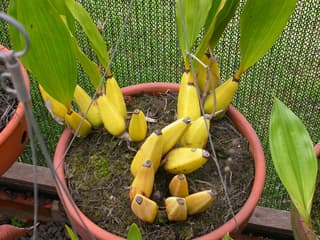
Harrison's Bifrenaria
Bifrenaria harrisoniae
Bifrenaria harrisoniae, commonly known as Harrison's Bifrenaria, is a striking epiphytic orchid endemic to Brazil. Found in the Atlantic Forest and Cerrado biomes at elevations between 200 and 1,200 meters, it produces large, waxy, fragrant flowers — predominantly white with a pink-to-burgundy labellum and dark veining — up to 8 cm across. The robust pseudobulbs store water and nutrients, enabling the plant to withstand seasonal dry periods.
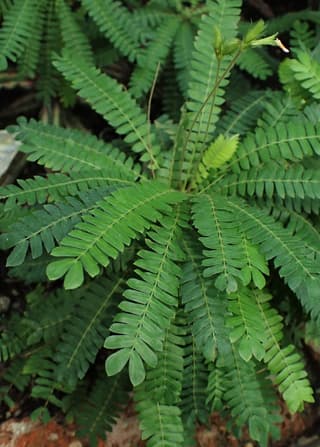
Little Tree Plant
Biophytum sensitivum
A small tropical herb from Asia with a palm-like rosette of feathery leaflets and tiny yellow star-shaped flowers. Its leaflets fold inward when touched, like the sensitive plant. It usually grows 15 to 30 cm tall.
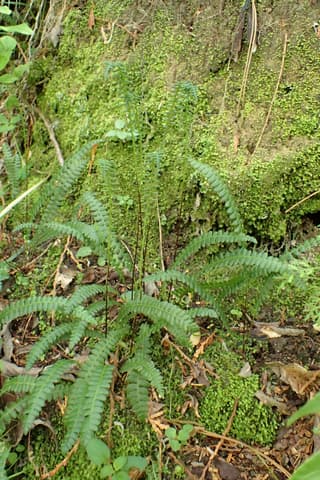
Membranous Hard Fern
Blechnum membranaceum
Blechnum membranaceum, commonly known as the Membranous Hard Fern, is a small Neotropical fern in the family Blechnaceae. Native to Central and South America, it produces delicate, thin fronds with a distinctive membranous texture, thriving in humid, shaded forest understories. Now reclassified as Austroblechnum membranaceum, it retains its historic trade name in horticulture.
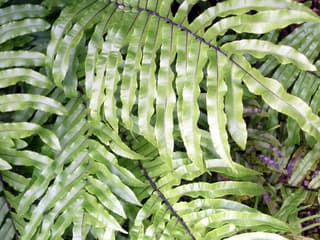
Soft Water Fern
Blechnum minus
Blechnum minus, commonly known as the Soft Water Fern, is a beautiful shade-loving terrestrial fern native to Australia, New Zealand, and Tasmania. It thrives in moist, riparian environments along creek banks and sheltered forest floors, forming dense, bushy clumps of glossy green fronds that reach 40–70 cm in length. As a member of the Blechnaceae family (synonyms: Lomaria minus, Parablechnum minus), it is a slow-growing evergreen fern prized for its graceful, arching fronds and adaptability to shaded garden positions.
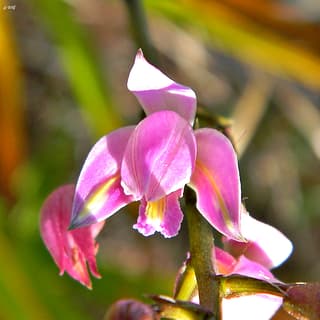
Pine-pink Orchid
Bletia purpurea
Bletia purpurea, commonly known as Pine-pink Orchid, is a terrestrial orchid native to the Caribbean, Florida, Mexico, and Central and South America. It produces oval pseudobulbs and elegant linear leaves, with impressive flower spikes carrying up to 80 pink-purple blooms on stems reaching 180 cm tall. The plant is deciduous, going dormant in winter before blooming in spring and summer.
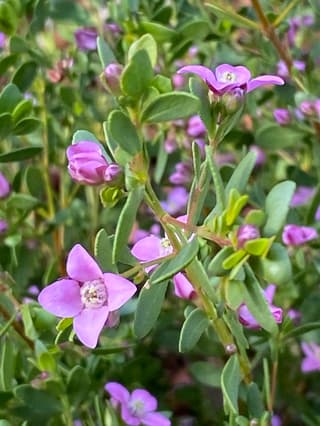
Aniseed Boronia
Boronia crenulata
Aniseed Boronia is an evergreen Australian shrub in the citrus family (Rutaceae), native to southwestern Western Australia, where it grows in sandy and rocky heathlands and open woodlands. It typically reaches 25–120 cm (10–47 inches) in height with an open, slightly pendulous growth habit. The small, serrated (crenulate) leaves release a distinct anise-like fragrance when crushed. From late winter to autumn—peaking in spring—the plant produces numerous small, four-petaled flowers in shades of pink to reddish-purple, appearing singly or in small clusters at the tips of the branches.
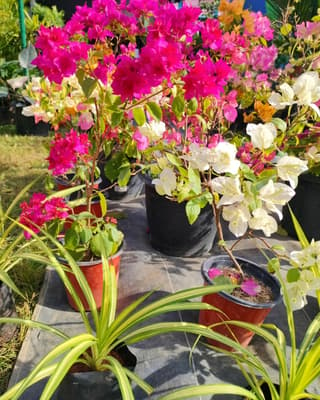
Garden Bougainvillea
Bougainvillea × buttiana
Garden Bougainvillea (Bougainvillea × buttiana) is a vigorous, thorny climbing hybrid celebrated for its vividly colored bracts surrounding small, inconspicuous flowers. Native to South America, it thrives in tropical and subtropical gardens thanks to its prolific blooming and drought tolerance.
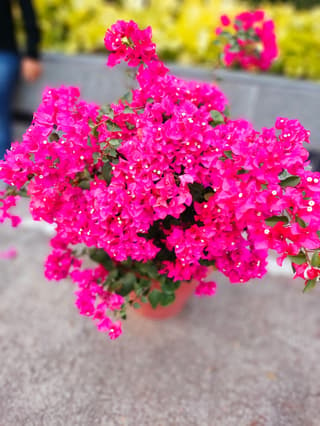
Bougainvillea
Bougainvillea glabra
Bougainvillea glabra, commonly known as Paperflower or Bougainvillea, is a vigorous woody climber native to Brazil. It is famous for its vibrant colors, which are actually bracts (modified leaves) surrounding its small, inconspicuous white flowers. It is an extremely resilient plant that thrives in full sun and is ideal for covering walls, fences, and pergolas, bringing a lush, tropical look to the garden.
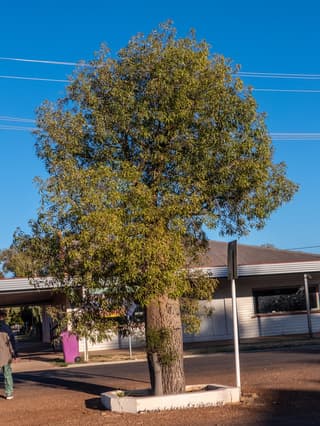
Queensland bottle tree
Brachychiton rupestris
Native to central Queensland, Australia, the Queensland bottle tree is a caudiciform species in the Malvaceae family, prized for the dramatically swollen, bottle-shaped trunk that stores water and carbohydrates to help it survive long droughts. In the wild it can grow 10-20+ m tall, though cultivated and bonsai specimens stay far more compact. It is deciduous, dropping its leaves in the dry season before producing cream-colored, red-marked flower panicles.
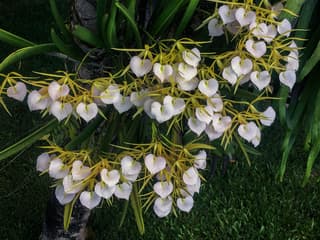
Lady of the Night
Brassavola nodosa
Brassavola nodosa, known as the Lady of the Night, is a medium-sized epiphytic orchid native to coastal regions of Central and South America, from Mexico to Brazil, where it grows on trees and even mangrove roots near the sea. Its cylindrical, succulent leaves produce stems with greenish-white flowers up to 6 inches (15 cm) wide, which release an intense, sweet fragrance at dusk to attract pollinating moths.
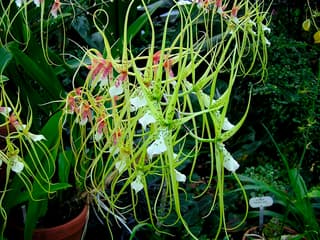
Spider Orchid
Brassia
Brassia is a genus of epiphytic orchids native to the tropical and subtropical forests of Central and South America, popularly known as spider orchids due to their long, thin petals and sepals that resemble spider legs. Their flower spikes can display up to 20 blooms in shades of yellow, cream, greenish, or reddish-brown, usually speckled with dark spots. It is a genus appreciated by both collectors and commercial hybridizers, valued for its exuberant flowering and exotic floral shape.
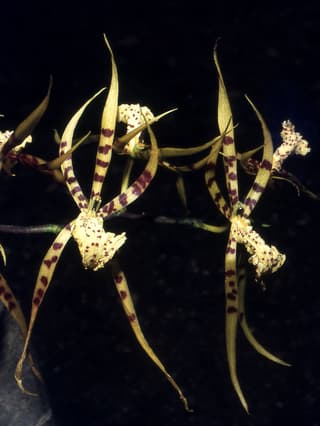
Spider Orchid
Brassia arachnoidea
Brassia arachnoidea, known as the spider orchid, is an epiphytic orchid native to the humid tropical forests of Central and South America, including Ecuador. It is named after the shape of its flowers—long, thread-like, greenish-yellow sepals and petals spotted with chocolate brown, reminiscent of a spider's legs. The leaves are broad and pleated, attached to ovoid pseudobulbs, and the flowering stems can bear up to 8 fragrant flowers, each with a diameter of 10-12 cm.
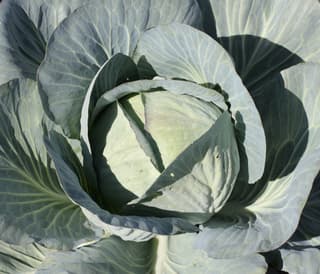
Wild Cabbage
Brassica oleracea
Brassica oleracea is the wild ancestor of many of the world's most important vegetables, including cabbage, kale, broccoli, cauliflower, Brussels sprouts, kohlrabi, and collard greens. Native to the coastal cliffs of the Mediterranean and Atlantic Europe, this biennial or perennial herb has been cultivated for over 2,000 years and selectively bred into an extraordinary array of cultivar groups. In its wild form it produces wavy blue-green leaves, a sturdy erect stem, and clusters of small yellow flowers. As the parent species of all these major cultivar groups, Brassica oleracea represents one of humanity's greatest achievements in plant domestication — transforming a coastal weed into the world's most important leafy edible crop.
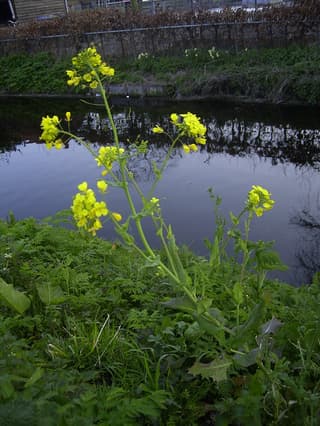
Turnip
Brassica rapa
Turnip (Brassica rapa) is a biennial vegetable from the Brassicaceae family, cultivated for thousands of years for its edible roots and nutritious leaves. Native to Central Asia, it thrives in temperate climates worldwide. The plant produces bright yellow flowers in spring and summer, and its swollen taproot is packed with vitamins C and K.
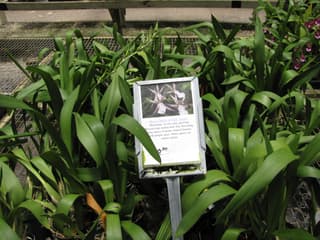
Miltassia orchid
Bratonia Charles M. Fitch
Bratonia Charles M. Fitch is a popular intergeneric orchid hybrid, a cross between Brassia verrucosa and Miltonia spectabilis. It is celebrated for its large, star-shaped flowers that resemble spiders, featuring striking lavender and purple hues with olive-green or brown spotting. The plant produces long, arching sprays of blooms that can last for several weeks, emerging from pseudobulbs with strap-like evergreen leaves.
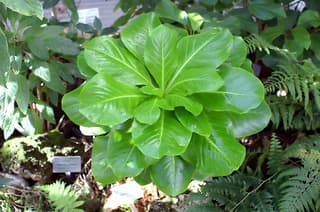
Hawaiian Palm
Brighamia insignis
Brighamia insignis, commonly known as the Hawaiian Palm or Vulcan Palm, is one of the world's most critically endangered plants. Native to the rocky sea cliffs of Kauaʻi and Niʻihau in Hawaii, this remarkable succulent features a bulbous, tapered trunk topped with a rosette of glossy green leaves. In autumn it produces clusters of fragrant, tubular yellow flowers. Now extinct in the wild, it survives only in cultivation, making it a living symbol of conservation.
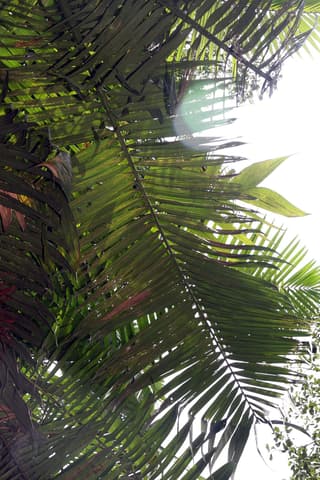
Breadnut
Brosimum alicastrum
Breadnut (Brosimum alicastrum) is a large, evergreen tropical tree in the family Moraceae, native to Central America, southern Mexico, the Caribbean, and northern South America. It can reach up to 45 metres tall with a straight trunk and wide, globose crown. One of the most ecologically and culturally important trees of Mesoamerica, it was a dietary staple for the ancient Maya civilization. Its highly nutritious seeds, leaves, and latex have sustained communities for millennia.
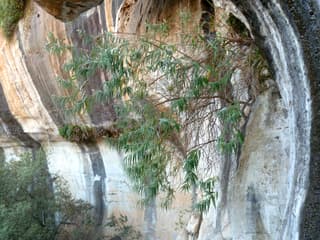
Sagewood
Buddleja salviifolia
Buddleja salviifolia, commonly known as Sagewood or South African Sagewood, is a fast-growing semi-evergreen shrub native to southern and eastern Africa. In spring it produces narrow panicles of small, highly fragrant flowers ranging from white and cream to lilac and pale mauve, with a distinctive orange throat. Highly valued for attracting butterflies, bees and birds, it is an excellent choice for wildlife gardens. Its hard, heavy wood has traditionally been used in Africa for assegais and fishing rods.
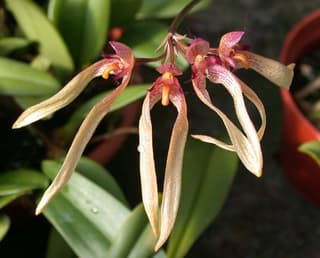
Pale Umbrella Orchid
Bulbophyllum longiflorum
The Pale Umbrella Orchid (Bulbophyllum longiflorum) is a widespread epiphytic or lithophytic orchid native to rainforests and hill forests across Africa, Madagascar, the Mascarenes, Seychelles, Southeast Asia, New Guinea, New Caledonia, Fiji and northern Australia. It grows from a creeping rhizome bearing widely-spaced, dark green pseudobulbs, each topped with a single fleshy leaf. Its most striking feature is the umbrella-like flower cluster: a semicircular umbel of small, greenish cream to yellowish blooms speckled with purple, held on an arching stem above the foliage.
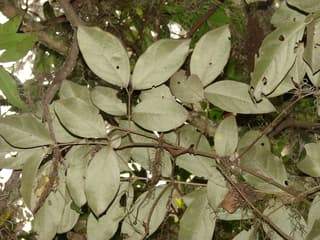
Peanut Butter Fruit Tree
Bunchosia argentea
Bunchosia argentea, commonly known as the Peanut Butter Fruit Tree, is a small tropical tree or large shrub in the family Malpighiaceae, native to the tropical forests of South America — including Venezuela, Colombia, Peru, Brazil, Guyana, and Suriname. It produces small oval fruits that ripen from orange to deep red, with a dense, sweet pulp that has a remarkable peanut butter-like flavor and texture. It is valued both as an ornamental plant and for its unique edible fruit.
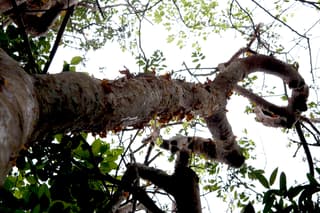
Bursera
Bursera
Bursera is a genus of about 100 species of trees and shrubs in the family Burseraceae, native to tropical and subtropical regions of the Americas, from Mexico to Argentina. They are known for their thin, papery, peeling bark and aromatic resin (copal), used for centuries in incense and purification rituals. Representative species include Bursera simaruba (gumbo-limbo) and Bursera graveolens (palo santo).
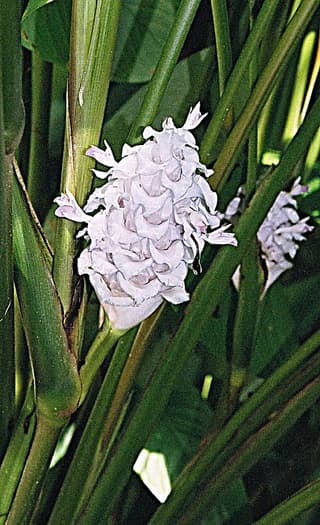
Fishbone Prayer Plant
Calathea burle-marxii
Native to the tropical forests of Brazil, the Fishbone Prayer Plant (Calathea burle-marxii, syn. Goeppertia burle-marxii) is a low, compact foliage plant in the Marantaceae family, prized for the silvery fishbone pattern on its gray-green leaves and their reddish undersides. Like other prayer plants, its leaves fold upward at night and open again during the day, following the light cycle.
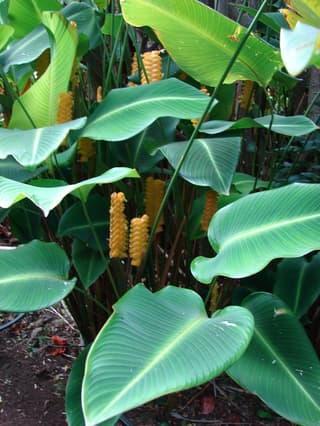
Yellow Rattleshaker
Calathea crotalifera
Calathea crotalifera, commonly known as the yellow rattleshaker, is a rhizomatous perennial herb in the family Marantaceae, native to the humid tropical forests of Central America and northern South America. It is grown for its large, glossy green foliage and its yellow, spike-shaped inflorescences that resemble the tail of a rattlesnake.
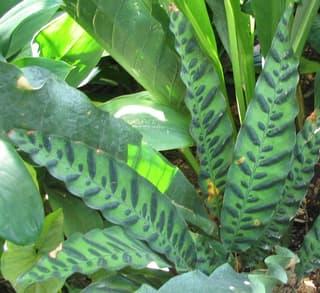
Rattlesnake Plant
Calathea lancifolia
The Calathea lancifolia, commonly known as the Rattlesnake Plant, is a tropical plant native to the rainforests of Brazil. Its elongated leaves display a dark green pattern with lighter green spots resembling rattlesnake markings, with a reddish-purple underside. Part of the Marantaceae family, it is known for its nyctinastic leaf movement, where leaves fold up at night like hands in prayer.
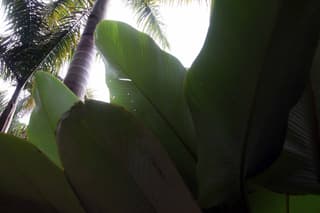
Cigar Plant
Calathea lutea
Calathea lutea, commonly known as the Cigar Plant or Cuban Cigar Calathea, is a large Neotropical Marantaceae native to tropical Americas. It is one of the tallest calatheas, with broad paddle-shaped leaves that can reach up to 1 meter long, featuring a distinctive waxy, pruinose silver-grey underside. It is widely used in tropical landscaping and traditionally used to wrap cigars in some regions.
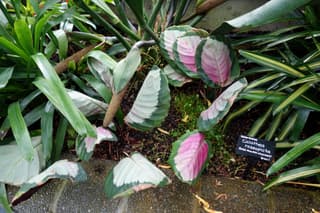
Rose Painted Calathea
Calathea roseopicta
Calathea roseopicta is a perennial rhizomatous herb native to the tropical rainforests of Brazil and South America. Part of the Marantaceae family, it is admired for its oval dark green leaves with pink and silvery-green markings, plus a purple underside. Known as a "prayer plant" because its leaves fold up at night like hands in prayer.
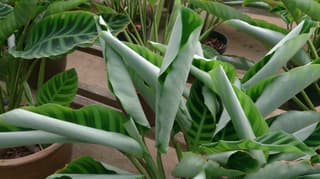
Zebra Plant
Calathea zebrina
Calathea zebrina is a tropical plant native to Brazil, belonging to the Marantaceae family. Its velvety leaves feature light green zebra-like stripes over a dark green background, with reddish-purple undersides. Known for its nyctinastic movement, the leaves fold upward at dusk as if praying.
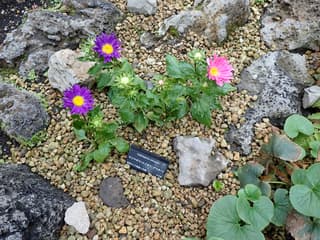
China Aster
Callistephus chinensis
China Aster (Callistephus chinensis) is a stunning annual flowering plant native to China, beloved for its vibrant, daisy-like blooms in shades of white, pink, red, blue, violet, and purple. A member of the Asteraceae family, it blooms from late summer through fall, making it a favorite for cut flower gardens and seasonal borders.
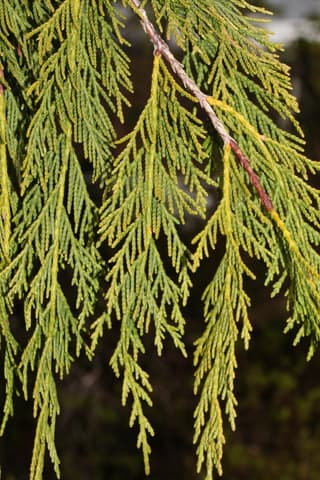
Nootka Cypress
Callitropsis nootkatensis
Nootka Cypress is a slow-to-medium growing evergreen conifer native to the cool, wet coastal forests of the Pacific Northwest, from Alaska down to northern California. It has a graceful, often weeping habit with drooping branchlets of gray-green, scale-like foliage, and matures over decades into a tall, narrow tree prized for its durable, aromatic wood. In gardens it is grown as a specimen or hedging conifer rather than a houseplant, doing best in cool, humid climates with consistently moist but well-drained soil.
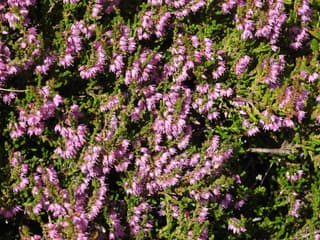
Common Heather
Calluna vulgaris
Calluna vulgaris, commonly known as common heather or ling, is a low-growing evergreen shrub native to Europe, western Asia, and parts of North Africa. It is the sole species in the genus Calluna and a defining plant of moorland and heathland ecosystems. Its tiny, scale-like leaves densely cover wiry stems, and from late summer into autumn it produces masses of small bell-shaped flowers in shades of purple, pink, and white that attract bees and other pollinators. Hardy and adaptable to poor, acidic soils, heather is prized in gardens for year-round foliage color and its ability to thrive where little else will grow.
Small Stagshorn
Calocera cornea
Calocera cornea is a saprophytic jelly fungus that grows in clusters on decaying hardwood from broadleaf trees. Its fruiting bodies are small, bright yellow or orange, with a cylindrical or horn-like shape that tapers to a point. Unlike other similar fungi, its texture is firm and elastic when hydrated, becoming hard and brittle upon drying. It is a fascinating species for bioactive terrariums that mimic a temperate forest floor.
Purple-spored puffball
Calvatia cyathiformis
Calvatia cyathiformis, commonly known as the purple-spored puffball or cup-shaped puffball, is a saprobic fungus characterized by its globose fruiting body that becomes cup-shaped as it matures. Its flesh is white and firm when young, turning into a dark purple spore mass as it ages.

Capirona
Calycophyllum spruceanum
Capirona (Calycophyllum spruceanum) is a majestic Amazonian canopy tree belonging to the Rubiaceae family. Its most remarkable feature is its smooth, highly polished green-yellow bark that naturally sheds once or twice a year, exposing a fresh, gleaming surface underneath. This unique phenomenon protects the tree from lichens, fungi, epiphytes, and climbing vines, making it exceptionally resistant to pests and diseases. The dense, high-quality timber is prized for construction and woodworking, while the bark and leaves have recognized medicinal properties in traditional Amazonian medicine.
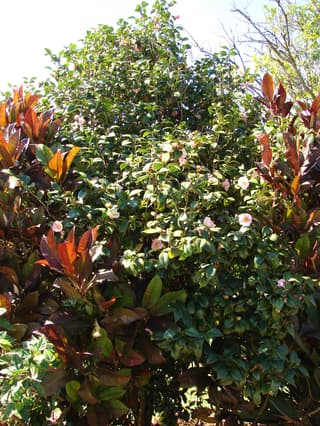
Japanese Camellia
Camellia japonica
Camellia japonica, commonly known as the Japanese camellia or common camellia, is an evergreen shrub or small tree native to China, Japan, and Korea. It is celebrated for its stunning, showy flowers in shades of red, pink, and white that bloom from late winter to early spring, brightening gardens when little else is flowering. Its glossy, dark green leathery leaves provide year-round ornamental interest.
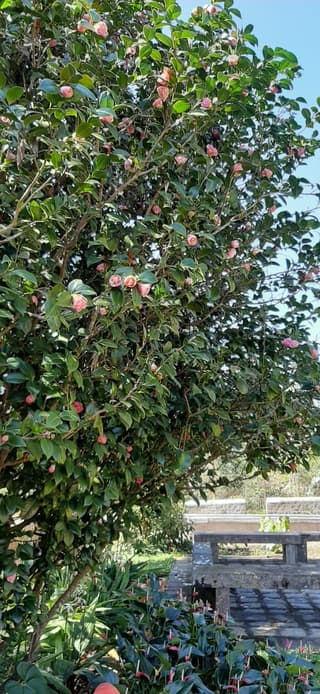
Sasanqua Camellia
Camellia sasanqua
Camellia sasanqua is an evergreen ornamental shrub native to Japan, belonging to the Theaceae family. Unlike many flowering shrubs, it blooms in fall through early winter — a season when most garden plants lie dormant — producing fragrant single or semi-double flowers in shades of white, pink, red, and cream. Mature plants reach 6 to 14 feet tall with a spread of 6 to 10 feet, bearing glossy, dark green leaves year-round. Compared to Camellia japonica, the sasanqua is more sun-tolerant, faster-growing, and more adaptable to a variety of landscape uses including hedges, screens, espaliers, foundation plantings, and container gardens. With minimal care once established, it can live for 50 to over 100 years.

Canterbury Bells
Campanula medium
Canterbury Bells is an ornamental biennial native to Southern Europe, in the family Campanulaceae. It forms a low rosette of leaves in its first year, then sends up tall flowering stems in its second year bearing large, bell- or cup-shaped blooms in shades of blue, violet, pink and white from spring into summer.
Medium Care Pet Safe
Our selection of 634 medium pet safe combines the characteristics of this category with moderate care needs. Ideal for those with basic experience.
Why Choose Medium Pet Safe?
Combining the beauty of pet safe with medium difficulty level lets you enjoy this category with a balanced care commitment. Each plant was selected to offer the best characteristics of the category at the care level you are looking for.