Complete Plant Guide
Explore plants by difficulty, season and more. Find the perfect plant for you.
Difficulty
Categories
Plants by City
🗺️ Plants by City3454 plants found
Showing 901-936 of 3454
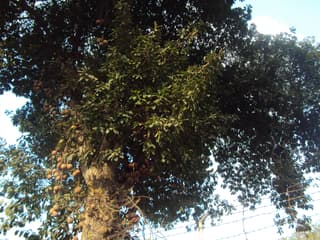
Cannonball Tree
Couroupita guianensis
The Cannonball Tree (Couroupita guianensis) is a majestic tropical tree native to South America, belonging to the family Lecythidaceae. It is renowned worldwide for its spectacular cauliflorous blooms — rose-pink to red fragrant flowers that grow directly from the trunk — and for its large, spherical, cannonball-like fruits weighing up to 7 kg. It can reach up to 30 metres in height in its natural habitat and is widely cultivated as an ornamental tree in botanical gardens and parks.
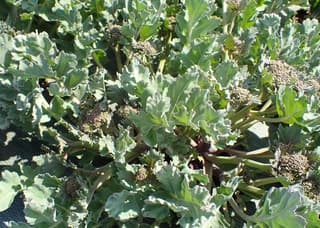
Sea Kale
Crambe
Crambe is a genus of flowering plants in the family Brassicaceae, native to coastal cliffs, stony shores, and Mediterranean regions. The best-known species, Crambe maritima (sea kale), is prized for both ornamental and culinary purposes.
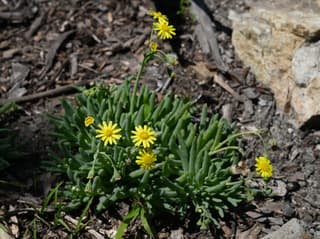
Little Pickles
Crassothonna capensis
Crassothonna capensis, commonly known as Little Pickles or Ruby Necklace, is a fast-growing trailing succulent native to the semi-arid Karoo scrub and rocky flats of the Eastern Cape Province, South Africa. It grows low to the ground with thin, reddish-purple stems bearing spirally arranged, finger-like, blue-green succulent leaves that flush to vivid ruby-red or maroon tones under intense sun or during dry stress. Small, cheerful yellow daisy-like flowers emerge on slender elongated stalks and can appear from spring through fall. It thrives in hanging baskets, rock gardens, and xeriscaping arrangements, making it a versatile and striking ornamental.
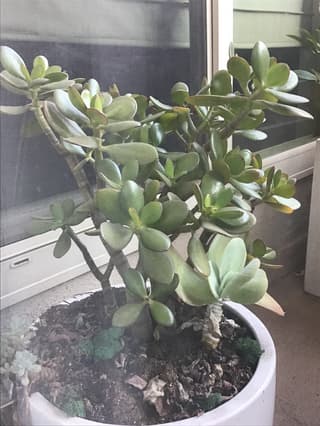
Crassula (genus)
Crassula
Crassula is a large genus of over 200 succulent species in the family Crassulaceae, native mainly to Southern Africa. Well-known species include C. ovata (jade plant), C. perforata (string of buttons), and C. capitella (red pagoda). They are slow-growing, drought-tolerant plants suited to both indoor and warm outdoor climates (zones 9–11).
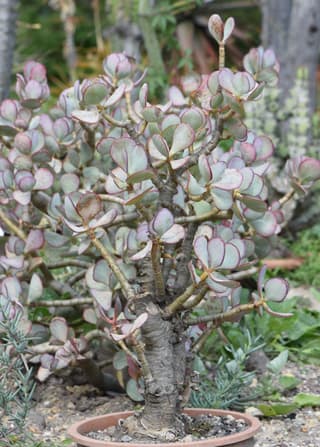
Silver Jade Plant
Crassula arborescens
Crassula arborescens, commonly known as the Silver Jade or Silver Dollar Plant, is a shrubby succulent native to the Western Cape of South Africa. Its rounded, blue-gray leaves with reddish edges provide a unique and sophisticated look. It grows slowly, reaching up to 120 cm in height, and produces small white or pink star-shaped flowers during spring and winter. It is an extremely hardy plant, perfect for both beginners and experienced growers.
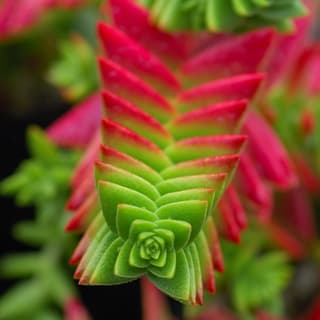
Campfire Crassula
Crassula capitella
Crassula capitella, commonly known as Campfire Crassula or Red Flames, is a low-growing succulent from the family Crassulaceae native to South Africa. It forms dense rosettes of propeller-shaped, fleshy leaves that are bright green at the base and turn vivid shades of orange, red, and scarlet when exposed to full sun or cooler temperatures. The dramatic color transformation makes it one of the most visually striking succulents for containers and garden borders. In summer it produces small clusters of white star-shaped flowers that attract bees and butterflies.
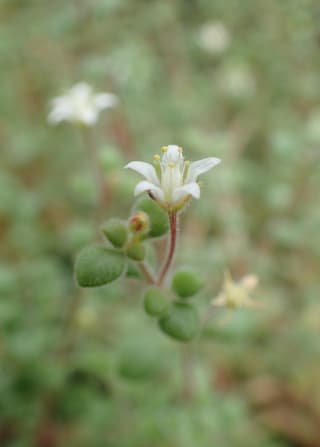
Fragile Crassula
Crassula expansa subsp. fragilis
Crassula expansa subsp. fragilis is a delicate, creeping succulent native to the rocky, humus-rich slopes of Southern Africa (South Africa, Mozambique, Zambia, Zimbabwe, Eswatini, Angola) and Madagascar, where it grows in partial shade at altitudes between 50 and 1800 m. It forms low mats of thin reddish-brown stems covered with tiny, fleshy light green leaves that can turn reddish under intense sunlight. In the wild, it blooms between November and January after the rains, producing small white tubular flowers, sometimes streaked with red, gathered in terminal clusters. The fragile stems root extremely easily upon contact with the soil, which gives the plant its common name.
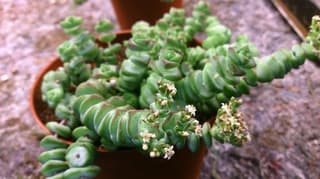
Worm Plant
Crassula marnieriana
Crassula marnieriana, commonly known as the Worm Plant or Jade Necklace, is a compact succulent native to South Africa. It forms distinctive rope-like stems of tightly stacked, fleshy round leaves that overlap in opposite pairs, creating a unique appearance. In spring, it produces delicate clusters of white to pale pink star-shaped flowers.

Fairy Crassula
Crassula multicava
Crassula multicava, known as Fairy Crassula or Cape Province pygmyweed, is a mat-forming succulent groundcover native to South Africa's Cape provinces. Its glossy, rounded leaves are dotted with tiny pits, and in winter it sends up airy sprays of small, star-shaped flowers that open white from pink buds. Extremely easy to grow, it tolerates neglect, poor soil and drought far better than overwatering.
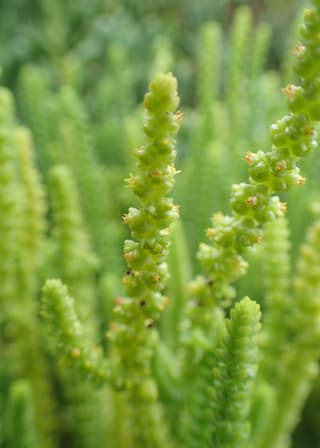
Watch Chain Plant
Crassula muscosa
Crassula muscosa, commonly known as the Watch Chain Plant or Zipper Plant, is a slow-growing succulent native to South Africa and Namibia. Its tiny, tightly overlapping scale-like leaves create a distinctive chain or zipper pattern along its stems. An excellent choice for bright windowsills, terrariums, and succulent arrangements.
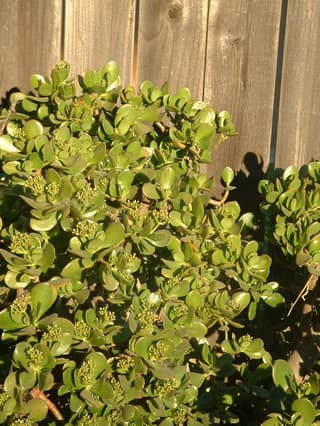
Jade Plant
Crassula ovata
The Jade Plant (Crassula ovata) is a beloved succulent native to South Africa and Mozambique, known for its thick, fleshy, oval-shaped leaves that resemble jade gemstones. This easy-care plant can live for decades, potentially reaching 70-100 years, and grows into an attractive shrub or small tree. Its compact growth and striking appearance have made it one of the most popular houseplants worldwide.
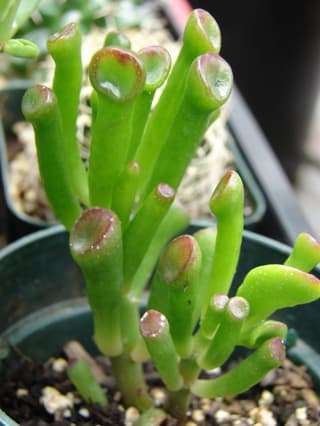
Hobbit Jade
Crassula ovata 'Hobbit'
Hobbit Jade is a cultivar of Crassula ovata distinguished by curled, tubular, finger- or trumpet-shaped leaves, unlike the flat oval leaves of the common jade plant. A perennial succulent descending from the South African parent species, it is a popular low-maintenance houseplant valued for its slow, compact growth. Leaf tips blush red under bright direct sun.
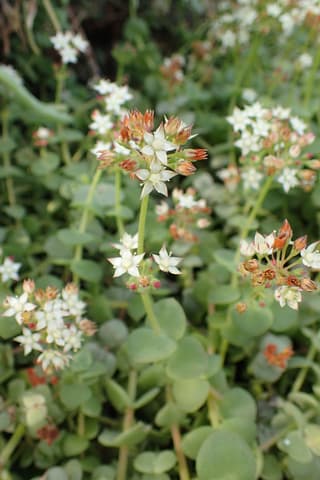
Calico Kitten
Crassula pellucida
Crassula pellucida is a low-growing, trailing succulent native to shaded, rocky forests of eastern and southern Africa. Its small, rounded to slightly heart-shaped leaves form a dense, cushion-like mat and range from pale green to reddish-pink depending on light exposure, and the variegated cultivar Calico Kitten (subsp. marginalis) is prized for its cream, pink, and purple marbled foliage. In spring and summer it produces clusters of tiny white to pale pink star-shaped flowers.
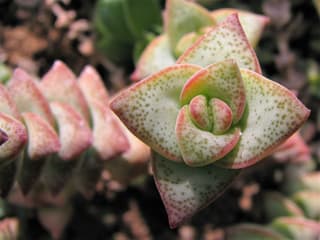
String of Buttons
Crassula perforata
Crassula perforata is a South African succulent in the Crassulaceae family, known for its distinctive stacked triangular leaves threaded along trailing stems. The leaves are grey-green with rosy pink margins that intensify under bright light. It grows upright when young and becomes trailing with age, reaching up to 60 cm. An easy-care plant that thrives in bright light and well-draining soil, it produces tiny star-shaped white to pale pink flowers in spring.
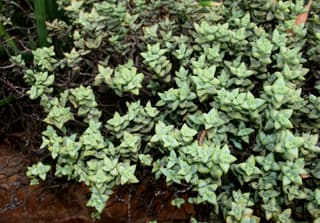
Concertina Plant
Crassula rupestris
Crassula rupestris is a charming stacked succulent native to South Africa, featuring triangular fleshy leaves threaded along creeping stems. Its geometric, bead-like foliage pattern gives it its popular names: Rosary Vine and Buttons on a String. In spring and summer it produces small star-shaped pink to white flowers.
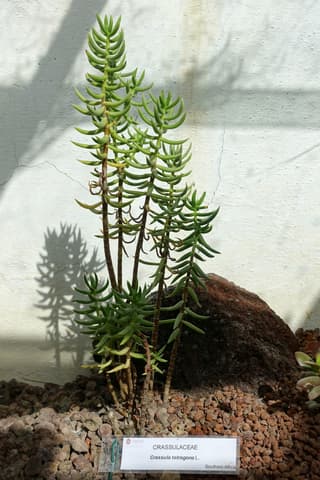
Miniature Pine Tree
Crassula tetragona
Crassula tetragona is a shrubby succulent native to South Africa, known for its narrow, needle-like leaves that resemble a tiny pine tree. Popular for bonsai styling and rock gardens, it grows slowly, forming woody, branching stems. In late spring to early summer it may produce small star-shaped white to cream flowers.

Hawthorn
Crataegus
Hawthorn (Crataegus) is a large genus of thorny shrubs and small trees in the rose family, native mostly to the Northern Hemisphere. Prized for spring clusters of white or pink flowers, glossy serrated leaves, and bright red autumn berries, hawthorns are tough, adaptable plants used widely as ornamental trees, hedging, and wildlife habitat.
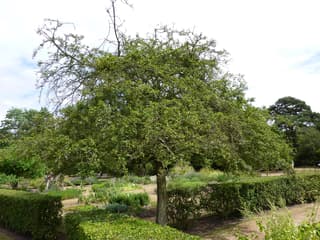
Midland Hawthorn
Crataegus laevigata
The Midland hawthorn (Crataegus laevigata) is a thorny, deciduous tree or shrub native to European woodlands. It is prized for its fragrant white blossom in spring, its clusters of red haws in autumn, and its long history in European folklore, where it is known simply as "the May tree". It grows 3-8m tall and wide, tolerates poor and clay soils, and is widely planted as a hedging and specimen tree.
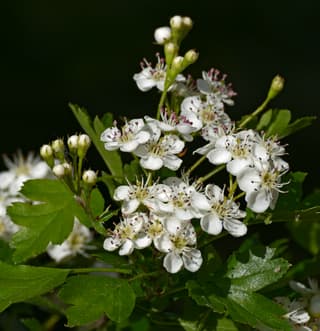
Common Hawthorn
Crataegus monogyna
Crataegus monogyna is a thorny, deciduous large shrub or small tree native to Europe, North Africa, and Western Asia. Prized for its clusters of white blossom in spring, deep red autumn haws, and dense, thorny growth, it has long been used as a hedging and wildlife plant across the British Isles and mainland Europe.
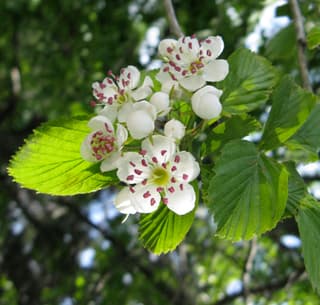
Dotted Hawthorn
Crataegus punctata
Dotted Hawthorn (Crataegus punctata) is a deciduous tree in the Rosaceae family, native to eastern North America. It grows up to 9 meters tall with a dense, rounded crown and characteristic thorns up to 7 cm long. In late spring, it develops white flowers in dense clusters, and in autumn, it is abundant with red fruits (pomes) with white dots, for which the species is named. It is particularly valuable for wildlife—the fruits attract migratory birds.
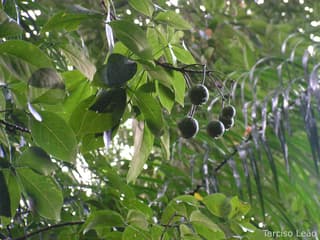
Garlic Pear
Crateva tapia
The Garlic Pear (Crateva tapia) is a tree native to the Americas, ranging from Mexico to southern Brazil, where it is common in the Caatinga, Cerrado, Pantanal, and Amazonian riparian forests. It can reach 4 to 15 m in height, with a broad, rounded crown and a twisted trunk with grayish bark that exudes a garlic odor when cut. The leaves are trifoliate, and the tree blooms between August and November, covered in white flowers with long reddish stamens that attract bees, butterflies, moths, and bats. The fruits, which are globose berries, ripen between February and April and have an edible pulp with a sweet flavor.
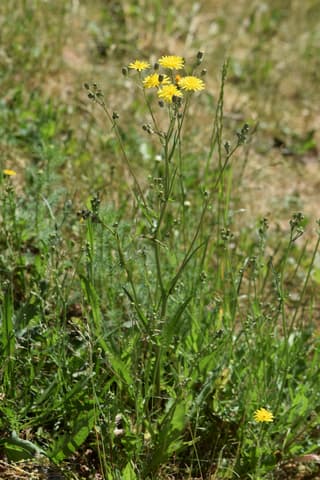
Hawksbeard
Crepis
Crepis is a genus of roughly 200 annual, biennial, and perennial wildflowers in the daisy family (Asteraceae), commonly called hawksbeards for their dandelion-like yellow flower heads and beaked seeds. This is a genus-level care profile — it covers general growing conditions shared across Crepis species rather than one particular species, since individual hawksbeards vary somewhat in height and habit. Native mainly to the Mediterranean Basin, Europe, Asia, and Africa, many Crepis species have naturalized worldwide along roadsides, lawns, and disturbed ground, where their nectar and seeds support bees, bumblebees, and seed-eating birds.
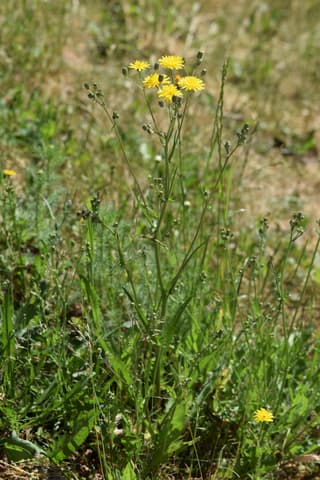
smooth hawksbeard
Crepis capillaris
Smooth hawksbeard (Crepis capillaris) is an annual or biennial herb in the Asteraceae family, native to Europe and western Asia and widely naturalized worldwide. It produces small yellow dandelion-like flowers in clusters that bloom from spring through autumn. Highly adaptable, it thrives in disturbed ground, roadsides, gardens, and grasslands. Young leaves are edible and have historically been used in Mediterranean salads.
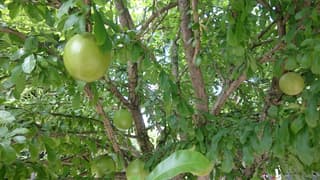
Calabash Tree
Crescentia cujete
Crescentia cujete, the calabash tree, is a small to medium-sized tropical evergreen tree native to Mexico, Central America, and the Caribbean, reaching up to 9 m in height with a broad, spreading canopy. It is instantly recognizable by its cauliflorous habit — large, hard-shelled spherical fruits and yellow-green flowers with purple striping emerge directly from the trunk and older branches. Bat-pollinated and night-flowering, it thrives in full sun and well-draining soils across USDA zones 10b–12b. The calabash has been inseparable from human culture for millennia: its gourd shells have served as bowls, water vessels, musical instruments (maracas, Haitian Vodou asson rattles), and ceremonial containers. In traditional medicine across Latin America and the Caribbean, preparations from bark, leaves, and fruit pulp are used for respiratory ailments, hypertension, wound healing, and as expectorants.
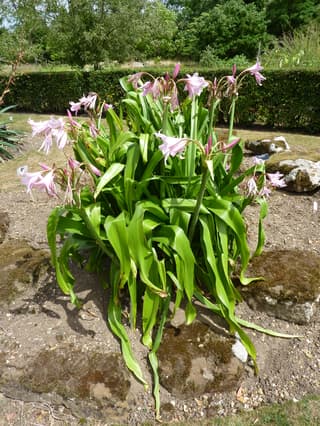
Swamp Lily
Crinum
Crinum is a large genus of about 180 bulbous plants in the family Amaryllidaceae, native to tropical and subtropical regions across Africa, Asia, and the Americas. Known as swamp lilies or crinum lilies, these bold, clump-forming plants produce strap-like leaves and spectacular fragrant flowers in shades of white and pink, typically in summer. Common species include C. asiaticum (giant crinum), C. moorei (Moore's crinum), and the garden hybrid C. × powellii.
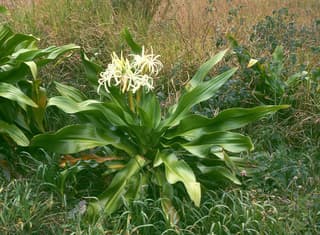
Poison Bulb
Crinum asiaticum
Crinum asiaticum, commonly known as poison bulb or giant crinum lily, is a large tropical bulbous plant in the family Amaryllidaceae. Native to coastal areas of tropical Asia, it produces spectacular umbels of fragrant white flowers on tall scapes above a rosette of long, strap-like evergreen leaves. Widely cultivated in tropical and subtropical gardens for its bold, dramatic appearance.
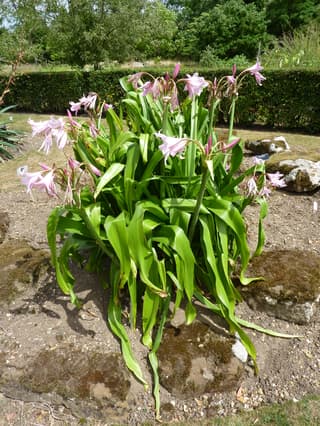
Powell's Crinum Lily
Crinum x powellii
Crinum x powellii, commonly known as Powell's Crinum Lily, is a stunning hybrid bulbous perennial resulting from a cross between two South African species, Crinum bulbispermum and Crinum moorei. It produces large, strap-like leaves and tall flower spikes bearing fragrant, trumpet-shaped flowers in shades of pink to white during late summer. A hardy and long-lived garden plant, it thrives in borders, cottage gardens, and warm temperate climates.

Rock samphire
Crithmum maritimum
Rock samphire (Crithmum maritimum) is a succulent perennial plant in the Apiaceae family, widespread along the rocky and sandy coasts of the Mediterranean, the Atlantic, and the Black Sea. It grows wild on cliffs and rocks battered by salty winds, forming compact, branched bushes with fleshy, glaucous, and aromatic leaves that have an intensely savory flavor. In summer, it produces umbels of small yellowish-white flowers, followed in autumn by aromatic seeds. Extremely resistant to drought and salt spray, it is one of the few truly halophytic horticultural plants.
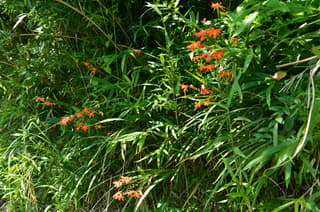
Montbretia
Crocosmia × crocosmiiflora
Montbretia (Crocosmia × crocosmiiflora) is a hybrid perennial corm-forming plant in the family Iridaceae, created by crossing Crocosmia aurea and Crocosmia pottsii by French horticulturist Victor Lemoine in 1880. It produces arching stems bearing funnel-shaped flowers in vivid shades of orange to red from mid-summer through early autumn. The foliage consists of bright green, sword-like leaves that emerge in spring and die back in winter. Widely grown in temperate gardens, it can naturalise readily and spread vigorously in mild, moist climates.
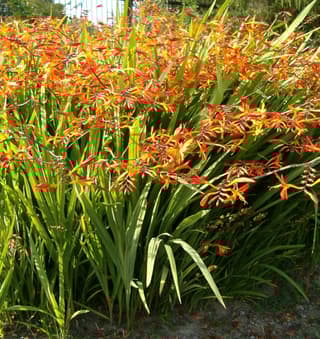
Montbretia
Crocosmia crocosmiiflora
Crocosmia crocosmiiflora, commonly known as Montbretia, is a vigorous cormous perennial from South Africa belonging to the Iridaceae family. It produces arching sprays of bright orange, red, and yellow tubular flowers in mid to late summer, making it a striking addition to borders and cottage gardens. Its sword-like foliage remains attractive throughout the growing season, and the plant naturalizes readily, forming impressive clumps over time.

Saffron crocus
Crocus sativus
The saffron crocus (Crocus sativus) is a cormous bulbous plant in the Iridaceae family, native to the eastern Mediterranean and Asia Minor. Unlike most crocuses that bloom in the spring, it flowers in the autumn, producing lilac to purple blossoms with three long red stigmas—the spice saffron, the most expensive in the world by weight. It is a sterile (triploid) plant, propagated exclusively by corm division, and has been cultivated for over 3,500 years for its aromatic stigmas.
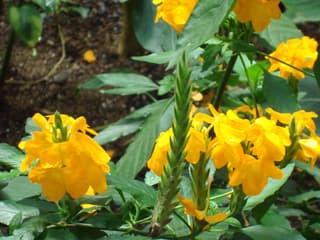
Firecracker Flower
Crossandra infundibuliformis
Crossandra infundibuliformis, commonly known as the Firecracker Flower, is a tropical evergreen shrub native to India and Sri Lanka. It belongs to the Acanthaceae family and is prized for its vibrant fan-shaped flowers that bloom nearly year-round in warm conditions. The glossy, dark green foliage with wavy margins provides an attractive backdrop to the spectacular orange, salmon, yellow, and pink blooms. Its seed pods famously "explode" when wet, which inspired its common name.
Croton
Croton
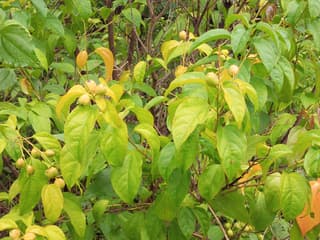
Croton is one of the largest genera in the spurge family Euphorbiaceae, comprising over 1,100 species of herbs, shrubs, and trees found across tropical and subtropical regions worldwide. The genus displays exceptional diversity in form, size, and habitat — from small ground-cover herbs in dry savannas to large canopy trees in rainforests. It is important to distinguish genus Croton from the popular houseplant known as "garden croton" (Codiaeum variegatum), which belongs to a separate genus despite sharing a common name. Several Croton species have significant medicinal and economic importance: cascarilla bark (Croton eluteria) flavors liqueurs such as Campari, while Croton megalocarpus is studied as a biofuel source. Many species produce a toxic latex and seeds that should be handled with care.
Croton
Croton variegatum
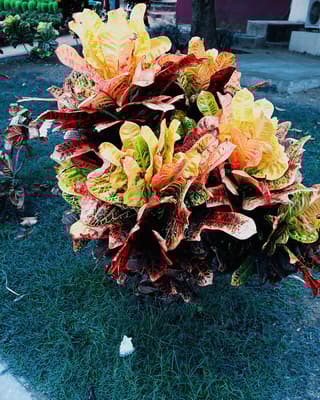
Croton (Codiaeum variegatum) is a stunning tropical plant native to Indonesia and Malaysia, prized for its brilliantly colored, leathery leaves that display a kaleidoscope of red, orange, yellow, green, and purple hues. This evergreen shrub belongs to the Euphorbiaceae family and can grow up to 3 meters tall in ideal conditions. The vibrant foliage makes it a popular choice for adding a splash of color to indoor spaces and tropical gardens.
common bird's nest fungus
Crucibulum laeve
Crucibulum laeve, commonly known as the common bird's nest fungus, is a saprobic species of fungus that grows on decaying wood, mulch, and plant debris. It is characterized by its small, cup-shaped fruiting bodies that resemble tiny bird nests containing 'eggs' (peridioles). These peridioles contain the spores and are splashed out of the cup by raindrops. The exterior of the cup is typically yellowish to tan and covered in fine hairs when young, while the interior is smooth and greyish-white.
Earth Star
Cryptanthus bivittatus
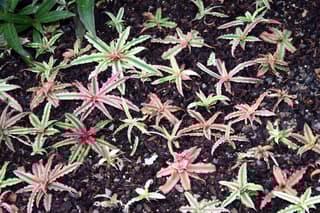
Cryptanthus bivittatus, commonly known as Earth Star, is a terrestrial bromeliad native to Brazil. It forms flat rosettes of stiff, wavy leaves marked with longitudinal stripes in pink, green, and silver tones. Ideal for terrariums and indoor settings, it is an easy-care and low-maintenance plant.
Find the Perfect Plant
Our plant guide helps you find ideal species for your experience level and time of year.
Browse by Difficulty, Season & More
Use the filters below to narrow this catalog by care difficulty, season, environment, or search directly by name. Each filter leads to a focused list tailored to your specific growing conditions.