1428 Easy Pet Safe | 2026 Guide - Page 28
Find 1428 easy pet safe. Complete guide for your garden.
1428 Pet Safe with easy level
Showing 973-1008 of 1428
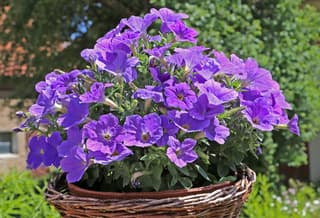
Petunia
Petunia × atkinsiana
Petunia × atkinsiana is one of the most popular garden flowers in the world, valued for its trumpet-shaped blooms and vibrant colors. This hybrid is extremely versatile, adapting well to flower beds, borders, and hanging baskets. They bloom profusely from early spring until the first frosts of autumn, offering a continuous visual spectacle.
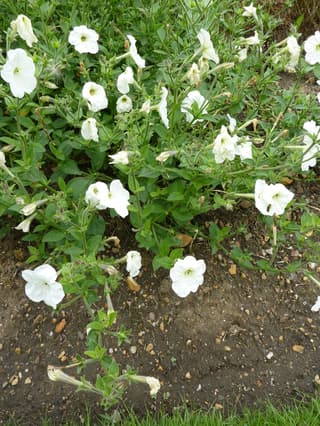
Large White Petunia
Petunia axillaris
Petunia axillaris, the large white petunia, is an erect annual to short-lived subshrub native to the temperate and subtropical grasslands of southern Brazil, Argentina, and Uruguay. It grows to about 60 cm tall, with sticky, glandular stems and opposite, elliptic to ovate leaves. Its trumpet-shaped white flowers, 3-7 cm long, are the only pure-white blooms in the genus Petunia and release a strong fragrance after dusk to attract nocturnal hawkmoths (Manduca sexta), their primary pollinator. Along with Petunia integrifolia, it is the wild ancestor of nearly all garden petunias grown today.
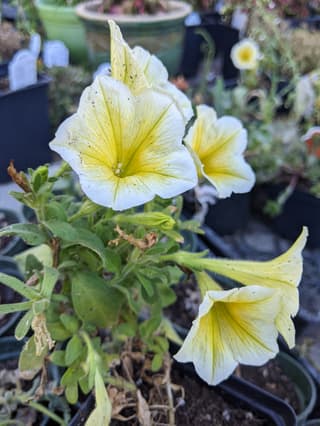
Garden Petunia
Petunia x hybrida
The garden petunia (Petunia x hybrida) is a herbaceous hybrid in the nightshade family (Solanaceae), bred from Petunia axillaris and Petunia integrifolia, both native to South America. Grown as an annual bedding plant nearly worldwide, it is one of the most popular flowers for beds, borders, hanging baskets, and containers thanks to its abundant, near-continuous bloom from spring until the first frost. Its trumpet-shaped flowers come in an enormous range of colors, from pure white to deep purple, plus pink, red, yellow, and bicolor combinations. Leaves are oval, green, slightly sticky, and softly fragrant due to fine glandular hairs. It is a fast-growing plant, ideal for gardeners who want quick, reliable color, but it demands full sun and regular watering to keep up its vigor and flower output.
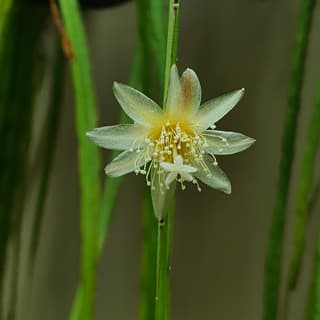
Bolivian Forest Cactus
Pfeiffera boliviana
Pfeiffera boliviana (synonym Lepismium bolivianum) is an epiphytic cactus native to the montane forests of Bolivia and northwestern Argentina, where it grows hanging from tree branches and other plants in a non-parasitic manner. The species features flat, ribbon-like green stems with wavy margins that can reach up to one meter in length, making it a highly valued indoor hanging plant. During spring and summer, small funnel- or rosette-shaped flowers develop in white or pale pink, often appearing individually at the stem areoles. Unlike desert cacti, this species is adapted to a more humid, shaded forest climate and thrives best in filtered light with consistent watering.
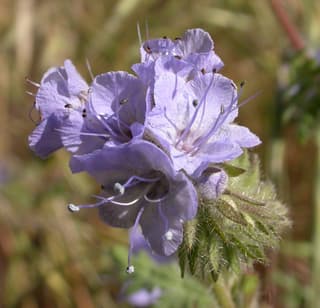
Lacy Phacelia
Phacelia tanacetifolia
Phacelia tanacetifolia, commonly known as Lacy Phacelia or Fiddleneck, is a fast-growing annual herb native to the southwestern United States. It produces masses of delicate, fern-like foliage and curling clusters of vibrant blue-purple flowers that are exceptionally attractive to bees, hoverflies, and other pollinators. Widely used as a cover crop and green manure in regenerative agriculture, it enriches soil, suppresses weeds, and supports beneficial insect populations.

Moth Orchid
Phalaenopsis
The Phalaenopsis, commonly known as the moth orchid, is one of the most popular orchids in the world due to its elegance and ease of indoor cultivation. Its flowers, which can last up to three months, grow on graceful stems and come in a wide range of colors and patterns. Its leaves are broad, fleshy, and deep green, serving as water reservoirs for the plant.
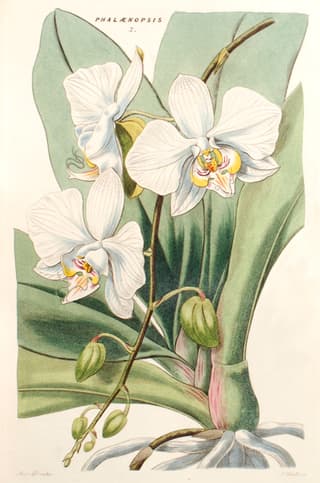
Moon Orchid
Phalaenopsis amabilis
Phalaenopsis amabilis is a stunning epiphytic orchid native to Southeast Asia, known for its large, pure white flowers that can bloom for several months. It is the national flower of Indonesia and one of the most popular orchids for indoor cultivation due to its elegant appearance and relatively easy care requirements.
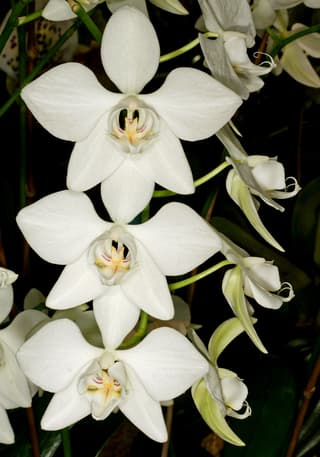
Moth Orchid
Phalaenopsis aphrodite
Phalaenopsis aphrodite, the Aphrodite moth orchid, is a species of epiphytic orchid native to the forests of the Philippines and southern Taiwan. It produces long, arching sprays of flat, pure-white flowers marked with a yellow-and-red throat, and its broad leaves persist year-round on a monopodial stem. It is the wild ancestor of countless modern Phalaenopsis hybrids sold as houseplants.
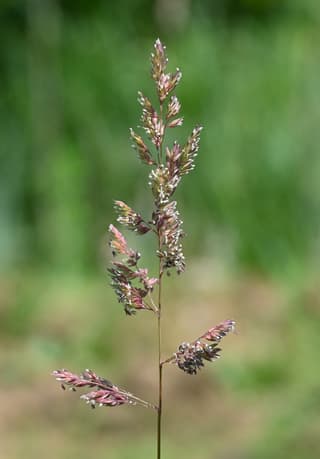
Ribbon Grass
Phalaris arundinacea
Ribbon grass (Phalaris arundinacea 'Picta') is a vigorous ornamental perennial grass prized for its striking green-and-white striped foliage. Native to Eurasia, it thrives in moist soils, water margins, and partly shaded borders. Its rapid-spreading rhizomes make it excellent for erosion control and mass plantings, though containment is recommended in garden settings to prevent invasive spread.
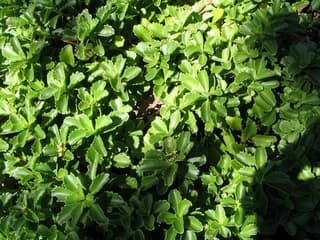
Kamchatka Stonecrop
Phedimus kamtschaticus
Phedimus kamtschaticus, commonly known as Kamchatka Stonecrop or Orange Stonecrop, is a low-growing succulent perennial in the Crassulaceae family. Native to rocky slopes of the Russian Far East, northern China, Japan, and Korea, this tough groundcover produces star-shaped golden-yellow flowers in summer over a mat of fleshy, bright green scalloped leaves that turn shades of orange and bronze in autumn. Its remarkable cold hardiness — surviving down to -34°C (-29°F) — combined with drought tolerance and fast spreading habit makes it one of the most versatile and low-maintenance groundcover plants available for temperate and cold climates.
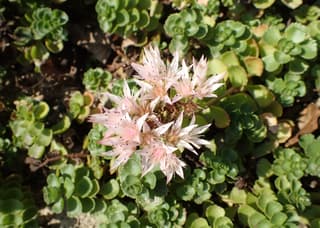
Two-row Stonecrop
Phedimus spurius
Phedimus spurius, commonly known as Two-row Stonecrop or Caucasian Stonecrop, is a hardy perennial succulent groundcover in the family Crassulaceae, native to the Caucasus region. Formerly classified as Sedum spurium, it is prized for its exceptional cold and drought tolerance, spreading mat-forming habit, and starry summer flowers in shades of pink, red, and white. It excels in rock gardens, slopes, borders, and as a lawn alternative.
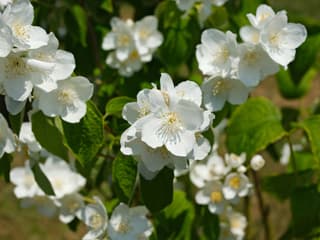
Scentless Mock Orange
Philadelphus inodorus
Philadelphus inodorus, commonly known as scentless mock orange, is a deciduous flowering shrub native to the southeastern United States and belonging to the hydrangea family (Hydrangeaceae). It forms a dense, upright, multi-stemmed shrub reaching 6 to 8 feet (1.8 to 2.4 m) tall and wide, with dark green, oval, finely toothed leaves and mature bark that peels in thin, orange-brown strips. In late spring, it produces abundant clusters of cup-shaped, four-petaled white flowers about 1 inch (2.5 cm) across. Unlike many of its relatives, the flowers of this species have little to no fragrance, which is reflected in its species name inodorus, meaning odorless. It is a tough, adaptable, fast-growing shrub well suited to informal hedges, shrub borders, and naturalized plantings.
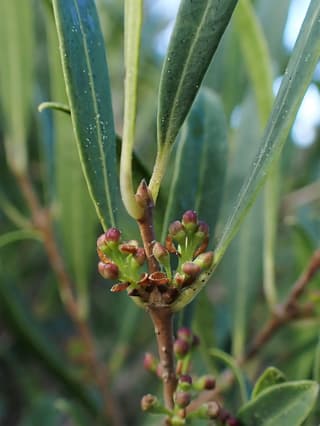
Narrow-leaved Phillyrea
Phillyrea angustifolia
Phillyrea angustifolia is an evergreen Mediterranean shrub in the olive family (Oleaceae), prized for its narrow, leathery dark-green leaves and small clusters of fragrant creamy-white flowers in late spring. Native to the Iberian Peninsula and wider Mediterranean basin, it forms part of the maquis scrubland and is valued in gardens for hedging, topiary, and coastal plantings thanks to its wind and drought tolerance.
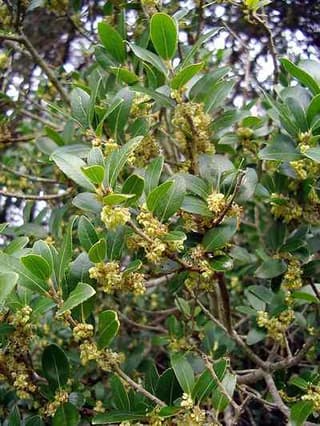
Green Olive Tree
Phillyrea latifolia
The Green Olive Tree (Phillyrea latifolia) is a slow-growing evergreen shrub or small tree native to the Mediterranean basin, where it forms part of the maquis and holm oak woodland understory. A member of the olive family (Oleaceae), it bears leathery, glossy dark-green leaves and produces small, fragrant, creamy-white flowers in axillary clusters during spring, followed by blue-black, olive-like drupes that ripen in autumn and are relished by birds. Highly drought-tolerant once established, it thrives on poor, rocky, or calcareous soils and withstands intense summer heat, making it a resilient choice for xeriscaping, hedging, and topiary in warm-temperate gardens.
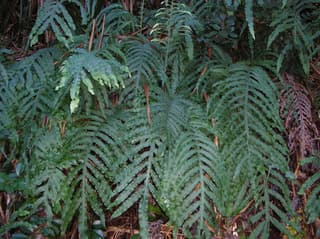
Blue Star Fern
Phlebodium aureum
A fascinating epiphytic fern, known for its deeply lobed, blue-green or glaucous fronds. Native to the tropical regions of the Americas, it grows from creeping rhizomes covered in dense, golden scales, which gives it the name 'aureum'. Unlike many ferns, it has a more robust and waxy texture to its leaves.
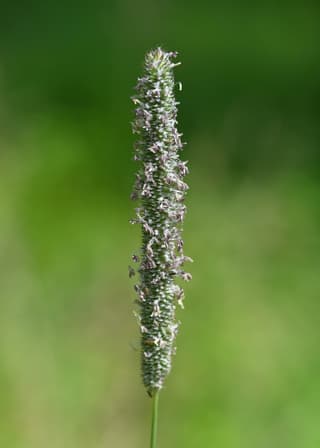
Timothy-grass
Phleum pratense
Phleum pratense, commonly known as Timothy-grass or Cat's Tail, is a perennial forage grass belonging to the Poaceae family, native to Europe and temperate Asia, and now naturalized in much of the temperate world. It forms erect clumps up to 100-115 cm tall, with linear leaves and a distinctive compact, cylindrical, greenish-purple inflorescence (a false spike). It is one of the most widely cultivated forage grasses in cool and mountainous regions for hay production and for grazing cattle, horses, sheep, and goats.
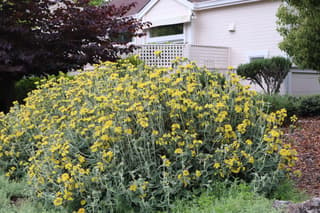
Jerusalem sage
Phlomis
Phlomis is a genus of roughly 100 evergreen to deciduous subshrubs and perennials native to the Mediterranean and Southwest Asia, in the mint family (Lamiaceae). Plants form mounds of wrinkled, woolly gray-green leaves topped by tiered whorls of hooded yellow or pink flowers held on upright spikes from late spring through summer. Highly drought-tolerant once established, Phlomis is prized for xeriscaping, cottage gardens, and pollinator borders.
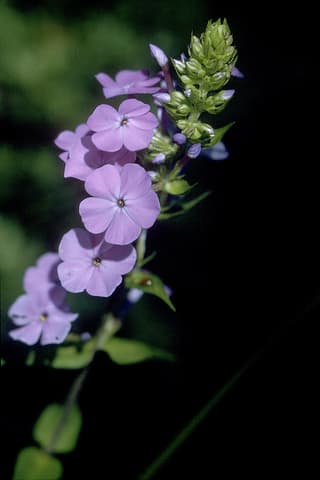
Wild Sweet William
Phlox maculata
Wild Sweet William (Phlox maculata) is a clump-forming herbaceous perennial native to the eastern United States, belonging to the family Polemoniaceae. Its distinctively spotted red-purple stems grow 60–90 cm (2–3 ft) tall and bear dense cylindrical clusters of fragrant flowers in shades of pink, lavender, purple, and white from early to midsummer. Significantly more resistant to powdery mildew than garden phlox (P. paniculata), this native wildflower thrives in moist meadows, woodland edges, and streambanks, attracting butterflies, hummingbirds, and sphinx moths.
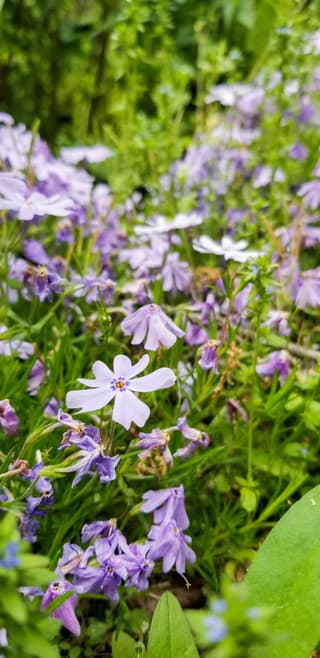
moss phlox
Phlox subulata
Phlox subulata, commonly known as moss phlox, is a vigorous, mat-forming evergreen perennial. It is celebrated for its needle-like foliage and its ability to produce a dense carpet of star-shaped flowers in early spring, often completely obscuring the leaves. It is native to the eastern and central United States and is a staple in rock gardens and as a flowering ground cover.

Date Palm
Phoenix dactylifera
Phoenix dactylifera, commonly known as the Date Palm, is a majestic palm tree native to the Middle East and North Africa. It can reach up to 30 meters in height and has been cultivated for over 5,000 years for its nutritious fruits — dates — and exceptional ornamental value.

Mountain Date Palm
Phoenix loureiroi
The Mountain Date Palm (Phoenix loureiroi) is a small, tough palm native to the hills and forests of southern Asia, from India and Pakistan through Burma, Thailand, Vietnam, China, Taiwan and the Philippines. It grows as a solitary or clustering palm reaching 1-4 m tall, with a trunk clad in diamond-shaped old leaf bases and stiff, plumose pinnate fronds up to 2 m long. Small yellow flowers are followed by bluish-black, single-seeded fruits. In the wild it thrives from sea level to 1,500 m altitude, tolerating both seasonal drought and periodic flooding, and is often found colonizing disturbed ground such as roadsides and rice-paddy borders. As a landscape or container plant it is prized for being slow-growing, drought-tolerant once established, and largely free of the serious pest and disease problems that trouble other ornamental palms.
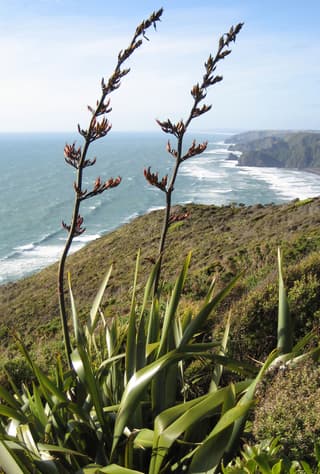
New Zealand Flax
Phormium
Phormium is a small genus of evergreen, clump-forming perennials native to New Zealand, grown for their bold, sword-shaped leaves and striking architectural form. The genus contains two main species, Phormium tenax (New Zealand flax) and the smaller Phormium cookianum (mountain flax), plus dozens of ornamental cultivars in green, bronze, purple, and variegated striped foliage. Tough, wind- and salt-tolerant, and largely pest-resistant once established, Phormium is a mainstay of coastal gardens, mixed borders, and large containers.

New Zealand Flax
Phormium tenax
Phormium tenax, commonly known as New Zealand Flax or Harakeke, is a bold, evergreen perennial native to New Zealand and Norfolk Island. It forms striking clumps of long, sword-shaped leaves that can reach up to 3 meters in height, making it a dramatic focal point in gardens. The plant produces tall flowering spikes of dark red tubular flowers in summer, attracting nectar-feeding birds. It is highly adaptable, tolerating coastal winds, drought, and a wide range of soil conditions once established.

Chinese Photinia
Photinia serratifolia
Photinia serratifolia, commonly known as Chinese Photinia or Oriental Photinia, is a broadleaf evergreen shrub or small tree in the Rosaceae family, native to China and Taiwan. It is prized for its striking new growth that emerges apple green to bronze or reddish-purple before maturing to glossy dark green. In spring, it bears terminal clusters of small, white, mildly fragrant flowers followed by small red pome fruits that persist into winter, providing wildlife value. A fast-growing, adaptable plant widely used for hedging, screening, and ornamental planting in temperate gardens worldwide.

Common Reed
Phragmites australis
The Common Reed (Phragmites australis) is a tall, perennial wetland grass that grows in dense stands—known as reed beds—along the banks of standing and slow-flowing bodies of water. It reaches heights of up to four meters and often spreads extensively via vigorous underground rhizomes. The characteristic dark purple to silvery-gray flower panicles appear in late summer and autumn above narrow, blue-green leaves that turn golden-brown in winter. Distributed worldwide, the reed is considered an ecologically significant habitat for birds and insects, but once established, it can spread very aggressively.
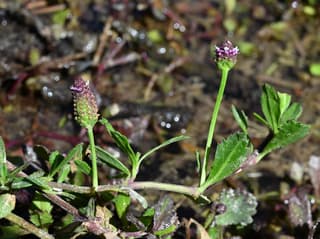
turkey tangle fogfruit
Phyla nodiflora
Phyla nodiflora, commonly known as turkey tangle fogfruit or frogfruit, is a vigorous, low-growing perennial groundcover. It features small, serrated green leaves and unique cylindrical flower heads surrounded by tiny white to pinkish-purple flowers. It is highly valued as a sustainable lawn alternative due to its ability to handle foot traffic and its high attractiveness to pollinators like butterflies and bees.
Stonebreaker
Phyllanthus amarus
A small annual tropical herb that grows rapidly to 30-60 cm in height. Native to tropical and subtropical regions of Africa, Americas, India, and Southeast Asia. Characterized by alternately arranged small elliptic-oblong leaves (5-10mm), tiny greenish-yellow flowers, and small seeds. The plant is drought-tolerant and thrives in warm, humid climates. Reaches maturity in 2-3 months.
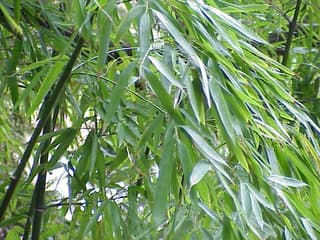
Golden Bamboo
Phyllostachys aurea
Golden Bamboo (Phyllostachys aurea) is a fast-growing, clump-forming bamboo native to southern China. Its canes start green and develop a golden-yellow hue when exposed to full sun, giving the plant its popular name. It can reach up to 9 meters tall and is widely used as a privacy screen, windbreak, and ornamental feature. However, it is classified as invasive in many regions due to its aggressive underground rhizome spread.
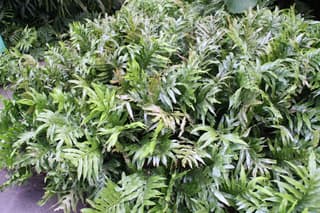
Wart Fern
Phymatosorus scolopendria
Phymatosorus scolopendria, popularly known as the Wart Fern, is a perennial, rhizomatous fern native to the tropical regions of Africa, Asia, and Oceania. Its fronds are leathery, bright green, and deeply lobed, reaching up to 90 cm (35 inches) in height. A striking feature is its sori (reproductive organs) which form rounded protuberances on the upper surface of the leaves, resembling small warts, hence its common name 'wart fern'. Extremely versatile, it can grow as an epiphyte on trees, as ground cover in tropical gardens, or as an indoor ornamental plant in environments with good humidity. It adapts well to shade and partial shade conditions, making it ideal for interiors, well-lit bathrooms, and shaded gardens.
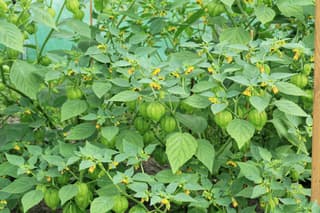
Tomatillo
Physalis ixocarpa
Physalis ixocarpa, commonly known as tomatillo, is an annual plant in the Solanaceae family native to Mexico and Central America. It produces green fruits enclosed in a distinctive papery husk, widely used in traditional Mexican cuisine for salsas, moles, and sauces.

Tomatillo
Physalis philadelphica
Tomatillo (Physalis philadelphica) is an annual herbaceous plant native to Mexico, grown for its small green fruits encased in a papery husk. A staple of Mexican cuisine, tomatillos are essential in salsas, green sauces, and stews. The plant grows vigorously in warm climates with full sun and well-drained soil, often noted as a synonym of Physalis ixocarpa.
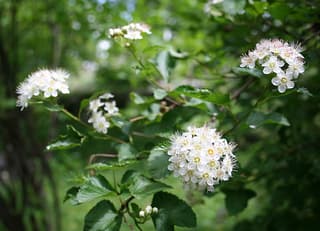
Common Ninebark
Physocarpus opulifolius
Common Ninebark (Physocarpus opulifolius) is a deciduous shrub native to eastern North America, renowned for its distinctive exfoliating bark that peels in multiple thin layers revealing reddish and light-brown inner bark. It produces clusters of creamy-white to pink-tinged flowers in late spring, and is widely valued in landscape gardening for its hardiness, multi-season interest, and adaptability.
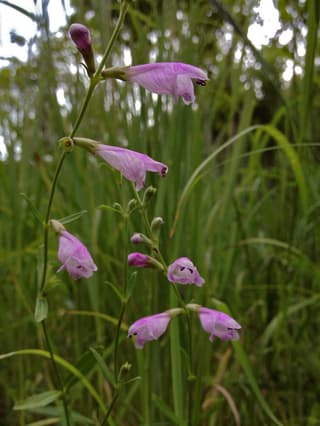
Obedient Plant
Physostegia virginiana
Obedient Plant (Physostegia virginiana) is a hardy, rhizomatous perennial from the mint family (Lamiaceae), native to moist meadows, stream banks, and prairies of North America. Its square stems bear spikes of pink, white, or purplish, dragonhead-like flowers from July to October. It gets its name from the fact that individual flowers, when manually moved, will temporarily hold their new position, as if obeying. It spreads quickly, forming dense clumps, so it's advisable to thin it out occasionally in the garden by division.

Dwarf Alberta Spruce
Picea glauca 'Conica'
Picea glauca 'Conica', or the Dwarf Alberta Spruce, is a slow-growing evergreen conifer derived from the native white spruce (Picea glauca) and discovered in Alberta, Canada, in 1904. This cultivar is renowned for its perfect, symmetrical conical shape—growing only 2 to 4 inches (5–10 cm) per year, making it ideal for small gardens, rockeries, and containers. Its short, soft, bright green needles are densely packed on the stems, giving the plant an elegant, compact appearance. This variety is very cold-hardy (down to -40 °F/-40 °C) and requires minimal maintenance, but it is highly susceptible to spider mites and does not tolerate high humidity or hot summers.
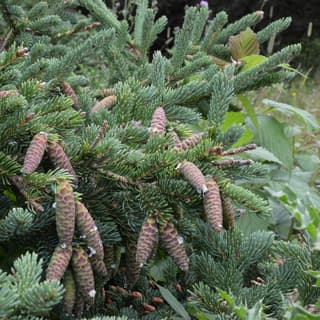
White Spruce
Picea laxa
White spruce (Picea glauca), also known as Canadian spruce, is a majestic coniferous tree native to the northern regions of North America—from Alaska to Newfoundland and south to Montana. It is characterized by a dense, conical crown, short four-sided needles of a blue-green color with a characteristic pungent odor, and small, thin cones. It is among the hardiest trees in the world, withstanding freezing temperatures down to -50 °C and surviving harsh northern winters. It grows to a height of up to 25 meters, naturally growing at a slower pace. It is a foundational species of northern forests and provides shelter for many birds and mammals. Dwarf cultivars such as 'Conica' are popular as ornamental plants for both gardens and containers.
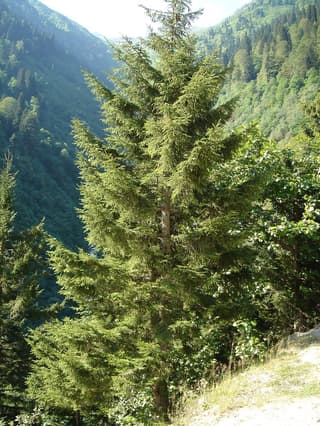
Oriental spruce
Picea orientalis
Oriental spruce (Picea orientalis) is an evergreen conifer from the Pinaceae family, native to northeastern Turkey and the Caucasus region of Georgia. The tree forms a dense, narrow, pyramidal crown with pendulous side branches and short, glossy, dark green needles that lie close to the shoots. In spring, the tree bears conspicuous reddish-purple male cones, which later mature into brown seed cones in the fall. In gardens and parks, the species typically reaches 15-18 meters in height with a width of 4-7 meters after many years of growth, while wild specimens can grow even taller. It is known for its slow but steady growth and is often used as an ornamental tree, windbreak, or specimen plant in large gardens and parks.
Easy Care Pet Safe
Our selection of 1428 easy pet safe combines the characteristics of this category with reduced care needs. Perfect for beginners who love this category.
Why Choose Easy Pet Safe?
Combining the beauty of pet safe with easy difficulty level lets you enjoy this category without excessive maintenance worries. Each plant was selected to offer the best characteristics of the category at the care level you are looking for.