1446 Easy Pet Safe | 2026 Guide - Page 26
Find 1446 easy pet safe. Complete guide for your garden.
1446 Pet Safe with easy level
Showing 901-936 of 1446
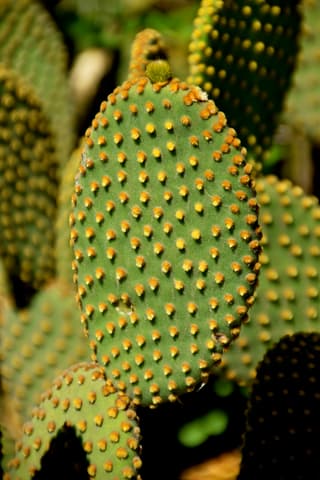
Bunny Ears Cactus
Opuntia microdasys
Native cactus from central and northern Mexico, known for its characteristic oval pads covered with white or yellow glochids that give it a velvety appearance. Forms dense bushes up to 60 cm tall and is highly valued as an ornamental plant both indoors and outdoors.
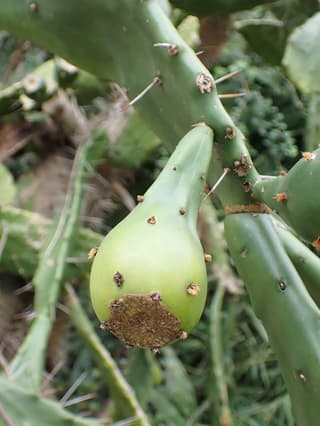
Drooping Prickly Pear
Opuntia monacantha
Opuntia monacantha, commonly known as the Drooping Prickly Pear, is a cactus native to South America (Brazil, Argentina, Uruguay, and Paraguay). It features flat, bright-green pads with yellow flowers and colorful edible fruits. A tough, drought-tolerant species, it thrives in full sun and well-draining sandy soil, making it an excellent choice for low-maintenance gardens and sunny interiors.
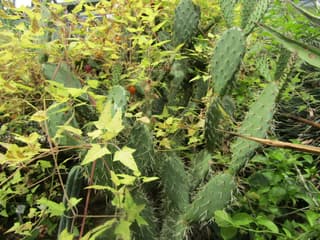
Prickly Pear
Opuntia orbiculata
Opuntia orbiculata is a paddle-type cactus belonging to the Cactaceae family, native to arid and semi-arid regions of the Americas. It forms shrubby clumps with flattened, succulent segments (pads) covered in glochids—tiny, fine, barbed spines that detach easily when touched. It is a hardy plant that grows in stacked segments, blooming in late spring and early summer with large, showy flowers followed by edible fruits (known as 'tunas').
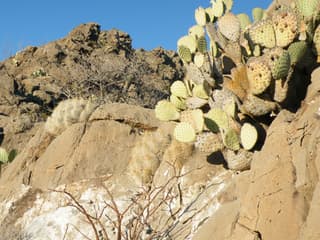
Blind Prickly Pear
Opuntia rufida
Opuntia rufida is a shrubby, many-branched cactus native to the Chihuahuan Desert of Big Bend, Texas and northern Mexico. Its flattened, blue-green pads (cladodes) are spineless but densely covered in reddish-brown glochid clusters that give the plant its cinnamon-colored look and its common name, since livestock that brush against the glochids can be blinded. In summer it produces yellow flowers that fade to apricot or red, followed by reddish edible fruit.
Woollyjoint Prickly Pear
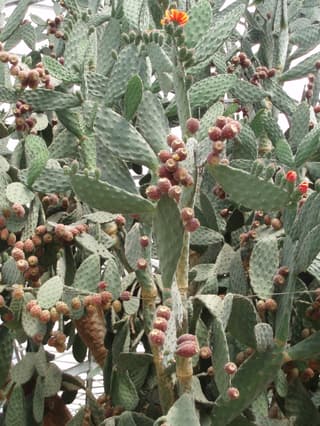
Opuntia tomentosa
Opuntia tomentosa, the woollyjoint prickly pear, is a tree-forming cactus native to central Mexico's semi-arid highlands. Over years it develops a short, thick trunk topped with broad, velvety green pads covered in fine, felt-like hairs (hence 'tomentosa'), eventually reaching 3-6 m and occasionally up to 8 m in the wild. In spring and summer it bears yellow-to-orange, sometimes red-tinged flowers followed by sweet, edible reddish-purple fruit ('tunas'). Extremely drought tolerant once established, it thrives in full sun and sandy, fast-draining soil, and is grown both ornamentally and for its edible pads and fruit.
Tuna Prickly Pear
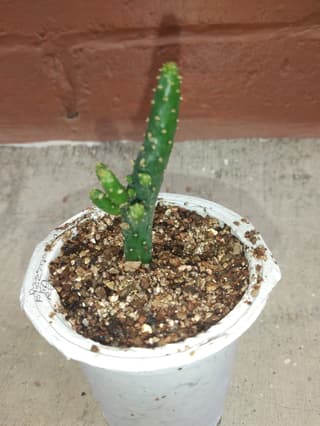
Opuntia tuna
Opuntia tuna, commonly known as tuna prickly pear or Caribbean prickly pear cactus, is a robust columnar cactus native to the Caribbean and tropical Americas. Its flattened pads (cladodes) are armed with spines and glochids, and it produces showy yellow-to-orange flowers in spring and summer, followed by edible reddish fruits.
Carrion Flower
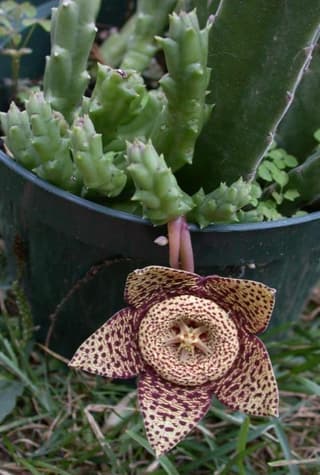
Orbea variegata
Orbea variegata, commonly known as Carrion Flower or Starfish Plant, is a low-growing succulent native to the Cape Province of South Africa. It produces striking star-shaped flowers up to 8 cm across, yellow or off-white with dark maroon spots, that emit a carrion odor to attract fly pollinators.

Old Man of the Andes
Oreocereus celsianus
A slow-growing columnar cactus native to the Andes of Bolivia, Peru, and Argentina, where it grows at altitudes between 2,900 and 3,600 meters. Its upright stems, which branch at the base, are covered in dense white wool and long yellowish spines. They can reach up to 3 meters in height in the wild, though they rarely exceed 1 meter in cultivation. The white 'beard' covering the top of the stems protects the plant from intense solar radiation and the extreme temperature fluctuations of its high-altitude habitat, giving it its popular names. In spring, it produces tubular pinkish-purple flowers, usually pollinated by hummingbirds, followed by small globose fruits.
Green Dunce Cap
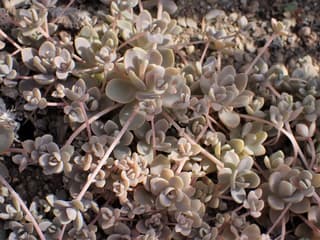
Orostachys malacophylla
Orostachys malacophylla is a hardy, monocarpic succulent from the Crassulaceae family (the same family as stonecrops and sedums). The plant forms dense rosettes of fleshy, bluish-green to green leaves with a diameter of 4-15 cm and spreads via runners (stolons), forming dense mats of rosettes. In the autumn, mature rosettes produce a conical inflorescence up to approximately 20 cm with white to greenish flowers and yellow stamens—after which the specific flowering rosette dies, while the numerous offsets ensure the colony lives on. The species is very hardy (USDA zones 3a-8b) and tolerates heavy frost, and the plant is not considered toxic to humans or pets.
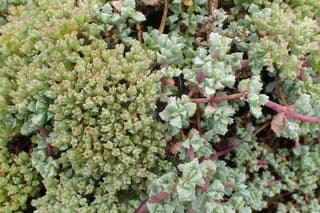
Deltoid Pumpkin
Oscularia deltoides
Oscularia deltoides is a succulent groundcover from the Aizoaceae family, native to the rocky and arid areas of the Western Cape in South Africa. It forms creeping cushions of triangular (deltoid) blue-green leaves, often with pinkish tints, edged with tiny translucent teeth that give it a frost-covered appearance. In spring and summer, it produces an abundant bloom of daisy-like flowers in magenta-pink or lavender hues, which are lightly scented and open during the day. Due to its extreme drought tolerance and ease of cultivation, it is highly valued as a groundcover, in rock gardens, and in containers.
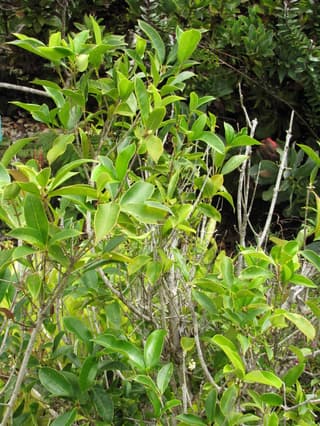
Sweet Olive
Osmanthus fragrans
Osmanthus fragrans, commonly known as Sweet Olive or Tea Olive, is an evergreen shrub or small tree native to China and parts of Asia. Renowned for its intensely fragrant, tiny white or yellow flowers, it is one of the most celebrated ornamental plants in Chinese culture. The flowers are used to scent teas, wines, and perfumes, and the plant holds deep cultural significance in China, where it is associated with the Mid-Autumn Festival.
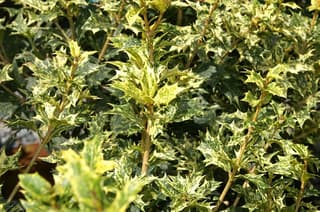
Goshiki False Holly
Osmanthus heterophyllus 'Goshiki'
Osmanthus heterophyllus 'Goshiki' is an evergreen shrub in the Oleaceae family, native to Japan and Taiwan. The cultivar 'Goshiki' (literally meaning "five colors" in Japanese) is distinguished by its variegated foliage: the leathery, spiny leaves, similar to those of holly, emerge in shades of bronze-pink before maturing into green mottled with cream, yellow, and pink. In autumn, it produces small white flowers that are discreet but highly fragrant, often hidden among the leaves. Slow-growing with a compact habit, it is prized as a specimen plant, in informal hedges, or in mixed borders.
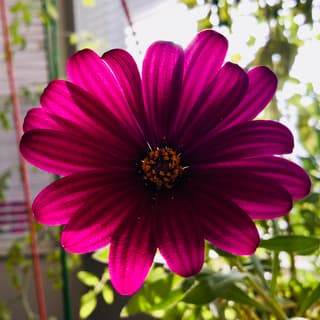
African Daisy
Osteospermum
Osteospermum, commonly called African daisy or Cape daisy, is a genus of roughly 70 species of daisy-like flowering plants native to South Africa and the surrounding region, belonging to the sunflower family (Asteraceae). Grown as mounding, spreading subshrubs or herbaceous perennials, they produce abundant 5 cm blooms in white, yellow, orange, red, coral, pink and purple, often with a striking dark or iridescent-blue center disc. In warm climates (USDA zones 9-11) they behave as tender perennials that flower nearly year-round; in cooler regions they are grown as fast-growing annuals or overwintered indoors. Prized for heat and drought tolerance once established, African daisies are popular as border edging, container spillers and ground cover in sunny, well-drained garden beds.
Bietou
Osteospermum moniliferum
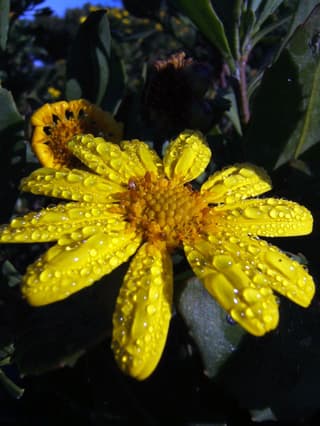
Bietou (Osteospermum moniliferum) is a fast-growing, evergreen shrub in the Asteraceae family, native to the coastal regions of southern Africa—from the Cape Peninsula through KwaZulu-Natal to Mozambique and Zimbabwe. The plant grows up to 2 meters tall and equally wide, forming a compact, rounded growth habit with dark green, slightly serrated leaves. The characteristic yellow flower heads, with a diameter of up to 40 mm, bloom primarily in late autumn and winter, and are highly attractive to bees and other pollinators. After flowering, berry-like fruits develop that ripen into dark brown or black spheres, which are a favorite for birds. The plant is extremely drought-tolerant due to its semi-succulent nature and thrives in well-drained, sandy soil in full sun. It is easy to grow, grows rapidly, and has a lifespan of 8–12 years.
European hop-hornbeam
Ostrya carpinifolia
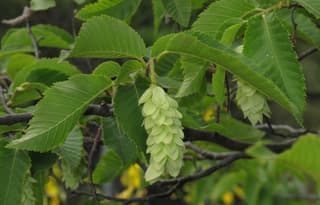
The European hop-hornbeam (Ostrya carpinifolia) is a deciduous tree of the Betulaceae family, widespread in the hilly and sub-mountainous areas of Southern Europe, the Balkans, and Southwestern Asia. It grows wild from sea level up to about 1300 m, often on calcareous soils and arid slopes, where it acts as a pioneer species capable of colonizing poor and degraded soils. It typically reaches 15-20 meters in height, with an oval crown, reddish-brown bark that flakes into thin plates, ovate serrated leaves similar to those of the common hornbeam but with more pronounced veins, and fruits enclosed in membranous bracts gathered in infructescences resembling hop cones, from which its English name "hop-hornbeam" is derived.
Money Tree
Pachira aquatica
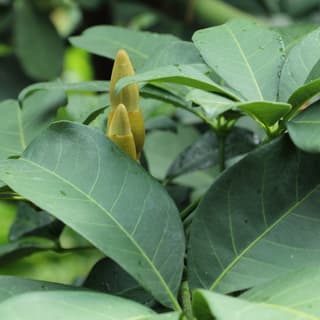
Pachira aquatica is a tropical plant native to Central America, known for its distinctive braided trunk and umbrella-shaped leaves. Popular in feng shui as a symbol of prosperity and good luck.
Saba Nut
Pachira glabra
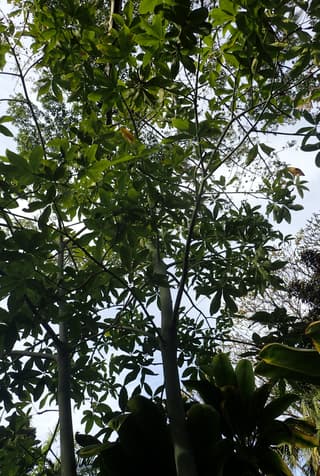
Pachira glabra, commonly known as Saba Nut or Money Tree, is a tropical tree native to eastern Brazil's Atlantic Forest. It is the species most commonly sold as the braided 'money tree' in plant shops — distinct from Pachira aquatica, which is larger and truly aquatic. P. glabra has more flexible young stems, making it ideal for braiding, and features deep-green palmate leaves and creamy-white flowers. It is non-toxic, easy to care for, and widely used in Feng Shui as a symbol of prosperity.
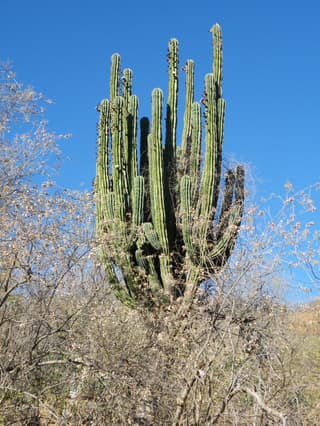
Indian Comb Cactus
Pachycereus pecten-aboriginum
Pachycereus pecten-aboriginum, known as the Indian Comb Cactus, is a massive columnar cactus native to western Mexico, from Sinaloa and Sonora to Chiapas. It can grow up to 20 meters tall with stems up to 1 meter in diameter. Its white nocturnal flowers are pollinated by bats, and its golden spiny fruits were historically used by indigenous peoples as hairbrushes — giving rise to its common name.
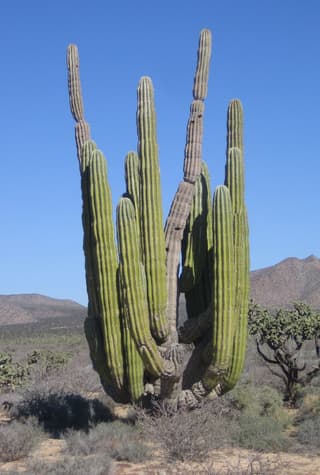
Mexican giant cardón
Pachycereus pringlei
Pachycereus pringlei, commonly known as the Mexican giant cardón or elephant cactus, is the tallest cactus species in the world and a defining feature of the Sonoran and Baja California deserts in northwestern Mexico. This columnar giant can grow up to 19.2 meters (63 feet) tall, live for over 300 years, and weigh as much as 25 tons at full maturity. Its blue-green trunk bears 10 to 16 ribs lined with clusters of brownish spines, and mature plants produce large, nocturnal white flowers followed by spiny red fruits that were historically a vital food source for the indigenous Seri people.
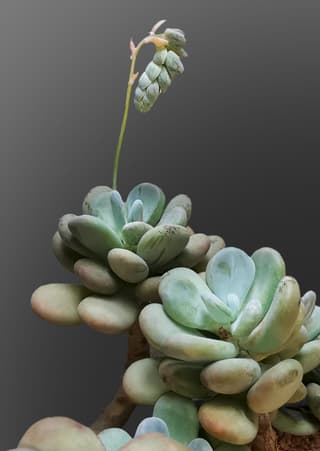
Moonstones
Pachyphytum
Pachyphytum is a genus of succulents in the stonecrop family (Crassulaceae), native to central-eastern Mexico, comprising about 25 to 27 species. Commonly known as "moonstones," these plants form compact rosettes of thick, plump, oval leaves coated in a fine powdery farina that gives them blue-grey, greenish, or pinkish tones. The care information here is based primarily on Pachyphytum oviferum, the most widely cultivated species in the genus.
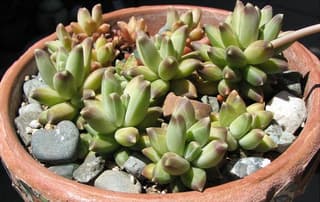
Little Jewel
Pachyphytum compactum
Succulent native to Mexico (Hidalgo and Querétaro) with compact rosettes of plump, cylindrical leaves covered in a grayish waxy bloom. It forms branching clumps up to about 15 cm tall and flowers in late spring.
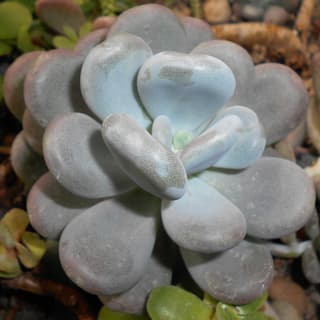
Moonstone Succulent
Pachyphytum oviferum
Pachyphytum oviferum, commonly known as the Moonstone Succulent, is a charming species native to the rocky cliffs of San Luis Potosí, Mexico. It belongs to the family Crassulaceae and is prized for its plump, egg-shaped leaves coated in a silvery-white farina (pruina) that gives them a dreamy, translucent appearance reminiscent of precious moonstones.
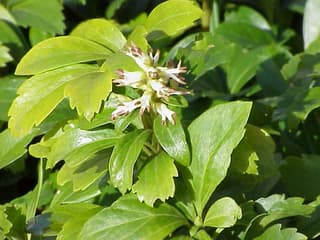
Japanese spurge
Pachysandra terminalis
Pachysandra terminalis (Japanese spurge) is a low-growing, evergreen perennial groundcover from the boxwood family (Buxaceae), native to the forests of Japan. It forms dense, 15-30 cm high mats of leathery, dark green leaves clustered at the ends of the stems - hence the specific name "terminalis". It spreads slowly via underground rhizomes and forms a continuous carpet within 2-3 years. In early spring, it produces small, inconspicuous white flowers in spike-like clusters. It is hardy in USDA zones 4a to 9b and excels in its ability to grow in deep shade where most other plants fail to thrive.

Christ's thorn
Paliurus spina-christi
Paliurus spina-christi (Rhamnaceae family), known in English as Christ's thorn or Jerusalem thorn, is a deciduous shrub or small tree native to the Mediterranean region and Western Asia, from Afghanistan to Romania. It grows up to 4-6 meters in height, with thin zigzagging branches equipped with paired spines—one straight and one curved. The leaves are oval, glossy, and feature three prominent veins. In late spring and summer, it produces small greenish-yellow flowers in clusters, followed by woody fruits surrounded by a disk-shaped wing resembling a small hat, which are green at first and turn brown when ripe. According to tradition, its thorny branches were used to weave the crown of thorns for Jesus, which is the origin of its common name.
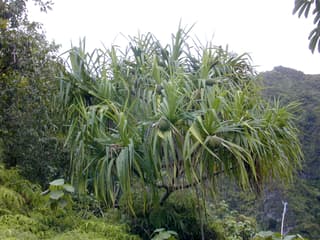
Tahitian Screwpine
Pandanus tectorius
Pandanus tectorius, known as the Tahitian Screwpine or Hala, is a coastal tropical tree in the Pandanaceae family. Native to the Pacific Islands, Southeast Asia, and Australia, it is renowned for its dramatic prop roots, long spiraling spiny leaves, and colorful pineapple-like fruits. A culturally significant species across the Pacific, it has been used for food, weaving, medicine, and shelter for thousands of years.
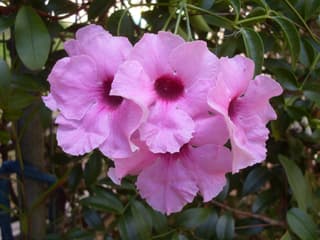
Bower Vine
Pandorea
Pandorea is a genus of woody evergreen climbers native to Australia, belonging to the family Bignoniaceae. Twining stems scramble over trellises, fences and pergolas, forming a dense curtain of glossy foliage studded with trumpet-shaped flowers in shades of white, pink and purple, often with a contrasting streaked throat. It is a vigorous, fast-growing plant popular for screening and shading in mild-to-warm gardens, though it is frost-tender and needs protection in cold climates.
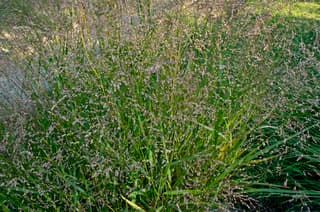
Switchgrass
Panicum virgatum
Switchgrass (Panicum virgatum) is a warm-season perennial grass native to the North American prairies, forming upright clumps of narrow blue-green blades that turn golden in fall. Prized in naturalistic gardens, erosion control, and as a biomass crop for biofuel, it is a rugged, drought-tolerant, low-maintenance plant that attracts birds and butterflies.
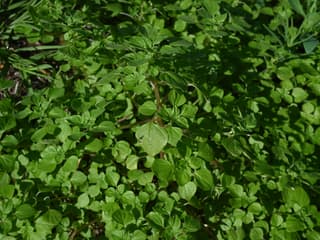
Florida Pellitory
Parietaria floridana
Parietaria floridana, commonly known as Florida pellitory, is an annual or short-lived herbaceous plant belonging to the Urticaceae family (nettles), although it lacks stinging hairs. Native to the southeastern United States, the Antilles, and much of Latin America, it grows in a branched and sometimes prostrate manner, reaching up to 40 cm in height. Its leaves are small, thin, heart-shaped or rhomboid, pale green, and have a fragile, translucent texture. It produces tiny, inconspicuous greenish flowers clustered in the leaf axils, blooming from spring until autumn (until the first frosts). It is common in sandy coasts, calcareous soils, and disturbed areas such as gardens or around greenhouses. Its pollen is a known respiratory allergen, so it is recommended to remove it before flowering for individuals sensitive to seasonal allergies.
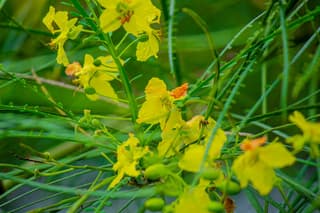
Jerusalem thorn
Parkinsonia aculeata
Parkinsonia aculeata is a small thorny tree or shrub in the Fabaceae family, native to a vast area ranging from the southwestern United States and northern Mexico to northern Argentina. It is recognized by its photosynthetic green branches, bipinnate leaves composed of tiny leaflets that drop during dry periods, and its fragrant yellow-orange flowers gathered in pendulous racemes. Fast-growing, it is widely used as an ornamental and shade tree in arid and urban regions with warm climates.
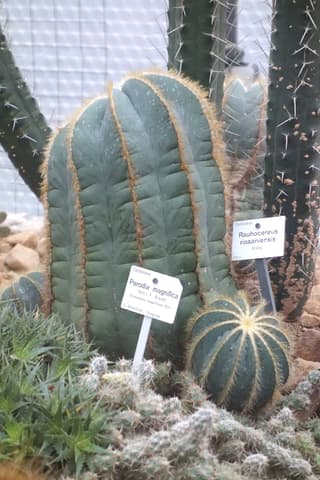
Parodia / Ball Cactus (genus)
Parodia
Parodia is a genus of globular and columnar cacti native to South America, particularly Argentina, Bolivia, Brazil, and Uruguay. These compact plants are highly prized in cactus collections for their ease of care and vibrant flowers in shades of yellow, orange, and red that emerge from the crown.
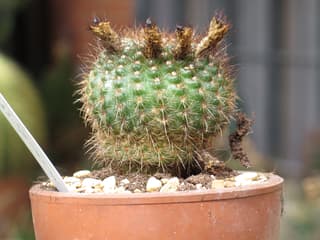
Hybrid Ball Cactus
Parodia × erubescens
Parodia × erubescens is a hybrid cactus from the Cactaceae family, native to South America. It features a compact globular form with golden spines and brilliant yellow flowers that bloom in spring and summer. Extremely drought-tolerant and low-maintenance, it is ideal for cactus collectors and succulent beginners alike.
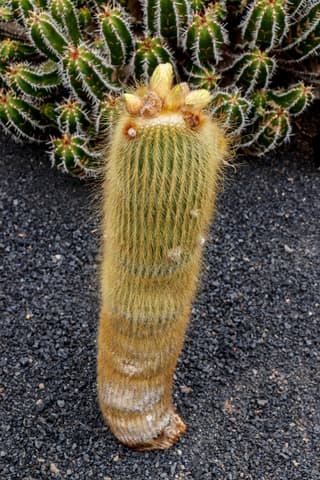
Golden Ball Cactus
Parodia leninghausii
Parodia leninghausii, commonly known as the golden ball cactus or lemon ball cactus, is a columnar cactus native to Rio Grande do Sul in southern Brazil, where it grows on rocky outcrops and cliff faces. Young plants are spherical, gradually becoming columnar with age and reaching up to 1 meter tall. The plant is covered in fine, soft golden spines that give it its characteristic shining appearance. Mature specimens produce bright yellow flowers at the crown during the growing season.
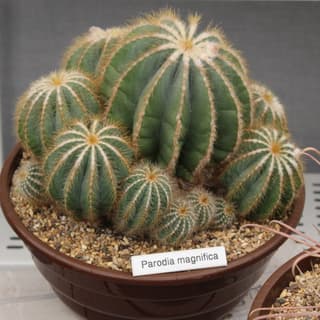
Balloon Cactus
Parodia magnifica
Parodia magnifica, commonly known as the Balloon Cactus, is a small globular cactus native to the grasslands and rocky slopes of southern Brazil and Uruguay. Its blue-green, ribbed body is covered in fine golden spines and often forms dense clusters over time. In summer, it crowns itself with vivid yellow flowers that open only in bright sunlight, making it a rewarding and low-maintenance addition to any sunny windowsill or succulent garden.
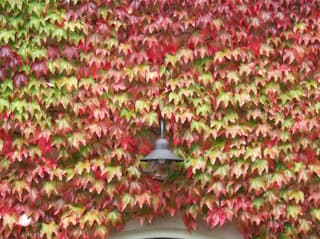
Boston Ivy
Parthenocissus tricuspidata
Boston Ivy (Parthenocissus tricuspidata) is a vigorous, deciduous climbing vine from the Vitaceae family, native to China, Japan, and Korea. Celebrated for its three-lobed dark green leaves that turn brilliant scarlet-red in autumn, it is one of the most popular plants for covering walls, facades, and trellises. It clings to surfaces via adhesive disc-tipped tendrils, requiring no additional support.
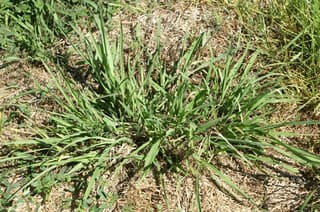
Dallisgrass
Paspalum dilatatum
Dallisgrass (Paspalum dilatatum) is a robust, clump-forming perennial grass native to southern Brazil, Argentina, Uruguay, and Paraguay. It forms dense tufts with short rhizomes and deep fibrous roots, and is widely grown as a warm-season pasture forage grass, though it is also considered a weed in lawns and disturbed ground. Its inflorescences bear pale green to purplish spikelets, which often develop a sticky black exudate when infected by ergot fungus.
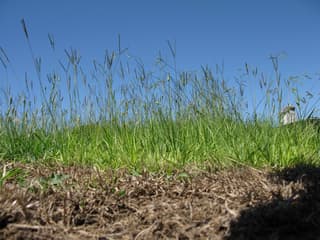
Bahiagrass
Paspalum notatum
Bahiagrass (Paspalum notatum) is a warm-season perennial grass native to South America, widely used for lawns, pastures, roadsides, and erosion control. Known for its exceptional drought tolerance, deep root system, and low maintenance requirements, it thrives in full sun and adapts to poor, sandy soils.
Easy Care Pet Safe
Our selection of 1446 easy pet safe combines the characteristics of this category with reduced care needs. Perfect for beginners who love this category.
Why Choose Easy Pet Safe?
Combining the beauty of pet safe with easy difficulty level lets you enjoy this category without excessive maintenance worries. Each plant was selected to offer the best characteristics of the category at the care level you are looking for.