1446 Easy Pet Safe | 2026 Guide - Page 4
Find 1446 easy pet safe. Complete guide for your garden.
1446 Pet Safe with easy level
Showing 109-144 of 1446
Cast Iron Plant
Aspidistra lurida
Aspidistra lurida, commonly known as the Cast Iron Plant, is a slow-growing, evergreen perennial native to the forest floors of East Asia. It features upright, leathery, lance-shaped dark green leaves that can reach up to 1 metre in height. Renowned for its extraordinary toughness, it thrives in deep shade, tolerates temperature fluctuations, irregular watering, and low humidity — conditions that would kill most houseplants. It is one of the most forgiving and long-lived indoor plants available, capable of surviving for decades with minimal care.
Spleenwort
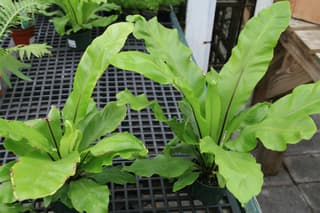
Asplenium
Asplenium is a genus of approximately 700 fern species found across tropical and subtropical regions worldwide. The most popular indoor species is Asplenium nidus, the Bird's Nest Fern, recognised by its long, glossy, bright-green fronds radiating from a central rosette. Naturally adapted to low-light forest floors and tree trunks, Asplenium makes an excellent houseplant for rooms with limited natural light.
Japanese Bird's Nest Fern
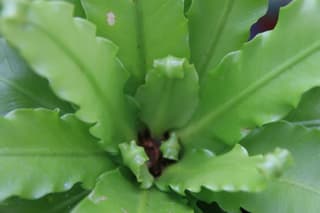
Asplenium antiquum
Asplenium antiquum, the Japanese bird's nest fern, is an evergreen epiphytic fern native to subtropical East Asia — Japan, Taiwan, southeastern China, and South Korea — where it grows on tree trunks, rocks, and cliffs in humid forests. Its glossy, undivided, arching fronds radiate from a single central rosette resembling a bird's nest, reaching roughly 60-90 cm across at maturity. It is a popular tropical houseplant valued for its bold architectural foliage and is non-toxic to pets.
Hen and Chickens Fern
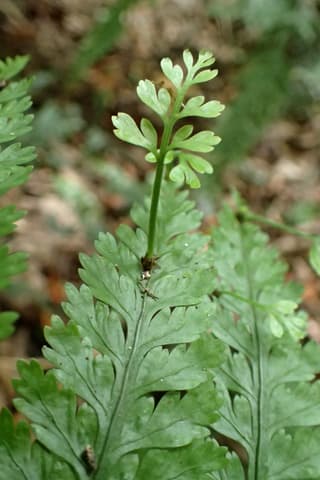
Asplenium bulbiferum
The Hen and Chickens Fern (Asplenium bulbiferum) is an elegant fern native to New Zealand and nearby islands, celebrated for its finely divided, bright-green fronds and its remarkable ability to produce tiny plantlets (bulbils) directly on mature fronds. This unique characteristic inspired its whimsical common name, as the plantlets resemble chicks clustering around a mother hen. It is widely grown as an indoor houseplant and in shaded garden settings.
Ebony Spleenwort
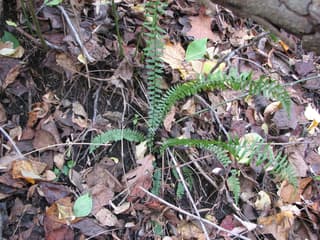
Asplenium platyneuron
Ebony Spleenwort is a small dimorphic fern native to eastern North America, characterized by its glossy ebony-black rachis contrasting beautifully with dark green fronds. It produces two distinct frond types: shorter sterile fronds that spread horizontally and taller fertile fronds that stand upright. A low-maintenance native fern ideal for shade gardens and rocky landscapes.
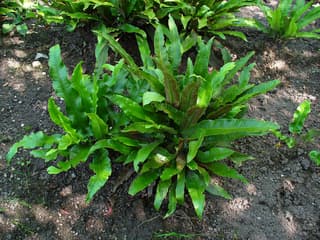
Hart's-tongue Fern
Asplenium scolopendrium
Asplenium scolopendrium, commonly known as the hart's-tongue fern, is an elegant evergreen fern native to moist, shady woodlands and rocky limestone habitats across Europe, Asia, and parts of North America. It produces distinctive undivided, strap-shaped, glossy bright-green fronds unlike most other ferns, giving it a unique tropical appearance in temperate gardens.

Maidenhair Spleenwort
Asplenium trichomanes
Asplenium trichomanes, commonly known as maidenhair spleenwort, is a small evergreen fern in the Aspleniaceae family. It forms neat rosettes of slender fronds lined with tiny, rounded, bright green leaflets attached to glossy black stems. Native to rocky, shaded habitats across the Northern Hemisphere and tropical mountains, it naturally colonizes crevices in limestone walls, rock outcrops, and stone masonry, making it a charming, low-maintenance choice for shaded gardens, terrariums, and rockeries.
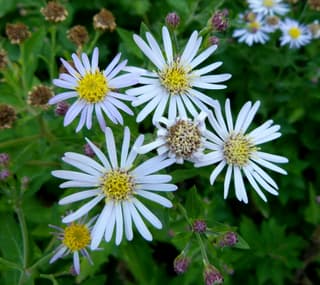
Wild Aster
Aster ageratoides
Aster ageratoides, the Asian aster, is a robust and hardy perennial from East Asia known for its late and abundant flowering. From late summer well into autumn, the plant is covered in a wealth of small, star-shaped flowers in shades of purple, blue, pink, or white with yellow centers. It has an upright growth habit with dark green, lance-shaped leaves that form a dense ground cover, and it thrives best in full sun to light shade. The plant is valued in horticulture for its low maintenance, but it is sensitive to wet, poorly drained soil, which can lead to root rot.
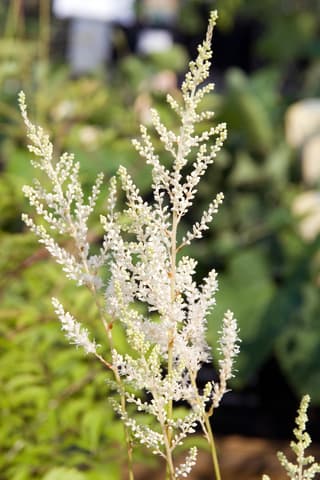
Japanese Astilbe
Astilbe japonica
Astilbe japonica, commonly known as Japanese Astilbe or False Goatsbeard, is a graceful rhizomatous herbaceous perennial native to Japan. It produces feathery, plume-like flower spikes in shades of white and pink above deeply divided, glossy dark green foliage. A beloved shade garden staple, it thrives in moist, organically rich soil and brings elegant texture and soft colour to woodland gardens, borders, and shaded landscapes from late spring into early summer.
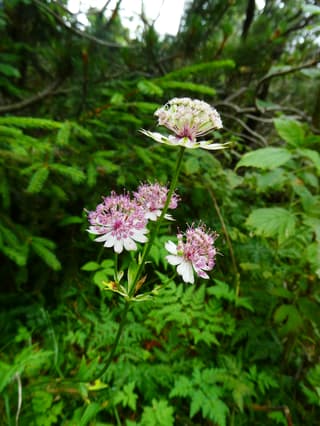
Great Masterwort
Astrantia major
Great Masterwort (Astrantia major) is a hardy perennial from the carrot family (Apiaceae), native to moist deciduous forests and stream banks of Central and Eastern Europe. The tiny, greenish-white flowers are surrounded by striking, star-shaped bracts in white, pink, green, or red, making the inflorescence resemble a small star-shaped umbrella. The plant forms compact clumps with 3- to 5-lobed leaves and blooms from June through September, making it a beloved addition to borders and cottage gardens.
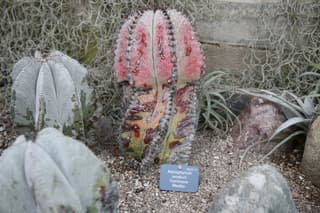
Monk's Hood Cactus
Astrophytum ornatum
The Monk's Hood Cactus (Astrophytum ornatum) is a slow-growing, typically solitary, columnar cactus native to Mexico, where it thrives on rocky terrain in full sun. The body reaches approximately 12 cm in diameter and can grow over one meter tall in its natural habitat; it features 7-8 spiraling ribs adorned with whitish to brownish spines and fine white scales. Starting at around five years of age, it produces large, vibrant yellow flowers over 7 cm in diameter, each lasting only a few days.
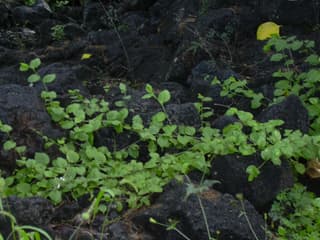
Chinese Violet
Asystasia gangetica
Asystasia gangetica, commonly known as Chinese violet or coromandel, is a fast-growing perennial herb in the family Acanthaceae, native to India and tropical Africa. This spreading groundcover reaches up to 1 meter tall when supported, producing delicate bell-shaped flowers in white, lilac, and purple throughout the year. It is widely cultivated in tropical and subtropical gardens for its ornamental value, vigorous growth, and ability to cover large areas quickly.
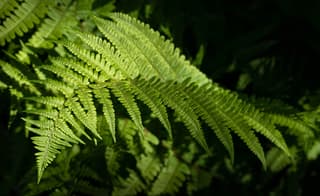
Lady Fern
Athyrium
Athyrium is a genus of around 180 deciduous ferns, best known through the widespread lady fern (A. filix-femina) and ornamental cultivars like the Japanese painted fern. Plants form graceful clumps of finely divided, lace-like fronds from a creeping or erect rhizome, thriving in shaded woodland conditions with consistently moist, humus-rich soil. They are generally trouble-free, cold-hardy, and popular for shade gardens, borders and pond margins.
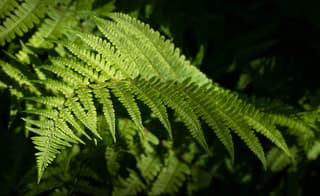
Lady Fern
Athyrium filix-femina
The Lady Fern (Athyrium filix-femina) is a deciduous, clump-forming woodland fern native across the cooler regions of Europe, Asia and North America. It produces finely divided, twice-pinnate fronds in a soft, lacy texture that arch outward from a central crown, giving the plant its graceful, feminine silhouette and common name. Fronds emerge pale green in spring, deepen through summer, and often turn gold before dying back at the first hard frost. Lady Fern spreads slowly by short rhizomes, gradually forming loose colonies in shaded woodland gardens, along stream banks, and in other consistently moist, humus-rich spots. It is exceptionally low-maintenance and largely free of serious pests or diseases when given the shaded, evenly moist conditions it evolved for.
Japanese Painted Fern
Athyrium niponicum
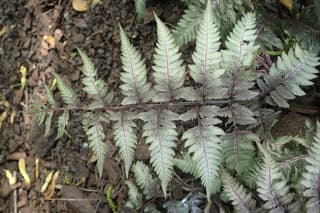
Athyrium niponicum, commonly known as Japanese painted fern, is a deciduous herbaceous fern native to eastern Asia, valued as one of the most ornamental and striking shade garden plants available. Its arching, triangular fronds reach up to 50 cm long and display a remarkable tricolor pattern: silvery-gray overlaid on soft green leaflets with a bold dark maroon midrib that runs the full length of each frond. The silvering is most intense on newly emerged spring fronds and softens to a deeper green as summer heat builds. Plants form a graceful, vase-shaped clump that spreads slowly through branching underground rhizomes, creating a lush colony effect over time without becoming invasive. Deer and rabbit resistant, it was named Perennial Plant of the Year by the Perennial Plant Association, confirming its exceptional landscape value.
Orache
Atriplex
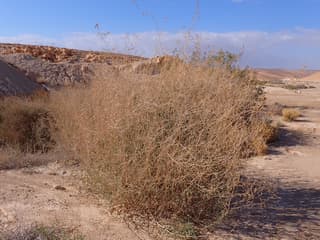
Atriplex, commonly known as Orache or Saltbush, is a resilient genus of plants found in arid and coastal regions. Many species, such as Atriplex hortensis, are cultivated as leaf vegetables similar to spinach. They are characterized by their mealy or scurfy leaves, which often have a silvery or purple hue, and their remarkable ability to thrive in saline soils where few other plants can survive.
Common Orache
Atriplex patula
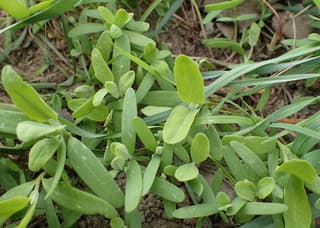
Common Orache (Atriplex patula) is an annual herb in the family Amaranthaceae, native to coastal margins, disturbed ground, and open fields across Europe, Asia, and North America. A facultative halophyte, it thrives in saline, sandy, and alkaline soils where few plants compete. Its arrowhead-shaped leaves are edible and have been used for centuries as a leafy green vegetable similar to spinach. Fast-growing and highly adaptable, it is valued both as a foraged wild food and as an indicator of nitrogen-rich, disturbed habitats.
Hastate Orache
Atriplex prostrata
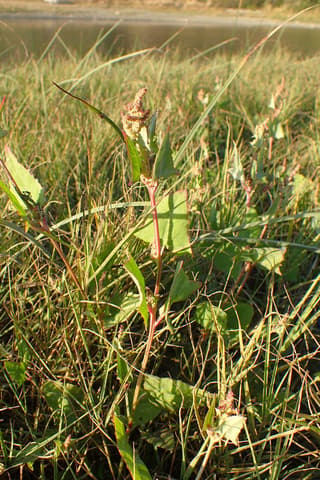
Atriplex prostrata, known as hastate orache or spear-leaved orache, is an annual halophytic herb in the Amaranthaceae family. Native to Europe, Macaronesia, North Africa and western Asia, it now grows across temperate regions worldwide in salt marshes, coastal beaches and disturbed saline ground. It forms sprawling to upright stems reaching up to 1 m, with distinctive hastate (spear- or arrowhead-shaped) leaves covered in tiny salt-excreting bladder hairs that let it thrive in brackish soils.
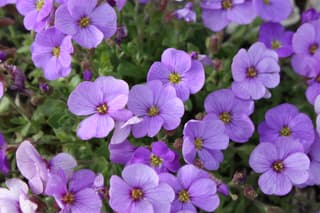
Rock Cress
Aubretia deltoidea
Aubretia deltoidea, commonly known as Rock Cress, is a low-growing evergreen perennial native to Southern Europe and Turkey. This mat-forming groundcover produces a spectacular carpet of purple, lavender, pink, or white flowers in spring, almost completely covering its grey-green foliage. It thrives in rocky, well-drained soils and is an ideal plant for rock gardens, wall crevices, and alpine borders.
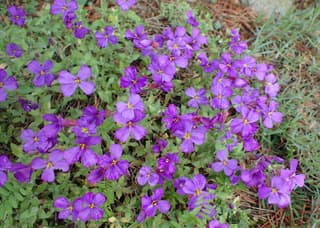
Aubrieta
Aubrieta deltoidea
Aubrieta is an evergreen, mat-forming perennial from the mustard family, originally native to Southeast Europe (including Greece, Bulgaria, and the Balkans). The plant forms dense, gray-green cushions of small, spatulate to egg-shaped leaves and is smothered in spring and early summer by numerous violet, purple, pink, or white four-petaled flowers. It is widely used as a groundcover in rock gardens, on walls, and on slopes, where it tolerates drought and poor soil better than most perennials.
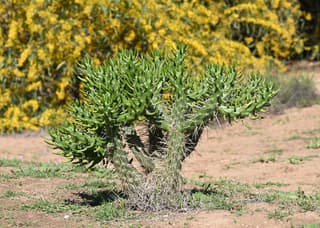
Eve's Pin Cactus / Cane Cholla (genus)
Austrocylindropuntia
Austrocylindropuntia is a genus of Andean columnar cacti native to South America, primarily Peru, Bolivia, and Ecuador. The most well-known species are A. subulata (Eve's Pin) and A. cylindrica (Cane Cholla). These are robust, fast-growing plants with cylindrical stems covered in sharp spines.
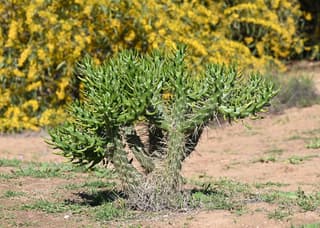
Eve's Needle Cactus
Austrocylindropuntia subulata
Austrocylindropuntia subulata, commonly known as Eve's Needle Cactus, is a columnar cactus native to the Peruvian Andes. Its dark green cylindrical stems can reach up to 4 meters in height in their natural habitat, and it is distinguished by its persistent needle-like leaves — a remarkable feature among cacti. This robust, drought-tolerant plant is highly ornamental and thrives in sunny gardens and bright indoor spaces.
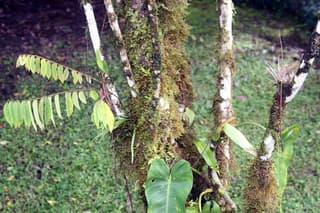
Bilimbi
Averrhoa bilimbi
Averrhoa bilimbi, commonly known as bilimbi or cucumber tree, is a tropical perennial fruit tree in the Oxalidaceae family. Unlike its close relative, the starfruit, its fruits are cylindrical, extremely acidic, and grow in clusters directly on the trunk and main branches (cauliflory). It features pinnate leaves and small, fragrant, deep purple flowers.
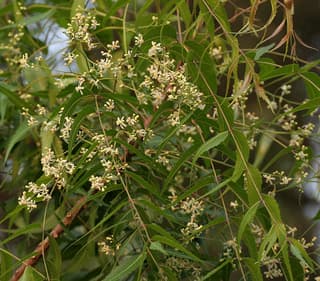
Neem
Azadirachta indica
Azadirachta indica, commonly known as Neem or Margosa, is a fast-growing evergreen tree native to the Indian subcontinent and Southeast Asia. Belonging to the mahogany family Meliaceae, it is one of the most versatile and celebrated trees in traditional medicine and sustainable agriculture. Neem can reach heights of 15–20 meters with a broad, spreading crown. Its small white fragrant flowers bloom in drooping clusters, and the olive-like fruits contain seeds rich in azadirachtin, the compound responsible for its powerful insecticidal properties.
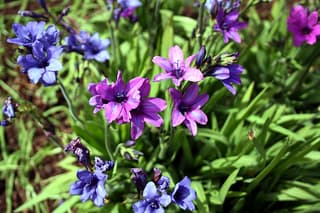
Baboon Flower
Babiana stricta
Babiana stricta, commonly known as the Baboon Flower or Blue Freesia, is a cormous perennial native to the Cape Province of South Africa. It produces beautiful blue, purple, or pink cup-shaped flowers in spring, rising from hairy, upright leaves. The plant grows 10–30 cm tall and is a popular garden ornamental in mild climates.
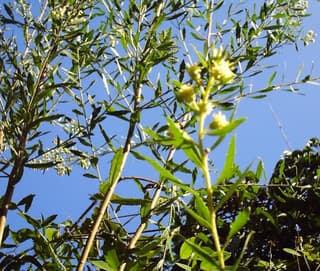
Field Rosemary
Baccharis dracunculifolia
Baccharis dracunculifolia, popularly known as field rosemary or vassourinha, is a shrub native to Brazil belonging to the Asteraceae family. It can reach up to 4 m in height, with thin, sparse, and aromatic branches, and small, lanceolate leaves, 1 to 2.5 cm long. It produces small white to slightly pink flowers, highly sought after by bees: it is one of the main botanical sources of Brazilian green propolis. It occurs naturally in Cerrado areas, rupestrian grasslands, forest edges, and degraded lands in South-Central Brazil, and is also used in the ecological restoration of degraded areas.
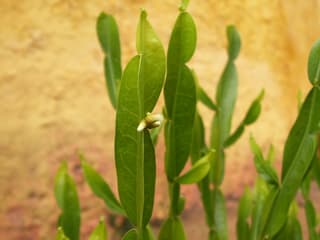
Carqueja
Baccharis trimera
Baccharis trimera, commonly known as Carqueja, is a fast-growing perennial shrub native to Brazil and South America. It is distinguished by its unique three-winged stems and is widely used in traditional South American medicine for its digestive, hepatoprotective, and anti-inflammatory properties. Small white flowers cluster at the stem tips during spring and summer, attracting pollinators.
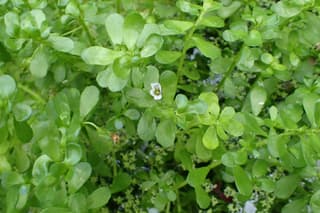
Water Hyssop
Bacopa monnieri
Bacopa monnieri, widely known as water hyssop or brahmi, is a creeping, succulent-leaved herb native to wetlands across Asia, including riverbanks, ponds and marshes in India, China and Vietnam. Its branching stems and small fleshy leaves form dense mats in moist soil, and the plant is also a popular aquarium species. In traditional Ayurvedic medicine it has been valued for centuries as a brain tonic for memory, focus and stress relief.
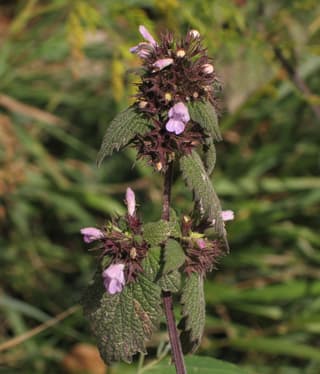
Black horehound
Ballota nigra
Black horehound (Ballota nigra) is a perennial herb in the mint family (Lamiaceae), originally native to the Mediterranean region and now widespread across Europe in roadside and wasteland plant communities. Its square, hairy stems and wrinkled, scalloped-toothed leaves emit a characteristic, unpleasant, musty odor when crushed — hence its genus name, which in Ancient Greek means 'repulsive' or 'rejected'. In summer and early autumn, pink-purple labiate flowers bloom in dense verticillasters, which fade to almost white after the first frosts. It often spreads in patches covering several square meters via underground rhizomes and overwinters well.
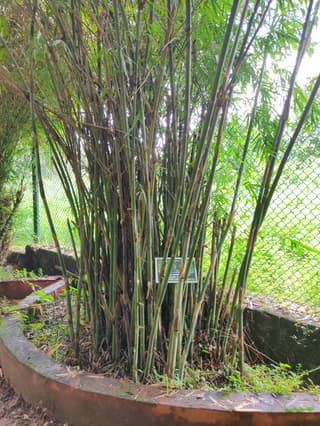
Hedge Bamboo
Bambusa multiplex
Hedge Bamboo (Bambusa multiplex) is a perennial grass known for its fast and dense growth, forming compact clumps. It features thin, flexible culms with vibrant green leaves that create a lush screen. It is a popular choice for landscaping, privacy hedges, and as an ornamental plant in pots.
Slender Weavers Bamboo
Bambusa textilis gracili
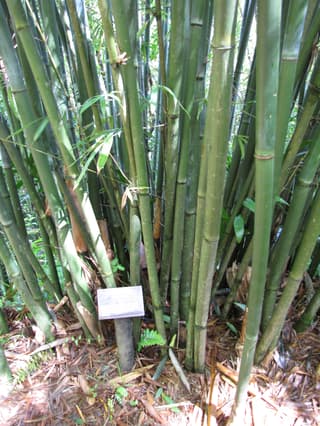
Slender Weavers Bamboo (Bambusa textilis gracili) is a clumping bamboo native to southern China, prized for its elegant, upright culms that can reach up to 9 meters tall. Unlike running bamboos, it forms compact, non-invasive clumps with culms up to 3 cm in diameter and a spread of only 2 meters. It is one of the most popular bamboos for privacy screens, hedges, and tropical garden landscaping worldwide. Its fast growth rate, low maintenance needs, and non-invasive root system make it an ideal choice for both residential and commercial gardens.
Buddha Belly Bamboo
Bambusa ventricosa
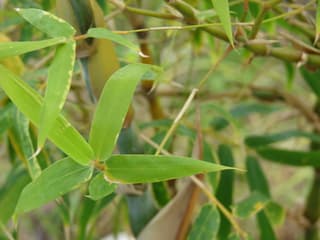
Buddha Belly Bamboo (Bambusa ventricosa) is a clumping bamboo native to China and Southeast Asia, celebrated for its distinctively swollen internodes resembling the rounded belly of the Buddha statue. This ornamental feature is most pronounced when the plant is grown in containers or under mild stress conditions. It is one of the most attractive bamboo species available, equally valued in gardens, patios, and as a bonsai subject.
Common Bamboo
Bambusa vulgaris
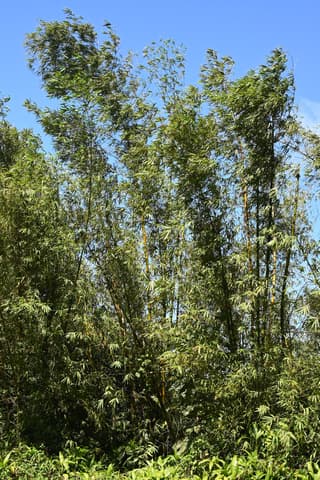
Bambusa vulgaris, commonly known as Common Bamboo or Golden Bamboo, is one of the most widely cultivated bamboo species in the world. Native to South and Southeast Asia, it has spread to tropical and subtropical regions across all continents. Its culms can reach up to 20 meters in height, featuring a characteristic yellow-green coloration. It is an extremely fast-growing, versatile, and resilient plant used in construction, landscaping, and food production.
Wintercress
Barbarea vulgaris
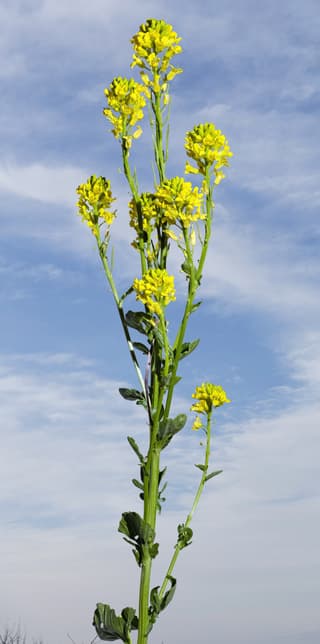
Wintercress (Barbarea vulgaris) is a biennial herbaceous plant in the Brassicaceae (mustard) family, native to Europe and widely naturalized across North America and beyond. It forms a basal rosette of dark, glossy, lobed leaves through autumn and winter, then sends up flowering stalks in early spring bearing clusters of bright yellow, four-petaled flowers. The young leaves have a pleasantly bitter, peppery flavor reminiscent of watercress or arugula and are one of the few fresh greens available during winter months. It grows in disturbed soils, roadsides, moist meadows, and stream banks, and is valued both as a wild edible and for its early-season nectar for pollinators.
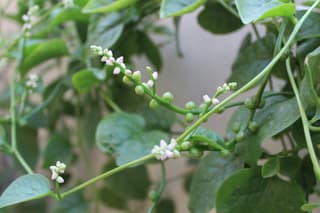
Malabar Spinach
Basella alba
Malabar Spinach (Basella alba) is a fast-growing tropical edible vine native to India and Southeast Asia. Its thick, succulent leaves are rich in vitamins A and C, calcium, and iron, making it a nutritious leafy green for warm climates. It thrives in heat and humidity where traditional spinach fails.
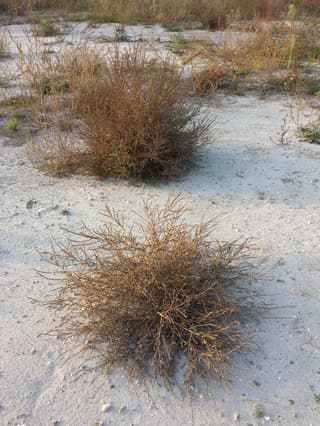
Burningbush
Bassia scoparia
Burningbush (Bassia scoparia) is a fast-growing annual herb native to Eurasia. It forms a dense, symmetrical mound of fine, bright green foliage that turns brilliant red or purple in autumn, creating a spectacular seasonal display. Widely grown as an ornamental in gardens and borders.
Easy Care Pet Safe
Our selection of 1446 easy pet safe combines the characteristics of this category with reduced care needs. Perfect for beginners who love this category.
Why Choose Easy Pet Safe?
Combining the beauty of pet safe with easy difficulty level lets you enjoy this category without excessive maintenance worries. Each plant was selected to offer the best characteristics of the category at the care level you are looking for.