2315 Easy Plants | 2026 Guide - Page 10
Discover 2315 easy plants for your garden. Complete care guide.
2315 Easy Plants
Showing 325-360 of 2315
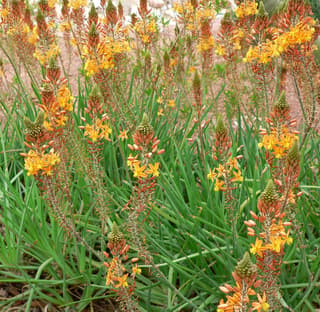
Burn Jelly Plant
Bulbine frutescens
Bulbine frutescens, commonly called the burn jelly plant, is a fast-growing, clump-forming succulent perennial from South Africa. Its narrow, fleshy, onion-like leaves radiate from a low rosette, while airy spikes of star-shaped yellow-to-orange flowers rise well above the foliage from spring through fall. Tough, drought-tolerant, and virtually pest-free, it thrives as a groundcover, border edging, or rockery accent in warm, sunny gardens.

Hare's Ear
Bupleurum
Bupleurum is a genus of about 180 species in the carrot family (Apiaceae), ranging from delicate annual wildflowers to woody Mediterranean shrubs. The most widely cultivated members are the ornamental hare's ear (Bupleurum rotundifolium), prized by florists for its chartreuse, cup-shaped bracts, and the East Asian medicinal species B. falcatum and B. chinense, whose dried roots are known in Traditional Chinese Medicine as 'chai hu.' Plants form airy clumps of blue-green, rounded leaves topped by flat umbels of tiny yellow-green flowers from summer into fall.
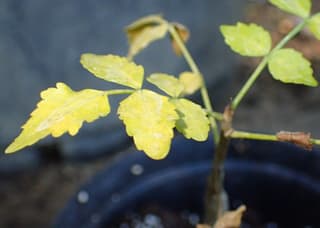
Fragrant Bursera
Bursera fagaroides
Bursera fagaroides, known as the fragrant bursera or elephant tree, is a deciduous shrub or small tree in the Burseraceae family, native to arid and semi-arid regions of Mexico, from Sonora to Oaxaca. It is recognized by its thick, sculptural (pachycaul) trunk and papery bark in reddish, gray or yellowish tones that peels away in layers to reveal a grey-green surface beneath. Its pinnate leaves, made up of several leaflets, release a citrus scent when crushed. In spring it produces small creamy-white flowers, sometimes tinged yellow or green. It is one of the most prized Bursera species in bonsai cultivation for its gnarled trunk and exfoliating bark.
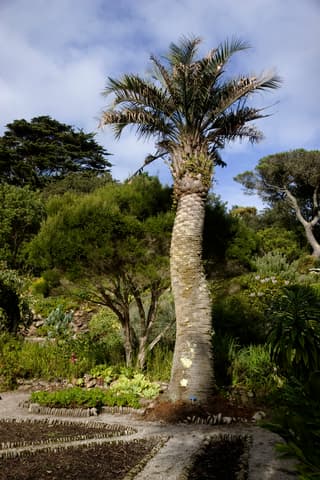
Pindo Palm
Butia capitata
Butia capitata, commonly known as the Pindo Palm or Jelly Palm, is a slow-growing feather palm native to southern Brazil, Uruguay, and Argentina. It is prized for its graceful blue-gray arching fronds and clusters of edible orange-yellow fruits used to make jellies and wines.
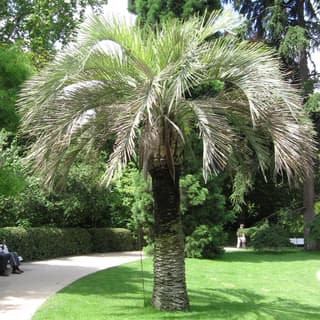
Jelly Palm
Butia odorata
Butia odorata, commonly known as the Jelly Palm or Pindo Palm, is a hardy feather palm native to the grasslands of southern Brazil, Uruguay, and Argentina. It is one of the most cold-tolerant palms in the world, withstanding temperatures as low as -12°C (10°F). Its arching blue-green fronds and clusters of edible orange-yellow fruits make it a prized ornamental and edible landscape tree.
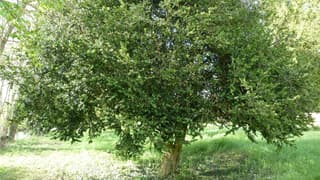
Boxwood
Buxus
Boxwood (Buxus) is an evergreen shrub in the Buxaceae family, prized for formal hedging, borders and topiary. Slow-growing with small, dense leaves, it tolerates heavy shearing and holds its shape for decades.
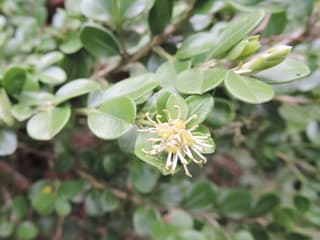
Japanese Boxwood
Buxus microphylla
Japanese Boxwood (Buxus microphylla) is a slow-growing, evergreen shrub native to Japan and Korea, prized for its dense, compact mounding habit and small, glossy dark green leaves. It is one of the most versatile shrubs in formal horticulture, widely used for hedges, borders, topiary, and foundation plantings. In spring it produces small, fragrant cream-yellow flowers. Remarkably long-lived and cold-hardy, it thrives in USDA zones 6–9.
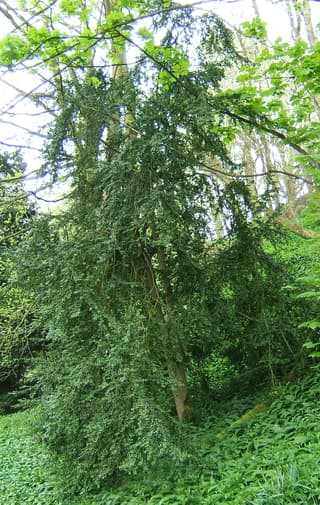
Common boxwood
Buxus sempervirens
Buxus sempervirens, commonly known as common boxwood or European box, is a slow-growing evergreen shrub or small tree native to southern Europe, northern Africa, and western Asia. Its dense, glossy, dark-green foliage makes it one of the most prized plants for formal gardens, hedging, and topiary. It can reach up to 5 metres in height under ideal conditions and is renowned for its exceptional longevity — some specimens live for centuries. Despite its ornamental appeal, all parts of the plant are toxic to humans and animals.
Cactus
Cactaceae
Cactaceae is a family of succulent plants adapted to arid environments. They are distinguished by the presence of areoles, from which spines, branches, and flowers grow. Most species have thickened, photosynthetic stems that store water, allowing them to survive in conditions of extreme drought.
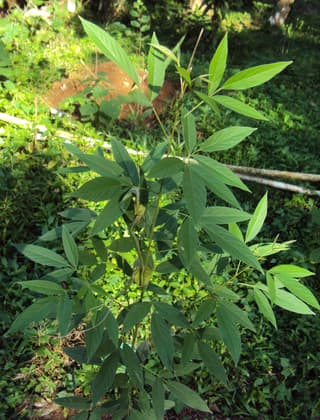
Pigeon pea
Cajanus cajan
The pigeon pea (Cajanus cajan) is a fast-growing, semi-perennial leguminous shrub, native to India or Africa and cultivated for over 3,000 years. It reaches between 1 and 3 meters in height, featuring trifoliate leaves and yellow flowers—sometimes with reddish streaks—that give way to pods containing 2 to 9 edible seeds. Thanks to its deep taproot and nitrogen-fixing capacity, it tolerates poor soils and drought periods, making it a key crop in tropical and subtropical agriculture.
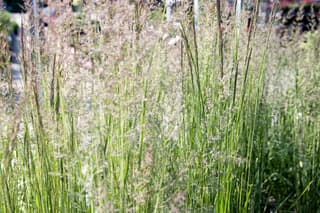
Feather Reed Grass
Calamagrostis x acutiflora
Feather Reed Grass 'Karl Foerster' is a perennial grass that forms a dense, upright clump of fresh green leaves. From June to August, slender, golden-brown spikes rise above the foliage and remain upright well into winter, providing structure and movement to winter garden beds. The variety is a sterile hybrid between Calamagrostis arundinacea and Calamagrostis epigejos and therefore does not set seed - it does not spread unwantedly in the garden. With its striking, columnar growth, it is one of the most popular ornamental grasses for contemporary perennial beds.

Furry Feather Calathea
Calathea rufibarba
Calathea rufibarba, now botanically reclassified as Goeppertia rufibarba, is a Brazilian rainforest native prized for its long, slender, wavy leaves. The upper leaf surface is a glossy dark green while the underside is a deep maroon-purple, and both the stalks and leaf undersides are covered in a fine, hair-like fuzz that gives the plant its 'furry feather' and 'velvet' nicknames.
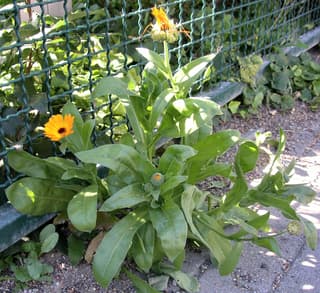
Pot Marigold
Calendula officinalis
Pot marigold (Calendula officinalis) is an annual plant native to the Mediterranean region, widely cultivated for its vibrant flowers in shades of orange, yellow, and cream. Belonging to the Asteraceae family, it is one of the oldest and most versatile medicinal herbs in the world, used since the Middle Ages for healing, culinary, and ornamental purposes. Its edible flowers bloom from spring to fall and attract beneficial pollinators to the garden.
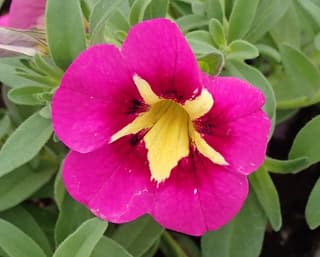
Million bells
Calibrachoa
Calibrachoa, commonly known as Million Bells, is a prolific bloomer featuring hundreds of small, petunia-like flowers. These compact, trailing plants are popular for hanging baskets and containers due to their vibrant colors and self-cleaning nature, meaning they do not require deadheading to continue blooming throughout the season.
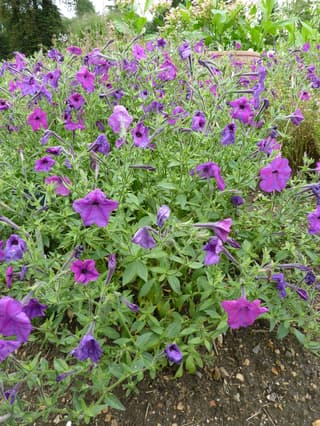
Seaside Petunia
Calibrachoa parviflora
Calibrachoa parviflora, commonly known as Seaside Petunia, is a small, trailing wildflower native to coastal and riparian habitats across Mexico, Central America, and South America. It produces tiny bell-shaped flowers under 1 cm wide, usually purple with a pale throat. It is the wild ancestor of modern garden Calibrachoa hybrids (million bells). The plant creeps along the ground, rooting at nodes, and thrives in moist, well-drained soils near streams and open slopes.
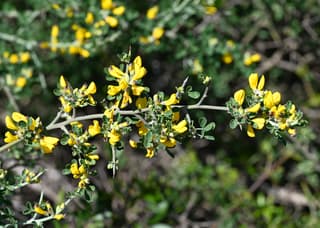
Hairy Thorny Broom
Calicotome villosa
The hairy thorny broom (Calicotome villosa) is a thorny evergreen shrub in the Fabaceae family, typical of the Mediterranean maquis and coastal garrigue. It grows between 1 and 3 meters in height with intricate, rigid branches ending in sharp spines; the leaves are trifoliate with oval, densely pubescent leaflets. In spring (from January to April), it is covered with vibrant, intense yellow flowers that are highly fragrant and gathered in small clusters of 6–15. The fruits are hairy legumes 2–4 cm long. The plant is nitrogen-fixing thanks to symbiotic bacteria in its roots, helping to renew poor and degraded soils. It resists salt winds, prolonged drought, and short frosts down to -10 °C (14 °F).
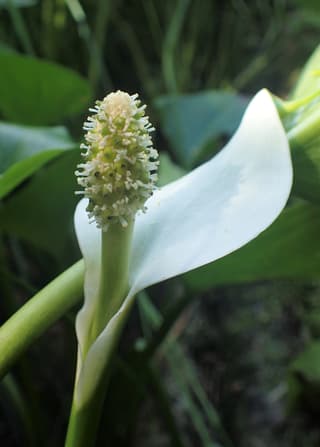
Bog Arum
Calla
Bog Arum (Calla palustris) is a rhizomatous, herbaceous perennial native to cold bogs, marshes, and lake margins across the Northern Hemisphere. It should not be confused with the common calla lily (Zantedeschia aethiopica). It has glossy, heart-shaped dark green leaves and a white spathe surrounding a small yellowish-green spadix, followed by clusters of red berries.

Powder Puff
Calliandra
Calliandra is a genus of roughly 140 shrub and small-tree species in the pea family (Fabaceae), native to the tropical and subtropical Americas. Grown for its striking pom-pom flowers made of hundreds of long, silky stamens, Calliandra is a fast-growing, evergreen ornamental prized in warm gardens and as a hummingbird magnet.
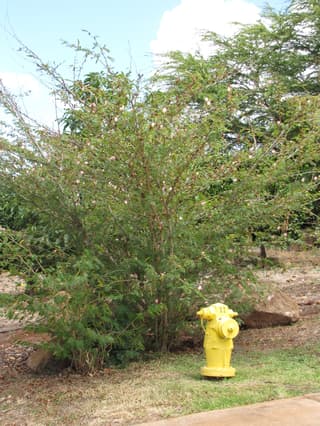
Surinam powderpuff
Calliandra surinamensis
The Surinam powderpuff (Calliandra surinamensis) is an evergreen tropical shrub or small tree from the legume family (Fabaceae), native to northern South America—Suriname, Brazil, Guyana, Venezuela, Colombia, Ecuador, Bolivia, French Guiana, and Peru. It features delicate, bipinnate leaves composed of tiny leaflets that close and droop at night. It is characterized by striking flowers resembling pink-and-white powderpuffs, consisting of up to a hundred silky stamens—white at the base and pink at the tips. It grows rapidly, reaching a height of approximately 11 to 15 feet with a similar spread, and enriches the soil through its ability to fix atmospheric nitrogen, a trait typical of leguminous plants.
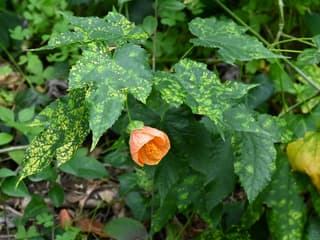
Painted Abutilon
Callianthe picta
Callianthe picta, commonly known as Painted Abutilon or Brazilian Bell Flower, is a fast-growing evergreen shrub native to Brazil and South America. A member of the Malvaceae family, it is prized for its stunning pendulous bell-shaped flowers in vibrant orange with distinctive red veining. It blooms prolifically from spring through fall, making it a favorite for gardens and patios.
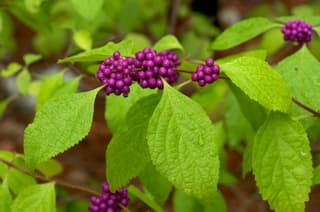
American beautyberry
Callicarpa americana
The American beautyberry (Callicarpa americana) is a deciduous shrub with an arching habit, native to the southeastern United States. It is highly prized for the striking contrast between its green foliage and the dense clusters of vibrant violet berries that cover its stems from late summer through winter. In spring and early summer, it produces small, inconspicuous lilac or white flowers that attract bees and butterflies before giving way to the famous berries, which are a vital food source for birds and other wildlife. It is a low-maintenance, heat-resistant plant that tolerates various soil types, making it ideal for pollinator gardens and naturalized landscapes.
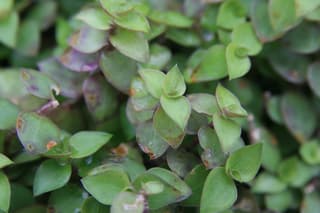
Inch Plant
Callisia
Callisia is a genus of fast-growing trailing succulents from the Commelinaceae family, native to Mexico, Central America, and the Caribbean. Their small oval leaves — green or tinged pink-purple in cultivars — cascade beautifully from hanging baskets or spread as ground cover. One of the easiest houseplant genera to maintain, thriving with minimal care and tolerating a range of indoor conditions.
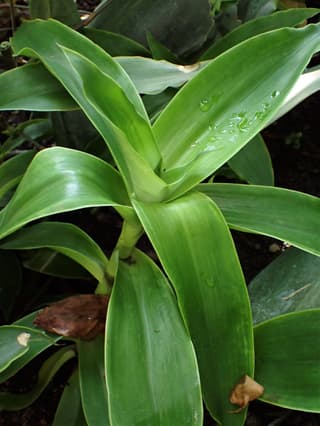
Basket Plant
Callisia fragrans
Callisia fragrans is a fast-growing tropical ornamental plant native to Mexico. Its long, arching leaves grow in rosette formations resembling bromeliads, making it ideal for hanging baskets and indoor spaces. In spring, it may produce small, fragrant white flowers.
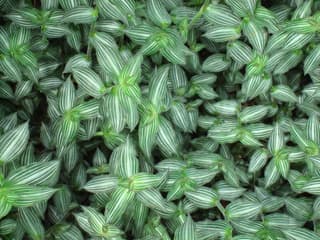
Chain Plant
Callisia gentlei
Callisia gentlei is a trailing, evergreen subshrub in the spiderwort family (Commelinaceae), native to the humid tropical forests of southern Mexico, Guatemala, Belize, and Honduras. Grown for its lush, glossy foliage and cascading habit, it thrives in a hanging basket or on a shelf where its stems can spill over the edge.

Chain Plant
Callisia navicularis
Callisia navicularis, commonly known as the Chain Plant, is a low-growing succulent-like perennial in the spiderwort family (Commelinaceae), native to Mexico. Its small, boat-shaped (navicular) leaves are densely arranged along creeping stems, forming tight mats or trailing chains that cascade attractively from hanging baskets. Leaf color shifts from soft green in shade to striking purplish-bronze under bright light, and short-lived three-petaled purple-pink flowers appear in spring and summer.
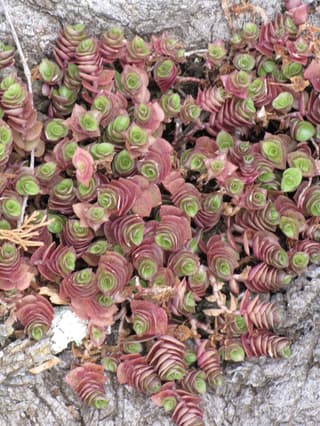
Turtle Vine
Callisia repens
Callisia repens, commonly known as Turtle Vine or Creeping Inch Plant, is a fast-growing trailing succulent from the Commelinaceae family, native to Central and South America. Its small, oval, fleshy leaves in deep green with purple undersides form dense, attractive mats. It is one of the easiest houseplants to grow, perfect for hanging baskets and as ground cover.
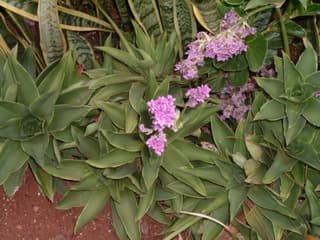
Basket Plant
Callisia warszewicziana
Callisia warszewicziana is a low-growing, evergreen perennial from the Commelinaceae family, native to Central America. Reaching only about 15 cm in height, it spreads readily via creeping stems and stolons, making it an ideal groundcover or hanging basket plant. In summer, it produces small white to pink flowers with yellow centers. It is valued as an ornamental plant and has traditional medicinal uses in its native region.
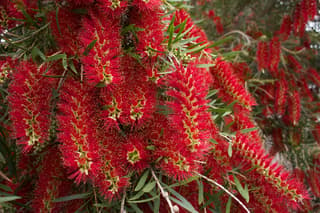
Weeping Bottlebrush
Callistemon viminalis
Callistemon viminalis, commonly known as the Weeping Bottlebrush, is a small tree or large shrub native to Australia. It is characterized by its pendulous branches and vibrant red cylindrical flower spikes that resemble bottle cleaning brushes. It is an extremely hardy plant, highly valued in landscaping for attracting pollinators, especially hummingbirds.
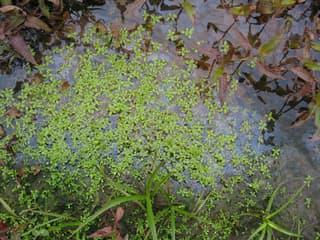
Pond Water-starwort
Callitriche stagnalis
Callitriche stagnalis, commonly known as Pond Water-starwort, is a delicate aquatic plant native to Europe and naturalized worldwide. It thrives in ponds, slow-moving streams, and waterlogged areas, forming attractive floating mats of bright green star-shaped leaf rosettes on the water surface. It is an excellent oxygenator for garden ponds and aquariums.
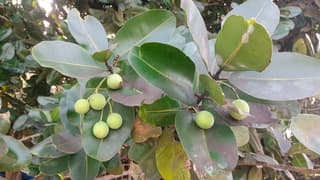
Beautyleaf / Alexandrian Laurel (genus)
Calophyllum
Calophyllum is a large genus of tropical trees in the family Calophyllaceae, known for their dense foliage, fragrant flowers, and timber value. Many species are used in coastal restoration and agroforestry systems.
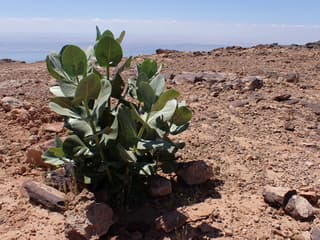
Giant Milkweed (genus)
Calotropis
Calotropis is a genus of tropical and subtropical shrubs in the family Apocynaceae, native to Africa, the Middle East, and Asia. It includes species such as C. procera (apple of Sodom) and C. gigantea (crown flower). All parts exude a milky latex containing cardiac glycosides, making the plant severely toxic.
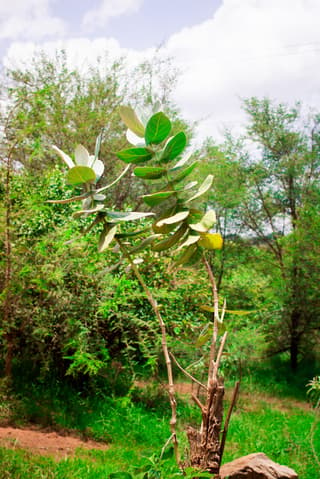
Sodom apple
Calotropis procera
A tall, evergreen, drought-tolerant shrub native to North Africa, the Middle East and South Asia, prized for its silvery-grey leaves, clusters of waxy white flowers tipped in purple, and inflated seed pods. Every part of the plant exudes a thick, milky latex that is highly toxic and can cause severe skin and eye irritation.
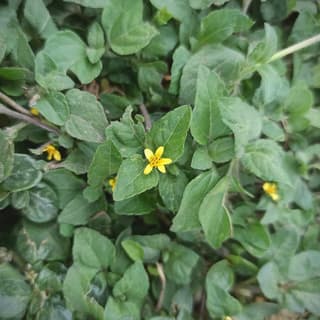
straggler daisy
Calyptocarpus vialis
Calyptocarpus vialis, commonly known as straggler daisy or horseherb, is a prostrate, mat-forming perennial native to the Southern United States and Mexico. It features small, opposite, serrated leaves and tiny yellow daisy-like flowers. It is highly valued as a native lawn alternative due to its ability to thrive in deep shade where most grasses fail, and its resilience to light foot traffic.
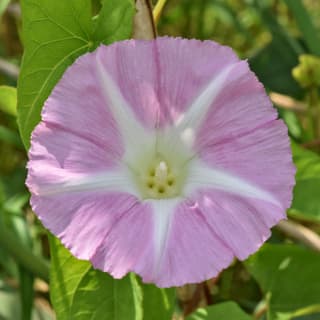
Bindweed / False Bindweed (genus)
Calystegia
Calystegia is a genus of herbaceous vining perennials in the family Convolvulaceae, closely related to morning glories (Ipomoea). Well-known species include C. sepium (hedge bindweed) and C. soldanella (beach morning glory). They are fast-growing climbers, often weedy or invasive in temperate gardens.
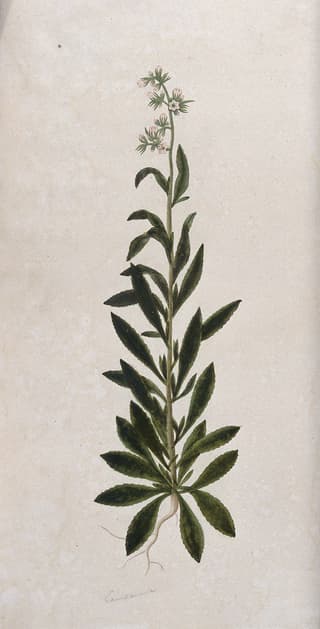
Bellflower
Campanula
Bellflower (Campanula) is a genus of approximately 500 flowering plant species in the family Campanulaceae, named for their distinctive bell-shaped blooms. Species range from low-growing ground covers to tall perennials, bearing flowers in shades of blue, purple, violet, white, and pink. Widely cultivated as ornamental plants in gardens and containers worldwide.
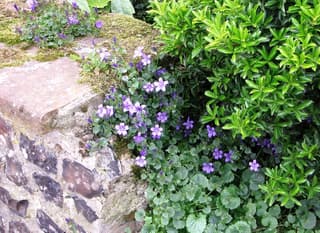
Dalmatian Bellflower
Campanula muralis
The Dalmatian Bellflower (Campanula portenschlagiana, still widely sold as Campanula muralis) is a vigorous, mat-forming evergreen perennial native to the rocky mountains of Dalmatia, Croatia. It produces a dense carpet of small, heart-shaped leaves smothered in purple-blue, star-shaped bells from late spring through summer. Prized for rock gardens, walls, and container edges, it is remarkably easy-going once established.
What are Easy Plants?
Easy Plants are ideal for beginners or people with little time for care. These species are tolerant of watering mistakes, light variations, and don't require constant attention. Perfect for those just starting out with plants.
Tips for Growing Easy Plants
To succeed with easy plants, remember: less is more. Avoid overwatering, choose a spot with adequate light, and let the soil dry between waterings. Most of these plants prefer to be 'forgotten' occasionally.