2320 Easy Plants | 2026 Guide - Page 52
Discover 2320 easy plants for your garden. Complete care guide.
2320 Easy Plants
Showing 1837-1872 of 2320
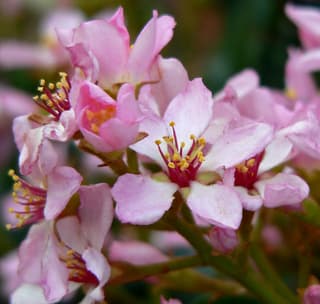
Indian Hawthorn
Rhaphiolepis
Indian Hawthorn (Rhaphiolepis) is an evergreen shrub in the Rosaceae family, native to southern China and Southeast Asia. Despite its common name, it does not originate from India. It produces clusters of fragrant white to pink flowers in spring and is widely cultivated as an ornamental plant for hedges, borders, and mass plantings.
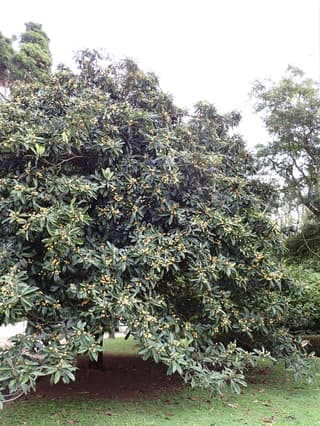
Loquat
Rhaphiolepis bibas
The loquat (Rhaphiolepis bibas, formerly Eriobotrya japonica) is an evergreen fruit tree native to Southeast China, widely cultivated in subtropical and Mediterranean regions worldwide. It reaches a height of 3 to 8 meters and is distinguished by its large, leathery, dark green leaves, its white, fragrant flowers that appear in autumn-winter, and its orange or yellow fruits that ripen in spring. It is one of the few fruit trees that blooms in winter, providing shelter and food for pollinators and birds during the cold months.
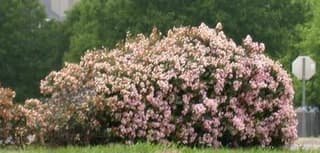
Indian Hawthorn
Rhaphiolepis indica
Indian hawthorn (Rhaphiolepis indica) is a compact, evergreen shrub native to southern China, Taiwan, and Vietnam, prized in gardens worldwide for its glossy dark-green foliage and clusters of fragrant white to pink, five-petaled flowers that bloom in spring and often again in fall. Reaching about 1.2-1.5 m (4-5 ft) in height and spread, it forms a dense, rounded mound that works well as a low hedge, foundation planting, or specimen shrub. Small blue-black pome fruits follow the flowers and are attractive to birds. The plant is a member of the rose family (Rosaceae) and, once established, tolerates heat, coastal salt spray, and moderate drought, making it a popular low-maintenance choice for warm-temperate and subtropical landscapes.
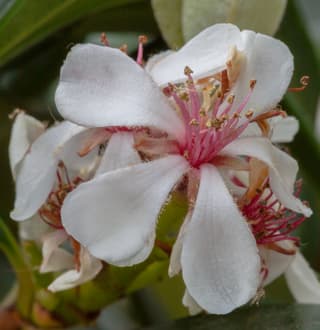
Yeddo Hawthorn
Rhaphiolepis umbellata
Rhaphiolepis umbellata, commonly known as Yeddo Hawthorn, is an evergreen shrub native to Japan and Korea, highly valued in coastal gardens for its remarkable tolerance to salt spray and wind. It features oval, leathery, glossy dark green leaves that often take on purple hues in winter. Between spring and early summer, it produces dense clusters of fragrant white or slightly pink flowers, followed by decorative blue-black berries. It is a hardy, slow-growing plant that typically reaches 3 to 6 feet in height and width.

Lady Palm
Rhapis excelsa
Rhapis excelsa, commonly known as the Lady Palm or Broadleaf Lady Palm, is an elegant fan palm native to southern China. With its slow growth and lush fan-shaped foliage, it is one of the best indoor palms for beginners. Its multiple slender stems covered in brown fibers give it a bamboo-like appearance, making it an excellent decorative choice for indoor spaces. NASA studies have recognized it as one of the top air-purifying plants.
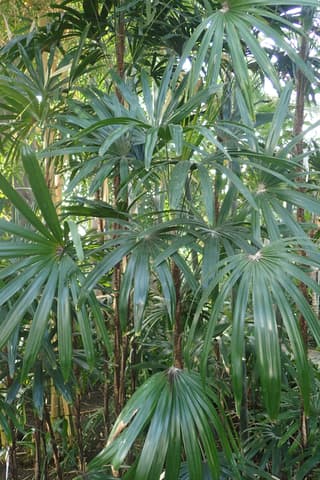
Slender Lady Palm
Rhapis humilis
Rhapis humilis, commonly known as the Slender Lady Palm or Reed Rhapis, is a clumping understory palm native to the subtropical forests of South China (Yunnan). It forms dense clusters of slender, bamboo-like stems topped with elegant fan-shaped fronds with narrow, finger-like segments. Slower growing than its cousin Rhapis excelsa, it is widely cultivated as both an indoor ornamental and a garden accent plant in warm climates.
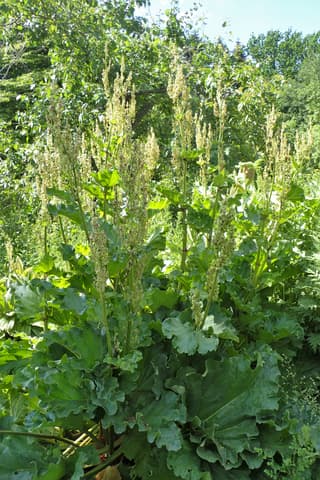
garden rhubarb
Rheum rhabarbarum
Garden rhubarb is a hardy perennial plant grown for its fleshy, tart edible stalks. It features large, heart-shaped green leaves that are toxic if ingested due to high concentrations of oxalic acid. The plant requires a cold winter dormancy period to produce a successful harvest in the following spring.
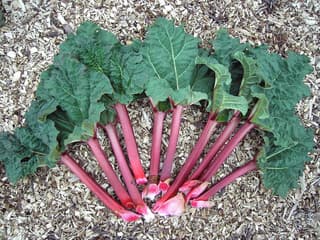
Garden Rhubarb
Rheum x hybridum
Garden rhubarb is a robust, cold-hardy perennial vegetable prized for its thick, tart, ruby-to-green stalks and enormous crinkled leaves. Though often used like a fruit in pies and jams, it is botanically a vegetable in the buckwheat family. The plant forms a dense clump from a woody rhizome and, if not removed, sends up tall flower stalks topped with creamy white plumes in late spring. Only the stalks are eaten -- the leaves contain high levels of oxalic acid and must never be consumed.
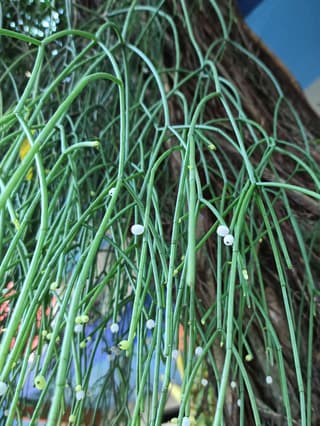
Mistletoe Cactus
Rhipsalis
Rhipsalis is a genus of epiphytic tropical cacti native to the rainforests of Central and South America, with a few species found in Africa and Sri Lanka — the only cacti native outside the Americas. Unlike desert cacti, Rhipsalis grows on trees and rocks in humid tropical forests, thriving under filtered light with regular moisture and high humidity. Its slender, pendulous, segmented stems resemble spaghetti or mistletoe strands, giving rise to its most popular common names. It produces small white or cream flowers in late winter to spring, followed by translucent pearl-like berries. Exceptionally long-lived (25+ years), and confirmed non-toxic to cats, dogs, and humans by the ASPCA.
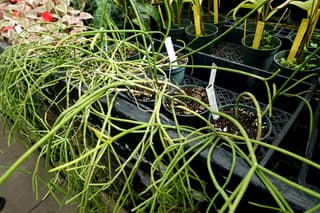
Mistletoe cactus
Rhipsalis baccifera
Rhipsalis baccifera is a unique epiphytic cactus native to Central and South America. Unlike typical desert cacti, this tropical cactus grows on trees in humid forests, hanging gracefully with cylindrical, branching stems that can reach up to 4 meters in length. It is the only cactus species found naturally outside the Americas, extending to Africa and Asia.
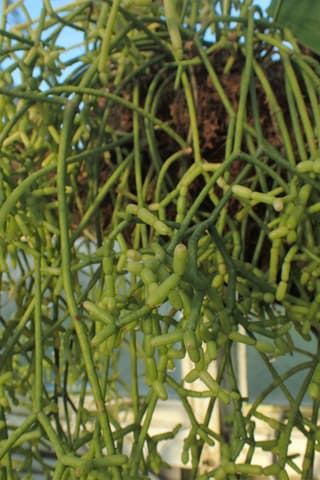
Rice Cactus
Rhipsalis cereuscula
Rhipsalis cereuscula, commonly known as Rice Cactus or Coral Cactus, is an epiphytic cactus native to the Brazilian Atlantic Forest. It features thin, segmented stems that branch profusely into small cylindrical segments resembling grains of rice or coral, giving the plant a delicate, cascading appearance ideal for hanging baskets.

Bride Cactus
Rhipsalis elliptica
Rhipsalis elliptica, commonly known as the Bride Cactus, is a trailing epiphytic cactus native to the humid tropical forests of Brazil. Unlike its desert-dwelling cousins, this jungle cactus grows without spines on trees and rocks, cascading with flat, paddle-shaped (elliptical) segments that can trail up to 2 meters long. Its stems display a rich dark green color, often blushed with purple or magenta under bright light, and in late winter to early spring it produces small, creamy white to pale yellow flowers scattered along the stem margins.
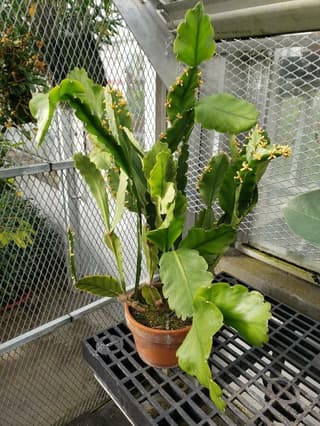
Jungle Cactus
Rhipsalis pachyptera
Rhipsalis pachyptera is a spineless epiphytic cactus native to the Atlantic Forest of southeastern and southern Brazil (Espírito Santo, Rio de Janeiro, São Paulo, Paraná, Santa Catarina and Rio Grande do Sul). In the wild it grows on tree trunks and moist rocks, producing broad, flattened, wavy-edged stems that trail up to 1.5 m long. Creamy-white to yellowish flowers appear in winter, followed by small translucent berries.
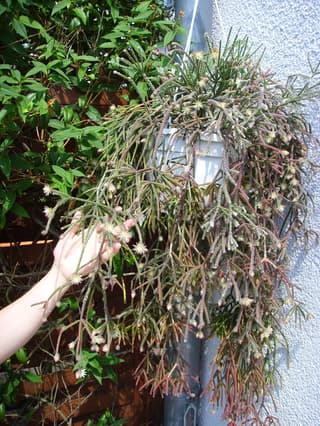
Hairy-stemmed Rhipsalis
Rhipsalis pilocarpa
Rhipsalis pilocarpa, commonly called the hairy-stemmed rhipsalis, is an epiphytic cactus endemic to Brazil's Atlantic Forest, native to the states of Espírito Santo, Minas Gerais, Rio de Janeiro, São Paulo, and Paraná. In the wild it grows harmlessly on tree trunks and branches, absorbing moisture and nutrients from humid forest air and organic debris rather than from soil. Its slender cylindrical stems, reaching up to 50 cm long, start upright and become pendant as they mature, covered in small gray-to-white bristles that give the plant a soft, fuzzy texture. Fragrant white flowers 2.5 to 4 cm wide appear from fall into early winter, followed by bristly, wine-red spherical fruits about 12 mm across. Unlike desert cacti, this forest species thrives in filtered light and higher humidity, reflecting its origins beneath the rainforest canopy.
Mistletoe Cactus
Rhipsalis teres
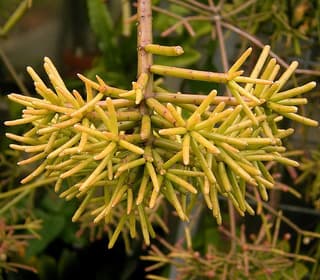
Rhipsalis teres, commonly known as Mistletoe Cactus, is a tropical epiphytic cactus native to southeastern and southern Brazil. Its slender, cylindrical, trailing stems cascade beautifully from hanging baskets, making it a popular houseplant. Unlike desert cacti, it thrives in humid, shadier conditions that mimic its natural rainforest habitat, where it grows anchored to tree branches.
Everlasting Daisy
Rhodanthe chlorocephala
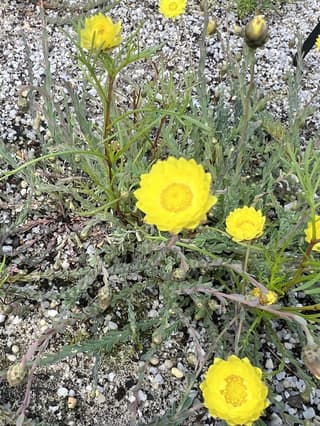
The Everlasting Daisy (Rhodanthe chlorocephala) is a popular Australian annual from the Asteraceae family, prized for its papery flower heads that retain their shape and color after drying. The plant grows to approximately 30 cm and produces upright stems with narrow, grey-green leaves. The flower heads, 1-6 cm in diameter, feature white, pink, or yellow ray bracts with a contrasting yellow-green or dark center. In its natural habitat in Western and South Australia, it grows in the sandy soils of eucalyptus forests and salt lakes, where it blooms primarily from late winter to spring.

Moroccan Daisy
Rhodanthemum hosmariense
Rhodanthemum hosmariense is a low, spreading evergreen subshrub from the Atlas Mountains of Morocco, prized for its finely divided silvery foliage and a long, generous display of white daisy-like flowers with sunny yellow centres. It forms a neat, wide mound rarely more than 30 cm tall, making it a favourite for rock gardens, gravel gardens and the front of sunny borders.
Rose Cactus
Rhodocactus grandifolius
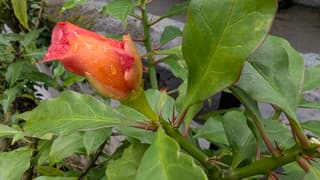
Rhodocactus grandifolius, formerly known as Pereskia grandifolia, is a fascinating primitive cactus that possesses true, persistent leaves, unlike most cacti. Native to Brazil, it grows as a shrub or small tree, featuring long spines on its woody stems and stunning rose-like flowers, typically in shades of intense pink or magenta.
Sumac
Rhus
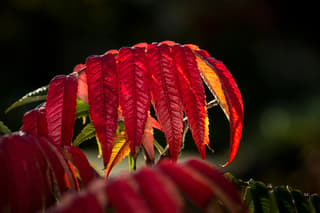
Sumac (Rhus) is a genus of approximately 35 species of shrubs and small trees in the family Anacardiaceae, distributed across temperate and subtropical regions of the Northern Hemisphere. They are celebrated for their spectacular autumn foliage, which transitions from green to brilliant shades of orange, red, and scarlet — among the most vibrant fall colors of any woody plant. Some species like Rhus typhina (staghorn sumac) grow as large multi-stemmed shrubs or small trees, while others like R. aromatica serve as ground cover. Note: R. radicans (poison ivy) has been reclassified to the genus Toxicodendron.
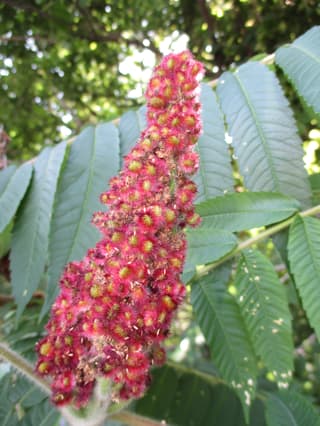
Staghorn Sumac
Rhus typhina
Staghorn Sumac (Rhus typhina) is a fast-growing, deciduous large shrub or small tree native to eastern North America. Named for its velvety, antler-like branches that resemble deer velvet, it is celebrated for its spectacular fall foliage in shades of scarlet, orange, and yellow, and for its striking upright clusters of fuzzy crimson berries that persist through winter. A champion of tough conditions, it thrives in poor, rocky soils and is highly drought-tolerant once established.
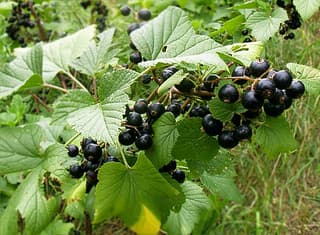
Blackcurrant
Ribes nigrum
Blackcurrant (Ribes nigrum) is a deciduous shrub native to temperate parts of central and northern Europe and northern Asia. It produces small, glossy black berries in pendant clusters, renowned for their exceptionally high vitamin C content and intense tart flavour. Widely grown for culinary and medicinal purposes, it thrives in cool climates with cold winters.
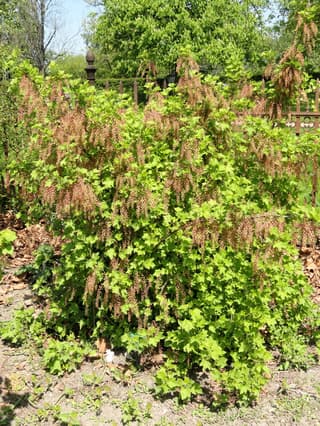
Downy Currant
Ribes spicatum
Ribes spicatum, commonly known as the downy currant or Nordic currant, is a deciduous shrub native to the boreal forests of northern Europe and northern Asia, from Scandinavia across Russia to Siberia and Mongolia. It typically reaches about 2 m (6.5 ft) in height, with duller, darker green leaves held at a right angle to the stem, distinguishing it from the closely related common redcurrant (Ribes rubrum). In spring it produces small, greenish-yellow, bell-shaped flowers in drooping racemes, followed in summer by clusters of glossy, bright red, tart-sweet berries prized for foraging and preserving in Nordic cuisine. Hardy down to about -20°C (USDA zones 3-7), it thrives in the cool, moist, well-drained soils typical of northern woodland edges.
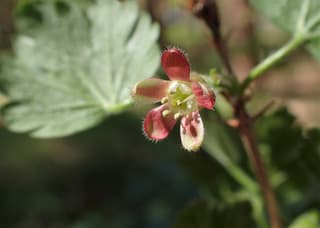
Gooseberry
Ribes uva-crispa
Ribes uva-crispa, commonly known as gooseberry, is a perennial fruit shrub from the Grossulariaceae family, widely cultivated in gardens across Europe and temperate zones. The shrub reaches 1–1.5 m in height and similar width, forming dense, thorny shoots covered with sharp spines. The leaves are palmately lobed and dark green. In spring (April–May), small, yellowish-green or pinkish flowers appear, from which oval berries develop—green, yellow, pink, or red depending on the variety. The fruits ripen in July and are exceptionally rich in vitamin C, B1, and pectins. Gooseberry is distinguished by its excellent frost resistance (up to -20°C) and is one of the most popular fruit shrubs in temperate gardens.
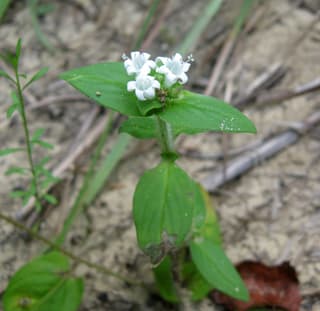
Tropical Mexican Clover
Richardia brasiliensis
Richardia brasiliensis is a low, sprawling member of the coffee family (Rubiaceae), native to a broad band of South America from Ecuador to northern Argentina. It has naturalized as a common weed of lawns, roadsides, pastures and disturbed ground across the southeastern United States, Sub-Saharan Africa, India, Australia and parts of Asia. Branching stems, prostrate to semi-erect, spread from a deep taproot and can reach about 40 cm, bearing opposite, oval leaves to 6.5 cm long. Clusters of small, white to pale pink, funnel-shaped flowers appear from spring through fall, followed by hairy nutlet fruits. Fast-growing and drought-tolerant, it forms a dense mat-like ground cover in full sun and poor, sandy soils, and is sometimes grown deliberately in xeriscaping, even though in agricultural settings it is considered a competitive weed of row crops and turf.
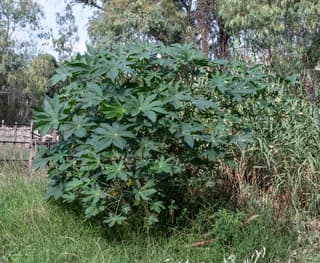
Castor Bean
Ricinus communis
Castor bean (Ricinus communis) is a fast-growing tropical shrub in the Euphorbiaceae family, native to northeastern Africa. Its giant palmate leaves can reach 60 cm across in deep green or bronzy-red varieties. WARNING: all parts are toxic, and the seeds contain ricin, one of the most lethal natural toxins known. Widely grown as a dramatic ornamental and commercially cultivated for castor oil, used across medicine and industry.

Rougeplant
Rivina humilis
Rougeplant (Rivina humilis) is a soft-stemmed evergreen perennial of the Petiveriaceae family, native to the warm Americas. It produces slender spikes of tiny white-to-pink flowers almost year-round, followed by glossy, bright-red berries that give the plant its name. The berry juice was historically used as a red dye or rouge. All parts, especially the berries and roots, are toxic if eaten.
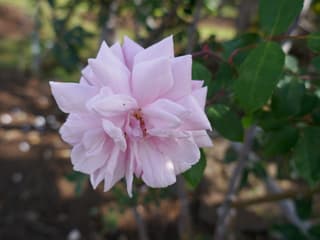
Cécile Brunner Rose
Rosa 'Cécile Brunner'
Rosa 'Cécile Brunner' is a heritage polyantha rose bred in France by Marie Ducher and introduced in 1881 by her son-in-law Joseph Pernet-Ducher. Nicknamed the 'Sweetheart Rose' for its perfectly formed, high-centered pink buds that resemble miniature hybrid teas, it opens into small, double, softly fragrant blooms borne in generous sprays from late spring through the first frost. The compact, nearly thornless bush has smooth, glossy mid-green foliage and a graceful, arching habit; a more vigorous climbing sport of the same cultivar can reach several metres. Long-lived, disease-resistant, and tolerant of poor soil and part shade, it remains a favourite for cottage gardens, mixed borders, and container culture more than 140 years after its introduction.
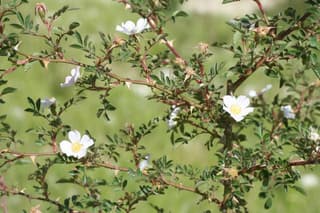
Small-leaved Sweet-briar
Rosa agrestis
Rosa agrestis, the small-leaved sweet-briar or field rose, is a deciduous wild shrub native to southern and central Europe, extending sporadically to the Caucasus. It forms an upright, bushy growth of arching stems armed with curved prickles, reaching 1.5-3 meters tall. Its pinnate leaves, made up of 5-7 small, coarsely serrated leaflets, are noticeably smaller than those of its close relative Rosa rubiginosa (sweet briar) and carry very little of the apple-like scent typical of that species. In mid-summer it bears clusters of subtly fragrant, single white to blush-pink flowers up to 4cm across, followed in autumn by small oval red hips that persist on the plant and add ornamental interest into winter.
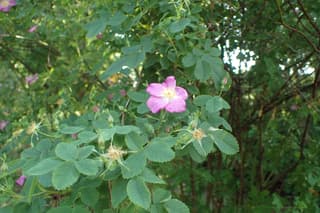
California Wild Rose
Rosa californica
Rosa californica, commonly known as the California Wild Rose, is a deciduous shrub native to the western United States, found naturally in California, Oregon, and northern Baja California. Growing up to 10 feet tall, it produces simple pink to magenta flowers with golden stamens from late spring through summer. Its bright red rose hips persist through winter and provide vital food for birds and wildlife. Once established, it is extremely drought-tolerant and low-maintenance — a true California native.
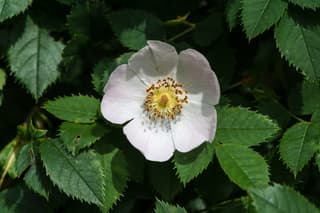
Dog Rose
Rosa canina
Rosa canina, commonly known as the Dog Rose, is a deciduous shrub native to Europe, Northwest Africa, and Western Asia. It features arching thorny branches, delicate pale pink to white flowers in late spring, and bright red oval hips that persist through winter. The hips are edible and exceptionally rich in vitamin C, making this wild rose both ornamentally beautiful and medicinally valuable.
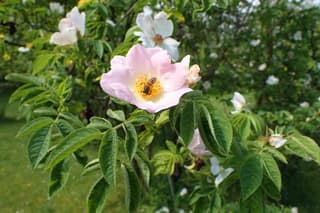
Corymb rose
Rosa corymbifera
Rosa corymbifera, commonly known as the corymb rose or hedge rose, is a vigorous deciduous shrub in the Rosaceae family, native to Europe, North Africa, the Caucasus, the Middle East, and Central Asia. Closely related to Rosa canina, it is primarily distinguished by the presence of denser hairs on the underside of the leaves. Its long, arching branches, covered in curved thorns, can reach up to 3 meters in height, forming impenetrable natural hedges. From May to July, it produces flat corymb inflorescences with 3 to 15 flowers featuring white to pale pink petals and a mild fragrance. In autumn, the intense red oval rose hips become a valuable ornament and a rich source of vitamin C. The 'Laxa' cultivar is the most widely used rootstock in Europe for garden roses.
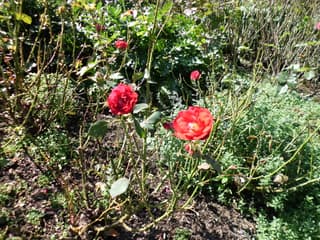
Kordes rose
Rosa kordesii
Rosa kordesii is a hardy climbing/shrub rose bred by Wilhelm Kordes in Germany during the 1940s, valued for its exceptional winter hardiness (down to USDA zone 3) and strong resistance to common rose diseases. It produces clusters of double, deep-pink repeat-blooming flowers on long, lanky canes that can be trained as a climber or left as a free-standing shrub, and it parented the disease-resistant Canadian Explorer Series roses.
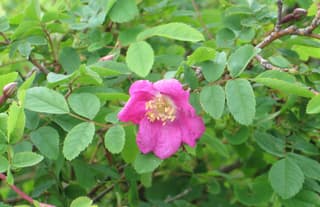
Alpine Rose
Rosa pendulina
The Alpine Rose (Rosa pendulina) is a nearly thornless wild shrub native to the mountains of central and southern Europe — the Pyrenees, Alps, Carpathians, and Apennines. It produces deep pink to fuchsia flowers with prominent yellow stamens, followed by distinctive pendulous, elongated red hips. Exceptionally cold-hardy, it tolerates temperatures down to -30°C and thrives in rocky mountain landscapes.
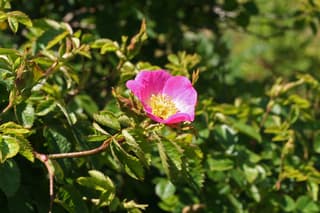
Sweet Briar
Rosa rubiginosa
Sweet Briar (Rosa rubiginosa) is a vigorous deciduous shrub native to Europe and western Asia, belonging to the Rosaceae family. Celebrated for its clear blush-pink single flowers, distinctive apple-scented foliage, and ornamental bright red hips that persist through winter, it is one of the most cherished wild roses in European gardens. Traditionally grown in hedgerows, cottage gardens, and wildlife plantings, it provides abundant food and shelter for pollinators and birds. The hips are exceptionally rich in Vitamin C and have long been used in teas, jams, and herbal remedies.
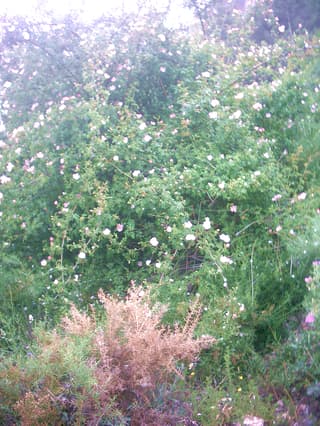
Scotch Rose
Rosa spinosissima
The Scotch Rose (Rosa spinosissima, syn. Rosa pimpinellifolia) is a low-growing, densely leaved shrub from the rose family (Rosaceae). It is also known as the burnet rose. It originates from Europe, southwestern Siberia, northwestern Iran, and Algeria; in Poland, it is found mainly in the south of the country, on dry, stony hills and in warm thickets, often on calcareous soil. It typically reaches 50–100 cm in height, forming compact, heavily thorny clumps with dark brown shoots densely covered with straight thorns and stiff bristles. The leaves are pinnate, composed of 5–11 small, rounded leaflets, often with a reddish tinge. From May to June, single, creamy-white (less often pink), fragrant flowers with five petals appear, followed in autumn by spherical, dark brown to black fruit clusters (hips).
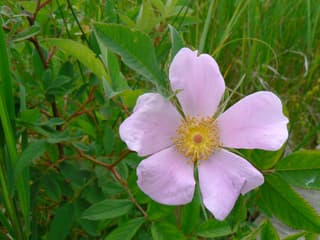
Virginia Rose
Rosa virginiana
Rosa virginiana, commonly known as Virginia rose or prairie rose, is a hardy, suckering deciduous shrub native to the eastern United States and eastern Canada, from Newfoundland south to Virginia and west to the Great Lakes. Growing 4 to 6 feet (occasionally to 10 feet) tall, it forms dense, thicket-like colonies via underground suckers, making it valuable for naturalized borders, erosion control, and wildlife gardens. Its glossy, dark green pinnate leaves turn vivid shades of purple, red-orange, and yellow in autumn, while reddish canes armed with curved prickles provide winter interest and habitat. From June through August, the shrub produces fragrant, single pink blooms with five petals and bright yellow stamens, followed by showy red rose hips that persist into winter and provide food for birds and small mammals.
What are Easy Plants?
Easy Plants are ideal for beginners or people with little time for care. These species are tolerant of watering mistakes, light variations, and don't require constant attention. Perfect for those just starting out with plants.
Tips for Growing Easy Plants
To succeed with easy plants, remember: less is more. Avoid overwatering, choose a spot with adequate light, and let the soil dry between waterings. Most of these plants prefer to be 'forgotten' occasionally.