2307 Easy Plants | 2026 Guide - Page 61
Discover 2307 easy plants for your garden. Complete care guide.
2307 Easy Plants
Showing 2161-2196 of 2307
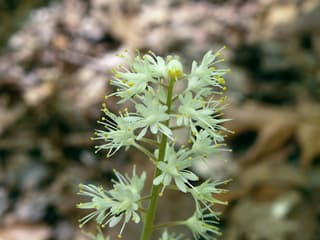
Foamflower
Tiarella cordifolia
Tiarella cordifolia, commonly known as foamflower, is a low-growing herbaceous perennial native to the woodlands of eastern North America, from Nova Scotia south through the Appalachian Mountains to Alabama. It forms a dense mat of heart-shaped, hairy-stalked leaves that often display attractive burgundy veining and takes on a bronze-red hue in cooler months. In mid to late spring, upright flower spikes rise above the foliage, covered in tiny, star-shaped white or pale pink blossoms that give the plant its foamy, frothy appearance. Foamflower spreads slowly by rhizomes and stolons, making it a popular choice for woodland gardens, shaded borders, and as a naturalizing ground cover beneath trees and shrubs.

Common lime
Tilia × europaea
The Common lime (Tilia x europaea) is a large, deciduous hybrid between the large-leaved lime and the small-leaved lime. This stately tree can reach heights of up to 35 meters and features a broad, dome-shaped canopy of heart-shaped leaves. In July, the tree bears clusters of small, yellowish flowers with a sweet, honey-like fragrance that attracts bees and other insects. Traditionally, the lime tree has been widely planted in the Netherlands along avenues, in squares, and as a village tree, symbolizing community and protection.

Large-leaved Lime
Tilia platyphyllos
The large-leaved lime (Tilia platyphyllos) is a large deciduous tree native to Europe, in the family Malvaceae. It grows up to 25 m tall with a dense, pyramidal crown. Its fragrant pale-yellow flowers, highly attractive to bees, are traditionally harvested to brew linden tea.

Silver Linden
Tilia tomentosa
Silver Linden (Tilia tomentosa) is a large deciduous shade tree native to southeastern Europe and western Asia, including Albania, Bulgaria, Greece, Hungary, Romania, and Turkey. A member of the Malvaceae family, it is widely planted as a street, park, and specimen tree thanks to its dense, broad-pyramidal canopy and outstanding tolerance of urban pollution, heat, and road salt. Its heart-shaped leaves are dark green above and covered with a fine silvery-white down beneath, creating a shimmering effect when stirred by the wind — the source of its common name. From late spring into summer the tree produces hanging clusters of small, creamy-yellow, intensely fragrant, nectar-rich flowers that are highly attractive to bees and other pollinators. It typically reaches 50-70 ft (15-21 m) tall, occasionally up to 100 ft (30 m), with a spread of 30-50 ft (9-15 m), and grows at a rapid rate.
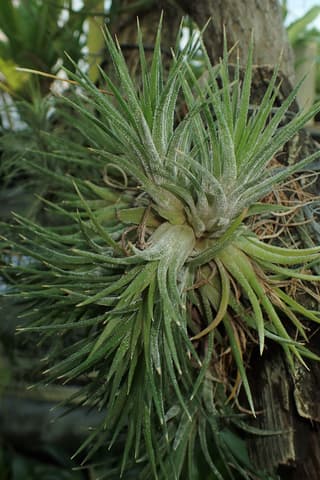
Air Plant
Tillandsia
Tillandsia is a genus of approximately 650 epiphytic plants in the Bromeliaceae family, native from the southern United States to Argentina. They require no soil, instead absorbing water and nutrients directly through their leaves via specialized structures called trichomes. Famous species include T. ionantha, T. xerographica, and Spanish Moss (T. usneoides).

Air plant
Tillandsia aeranthos
Tillandsia aeranthos is an epiphytic air plant from South America that lives without soil, clinging to branches, rocks or mounts. It forms clumps of stiff, silvery leaves and produces pink bracts with blue-violet flowers in spring.
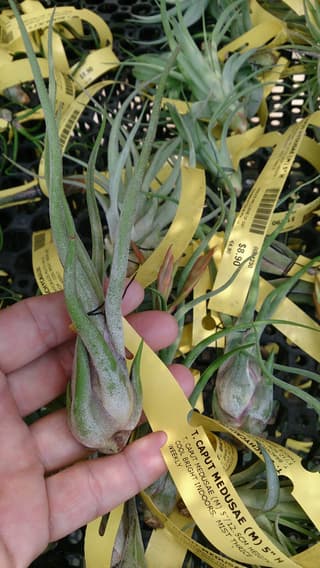
Medusa's Head Air Plant
Tillandsia caput-medusae
Tillandsia caput-medusae is an epiphytic bromeliad native to Mexico and Central America, where it grows attached to tree branches at elevations up to 2,000 meters. Its name comes from the bulbous base of the rosette, from which twisting, silvery-green leaves emerge, resembling snakes or the tentacles of an octopus. The leaves are covered in fine trichomes that absorb water and nutrients directly from the air. It is a hardy, slow-growing species, widely used in terrariums and mounted displays since it needs no soil at all.
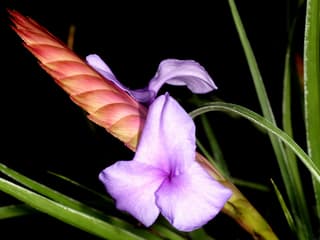
Guatemalan Air Plant
Tillandsia guatemalensis
Tillandsia guatemalensis is an epiphytic bromeliad native to forests from Mexico to Panama. It forms a rosette of silvery-grey leaves and produces a striking flower spike with deep rose-pink bracts and tubular violet-blue flowers. As a true air plant, it absorbs water and nutrients directly from the air through specialized leaf scales called trichomes.
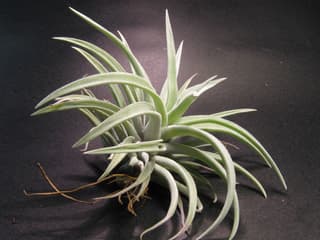
Harris's Air Plant
Tillandsia harrisii
Tillandsia harrisii is a slow-growing epiphytic bromeliad endemic to the dry rocky slopes of Zacapa, Guatemala. Its silvery, densely trichome-covered leaves form a tight rosette on a short stem, giving the plant a soft, fuzzy, almost white appearance that helps it survive intense sun and low humidity in its native habitat. After a year or two of growth it produces an upright spike with coral-red to orange bracts and violet-blue flowers, after which pups form at the base.

Sky Plant
Tillandsia ionantha
Tillandsia ionantha is a fascinating epiphytic plant from the bromeliad family, native to Central America and Mexico. Known as the air plant, it does not need soil to grow, absorbing water and nutrients directly from the air through its silver trichome-covered leaves. During flowering, its central leaves turn vivid red, contrasting with the delicate purple flowers.
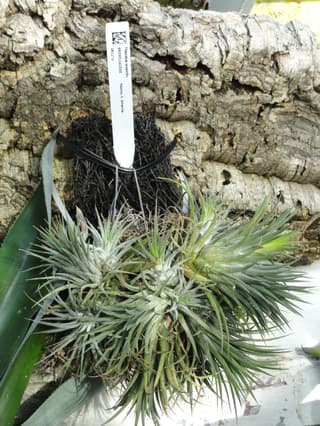
Air Plant
Tillandsia sp
Tillandsias, commonly known as air plants, belong to the Bromeliaceae family and represent its largest genus with over 660 species. Native to the tropical and subtropical Americas, from the southern United States to Argentina, these fascinating epiphytes require no soil to thrive. Instead, they absorb water and nutrients directly from the air through specialized leaf structures called trichomes. Their ability to adapt to diverse environments—from tropical rainforests and cloud forests to arid deserts and rocky mountainsides—makes them among the most versatile and unique plants in the world.
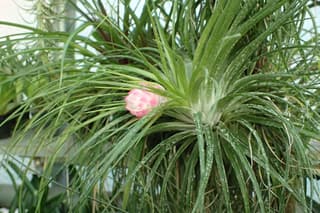
Upright Air Plant
Tillandsia stricta
Tillandsia stricta, commonly known as the Upright Air Plant, is an epiphytic bromeliad native to eastern South America, ranging from Venezuela to northern Argentina. Unlike most plants, it requires no soil to thrive — it absorbs water and nutrients directly through its silvery trichome-covered leaves. It produces stunning blooms in shades of red, pink, blue, and purple in spring and summer, making it one of the most ornamental air plants available.
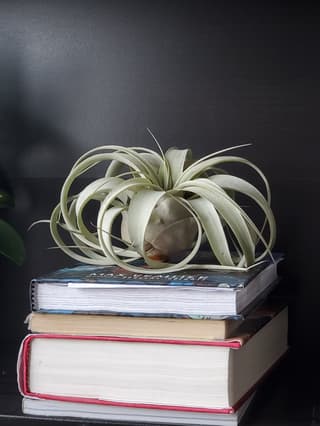
King of Air Plants
Tillandsia xerographica
Tillandsia xerographica is known as the "King of Air Plants" due to its impressive size and beautifully curled silvery-green leaves. This epiphytic plant is native to southern Mexico, Guatemala, and El Salvador. It can reach up to 90 cm in diameter and is highly prized for its sculptural rosette shape. Like all tillandsias, it doesn't need soil to grow and absorbs water and nutrients through its leaves. It is protected under CITES due to past overharvesting in the wild.

Tipu tree
Tipuana tipu
The Tipu tree (Tipuana tipu) is a majestic, fast-growing tree native to South America. Known for its broad, leafy umbrella-shaped canopy, it provides dense and refreshing shade. During spring and early summer, the tree is covered in clusters of vibrant yellow flowers that, when they fall, create a beautiful golden carpet on the ground. Its leaves are compound and light green, and its fruits are winged samaras, similar to those of a maple.
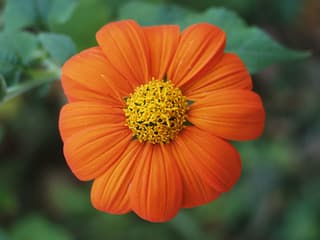
Mexican Sunflower
Tithonia
Tithonia is a genus of flowering plants in the family Asteraceae, native to Mexico and Central America, widely grown as a garden ornamental worldwide. The most popular species, Tithonia rotundifolia, is celebrated for its brilliant orange daisy-like blooms that attract butterflies, bees, and hummingbirds. Fast-growing and highly heat- and drought-tolerant, it is an outstanding choice for sunny summer gardens.
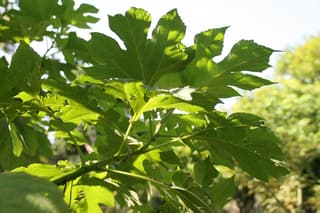
Mexican Sunflower
Tithonia diversifolia
Mexican Sunflower (Tithonia diversifolia) is a fast-growing shrub in the Asteraceae family, native to Mexico and Central America. It reaches up to 4 meters tall and produces vivid orange and yellow flowers from summer through fall. Widely naturalized across the tropics, it is prized as an ornamental, green manure crop, and medicinal plant.

Mexican Sunflower
Tithonia rotundifolia
Mexican Sunflower (Tithonia rotundifolia) is a fast-growing annual native to Mexico and Central America, celebrated for its bold orange, red, and yellow daisy-like blooms. Growing up to 8 feet tall, it is a magnet for butterflies, hummingbirds, and bees throughout summer and fall.
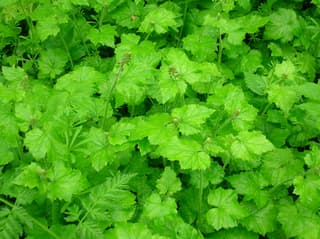
Piggyback Plant
Tolmiea menziesii
Tolmiea menziesii, commonly known as the Piggyback Plant, is a charming evergreen perennial native to the moist, shady forests of the Pacific Northwest coast of North America. It earns its whimsical name from its unique ability to produce tiny plantlets directly at the base of its mature leaves — babies riding "piggyback" on the parent leaf. With soft, hairy, maple-like leaves and a lush mounding habit, it makes an attractive ground cover outdoors and a delightful cascading houseplant indoors.
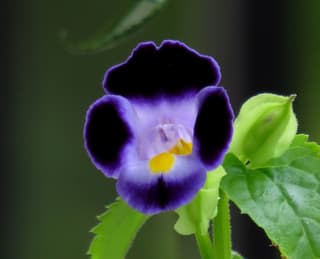
Wishbone flower
Torenia fournieri
Torenia fournieri, commonly known as the Wishbone flower, is a compact and charming herbaceous plant. Its trumpet-shaped flowers feature vibrant colors, usually with a contrasting yellow blotch on the throat. Unlike traditional pansies, this species is highly heat and humidity tolerant, making it ideal for tropical and subtropical gardens.
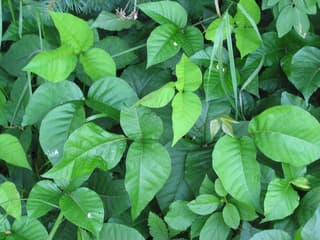
Poison ivy
Toxicodendron radicans
Toxicodendron radicans, commonly known as eastern poison ivy, is a deciduous woody vine or shrub famous for its ability to produce urushiol. This oily organic compound causes an allergic reaction, leading to an itchy, irritating, and painful rash in most humans. The plant is easily identified by its compound leaves consisting of three leaflets, often described by the mnemonic 'leaves of three, let it be.' It is highly adaptable, growing as a trailing vine, a shrub, or a climbing vine that uses aerial rootlets to scale trees and structures.
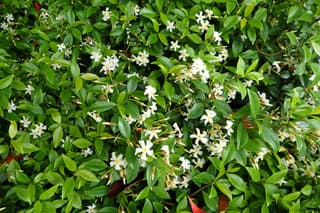
Asian Jasmine
Trachelospermum asiaticum
Asian Jasmine (Trachelospermum asiaticum) is a vigorous, evergreen woody vine native to China, Japan and Korea. Grown low and dense, it is one of the most popular groundcovers in warm climates, forming a glossy dark-green carpet studded with small cream-to-yellow star-shaped flowers in late spring and early summer. Left to climb, it will scale trellises, walls and fences with twining stems.
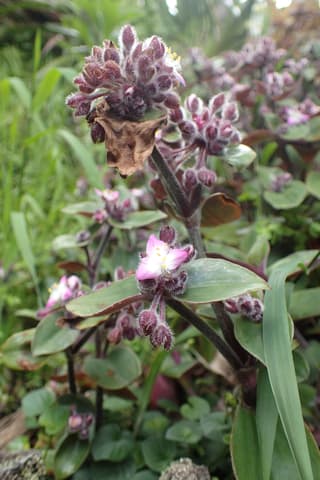
Flowering Inch Plant
Tradescantia cerinthoides
Tradescantia cerinthoides is a fast-growing trailing tropical plant native to southeastern Brazil and northeastern Argentina. It features attractive green-purple foliage and produces delicate white flowers with pink-tipped petals. It is highly popular as a hanging basket plant and ground cover, valued for its colorful, low-maintenance nature.

Small-leaf Spiderwort
Tradescantia fluminensis
Tradescantia fluminensis is a fast-growing trailing groundcover native to Brazil and Argentina, belonging to the family Commelinaceae. It produces succulent stems with glossy green oval leaves and small white three-petaled flowers in spring and summer. Widely grown as a houseplant in hanging baskets and as outdoor ground cover in frost-free regions.
Small-leaf Spiderwort
Tradescantia mundula
Tradescantia mundula, commonly known as small-leaf spiderwort, is a trailing groundcover plant with small glossy leaves, native to southeastern and southern Brazil down to northeastern Argentina. It belongs to the Commelinaceae family and is popular as a hanging basket plant or shaded ground cover thanks to its fast growth and easy care.
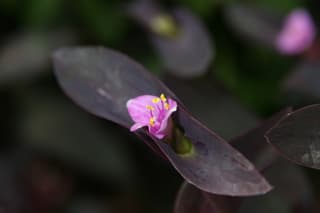
Purple Heart
Tradescantia pallida
Purple Heart (Tradescantia pallida) is a fast-growing, trailing herbaceous perennial native to eastern Mexico, prized for its striking deep purple foliage and stems. It is equally at home as a houseplant, hanging basket specimen, or ground cover in warm-climate gardens.
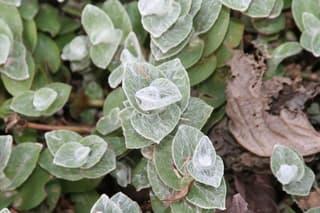
White Velvet
Tradescantia sillamontana
Tradescantia sillamontana, commonly known as White Velvet or Cobweb Spiderwort, is a trailing succulent native to the arid regions of northeastern Mexico. It is beloved for its distinctive densely white-hairy stems and leaves that give it a silvery, velvety appearance. In summer it produces striking magenta three-petaled flowers that contrast beautifully with the silvery foliage. Excellent for containers, hanging baskets, and rock gardens.
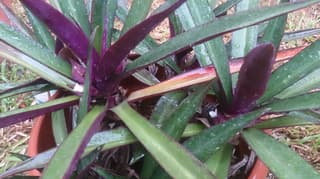
Moses in the Cradle
Tradescantia spathacea
Tradescantia spathacea, commonly known as Moses in the Cradle or Oyster Plant, is a striking tropical perennial native to Mexico. It features bold, sword-shaped leaves that are deep green on top and rich purple underneath, forming dense, compact rosettes. Tiny white flowers nestled within boat-shaped bracts give rise to its charming common names.
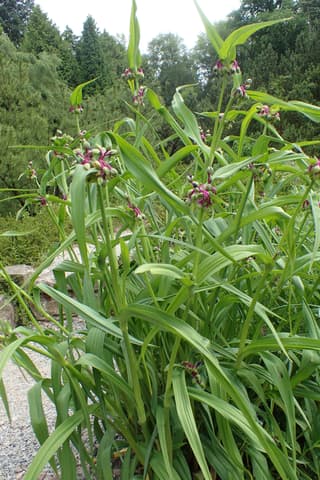
Virginia Spiderwort
Tradescantia virginiana
Tradescantia virginiana, commonly known as Virginia Spiderwort, is a hardy native perennial from Eastern North America. It produces clumps of arching grass-like foliage and bears charming 3-petaled flowers in shades of blue, purple, pink, or white that open in the morning and close by afternoon. A resilient groundcover perfect for naturalized gardens, shade gardens, rain gardens, and pollinator-friendly spaces.
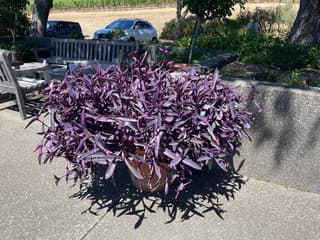
Inch Plant
Tradescantia zebrina
Perennial herbaceous plant native to Mexico and Central America, highly valued for its bicolor foliage featuring leaves with green and silver stripes on the upper surface and intense purple underneath. With a trailing or creeping habit, it is one of the most popular houseplants due to its easy care and fast growth.
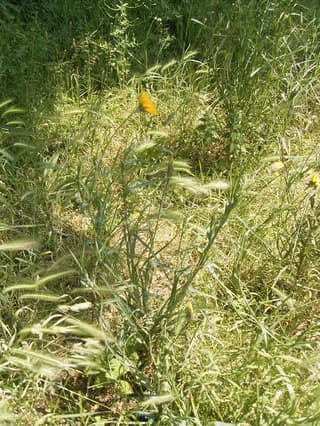
Goat's Beard
Tragopogon
Tragopogon is a genus of biennial or perennial herbs in the Asteraceae family, native to Europe and Asia, with narrow grass-like leaves and milky sap. It produces large daisy-like flowers in shades of yellow or purple, followed by large fluffy seed heads. The most widely cultivated species, salsify (T. porrifolius), is grown for its edible root, prized for its subtle oyster-like flavor.
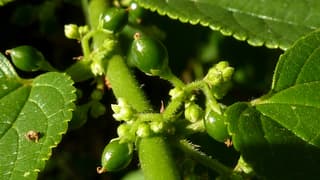
Jamaican Nettle Tree
Trema micrantha
The Jamaican nettle tree (Trema micrantha) is a fast-growing pioneer tree in the Cannabaceae family, native to the tropical and subtropical regions of the Americas, including Brazil. It reaches 5 to 15 meters in height, featuring a dense, rounded crown, oval leaves with a rough texture, and small, greenish-white flowers followed by reddish fruits highly sought after by birds such as parakeets, parrots, and doves, as well as bats. As one of the first species to colonize degraded areas, abandoned pastures, and roadsides, it plays a fundamental role in soil recovery and the restoration of riparian forests.

Chinese Tallow Tree
Triadica sebifera
The Chinese tallow tree (Triadica sebifera) is a fast-growing deciduous tree native to China and Japan, belonging to the Euphorbiaceae family. It is widely cultivated for its spectacular autumn foliage — leaves turn brilliant shades of red, orange, and yellow — and for its waxy white seeds that resemble popcorn. The tree is considered invasive in subtropical regions, particularly the southeastern United States. All parts of the plant are toxic if ingested.
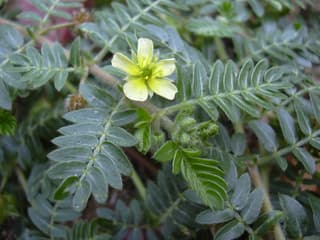
Puncturevine
Tribulus terrestris
Tribulus terrestris is a prostrate herbaceous plant, famous for its fruits covered in rigid spines that can penetrate light surfaces and cause injury. Native to warm and temperate regions of the Old World, it is considered a pioneer species and often an invasive weed due to its extreme resilience. Its leaves are pinnate and its five-petaled yellow flowers open during the day. In traditional medicine, especially in Ayurveda and Chinese medicine, it is used to treat various conditions, being popularly associated with increased vitality and libido.
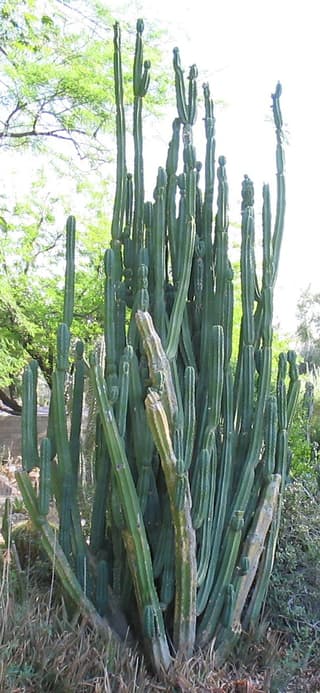
San Pedro Cactus
Trichocereus pachanoi
Trichocereus pachanoi, known as the San Pedro cactus, is a fast-growing columnar cactus native to the Andes Mountains of Ecuador and Peru, where it grows at altitudes of 2,000–3,000 meters above sea level. It produces upright, bluish-green stems with 6–8 ribs, reaching heights of 3–6 meters (exceptionally more) in the wild. It blooms at night with large, strongly scented white flowers that last only about two days. For over 2,000 years, it has been part of traditional Andean medicine and shamanic rituals due to its mescaline alkaloid content.
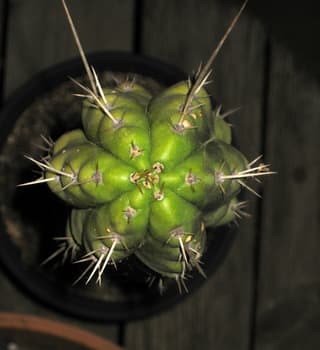
Peruvian torch cactus
Trichocereus peruvianus
Trichocereus peruvianus (synonym Echinopsis peruviana) is a large columnar cactus native to the Andes of Peru and neighbouring regions. It forms erect, branching, blue-green stems with a few well-defined ribs and spines that vary with light conditions. Mature plants can reach several metres in height. The large white flowers open at night near the tops of the stems in late spring and summer. It is a striking architectural plant, popular in xeric gardens and cactus collections, and it tolerates drought well when grown in full sun and very free-draining, gritty soil.
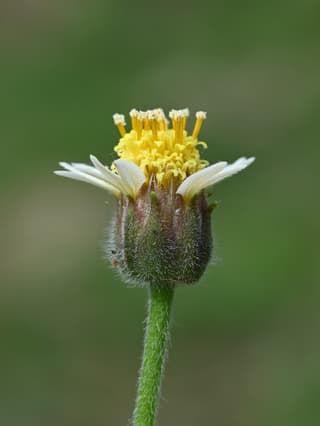
Coatbuttons
Tridax procumbens
Coatbuttons (Tridax procumbens) is a creeping herbaceous plant in the Asteraceae family, native to tropical Americas and now naturalized throughout the tropics worldwide. It produces small daisy-like flowers with white ray florets and yellow centers, and is widely used in traditional medicine for wound healing, antifungal, and anti-inflammatory purposes.
What are Easy Plants?
Easy Plants are ideal for beginners or people with little time for care. These species are tolerant of watering mistakes, light variations, and don't require constant attention. Perfect for those just starting out with plants.
Tips for Growing Easy Plants
To succeed with easy plants, remember: less is more. Avoid overwatering, choose a spot with adequate light, and let the soil dry between waterings. Most of these plants prefer to be 'forgotten' occasionally.