2742 Easy Plants | 2026 Guide - Page 73
Discover 2742 easy plants for your garden. Complete care guide.
2742 Easy Plants
Showing 2593-2628 of 2742
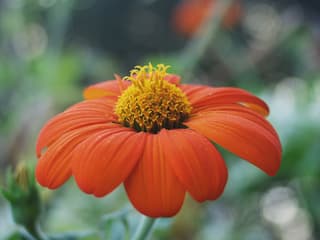
Mexican Sunflower
Tithonia rotundifolia
Mexican Sunflower (Tithonia rotundifolia) is a fast-growing annual native to Mexico and Central America, celebrated for its bold orange, red, and yellow daisy-like blooms. Growing up to 8 feet tall, it is a magnet for butterflies, hummingbirds, and bees throughout summer and fall.
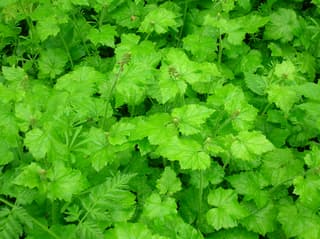
Piggyback Plant
Tolmiea menziesii
Tolmiea menziesii, commonly known as the Piggyback Plant, is a charming evergreen perennial native to the moist, shady forests of the Pacific Northwest coast of North America. It earns its whimsical name from its unique ability to produce tiny plantlets directly at the base of its mature leaves — babies riding "piggyback" on the parent leaf. With soft, hairy, maple-like leaves and a lush mounding habit, it makes an attractive ground cover outdoors and a delightful cascading houseplant indoors.
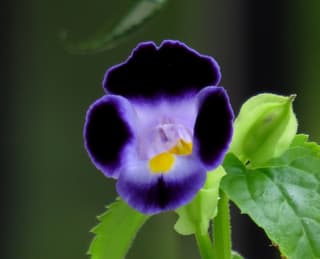
Wishbone flower
Torenia fournieri
Torenia fournieri, commonly known as the Wishbone flower, is a compact and charming herbaceous plant. Its trumpet-shaped flowers feature vibrant colors, usually with a contrasting yellow blotch on the throat. Unlike traditional pansies, this species is highly heat and humidity tolerant, making it ideal for tropical and subtropical gardens.
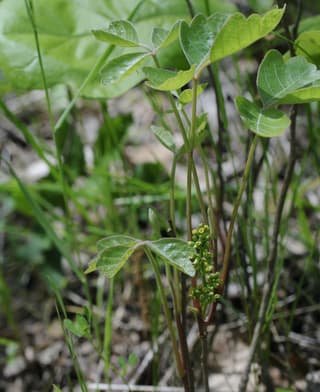
Atlantic Poison Oak
Toxicodendron pubescens
Atlantic poison oak (Toxicodendron pubescens) is an upright, deciduous shrub in the sumac family (Anacardiaceae), not a true oak. Native to the southeastern and central United States, it grows in open pine and oak woods, thickets and dry, sandy fields. It usually reaches 0.6-1.2 m and spreads by rhizomes into colonies. Each leaf has three lobed, oak-like leaflets that are hairy on both sides and turn orange-red in autumn. In spring it bears small clusters of yellow-green flowers, followed by whitish berries that birds eat. Every part of the plant contains urushiol, the same oil found in poison ivy, which causes strong contact dermatitis in most people.
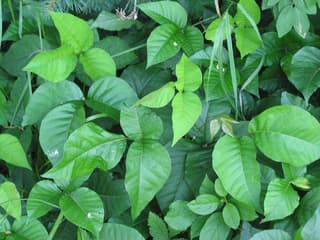
Poison ivy
Toxicodendron radicans
Toxicodendron radicans, commonly known as eastern poison ivy, is a deciduous woody vine or shrub famous for its ability to produce urushiol. This oily organic compound causes an allergic reaction, leading to an itchy, irritating, and painful rash in most humans. The plant is easily identified by its compound leaves consisting of three leaflets, often described by the mnemonic 'leaves of three, let it be.' It is highly adaptable, growing as a trailing vine, a shrub, or a climbing vine that uses aerial rootlets to scale trees and structures.
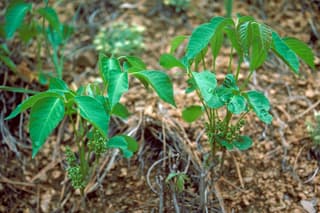
Western poison ivy
Toxicodendron rydbergii
Western poison ivy is a low North American shrub and a close relative of eastern poison ivy. Unlike its cousin it grows upright from a woody stem and doesn't climb trees. It is usually 30 to 60 cm tall, sometimes 1 m, and it spreads underground into large patches. Each leaf has three leaflets: the two side ones are lopsided and the middle one is even. They turn yellow or orange in fall. Small yellowish-white flowers open from late spring into summer, followed by round, yellowish berries. Every part contains urushiol, an oil that gives most people an itchy, blistering rash.
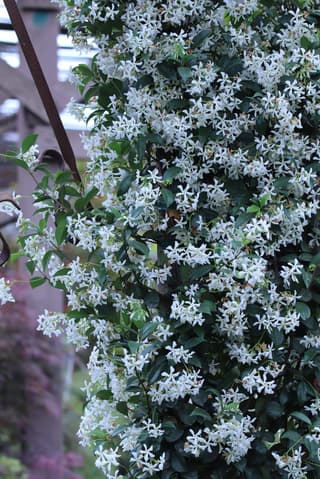
Trachelospermum
Trachelospermum
Trachelospermum is a genus of evergreen, woody, twining vines in the dogbane family (Apocynaceae), native mainly to East and Southeast Asia, from Japan, Korea and China to the Himalayas and Indochina. In the wild the stems climb 12 m or more into trees. The leaves are opposite, glossy and oval, and the very fragrant, star-shaped flowers, usually white or pale yellow, have five twisted petals joined in a tube. The two species grown in gardens are T. jasminoides (star or Confederate jasmine), a vigorous climber, and T. asiaticum (Asian jasmine), mostly used as a low groundcover. Despite the name, they are not true jasmines (Jasminum); broken stems ooze a milky latex.
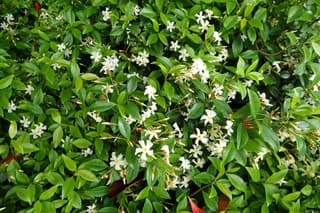
Asian Jasmine
Trachelospermum asiaticum
Asian Jasmine (Trachelospermum asiaticum) is a vigorous, evergreen woody vine native to China, Japan and Korea. Grown low and dense, it is one of the most popular groundcovers in warm climates, forming a glossy dark-green carpet studded with small cream-to-yellow star-shaped flowers in late spring and early summer. Left to climb, it will scale trellises, walls and fences with twining stems.
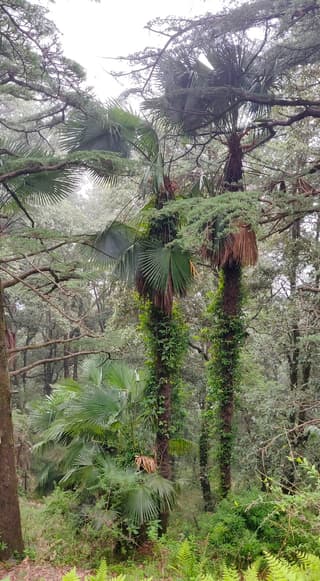
Kumaon palm
Trachycarpus takil
Trachycarpus takil is a fan palm in the family Arecaceae, endemic to the Himalaya in the Kumaon region (Uttarakhand, northern India) and neighbouring western Nepal, where it grows at 1,800-2,700 m in cool, moist oak and rhododendron forest that gets snow every winter. It has a single trunk covered in tightly clasping chestnut-brown fibre and, with time, reaches 10-15 m. The fan leaves, almost three-quarters of a circle, are 1-1.2 m across and split to the middle into 45-50 stiff segments that do not droop at the tips. It is dioecious (separate male and female plants). It ranks among the most cold-hardy tall-trunked palms. In the trade it is often confused with Trachycarpus fortunei, and plants sold as "takil" are sometimes another species.
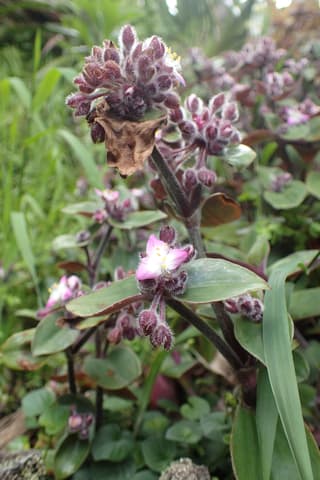
Flowering Inch Plant
Tradescantia cerinthoides
Tradescantia cerinthoides is a fast-growing trailing tropical plant native to southeastern Brazil and northeastern Argentina. It features attractive green-purple foliage and produces delicate white flowers with pink-tipped petals. It is highly popular as a hanging basket plant and ground cover, valued for its colorful, low-maintenance nature.
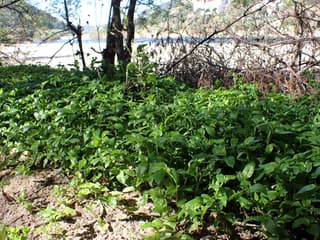
Small-leaf Spiderwort
Tradescantia fluminensis
Tradescantia fluminensis is a fast-growing trailing groundcover native to Brazil and Argentina, belonging to the family Commelinaceae. It produces succulent stems with glossy green oval leaves and small white three-petaled flowers in spring and summer. Widely grown as a houseplant in hanging baskets and as outdoor ground cover in frost-free regions.
Small-leaf Spiderwort
Tradescantia mundula
Tradescantia mundula, commonly known as small-leaf spiderwort, is a trailing groundcover plant with small glossy leaves, native to southeastern and southern Brazil down to northeastern Argentina. It belongs to the Commelinaceae family and is popular as a hanging basket plant or shaded ground cover thanks to its fast growth and easy care.
Tradescantia Nanouk
Tradescantia nanouk
Tradescantia Nanouk, also sold as Fantasy Venice, is a cultivar of Tradescantia albiflora, in the spiderwort family (Commelinaceae), bred in the Netherlands and patented in 2017. The genus is native to Mexico and Central and South America. The fleshy leaves are striped in green, grey-green and purplish pink, with purple undersides. It starts compact and upright, about 30 cm (12 in) tall, then the stems lengthen and trail, which makes it a good hanging plant. It grows fast. Pink buds open into small, three-petalled white flowers when the plant gets plenty of light.
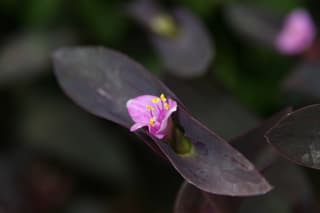
Purple Heart
Tradescantia pallida
Purple Heart (Tradescantia pallida) is a fast-growing, trailing herbaceous perennial native to eastern Mexico, prized for its striking deep purple foliage and stems. It is equally at home as a houseplant, hanging basket specimen, or ground cover in warm-climate gardens.
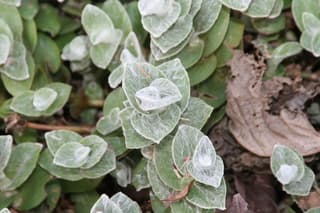
White Velvet
Tradescantia sillamontana
Tradescantia sillamontana, commonly known as White Velvet or Cobweb Spiderwort, is a trailing succulent native to the arid regions of northeastern Mexico. It is beloved for its distinctive densely white-hairy stems and leaves that give it a silvery, velvety appearance. In summer it produces striking magenta three-petaled flowers that contrast beautifully with the silvery foliage. Excellent for containers, hanging baskets, and rock gardens.
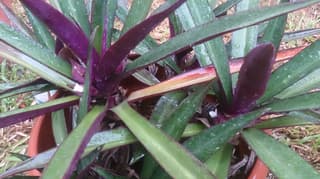
Moses in the Cradle
Tradescantia spathacea
Tradescantia spathacea, commonly known as Moses in the Cradle or Oyster Plant, is a striking tropical perennial native to Mexico. It features bold, sword-shaped leaves that are deep green on top and rich purple underneath, forming dense, compact rosettes. Tiny white flowers nestled within boat-shaped bracts give rise to its charming common names.
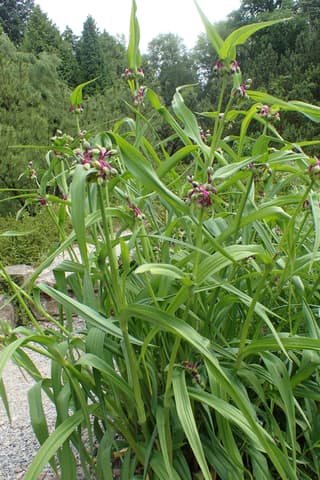
Virginia Spiderwort
Tradescantia virginiana
Tradescantia virginiana, commonly known as Virginia Spiderwort, is a hardy native perennial from Eastern North America. It produces clumps of arching grass-like foliage and bears charming 3-petaled flowers in shades of blue, purple, pink, or white that open in the morning and close by afternoon. A resilient groundcover perfect for naturalized gardens, shade gardens, rain gardens, and pollinator-friendly spaces.
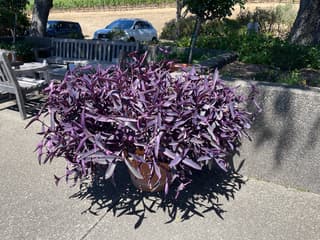
Inch Plant
Tradescantia zebrina
Perennial herbaceous plant native to Mexico and Central America, highly valued for its bicolor foliage featuring leaves with green and silver stripes on the upper surface and intense purple underneath. With a trailing or creeping habit, it is one of the most popular houseplants due to its easy care and fast growth.
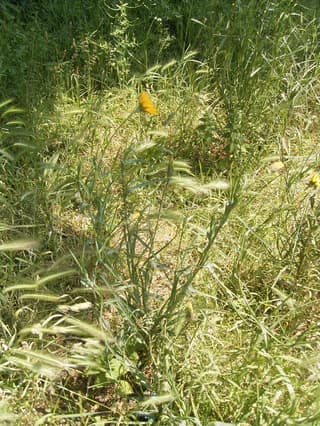
Goat's Beard
Tragopogon
Tragopogon is a genus of biennial or perennial herbs in the Asteraceae family, native to Europe and Asia, with narrow grass-like leaves and milky sap. It produces large daisy-like flowers in shades of yellow or purple, followed by large fluffy seed heads. The most widely cultivated species, salsify (T. porrifolius), is grown for its edible root, prized for its subtle oyster-like flavor.
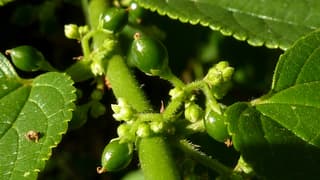
Jamaican Nettle Tree
Trema micrantha
The Jamaican nettle tree (Trema micrantha) is a fast-growing pioneer tree in the Cannabaceae family, native to the tropical and subtropical regions of the Americas, including Brazil. It reaches 5 to 15 meters in height, featuring a dense, rounded crown, oval leaves with a rough texture, and small, greenish-white flowers followed by reddish fruits highly sought after by birds such as parakeets, parrots, and doves, as well as bats. As one of the first species to colonize degraded areas, abandoned pastures, and roadsides, it plays a fundamental role in soil recovery and the restoration of riparian forests.
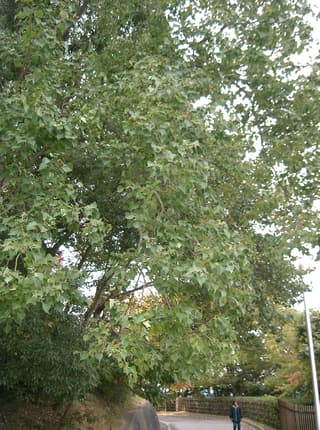
Chinese Tallow Tree
Triadica sebifera
The Chinese tallow tree (Triadica sebifera) is a fast-growing deciduous tree native to China and Japan, belonging to the Euphorbiaceae family. It is widely cultivated for its spectacular autumn foliage — leaves turn brilliant shades of red, orange, and yellow — and for its waxy white seeds that resemble popcorn. The tree is considered invasive in subtropical regions, particularly the southeastern United States. All parts of the plant are toxic if ingested.
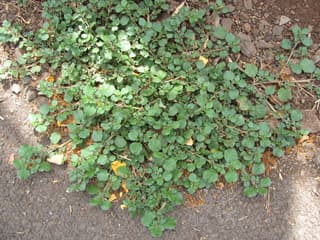
Desert Horse Purslane
Trianthema portulacastrum
Trianthema portulacastrum is a succulent annual herb in the Aizoaceae family, native to parts of Africa and the Americas and now widespread as a weed throughout tropical and subtropical regions of the world. It forms prostrate mats of reddish stems, up to 1 m in length, with fleshy, opposite, and rounded leaves in pairs of unequal sizes. The flowers are small, solitary in the leaf axils, lacking petals, with pink to purple sepals. It occupies sandy soils, riverbanks, alkaline terrains, irrigated gardens, and disturbed areas.
Puncturevine
Tribulus terrestris
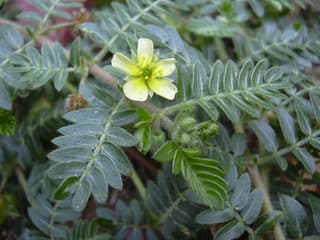
Tribulus terrestris is a prostrate herbaceous plant, famous for its fruits covered in rigid spines that can penetrate light surfaces and cause injury. Native to warm and temperate regions of the Old World, it is considered a pioneer species and often an invasive weed due to its extreme resilience. Its leaves are pinnate and its five-petaled yellow flowers open during the day. In traditional medicine, especially in Ayurveda and Chinese medicine, it is used to treat various conditions, being popularly associated with increased vitality and libido.
Torch cactus
Trichocereus
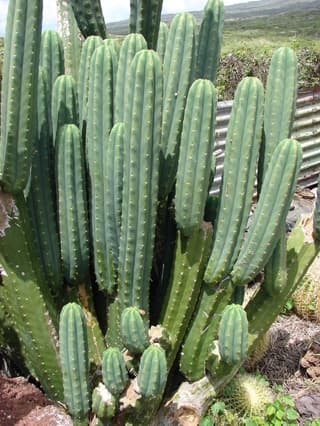
Trichocereus is a group of columnar cacti from the Andes of Ecuador, Peru, Bolivia, Chile and Argentina, best known for the San Pedro (T. pachanoi), Peruvian torch (T. peruvianus), Bolivian torch (T. bridgesii) and golden torch (T. spachianus). Most form ribbed, upright stems that branch from the base and range from about 1 m to tree-sized plants over 10 m in the wild, while staying much smaller in pots. They bear large, funnel-shaped, woolly-tubed flowers, usually white and fragrant, that open at night in spring and summer. Plants of the World Online currently merges the genus into Echinopsis, but growers and nurseries still widely use the name Trichocereus.
Macrogonus Torch Cactus
Trichocereus macrogonus
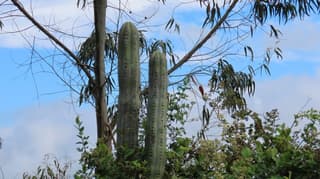
Trichocereus macrogonus is a columnar cactus from the high valleys of Peru and possibly northwestern Bolivia. Its upright stems reach 2.5 to 5 metres and branch from the base. The branches are thick, 6 to 20 cm across, with 6 to 8 broad ribs and blue-green skin that is sometimes covered in a bluish bloom. The grey or dark brown areoles sit more than 2.5 cm apart and carry up to 20 spines, including 3 or 4 central spines up to 5 cm long. Flowers open at night near the stem tips. They are large, about 21 cm long, white inside, with pale yellow or greenish outer tepals. It is a close relative of San Pedro (Trichocereus pachanoi) and the Peruvian torch (T. peruvianus), and some botanists treat all three as one species.
San Pedro Cactus
Trichocereus pachanoi
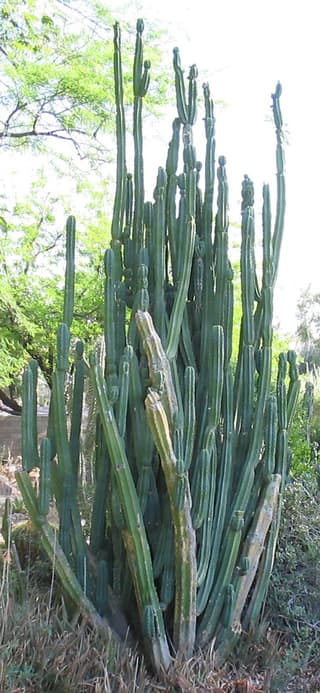
Trichocereus pachanoi, known as the San Pedro cactus, is a fast-growing columnar cactus native to the Andes Mountains of Ecuador and Peru, where it grows at altitudes of 2,000–3,000 meters above sea level. It produces upright, bluish-green stems with 6–8 ribs, reaching heights of 3–6 meters (exceptionally more) in the wild. It blooms at night with large, strongly scented white flowers that last only about two days. For over 2,000 years, it has been part of traditional Andean medicine and shamanic rituals due to its mescaline alkaloid content.
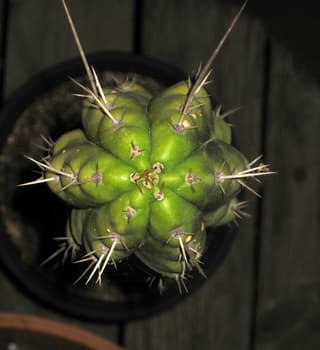
Peruvian torch cactus
Trichocereus peruvianus
Trichocereus peruvianus (synonym Echinopsis peruviana) is a large columnar cactus native to the Andes of Peru and neighbouring regions. It forms erect, branching, blue-green stems with a few well-defined ribs and spines that vary with light conditions. Mature plants can reach several metres in height. The large white flowers open at night near the tops of the stems in late spring and summer. It is a striking architectural plant, popular in xeric gardens and cactus collections, and it tolerates drought well when grown in full sun and very free-draining, gritty soil.
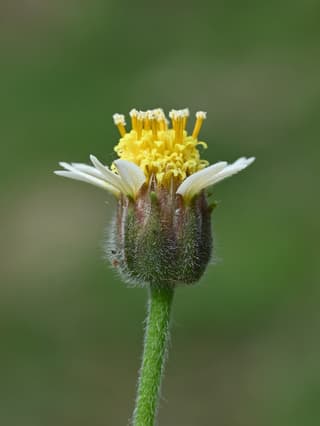
Coatbuttons
Tridax procumbens
Coatbuttons (Tridax procumbens) is a creeping herbaceous plant in the Asteraceae family, native to tropical Americas and now naturalized throughout the tropics worldwide. It produces small daisy-like flowers with white ray florets and yellow centers, and is widely used in traditional medicine for wound healing, antifungal, and anti-inflammatory purposes.
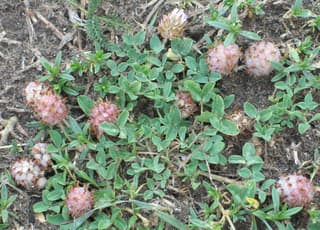
Strawberry Clover
Trifolium fragiferum
Trifolium fragiferum, commonly known as strawberry clover, is a perennial creeping legume native to the Eastern Mediterranean, Southwest Asia, and Northwest Africa, including mainland Portugal and Madeira. It is distinguished by its round, pale-pink flower heads that, after fruiting, inflate into strawberry-like globes — giving rise to its common name. The plant spreads vigorously through creeping stolons that root at the nodes, forming a dense ground cover. It is one of the most salt-tolerant and waterlogging-tolerant clover species commercially available.
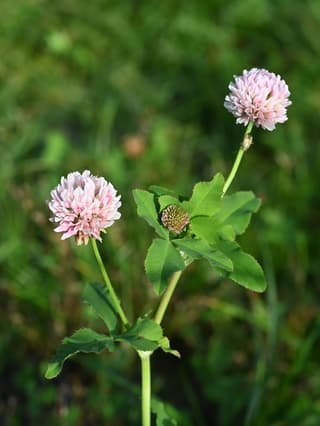
Alsike Clover
Trifolium hybridum
Alsike clover (Trifolium hybridum) is a perennial herbaceous plant in the Fabaceae family, native to southern Europe and southwestern Asia. It produces globose flower heads ranging from white to pink during summer and is widely used as a forage crop, ground cover, and nectar source for pollinators. It fixes atmospheric nitrogen through symbiotic root bacteria, enriching the soil naturally.
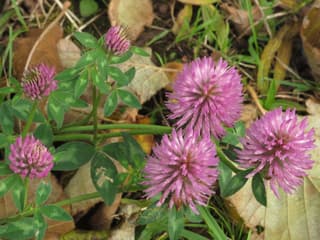
Red Clover
Trifolium pratense
Red clover (Trifolium pratense) is a short-lived herbaceous perennial native to Europe, Western Asia, and northwest Africa, now naturalized worldwide. It produces dense globe-shaped flower heads in shades of pink to reddish-purple and is widely cultivated as livestock fodder, green manure, and a medicinal herb. It fixes atmospheric nitrogen through symbiotic root bacteria, naturally enriching the soil.

White clover
Trifolium repens
Trifolium repens, commonly known as white clover, is a low-growing, perennial herbaceous plant in the pea family Fabaceae. It is native to Europe and Western Asia but has been widely naturalized throughout the world. It is characterized by its trifoliate leaves and dense heads of white flowers. It is often found in lawns, pastures, and meadows, and is known for its ability to fix nitrogen in the soil.
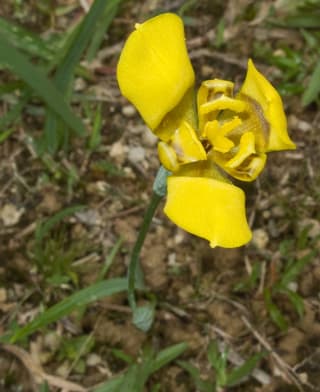
Yellow Walking Iris
Trimezia
Trimezia is a rhizomatous herbaceous plant native to the Americas, highly valued in tropical landscaping. Its leaves are long, green, and sword-shaped, growing in dense fans. The flowers are a vibrant yellow with tiger-striped brown spots in the center. Although each individual flower lasts only one day, the plant produces continuous flower stalks that ensure a visual spectacle during the warmer months.
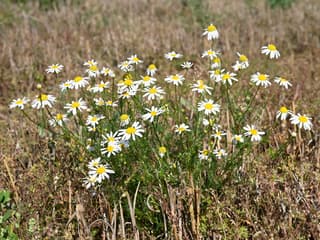
Scentless Chamomile
Tripleurospermum inodorum
Scentless chamomile (Tripleurospermum inodorum) is an annual or biennial herb from the Asteraceae family, native to Eurasia and widely distributed in cultivated fields, roadsides, and waste ground. The plant is characterized by fine, feathery leaves and classic white daisy-like flowers with a yellow central disc, 3–5 cm in diameter. It grows 20–80 cm tall and blooms from June to November. Unlike true chamomile, it completely lacks the characteristic apple scent – hence the name.
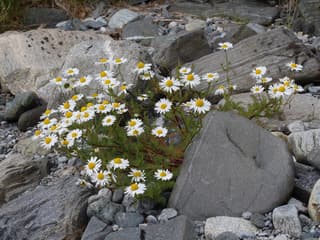
Sea Mayweed
Tripleurospermum maritimum
Sea Mayweed (Tripleurospermum maritimum) is a short-lived perennial in the daisy family, native to the coasts of Europe, Greenland, and the Azores. It forms sprawling, fleshy-leaved mounds along drift-lines, shingle beaches, and cliff tops, producing classic daisy-like flowers with white ray petals around a yellow disk from early summer into autumn. Its succulent, finely divided foliage is an adaptation to salty, windswept habitats, and mature stems often turn purple by late summer.
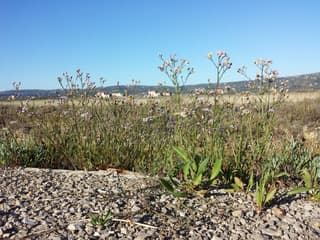
Sea Aster
Tripolium pannonicum
The Sea Aster (Tripolium pannonicum, formerly Aster tripolium) is an herbaceous plant in the Asteraceae family, a short-lived perennial or biennial typical of salt marshes, estuaries, and coastal mudflats across Europe, North Africa, and Asia. It is found along all coastlines and, more rarely, in inland saline areas. Its erect stems, ranging from 20 to 40 inches, bear narrow, fleshy, and somewhat succulent leaves rich in salt content. From July to September, and often into autumn, it is covered with flower heads featuring yellow centers surrounded by pale mauve to pinkish ray florets; some forms lack these ray florets entirely. The late blooms provide nectar for the season's last butterflies, and the silvery, fluffy seed heads decorate the autumn landscape. The young leaves, which are salty and slightly sweet, are edible and are notably harvested in Zeeland (Netherlands).
What are Easy Plants?
Easy Plants are ideal for beginners or people with little time for care. These species are tolerant of watering mistakes, light variations, and don't require constant attention. Perfect for those just starting out with plants.
Tips for Growing Easy Plants
To succeed with easy plants, remember: less is more. Avoid overwatering, choose a spot with adequate light, and let the soil dry between waterings. Most of these plants prefer to be 'forgotten' occasionally.