2742 Easy Plants | 2026 Guide - Page 72
Discover 2742 easy plants for your garden. Complete care guide.
2742 Easy Plants
Showing 2557-2592 of 2742

Clockvine
Thunbergia
Thunbergia is a genus in the acanthus family (Acanthaceae) with about 150 species of vines and shrubs from tropical Africa, Madagascar and southern Asia. The most widely grown are black-eyed Susan vine (Thunbergia alata), with orange, yellow or white flowers around a dark eye; sky vine or Bengal clockvine (T. grandiflora), with large blue-lilac flowers; orange clockvine (T. gregorii); and Mysore trumpet vine (T. mysorensis), with hanging chains of red and yellow flowers. They are twining climbers that wrap around supports and grow quickly, from 2 to 8 m depending on the species, with trumpet-shaped flowers from summer into autumn. In the tropics they live for years; where there is frost they are grown as annuals or in a sheltered pot. Some species escape from gardens and become invasive in warm regions.
Bush Clockvine
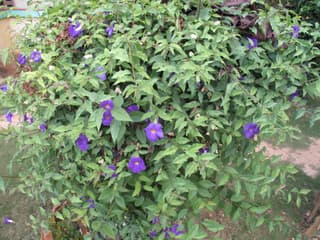
Thunbergia erecta
Thunbergia erecta, commonly known as Bush Clockvine or King's Mantle, is a fast-growing evergreen shrub native to West Africa. It produces stunning deep purple to blue tubular flowers with creamy yellow throats throughout summer and fall, making it a prized ornamental in tropical and subtropical gardens.

Blue Trumpet Vine
Thunbergia grandiflora
Thunbergia grandiflora, commonly known as the Blue Trumpet Vine or Sky Vine, is a vigorous, woody-stemmed evergreen climber native to India and Southeast Asia. It produces an abundance of large, trumpet-shaped lavender-blue flowers with pale yellow or white throats, blooming from summer through fall and year-round in tropical climates. Its heart-shaped, velvety dark green leaves and fast-growing twining stems make it a spectacular choice for covering fences, trellises, arbors, and pergolas.

Laurel Clockvine
Thunbergia laurifolia
Thunbergia laurifolia is a vigorous, evergreen climbing vine native to the Indomalayan region (India, Thailand, and Malaysia), prized for its glossy, laurel-like leaves and pale blue to lavender trumpet-shaped flowers with a creamy-yellow throat. It grows rapidly, often covering trellises, fences, and pergolas within a single season, and blooms nearly year-round in warm climates. In Southeast Asian traditional medicine, its leaves are used to make a detoxifying herbal tea (rang jeud). Because of its fast growth and tuberous root system, it has become an invasive weed in parts of Brazil, Australia, and other tropical regions, so it should be planted with care and contained.

Thyme
Thymus
Thyme (Thymus) is a genus of approximately 350 species of aromatic perennial herbs and subshrubs in the family Lamiaceae, native to the Mediterranean region, North Africa, and southwestern Asia. These low-growing woody plants feature tiny aromatic leaves and small tubular flowers in pink, lavender, or white. Widely grown as a culinary, medicinal, and ornamental herb, thyme is a cornerstone of Mediterranean cuisine and herbal medicine.
Mediterranean Thyme
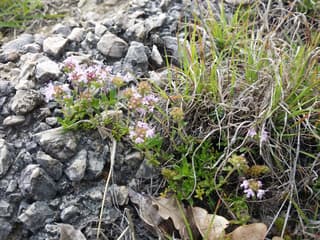
Thymus longicaulis
Thymus longicaulis, also known as Mediterranean thyme or long-stemmed thyme, is a low-growing, mat-forming perennial herb from the Lamiaceae family. The plant is native to southern Europe and grows naturally on dry, rocky slopes and in Mediterranean scrubland. It forms dense, prostrate mats with sparse, twig-like stems that can reach up to 4 inches (10 cm) in height and spread up to 16 inches (40 cm) wide. The leaves are lanceolate, dark green, and aromatic. In spring and summer, the plant produces clusters of pale pink flowers that attract bees and other pollinators. Like all thyme species, Thymus longicaulis contains essential oils with antibacterial and antifungal properties.
Creeping thyme
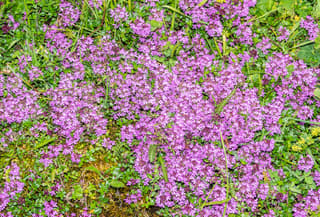
Thymus praecox
Creeping thyme (Thymus praecox) is a low, mat-forming, woody-based perennial in the mint family (Lamiaceae), native to Europe, Turkey and Greenland. Its stems spread along the ground and root as they go, forming a dense carpet 5 to 15 cm tall of tiny, hairy, blue-green leaves with a spicy scent. From late spring into summer it is covered in tiny pinkish-purple flowers that draw bees and butterflies. It tolerates light foot traffic and is a classic between stepping stones. It is a different species from Thymus serpyllum, though the two are often sold under each other's name.
Broad-leaved Thyme
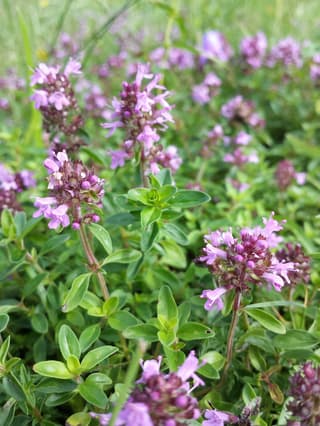
Thymus pulegioides
Thymus pulegioides is a low, mound-forming evergreen sub-shrub in the mint family (Lamiaceae), native to Europe. It has broader, more rounded leaves than common thyme, often marked with reddish tints, and produces clusters of small rose-purple to pale lilac flowers in summer. It is prized as a culinary herb, groundcover, and pollinator-friendly garden plant.
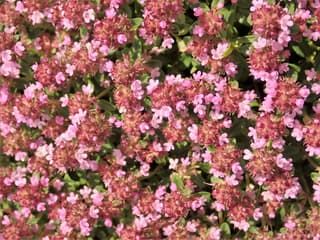
Wild Thyme
Thymus serpyllum
Wild Thyme (Thymus serpyllum) is a low-growing, creeping perennial herb from the Lamiaceae family, native to Europe and Western Asia. The plant forms dense, aromatic mats of small, dark glossy leaves and is covered in tiny purple-pink flowers in summer. It thrives in full sun, lean, well-draining soils, and is extremely drought-tolerant and hardy down to -15°C. Thymus serpyllum has a long history as a medicinal and culinary herb and is closely associated with symbols of courage and love.
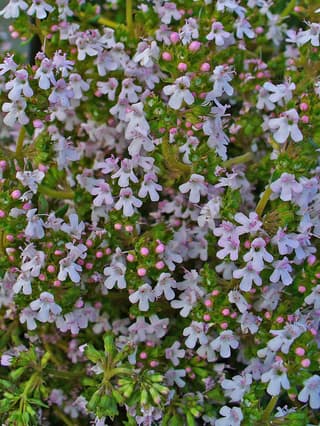
Common Thyme
Thymus vulgaris
Thymus vulgaris, commonly known as common thyme or garden thyme, is a fragrant evergreen herb native to the Mediterranean region. A member of the Lamiaceae (mint) family, this small woody-stemmed perennial has been cultivated for thousands of years for its culinary, medicinal, and ornamental virtues. It produces tiny aromatic leaves and delicate pink to purple flowers that attract pollinators.
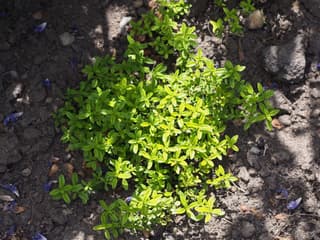
Lemon thyme
Thymus x citriodorus
Lemon thyme is a woody-based perennial subshrub that is primarily grown as a culinary herb for its intense lemon-scented foliage. It forms a low, spreading mat of tiny, oval, dark green leaves that may be variegated with gold or silver depending on the cultivar. During the summer, it produces small, nectar-rich lavender to pink flowers that are highly attractive to pollinators like bees and butterflies.
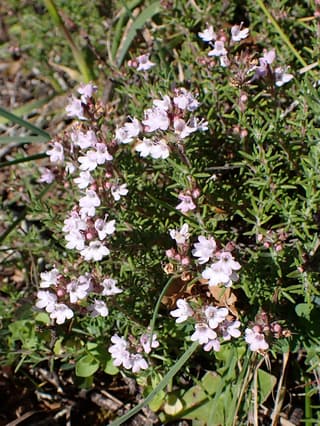
Spanish Thyme
Thymus zygis
Thymus zygis, commonly known as Spanish thyme or white thyme, is a perennial aromatic subshrub native to the Iberian Peninsula, belonging to the Lamiaceae family. It thrives in poor, sandy, and rocky soils, typically alkaline, adapted to the Mediterranean climate of hot, dry summers and mild winters. Its small, linear leaves are rich in essential oil (thymol, carvacrol, linalool), giving it an intense, characteristic aroma that makes it widely cultivated for both culinary and medicinal purposes. It flowers from May to July, producing small tubular pink, lilac, or white flowers clustered in dense inflorescences at the top of the stems, highly attractive to bees and other pollinators.

Tiger grass
Thysanolaena latifolia
Tiger grass (Thysanolaena latifolia) is a vigorous perennial grass from the Poaceae family, native to the tropical and subtropical regions of Asia. It forms dense clumps up to 3 meters tall, featuring broad bamboo-like leaves and large feathery panicles at the end of the season. It is widely used as a hedge and specimen plant in gardens, and its panicles are traditionally tied together to make brooms.
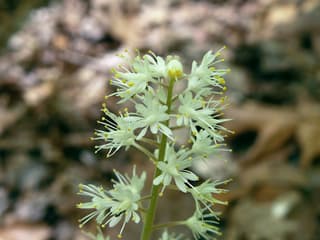
Foamflower
Tiarella cordifolia
Tiarella cordifolia, commonly known as foamflower, is a low-growing herbaceous perennial native to the woodlands of eastern North America, from Nova Scotia south through the Appalachian Mountains to Alabama. It forms a dense mat of heart-shaped, hairy-stalked leaves that often display attractive burgundy veining and takes on a bronze-red hue in cooler months. In mid to late spring, upright flower spikes rise above the foliage, covered in tiny, star-shaped white or pale pink blossoms that give the plant its foamy, frothy appearance. Foamflower spreads slowly by rhizomes and stolons, making it a popular choice for woodland gardens, shaded borders, and as a naturalizing ground cover beneath trees and shrubs.

Common lime
Tilia × europaea
The Common lime (Tilia x europaea) is a large, deciduous hybrid between the large-leaved lime and the small-leaved lime. This stately tree can reach heights of up to 35 meters and features a broad, dome-shaped canopy of heart-shaped leaves. In July, the tree bears clusters of small, yellowish flowers with a sweet, honey-like fragrance that attracts bees and other insects. Traditionally, the lime tree has been widely planted in the Netherlands along avenues, in squares, and as a village tree, symbolizing community and protection.
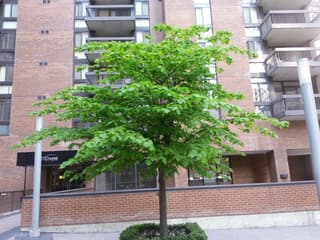
American basswood
Tilia americana
American basswood (Tilia americana) is a large deciduous tree of eastern and central North America, from Canada south to Florida and Texas. It reaches 18-25 m in cultivation and more than 30 m in the wild, with a broad crown and large heart-shaped leaves. In early summer it bears drooping clusters of small, pale yellow, very fragrant flowers hanging from a leaf-like bract. Bees work the flowers heavily, and basswood honey is prized. The wood is pale, light and soft, a favorite of woodcarvers.

Large-leaved Lime
Tilia platyphyllos
The large-leaved lime (Tilia platyphyllos) is a large deciduous tree native to Europe, in the family Malvaceae. It grows up to 25 m tall with a dense, pyramidal crown. Its fragrant pale-yellow flowers, highly attractive to bees, are traditionally harvested to brew linden tea.

Silver Linden
Tilia tomentosa
Silver Linden (Tilia tomentosa) is a large deciduous shade tree native to southeastern Europe and western Asia, including Albania, Bulgaria, Greece, Hungary, Romania, and Turkey. A member of the Malvaceae family, it is widely planted as a street, park, and specimen tree thanks to its dense, broad-pyramidal canopy and outstanding tolerance of urban pollution, heat, and road salt. Its heart-shaped leaves are dark green above and covered with a fine silvery-white down beneath, creating a shimmering effect when stirred by the wind — the source of its common name. From late spring into summer the tree produces hanging clusters of small, creamy-yellow, intensely fragrant, nectar-rich flowers that are highly attractive to bees and other pollinators. It typically reaches 50-70 ft (15-21 m) tall, occasionally up to 100 ft (30 m), with a spread of 30-50 ft (9-15 m), and grows at a rapid rate.
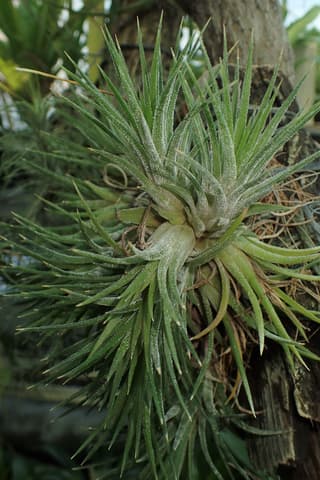
Air Plant
Tillandsia
Tillandsia is a genus of approximately 650 epiphytic plants in the Bromeliaceae family, native from the southern United States to Argentina. They require no soil, instead absorbing water and nutrients directly through their leaves via specialized structures called trichomes. Famous species include T. ionantha, T. xerographica, and Spanish Moss (T. usneoides).

Air plant
Tillandsia aeranthos
Tillandsia aeranthos is an epiphytic air plant from South America that lives without soil, clinging to branches, rocks or mounts. It forms clumps of stiff, silvery leaves and produces pink bracts with blue-violet flowers in spring.
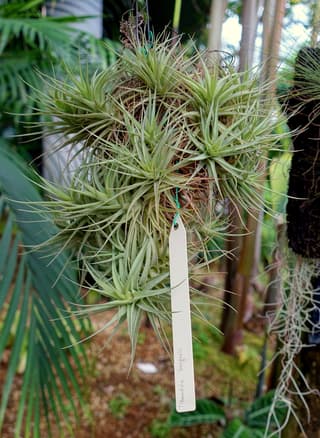
Berger's Airplant
Tillandsia bergeri
Tillandsia bergeri is an epiphytic and rock-dwelling bromeliad in the family Bromeliaceae, native to southern Brazil (Rio Grande do Sul), Uruguay and Argentina down to Buenos Aires, where it grows on trees and granite cliffs. It forms dense clumps of rosettes with narrow, grey-green, scaly leaves up to 14 cm long. In spring it produces a short spike of rose-pink bracts with pale lilac flowers with wavy petals. It needs no soil: it takes up water and nutrients through its leaves.
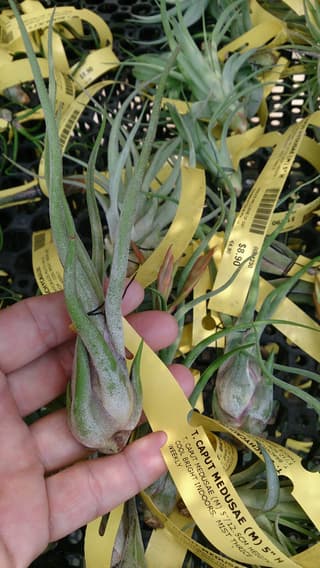
Medusa's Head Air Plant
Tillandsia caput-medusae
Tillandsia caput-medusae is an epiphytic bromeliad native to Mexico and Central America, where it grows attached to tree branches at elevations up to 2,000 meters. Its name comes from the bulbous base of the rosette, from which twisting, silvery-green leaves emerge, resembling snakes or the tentacles of an octopus. The leaves are covered in fine trichomes that absorb water and nutrients directly from the air. It is a hardy, slow-growing species, widely used in terrariums and mounted displays since it needs no soil at all.
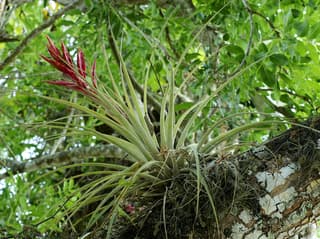
Giant airplant
Tillandsia fasciculata
Giant airplant (Tillandsia fasciculata) is an epiphytic bromeliad native to Florida and Georgia, Mexico, Central America, the Caribbean and northern South America. It forms rosettes of stiff, leathery, grey-green leaves 30 to 70 cm long and, when flowering, a branched spike of showy red, orange or yellow bracts with small violet flowers. In the wild it clings to tree trunks, especially bald cypress, taking up water and nutrients through its leaves.
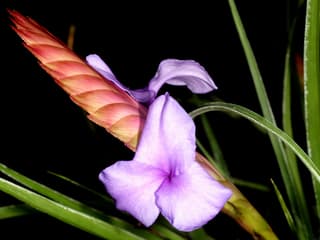
Guatemalan Air Plant
Tillandsia guatemalensis
Tillandsia guatemalensis is an epiphytic bromeliad native to forests from Mexico to Panama. It forms a rosette of silvery-grey leaves and produces a striking flower spike with deep rose-pink bracts and tubular violet-blue flowers. As a true air plant, it absorbs water and nutrients directly from the air through specialized leaf scales called trichomes.
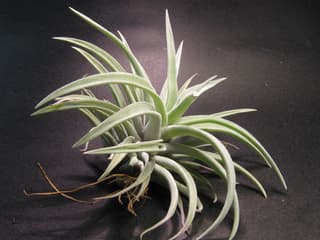
Harris's Air Plant
Tillandsia harrisii
Tillandsia harrisii is a slow-growing epiphytic bromeliad endemic to the dry rocky slopes of Zacapa, Guatemala. Its silvery, densely trichome-covered leaves form a tight rosette on a short stem, giving the plant a soft, fuzzy, almost white appearance that helps it survive intense sun and low humidity in its native habitat. After a year or two of growth it produces an upright spike with coral-red to orange bracts and violet-blue flowers, after which pups form at the base.
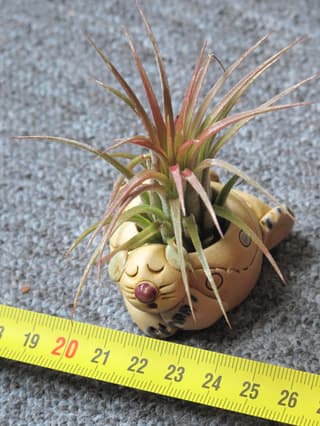
Sky Plant
Tillandsia ionantha
Tillandsia ionantha is a fascinating epiphytic plant from the bromeliad family, native to Central America and Mexico. Known as the air plant, it does not need soil to grow, absorbing water and nutrients directly from the air through its silver trichome-covered leaves. During flowering, its central leaves turn vivid red, contrasting with the delicate purple flowers.
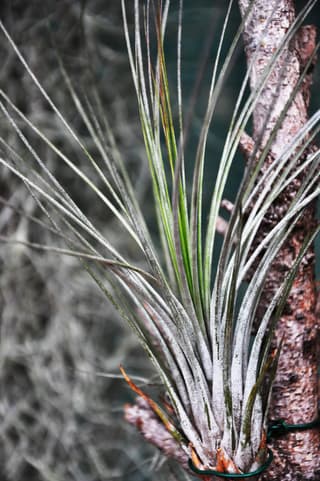
Rush-leaf Air Plant
Tillandsia juncea
Tillandsia juncea, the rush-leaf air plant, is an epiphytic bromeliad found from Mexico, Central America and the West Indies down to Colombia, Venezuela, Ecuador, Peru, Bolivia and eastern Brazil. It lives on tree trunks and branches from the lowlands up to mountain forests; in Mexico it is a classic fog-catcher, sitting high in the exposed canopy and drinking moisture from mist through the silvery scales (trichomes) that cover its leaves. It forms an upright clump up to about 40 cm tall of long, very narrow, grey-green leaves that look like rushes or grass. In spring and summer a mature plant sends up a spike of red bracts with small purple tubular flowers. Like other air plants it needs no soil: its roots only anchor it to bark. Each rosette flowers once, then produces offsets (pups) that carry on the clump.
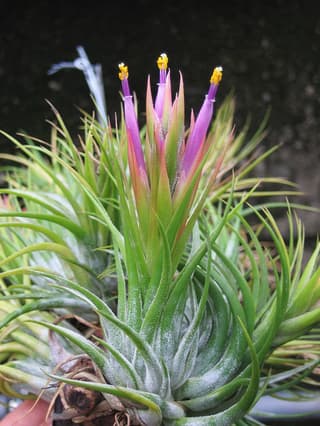
Kolbii air plant
Tillandsia kolbii
Tillandsia kolbii is an air plant (epiphytic bromeliad) native to Oaxaca and Chiapas in Mexico and to Guatemala, where it clings to trees and rocks at altitude. It forms a small, compact, upright rosette 6-12 cm tall of narrow, slightly curved leaves covered in silvery scales (trichomes) that give it a grey-green tone. At bloom time the central leaves blush red and purple tubular flowers appear. It was long sold as Tillandsia ionantha var. scaposa, a name now treated as a synonym.
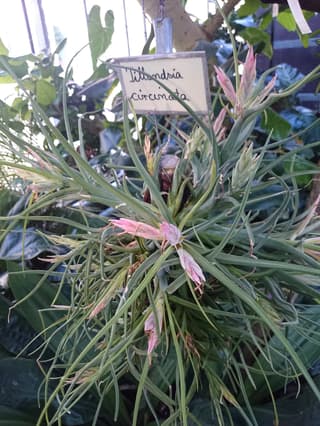
Potbelly airplant
Tillandsia paucifolia
Tillandsia paucifolia, often sold as Tillandsia circinnata, is an air plant in the bromeliad family that grows attached to trunks and branches, with no soil. It is native to Florida, the Caribbean, Mexico, Central America, Colombia and Venezuela. The rosette is about 18 cm tall and 15 cm wide, with a swollen bulb-like base and 5 to 10 thick, recurved leaves covered in silvery scales that take up water and nutrients from the air. When it blooms, in spring and summer, the plant blushes pink and sends up a spike with pink bracts and tubular purple to lavender flowers. It then produces pups that grow at right angles, like spokes on a wheel.
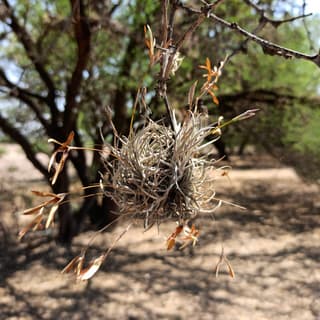
Ball moss
Tillandsia recurvata
Tillandsia recurvata is an epiphytic bromeliad in the family Bromeliaceae that clings to tree branches, fences and even power lines, from the warm southern United States down to northern Argentina and Chile. It forms gray balls from golf-ball to soccer-ball size, which are really many small plants joined together. The leaves are thin (3 mm), covered in silvery scales and curved backward, up to 18 cm long. The flowers are small, pale violet to white. Despite its name it is not a moss, and it is not a parasite: it makes its own food, drinks the water that lands on its leaves and takes minerals from dust.
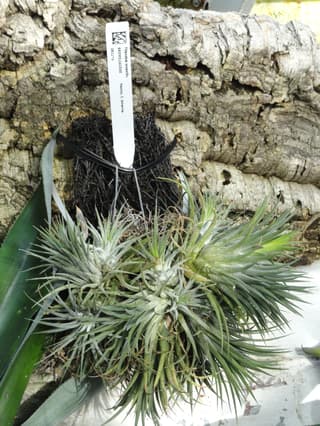
Air Plant
Tillandsia sp
Tillandsias, commonly known as air plants, belong to the Bromeliaceae family and represent its largest genus with over 660 species. Native to the tropical and subtropical Americas, from the southern United States to Argentina, these fascinating epiphytes require no soil to thrive. Instead, they absorb water and nutrients directly from the air through specialized leaf structures called trichomes. Their ability to adapt to diverse environments—from tropical rainforests and cloud forests to arid deserts and rocky mountainsides—makes them among the most versatile and unique plants in the world.
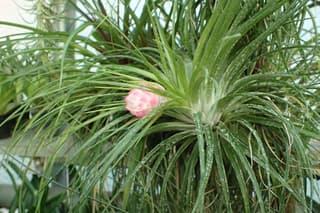
Upright Air Plant
Tillandsia stricta
Tillandsia stricta, commonly known as the Upright Air Plant, is an epiphytic bromeliad native to eastern South America, ranging from Venezuela to northern Argentina. Unlike most plants, it requires no soil to thrive — it absorbs water and nutrients directly through its silvery trichome-covered leaves. It produces stunning blooms in shades of red, pink, blue, and purple in spring and summer, making it one of the most ornamental air plants available.
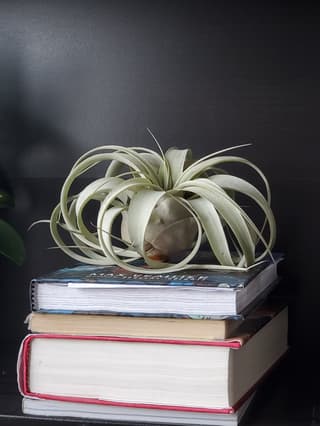
King of Air Plants
Tillandsia xerographica
Tillandsia xerographica is known as the "King of Air Plants" due to its impressive size and beautifully curled silvery-green leaves. This epiphytic plant is native to southern Mexico, Guatemala, and El Salvador. It can reach up to 90 cm in diameter and is highly prized for its sculptural rosette shape. Like all tillandsias, it doesn't need soil to grow and absorbs water and nutrients through its leaves. It is protected under CITES due to past overharvesting in the wild.

Tipu tree
Tipuana tipu
The Tipu tree (Tipuana tipu) is a majestic, fast-growing tree native to South America. Known for its broad, leafy umbrella-shaped canopy, it provides dense and refreshing shade. During spring and early summer, the tree is covered in clusters of vibrant yellow flowers that, when they fall, create a beautiful golden carpet on the ground. Its leaves are compound and light green, and its fruits are winged samaras, similar to those of a maple.
Mexican Sunflower
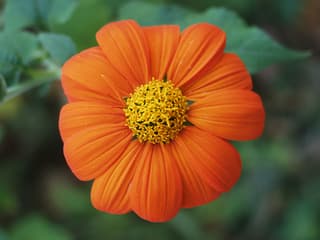
Tithonia
Tithonia is a genus of flowering plants in the family Asteraceae, native to Mexico and Central America, widely grown as a garden ornamental worldwide. The most popular species, Tithonia rotundifolia, is celebrated for its brilliant orange daisy-like blooms that attract butterflies, bees, and hummingbirds. Fast-growing and highly heat- and drought-tolerant, it is an outstanding choice for sunny summer gardens.
Mexican Sunflower
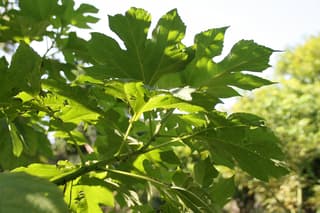
Tithonia diversifolia
Mexican Sunflower (Tithonia diversifolia) is a fast-growing shrub in the Asteraceae family, native to Mexico and Central America. It reaches up to 4 meters tall and produces vivid orange and yellow flowers from summer through fall. Widely naturalized across the tropics, it is prized as an ornamental, green manure crop, and medicinal plant.
What are Easy Plants?
Easy Plants are ideal for beginners or people with little time for care. These species are tolerant of watering mistakes, light variations, and don't require constant attention. Perfect for those just starting out with plants.
Tips for Growing Easy Plants
To succeed with easy plants, remember: less is more. Avoid overwatering, choose a spot with adequate light, and let the soil dry between waterings. Most of these plants prefer to be 'forgotten' occasionally.