Complete Plant Guide
Explore plants by difficulty, season and more. Find the perfect plant for you.
Difficulty
Categories
Plants by City
🗺️ Plants by City3454 plants found
Showing 685-720 of 3454
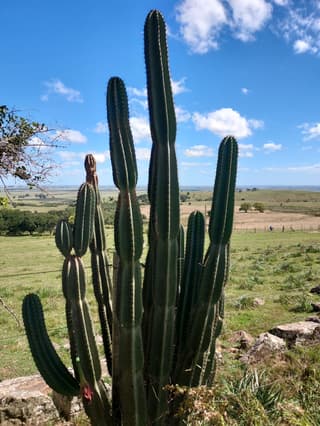
Cereus / Hedge Cactus (genus)
Cereus
Cereus is a genus of tall columnar cacti native to South America, including species like C. hildmannianus, C. repandus, and C. peruvianus. These robust, fast-growing cacti produce spectacular white nocturnal flowers and are widely grown as ornamental plants in gardens and sunny interiors.

Beach Apple Cactus
Cereus fernambucensis
The beach apple cactus is a shrubby, richly branching columnar cactus endemic to the eastern coast of Brazil, where it grows on sand dunes, restinga scrub, and rocky coastal outcrops, forming dense clumps up to 5 meters across. Its ribbed, spiny stems bear large, night-blooming white flowers followed by edible fruit with tangy white pulp. It is a tough, drought- and salt-tolerant species well suited to hot, sunny coastal conditions.
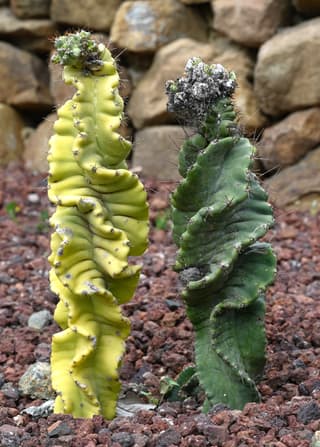
Spiral Cactus
Cereus forbesii 'Spiralis'
Cereus forbesii 'Spiralis' is a columnar cactus featuring blue-green, waxy-coated stems with ribs that twist spirally around the trunk, creating a striking decorative effect. In its natural South American habitat, it can reach several meters in height, but in container cultivation, it grows much slower and remains more compact. During summer nights, mature specimens may produce large, funnel-shaped white flowers. It is an easy-to-care-for plant, drought-tolerant and resilient to neglect, making it ideal for beginner succulent enthusiasts.
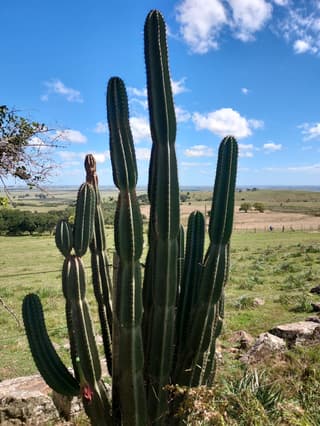
Monster Cactus
Cereus hildmannianus
Cereus hildmannianus f. monstrosus, commonly known as Monster Cactus, is a fascinating and sculptural variant of the columnar cactus native to South America. Its most striking characteristic is its irregular and twisted growth, resulting from mutations in the growth points, which creates unique and 'monstrous' forms. It has a bluish-green coloration and, although rarely in pots, can produce large nocturnal white flowers followed by reddish, sweet fruits.
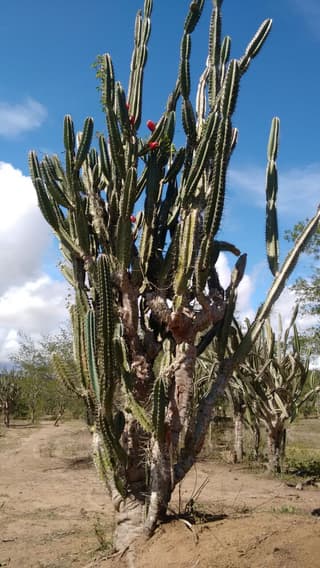
Mandacaru Cactus
Cereus jamacaru
Cereus jamacaru, popularly known as Mandacaru, is an iconic columnar cactus native to the Brazilian semi-arid region. It is characterized by its imposing stature, thorny branches, and magnificent white flowers that bloom only at night and wither by dawn. A symbol of the Caatinga's resilience and vitality, it is capable of storing large amounts of water in its succulent stem.
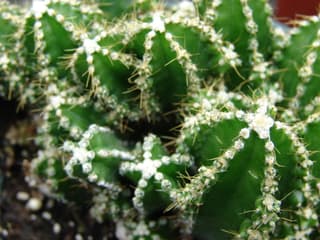
Giant Peruvian Cereus
Cereus peruvianus
The Giant Peruvian Cereus (Cereus peruvianus) is a fast-growing columnar cactus native to South America, closely related to other Cereus species and prized for its dramatic upright form and large, fragrant, night-blooming flowers. It can grow several meters tall, featuring blue-green ribbed stems armed with sturdy spines. Its cream to white flowers open only at night and wilt by morning. Extremely drought-tolerant, it is commonly grown as an ornamental accent, security hedge, or living fence in warm climates.
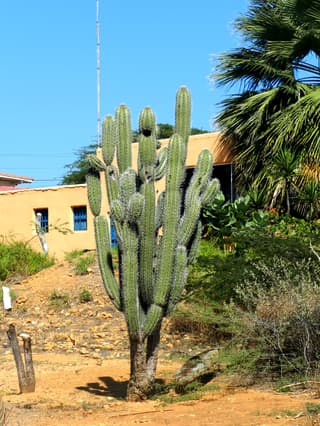
Peruvian Apple Cactus
Cereus repandus
Cereus repandus, commonly known as the Peruvian Apple Cactus, is a tall columnar cactus native to South America, particularly Venezuela and Colombia. Its gray-green to blue-green cylindrical stems can reach up to 33 feet (10m) in the wild, adorned with 8-13 ribs and robust spines. In late spring through fall, fragrant white flowers bloom for a single night before giving way to edible red fruit. This fast-growing species is celebrated worldwide for its architectural beauty and remarkable drought tolerance.

honeywort
Cerinthe major
Cerinthe major, commonly called honeywort, is a fast-growing Mediterranean annual in the borage family prized for its waxy, blue-green foliage and nodding clusters of tubular flowers cupped by heart-shaped bracts. Native to southern Europe, western Asia and North Africa, it self-seeds readily in warm borders and containers, blooming from spring through fall. Its nectar-rich flowers are a magnet for bees and other pollinators, and the genus name -- Greek for "wax flower" -- nods to the old belief that bees gathered wax from its blooms.
Cerioporus
Cerioporus
Cerioporus is a genus of polypore fungi, most notably represented by Cerioporus squamosus, commonly known as Dryad's Saddle. These fungi are characterized by their large, fan-shaped or kidney-shaped fruiting bodies that grow on decaying hardwood. They feature a distinctive pattern of brownish scales on their upper surface and a porous underside instead of gills. When young, they are tender and possess a unique scent reminiscent of watermelon rind or cucumber.
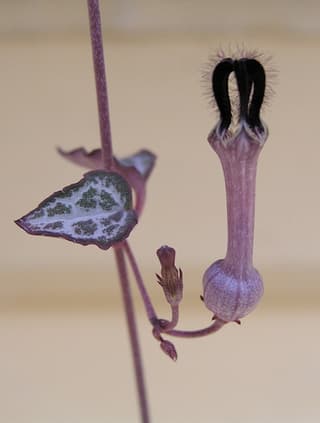
Rosary Vine
Ceropegia
Ceropegia is a genus of succulent trailing and climbing plants in the family Apocynaceae, native primarily to South Africa, Eswatini, and Zimbabwe. The most popular species is Ceropegia woodii, commonly known as String of Hearts or Rosary Vine, celebrated for its heart-shaped leaves in dark green with silver variegations and purple undersides, cascading along long trailing stems. It produces tubular lantern-shaped flowers in pale pink to deep purple during summer and fall, and forms aerial tubers along its stems that can be used for propagation.
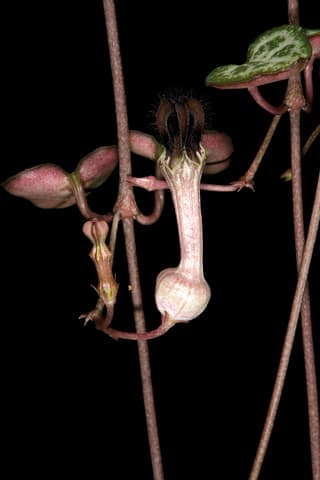
String of Hearts
Ceropegia woodii
Ceropegia woodii, commonly known as String of Hearts, is a charming trailing succulent native to South Africa. This elegant plant features delicate heart-shaped leaves with beautiful marbled patterns in shades of green and silver, growing on slender, cascading vines that can reach up to 4 meters in length. It produces small, tube-shaped pink-purple flowers in summer and fall, and develops small aerial tubers along its stems.
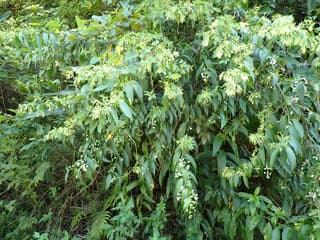
Night-blooming jasmine
Cestrum nocturnum
Cestrum nocturnum, commonly known as Night-blooming jasmine, is a fast-growing woody shrub famous for its small, greenish flowers that open at dusk, releasing a sweet and powerful fragrance that can be detected from long distances.
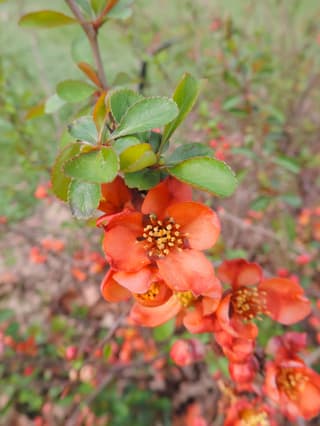
Maule's Quince
Chaenomeles japonica
Maule's Quince (Chaenomeles japonica) is a thorny, deciduous shrub native to Japan and South Korea, belonging to the Rosaceae family. It is prized as an ornamental plant for its spectacular early spring blooms in shades of red, orange, pink, and white, which appear on bare branches before the leaves emerge. The small, yellow-green fruits are aromatic and edible, commonly used in jellies, preserves, and liqueurs. Highly cold-hardy (USDA zones 5a–9b), it is widely used in borders, hedges, erosion control, and bonsai cultivation.
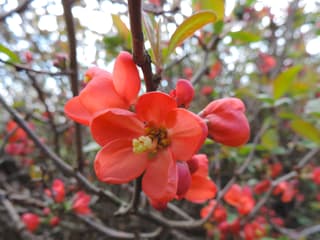
Flowering Quince
Chaenomeles speciosa
Flowering quince (Chaenomeles speciosa) is a dense, deciduous shrub native to China, Tibet, and Myanmar, belonging to the Rosaceae family. It bursts into spectacular bloom in late winter and early spring—often before its leaves emerge—producing flowers in shades of red, pink, and white. The plant also yields fragrant, yellow-green fruits high in vitamin C, valued for making jams, jellies, and medicinal preparations. It is extremely cold-hardy and adaptable to a wide range of garden conditions.
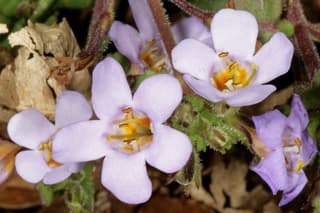
Bacopa
Chaenostoma cordatum
Chaenostoma cordatum, popularly known as Bacopa, is a fast-growing evergreen creeping perennial from the Scrophulariaceae family, native to South Africa. The plant forms a dense carpet of small heart-shaped green leaves and produces an abundance of small five-petaled flowers in white, pink, blue, or purple shades. It features a bushy and naturally trailing growth habit, making it popular for balcony boxes, hanging baskets, and as groundcover in garden beds.
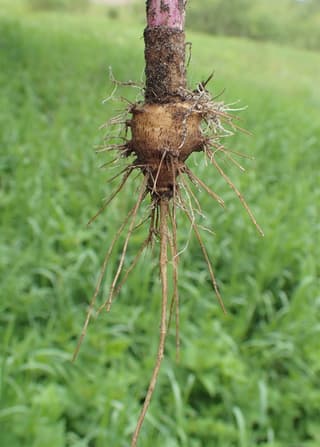
Bulbous Chervil
Chaerophyllum
Chaerophyllum is a genus of roughly 35-40 flowering herbs in the carrot family (Apiaceae), native to temperate regions of Europe, Asia, North America and northern Africa. The genus includes both wild roadside species, such as rough chervil (C. temulum), and the cultivated turnip-rooted chervil (C. bulbosum), grown for its sweet, starchy taproot. Plants form feathery, fern-like foliage and produce flat umbels of small white flowers in late spring to summer.
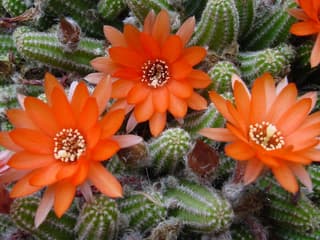
Peanut Cactus
Chamaecereus silvestrii
Chamaecereus silvestrii, commonly known as the Peanut Cactus, is a succulent native to Argentina. It features cylindrical, branched stems that grow in a prostrate manner, resembling peanuts. It is famous for its spectacular spring blooming, producing large, vibrant orange and red flowers that contrast with the light green of its stems.
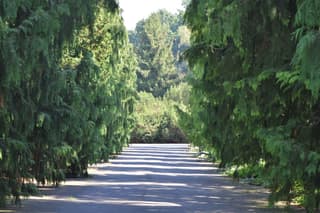
Lawson's Cypress
Chamaecyparis lawsoniana
Chamaecyparis lawsoniana, known as Lawson's Cypress or Port-Orford-cedar, is a large evergreen conifer native to southwestern Oregon and northwestern California. Renowned for its graceful, drooping branch tips and scale-like foliage, it is widely cultivated as an ornamental tree and hedge plant in temperate gardens worldwide.
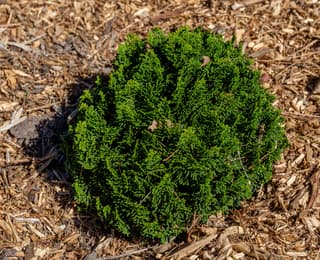
Hinoki Cypress
Chamaecyparis obtusa
Chamaecyparis obtusa, commonly known as Hinoki Cypress, is an evergreen conifer native to central and southern Japan. It features elegant, dark-green scale-like foliage with a slow, pyramidal growth habit. Widely used in Japanese Zen gardens, bonsai, and ornamental landscaping, it can reach over 20 meters in the wild but remains compact in cultivation.
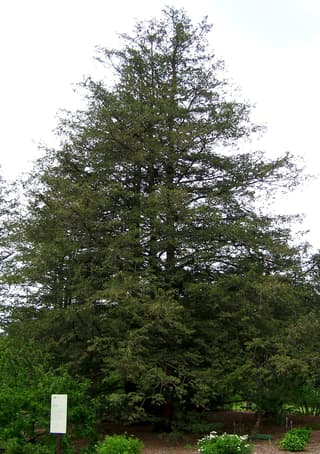
Sawara cypress
Chamaecyparis pisifera
Chamaecyparis pisifera, commonly known as Sawara cypress or Sawara false cypress, is an evergreen conifer native to Japan, belonging to the Cupressaceae family. It is widely cultivated as an ornamental tree prized for its graceful, scale-like foliage and pyramidal form. The species encompasses over 100 cultivars ranging in color from deep green to golden yellow and silver-blue, and in size from compact dwarf forms to large specimen trees reaching 60 feet. Highly valued in Japanese gardens, it is frequently found near Shinto shrines and Buddhist temples.
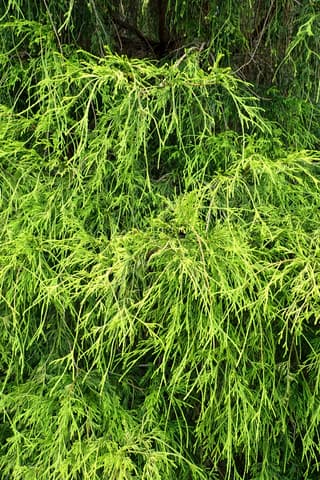
Golden Thread Cypress
Chamaecyparis pisifera filifera aurea
Golden Thread Cypress (Chamaecyparis pisifera filifera aurea) is a slow-growing, semi-dwarf evergreen conifer native to Japan. It is prized for its gracefully weeping, thread-like golden foliage that creates a striking focal point in any garden. In ideal conditions it can reach up to 20 feet (6 m), but typically grows 6-7 feet in residential gardens over 20 years. Widely used in Japanese-style gardens, rock gardens, and as a year-round landscape specimen.
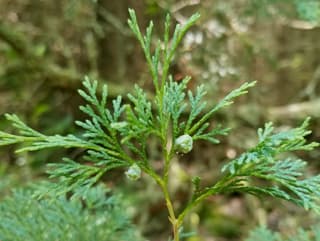
Atlantic White Cedar
Chamaecyparis thyoides
Atlantic White Cedar is a slow-growing, evergreen conifer native to the coastal freshwater swamps and bogs of eastern North America, ranging from Maine to Florida. It forms a graceful, narrow columnar shape with soft, aromatic, blue-green scale-like foliage and fibrous reddish-brown bark.
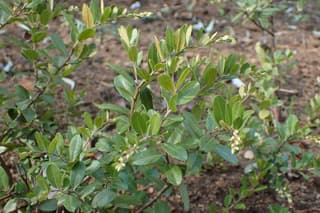
Leatherleaf
Chamaedaphne calyculata
Chamaedaphne calyculata, commonly called leatherleaf or cassandra, is a perennial dwarf evergreen shrub in the family Ericaceae and the sole species in genus Chamaedaphne. Native to acidic bogs and boreal peatlands across North America, Europe, and Asia, it spreads via rhizomes to form dense thickets. Its thick, leathery, dark green leaves turn bronze-red in winter, and it produces small white urn-shaped flowers in one-sided racemes in spring.

Parlor Palm
Chamaedorea
Chamaedorea is a genus of about 110 species of understory palms native to the tropical rainforests of Central America and Mexico. The most famous member, Chamaedorea elegans (Parlor Palm), is one of the world's most popular houseplants, celebrated for its graceful arching fronds and remarkable tolerance of low-light indoor conditions.

Cat Palm
Chamaedorea cataractarum
Chamaedorea cataractarum, commonly known as the cat palm or cascade palm, is a clumping, trunkless palm native to riverbanks and waterfalls in Mexico and Central America. Its arching, deep-green pinnate fronds emerge directly from the soil, forming dense, jungle-like clusters. It is one of the few palms considered truly non-toxic to cats and dogs.
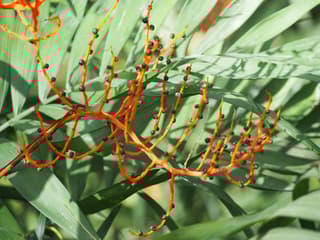
Parlor Palm
Chamaedorea elegans
Chamaedorea elegans is a small palm native to the tropical rainforests of Mexico and Guatemala. It is one of the most popular houseplants due to its elegant bright green foliage, ability to thrive in low light conditions, and easy care requirements. It was featured in NASA's Clean Air Study for its ability to purify air by removing toxins like formaldehyde and benzene. Completely safe for pets and children.
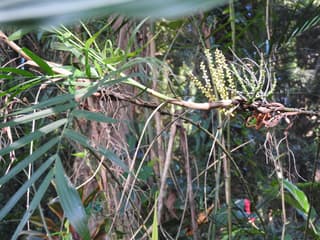
Bamboo Palm
Chamaedorea seifrizii
Chamaedorea seifrizii is a tropical palm native to Mexico and Central America that forms dense clusters of slender bamboo-like stems. Highly valued as an indoor plant for its elegance, low light tolerance and air-purifying qualities. It can reach up to 3 meters tall with dark green pinnate fronds.
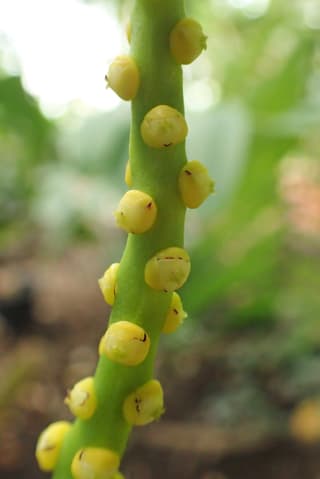
Pacaya Palm
Chamaedorea tepejilote
Chamaedorea tepejilote, commonly known as the Pacaya Palm, is a tropical understory palm native to Central America and southern Mexico. It is prized for its edible inflorescences, widely used in Guatemalan and Mexican cuisine, and for its graceful arching fronds that make it an excellent indoor or shaded garden plant.
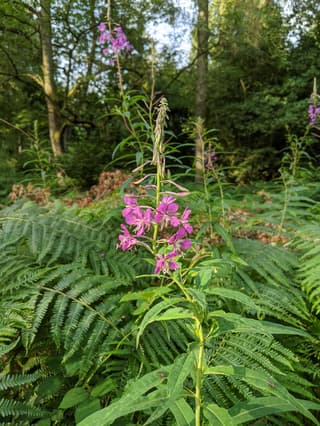
Fireweed
Chamaenerion angustifolium
Fireweed (Chamaenerion angustifolium) is a perennial herbaceous plant in the willowherb family Onagraceae. The height of the aerial stem usually reaches 60-120 cm, rarely up to 150-200 cm. The stem is generally unbranched and hairless, with leaves arranged spirally along the stem. The flowers are lilac-pink to dark pink, radially symmetrical with four petals, blooming in long racemes from early June to September. The four-chambered capsule opens to disperse seeds via the wind using white feathery hairs. The rhizome is creeping and thick, forming numerous new shoots. The plant is a pioneer species that quickly colonizes burn sites, clearings, and other disturbed areas, and is common in Estonia.
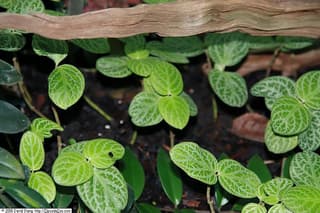
Veined Chamaeranthemum
Chamaeranthemum venosum
Chamaeranthemum venosum, commonly known as the Veined Chamaeranthemum or Silver Vein Plant, is a low-growing perennial herb native to the tropical forests of Brazil. Its oval dark-green leaves are elegantly decorated with silver veins, creating a striking ornamental display. Compact and creeping, it rarely exceeds 20 cm in height, making it ideal as a ground cover or houseplant.
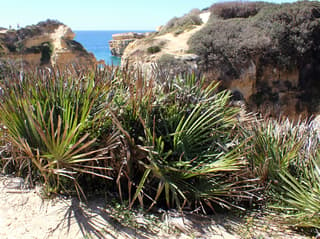
European Fan Palm
Chamaerops humilis
Chamaerops humilis, commonly known as the European Fan Palm or Mediterranean Fan Palm, is the only palm species native to mainland Europe. Indigenous to the western Mediterranean basin — spanning Spain, Portugal, and North Africa — this slow-growing, clumping shrub palm is celebrated for its exceptional hardiness: it tolerates frost down to -12°C, prolonged drought, and poor soils. Its striking silver-green fan-shaped fronds and multi-stemmed habit make it a prized specimen in Mediterranean gardens and a handsome indoor plant for bright spaces.
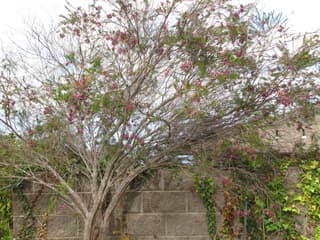
Geraldton Waxflower
Chamelaucium uncinatum
Chamelaucium uncinatum, commonly known as the Geraldton Waxflower, is a stunning evergreen shrub native to the coastal heathlands of Western Australia, particularly the Geraldton region. It produces masses of small, waxy, five-petalled flowers in shades of white, pink, magenta, and purple from late winter through spring. The needle-like foliage releases a light citrus fragrance when crushed. Highly valued as a cut flower worldwide, it thrives in dry, sunny Mediterranean-type conditions and is beloved in Australian native gardens.
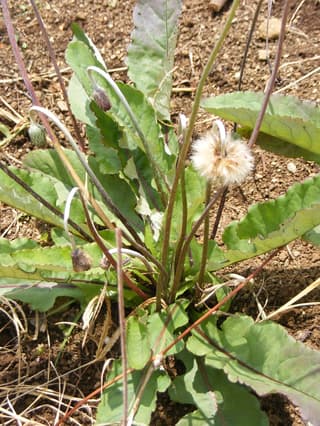
Silverpuff
Chaptalia nutans
Silverpuff (Chaptalia nutans) is a perennial herb native to Brazil and the Asteraceae family. It is stemless (acaulescent) with leaves arranged in a basal rosette; these leaves are entire or slightly toothed, dark green on top, and whitish and velvety underneath due to a dense layer of hairs. Its flower stalks emerge from the center of the rosette, supporting flower heads of pale pink, nodding flowers (a characteristic that gave rise to the scientific name "nutans," meaning "drooping"). It is very common in pastures, lawns, and vacant lots in tropical and subtropical climates, blooming mainly between October and January in Brazil, and is traditionally used as a medicinal plant in backyards and herbal gardens.
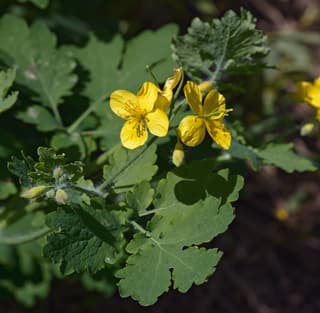
Greater celandine
Chelidonium majus
Greater celandine (Chelidonium majus) is a perennial herb in the poppy family (Papaveraceae), native to Europe and western Asia, and now widespread in North America where it is considered invasive. It grows to a height of approximately 30–120 cm, featuring grayish-green pinnately divided leaves and small four-petaled yellow flowers that bloom from May to September. When injured, every part of the plant exudes a characteristic orange-yellow toxic sap containing isoquinoline alkaloids (such as chelidonine, sanguinarine, berberine, and coptisine). It grows on waste ground, near fences, in forest undergrowth, and in shady areas near human settlements. Both the Latin and common names refer to swallows (Greek: chelidón) – according to tradition, the plant blooms from their arrival until their departure.
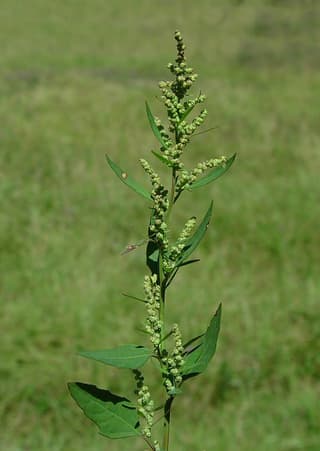
Goosefoot
Chenopodium
Chenopodium is a large genus of annual herbaceous plants in the family Amaranthaceae, found across temperate and tropical regions worldwide. It includes well-known species such as quinoa (C. quinoa), lambsquarters (C. album), and epazote (C. ambrosioides), valued for their culinary and medicinal properties.
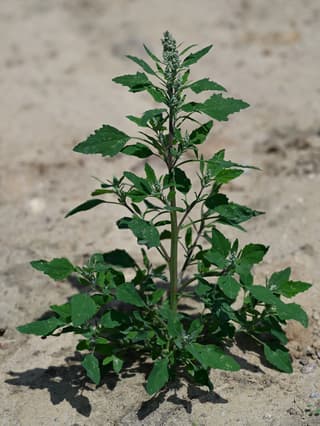
Lamb's Quarters
Chenopodium album
Lamb's quarters (Chenopodium album) is a fast-growing annual herb found across the world in disturbed soils, garden beds, and agricultural fields. Often considered an invasive weed, it is also a highly nutritious edible and medicinal plant used for thousands of years across cultures.
Find the Perfect Plant
Our plant guide helps you find ideal species for your experience level and time of year.
Browse by Difficulty, Season & More
Use the filters below to narrow this catalog by care difficulty, season, environment, or search directly by name. Each filter leads to a focused list tailored to your specific growing conditions.