Complete Plant Guide
Explore plants by difficulty, season and more. Find the perfect plant for you.
Difficulty
Categories
Plants by City
🗺️ Plants by City3658 plants found
Showing 3493-3528 of 3658
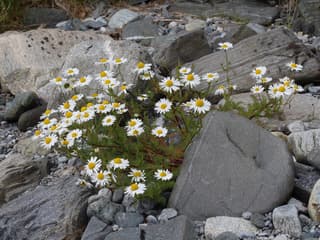
Sea Mayweed
Tripleurospermum maritimum
Sea Mayweed (Tripleurospermum maritimum) is a short-lived perennial in the daisy family, native to the coasts of Europe, Greenland, and the Azores. It forms sprawling, fleshy-leaved mounds along drift-lines, shingle beaches, and cliff tops, producing classic daisy-like flowers with white ray petals around a yellow disk from early summer into autumn. Its succulent, finely divided foliage is an adaptation to salty, windswept habitats, and mature stems often turn purple by late summer.
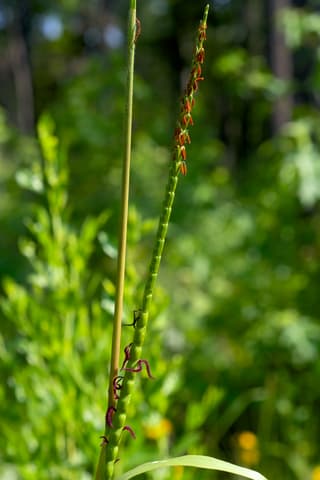
eastern gamagrass
Tripsacum dactyloides
Tripsacum dactyloides, commonly known as Eastern Gamagrass, is a robust, native perennial bunchgrass of North America. A distant relative of maize, it forms large, impressive clumps of arching, wide green leaves. It is highly valued for its deep root system, which aids in soil stabilization and drought resistance, and its unique flowering spikes that feature distinct male and female sections.
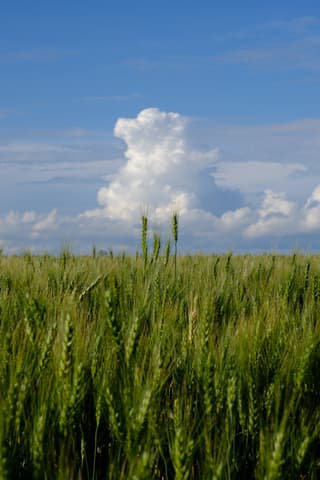
Common wheat
Triticum aestivum
Common wheat (Triticum aestivum) is the most widely cultivated cereal grain in the world and is among humanity's oldest cultivated plants. Domesticated over 9,000 years ago in the Near East, it is now grown on every continent. This annual grass reaches a height of up to 120 cm and forms characteristic spikes that ripen in summer. Its grains are the foundation for bread, flour, pasta, and a variety of other foods. Common wheat has relatively high demands for soil, water, and climate, preferring sunny locations with nutrient-rich, well-drained soils.
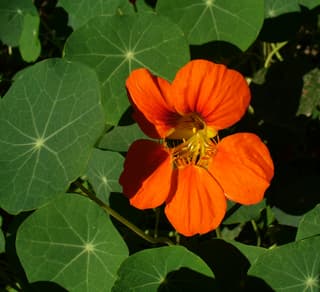
Nasturtium
Tropaeolum
Tropaeolum is a genus of trailing or climbing herbaceous plants in the family Tropaeolaceae, native to Central and South America. The most widely cultivated species, Tropaeolum majus (garden nasturtium), has rounded peltate leaves and showy flowers in red, orange, yellow, pink, white and cream. It is a fast-growing annual popular as an ornamental, an edible plant, and a companion plant that lures aphids away from vegetable crops.
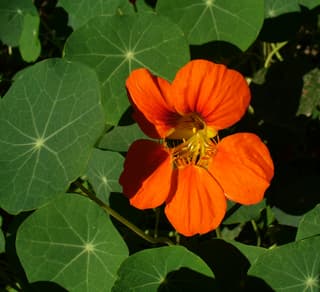
Nasturtium
Tropaeolum majus
Tropaeolum majus, commonly known as Nasturtium, is a fast-growing annual or short-lived perennial plant famous for its vibrant, funnel-shaped flowers and peltate (shield-shaped) leaves. Originating from the Andes, it has become a garden staple worldwide due to its hardiness and versatility. Every part of the plant above ground is edible, offering a peppery flavor similar to watercress. It is often used in companion planting to deter pests from vegetables like cucumbers and tomatoes.
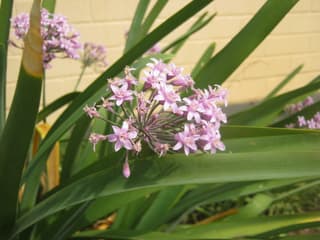
Sweet Garlic
Tulbaghia simmleri
Tulbaghia simmleri, commonly known as Sweet Garlic, is an elegant, clump-forming evergreen perennial native to the grasslands and rocky slopes of South Africa. It produces slender grey-green strap-like leaves and bears delicate umbels of sweetly fragrant pink to mauve-pink tubular flowers from spring through autumn. Unlike its relative Society Garlic, its flowers carry a pleasant sweet scent rather than a garlicky one.

Tulip
Tulipa
Tulipa is a genus of spring-flowering bulbous perennials in the lily family (Liliaceae), prized for their cup-shaped blooms in nearly every color imaginable. Native to Central Asia and naturalized across Europe, tulips are among the most popular ornamental bulbs worldwide, planted in fall to bloom the following spring.
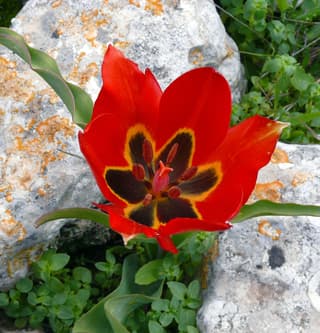
Sun's-Eye Tulip
Tulipa agenensis
Tulipa agenensis, commonly known as the Sun's-Eye Tulip or Sharon Tulip, is a wild tulip species native to the Middle East and eastern Mediterranean region. It produces striking scarlet flowers with a distinctive black basal blotch edged in yellow, blooming in spring. As a deciduous bulbous perennial, it enters summer dormancy and is well-adapted to dry, sunny Mediterranean climates.
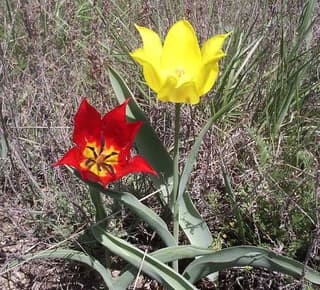
Tulip
Tulipa gesneriana
The garden tulip (Tulipa gesneriana) is one of the most iconic and beloved flowers in the world, originating from Central Asia and widely cultivated in Europe since the 16th century. Its cup-shaped flowers, with vibrant petals in shades of red, yellow, white, pink, and purple, emerge in spring and transform gardens into spectacles of color. It is a bulbous plant that requires a cold dormancy period to bloom exuberantly.
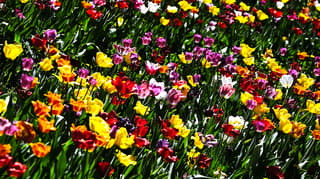
Hybrid Tulip
Tulipa hybrida
Hybrid Tulips (Tulipa hybrida) are the iconic spring-blooming bulbous perennials beloved worldwide for their vivid, cup-shaped flowers. Originating from wild species of Central Asia and Turkey, centuries of cultivation in the Netherlands and beyond have produced thousands of named varieties in nearly every color imaginable. They bloom in early to late spring and are a classic feature of both formal gardens and informal borders.
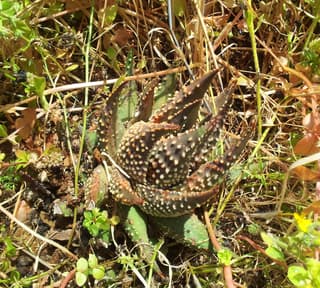
Pearl Plant
Tulista pumila
Tulista pumila (formerly Haworthia pumila / Haworthiopsis pumila) is a small South African succulent from the Asphodelaceae family, native to the Western Cape Karoo in the Robertson-Worcester region. It forms compact, stemless rosettes with rigid, upright, and slightly incurved leaves covered in rounded whitish tubercles that resemble pearls—hence its common name. In summer (November-December in its native habitat), it produces a thin flower spike with small tubular flowers in shades of white and pink. It is a slow-growing, long-lived plant (capable of living 30-40 years) and is highly prized as an ornamental indoor succulent and in rock gardens.
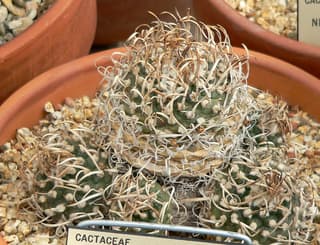
Schmiedicke's Turbinicarpus
Turbinicarpus schmiedickeanus
Turbinicarpus schmiedickeanus is a small, slow-growing cactus endemic to the arid deserts of Nuevo Leon, San Luis Potosi and Tamaulipas in northeastern Mexico. Its solitary, spherical to slightly depressed green stem barely reaches 5 cm tall and 4 cm wide, covered in pyramidal tubercles tipped with woolly areoles and a handful of slender spines. In summer it produces delicate white flowers from the woolly crown. The species is listed as Near Threatened by the IUCN and protected under CITES Appendix I due to habitat loss and over-collection.
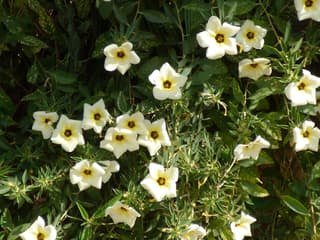
White Buttercup
Turnera subulata
White buttercup (Turnera subulata) is a low, woody-based perennial subshrub native to Central and South America, from Panama south through Brazil, and now naturalized across many tropical regions including Malaysia, Indonesia, the Pacific Islands, the Caribbean and Florida. It grows to about 80 cm tall, with oval, toothed leaves up to 9 cm long and white-haired undersides. Its five-petaled white to pale-yellow flowers have a darker purple-brown throat and open in the early morning, closing again by around 11 a.m. The plant blooms nearly year-round and is a reliable nectar source for bees.
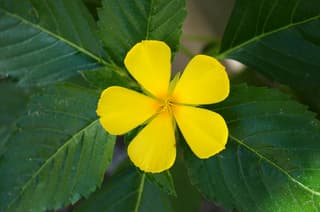
Yellow Alder
Turnera ulmifolia
Yellow alder (Turnera ulmifolia) is a tropical perennial subshrub native to Mexico, Central America, the Caribbean and northern South America. It produces bright yellow flowers that open at sunrise and wilt by midday, and is widely grown as a butterfly-attracting ornamental.
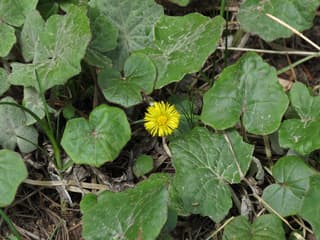
Coltsfoot
Tussilago farfara
Coltsfoot (Tussilago farfara) is a perennial herbaceous plant in the Asteraceae family, known for its exceptional growth habit: flowers emerge in early spring before the leaves appear. The scaly, 5–15 cm tall flower stalks bear bright yellow, dandelion-like inflorescences as early as April or May. Only after flowering do the large, 10–20 cm wide heart- or kidney-shaped leaves emerge from the ground, with undersides covered in a dense white down. The plant spreads effectively via long rhizomes reaching depths of up to 70 cm and often forms extensive colonies in open, sunny locations—roadside verges, ditch banks, sandy shores, and disturbed ground. The species is very common in Southern and Central Finland, becoming rarer toward the north. The genus and species names derive from the Latin words 'tussis' (cough) and 'agere' (to act on/expel), referring to the plant's long history in folk medicine for treating coughs.
Bitter Bolete
Tylopilus felleus
Tylopilus felleus, commonly known as the bitter bolete, is a species of fungus in the Boletaceae family. It is notorious for its extremely bitter taste, which renders it inedible, although it is not lethally poisonous. The mushroom features a brown cap, a white to pinkish pore surface, and a characteristic dark reticulation (net-like pattern) on the stem. It grows in symbiosis with coniferous and deciduous trees, preferring acidic soil.
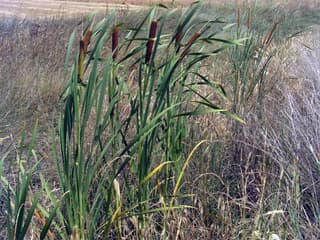
Southern Cattail
Typha domingensis
The Southern Cattail (Typha domingensis) is a perennial herbaceous plant from the Typhaceae family, native to wetlands, marshes, and the banks of rivers and lagoons in tropical and subtropical regions of the Americas. It forms dense reed beds up to 4 meters high thanks to its creeping, vigorous, and colonizing rhizomes. Its leaves are long, flat, and upright, and its flowers are grouped in a characteristic brown cylindrical spike reminiscent of a cigar. It tolerates flooding up to 1.5 meters and saline soils, playing a key ecological role by purifying water and providing shelter for aquatic wildlife.
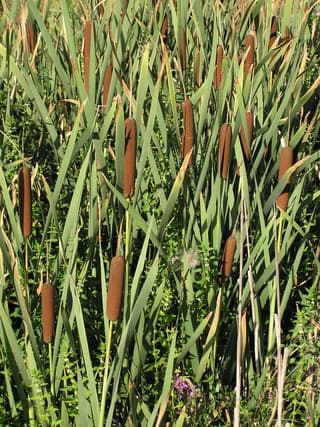
Broadleaf cattail
Typha latifolia
The broadleaf cattail (Typha latifolia) is a perennial, rhizomatous aquatic and marsh plant common in canals, reed beds, marshes, and along the shores of standing waters. It can grow up to 2.5–3 meters tall, with pale bluish-green, parallel-veined, ribbon-like leaves that are 8–20 mm wide. Its characteristic brown, "cigar-shaped" inflorescence consists of two parts: the brown female spike at the bottom and the yellow male portion above it, which falls off after flowering. Through its vigorously spreading rhizomes, it forms dense stands and provides important habitat and food sources for wetland wildlife.
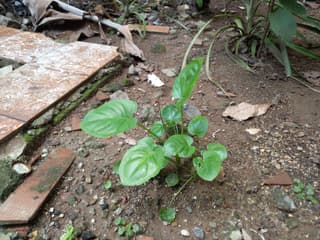
Typhonium
Typhonium
Typhonium is a genus of tuberous aroids comprising over 70 species, native to tropical Asia, Mongolia, and northeastern Australia. These clumping perennials produce glossy, lobed, triangular leaves in medium to dark green, held on long petioles. In summer, dark purple or maroon spathes appear, often malodorous, which is typical of the Araceae family. The plant enters dormancy in winter, losing its foliage until the following spring.
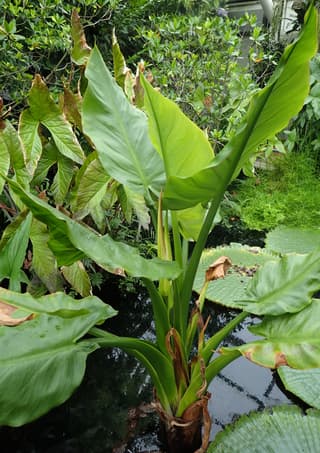
Water Banana
Typhonodorum lindleyanum
Typhonodorum lindleyanum, commonly known as the Water Banana, is a giant monotypic aroid from Madagascar, the Comoros, Zanzibar, Mauritius, and eastern Tanzania. Growing in freshwater swamps, river banks, and shallow lagoons, it produces massive arrow-shaped evergreen leaves up to 1 meter long, forming impressive pseudo-stems that can reach 4 meters in height. Its cream-colored spathe and spadix inflorescence and large bright-yellow berries make it a truly spectacular specimen plant.
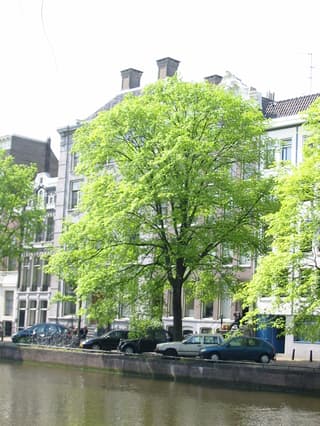
Dutch Elm
Ulmus × hollandica
Ulmus × hollandica, commonly known as the Dutch Elm, is a natural hybrid between the Wych Elm (Ulmus glabra) and the Field Elm (Ulmus minor) that arose spontaneously across Europe wherever the ranges of its two parent species overlap. A large, fast-growing deciduous tree, it was historically planted in vast numbers as a street and canal-side tree throughout the Netherlands and the rest of the Low Countries, prized for its tolerance of urban conditions and its elegant, broadly spreading crown. Its leaves are intermediate in shape between the two parent species, and inconspicuous reddish flowers appear in early spring before the foliage, followed by winged samara fruits. The hybrid became infamous during the 20th century for its role in the Dutch elm disease epidemics, though some clones show moderate resistance and continue to be bred for improved tolerance.
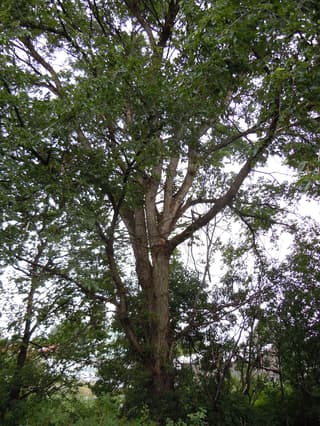
American elm
Ulmus americana
The American elm (Ulmus americana) is a fast-growing, deciduous tree from the elm family (Ulmaceae), originally native to eastern North America. The tree is known for its characteristic vase-shaped crown and can reach heights of up to 24 meters in the wild with a correspondingly wide canopy. From the mid-20th century, Dutch elm disease decimated large portions of the wild population in North America, but disease-resistant cultivars have since been developed. The species produces small, inconspicuous greenish-red flowers in early spring before the leaves emerge, and features coarse, dark green foliage that turns golden in the fall.
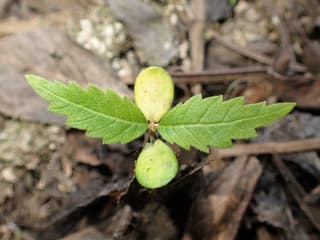
Field Elm
Ulmus minor
Ulmus minor, known as the field elm, is a majestic deciduous tree native to Europe, North Africa, and Western Asia. It is distinguished by its robust stature, deeply fissured bark in mature specimens, and alternate leaves with a markedly asymmetrical base. It is a keystone species in riparian forests, although its populations have been drastically reduced in recent decades due to Dutch elm disease, a devastating fungal infection.
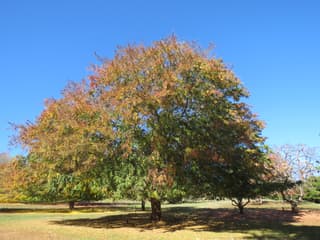
Chinese Elm
Ulmus parvifolia
Ulmus parvifolia, commonly known as the Chinese Elm or Lacebark Elm, is a deciduous to semi-evergreen tree native to East Asia (China, Japan, and Korea), where it can reach heights of 10 to 15 meters in natural conditions. Its most striking feature is the bark: as it matures, it exfoliates in irregular plates, revealing mosaics of gray, green, orange, and brown tones. The leaves are small (1–3 cm), glossy, and serrated, turning golden, reddish, or purple in autumn before falling. It blooms discreetly in late summer or autumn, producing reddish-green flowers that give way to small winged samaras. It is one of the most valued species in the art of bonsai due to its vigor, fine branching, and ease of handling. In urban landscaping, it stands out as a shade and street tree for its tolerance to pollution, moderate drought, and heavy pruning.
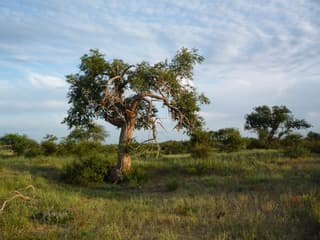
Siberian Elm
Ulmus pumila
The Siberian elm (Ulmus pumila) is a hardy, fast-growing deciduous tree native to Siberia, northern China, Mongolia and the Himalayas. Prized for its extreme cold hardiness, drought tolerance and ability to thrive in poor, compacted or alkaline soils, it was widely planted across the US Great Plains for windbreaks and shelterbelts in the 20th century. It is notably resistant to Dutch elm disease, unlike most other elms, but its rapid growth produces weak, brittle wood prone to storm damage, and it remains vulnerable to elm leaf beetle and bark beetle infestations. In many US states it has escaped cultivation and is now classified as an invasive or noxious weed due to its prolific self-seeding. Its small leaves and tolerance of heavy pruning also make it a popular, if fast-growing, choice for bonsai.

California bay laurel
Umbellularia californica
Umbellularia californica is an evergreen tree in the Lauraceae family, native to the coastal forests of California and southwestern Oregon. It can reach heights of 20 to 25 meters, though it often grows in a more shrub-like form in dry soils. Its lanceolate, dark green, and glossy leaves release an intense, spicy aroma when crushed, due to volatile oils rich in umbellulone. In spring, it produces small creamy-yellow flowers clustered in umbels, followed by green to purple drupe-like fruits. It is a long-lived, hardy, and drought-tolerant species, highly valued in native landscaping and for its wood (known as myrtlewood).

Navelwort
Umbilicus rupestris
Navelwort (Umbilicus rupestris) is a fleshy, perennial succulent of the stonecrop family, native to southern and western Europe, where it grows wild in shady wall crevices and damp rocky banks. Its round, waxy leaves have a distinctive navel-like central depression, giving rise to both its common and scientific names. In late spring and summer it sends up tall spikes of small, bell-shaped greenish-pink flowers.
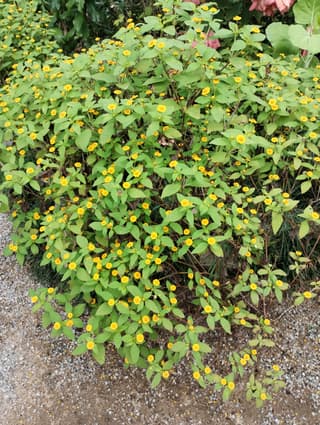
Golden Button
Unxia kubitzkii
Unxia kubitzkii, commonly known as Golden Button, is a perennial herbaceous plant native to Brazil, belonging to the Asteraceae family. It grows 30–50 cm tall and produces small golden-yellow flowers year-round, with peak blooming in spring and summer. Hardy and virtually immune to pests and diseases, it is widely used in borders, flower beds, and container gardens.
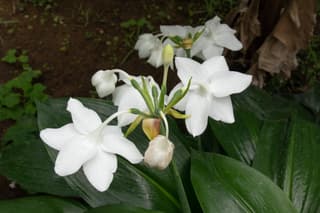
Amazon Lily Grandiflora
Urceolina × grandiflora
The Amazon Lily Grandiflora (Urceolina × grandiflora, syn. Eucharis grandiflora) is a tropical bulbous plant native to the Andean slopes of Colombia and Peru. It produces clusters of 3–6 fragrant, pure-white flowers resembling daffodils atop elegant stems up to 70 cm tall. It is prized as an ornamental houseplant and a feature of tropical gardens worldwide.
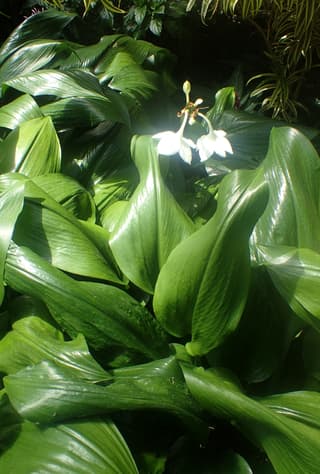
Amazon Lily
Urceolina amazonica
Amazon Lily (Urceolina amazonica, syn. Eucharis amazonica) is a stunning tropical bulbous perennial native to the Andes of Colombia and Peru. It produces glossy, deep green leaves and clusters of snow-white, narcissus-like flowers with a delicate green-tinged cup, prized for their sweet fragrance. It thrives indoors as a houseplant in temperate climates.
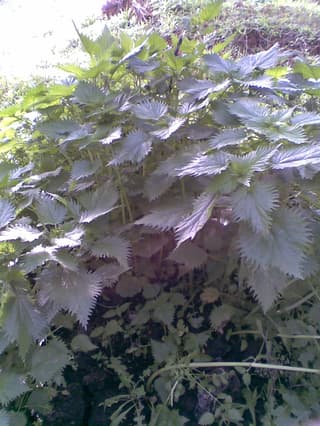
Stinging Nettle
Urtica dioica
Stinging nettle (Urtica dioica) is a perennial herb that grows wild throughout Europe, Asia, and North America. It can reach heights of up to 180 cm and spreads vigorously via rhizomes. The plant is easily recognizable by its ovate leaves with serrated margins and the numerous stinging hairs covering the stems and foliage. These hairs contain formic acid and histamine, which cause a brief burning sensation upon contact. The flowers are small, greenish to whitish, and appear in dense clusters from spring to late summer. Stinging nettle is one of nature's most versatile plants, with documented medicinal, culinary, and textile applications.
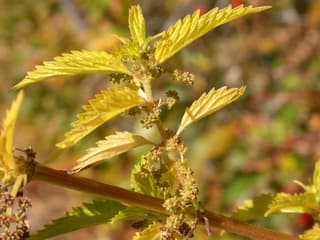
Slender Stinging Nettle
Urtica gracilis
Urtica gracilis, the slender stinging nettle or American stinging nettle, is a perennial herbaceous plant native to North America, ranging from Guatemala to Canada. It can grow up to 3 meters tall and features deeply serrated leaves covered with stinging trichomes that cause intense skin irritation upon contact. Despite its fearsome reputation, it is highly valued in traditional medicine, cooking, and Indigenous textile crafts. It thrives naturally in forested floodplains, streambanks, and nitrogen-rich disturbed soils.
Small Nettle
Urtica urens
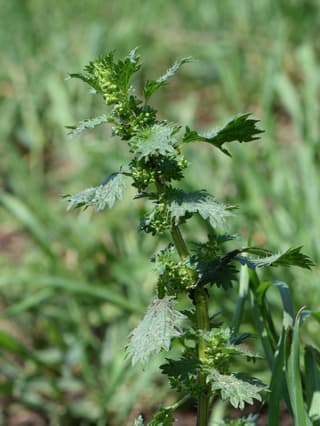
Urtica urens, commonly known as small nettle or annual nettle, is a herbaceous annual plant in the family Urticaceae. Native to Europe and the Mediterranean region, it has become a cosmopolitan weed found across temperate regions worldwide. Growing up to 100 cm tall, it is notable for its stinging hairs (trichomes) that cause intense skin irritation on contact — reputedly stinging more strongly than the common nettle (Urtica dioica). It bears small greenish-white flowers throughout summer and is a monoecious, wind-pollinated species.
beard lichen
Usnea hirta
Usnea hirta, commonly known as Bristly Beard Lichen, is a fruticose lichen characterized by its pale green to yellowish-green, shrubby appearance. It consists of a symbiotic relationship between a fungus and an alga. It typically grows on the bark of coniferous trees in clean-air environments. It is highly sensitive to sulfur dioxide pollution, making it an excellent bio-indicator of air quality.
Leafy Bladderwort
Utricularia foliosa
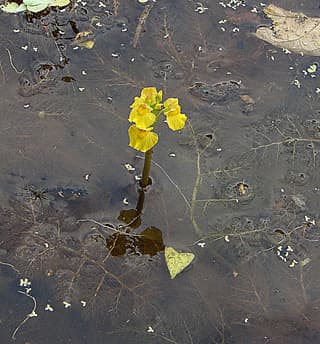
Utricularia foliosa is an aquatic carnivorous plant in the Lentibulariaceae family, native to tropical and subtropical regions of the Americas and Africa. It floats freely or remains submerged in the still waters of ponds, marshes, and slow-moving rivers, forming dense mats of thin, branched stems that can reach several meters in length. Its filiform leaves, up to 30 cm long, support small bladder-like traps (utricles) that suck in and capture microcrustaceans, mosquito larvae, and other small aquatic invertebrates. During the reproductive period, it produces an erect flower stalk that rises above the water, up to 40 cm high, displaying several yellow flowers similar to small snapdragons.
Lowbush Blueberry
Vaccinium angustifolium
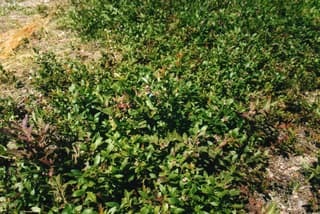
Vaccinium angustifolium, commonly known as the Lowbush Blueberry, is a low-growing native shrub of northeastern North America. It produces small, intensely flavored blueberries beloved by wildlife and humans alike. Its brilliant red autumn foliage makes it equally valued as an ornamental ground cover.
Find the Perfect Plant
Our plant guide helps you find ideal species for your experience level and time of year.
Browse by Difficulty, Season & More
Use the filters below to narrow this catalog by care difficulty, season, environment, or search directly by name. Each filter leads to a focused list tailored to your specific growing conditions.