1451 Easy Pet Safe | 2026 Guide - Page 24
Find 1451 easy pet safe. Complete guide for your garden.
1451 Pet Safe with easy level
Showing 829-864 of 1451
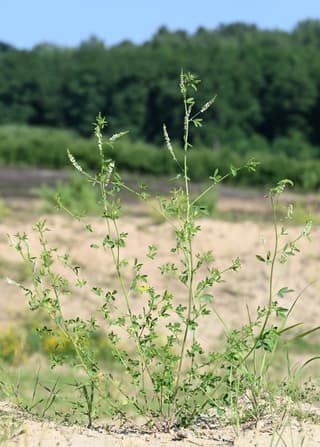
White sweet clover
Melilotus albus
White sweet clover (Melilotus albus) is an annual or biennial herbaceous plant in the legume family (Fabaceae), native to Eurasia and now widely distributed throughout the world's temperate regions. The plant can grow up to 2 meters tall and bears long, narrow racemes of small white flowers with a subtle, sweet scent of coumarin. Thanks to its deep taproot, it is particularly drought-resistant and improves the soil through nitrogen fixation in symbiosis with Rhizobium bacteria.
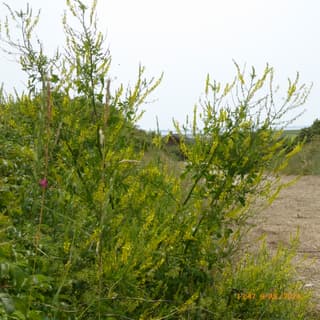
Yellow Sweet Clover
Melilotus officinalis
Yellow sweet clover (Melilotus officinalis) is a biennial herb in the Fabaceae (legume) family, native to Europe and Asia and now naturalized across much of the world. It forms freely branching stems up to about 1.5 m tall, with trifoliate leaves and small, fragrant yellow flowers borne in slender racemes that are highly attractive to bees. It grows from a deep taproot, fixes nitrogen in the soil through symbiosis with rhizobia, and is widely used as a green manure and honey plant.
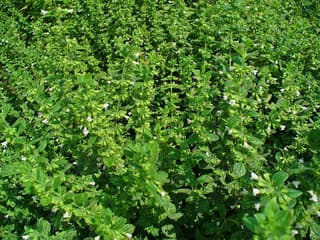
Lemon Balm
Melissa officinalis
Lemon balm (Melissa officinalis) is a perennial aromatic herb in the Lamiaceae family, native to the Mediterranean and Southern Europe. Prized for its delicate lemon scent, it is widely cultivated for medicinal, culinary, and ornamental purposes. Its dark green leaves are rich in essential oils with calming, antioxidant, and antiviral properties.
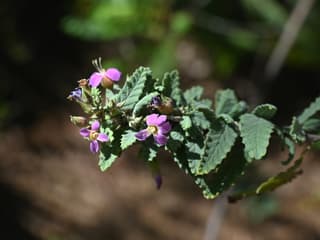
Woolly Pyramidbush
Melochia tomentosa
The Woolly Pyramidbush (Melochia tomentosa) is a perennial shrub in the Malvaceae family, native to arid and semi-arid regions of tropical and subtropical America, ranging from the southwestern United States to South America. It reaches between 0.3 and 2.5 meters in height, with stems and ovate leaves covered in a dense, whitish stellate pubescence that gives it a velvety appearance. It produces small pink to purple flowers clustered in the leaf axils, with a blooming period extending primarily from spring to fall, attracting abundant pollinators such as butterflies and native bees. Its fruits are winged pyramidal capsules, a distinctive characteristic of the genus. It grows naturally along roadsides, rocky slopes, xerophytic scrublands, and dry forests, from sea level up to 1,600 meters in altitude.

Water Mint
Mentha aquatica
Mentha aquatica, commonly known as water mint, is an aromatic perennial herb in the mint family (Lamiaceae), native to Europe, North Africa, and western Asia. It grows naturally along pond edges, streams, ditches, and marshy meadows, where its square stems and oval, toothed leaves spread rapidly by creeping runners. From midsummer into fall, dense whorls of small pink to lilac flowers cluster at the stem tips, attracting bees, butterflies, and other pollinators. Every part of the plant carries a strong minty-menthol fragrance, released readily when the leaves are brushed or crushed.
Spearmint
Mentha spicata
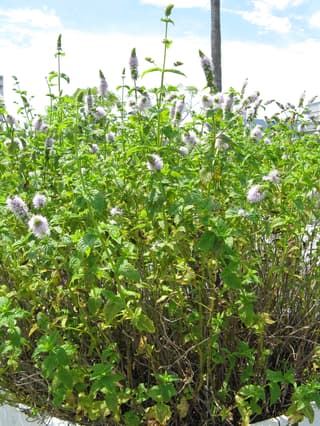
Spearmint (Mentha spicata) is a vigorous perennial herb in the Lamiaceae family, native to Europe and the Mediterranean but now naturalized worldwide. It is prized for its fresh, mildly sweet menthol fragrance — gentler than peppermint — and is one of the most widely cultivated culinary and medicinal herbs on the planet. The plant spreads aggressively through underground rhizomes, forming dense colonies. Bright green serrated leaves top upright stems that produce slender spikes of lilac or white flowers in summer, attracting bees and butterflies.
Common Ice Plant
Mesembryanthemum
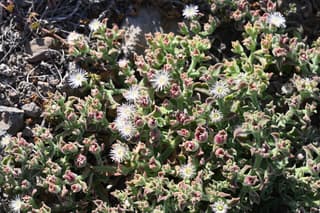
Mesembryanthemum is a genus of succulent annual or biennial plants in the family Aizoaceae, native to southern and eastern Africa. It is best known for the glistening, bladder-like epidermal cells (papillae) covering its leaves and stems, which give the plant a frosted, ice-crystal appearance and inspired both its common and scientific names. It is a facultative halophyte, tolerating saline soils by storing salt in these epidermal bladder cells, and it can shift from C3 photosynthesis to Crassulacean Acid Metabolism (CAM) under drought or salt stress. Widely grown as an ornamental ground cover in coastal and rock gardens, it is also used as a leafy vegetable and in traditional medicine.
Baby Sun Rose
Mesembryanthemum cordifolium
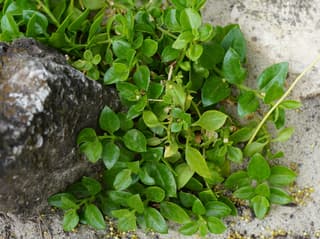
The Baby Sun Rose is a perennial trailing succulent, native to South Africa, known for its bright green, fleshy heart-shaped foliage. Its flowers are small, vibrant, and daisy-like, opening only under direct sunlight. It is an extremely resilient plant, ideal for ground cover in sunny areas or for adorning hanging baskets, where its branches can cascade down.
Common Ice Plant
Mesembryanthemum crystallinum
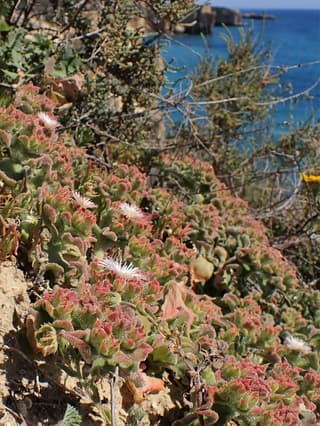
Mesembryanthemum crystallinum, commonly known as the common ice plant, is a low-growing halophytic succulent native to the coastal sands and salt marshes of South Africa, now naturalized along Mediterranean and other mild coastlines worldwide. Its leaves and stems are covered in glistening, bladder-like epidermal cells that store water and salt, giving the plant a frosted, ice-crystal appearance. It is grown both as an ornamental groundcover and as a gourmet edible green, prized for its succulent, slightly salty leaves eaten raw or cooked.
Slender Iceplant
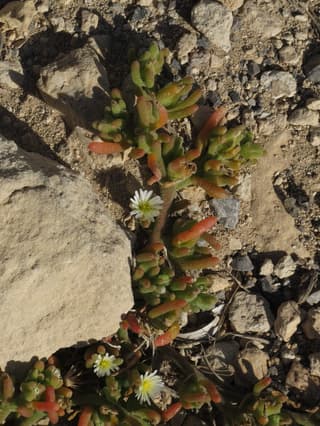
Mesembryanthemum nodiflorum
Mesembryanthemum nodiflorum, known as slender iceplant, is a low-growing succulent annual herb in the ice plant family (Aizoaceae). Native to the coastal Mediterranean Basin, Macaronesia, southern Africa, and the Middle East, it forms prostrate mats of fleshy, cylindrical leaves covered in glistening bladder cells that give the plant its characteristic icy sheen. Small white to pale yellow flowers appear from spring through summer. Highly salt- and drought-tolerant, it thrives in sandy coastal soils, dunes, and saline wetland margins, and has become naturalized in parts of Australia and the western United States.
Medlar
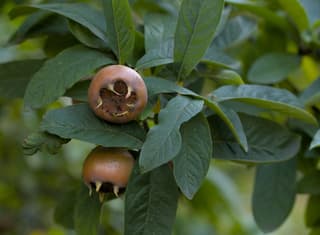
Mespilus germanica
The medlar (Mespilus germanica) is a small deciduous tree or large shrub in the rose family, native to the mountains of southeastern Europe, the Caucasus, and northern Iran. It grows slowly into a spreading, rounded crown 4-8 m tall and wide, with dark green oblong leaves that turn russet in autumn. Its five-petaled white to pale-pink flowers open late, in May or June, well after most other fruit trees have finished blooming. The brown, apple-shaped fruit does not ripen on the tree; it must "blett" (soften through frost or storage) before it becomes sweet and edible.

Dawn Redwood
Metasequoia glyptostroboides
Metasequoia glyptostroboides, known as the Dawn Redwood, is a fast-growing, large deciduous conifer native to the mountain forests of central China. Considered extinct for millennia—known only from fossil records—it was rediscovered alive in 1941 in Hubei province, becoming one of the most remarkable botanical finds of the 20th century. It is the only extant species in the genus Metasequoia. In spring and summer, it displays delicate, light green foliage similar to ferns; in autumn, it transforms into stunning shades of orange and copper before shedding all its leaves. The mature trunk develops deeply fissured, reddish-brown bark. It can reach up to 30 meters in height in gardens and parks, with an elegantly pyramidal habit.
Sabia Mimosa
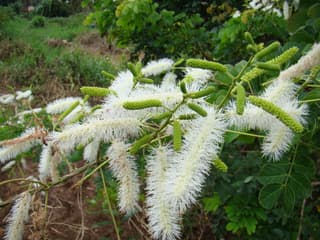
Mimosa caesalpiniifolia
Mimosa caesalpiniifolia, known as sabiá or sansão-do-campo, is a native tree of the Brazilian Caatinga and Cerrado biomes, particularly from the Northeast region. Belonging to the Fabaceae family, this fast-growing species is prized for its hardiness, rapid growth, and multiple uses: ornamental, fodder, medicinal, and timber. Its thorny branches make it ideal for living fences, while its white-cream flowers attract pollinators, especially bees. The species is listed as Vulnerable on the IUCN Red List and is found exclusively in Brazil.
Chinese Silver Grass
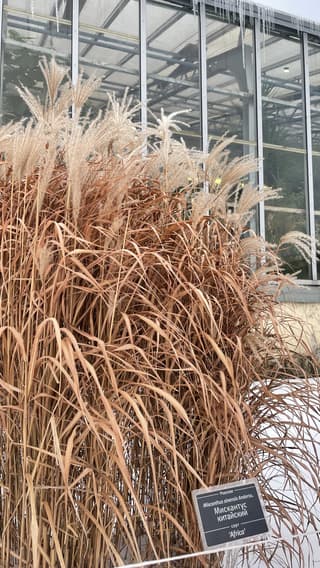
Miscanthus sinensis
Miscanthus sinensis, commonly known as Chinese Silver Grass or Eulalia, is a perennial ornamental grass native to eastern Asia. It forms elegant clumping tufts with arching foliage and feathery silvery plumes that persist through autumn and winter, making it a standout feature in gardens during the cooler seasons.
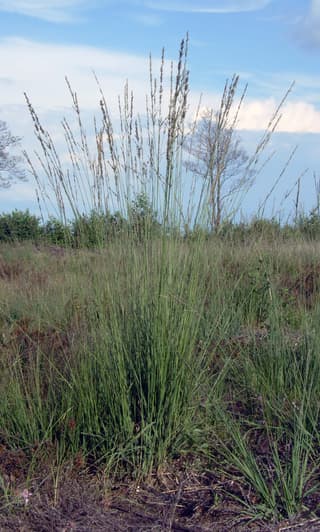
Purple Moor Grass
Molinia caerulea
Purple moor grass (Molinia caerulea) is a deciduous, clump-forming grass from the genus Molinia, native to moist heaths, bogs, and woodland edges in Europe and Asia. The plant forms dense, upright clumps of narrow, light green leaves that turn golden yellow in autumn. From mid to late summer, slender, arching flower stalks emerge with dark purple to reddish-brown spikelets on yellowish stems, giving a light and transparent appearance in the garden bed.
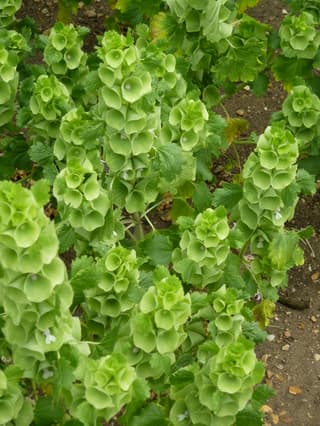
Bells of Ireland
Moluccella laevis
Moluccella laevis, commonly known as Bells of Ireland, is an annual flowering plant native to western Asia (Turkey, Syria, Caucasus region). It produces tall, elegant spikes adorned with distinctive green, bell-shaped calyces encasing small white fragrant flowers. Despite its Irish name, it has no connection to Ireland. Cultivated since 1570, it is prized in fresh and dried floral arrangements worldwide.
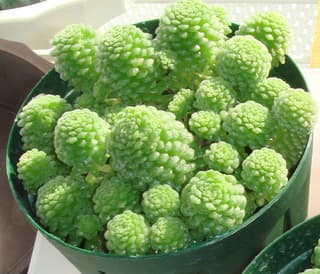
Monanthes polyphylla
Monanthes polyphylla
Monanthes polyphylla is a small perennial succulent endemic to the Canary Islands (Gran Canaria, Tenerife, La Palma, and La Gomera), where it grows in very localized areas within shaded cliff crevices and damp rocks between 100 and 1500 meters in altitude. It forms dense mats of tiny, globose rosettes composed of tightly packed fleshy leaves, resembling succulent moss, and barely reaches 10-12 cm in height. Between late spring and summer, it produces small star-shaped flowers in shades of purple, pink, yellowish, or greenish on thin stems that rise above the foliage.
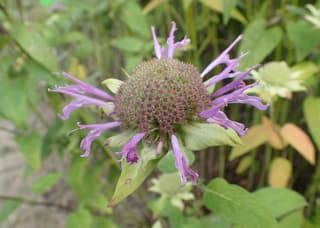
Scarlet Bee Balm
Monarda didyma
Monarda didyma (scarlet bee balm) is a perennial plant in the mint family native to the moist woods and riverbanks of North America. It features dense, globular flower heads with bright red (also pink, purple, or white in cultivars) tubular flowers that bloom from mid-summer to early fall, attracting hummingbirds, butterflies, and bees. The aromatic leaves on square stems release a spicy scent when crushed. The plant spreads via rhizomes and forms expanding clumps.
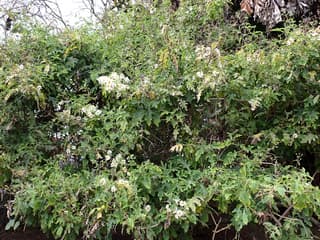
Mexican Daisy Bush
Montanoa bipinnatifida
Montanoa bipinnatifida, commonly known as the Mexican Daisy Bush or Tree Chrysanthemum, is a fast-growing shrub or small tree in the Asteraceae family, native to Mexico and Central America. It can reach up to 5 meters in height, featuring deeply lobed leaves and clusters of white or yellowish daisy-like flowers with a delightful sweet fragrance reminiscent of chocolate or freshly baked cookies. It blooms in fall and winter, making it a standout specimen in the garden during the cooler months.
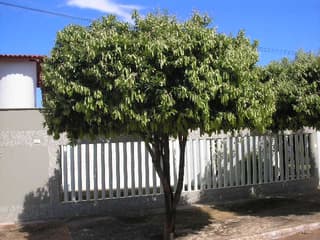
Oiti
Moquilea tomentosa
Moquilea tomentosa, popularly known as Oiti, is a tree native to the Atlantic Forest and Brazilian flora. It is widely used in urban landscaping for streets, parks, and squares due to its dense, rounded canopy that provides excellent shade. It can reach heights of 30 to 50 feet. Its leaves are simple, dark green, and have a velvety texture. It blooms in winter with small white or cream flowers of low ornamental value, and bears fruit between November and January, producing oval, yellow-orange drupes with fibrous, aromatic pulp that is edible for both humans and local wildlife.
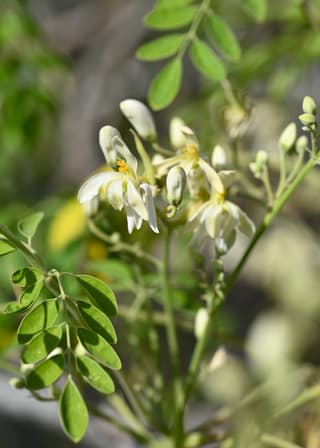
Moringa
Moringa oleifera
Moringa oleifera, commonly known as the drumstick tree, horseradish tree, or ben oil tree, is a fast-growing, drought-resistant tree native to the foothills of the Himalayas. It is widely cultivated in tropical and subtropical areas for its highly nutritious leaves, pods, seeds, and flowers. The tree has a slender trunk, a spreading crown, and compound leaves that are feathery in appearance. It produces clusters of fragrant, white to cream-colored flowers and long, slender, triangular pods.
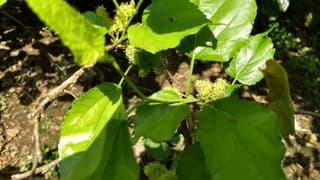
Indian Mulberry
Morus indica
Morus indica is a shrub or small tree in the Moraceae family, native to the temperate and sub-tropical Himalayas and Indochina and cultivated in India, China, Japan and East Africa. Its leaves feed silkworms and its berries are edible.

Red Mulberry
Morus rubra
Morus rubra, the red mulberry, is a deciduous tree native to eastern North America, prized for its heart-shaped leaves and sweet, blackberry-like fruit that ripens from red to deep purple in summer.
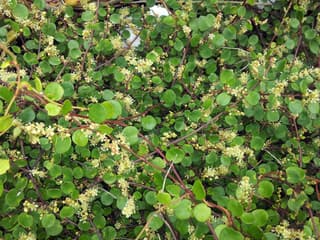
Wire Vine
Muehlenbeckia
Muehlenbeckia is a genus of fast-growing creeping and climbing plants from the Polygonaceae family, native to New Zealand and South America. Recognised by their wiry dark stems, tiny rounded leaves, and intricate lace-like texture, these plants are widely used as ground covers, in hanging baskets, and as trailing accents in containers. They are highly adaptable and easy to care for.
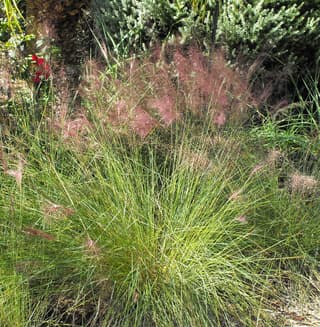
Pink Muhly Grass
Muhlenbergia capillaris
Pink muhly grass (Muhlenbergia capillaris) is a stunning warm-season perennial bunchgrass native to the eastern United States. It forms dense, fine-textured clumps of narrow, arching green blades that reach 60–90 cm tall. In late summer and fall, it erupts into a breathtaking cloud of airy, pink-to-purple panicles that can double its height, creating a spectacular misty effect in the landscape. Hardy from USDA zones 5 to 9b, it thrives in full sun with dry to well-drained soils and is highly drought tolerant once established. Its low-maintenance nature and striking fall display make it one of the most popular ornamental grasses for mass plantings, borders, meadows, and xeriscaping.
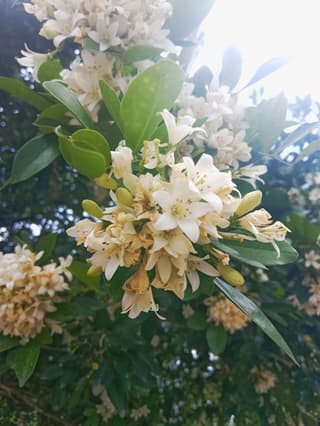
Orange Jasmine
Murraya paniculata
Murraya paniculata is an evergreen shrub or small tree native to South and Southeast Asia. It is widely cultivated for its dense, glossy dark green foliage and intensely fragrant white flowers that resemble the scent of orange blossoms. It is a popular choice for hedges and bonsai.
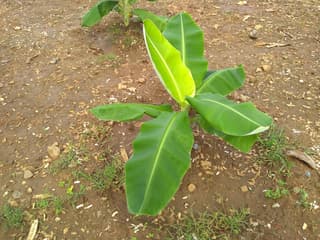
Banana
Musa
Banana (Musa spp.) is a large tropical plant belonging to the family Musaceae. This is a genus-level entry with care data representative of commonly grown ornamental and edible bananas, particularly Musa acuminata-type cultivars such as Dwarf Cavendish. Native to tropical Asia, the banana plant is one of the most recognizable plants in the world, celebrated for its broad, glossy green leaves and iconic fruit. Cultivated for over 8,000 years, it is a symbol of abundance and fertility across many cultures. As a houseplant, it is a fast-growing specimen that can reach 1.5 to 5 metres depending on the cultivar, creating a dramatic tropical focal point.
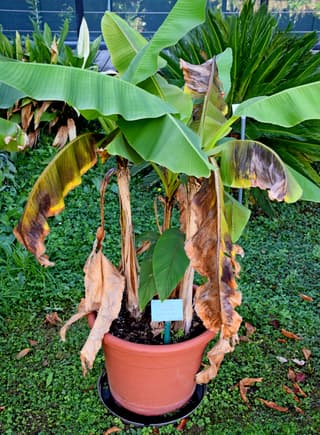
Japanese Banana
Musa basjoo
Musa basjoo, known as the Japanese Banana or Hardy Banana, is a fast-growing herbaceous perennial in the family Musaceae. Native to the Ryukyu Islands of Japan and originally from Sichuan, China, it produces enormous paddle-shaped leaves up to 6 feet long, creating a lush tropical effect in temperate gardens. Unlike most bananas, its underground rhizomes can survive temperatures as low as -10°F with mulch, making it the hardiest banana available for cold-climate gardening.
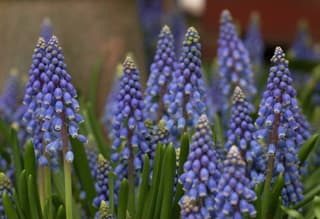
Grape Hyacinth
Muscari armeniacum
Muscari armeniacum, commonly known as Grape Hyacinth, is a bulbous perennial native to Turkey and the Caucasus region. It belongs to the family Asparagaceae and produces small clusters of deep blue-violet, urn-shaped flowers in early spring that resemble bunches of grapes. Hardy, low-maintenance, and highly rewarding, it naturalizes readily in gardens and containers.
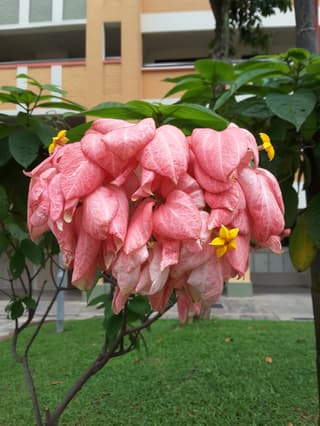
Dona Alicia Mussaenda
Mussaenda alicia
Mussaenda alicia, commonly known as Doña Alicia, is a stunning tropical flowering shrub native to the Philippines and Tropical Asia. It belongs to the family Rubiaceae and is celebrated for its showy pink bracts that surround small yellow tubular flowers. Named in honor of Alicia Santos-Garchitorena, this cultivar is one of the most beloved ornamental plants in Philippine gardens and is grown throughout tropical regions worldwide. The plant produces cascading branches adorned with large, soft, velvety pink sepals, creating a spectacular display from spring through fall.
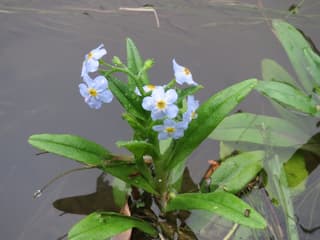
Water Forget-me-not
Myosotis scorpioides
The Water Forget-me-not is a moisture-loving perennial herb from the Boraginaceae family, native to Europe and Asia. It grows on muddy banks, in wetlands, and on river floodplains, blooming from May to September with small blue flowers featuring a yellow center. It is very frost-resistant (down to -20 °C). It spreads easily in nature and can be invasive in some wetland areas.
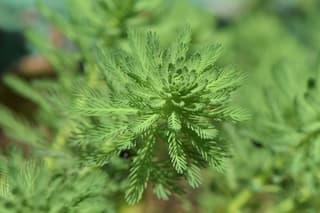
Parrot's feather
Myriophyllum aquaticum
Myriophyllum aquaticum, commonly known as parrot's feather, is a rhizomatous perennial aquatic plant native to the Amazon basin of South America. It produces creeping stems that root in submerged mud and erect stems that emerge from the water surface up to 12-24 inches, covered in bright light green pinnate leaves arranged in feathery whorls that resemble parrot feathers. In summer, it bears tiny, almost imperceptible white or yellowish flowers in the leaf axils of the emergent stems. Widely used ornamentally for ponds and aquariums due to its oxygenating and filtering action, this species is now listed as an invasive alien species of Union concern (EU Regulation 1143/2014): its cultivation, sale, and release into the wild are prohibited in Italy and the rest of the European Union, as it forms dense mats that choke waterways and displace native flora.
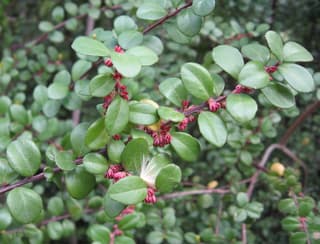
African Boxwood
Myrsine africana
Myrsine africana is a compact, evergreen shrub native to Africa, Asia, and the Mediterranean. Its small, glossy, serrated leaves form a dense canopy, making it excellent for hedging, topiary, and garden borders. It is highly adaptable and drought-tolerant once established.
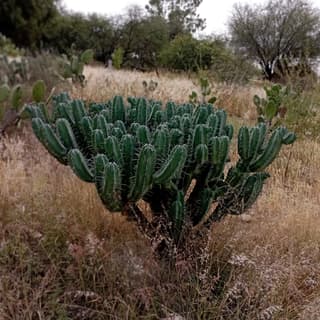
Blue Candle Cactus
Myrtillocactus geometrizans
Myrtillocactus geometrizans, commonly known as the Blue Candle Cactus, is a striking columnar cactus native to central and northern Mexico. Its branching stems display a distinctive blue-green hue that intensifies with sun exposure, and the plant can reach heights of up to 5 meters in its native habitat. It produces small, edible berries called garambullos, similar in appearance to blueberries and long used by indigenous Mexican communities. It is widely cultivated as an ornamental specimen in dry gardens and as a grafting rootstock.
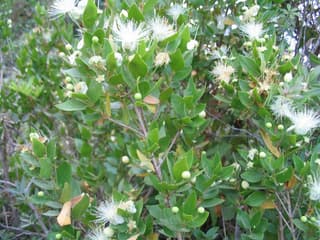
Common Myrtle
Myrtus
Myrtus (myrtle) is an aromatic evergreen shrub native to the Mediterranean, valued for its glossy dark-green leaves, fragrant white star-shaped flowers, and dark berries used in cooking and traditional remedies. Slow-to-medium growing and remarkably drought-tolerant once established, it thrives in full sun and well-drained soil, making it a popular choice for hedges, topiary, and containers.
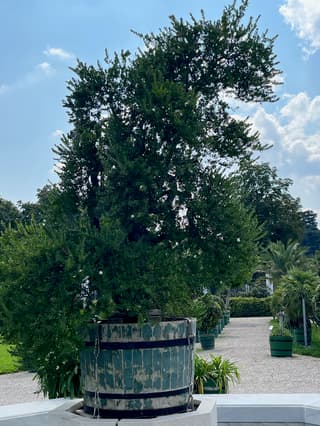
Common Myrtle
Myrtus communis
Common myrtle (Myrtus communis) is an evergreen, aromatic shrub native to the Mediterranean region and a member of the Myrtaceae family. Its small, glossy leaves are packed with essential oils and release a strong fragrance when crushed. From late spring through summer the plant produces delicate white flowers with long, showy stamens, followed by small blue-black to purple berries that are edible and have been used for centuries in cooking and in liqueurs such as Sardinian mirto. Grown as an ornamental shrub, aromatic hedge, or even as a container bonsai, common myrtle is drought-tolerant and low-maintenance, and carries strong historical symbolism tied to love and fidelity.
Easy Care Pet Safe
Our selection of 1451 easy pet safe combines the characteristics of this category with reduced care needs. Perfect for beginners who love this category.
Why Choose Easy Pet Safe?
Combining the beauty of pet safe with easy difficulty level lets you enjoy this category without excessive maintenance worries. Each plant was selected to offer the best characteristics of the category at the care level you are looking for.