280 Easy Succulents | 2026 Guide - Page 8
Find 280 easy succulents. Complete guide for your garden.
280 Succulents with easy level
Showing 253-280 of 280

Showy Stonecrop
Sedum spectabile
Sedum spectabile, commonly known as Showy Stonecrop or Ice Plant, is a hardy succulent perennial native to China and Korea. It produces clusters of star-shaped pink to red flowers from late summer through fall, making it one of the most ornamental sedums available. The fleshy blue-green leaves store water, enabling the plant to tolerate drought conditions with ease. It is particularly valued as a pollinator magnet, attracting butterflies, bees, and other beneficial insects when little else is in bloom.

Two-row Stonecrop
Sedum spurium
Sedum spurium (now botanically accepted as Phedimus spurius) is a low-growing, mat-forming succulent perennial in the Crassulaceae family, native to the rocky subalpine meadows of the Caucasus region (Georgia, northern Iran, and northeastern Turkey). Its trailing stems root as they spread, forming dense, evergreen mats of fleshy, opposite leaves that shift from green to deep burgundy in cooler months. Star-shaped flowers ranging from white to crimson appear in summer. Extremely drought-tolerant and low-maintenance, it is one of the most popular ground-cover sedums for rock gardens, green roofs, and sunny borders.

Chinese Stonecrop
Sedum tetractinum
Sedum tetractinum is a low-growing, mat-forming succulent native to southeastern China, prized as a groundcover for its round, fleshy blue-green leaves that blush coppery-pink in strong sun. Small star-shaped white to pale pink flowers appear in summer above the dense foliage mat.
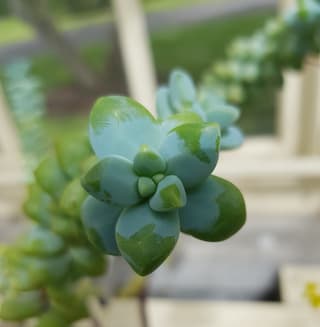
Silver Sedum
Sedum treleasei
Sedum treleasei, commonly known as Silver Sedum or Blue Sedum, is a perennial succulent in the Crassulaceae family native to the Puebla region of Mexico. It forms tight rosettes of thick, fleshy, blue-gray leaves coated in a fine waxy layer (farina) that gives the plant its signature silvery sheen and helps reflect intense sunlight. Over time it develops short, branching stems that form small, compact clusters, making it a popular choice for rock gardens, containers, and succulent arrangements.

Night-blooming Cereus
Selenicereus
Selenicereus is a genus of epiphytic and climbing cacti native to Mexico, Central America, the Caribbean, and northern South America. Its flattened or angled stems climb trees and rocks using aerial roots, producing enormous, intensely fragrant flowers that bloom for a single night before wilting by dawn. Several species in the genus produce the fruit known as pitaya or dragon fruit.
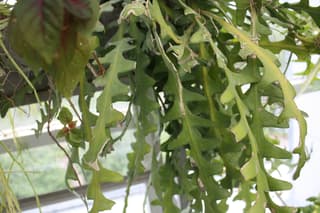
Ric Rac Cactus
Selenicereus anthonyanus
The ric rac cactus (Selenicereus anthonyanus) is an epiphytic jungle cactus native to the tropical forests of Chiapas, Mexico. Its flattened, deeply lobed stems zigzag like a fish skeleton -- earning it the nickname "fishbone cactus" -- making it a striking trailing or climbing houseplant. Unlike desert cacti, it thrives in humid, shaded conditions and produces large, fragrant flowers that open for a single night.
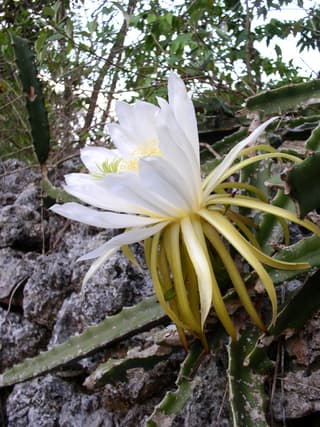
Strawberry Pear
Selenicereus triangularis
Selenicereus triangularis, commonly known as Strawberry Pear or Triangle Cactus, is a vigorous climbing cactus native to the Caribbean islands including Cuba, Haiti, Dominican Republic, and Puerto Rico. Its triangular stems can reach over 10 meters in length and produce spectacular large white flowers that bloom only at night during summer and fall. The edible red fruits, 2–5 cm long, are sweet, vitamin-rich, and resemble dragonfruit.
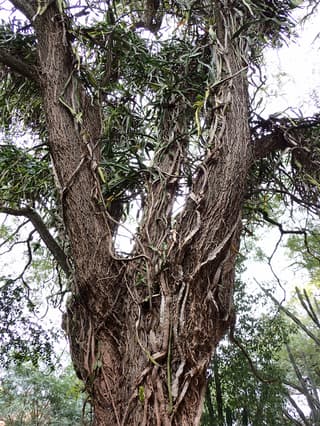
Dragon Fruit
Selenicereus undatus
Selenicereus undatus, popularly known as White Pitaya or Dragon Fruit, is a fast-growing epiphytic cactus native to Central and South America. It is characterized by its triangular, succulent stems that climb trees or supports. Its flowers are spectacular, large, and white, opening only at night, which earns it the name 'Queen of the Night'. The fruit is oval, with vibrant pink skin and green scales, containing a sweet white pulp dotted with small edible black seeds.
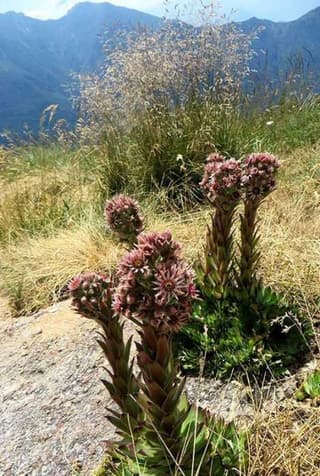
Hens and Chicks
Sempervivum
Sempervivum is a genus of approximately 40 species of hardy alpine succulents in the family Crassulaceae, native to the mountains of Europe and parts of Asia. They form tight, fleshy rosettes that continuously produce offsets ("chicks") around the mother plant ("hen"), creating dense spreading mats. Exceptionally cold-hardy, they tolerate temperatures as low as -34°C (-29°F) and survive in rocky, nutrient-poor soils.
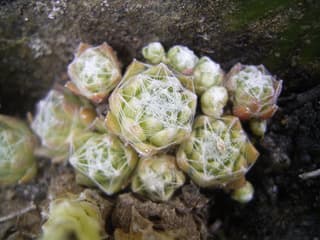
Cobweb Houseleek
Sempervivum arachnoideum
Sempervivum arachnoideum, the cobweb houseleek, is a compact alpine succulent whose tight rosettes are laced with fine white webbing, giving each cluster a spiderweb-like appearance. Native to the mountains of Europe, it is remarkably cold-hardy and spreads into dense mats via offsets ("chicks").
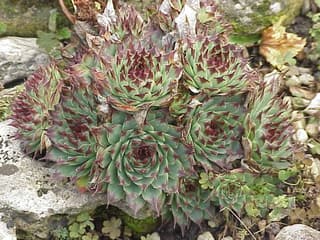
Limestone Houseleek
Sempervivum calcareum
Sempervivum calcareum is a perennial alpine succulent, highly cold-hardy. It forms compact rosettes of fleshy leaves, often featuring distinct reddish-purple tips. Native to the limestone regions of Southern Europe, it is extremely drought-tolerant and thrives in poor, well-drained soils. Its intense colors stand out in rock gardens and arid landscapes. It is an excellent choice for beginners.
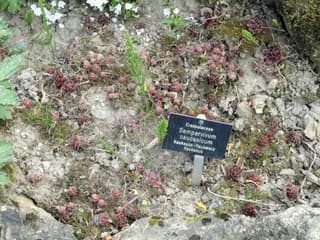
Caucasian Houseleek
Sempervivum caucasicum
Sempervivum caucasicum is a rosette-forming alpine succulent native to the Caucasus mountains of Georgia, Armenia, and Russia. It produces dense clusters of fleshy, pointed leaves arranged in tight rosettes, spreading via offsets to form low-growing mats. Extremely cold-hardy, it survives temperatures down to -34°C and thrives in rocky, well-draining soils with minimal care.
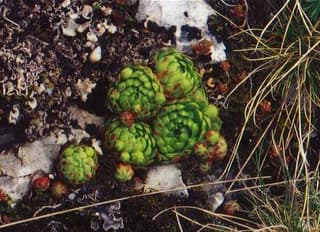
Globe Houseleek
Sempervivum globiferum
Sempervivum globiferum, commonly known as Globe Houseleek or Rolling Hen and Chicks, is a charming alpine succulent native to the mountains of Central and Eastern Europe. It forms tight, globe-shaped rosettes of fleshy green leaves that often blush red under stress. Unlike most sempervivums, its offsets naturally detach and roll away to root independently — giving rise to the delightful common name "Rollers". A monocarpic plant, each rosette dies after flowering but is quickly replaced by its many chicks.
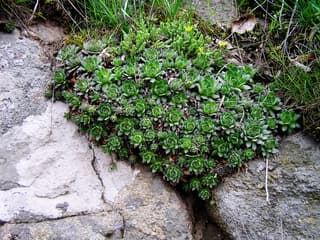
Russian Houseleek
Sempervivum ruthenicum
Sempervivum ruthenicum, the Russian houseleek, is a hardy evergreen succulent from the Crassulaceae family native to the rocky mountains and stony terrain of Eastern Europe and the Caucasus region. It forms low, mat-like rosettes of slightly hairy, pale green fleshy leaves tipped in pink, and sends up unusual yellow flower spikes in summer. Extremely drought- and cold-tolerant, it thrives on neglect in rock gardens, alpine troughs, and shallow containers.
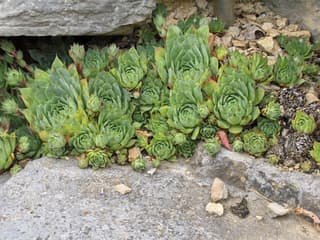
Common Houseleek
Sempervivum tectorum
Sempervivum tectorum is a hardy, evergreen succulent forming attractive rosettes of fleshy, blue-green leaves with reddish-purple tips. Native to European mountain regions including the Alps and Pyrenees, this resilient plant has been cultivated for centuries. The name "Sempervivum" means "live forever" in Latin, referring to its ability to produce numerous offsets. The species name "tectorum" means "of roofs," as Romans traditionally planted it on rooftops believing it protected buildings from lightning.
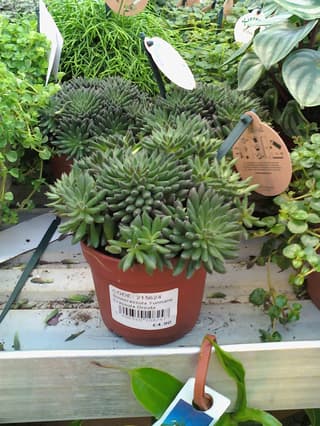
Chinese jade
Sinocrassula yunnanensis
Sinocrassula yunnanensis, or Chinese jade, is a small rosette-forming succulent native to the mountainous Yunnan province of China. Its spindle-shaped leaves are densely covered in fine soft hairs and shift from dark green in summer to deep chocolate-brown or red tones in cooler months. Plants multiply readily by offsets, eventually forming dense clumps, and produce cream-to-white flowers on tall stalks; the flowering rosette itself dies back afterward.
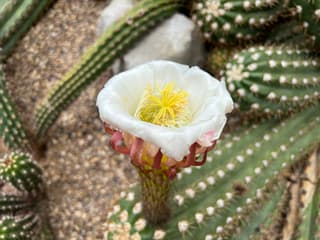
Argentine White Torch Cactus
Soehrensia candicans
The Argentine White Torch Cactus (Soehrensia candicans) is a columnar cactus native to northern Argentina, renowned for its spectacular large white fragrant flowers that bloom at night. It forms sprawling clumps up to 3 m (10 ft) wide, with individual stems reaching 60 cm (24 in) tall. Hardy, drought-tolerant, and cold-resistant to -6°C (21°F), it thrives in xeriscapes and rock gardens.

Brain Cactus
Stenocactus phyllacanthus
Stenocactus phyllacanthus is a small, solitary, globose to short-cylindrical cactus native to the high-desert scrublands of central and northern Mexico (Aguascalientes, Guanajuato, Hidalgo, Jalisco, Nuevo León, Querétaro, San Luis Potosí and Zacatecas), typically found between 1,700 and 2,800 m elevation. Rarely exceeding 15 cm in height and 10 cm in diameter, it is prized by collectors for its dramatically wavy, paper-thin ribs crowned with dense tufts of fine spines. In spring and summer it bears funnel-shaped, yellowish-white flowers with brownish-red throats near the crown. Slow-growing and undemanding, it is one of the easiest Stenocactus species to bring into flower in cultivation.

Organ Pipe Cactus
Stenocereus
Stenocereus is a genus of large, tree-like columnar cacti native to the deserts of Mexico and the southwestern United States. The best-known species, Stenocereus thurberi (organ pipe cactus), forms clusters of slender, upright stems rising from a short trunk, resembling the pipes of a musical organ. Ribbed, spiny stems can reach up to 8 m tall and 3.5 m wide, producing white, night-blooming flowers followed by spiny, sweet edible fruit.

Gray Ghost Organ Pipe Cactus
Stenocereus pruinosus
A slow-to-moderate growing Mexican columnar cactus with pale, gray-green branching stems dusted with a fine bloom (pruina) and covered in yellow spines, giving it a ghostly appearance. Native to arid regions of Mexico, it produces large, funnel-shaped white flowers that open at night in summer, followed by sweet, edible pitaya fruit prized locally.
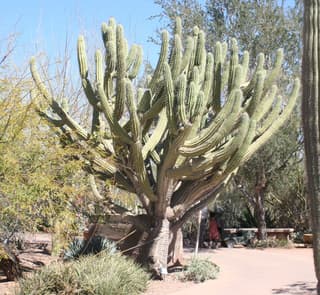
Argentine Toothpick Cactus
Stetsonia coryne
Stetsonia coryne is a large, tree-like columnar cactus native to the high-altitude arid regions of northwestern Argentina, Bolivia, Paraguay, and Brazil. In habitat it develops a thick trunk topped by many blue-green, eight- to nine-ribbed branches armed with stiff black or yellowish-brown spines that fade to white with age -- the source of its common name. Large, funnel-shaped white flowers open at night on mature plants, followed by fleshy, edible fruit.
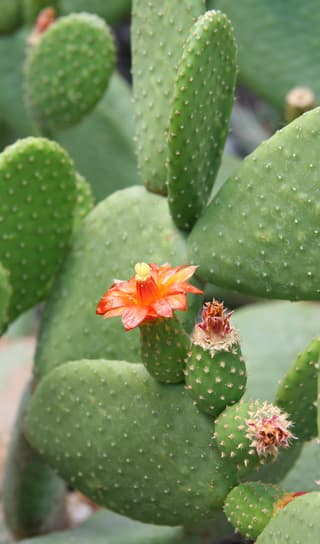
Pink Toad Cactus
Tacinga
Tacinga is a genus of cacti native to the Caatinga biome of northeastern Brazil, belonging to the family Cactaceae (subfamily Opuntioideae). Closely related to Opuntia, it includes species such as T. inamoena and T. funalis, perfectly adapted to semi-arid conditions. It produces colorful flowers and edible fruits, and is an iconic symbol of Brazil's endemic flora.
Verschaffelt Tephrocactus
Tephrocactus verschaffeltii
Tephrocactus verschaffeltii is a captivating segmented cactus native to the arid regions of Argentina and Bolivia. Its oval segments display colors ranging from mint green to plum purple, adorned with distinctive white fluffy areoles. In spring and summer, it produces vibrant fire-red to orange blooms that make it a striking collector's piece. A slow-growing species, it is well-suited for rock gardens, desert landscapes, and container growing.
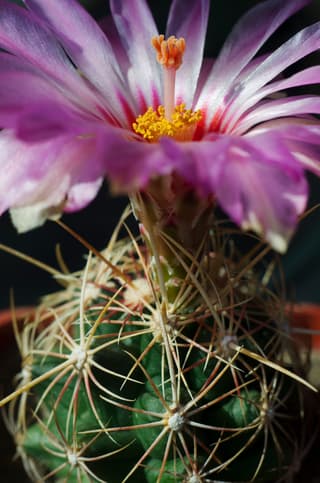
Thelocactus
Thelocactus
Thelocactus is a genus of about 13 species of globose to short cylindrical cacti that grow wild in the arid regions of central and northern Mexico as well as in the Big Bend region of Texas. The plants are characterized by prominent, often spiraling ribs set with distinct tubercles and star-shaped spine clusters in colors ranging from white and golden to reddish-brown. In spring and summer, large, funnel-shaped flowers bloom from the plant's apex in shades of white, yellow, pink, and purple – often nearly as wide as the plant itself.
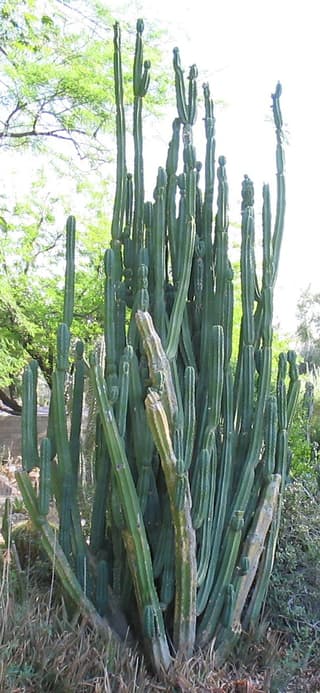
San Pedro Cactus
Trichocereus pachanoi
Trichocereus pachanoi, known as the San Pedro cactus, is a fast-growing columnar cactus native to the Andes Mountains of Ecuador and Peru, where it grows at altitudes of 2,000–3,000 meters above sea level. It produces upright, bluish-green stems with 6–8 ribs, reaching heights of 3–6 meters (exceptionally more) in the wild. It blooms at night with large, strongly scented white flowers that last only about two days. For over 2,000 years, it has been part of traditional Andean medicine and shamanic rituals due to its mescaline alkaloid content.
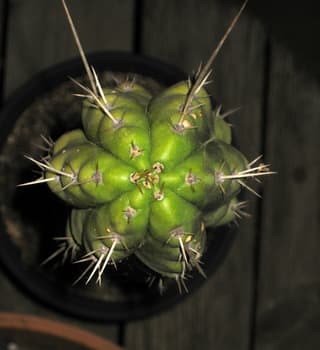
Peruvian torch cactus
Trichocereus peruvianus
Trichocereus peruvianus (synonym Echinopsis peruviana) is a large columnar cactus native to the Andes of Peru and neighbouring regions. It forms erect, branching, blue-green stems with a few well-defined ribs and spines that vary with light conditions. Mature plants can reach several metres in height. The large white flowers open at night near the tops of the stems in late spring and summer. It is a striking architectural plant, popular in xeric gardens and cactus collections, and it tolerates drought well when grown in full sun and very free-draining, gritty soil.

Navelwort
Umbilicus rupestris
Navelwort (Umbilicus rupestris) is a fleshy, perennial succulent of the stonecrop family, native to southern and western Europe, where it grows wild in shady wall crevices and damp rocky banks. Its round, waxy leaves have a distinctive navel-like central depression, giving rise to both its common and scientific names. In late spring and summer it sends up tall spikes of small, bell-shaped greenish-pink flowers.
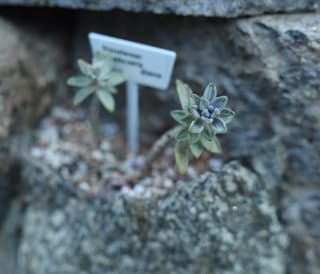
Little Jewel
x Pachyveria glauca
x Pachyveria 'Glauca' (Little Jewel) is a hybrid succulent from the Crassulaceae family, resulting from a cross between the Pachyphytum and Echeveria genera. It forms a compact, spiky rosette of thick, fleshy, cylindrical leaves with a dusty blue-gray coloration and tips that take on red and violet tones under intense sun. It is a plant of exclusively horticultural origin (does not occur in nature), very popular in rock gardens, shallow pot compositions, and succulent collections for its hardiness and understated beauty. In winter and early spring, it can produce small flowers in shades of pink and peach.
Easy Care Succulents
Our selection of 280 easy succulents combines the characteristics of this category with reduced care needs. Perfect for beginners who love this category.
Why Choose Easy Succulents?
Combining the beauty of succulents with easy difficulty level lets you enjoy this category without excessive maintenance worries. Each plant was selected to offer the best characteristics of the category at the care level you are looking for.