283 Easy Succulents | 2026 Guide - Page 7
Find 283 easy succulents. Complete guide for your garden.
283 Succulents with easy level
Showing 217-252 of 283
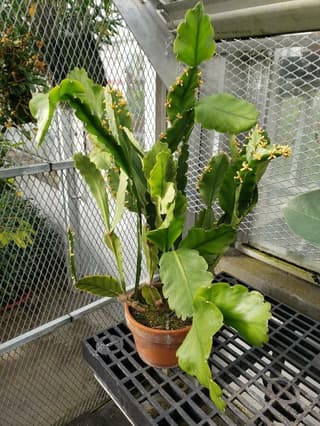
Jungle Cactus
Rhipsalis pachyptera
Rhipsalis pachyptera is a spineless epiphytic cactus native to the Atlantic Forest of southeastern and southern Brazil (Espírito Santo, Rio de Janeiro, São Paulo, Paraná, Santa Catarina and Rio Grande do Sul). In the wild it grows on tree trunks and moist rocks, producing broad, flattened, wavy-edged stems that trail up to 1.5 m long. Creamy-white to yellowish flowers appear in winter, followed by small translucent berries.
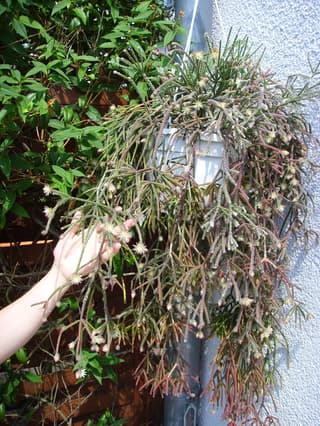
Hairy-stemmed Rhipsalis
Rhipsalis pilocarpa
Rhipsalis pilocarpa, commonly called the hairy-stemmed rhipsalis, is an epiphytic cactus endemic to Brazil's Atlantic Forest, native to the states of Espírito Santo, Minas Gerais, Rio de Janeiro, São Paulo, and Paraná. In the wild it grows harmlessly on tree trunks and branches, absorbing moisture and nutrients from humid forest air and organic debris rather than from soil. Its slender cylindrical stems, reaching up to 50 cm long, start upright and become pendant as they mature, covered in small gray-to-white bristles that give the plant a soft, fuzzy texture. Fragrant white flowers 2.5 to 4 cm wide appear from fall into early winter, followed by bristly, wine-red spherical fruits about 12 mm across. Unlike desert cacti, this forest species thrives in filtered light and higher humidity, reflecting its origins beneath the rainforest canopy.
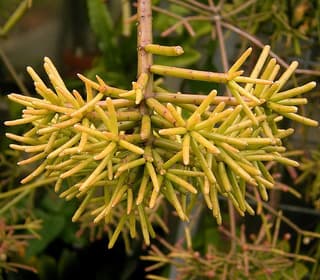
Mistletoe Cactus
Rhipsalis teres
Rhipsalis teres, commonly known as Mistletoe Cactus, is a tropical epiphytic cactus native to southeastern and southern Brazil. Its slender, cylindrical, trailing stems cascade beautifully from hanging baskets, making it a popular houseplant. Unlike desert cacti, it thrives in humid, shadier conditions that mimic its natural rainforest habitat, where it grows anchored to tree branches.
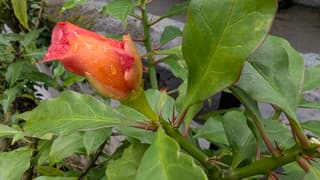
Rose Cactus
Rhodocactus grandifolius
Rhodocactus grandifolius, formerly known as Pereskia grandifolia, is a fascinating primitive cactus that possesses true, persistent leaves, unlike most cacti. Native to Brazil, it grows as a shrub or small tree, featuring long spines on its woody stems and stunning rose-like flowers, typically in shades of intense pink or magenta.
Christmas Cactus
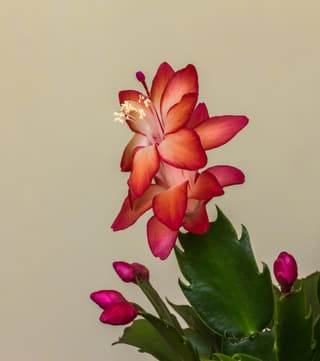
Schlumbergera
Schlumbergera is an epiphytic cactus native to the humid coastal rainforests of southeastern Brazil, where it grows on tree branches and rock crevices in dappled shade. Unlike desert cacti, its flattened, segmented stems (cladodes) store some water but need humidity and indirect light to thrive. Grown worldwide as a popular houseplant, it produces showy tubular flowers in red, pink, white, orange, and purple during fall and winter.
Christmas Cactus
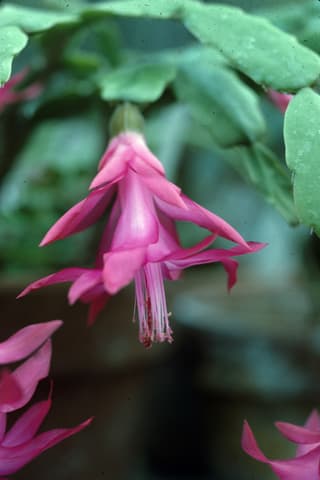
Schlumbergera × buckleyi
Schlumbergera × buckleyi, the true Christmas Cactus, is a hybrid epiphytic cactus that originates from the crossing of S. truncata and S. russelliana, native to the cloud forests of Brazil. Unlike the more common Thanksgiving Cactus (S. truncata), it bears smooth, rounded stem segments and blooms reliably in late December, making it one of the most beloved winter-flowering houseplants in the world. Its tubular, drooping flowers range from pink and red to white and purple, and the plant can live for decades with proper care.
Christmas Cactus
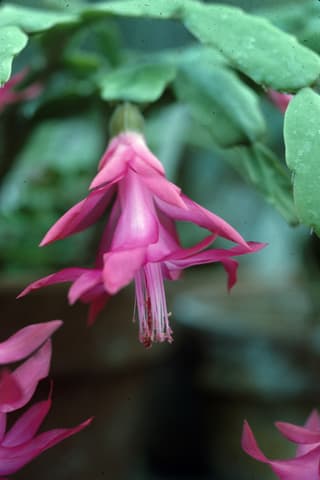
Schlumbergera buckleyi
The Christmas Cactus (Schlumbergera buckleyi) is a tropical epiphytic cactus native to the cloud forests of southeastern Brazil. Unlike desert cacti, it thrives in humid conditions with bright indirect light, producing spectacular tubular flowers in shades of pink, red, white, purple, and coral during winter. It is one of the most beloved holiday houseplants worldwide, celebrated for blooming around Christmas.
Christmas Cactus
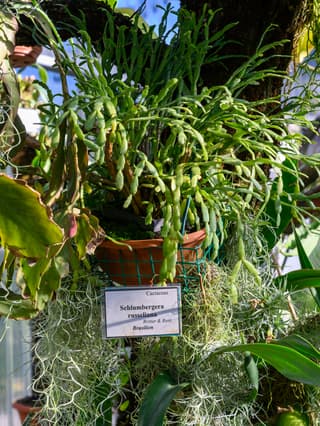
Schlumbergera russelliana
Schlumbergera russelliana, commonly known as Christmas Cactus, is an epiphytic cactus native to the Brazilian Atlantic Forest. It is the ancestral species of garden Christmas cactus hybrids, producing tubular flowers in shades of pink, red, and purple during winter. It naturally grows on trees and rocks in filtered light and moderate humidity typical of tropical rainforests.
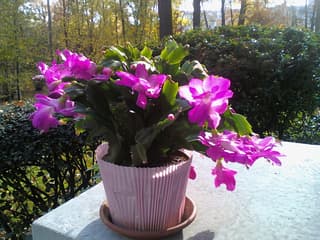
Thanksgiving Cactus
Schlumbergera truncata
The Thanksgiving Cactus is an epiphytic succulent native to the humid Atlantic Forest of southeastern Brazil, particularly found in the mountains of Rio de Janeiro state. Its flattened, pendulous stems produce spectacular tubular flowers in shades of pink, red, white, orange, and purple during fall and winter. It is highly valued as an ornamental plant for its beauty and ease of cultivation.

Letizia Sedeveria
Sedeveria 'Letizia'
Sedeveria 'Letizia' is a compact hybrid succulent in the Crassulaceae family, created by crossing Echeveria setosa with Sedum cuspidatum and named in 2006 after Letizia Alleruzzo. Fleshy, spoon-shaped leaves form small rosettes atop trailing stems that reach about 8 in (20 cm) tall, turning from soft green to a vivid red-pink blush along the margins when grown in bright light or cool temperatures. In spring, slender stalks rise above the foliage bearing small white flowers tipped in pink. It is easy to grow indoors on a sunny windowsill or outdoors in USDA zones 9a-11b, provided it is protected from hard frost.
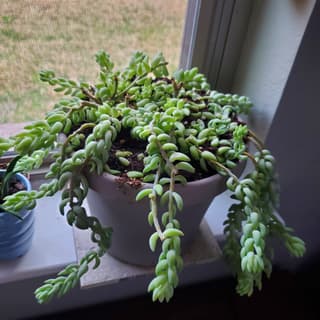
Stonecrop (genus)
Sedum
Sedum is a vast genus of over 600 succulent species in the family Crassulaceae, ranging from low-growing creeping groundcovers like S. acre to upright clump-formers like S. spectabile and the beloved trailing S. morganianum (Donkey's Tail). Incredibly hardy, drought-tolerant, and adaptable across USDA zones 3–11.
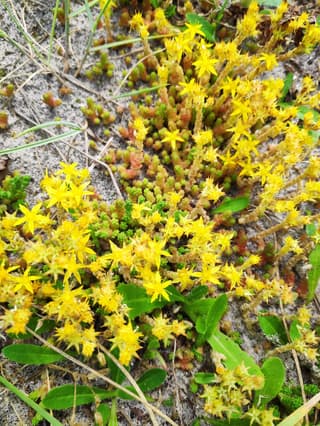
Goldmoss stonecrop
Sedum acre
Sedum acre, known as goldmoss stonecrop, is a low, mat-forming evergreen succulent in the Crassulaceae family, native to Europe and North Africa. Its tiny, fleshy green leaves store water and are topped by bright yellow star-shaped flowers in early summer. Exceptionally hardy, it is a favourite for green roofs, rock gardens and edging.
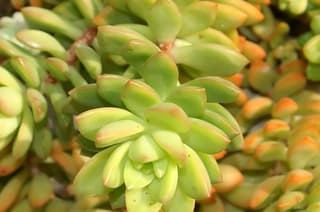
Golden Sedum
Sedum adolphi
Sedum adolphi, commonly known as Golden Sedum or Coppertone Stonecrop, is a perennial succulent in the Crassulaceae family, native to Mexico. Its fleshy yellow-green leaves turn stunning shades of orange and copper when exposed to full sun, a phenomenon known as sun stress. It is a low-maintenance, drought-tolerant plant that thrives both indoors and outdoors in warm climates.
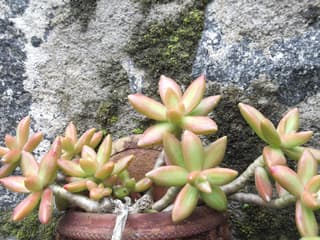
Golden Sedum
Sedum adolphii
Sedum adolphii is a versatile perennial succulent known for its fleshy, lance-shaped leaves that take on a vibrant yellow-orange hue when exposed to full sun. Native to Mexico, it forms dense rosettes and is ideal for rock gardens or hanging pots.
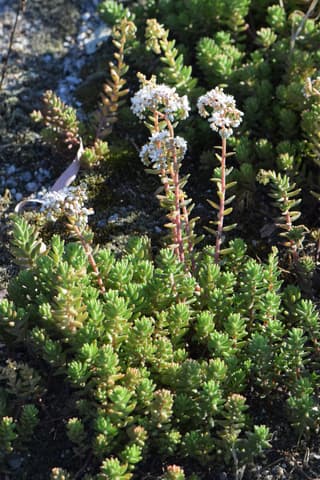
White Stonecrop
Sedum album
Sedum album, commonly known as White Stonecrop, is a low-growing evergreen succulent native to Europe, North Africa, and western Asia. It forms dense mats of small, plump green leaves that often turn reddish in full sun or during drought. In summer it produces masses of tiny starry white flowers, making it a popular choice for rock gardens, green roofs, and ground cover applications.
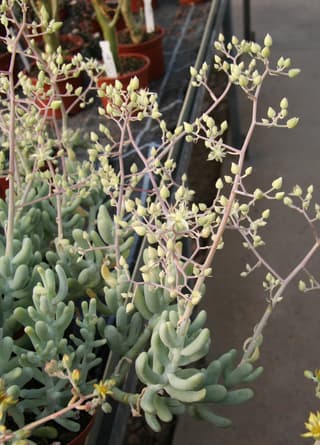
Ghost Sedum
Sedum allantoides
Sedum allantoides is a compact succulent in the Crassulaceae family, native to Mexico (Oaxaca). Its fleshy, cylindrical leaves are coated in a white powdery bloom (pruina), giving it a ghostly appearance. In summer it produces small star-shaped greenish-white flowers.
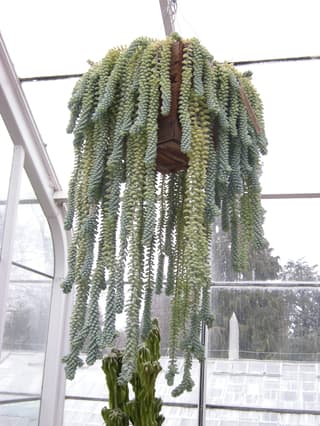
Baby Donkey Tail
Sedum burrito
Sedum burrito, often sold as Sedum morganianum 'Burrito', is a compact trailing succulent prized for its dense rows of plump, blue-green, bead-like leaves that cascade over the edge of hanging pots. Unlike its parent species Sedum morganianum, its leaves are shorter, rounder, and less prone to dropping, making it a sturdier houseplant choice.
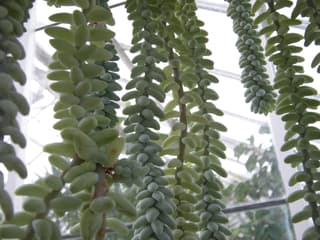
Baby Burro's Tail
Sedum burritum
Baby Burro's Tail is a compact, trailing succulent in the Crassulaceae family, closely related to the larger Sedum morganianum. It forms dense ropes of tiny, plump, blue-green leaves that overlap like beads along pendulous stems, making it a favorite for hanging baskets and shelves where its foliage can cascade freely. Native to the arid regions of southern Mexico, it is extremely drought-tolerant and thrives on benign neglect, needing only bright light and infrequent, deep watering. Mature plants may produce small star-shaped pink to red flowers at the stem tips in summer. The leaves are delicate and detach easily at the slightest touch, so the plant is best kept somewhere it will not be brushed against.

Corsican Stonecrop
Sedum dasyphyllum
Sedum dasyphyllum is a tiny, mat-forming evergreen succulent with plump, rounded blue-grey leaves that often blush lavender-pink in strong light. In early summer it carries small white star flowers on short stems. This low, spreading groundcover is perfect for troughs, rock gardens, walls and the gaps between paving.
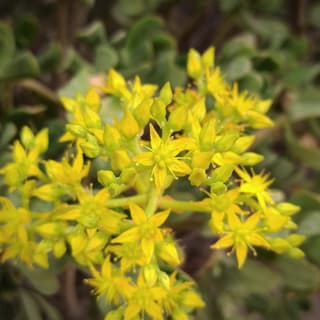
Tree Stonecrop
Sedum dendroideum
Tree Stonecrop (Sedum dendroideum) is a robust, shrubby succulent native to the mountainous regions of Mexico and Guatemala, from Chiapas and Oaxaca to Veracruz and Michoacan. It forms dense, much-branched clumps of thick woody stems topped with rosettes of fleshy, spatula-shaped green leaves that blush red or bronze under strong sun or cool temperatures. From late winter into spring it produces abundant clusters of small, star-shaped yellow flowers that attract pollinators. Easy to grow and highly drought-tolerant, it is a popular choice for rock gardens, succulent borders, ground cover, and container displays in warm, sunny climates.
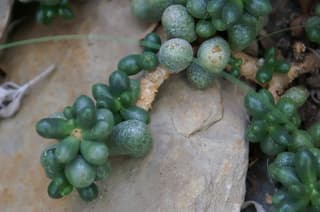
Jellybean Sedum
Sedum hernandezii
Sedum hernandezii is a Mexican succulent prized for its plump, jellybean-shaped leaves arranged in tidy whorls along branching, semi-trailing stems. In bright light the emerald leaf tips blush red and gold, and clusters of small star-shaped yellow flowers appear from late winter into spring.
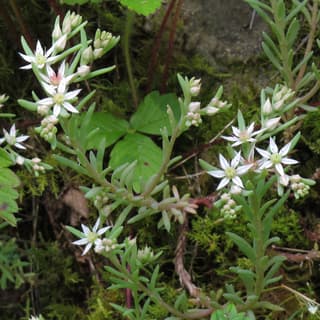
Spanish Stonecrop
Sedum hispanicum
Low-growing succulent groundcover with tiny, narrow, bluish-grey leaves forming a dense mat. It reaches about 5 to 15 cm tall and spreads roughly 30 cm. Small star-shaped white to pale pink flowers, usually with six petals, appear in summer. Foliage can turn burgundy in autumn. Despite the name, it is native to south-central and southeastern Europe through to Iran and the Arabian Peninsula.
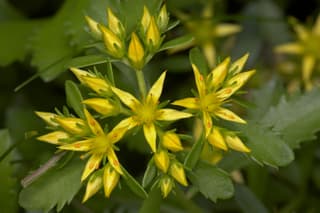
Orange Stonecrop
Sedum kamtschaticum
Sedum kamtschaticum, commonly known as Orange Stonecrop or Russian Stonecrop, is a low-growing succulent groundcover in the Crassulaceae family, native to rocky mountain slopes across Japan, Korea, northeastern China, and the Russian Far East (including the Kamchatka Peninsula, from which it takes its name). It forms dense, spreading mats of glossy, spoon-shaped green leaves that flush bronze-red in cooler weather, topped in late spring through midsummer by clusters of star-shaped golden-yellow flowers that attract bees and butterflies. Extremely drought-tolerant once established, it is prized as a rock garden, wall, or edging plant that thrives where little else will grow.
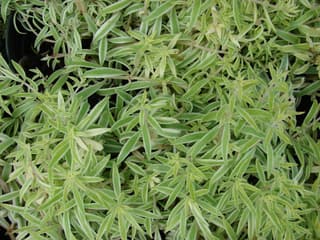
Needle Stonecrop
Sedum lineare
Sedum lineare, commonly known as Needle Stonecrop or Carpet Sedum, is a mat-forming succulent groundcover native to eastern China, Japan, and Taiwan. It has slender, branching stems covered in narrow, light green leaves arranged in whorls of three. In late spring to early summer it produces small star-shaped yellow flowers. Extremely tough, it tolerates poor soil, drought, and full sun, making it a popular choice for rock gardens, borders, and hanging containers.
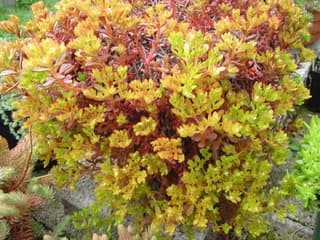
Japanese Stonecrop
Sedum makinoi
Sedum makinoi is a perennial creeping succulent plant native to Japan. It is characterized by its small, rounded, fleshy, bright green leaves that form a dense and attractive carpet. During the summer, it produces small, star-shaped yellow flowers that stand out against the foliage. It is an excellent choice for rock gardens, ground cover in sunny areas, or as a trailing plant in pots and hanging baskets.
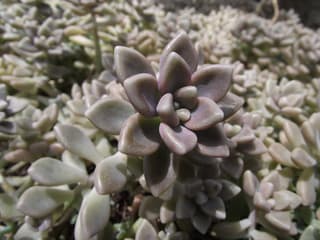
Marbled Succulent
Sedum mendozae
Sedum mendozae, commonly known as the Marbled Succulent, is a compact rosette-forming succulent in the Crassulaceae family. Native to the volcanic hillsides of Veracruz, Mexico, it features thick, fleshy leaves in grayish tones with green and pink hues depending on sun exposure. It produces small white star-shaped flowers in spring and summer. Also known as Graptopetalum mendozae, it is prized in succulent arrangements and rock gardens.
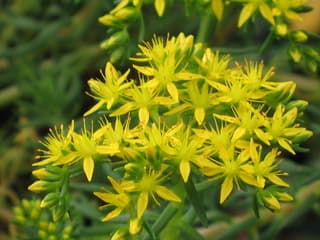
Mexican Stonecrop
Sedum mexicanum
Mexican Stonecrop (Sedum mexicanum) is a low-growing succulent groundcover in the Crassulaceae family, native to Mexico. It forms dense mats of bright green, needle-like leaves and produces masses of small, star-shaped yellow flowers in late spring to early summer. It is widely used in rock gardens, borders, and green roofs.
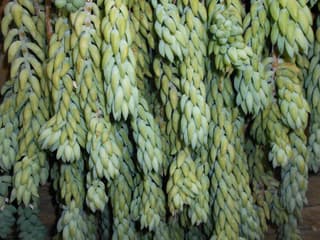
Burro's Tail
Sedum morganianum
Sedum morganianum is a trailing succulent native to Mexico, famous for its long stems covered with plump, blue-green fleshy leaves that can reach up to 60 cm (24 inches) in length. Pink to red flowers appear in summer. Perfect for hanging baskets, but must be handled carefully as leaves detach easily.
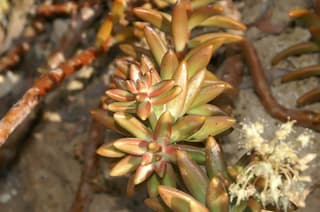
Coppertone Stonecrop
Sedum nussbaumerianum
Sedum nussbaumerianum, commonly called Coppertone Stonecrop, is a trailing succulent in the Crassulaceae family native to the volcanic highlands of Veracruz, Mexico. Its fleshy, teardrop-shaped leaves form loose rosettes that shift from pale yellow-green to a vivid copper-orange under strong sun, giving the plant its common name. Left to spread, it cascades attractively over pot edges or spills across rock gardens as ground cover.
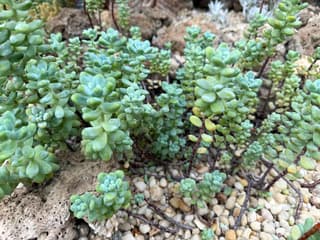
Jelly Bean Plant
Sedum pachyphyllum
Sedum pachyphyllum is a charming perennial succulent native to Mexico. It is characterized by its short, cylindrical, fleshy leaves that grow on upright or slightly trailing stems. Its coloration is a pale bluish-green (glaucous), but what makes it special are the leaf tips, which turn bright red or pink when the plant is exposed to full sun or moderate cold. It produces small, star-shaped yellow flowers during the spring.
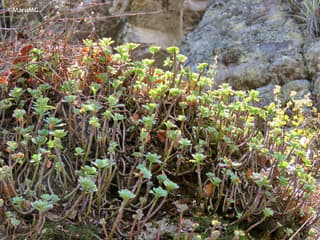
Palmer's Sedum
Sedum palmeri
Sedum palmeri is an evergreen perennial succulent native to the rocky cliffs of the Sierra Madre in Mexico. It forms compact rosettes of glaucous blue-green leaves on trailing stems, making it an excellent choice for hanging baskets, rock gardens, and container gardens. In spring, it produces bright yellow star-shaped flowers that attract pollinators.
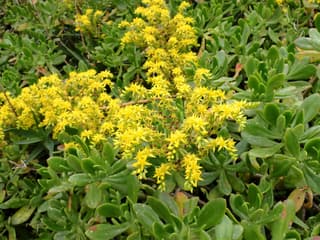
Shrubby Stonecrop
Sedum praealtum
Shrubby stonecrop (Sedum praealtum) is a shrub-forming succulent native to Mexico, growing up to 90 cm tall. Its spatula-shaped, yellow-green leaves turn reddish under strong sun or cold temperatures and cluster into rosettes at the stem tips. In late winter and early spring it produces abundant clusters of small yellow flowers. It is an extremely hardy, low-maintenance plant, well suited to rock gardens, borders and outdoor containers.

Blue Spruce Stonecrop
Sedum reflexum
Sedum reflexum is a low, mat-forming evergreen succulent with needle-like blue-green leaves that resemble tiny spruce foliage. In summer it sends up arching stems topped with star-shaped yellow flowers. A tough, drought-tolerant groundcover ideal for rock gardens, green roofs and containers.
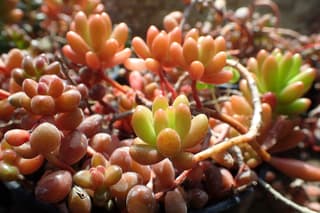
Jelly Bean Plant
Sedum rubrotinctum
Sedum rubrotinctum, commonly known as the Jelly Bean Plant or Pork and Beans, is a charming succulent native to Mexico. Its plump, bean-shaped leaves are bright green at the base, turning vivid red at the tips when exposed to bright sunlight or stress — a natural phenomenon called anthocyanin production. It is a popular choice for rock gardens, container arrangements, and indoor windowsills.
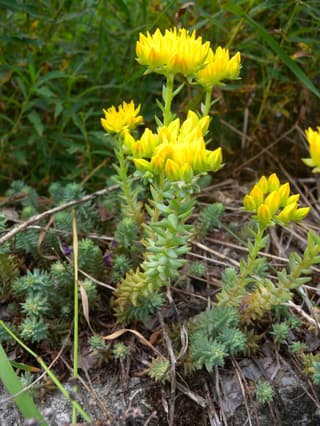
Jenny's Stonecrop
Sedum rupestre
Jenny's stonecrop is a low, mat-forming evergreen succulent native to central, western, and southern Europe. Its trailing stems are densely packed with narrow, cylindrical, blue-gray to gray-green leaves that resemble miniature spruce sprigs, giving rise to one of its other common names, blue spruce stonecrop. In summer, upright flowering stems rise above the foliage mat and open into clusters of small, star-shaped yellow flowers that are pendent in bud and turn upward as they open. The plant spreads steadily by rooting along its stems, forming a dense groundcover that tolerates poor, dry soils and long dry spells once established. It is widely grown in rock gardens, on green roofs, in gravel gardens, and as a filler for containers and stone walls.
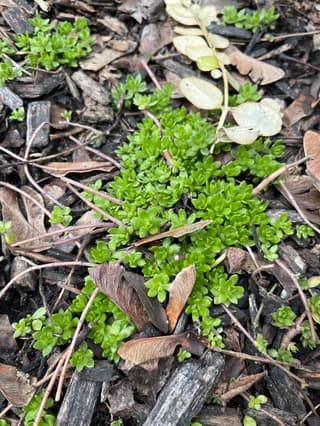
Stringy Stonecrop
Sedum sarmentosum
Sedum sarmentosum is a fast-spreading creeping succulent native to China, Korea, and Japan. It forms dense mats of fleshy yellow-green leaves and produces cheerful star-shaped yellow flowers in late spring to summer. Widely used as a ground cover in rock gardens and slopes.
Easy Care Succulents
Our selection of 283 easy succulents combines the characteristics of this category with reduced care needs. Perfect for beginners who love this category.
Why Choose Easy Succulents?
Combining the beauty of succulents with easy difficulty level lets you enjoy this category without excessive maintenance worries. Each plant was selected to offer the best characteristics of the category at the care level you are looking for.