Complete Plant Guide
Explore plants by difficulty, season and more. Find the perfect plant for you.
Difficulty
Categories
Plants by City
🗺️ Plants by City3478 plants found
Showing 1693-1728 of 3478
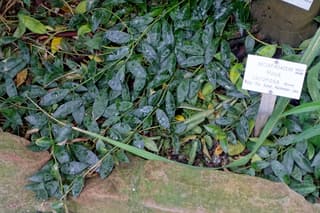
Cinnamon-scented Hoya
Hoya lacunosa
Hoya lacunosa is a compact tropical vine native to the rainforests of Malaysia and Indonesia. Beloved for its intensely sweet, cinnamon-like fragrance — strongest at dusk and into the night — it produces dense clusters of small, star-shaped white flowers. A popular and rewarding houseplant, especially among hoya collectors.

Wax Plant Memoria
Hoya memoria
Hoya memoria, also known by its synonym Hoya gracilis, is a trailing epiphytic vine native to the Philippines. It features dark green, pointed, slightly succulent leaves with a distinctive waxy texture. Beloved by indoor plant enthusiasts, it produces clusters of fuzzy, raspberry-pink star-shaped flowers with a sweet caramel fragrance during spring and summer. Its vining habit makes it ideal for hanging baskets and shelves.
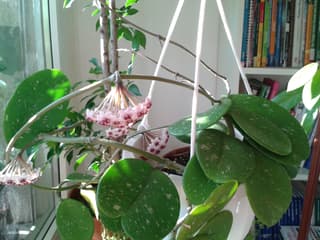
Obovata Wax Plant
Hoya obovata
Hoya obovata is a tropical epiphytic climber native to the rainforests of India, Indonesia, and Fiji. It is prized for its thick, waxy, round-to-oval dark green leaves often adorned with silver splash markings. It produces sweetly fragrant, star-shaped pink flowers arranged in globe-like umbels with a reddish central corona.
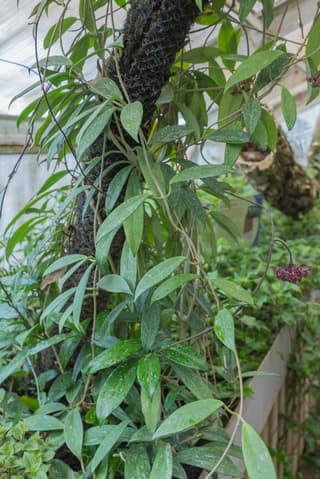
Wax Flower Vine
Hoya pubicalyx
Hoya pubicalyx is a vigorous tropical vining plant native to the Philippines, prized for its glossy, lance-shaped leaves and spectacular dark-pink to deep-crimson star-shaped flowers arranged in rounded umbels. The blooms have a sweet, pleasant fragrance and appear repeatedly from the same spurs, making it a long-lived flowering houseplant. It is one of the most popular hoyas in cultivation due to its reliable blooming and ease of care.
Hoya Burtoniae
Hoya sp. aff. burtoniae
Hoya sp. aff. burtoniae is a fuzzy-leaved trailing epiphyte closely related to Hoya burtoniae, native to the forests of the Philippines. Its small, velvety, almond-shaped leaves blush deep burgundy-red in bright light, and mature vines reward patient growers with clusters of tiny, fuzzy, star-shaped flowers with a red-and-gold corona and a sweet, honey-like fragrance. Grown in a hanging basket or on a trellis, it makes a striking, low-maintenance addition to any bright indoor space.
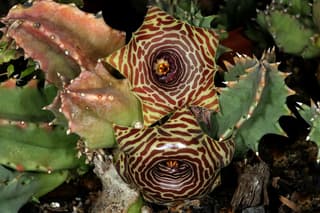
Lifesaver Plant
Huernia
Huernia is a genus of low-growing, clump-forming succulents native to eastern and southern Africa, prized for their soft, toothed, cucumber-like stems and unusual star-shaped flowers. The most widely cultivated species, Huernia zebrina, produces cream-to-yellow blooms marked with maroon zebra-like stripes and a glossy, donut-shaped center ring that resembles a lifesaver candy - the source of its common name. Like other members of the milkweed subfamily (Apocynaceae, Asclepiadoideae), its flowers emit a faint carrion-like odor to attract fly pollinators.
Red Dragon Flower
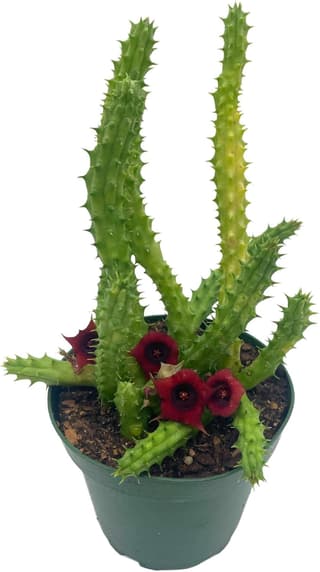
Huernia schneideriana
Huernia schneideriana is a fascinating succulent native to East Africa. It features grayish-green, cylindrical stems with prominent teeth along the edges. Its flowers are the main highlight: small, bell-shaped or star-shaped, with a velvety interior of dark red or intense burgundy. It is a low-growing or slightly trailing plant, making it ideal for hanging baskets or succulent collections in small spaces.
Lifesaver Cactus
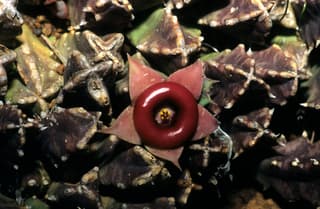
Huernia zebrina
Huernia zebrina, commonly called the lifesaver cactus, is a low-growing succulent from the family Apocynaceae native to southern Africa (Namibia, Botswana, South Africa, Zimbabwe and Mozambique). Its toothed, four-angled stems form dense mats, and from late spring through summer it produces striking star-shaped flowers with a raised, glossy red-and-cream ring at the center that resembles a life-saver candy. The blooms emit a faint carrion scent to attract fly pollinators.
Hops
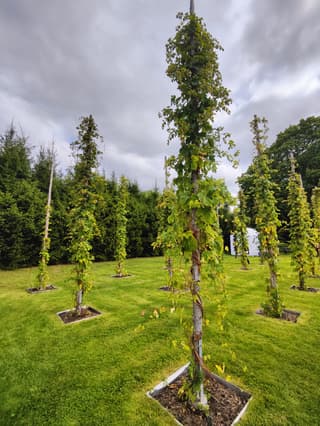
Humulus lupulus
Hops (Humulus lupulus) is a vigorous, perennial climbing plant in the hemp family (Cannabaceae), native to Europe, North Asia, and North America. It is known for its impressive growth rate—under optimal conditions, shoots can grow up to 7 inches (18 cm) per day in early summer, and the plant can reach 20–26 feet (6–8 meters) in length during a single growing season. The plant is dioecious: female plants produce the characteristic cone-shaped inflorescences rich in bitter substances (humulones and lupulones) and essential oils. These cones are indispensable in brewing beer, providing bitterness, aroma, and preservative properties. Hops have also been used medicinally in folk medicine for hundreds of years, particularly as a sedative.
Spanish Bluebell
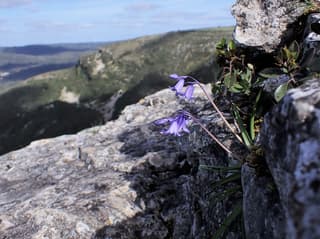
Hyacinthoides hispanica
The Spanish Bluebell (Hyacinthoides hispanica) is a bulbous perennial native to the Iberian Peninsula, prized for its nodding bell-shaped flowers in shades of blue, lavender, pink, or white that bloom in mid to late spring. It naturalizes readily, forming stunning colonies under deciduous trees. Caution: all plant parts are toxic if ingested.
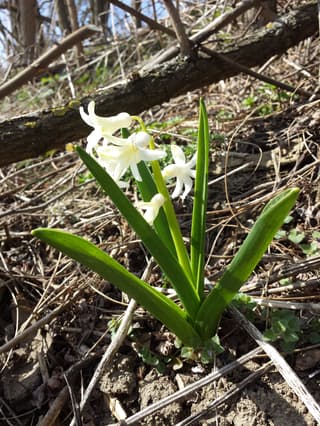
Common Hyacinth
Hyacinthus orientalis
Hyacinthus orientalis, commonly known as the Common Hyacinth or Garden Hyacinth, is a bulbous perennial prized for its intensely fragrant, densely packed flower spikes that bloom in spring. Native to the Eastern Mediterranean and Asia Minor, it produces upright stalks bearing clusters of bell-shaped flowers in shades of blue, violet, white, pink, and yellow. After blooming, the foliage dies back and the bulb remains dormant until the next season.
Mealy tooth
Hydnellum ferrugineum
Hydnellum ferrugineum, known as the mealy tooth, is a fascinating terrestrial fungus that forms a mycorrhizal relationship with pine trees. It is characterized by its tough, corky texture and the deep reddish-brown droplets of fluid that are often exuded from its upper surface during active growth. The fungus features spines on its underside instead of gills, which is typical for the genus. It is not edible due to its extremely bitter taste and woody texture, but it is highly valued for dyeing wool, where it produces beautiful beige to brown tones.
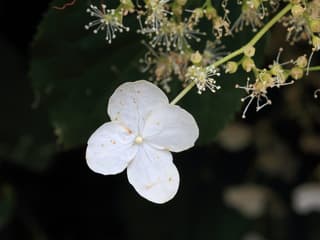
Climbing hydrangea
Hydrangea anomala
Hydrangea anomala is a deciduous, self-clinging climbing vine native to Japan, China, Korea and eastern Siberia. It attaches to walls, fences and trees using aerial rootlets, producing broad, glossy dark-green leaves and flat lacecap flower heads of small fertile florets ringed by showy white sterile ones in late spring to summer.
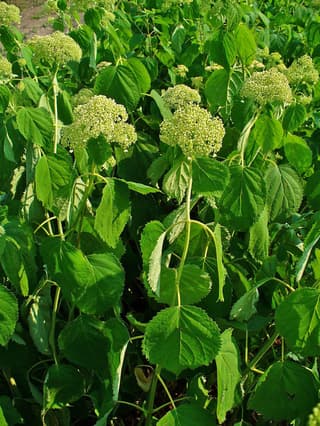
Smooth Hydrangea
Hydrangea arborescens
Hydrangea arborescens, commonly known as Smooth Hydrangea or Wild Hydrangea, is a deciduous shrub native to the eastern United States. The 'Annabelle' cultivar is iconic for its massive, globe-shaped white flower heads reaching up to 30 cm across. Hardy to USDA zone 3, it is one of the most cold-tolerant hydrangeas available.
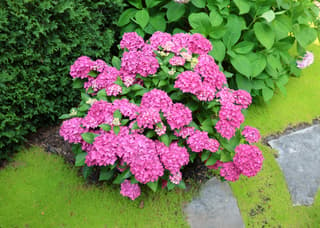
Bigleaf Hydrangea
Hydrangea macrophylla
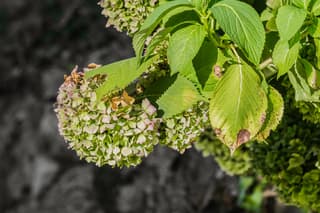
Hydrangea macrophylla, commonly known as Bigleaf Hydrangea, is a deciduous flowering shrub native to Japan. It is celebrated for its large, rounded flower clusters that dramatically change color — from pink to blue — based on the pH of the soil. This versatility and visual impact make it one of the most popular ornamental shrubs in gardens worldwide.
Panicle Hydrangea
Hydrangea paniculata
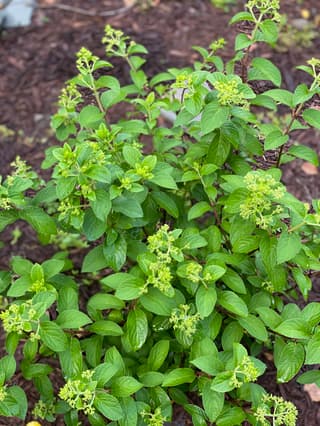
Hydrangea paniculata, commonly known as Panicle Hydrangea, is a deciduous shrub native to China, Japan, and Russia. It is celebrated for its large cone-shaped flower clusters (panicles) that bloom from mid-summer through fall, transitioning from creamy white to shades of pink. It is the most sun-tolerant and cold-hardy hydrangea species.
Mountain Hydrangea
Hydrangea serrata
Hydrangea serrata, commonly known as mountain hydrangea, is a compact deciduous shrub native to the mountainous regions of Korea and Japan. It produces elegant lacecap flower heads in shades of blue, pink, white, and lavender, with colour determined by soil pH. Growing slowly to about 120 cm tall and 150 cm wide, it is prized for its delicate texture, long summer-to-fall bloom period, and adaptability to woodland and cottage garden settings.
Marsh pennywort
Hydrocotyle vulgaris
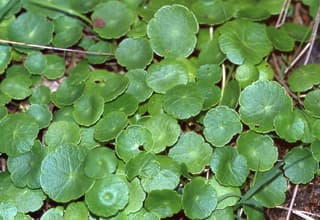
Marsh pennywort (Hydrocotyle vulgaris) is a low, creeping perennial of the family Araliaceae, native to wet meadows, bogs, and pond margins across Europe. Its rounded, umbrella-shaped leaves form a dense mat that spreads readily over saturated soil or shallow water, making it a popular marginal plant for ponds and bog gardens.
Persistent Waxcap
Hygrocybe acutoconica
Hygrocybe acutoconica, commonly known as the Persistent Waxcap, is a striking mushroom characterized by its bright yellow to orange-yellow conical cap. The cap is often slimy or viscid when moist and maintains its pointed shape even as it matures. It is typically found in unimproved grasslands, dunes, and woodland edges. As a fungal species, it does not possess foliage or flowers but produces spores for reproduction.
Red Pitaya
Hylocereus costaricensis
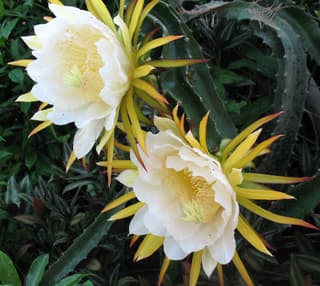
Red Pitaya (Hylocereus costaricensis) is a climbing cactus native to Costa Rica and Central America, prized for its intensely red, sweeter-tasting flesh compared to the white-fleshed variety. This succulent vine has triangular, fleshy stems that climb using aerial roots and needs a trellis or support to thrive. It produces enormous white flowers that bloom only at night and wilt by morning, followed by pink-skinned fruit covered in leathery scales that reveal a vivid ruby pulp dotted with tiny edible black seeds.

Dragon Fruit
Hylocereus undatus
The dragon fruit (Hylocereus undatus) is an epiphytic climbing cactus native to Central America and Mexico, now widely cultivated in tropical and subtropical regions for its exotic fruits with pink skin and white pulp speckled with black seeds. Its green, triangular, and succulent stems grow like vines, clinging to trees, walls, or trellises via aerial roots. At night, it produces massive, fragrant white flowers that open for only a few hours, earning it the nickname 'Queen of the Night'.

Mountain fern moss
Hylocomium splendens
Mountain fern moss (Hylocomium splendens) is a prominent moss in the Hylocomiaceae family, forming dense, shimmering, olive- or yellow-green mats with a characteristic tiered (stair-step) structure—each annual growth segment emerges from the center of the previous year's shoot, creating distinct steps. The stems, reddish at the base, reach 10-20 cm in length and are bipinnately branched. This moss lacks true roots; it attaches to the substrate via rhizoids and absorbs water and nutrients through its entire surface. It is a common species in boreal coniferous and mixed forests of the Northern Hemisphere. It prefers nutrient-poor, acidic forest soils, growing on earth, humus, and decaying wood in shaded areas.
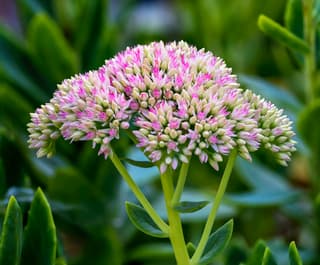
Autumn Joy Sedum
Hylotelephium
Hylotelephium is a genus of succulent perennial plants in the family Crassulaceae, formerly classified under Sedum. Commonly known as Autumn Joy Sedum or showy stonecrop, these plants are beloved for their fleshy, blue-green leaves and large, dome-shaped flower heads that emerge in late summer and persist through fall, providing late-season interest in the garden. Native to Asia and Europe, they are exceptionally hardy, drought-tolerant, and attract butterflies, bees, and other pollinators in abundance.
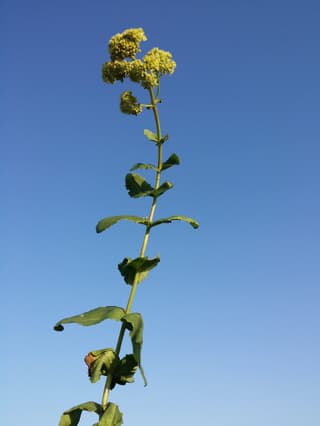
Great Stonecrop
Hylotelephium maximum
Hylotelephium maximum, commonly known as great stonecrop or orpine, is a robust, clump-forming succulent perennial in the Crassulaceae family native to Europe, the Caucasus, and western Siberia. It forms upright, fleshy stems 30-80 cm tall arising from a tuberous rootstock, with broad, opposite, grey-green succulent leaves. In late summer and autumn (September-October) it produces dense, flattened clusters of small creamy-white to pale pink flowers that attract bees and butterflies. Long treated as a subspecies of Hylotelephium telephium (as Sedum maximum), it thrives on dry, stony, calcareous slopes and forest edges at elevations up to 2,500 m, and is prized in gardens for its drought tolerance and low-maintenance nature.
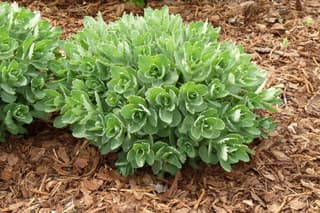
Showy Stonecrop
Hylotelephium spectabile
Hylotelephium spectabile, commonly known as Showy Stonecrop or Ice Plant, is a hardy succulent perennial native to China and Korea. It forms upright, clumping mounds of fleshy, blue-green leaves topped with flat-topped clusters of star-shaped pink flowers in late summer and fall — a magnet for butterflies and bees.
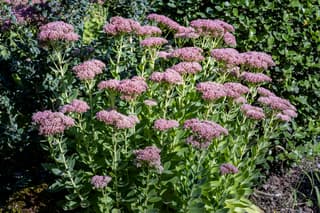
Orpine
Hylotelephium telephium
Orpine (Hylotelephium telephium) is a hardy Eurasian succulent perennial celebrated for its fleshy blue-green foliage and dense clusters of star-shaped flowers in shades of pink and purple from midsummer to autumn. Exceptionally drought-tolerant and cold-hardy to USDA zone 3, it thrives in sunny borders, rock gardens, and dry landscapes.
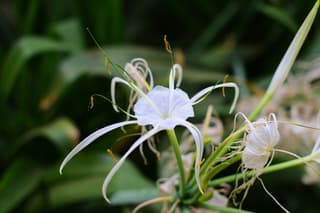
Spider Lily
Hymenocallis
Hymenocallis, commonly known as spider lily, is a bulbous perennial genus in the Amaryllidaceae family, prized for its fragrant, spidery white flowers with long ribbon-like petals. Native to the tropical and subtropical Americas, these evergreen to semi-evergreen plants form clumps of strap-shaped leaves and thrive in warm, humid climates near coastlines, wetlands, or well-drained garden beds.
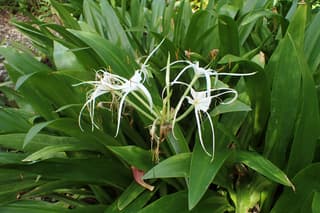
Beach Spider Lily
Hymenocallis littoralis
The Beach Spider Lily (Hymenocallis littoralis) is a perennial bulbous plant in the Amaryllidaceae family, native to the tropical and subtropical coastal regions of the Americas, from the southeastern United States to South America. It produces fragrant, elegant white flowers with long, slender petals resembling spider legs, rising above glossy dark-green strap-like foliage. Highly valued in coastal and tropical gardens for its ornamental beauty and salt-spray tolerance.
Rooting Shank
Hymenopellis radicata
Hymenopellis radicata, also known as the Rooting Shank, is an edible mushroom characterized by its long, spindle-shaped stem that extends deep into the ground to decaying roots of deciduous trees. When wet, the cap is distinctly slimy, wrinkled, and colored in brownish to olive tones. It is a fascinating species that indicates the presence of old beech wood beneath the forest floor.
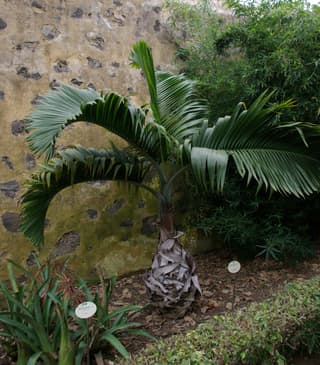
Bottle palm
Hyophorbe lagenicaulis
The bottle palm (Hyophorbe lagenicaulis) is a solitary palm from the Arecaceae family, endemic to Round Island in the Mascarene Islands (Mauritius). It is famous for its smooth, grayish trunk, which is swollen in a bottle shape at the base and tapers toward the crown, supporting a small canopy of 4 to 8 deep green pinnate leaves (young plants often show reddish or orange tones). A slow-growing species, fewer than 10 adult specimens remain in the wild, making it critically endangered, although its ornamental cultivation is widespread in tropical and subtropical climates worldwide.
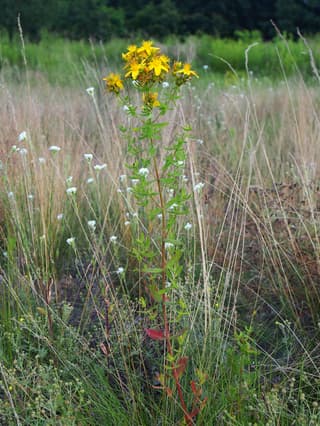
St. John's Wort
Hypericum
Hypericum is a large genus of herbaceous perennials and low shrubs prized for their bright golden, five-petaled flowers with a prominent burst of stamens. Blooming mainly through spring and summer, the genus is tough, drought-tolerant once established, and adaptable to a wide range of soils, making it equally popular as a garden ornamental and as a traditional medicinal herb.
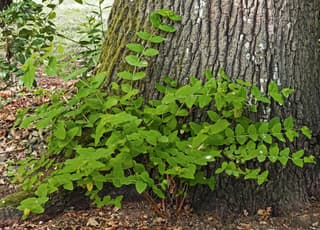
Tutsan
Hypericum androsaemum
Hypericum androsaemum, commonly called tutsan or sweet-amber, is a semi-evergreen shrub in the family Hypericaceae, native to Europe, North Africa, and western Asia. It grows 0.5-1 m tall with paired oval leaves and golden-yellow, star-shaped flowers that bloom from late spring through summer. The berry-like fruits mature from red to purplish-black and are ornamental but not edible.
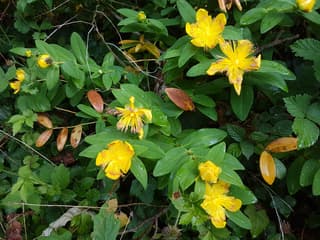
Aaron's Beard
Hypericum calycinum
Aaron's Beard (Hypericum calycinum) is a low-growing, semi-evergreen shrub in the St. John's Wort family (Hypericaceae), native to southeastern Europe and Asia Minor. Valued as a tough, spreading groundcover, it forms dense mats 30-60 cm tall via underground stolons and bears large, cup-shaped golden-yellow flowers with prominent bushy stamens from early to late summer.

St. John's Wort
Hypericum perforatum
St. John's Wort is a hardy, sun-loving perennial herb native to Europe and Asia, now naturalized across temperate regions worldwide. It forms upright, multi-stemmed clumps with slender oblong leaves dotted with tiny translucent oil glands, and produces abundant star-shaped yellow flowers with black-dotted petal margins in early to late summer. Low-maintenance and largely pest- and disease-free, it spreads readily by seed and rhizome, making it valuable for erosion control on banks and slopes but also a listed noxious weed in some regions. It is best known as a traditional medicinal herb, though all parts contain hypericin, a compound that can cause photosensitivity in people, pets, and livestock.
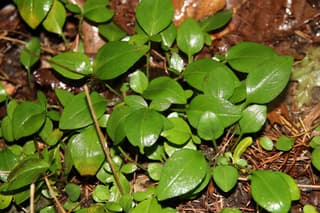
Shrubby St. John's Wort
Hypericum prolificum
Hypericum prolificum, commonly known as shrubby St. John's wort, is a compact, deciduous shrub native to the eastern and central United States. Its dense, upright stems are adorned with bright yellow, five-petaled flowers from June to October, which are distinguished by their numerous prominent stamens. Its dark green, lance-shaped leaves drop during the winter season. It is an extremely adaptable plant: it tolerates drought, compacted soil, and various soil types. It is popular in naturalistic gardens, butterfly gardens, and rain gardens, where it is utilized as a perennial ornamental shrub.
Brick Cap
Hypholoma lateritium
Hypholoma lateritium, commonly known as the Brick Cap, is a wood-decaying fungus that forms dense clusters on hardwood stumps. It features a characteristic brick-red cap that is darker in the center and lighter toward the edges. Unlike its toxic relative (the Sulphur Tuft), the flesh of this mushroom is milder, though sometimes slightly bitter.
Find the Perfect Plant
Our plant guide helps you find ideal species for your experience level and time of year.
Browse by Difficulty, Season & More
Use the filters below to narrow this catalog by care difficulty, season, environment, or search directly by name. Each filter leads to a focused list tailored to your specific growing conditions.