Complete Plant Guide
Explore plants by difficulty, season and more. Find the perfect plant for you.
Difficulty
Categories
Plants by City
🗺️ Plants by City3478 plants found
Showing 1945-1980 of 3478
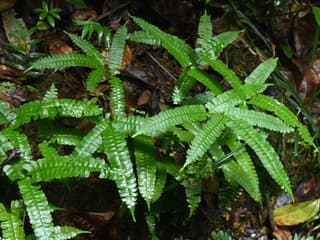
Necklace Fern
Lindsaea
Lindsaea is a genus of roughly 180 small to medium-sized ferns in the family Lindsaeaceae, commonly known as necklace ferns. Native to moist tropical and subtropical forests across Asia, Australia, the Pacific, Madagascar, and South America, these ferns grow as low, spreading clumps of finely divided, leathery fronds. Species such as the screw fern (Lindsaea linearis) and weeping fern (Lindsaea pendula) are grown as ornamental houseplants and shade-garden specimens for their delicate, evergreen foliage.
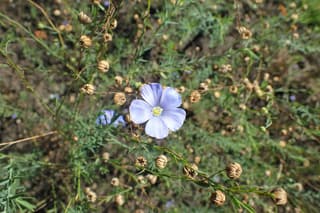
Lewis Flax
Linum lewisii
Lewis Flax (Linum lewisii) is a native wildflower of western North America, celebrated for its sky-blue petals that bloom each morning and fall by midday. A hardy herbaceous perennial in the Linaceae family, it thrives in dry, open landscapes and is a staple of wildflower gardens, meadows, and xeriscape designs.
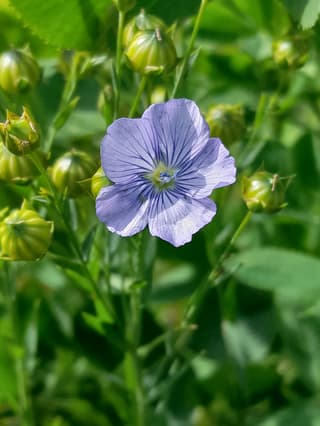
Flax
Linum usitatissimum
Flax (Linum usitatissimum) is an annual herbaceous plant in the Linaceae family, native to the Caucasus region and the Middle East, cultivated since antiquity for both its textile fiber (linen) and its oilseed. It features a slender, upright stem reaching up to 90 cm, alternate bluish-green lanceolate leaves, and delicate five-petaled flowers, typically sky-blue, which open during the morning in spring and summer. Its seeds, flattened and ranging from golden brown to light gold, are rich in omega-3 fatty acids, soluble fiber, and lignans, making it a highly valued food crop in addition to its ornamental use.
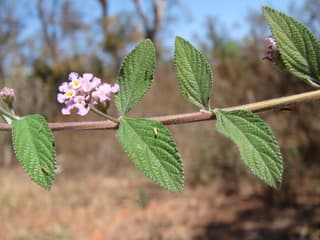
Bushy Lippia
Lippia alba
Bushy Lippia (Lippia alba) is a fast-growing, aromatic perennial shrub native to tropical and subtropical Americas, from Argentina to southern Mexico, and widely naturalized across the Caribbean and parts of Asia and Australia. It features small, elliptical, rough-textured leaves with serrated edges that release a pleasant citrus-herbal scent when crushed. Tiny white to lilac flowers arranged in dense clusters bloom from spring through summer, attracting bees and other pollinators. Highly adaptable and resilient, it thrives in a wide range of conditions and is valued both as an ornamental and a potent medicinal herb.
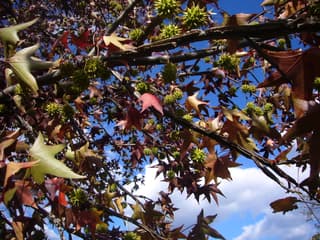
Sweetgum
Liquidambar styraciflua
Sweetgum (Liquidambar styraciflua) is a majestic deciduous tree native to eastern North America. Celebrated for its spectacular autumn foliage in shades of red, orange, yellow, and purple, it is one of the most admired ornamental trees in parks and gardens. It can reach up to 80 feet tall and produces distinctive spiky seed pods known as "gumballs."
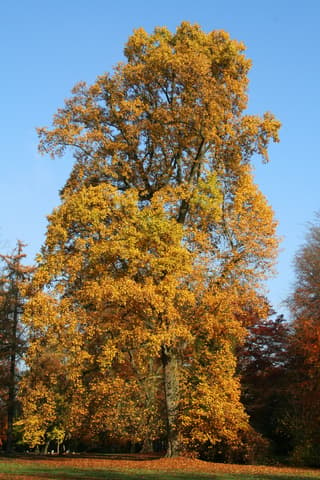
tuliptree
Liriodendron tulipifera
Liriodendron tulipifera, commonly known as the Tuliptree or Tulip Poplar, is one of the largest and most majestic deciduous trees native to eastern North America. It is characterized by its unique four-lobed leaves and large, tulip-shaped flowers that appear in late spring. The flowers are greenish-yellow with a vibrant orange band at the base. It is a fast-growing hardwood that can reach massive heights, often serving as a canopy tree in forests.
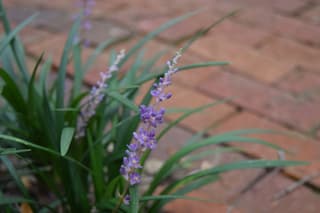
Big Blue Lilyturf
Liriope muscari
Liriope muscari, commonly known as Big Blue Lilyturf or Monkey Grass, is a clump-forming evergreen perennial native to East Asia. It produces arching, grass-like dark green foliage and upright spikes of violet-purple flowers resembling grape hyacinths in late summer. Extremely adaptable, it thrives in sun or shade and is widely used as a groundcover, border edging, and lawn alternative.
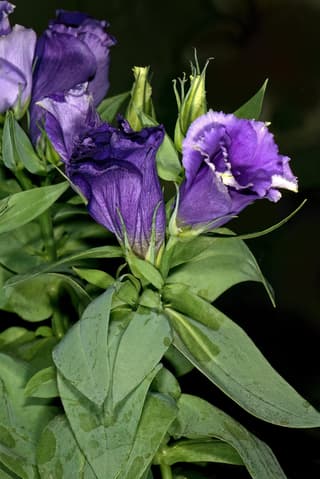
Lisianthus
Lisianthus russellianus
Lisianthus (Eustoma russellianum, synonym Eustoma grandiflorum) is an annual or biennial herbaceous plant in the Gentianaceae family, native to the prairies and moist fields of the southern United States, Mexico, and northern South America. Known for its large, silky, rose- or tulip-shaped flowers, it is one of the most widely cultivated cut flowers in the world, frequently used in wedding bouquets and floral arrangements due to its elegance and long vase life. Its erect stems support multiple blooms in shades of purple, white, pink, lavender, and blue, above waxy, grayish-green foliage.
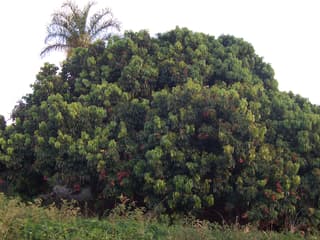
Lychee
Litchi chinensis
Lychee (Litchi chinensis) is a subtropical fruit tree native to southern China (Guangdong and Fujian provinces), belonging to the Sapindaceae family. Renowned for its delicious rose-colored fruits with juicy, translucent white flesh and a floral fragrance, it is cultivated across tropical and subtropical regions worldwide. The evergreen tree grows slowly, reaching up to 12 meters in height under ideal conditions. Small white flowers emerge in spring, developing into the characteristic clusters of rough-skinned fruits.
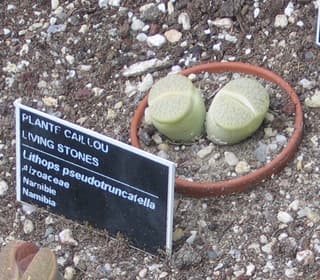
Living stones
Lithops pseudotruncatella
Lithops pseudotruncatella is a succulent from the ice plant family (Aizoaceae), native to the arid, stony regions of Namibia and South Africa. The plant belongs to the group known as "living stones" – its two thick leaves, fused at the base, mimic the color and texture of surrounding pebbles as a form of camouflage against herbivores. Every year, after a period of dormancy, the old pair of leaves withers and is "absorbed" by a new pair emerging between them – a process called molting. In autumn, a single daisy-like flower in yellow or white appears between the leaves. The plant grows very slowly, reaching only 2-5 cm in height, eventually forming small clusters.
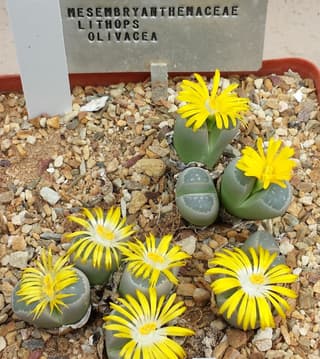
Living Stones
Lithops sp
Living Stones (Lithops sp) are fascinating succulents native to southern Africa, renowned for their extraordinary ability to mimic pebbles and rocks in their desert habitat. Belonging to the family Aizoaceae, these miniature marvels evolved thick, fleshy leaf pairs that store water, enabling survival in extreme arid conditions. Standing just 3-5 cm tall, they produce stunning daisy-like flowers in yellow, white, or orange during autumn and winter.
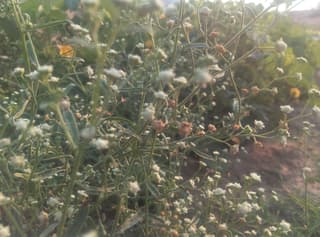
Living Stones
Lithops species
Lithops, known as living stones, are fascinating succulents native to South Africa that have evolved to resemble rocks and pebbles. This natural camouflage protects them from predators in their desert habitat. Each plant consists of two fused leaves with a fissure in the center from which flowers emerge.
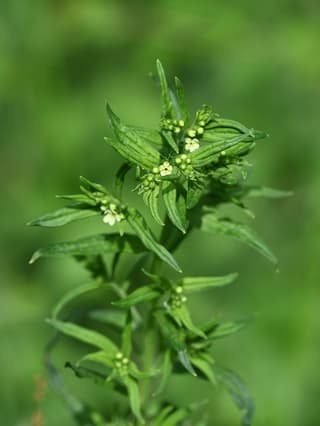
Stoneseed / Gromwell (genus)
Lithospermum
Lithospermum is a genus of drought-tolerant herbaceous perennials in the Boraginaceae family, widely distributed across temperate regions of North America, Europe, and Asia. The genus name derives from the Greek lithos (stone) and sperma (seed), referring to the characteristically hard, polished nutlets. Plants typically grow in dry prairies, open woodlands, and rocky slopes, thriving with minimal water input.
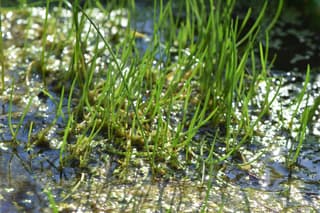
Shoreweed
Littorella uniflora
Littorella uniflora, commonly known as shoreweed, is a small aquatic perennial plant native to the shores of nutrient-poor freshwater lakes across Northwestern Europe. It forms dense, grass-like carpets on sandy or gravelly substrates and is popular in aquascaping for its fine-textured, low-growing foreground coverage. This dioecious plant produces inconspicuous white flowers when grown emersed in summer.

Chinese Fan Palm
Livistona chinensis
Livistona chinensis, commonly known as the Chinese Fan Palm or Fountain Palm, is a slow-growing tropical palm native to southern Japan, Taiwan, and southern China. Its distinctive fan-shaped fronds with gracefully drooping tips can reach up to 15 meters tall in the wild, making it a striking ornamental choice for gardens and spacious interiors.
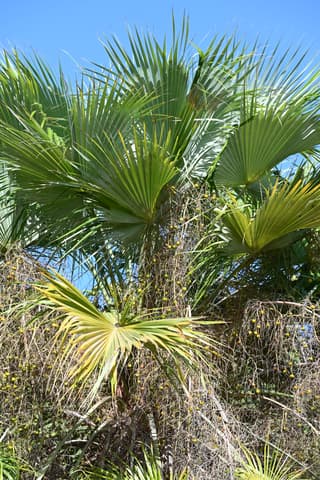
Footstool Palm
Livistona rotundifolia
Livistona rotundifolia, commonly known as the Footstool Palm, is an elegant tropical palm native to Southeast Asia. It is characterized by its large, glossy, rounded leaves that resemble a fan, hence its popular name. It is a moderate-growing plant that can reach considerable heights in its natural habitat, though its size remains more contained when grown in pots. Highly valued for its ornamental beauty, it is ideal for well-lit interiors and tropical gardens.
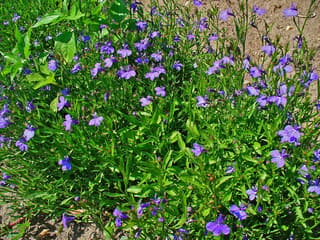
Lobelia
Lobelia
Lobelia is a large genus of roughly 400 flowering plant species in the bellflower family (Campanulaceae), ranging from low-growing bedding annuals like Lobelia erinus to the herbaceous Lobelia inflata (Indian tobacco), historically used in traditional medicine. Most garden lobelias form compact mounds or trailing mats covered in small two-lipped flowers in shades of blue, purple, pink, white, and red, blooming from spring through fall. All parts of the plant contain the alkaloid lobeline and are toxic if ingested by humans and pets.
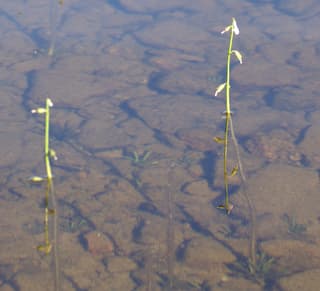
Water Lobelia
Lobelia dortmanna
Water lobelia is a small, evergreen aquatic perennial native to cold, nutrient-poor lakes across northern Europe and North America. It forms submerged rosettes of stiff, tubular leaves on the lake bottom, while slender flower spikes rise 10-30 cm above the surface in summer, bearing pale blue to white two-lipped flowers. Unusually, it draws most of its carbon dioxide from the sediment rather than the air, an adaptation that lets it thrive where few other plants can survive.
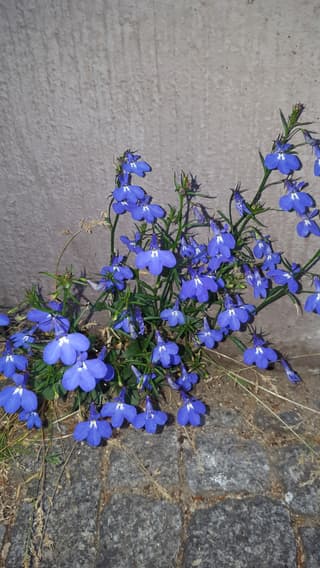
Edging lobelia
Lobelia erinus
Lobelia erinus is a delicate herbaceous plant, widely appreciated for its abundant blooms in vibrant shades of blue, purple, and white. Native to South Africa, it grows in low mounds or cascades, making it perfect for borders, window boxes, and hanging baskets. Although it is a perennial in tropical climates, it is often grown as an annual in cooler regions due to its sensitivity to extreme heat and frost.
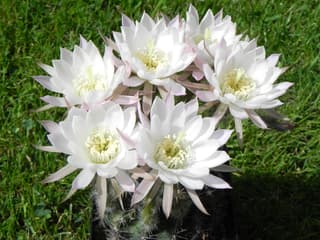
Easter Lily Cactus
Lobivia ancistrophora
Lobivia ancistrophora is a small globular cactus native to Argentina and Bolivia, belonging to the Cactaceae family. It forms compact clumps of ribbed, dark green globes adorned with hooked central spines. In summer it produces spectacular large white fragrant flowers that open at night and last less than 24 hours, repeating several times throughout the season.
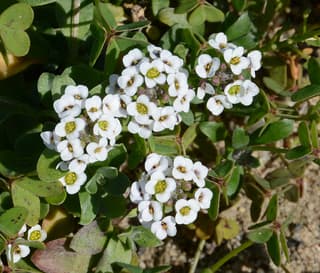
Sweet Alyssum
Lobularia maritima
Small annual herbaceous plant native to the Mediterranean, member of the Brassicaceae family. Cultivated as an ornamental for its profusion of tiny aromatic flowers in white, pink, purple, and lavender tones. Ideal for borders, containers, and ground cover in gardens. Blooms copiously during spring and summer, with a sweet fragrance reminiscent of honey and new-mown hay, attracting bees and butterflies.
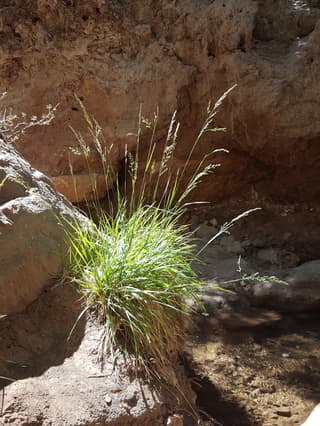
Tall Fescue
Lolium arundinaceum
Tall Fescue (Lolium arundinaceum) is a robust cool-season perennial grass native to Europe and widely naturalized worldwide. Renowned for its deep root system — extending up to 3 feet — it is one of the most heat- and drought-tolerant cool-season grasses available. It forms dense clumps and grows vigorously in spring and fall, thriving in a wide range of soils and light conditions from full sun to partial shade. It is widely used for lawns, pastures, erosion control, and sports fields.
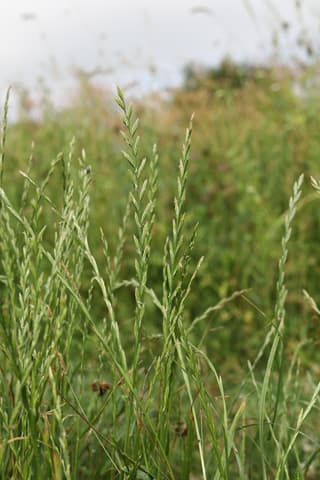
Perennial ryegrass
Lolium perenne
Perennial ryegrass (Lolium perenne) is one of the most widespread and important perennial turfgrasses in the world. A member of the Poaceae (grass) family, it is a bunch-forming perennial with dense, shiny, dark green leaves, growing to a height of 10–80 cm. Due to its outstanding wear tolerance and exceptional recovery capacity, it is extensively used on sports fields, airports, parks, and home lawns. With rapid germination (5–10 days) and a vigorous growth rate, it is one of the most reliable turf-forming grasses, while also serving as an important forage crop in agriculture.
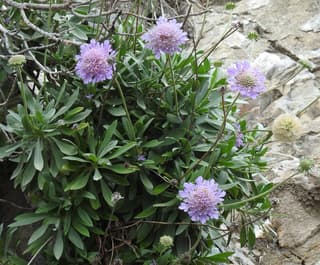
Cretan Scabious
Lomelosia cretica
The Cretan Scabious (Lomelosia cretica, formerly known as Scabiosa cretica) is a low-growing, semi-evergreen perennial shrub in the honeysuckle family (Caprifoliaceae), native to the eastern Mediterranean basin, primarily the island of Crete. Its characteristic pincushion-shaped, lavender-pink flowers bloom from late spring to mid-summer above silvery gray-green, ovate-lanceolate leaves, held by white-tomentose stems. It is a drought-tolerant, sun-loving species best suited for rock gardens and Mediterranean-style plantings with well-ventilated, calcareous soil.
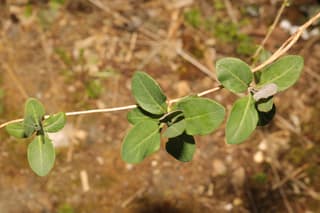
Honeysuckle
Lonicera
Lonicera, commonly known as honeysuckle, is a large genus of around 200 species in the family Caprifoliaceae, native to the Northern Hemisphere. The genus includes both climbing vines and shrubs, deciduous and semi-evergreen, prized for their tubular, often fragrant flowers, long bloom season, and ornamental berries. Species such as Lonicera periclymenum (European honeysuckle) and L. japonica (Japanese honeysuckle) are garden classics that attract pollinators, hummingbirds, and birds.
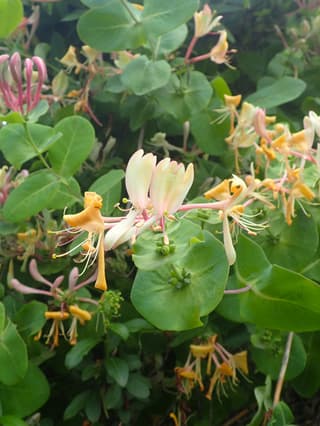
Italian Honeysuckle
Lonicera caprifolium
Lonicera caprifolium, commonly known as Italian honeysuckle or goat-leaf honeysuckle, is a vigorous deciduous climbing vine native to Europe, from Norway south to Spain and east into the Caucasus. It is celebrated for its exceptionally fragrant tubular flowers in shades of cream, white, and pink, which are especially intoxicating at dusk and dawn. A classic cottage garden plant, it twines readily over pergolas, fences, and trellises, attracting bees, butterflies, and hummingbirds.
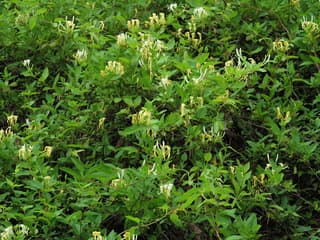
Japanese Honeysuckle
Lonicera japonica
Lonicera japonica, commonly known as Japanese Honeysuckle, is a vigorous, twining, woody vine native to eastern Asia. It produces intensely fragrant tubular flowers that open white and fade to golden yellow, attracting hummingbirds and butterflies. While beloved for its sweet scent and ornamental value, it is classified as an invasive species in many regions outside its native range due to its rapid, aggressive growth.
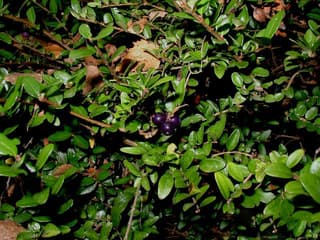
Boxleaf Honeysuckle
Lonicera nitida
Lonicera nitida, commonly known as Boxleaf Honeysuckle, is a fast-growing evergreen shrub native to China. It is widely valued in horticulture for its dense, small-leaved foliage that responds exceptionally well to clipping and shaping. Frequently used for hedging, topiary, ground cover, and border planting, it produces small, fragrant white flowers in spring followed by blue-purple berries.
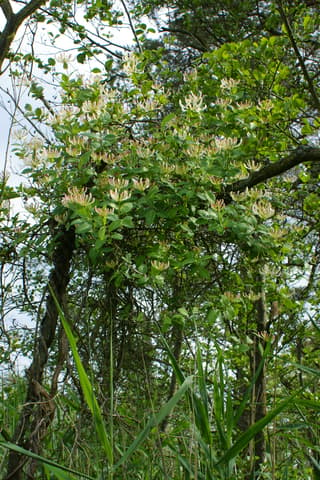
European Honeysuckle
Lonicera periclymenum
Lonicera periclymenum, commonly known as European Honeysuckle or Woodbine, is a vigorous deciduous climbing vine native to Europe and Western Asia. Celebrated for its intensely fragrant tubular flowers that transition from creamy white and pink to golden yellow, it blooms from late spring through summer, attracting bees, moths, and butterflies. Its twining stems can reach 7 metres, making it ideal for covering trellises, fences, and pergolas. The plant produces small red berries in autumn that are attractive to birds but mildly toxic to humans and pets.
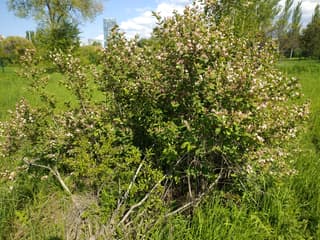
Tatarian Honeysuckle
Lonicera tatarica
Tatarian honeysuckle (Lonicera tatarica) is a fast-growing deciduous shrub in the Caprifoliaceae family, native to Central Asia and southern Siberia. It typically reaches 2-3 m tall and wide, with oval blue-green leaves and fragrant, tubular pink-to-white flowers that bloom in late spring, followed by round red-to-orange berries in summer. Long valued as an ornamental hedge and screening plant for its dense growth and early flowering, it has since escaped cultivation across much of the northeastern and midwestern United States and eastern Canada, where it is classified as invasive: it leafs out earlier and drops leaves later than native shrubs, shading out spring wildflowers and outcompeting native understory vegetation. Its berries, while attractive to birds that spread the seeds widely, are mildly toxic to humans and pets if eaten in quantity.
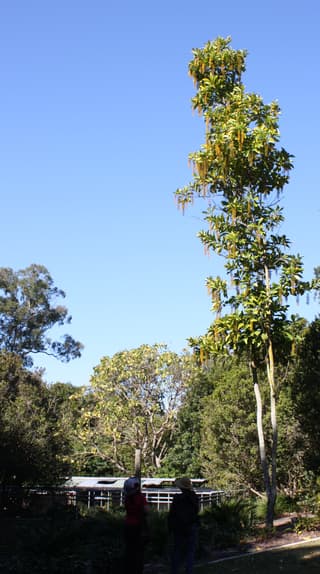
Golden Chain Tree
Lophantera lactescens
The Golden Chain Tree (Lophantera lactescens) is a stunning ornamental tree native to the Brazilian Amazon rainforest, belonging to the family Malpighiaceae. It is renowned for its spectacular long, pendulous inflorescences of bright yellow flowers that cascade downward like golden chains. Growing 10–20 metres tall with a dense pyramidal canopy, it is widely planted as a street tree and landscape specimen across tropical regions worldwide.
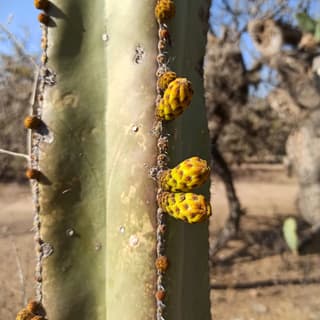
Mexican Fencepost Cactus
Lophocereus marginatus
The Mexican Fencepost Cactus (Lophocereus marginatus) is a tall columnar cactus native to Mexico, traditionally used as a living fence in rural areas. Its upright, spine-laden stems form effective natural barriers. It grows rapidly, potentially exceeding 20 feet, and produces small pinkish-red flowers in spring and summer.
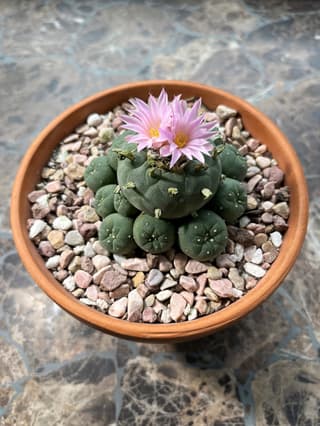
Peyote
Lophophora williamsii
Peyote (Lophophora williamsii) is a small, spineless, globose cactus native to the limestone deserts of northern Mexico and southern Texas within the Chihuahuan Desert region. It reaches only 2–7 cm in height and 4–12 cm in diameter, featuring a surface divided into rounded ribs and tufts of woolly hair (areoles) instead of spines. It grows extremely slowly, taking years to reach maturity and bloom with small pink, white, or yellowish flowers between spring and summer. It is primarily known for containing mescaline and other psychoactive alkaloids in its tissues, which is why its possession and cultivation are subject to legal restrictions in many countries.
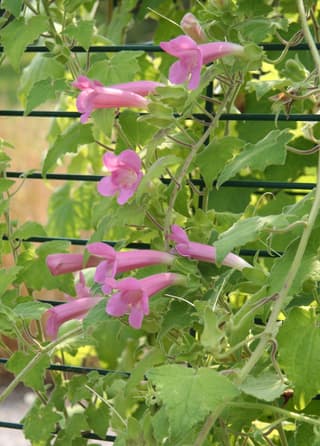
Climbing Snapdragon
Lophospermum erubescens
Lophospermum erubescens, also known as climbing snapdragon or Mexican twist, is a tender perennial climber native to the mountainous regions of Mexico, often grown as an annual in colder climates. Related to snapdragons (Antirrhinum), the plant features heart- to triangular-shaped, hairy leaves and large, pink to white trumpet-shaped flowers that bloom from spring to fall and attract hummingbirds. Its twining leaf stalks make the plant well-suited for trellises, hanging baskets, and training along fences and lattices.
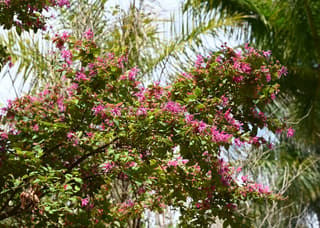
Chinese Fringe Flower
Loropetalum chinense
The Chinese fringe flower (Loropetalum chinense) is an evergreen shrub in the Hamamelidaceae family, native to China, Japan, and northern India. It is highly valued in ornamental gardening for its striking ribbon-like or fringed flowers, which bloom in clusters toward the end of winter and early spring, and for its foliage, which in popular varieties (such as var. rubrum) takes on deep purple or burgundy tones under direct sunlight. With a medium growth rate and compact habit, it is commonly used as a hedge, specimen shrub, or border plant in temperate to warm climate gardens.
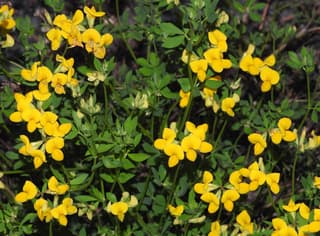
Bird's-Foot Trefoil
Lotus
Bird's-Foot Trefoil (Lotus) is a low-growing perennial wildflower in the pea family (Fabaceae), native to temperate Eurasia and North Africa. It forms spreading mats of bright yellow-orange flowers from late spring through summer, attracting bumblebees and butterflies. Exceptionally drought-tolerant, it thrives in poor soils and can fix atmospheric nitrogen through root symbionts, making it valuable for meadow restoration and erosion control.
Find the Perfect Plant
Our plant guide helps you find ideal species for your experience level and time of year.
Browse by Difficulty, Season & More
Use the filters below to narrow this catalog by care difficulty, season, environment, or search directly by name. Each filter leads to a focused list tailored to your specific growing conditions.