Complete Plant Guide
Explore plants by difficulty, season and more. Find the perfect plant for you.
Difficulty
Categories
Plants by City
🗺️ Plants by City3454 plants found
Showing 2485-2520 of 3454
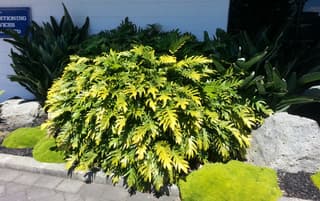
Xanadu Philodendron
Philodendron xanadu
The Xanadu Philodendron (Philodendron xanadu) is a tropical plant native to Brazil, prized for its deeply lobed, glossy dark-green leaves. Compact compared to other philodendrons, it grows in a dense, lush clump and is widely popular as both an indoor and outdoor tropical garden plant. It belongs to the Araceae family and is reclassified by modern botanists under the genus Thaumatophyllum.
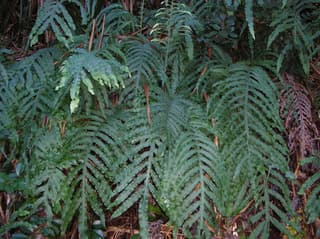
Blue Star Fern
Phlebodium aureum
A fascinating epiphytic fern, known for its deeply lobed, blue-green or glaucous fronds. Native to the tropical regions of the Americas, it grows from creeping rhizomes covered in dense, golden scales, which gives it the name 'aureum'. Unlike many ferns, it has a more robust and waxy texture to its leaves.
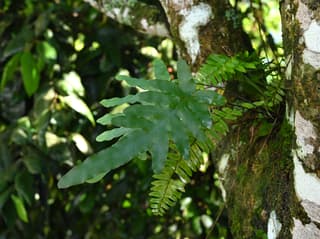
False Golden Polypody
Phlebodium pseudoaureum
Phlebodium pseudoaureum is a striking epiphytic fern native to the tropical and subtropical Americas. It produces elegant, deeply lobed fronds in a distinctive bluish-green hue, crawling along trees and rocks via creeping red-hairy rhizomes. Unlike its cousin P. aureum (Golden Polypody), this species is distinguished by its more glaucous, muted blue-green coloration and smaller stature. It thrives from cloud forests to tropical lowlands, making it one of the most adaptable ferns in the Polypodiaceae family.
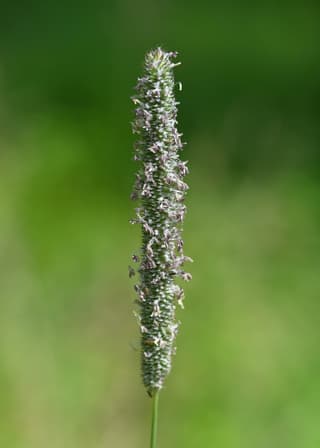
Timothy-grass
Phleum pratense
Phleum pratense, commonly known as Timothy-grass or Cat's Tail, is a perennial forage grass belonging to the Poaceae family, native to Europe and temperate Asia, and now naturalized in much of the temperate world. It forms erect clumps up to 100-115 cm tall, with linear leaves and a distinctive compact, cylindrical, greenish-purple inflorescence (a false spike). It is one of the most widely cultivated forage grasses in cool and mountainous regions for hay production and for grazing cattle, horses, sheep, and goats.
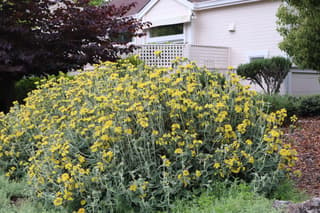
Jerusalem sage
Phlomis
Phlomis is a genus of roughly 100 evergreen to deciduous subshrubs and perennials native to the Mediterranean and Southwest Asia, in the mint family (Lamiaceae). Plants form mounds of wrinkled, woolly gray-green leaves topped by tiered whorls of hooded yellow or pink flowers held on upright spikes from late spring through summer. Highly drought-tolerant once established, Phlomis is prized for xeriscaping, cottage gardens, and pollinator borders.
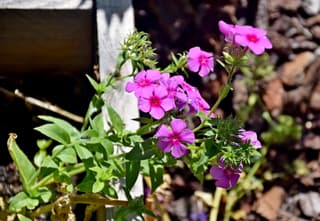
Annual Phlox
Phlox drummondii
Phlox drummondii, known as annual phlox or Drummond's phlox, is a fast-growing annual native to Texas, prized for dense clusters of star-shaped flowers in red, pink, white, lavender and purple. It thrives in full sun and is popular in beds, borders and containers.
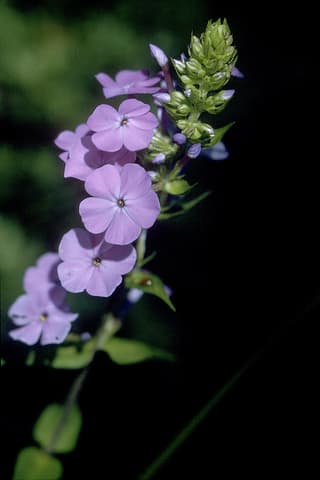
Wild Sweet William
Phlox maculata
Wild Sweet William (Phlox maculata) is a clump-forming herbaceous perennial native to the eastern United States, belonging to the family Polemoniaceae. Its distinctively spotted red-purple stems grow 60–90 cm (2–3 ft) tall and bear dense cylindrical clusters of fragrant flowers in shades of pink, lavender, purple, and white from early to midsummer. Significantly more resistant to powdery mildew than garden phlox (P. paniculata), this native wildflower thrives in moist meadows, woodland edges, and streambanks, attracting butterflies, hummingbirds, and sphinx moths.
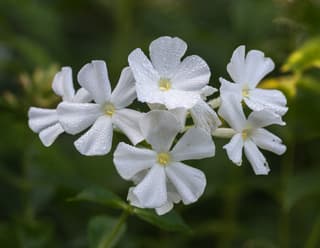
Garden Phlox
Phlox paniculata
Phlox paniculata, commonly known as Garden Phlox or Summer Phlox, is a fragrant, long-blooming herbaceous perennial native to eastern North America. It produces large, domed clusters of five-petaled flowers in shades of pink, purple, red, white, and lavender from mid-summer through fall, making it a staple of cottage and perennial gardens. The plant grows 2–4 feet tall and spreads 2–3 feet wide, returning reliably each year.
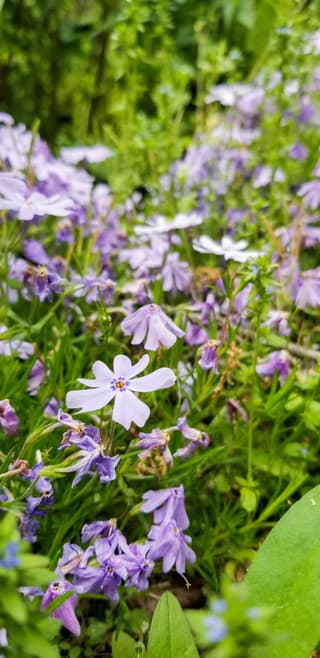
moss phlox
Phlox subulata
Phlox subulata, commonly known as moss phlox, is a vigorous, mat-forming evergreen perennial. It is celebrated for its needle-like foliage and its ability to produce a dense carpet of star-shaped flowers in early spring, often completely obscuring the leaves. It is native to the eastern and central United States and is a staple in rock gardens and as a flowering ground cover.
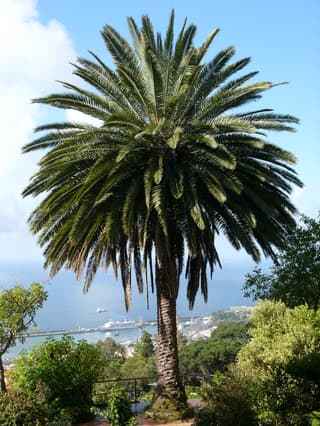
Canary Island Date Palm
Phoenix canariensis
Phoenix canariensis, commonly known as the Canary Island Date Palm or Pineapple Palm, is a majestic feather palm native to the Canary Islands, Spain. It is one of the most widely planted ornamental palms in the world, recognizable by its stout trunk adorned with distinctive diamond-shaped leaf scars, and its long arching pinnate fronds that can reach over 6 meters. Unlike Phoenix roebelenii (the pygmy date palm already in the database), this species is a large-scale outdoor tree that can grow up to 18 meters tall.

Date Palm
Phoenix dactylifera
Phoenix dactylifera, commonly known as the Date Palm, is a majestic palm tree native to the Middle East and North Africa. It can reach up to 30 meters in height and has been cultivated for over 5,000 years for its nutritious fruits — dates — and exceptional ornamental value.

Mountain Date Palm
Phoenix loureiroi
The Mountain Date Palm (Phoenix loureiroi) is a small, tough palm native to the hills and forests of southern Asia, from India and Pakistan through Burma, Thailand, Vietnam, China, Taiwan and the Philippines. It grows as a solitary or clustering palm reaching 1-4 m tall, with a trunk clad in diamond-shaped old leaf bases and stiff, plumose pinnate fronds up to 2 m long. Small yellow flowers are followed by bluish-black, single-seeded fruits. In the wild it thrives from sea level to 1,500 m altitude, tolerating both seasonal drought and periodic flooding, and is often found colonizing disturbed ground such as roadsides and rice-paddy borders. As a landscape or container plant it is prized for being slow-growing, drought-tolerant once established, and largely free of the serious pest and disease problems that trouble other ornamental palms.
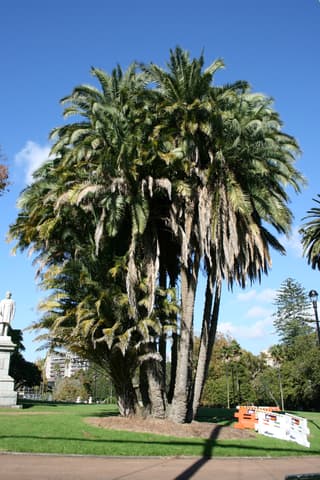
Senegal Date Palm
Phoenix reclinata
The Senegal date palm is a multi-stemmed palm native to tropical Africa, known for its arching, feathery fronds and spiny trunks. It is widely used in landscaping as an ornamental focal point in gardens and parks.
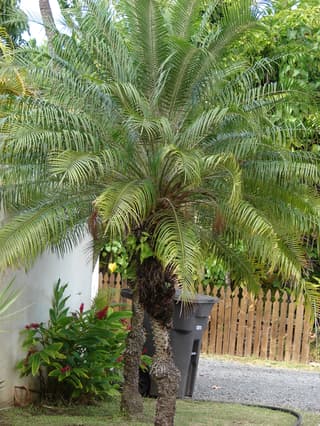
Pygmy Date Palm
Phoenix roebelenii
Phoenix roebelenii, commonly known as the Pygmy Date Palm, is a graceful miniature palm native to the tropical forests of Southeast Asia, particularly Laos and Vietnam. It is one of the most popular indoor palms worldwide due to its compact size, elegant arching fronds, and easy-going nature. Growing slowly to about 2 meters tall, this palm adds a tropical touch to any interior space or warm outdoor garden.
New Zealand Flax
Phormium
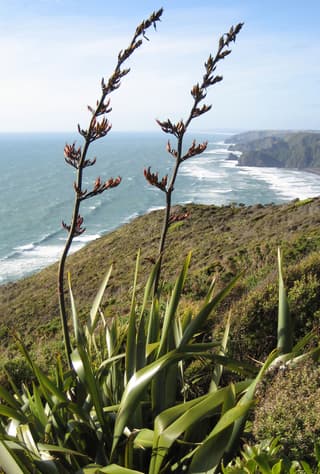
Phormium is a small genus of evergreen, clump-forming perennials native to New Zealand, grown for their bold, sword-shaped leaves and striking architectural form. The genus contains two main species, Phormium tenax (New Zealand flax) and the smaller Phormium cookianum (mountain flax), plus dozens of ornamental cultivars in green, bronze, purple, and variegated striped foliage. Tough, wind- and salt-tolerant, and largely pest-resistant once established, Phormium is a mainstay of coastal gardens, mixed borders, and large containers.
New Zealand Flax
Phormium tenax
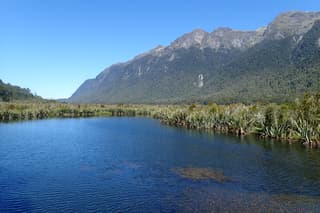
Phormium tenax, commonly known as New Zealand Flax or Harakeke, is a bold, evergreen perennial native to New Zealand and Norfolk Island. It forms striking clumps of long, sword-shaped leaves that can reach up to 3 meters in height, making it a dramatic focal point in gardens. The plant produces tall flowering spikes of dark red tubular flowers in summer, attracting nectar-feeding birds. It is highly adaptable, tolerating coastal winds, drought, and a wide range of soil conditions once established.
Photinia / Christmas Berry (genus)
Photinia
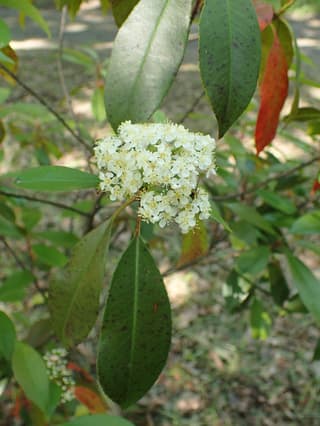
Photinia is a genus of evergreen shrubs and small trees in the Rosaceae family, prized for their strikingly bright red new growth. The most popular cultivar, Photinia × fraseri 'Red Robin', is widely used as a hedge plant across Europe and temperate regions worldwide. Species range from compact shrubs to small trees reaching up to 5 m, bearing white flower clusters in spring.
Red Tip Photinia
Photinia × fraseri
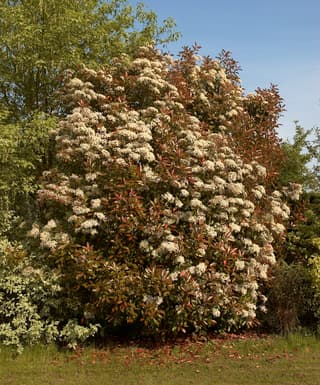
Red Tip Photinia (Photinia × fraseri) is an evergreen hybrid shrub in the rose family, bred from Photinia glabra and Photinia serratifolia. It is widely planted as a hedge for its vivid red new leaves, which contrast with the glossy dark green mature foliage. Small clusters of white flowers appear in spring, followed by red berries in autumn.
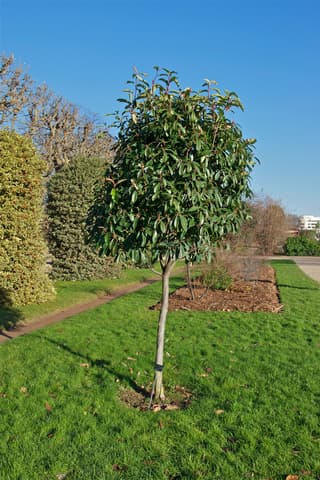
Chinese Photinia
Photinia serratifolia
Photinia serratifolia, commonly known as Chinese Photinia or Oriental Photinia, is a broadleaf evergreen shrub or small tree in the Rosaceae family, native to China and Taiwan. It is prized for its striking new growth that emerges apple green to bronze or reddish-purple before maturing to glossy dark green. In spring, it bears terminal clusters of small, white, mildly fragrant flowers followed by small red pome fruits that persist into winter, providing wildlife value. A fast-growing, adaptable plant widely used for hedging, screening, and ornamental planting in temperate gardens worldwide.
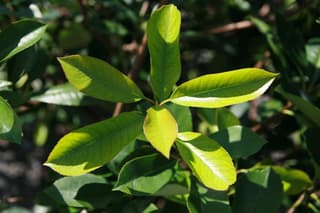
Red Robin Photinia
Photinia x fraseri
Photinia x fraseri, commonly known as Red Robin Photinia or Red Tip Photinia, is a vigorous evergreen shrub prized for its brilliant crimson-red new growth that matures to glossy dark green. A hybrid of Photinia glabra and Photinia serratifolia bred in the mid-20th century, it is one of the most widely planted hedging and screening shrubs in temperate gardens. In mid-spring it produces small clusters of white, faintly unpleasant-scented flowers, followed by red berry-like fruit that birds enjoy. Left untrimmed it can reach small tree proportions, but regular pruning keeps it as a dense, colorful hedge, with striking new foliage flushes appearing several times a year after each trim.
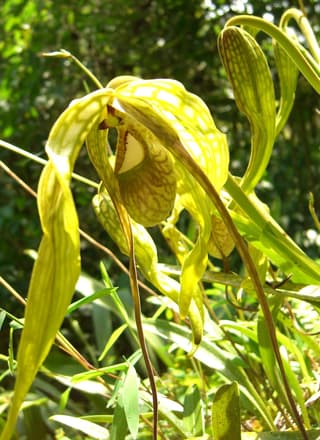
Tailed Slipper Orchid
Phragmipedium caudatum
Phragmipedium caudatum is a large, fan-shaped terrestrial to lithophytic orchid native to cloud forests from Mexico to Peru and Bolivia, growing on humid, mossy slopes and cliff faces between 800 and 2500 meters elevation. It is famed for its extraordinarily long, spiraling lateral petals, which trail downward and can reach 60 to 90 centimeters (occasionally over a meter) in mature specimens, among the longest floral structures in the plant kingdom. The cream to yellow-green flowers are veined with darker green and flushed with maroon-red along the twisting petals, opening in succession over many weeks. Prized by collectors since Victorian times, it remains one of the most spectacular and challenging slipper orchids to grow well.

Common Reed
Phragmites australis
The Common Reed (Phragmites australis) is a tall, perennial wetland grass that grows in dense stands—known as reed beds—along the banks of standing and slow-flowing bodies of water. It reaches heights of up to four meters and often spreads extensively via vigorous underground rhizomes. The characteristic dark purple to silvery-gray flower panicles appear in late summer and autumn above narrow, blue-green leaves that turn golden-brown in winter. Distributed worldwide, the reed is considered an ecologically significant habitat for birds and insects, but once established, it can spread very aggressively.

Aztec Sweet Herb
Phyla dulcis
Aztec Sweet Herb (Phyla dulcis, syn. Lippia dulcis) is a perennial herb in the Verbenaceae family, native to southern Mexico, Central America, the Caribbean (Cuba, Hispaniola, Puerto Rico), and northern South America (Colombia, Venezuela). The Aztecs used it as a natural sweetener and medicinal herb long before the arrival of Europeans; it was first scientifically described in the 16th century by Spanish physician Francisco Hernández. The leaves contain an extremely sweet substance called hernandulcin, but also contain camphor, so they should only be consumed in small quantities. The plant forms low, creeping to trailing mats with tiny white flowers and is popular in hanging baskets as well as a groundcover.
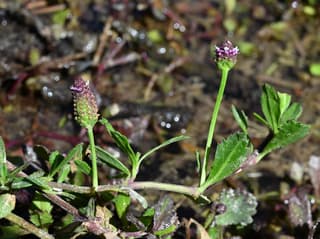
turkey tangle fogfruit
Phyla nodiflora
Phyla nodiflora, commonly known as turkey tangle fogfruit or frogfruit, is a vigorous, low-growing perennial groundcover. It features small, serrated green leaves and unique cylindrical flower heads surrounded by tiny white to pinkish-purple flowers. It is highly valued as a sustainable lawn alternative due to its ability to handle foot traffic and its high attractiveness to pollinators like butterflies and bees.
Stonebreaker
Phyllanthus amarus
A small annual tropical herb that grows rapidly to 30-60 cm in height. Native to tropical and subtropical regions of Africa, Americas, India, and Southeast Asia. Characterized by alternately arranged small elliptic-oblong leaves (5-10mm), tiny greenish-yellow flowers, and small seeds. The plant is drought-tolerant and thrives in warm, humid climates. Reaches maturity in 2-3 months.
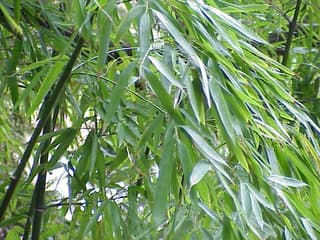
Golden Bamboo
Phyllostachys aurea
Golden Bamboo (Phyllostachys aurea) is a fast-growing, clump-forming bamboo native to southern China. Its canes start green and develop a golden-yellow hue when exposed to full sun, giving the plant its popular name. It can reach up to 9 meters tall and is widely used as a privacy screen, windbreak, and ornamental feature. However, it is classified as invasive in many regions due to its aggressive underground rhizome spread.
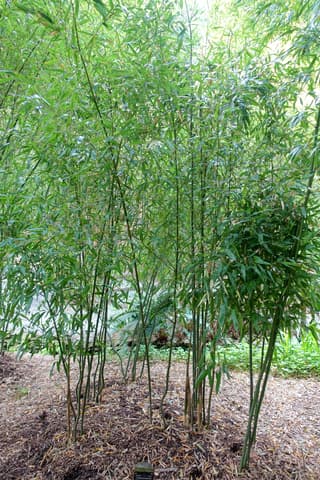
Yellow Groove Bamboo
Phyllostachys aureosulcata
Yellow Groove Bamboo (Phyllostachys aureosulcata) is a striking running bamboo native to the Zhejiang Province of China. It is named for the distinctive yellow groove that runs along each dark green culm, creating an eye-catching two-tone effect. One of the hardiest bamboos available, it tolerates temperatures down to -20°C (-4°F), making it suitable for temperate gardens in USDA zones 4–9. Its fast, vigorous growth makes it popular as a privacy screen, windbreak, and ornamental specimen. The young shoots are edible and notably free of the bitter flavor common to many bamboo species.
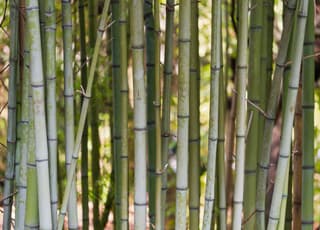
Moso Bamboo
Phyllostachys edulis
Moso Bamboo (Phyllostachys edulis) is the world's largest temperate bamboo, native to the mountain forests of central China. Its culms can reach up to 28 meters tall and 15 cm in diameter. Widely cultivated for edible shoots, construction timber, and ornamental beauty, it is also one of the fastest-growing plants on Earth.
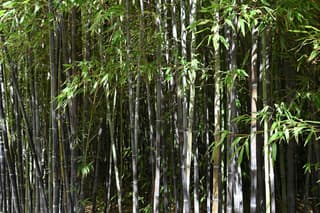
Black bamboo
Phyllostachys nigra
Phyllostachys nigra, or black bamboo, is a fast-growing, evergreen running bamboo prized for its glossy green canes that mature to a striking jet-black over two to three years. Native to China, it forms tall, dense clumps of arching foliage and is widely used as an ornamental screen or privacy hedge. As a running bamboo it spreads via underground rhizomes and can become invasive if left uncontained, so planting in a large container or behind a rhizome barrier is recommended.
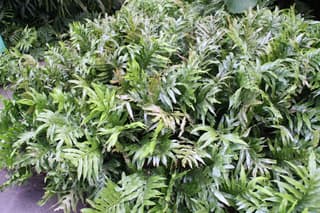
Wart Fern
Phymatosorus scolopendria
Phymatosorus scolopendria, popularly known as the Wart Fern, is a perennial, rhizomatous fern native to the tropical regions of Africa, Asia, and Oceania. Its fronds are leathery, bright green, and deeply lobed, reaching up to 90 cm (35 inches) in height. A striking feature is its sori (reproductive organs) which form rounded protuberances on the upper surface of the leaves, resembling small warts, hence its common name 'wart fern'. Extremely versatile, it can grow as an epiphyte on trees, as ground cover in tropical gardens, or as an indoor ornamental plant in environments with good humidity. It adapts well to shade and partial shade conditions, making it ideal for interiors, well-lit bathrooms, and shaded gardens.
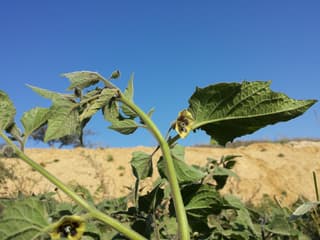
Groundcherry (genus)
Physalis
Physalis is a large genus of the nightshade family (Solanaceae) comprising over 100 species, including the cape gooseberry (P. peruviana), tomatillo (P. ixocarpa), and Chinese lantern (P. alkekengi). All species produce fruit enclosed in a papery husk (calyx), the genus's hallmark trait. They thrive in full sun with well-draining soil and are easy to grow.
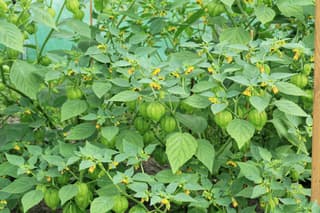
Tomatillo
Physalis ixocarpa
Physalis ixocarpa, commonly known as tomatillo, is an annual plant in the Solanaceae family native to Mexico and Central America. It produces green fruits enclosed in a distinctive papery husk, widely used in traditional Mexican cuisine for salsas, moles, and sauces.
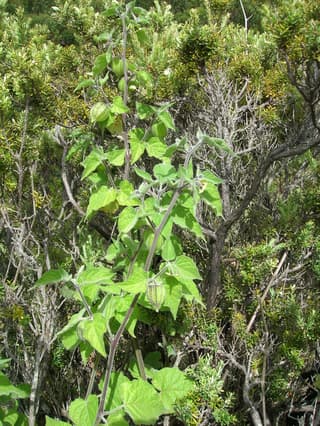
Cape Gooseberry
Physalis peruviana
Physalis peruviana, commonly known as cape gooseberry or goldenberry, is a sprawling perennial subshrub in the nightshade family (Solanaceae), native to the Andean highlands of Peru, Ecuador, Colombia, and Bolivia. It produces small, round, golden-orange berries wrapped in a papery husk (calyx) that resembles a Chinese lantern. Only the fully ripe fruit is edible; the unripe fruit and all vegetative parts (leaves, stems, and the papery husk) contain solanine and other toxic alkaloids and should never be eaten.
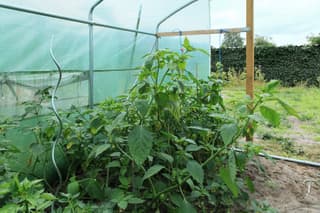
Tomatillo
Physalis philadelphica
Tomatillo (Physalis philadelphica) is an annual herbaceous plant native to Mexico, grown for its small green fruits encased in a papery husk. A staple of Mexican cuisine, tomatillos are essential in salsas, green sauces, and stews. The plant grows vigorously in warm climates with full sun and well-drained soil, often noted as a synonym of Physalis ixocarpa.
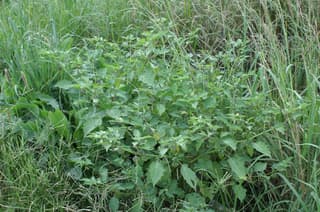
Ground Cherry
Physalis sp
Physalis is a genus of about 90 species in the Solanaceae family, native to the Americas, particularly Central and South America. Known for their distinctive papery husk enclosing an orange berry, these plants are valued for ornamental beauty, edible fruit, and medicinal properties. White to yellow flowers bloom in spring and summer, followed by nutritious fruits rich in vitamins and antioxidants.
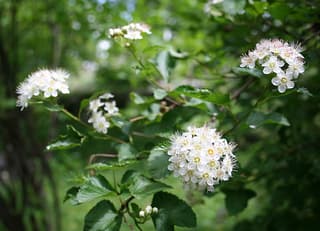
Common Ninebark
Physocarpus opulifolius
Common Ninebark (Physocarpus opulifolius) is a deciduous shrub native to eastern North America, renowned for its distinctive exfoliating bark that peels in multiple thin layers revealing reddish and light-brown inner bark. It produces clusters of creamy-white to pink-tinged flowers in late spring, and is widely valued in landscape gardening for its hardiness, multi-season interest, and adaptability.
Find the Perfect Plant
Our plant guide helps you find ideal species for your experience level and time of year.
Browse by Difficulty, Season & More
Use the filters below to narrow this catalog by care difficulty, season, environment, or search directly by name. Each filter leads to a focused list tailored to your specific growing conditions.