Complete Plant Guide
Explore plants by difficulty, season and more. Find the perfect plant for you.
Difficulty
Categories
Plants by City
🗺️ Plants by City3454 plants found
Showing 2881-2916 of 3454
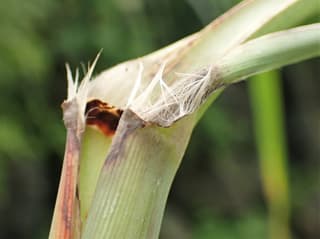
Sugarcane
Saccharum officinarum
Sugarcane (Saccharum officinarum) is a large, perennial grass native to Southeast Asia and New Guinea, cultivated for millennia for its succulent stalks rich in sucrose. It forms vigorous clumps with erect, jointed, and fibrous stalks that can exceed 13 to 20 feet (4 to 6 meters) in height, covered by long, narrow, and sharp-edged leaves. It is the world's primary source of sugar and one of the most important agricultural crops on the planet, also used in the production of ethanol, rum, molasses, and unrefined cane sugar. It blooms only when days shorten, producing a silvery, feathery inflorescence known as an "arrow."
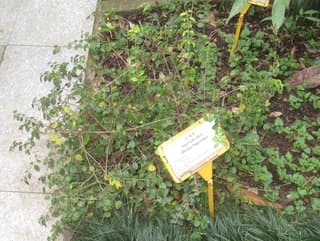
Sweet Plum
Sageretia theezans
The Chinese Sweet Plum (Sageretia theezans) is an evergreen shrub from the buckthorn family (Rhamnaceae), native to southern China. It is one of the most popular indoor bonsai species, combining fine, glossy foliage, attractive scaly, multicolored bark, and reddish new growth at the shoot tips. In late summer, inconspicuous creamy-white flower panicles appear, followed by small, edible blue-black drupes. In its native habitat, it grows 1 to 3 meters tall, but as a bonsai, it remains significantly smaller through regular pruning.
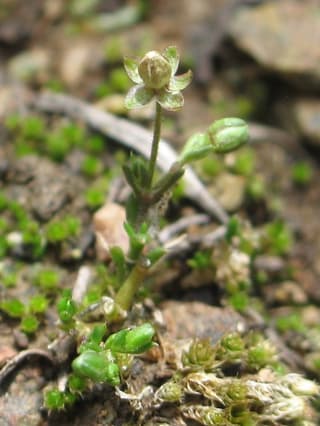
Annual Pearlwort
Sagina apetala
Sagina apetala is a small annual or biennial herbaceous plant that forms low, dense tufts. It is frequently found in urban environments, growing in sidewalk cracks, walls, and compacted sandy soils. Its leaves are linear and its flowers are tiny, usually greenish and without visible petals, which gives it the specific name 'apetala'. It is an extremely resilient and colonizing plant.
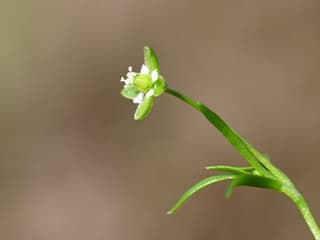
Procumbent pearlwort
Sagina procumbens
Sagina procumbens (procumbent pearlwort) is a perennial, creeping herb from the pink family (Caryophyllaceae), native to Europe, Western and Central Asia, and Northwest Africa. It forms dense, hairless, moss-like mats thanks to stems that root at the nodes and spread rapidly vegetatively. The leaves are linear, 1-2 cm long. Small, solitary flowers have 4-5 sepals and 4-5 small white petals (sometimes absent) with 4 free stigmas. The plant tolerates trampling exceptionally well, which is why it is commonly found in lawns, cracks between paving stones, and in moist flower pots.
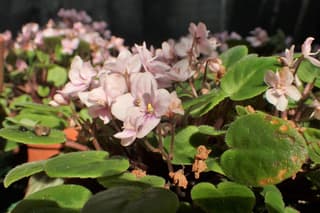
African Violet
Saintpaulia ionantha
The African Violet is a beloved compact houseplant native to the cloud forests of Tanzania and Kenya. Discovered in 1892 by Baron Walter von Saint Paul, it features velvety, dark green leaves and delicate flowers that bloom in shades of purple, blue, pink, white, and red. With proper care, these charming plants can live up to 50 years and bloom nearly year-round.
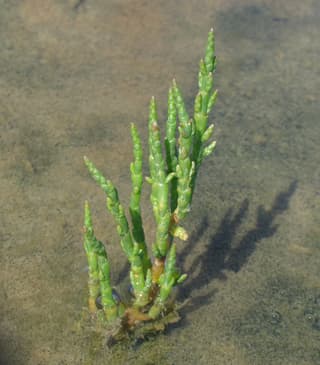
Glasswort
Salicornia
Glasswort (Salicornia) is a genus of annual, succulent-stemmed plants in the Amaranthaceae family, adapted to saltwater habitats. Its jointed, leafless, succulent shoots are green, often turning red or orange in the fall. It grows in coastal salt marshes, saline soils, and on the shores of salt lakes, where almost no other plants can survive. Its young shoots are also known as "sea asparagus" or "sea beans" and are a sought-after vegetable worldwide for their crunchy, salty flavor.
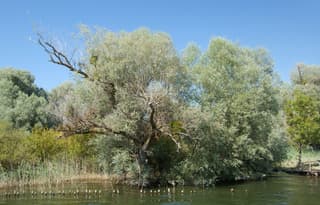
Willow
Salix
Willow (Salix) is a large genus of deciduous trees and shrubs in the family Salicaceae, native across the Northern Hemisphere. Best known for the graceful weeping willow (Salix babylonica) with its long, pendulous branches sweeping toward water, willows have been culturally and medicinally significant for millennia. The bark of Salix alba (white willow) contains salicin, the natural compound that inspired the synthesis of aspirin in 1897. Willows thrive near rivers, lakes, and wetlands, and are among the fastest-growing trees in the world.
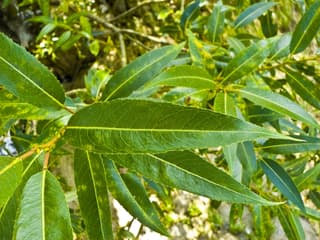
Crack willow
Salix × fragilis
Salix × fragilis, the crack willow, is a fast-growing deciduous tree native to Eurasia, common along rivers, marshes and wet ground. It reaches around 15 m and is named for its twigs, which snap off cleanly and readily root where they land.
White Willow
Salix alba
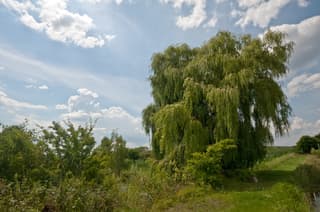
The white willow (Salix alba) is a fast-growing deciduous tree native to Europe, temperate Asia, and North Africa. It can reach up to 25 meters (82 feet) in height, with characteristic silvery-green lanceolate leaves, especially on the underside. It thrives in moist soils and near watercourses, making it a popular choice for riparian landscaping and erosion control.
Weeping Willow
Salix babylonica
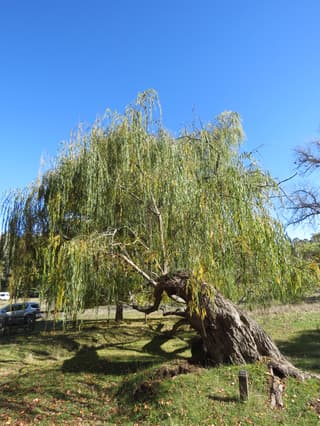
The Weeping Willow (Salix babylonica) is a majestic tree native to northern China, widely cultivated around the world for its graceful, cascading branches that sweep the ground. It thrives near water — rivers, lakes, and ponds — where it can reach its full potential. Its iconic silhouette makes it one of the most recognizable ornamental trees globally.
goat willow
Salix caprea
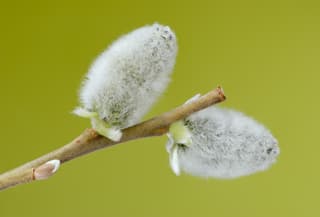
Salix caprea, commonly known as goat willow or pussy willow, is a robust deciduous tree or large shrub native to Europe and Western Asia. It is most famous for its soft, silky-grey catkins that emerge in early spring, which eventually turn yellow with pollen, providing a vital early nectar source for bees and other pollinators. The leaves are broader than most other willows, with a felt-like underside.
Grey Willow
Salix cinerea
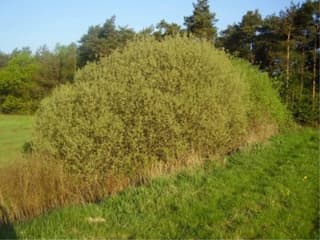
Salix cinerea, the grey willow (also called grey sallow), is a fast-establishing deciduous shrub or small tree native to Europe and western Asia. It thrives in wet, poorly drained soils along riverbanks, ditches and marshes, producing fuzzy grey-to-yellow catkins in early spring before the leaves emerge. Its dense, downy grey-green foliage and tolerance of waterlogged ground make it a valuable pioneer species for wetland restoration and a key early-season nectar source for bees.
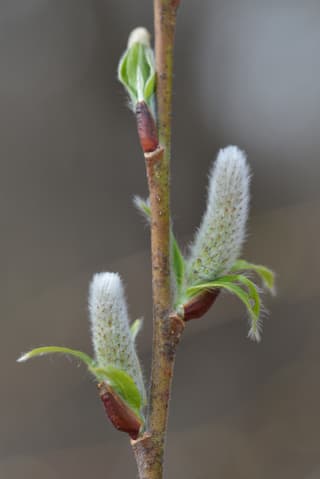
Pussy Willow
Salix discolor
Salix discolor, commonly known as Pussy Willow, is a fast-growing deciduous shrub or small tree native to North America. Celebrated for its silky, pearl-gray catkins that emerge in late winter before the leaves, it is one of the first plants to signal the arrival of spring. It thrives in moist to wet soils and is ideal for rain gardens, stream banks, and wildlife habitats.
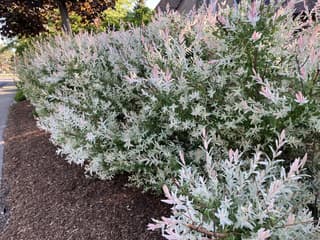
Dappled Willow
Salix integra
Salix integra is a deciduous shrub in the willow family (Salicaceae), grown mainly for its ornamental foliage rather than its inconspicuous yellow catkins. The widely planted cultivar 'Hakuro-nishiki' (dappled willow) produces slender, lance-shaped leaves splashed with pink, cream and green when they emerge, maturing to green by summer and turning gold in fall. It is fast-growing, cold-hardy, and adaptable to a range of soils, including damp or heavier ground where many other ornamentals struggle.
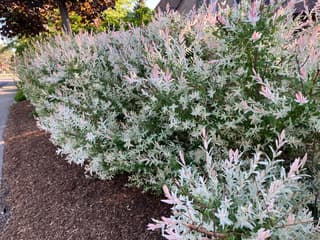
Dappled Willow 'Hakuro Nishiki'
Salix integra 'Hakuro Nishiki'
The Dappled Willow 'Hakuro Nishiki' (Salix integra) is an ornamental deciduous shrub from the Salicaceae family, renowned for its striking variegated foliage in shades of pink, white, and green. These colors are most vibrant on new growth during spring and early summer. In spring, it produces small, inconspicuous yellow-green catkins. It is a fast-growing plant, often pruned into a low shrub or grafted onto a trunk to create a 'standard' or 'lollipop' form. It is popular in gardens as a specimen plant or in mixed borders, particularly near water features, as it thrives in moist conditions.
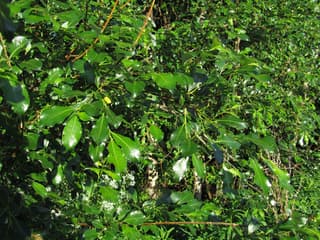
Tea-leaved Willow
Salix phylicifolia
The tea-leaved willow (Salix phylicifolia) is a hardy deciduous shrub native to the boreal and montane regions of northern Europe, including Scotland, Ireland, and Fennoscandia. It grows along streambanks, in ditches, and in flushed upland ground, usually on moist, base-rich soils, from near sea level up to over 1,000 metres in altitude. The shrub reaches 2.5 to 4 metres in height with a bushy, spreading habit, smooth reddish-brown young stems, and thin, glossy dark green leaves with greyish undersides that resemble tea leaves, giving the species its common name. Like most willows, it is dioecious, with male and female catkins borne on separate plants; the yellow male catkins and greener female catkins appear on bare stems in early spring before the leaves unfurl, providing an important early nectar source for pollinators. Its bark is rich in salicin and related phenolic compounds that have been studied for antibacterial, antiviral, and antioxidant activity, continuing a long tradition of willow bark use in folk medicine for pain and fever relief.
Purple Willow
Salix purpurea
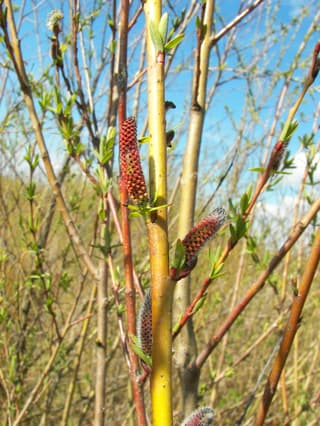
Salix purpurea, the purple willow or purple osier, is a fast-growing deciduous shrub native to Europe, North Africa, and temperate Asia. It forms dense thickets of slender, purple-tinted stems and narrow grey-green leaves arranged in an unusual near-opposite pattern for a willow. Purple-red catkins appear on bare branches in early spring before the leaves emerge, turning golden as they release pollen. Long prized by basket weavers for its flexible, colorful osier rods, it is equally valued in modern landscapes for erosion control along streambanks and as a fast, low-maintenance ornamental hedge or screen.

Basket Willow
Salix viminalis
Salix viminalis, commonly known as basket willow or common osier, is a fast-growing deciduous shrub or small tree native to Europe and western/central Asia. Prized for centuries for its long, flexible, unbranched shoots, it is the classic species used in traditional basket weaving and wickerwork. It thrives in damp, wet ground along riverbanks and wetlands, forming dense thickets of slender silvery-green leaves and, in early spring, soft grey catkins that appear before the foliage. Its vigorous growth and tolerance of coppicing make it a popular choice for biomass production, erosion control on riverbanks, and living willow structures in gardens.
Lily of the Valley Vine
Salpichroa origanifolia
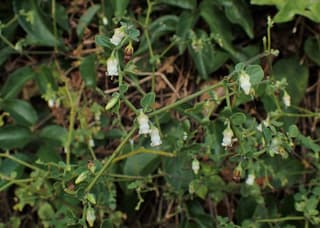
Salpichroa origanifolia, popularly known as 'Lily of the Valley Vine' or 'Cock's Eggs', is a perennial, rhizomatous herb belonging to the Solanaceae family, native to South America—Argentina, Uruguay, Brazil, Bolivia, and Peru. Its climbing and highly branched stems can reach up to 3 meters (10 feet) in length; its leaves are elliptical or oval, and its flowers are small, bell-shaped, and white or greenish-white. In late summer, it produces oval berries, 10–15 mm (0.4–0.6 inches) in size, that ripen from green to white or pale yellow, with a sweet and edible taste. The plant has naturalized in regions of Europe, California, and Tasmania, where it is considered invasive.
Prickly Russian thistle
Salsola kali
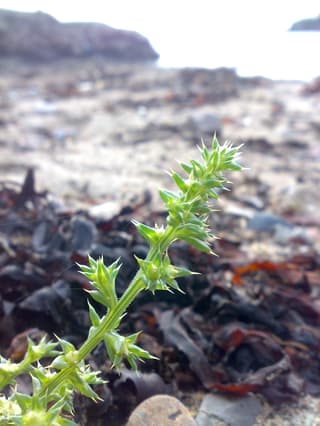
Salsola kali, commonly known as prickly Russian thistle, saltwort, or tumbleweed, is an annual halophytic plant in the Amaranthaceae family. It grows in a globose and spiny form on sandy beaches, dunes, and saline soils in coastal areas of Europe, North Africa, and Asia, and has become naturalized as an invasive weed in North America. Upon drying in the fall, the plant detaches from its root and rolls with the wind (the 'tumbleweed' effect), thereby dispersing its seeds.
Sage
Salvia
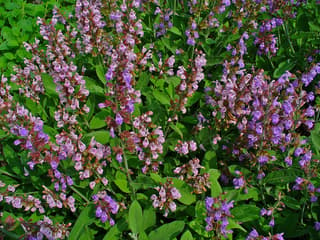
Salvia is one of the largest genera in the mint family Lamiaceae, comprising over 900 species native to regions spanning the Mediterranean, the Americas, and Asia. The genus encompasses culinary herbs such as S. officinalis, brilliant ornamentals like S. splendens (scarlet sage), and hardy perennials like S. nemorosa (woodland sage). All species are aromatic, typically featuring soft or velvety foliage and tubular flowers highly attractive to pollinators.
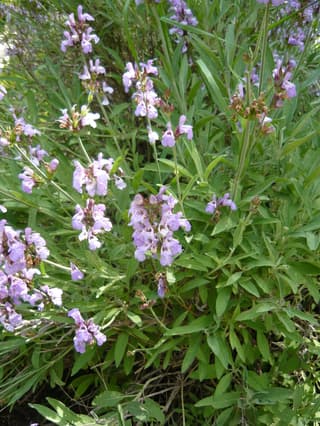
Lavender Sage
Salvia × lavandulacea
Lavender Sage (Salvia × lavandulacea) is an aromatic evergreen sub-shrub in the mint family, closely related to Spanish sage (Salvia lavandulifolia). It has narrow, grey-green, downy leaves with a rosemary-like scent and produces spikes of violet-blue flowers in summer. Drought-tolerant and sun-loving, it thrives in Mediterranean-style gardens, sunny containers, and herb beds.
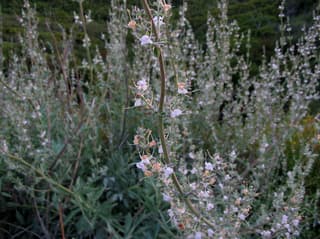
White Sage
Salvia apiana
Salvia apiana, commonly known as white sage, is an aromatic evergreen shrub native to the coastal sage scrub of Southern California and northern Baja California. It forms a rounded mound of silvery-white, felted leaves and sends up tall flowering spikes of pale lavender-white blossoms in late spring. Deeply drought-adapted, white sage thrives in poor, rocky, well-drained soil and full sun, asking for little water once established. Beyond its garden appeal, it is one of the most culturally significant plants of California, long tended and used ceremonially by Indigenous peoples including the Cahuilla, Kumeyaay, Chumash, and Luiseno.
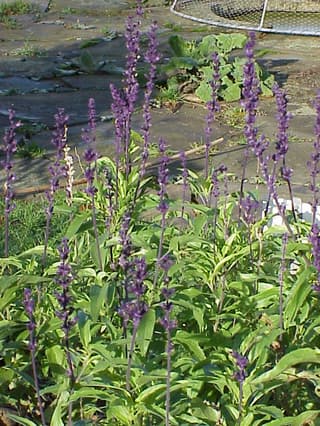
Mealycup Sage
Salvia farinacea
Salvia farinacea, commonly known as Mealycup Sage or Blue Sage, is a tender perennial native to the prairies and meadows of south-central Texas, Oklahoma, and northeast Mexico. It produces tall, elegant spikes of vivid blue-to-violet flowers from late spring through autumn, making it a favorite in pollinator gardens. The plant is deer-resistant, drought-tolerant once established, and attracts bees, butterflies, and hummingbirds.
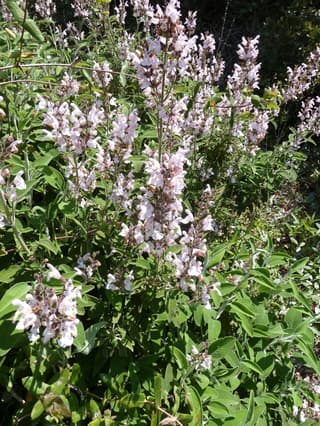
Greek Sage
Salvia fruticosa
Salvia fruticosa, commonly called Greek sage or three-lobed sage, is an aromatic, evergreen shrub native to rocky hillsides of the Eastern Mediterranean, including Greece, Crete, Turkey, Cyprus, and the Levant. Its soft, silvery-green, three-lobed leaves release a warm, resinous fragrance milder than common sage, and its pink-to-lilac flower spikes attract bees and butterflies through late spring and summer. Grown for centuries as a culinary herb and folk remedy, it thrives in poor, dry, sun-baked soil and needs almost no attention once established.
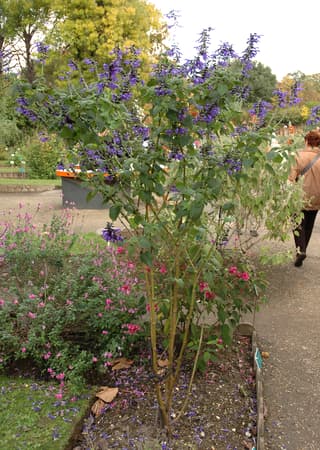
Anise-Scented Sage
Salvia guaranitica
Salvia guaranitica, commonly known as anise-scented sage or hummingbird sage, is a bushy herbaceous perennial native to Brazil, Paraguay, Uruguay, and Argentina, belonging to the Lamiaceae family. Its fresh mint-green, ovate leaves release a soft anise scent when crushed, and its upright stems bear spikes of deep blue tubular flowers (with dark calyces in the 'Black and Blue' cultivar) from summer into fall. It is a favorite of hummingbirds and butterflies in warm-climate gardens.
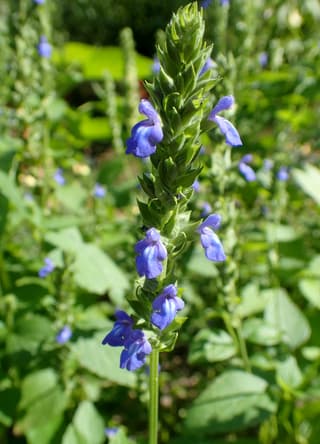
Chia
Salvia hispanica
Chia (Salvia hispanica) is an annual herb in the Lamiaceae family, native to central and southern Mexico. Cultivated for centuries by the Aztecs, it is now known worldwide for its fiber- and omega-3-rich seeds. The plant grows upright stems with dark green leaves and small purple or white flowers clustered in spikes during summer and fall.
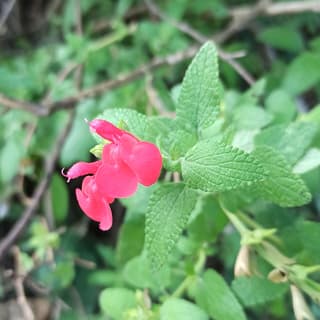
Baby Sage
Salvia microphylla
Salvia microphylla, commonly known as Baby Sage or Little Leaf Sage, is a compact perennial shrub native to Mexico and the southwestern United States. It produces abundant tubular flowers in shades of red, pink, purple, and white, making it a magnet for hummingbirds, bees, and butterflies. Hardy, drought-tolerant, and easy to grow, it thrives in sunny gardens with minimal care.
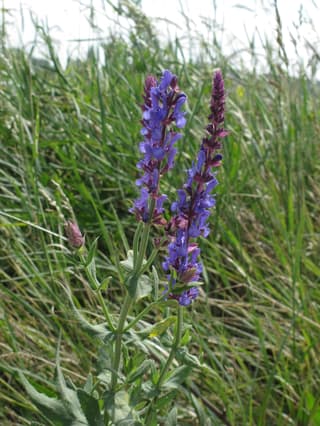
Woodland Sage
Salvia nemorosa
Salvia nemorosa, commonly known as Woodland Sage or Violet Sage, is a hardy herbaceous perennial in the Lamiaceae family, native to Europe and Western Asia. It produces dense, upright spikes of lavender-violet to deep blue-purple flowers from late spring through summer. Exceptionally drought-tolerant and cold-hardy (USDA zones 4–8), it is a low-maintenance staple in cottage, pollinator, and xeriscape gardens.
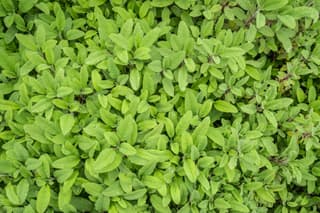
Garden Sage
Salvia officinalis
Salvia officinalis, commonly known as Garden Sage or Common Sage, is a perennial aromatic herb native to the Mediterranean region. It features soft, gray-green velvety leaves and vibrant purple-blue flower spikes in summer. A staple in kitchens and apothecaries for over 2,000 years, it belongs to the Lamiaceae (mint) family.
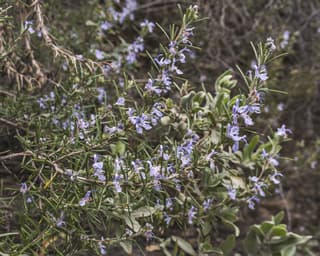
Rosemary
Salvia rosmarinus
Salvia rosmarinus, commonly known as rosemary, is a woody, perennial herb with fragrant, evergreen, needle-like leaves and white, pink, purple, or blue flowers. Native to the Mediterranean region, it is a member of the sage family Lamiaceae. It is highly valued for its aromatic foliage and culinary versatility.
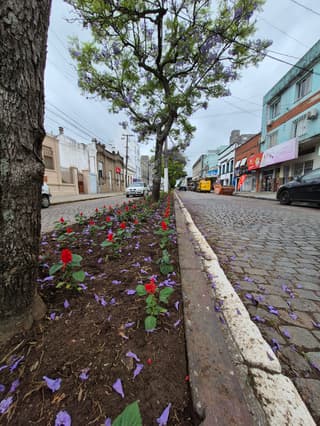
Scarlet Sage
Salvia splendens
Salvia splendens, commonly known as Scarlet Sage, is a flowering ornamental plant native to Brazil. It is prized for its vibrant tubular flower spikes ranging from classic scarlet red to pink, purple, lavender, and white. Fast-growing and prolific, it blooms from late spring through frost, making it a garden staple worldwide.
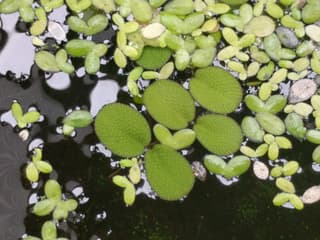
Floating Fern
Salvinia sp
Salvinia sp is a free-floating aquatic fern native to tropical Americas. Characterized by pairs of small, velvety leaves on the water surface with submerged leaf-like structures that absorb nutrients directly from the water. It is one of the easiest aquatic plants to grow and reproduces with extraordinary speed under ideal conditions.
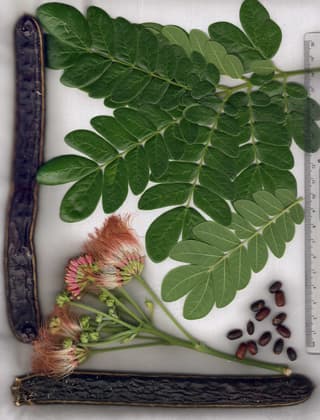
Rain Tree
Samanea saman
Samanea saman, commonly known as the Rain Tree or Monkeypod, is a monumental tropical tree native to Central and South America, now naturalized in tropical regions worldwide. It reaches heights of 15 to 30 m and develops an umbrella-shaped canopy that can exceed 30-40 m in diameter, providing exceptional shade. It is famous for folding its leaflets at night or before rain, allowing water to reach the ground. Its flowers are tassel-like heads, pink with white stamens, highly attractive to pollinators, and its pods contain a sweet edible pulp.
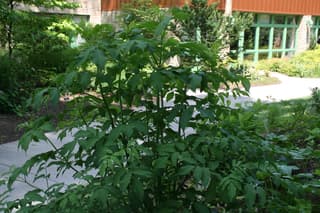
American elderberry
Sambucus canadensis
Sambucus canadensis, the American elderberry, is a fast-growing deciduous shrub native to eastern and central North America. It forms an open, multi-stemmed thicket 1.5-3.5 m tall, with pinnately compound leaves and large flat-topped clusters of fragrant creamy-white flowers in early summer, followed by clusters of small purple-black berries in late summer.
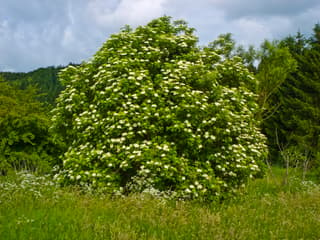
Black Elder
Sambucus nigra
Sambucus nigra, commonly known as Black Elder or European Elderberry, is a fast-growing deciduous shrub or small tree native to Europe, Western Asia, and Northwest Africa. It produces large, flat-topped clusters of fragrant creamy-white flowers in late spring, followed by drooping bunches of glossy dark purple-black berries in late summer and autumn. The plant is famous for its dual edible and medicinal uses — elderflower cordials and elderberry syrups are beloved across Europe. Important note: all green plant parts (leaves, stems, roots, unripe berries, and raw seeds) are toxic due to cyanogenic glycosides; only fully cooked ripe berries and fresh flowers are safe for consumption.
Find the Perfect Plant
Our plant guide helps you find ideal species for your experience level and time of year.
Browse by Difficulty, Season & More
Use the filters below to narrow this catalog by care difficulty, season, environment, or search directly by name. Each filter leads to a focused list tailored to your specific growing conditions.