2795 Easy Easy Care | 2026 Guide - Page 69
Find 2795 easy easy care. Complete guide for your garden.
2795 Easy Care with easy level
Showing 2449-2484 of 2795
Bladder Campion
Silene vulgaris
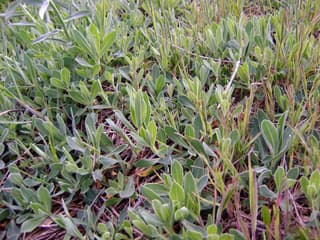
Silene vulgaris is a herbaceous perennial in the family Caryophyllaceae, native to Europe, temperate Asia and North Africa and naturalised across much of North America. It forms clumps 50 cm to 1 m tall with grey-green leaves and a slightly woody base. From spring to late summer it opens white flowers with deeply notched petals, each sitting on an inflated, veined calyx that looks like a small bladder. In the wild it grows on roadsides, dry meadows and stony slopes.
Silphium
Silphium
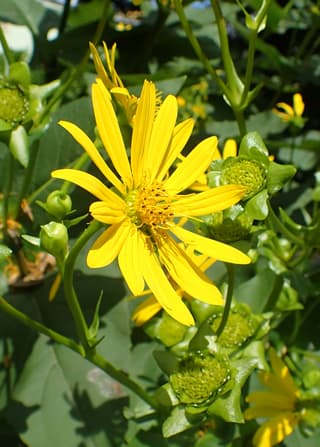
Silphium is a genus of robust, perennial prairie plants from North America, belonging to the sunflower family (Asteraceae). The genus comprises approximately 17–18 species, including the well-known Cup Plant (Silphium perfoliatum), Compass Plant (Silphium laciniatum), and Wholeleaf Rosinweed (Silphium integrifolium). These impressive perennials can reach up to 3 meters in height and bear bright yellow, sunflower-like flower heads in summer and autumn. The leaves of the Compass Plant orient themselves north-south to minimize water loss in the intense midday sun, while the Cup Plant's perfoliate leaves form natural "cups" that collect rainwater for birds and insects. Silphium species are essential for prairie biodiversity and attract a wide variety of pollinators, birds, and insects.
Milk thistle
Silybum marianum
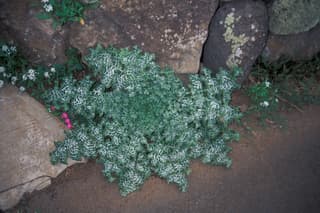
Milk thistle is an annual or biennial herb from the Asteraceae family, native to the Mediterranean region and extending to Central Asia. In its first year, it forms a basal rosette of large, glossy leaves characterized by white veins and spiny margins. It then sends up a stem 1 to 2 meters tall topped with purple flower heads that bloom in summer and are surrounded by hard spines. The seeds, equipped with white downy tufts, are dispersed by the wind, allowing the plant to self-seed easily and often behave as a weed outside its native range.
Paradise Tree
Simarouba amara
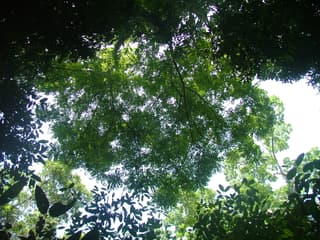
Simarouba amara, commonly known as the Paradise Tree or Bitterwood, is a majestic tropical evergreen tree native to the rainforests of Central and South America. It is distinguished by its glossy, dark green pinnate leaves and a straight trunk with smooth, greyish bark. The tree produces small, inconspicuous yellowish flowers that develop into oval drupes, which turn from red to blackish-purple when ripe. It is highly valued in its native range for its medicinal properties, particularly the bark, which contains bitter quassinoids used to treat various ailments.
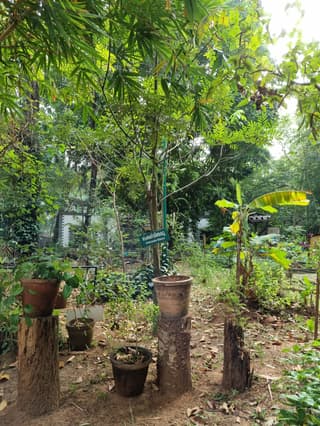
Bitterwood
Simarouba glauca
Bitterwood (Simarouba glauca) is a fast-growing evergreen tree native to Central America, the Caribbean, and southern Florida, belonging to the Simaroubaceae family. It features glossy, pinnately compound leaves that emerge reddish-orange before maturing to deep green, and clusters of small yellow-to-creamy-white flowers that bloom from late winter into spring, followed by dark purple, olive-shaped drupes. Highly adaptable, it tolerates a wide range of soils, drought, salt spray, and poor conditions once established, making it a popular shade and street tree in warm climates. Its bark and leaves have a long history of traditional medicinal use, particularly for fevers and dysentery.
Jojoba
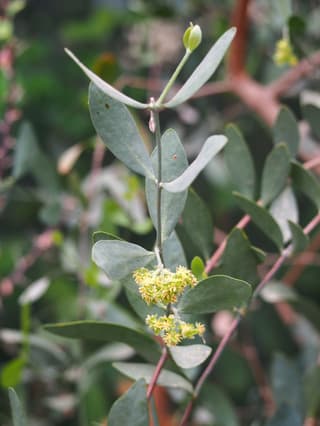
Simmondsia chinensis
Jojoba (Simmondsia chinensis) is a perennial evergreen shrub native to the desert regions of the Southwestern United States and Northwestern Mexico (Sonoran Desert). As the sole member of the Simmondsiaceae family, it forms a dense, rounded bush that can reach 6 to 8 feet in height, featuring thick, leathery, gray-green leaves designed to minimize water loss. It is a dioecious plant (separate male and female plants) whose seeds produce a unique liquid wax very similar to human sebum, widely used in cosmetics as jojoba oil. Extremely drought-tolerant once established, it can survive on only 10 to 30 inches of annual rainfall and tolerate poor, saline soils.
Mustard (genus)
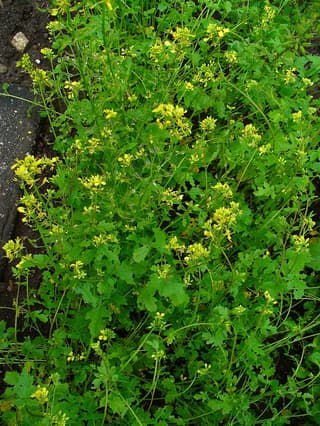
Sinapis
Sinapis is a small genus of annual herbs in the cabbage family (Brassicaceae), native to the Mediterranean, Europe and western Asia. The best-known species is white or yellow mustard (Sinapis alba), whose ground seeds make yellow table mustard; charlock or wild mustard (S. arvensis), a common weed of arable fields, is also often placed in the genus. They are upright plants 50 cm to 1 m tall, with rough, lobed leaves and clusters of four-petalled yellow flowers in spring and summer, followed by slender seed pods. They grow very fast, flowering 4-6 weeks after sowing. Besides the condiment, young leaves are eaten cooked, and in Europe white mustard is widely sown as a green manure and cover crop.
Charlock
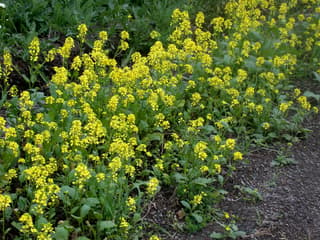
Sinapis arvensis
Charlock (Sinapis arvensis) is an annual herb in the cabbage family (Brassicaceae), native to the Mediterranean basin, Europe, North Africa and parts of Asia, and now naturalised in the Americas, Australia and South Africa. It usually grows 20 cm to 1 m tall and bears clusters of four-petalled yellow flowers from spring to late summer. It grows mainly in arable fields, roadsides and waste ground, preferring sunny, chalky soils, and is a common weed of crops. Young leaves are edible when cooked and the ground seeds make a mustard-like condiment.
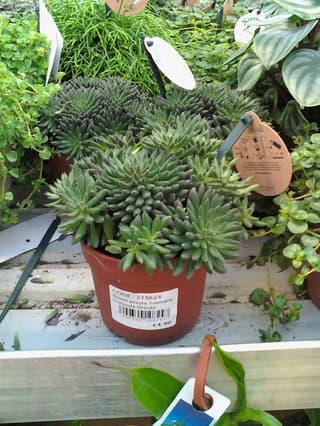
Chinese jade
Sinocrassula yunnanensis
Sinocrassula yunnanensis, or Chinese jade, is a small rosette-forming succulent native to the mountainous Yunnan province of China. Its spindle-shaped leaves are densely covered in fine soft hairs and shift from dark green in summer to deep chocolate-brown or red tones in cooler months. Plants multiply readily by offsets, eventually forming dense clumps, and produce cream-to-white flowers on tall stalks; the flowering rosette itself dies back afterward.
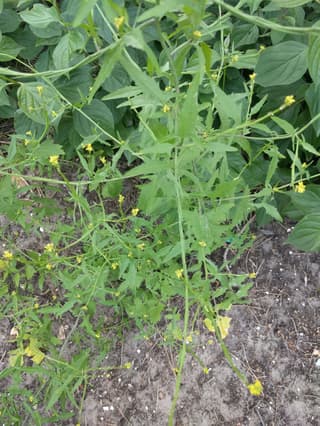
Hedge mustard
Sisymbrium
Sisymbrium is a genus of around 40 species of annual and biennial herbs in the mustard family (Brassicaceae), commonly known as hedge mustards. The most widespread species, Sisymbrium officinale, is a weedy plant of disturbed ground, roadsides and hedgerows across Europe and naturalized worldwide, bearing small yellow four-petaled flowers and slender seed pods. Historically nicknamed "the singer's plant", it was used by opera singers and orators to soothe hoarseness and protect the voice.
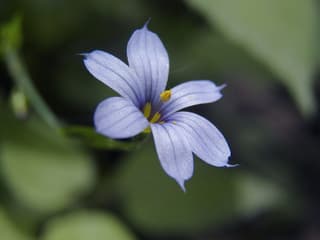
Narrow-leaf blue-eyed grass
Sisyrinchium angustifolium
Sisyrinchium angustifolium (commonly known as narrow-leaf blue-eyed grass) is a perennial native to eastern North America that grows in dense, grass-like clumps from short rhizomes. Although it resembles a grass, it actually belongs to the Iris family (Iridaceae). Its narrow, sword-shaped leaves are 2–6 mm wide and arranged in fan-like clusters, while its stems are flat and winged, reaching 15–50 cm in height. From late spring to early summer, it produces small, approximately 1–1.5 cm wide, six-petaled bluish-purple flowers with a distinct yellow 'eye' in the center. The flowers open in the morning and close in the afternoon or evening. Its natural habitats include meadows, open woodlands, and damp grasslands. It attracts bees, hoverflies, and butterflies, and self-seeds easily.
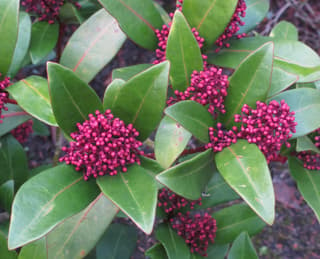
Japanese Skimmia
Skimmia japonica
Japanese Skimmia (Skimmia japonica) is a compact, slow-growing evergreen shrub from the Rutaceae family. It is an ornamental shrub native to Japan, notable for its fragrant, creamy-white to pink flowers in spring, followed by bright red berries that persist throughout fall and winter. The foliage releases an aromatic scent when crushed.

Sarsaparilla
Smilax aspera
Smilax aspera, commonly known as sarsaparilla or rough bindweed, is an evergreen, thorny climbing vine native to the Mediterranean Basin, southern Europe and North Africa. Using tendrils, it scrambles over shrubs, walls and trellises, reaching 1 to 4 metres in length. Its wiry, zigzagging stems and leathery, heart-shaped leaves are armed with small spines, and from September to November it produces clusters of tiny, strongly fragrant greenish-white flowers followed by red berries that ripen to black.
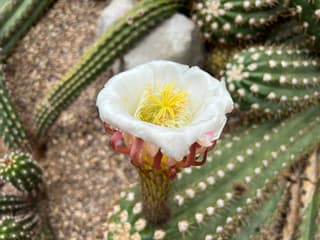
Argentine White Torch Cactus
Soehrensia candicans
The Argentine White Torch Cactus (Soehrensia candicans) is a columnar cactus native to northern Argentina, renowned for its spectacular large white fragrant flowers that bloom at night. It forms sprawling clumps up to 3 m (10 ft) wide, with individual stems reaching 60 cm (24 in) tall. Hardy, drought-tolerant, and cold-resistant to -6°C (21°F), it thrives in xeriscapes and rock gardens.
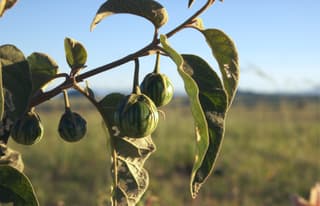
Ethiopian Eggplant
Solanum aethiopicum
Solanum aethiopicum, commonly known as Ethiopian eggplant or scarlet eggplant, is a fruiting shrub in the Solanaceae family native to tropical Africa. It grows up to 2.5 m tall with lobed leaves, produces star-shaped white to violet flowers, and bears small egg-shaped berries that ripen from green to vivid orange-red. It is one of the five most economically important vegetables in sub-Saharan Africa, valued for both its edible fruits and nutritious leaves.
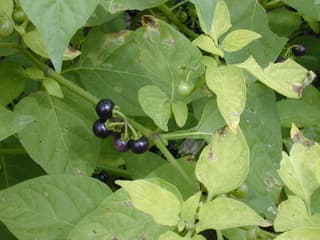
American Black Nightshade
Solanum americanum
American black nightshade (Solanum americanum) is an annual or short-lived perennial herbaceous plant in the Solanaceae family, widely distributed across tropical and subtropical regions worldwide. Native to the Americas, it has become a cosmopolitan weed found in disturbed soils, roadsides, gardens, and waste ground. It produces small white star-shaped flowers and round berries (5–10 mm) that ripen from green to glossy black. All parts are considered severely toxic — particularly the green parts and unripe berries, which contain solanine, chaconine, and solamargine — though the plant has traditional medicinal uses across Africa, Asia, and the Americas.
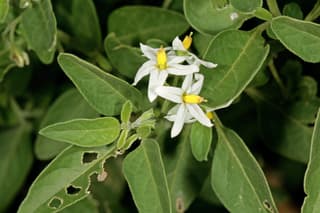
Tall nightshade
Solanum chenopodioides
Tall nightshade (Solanum chenopodioides) is a weedy, sprawling perennial subshrub in the nightshade family, native to South America and now naturalized in disturbed ground, coastal scrub, and gardens across mild-climate regions worldwide. It bears small star-shaped white flowers followed by round berries that ripen from green to dark purple-black. As with other Solanum species, its leaves and unripe berries contain solanine and related glycoalkaloids, making the whole plant toxic if eaten.
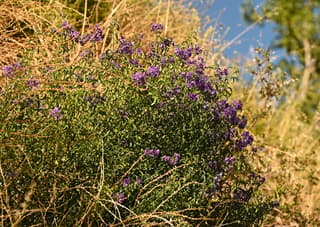
Chilean potato vine
Solanum crispum
Solanum crispum is a semi-climbing shrub in the nightshade family (Solanaceae), native to Chile, Peru and western Argentina, where it is a common shrub of the central Chilean scrubland and is known as natre. Its scrambling woody stems reach 6 to 8 m against a support, and it keeps its leaves in mild climates but drops them where winters are cold. The leaves are oval to lance-shaped, 7 to 13 cm long. From late spring to autumn it carries clusters of fragrant, star-shaped blue to violet flowers, 1.5 to 3 cm across, with a yellow cone of anthers in the centre, much like potato flowers. The small berries that follow are poisonous. A white-flowered form, 'Album', and the free-flowering 'Glasnevin' are popular in gardens.
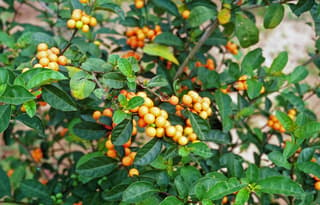
Two-leaf nightshade
Solanum diphyllum
Two-leaf nightshade (Solanum diphyllum) is an evergreen shrub in the nightshade family (Solanaceae), the same family as tomatoes and eggplants, native to the dry lowlands from Mexico to Costa Rica. It grows 1–2 m tall with smooth stems and smooth, glossy leaves; on flowering shoots the leaves come in pairs of very different sizes at the same node, hence the name. From late spring to early autumn it bears clusters of tiny white to pale lavender flowers, followed by round berries that turn from green to bright orange. It was grown as an ornamental and has escaped from gardens in the tropics and subtropics; in Florida it is listed as an invasive plant.
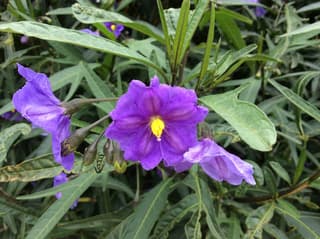
Kangaroo apple
Solanum laciniatum
Solanum laciniatum is an evergreen shrub in the nightshade family (Solanaceae, like tomato and potato), native to south-eastern Australia, Tasmania and New Zealand, where it grows in open scrub and forest margins, usually near the coast. It reaches 1-3 m tall and wide, with purplish stems and long, narrow dark green leaves, 15-30 cm, often cut into irregular lobes. In spring and summer it opens large blue-purple flowers (rarely white), followed by oval berries about 3 cm long that turn from green to orange when ripe and draw birds. It grows fast but is short-lived. Caution: the green parts and unripe fruit are poisonous.
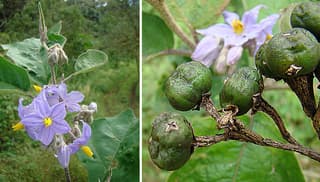
Lance-leaf Nightshade
Solanum lanceolatum
Solanum lanceolatum is a perennial shrub native to Mexico and Central America, prized for its striking star-shaped purple flowers with bright yellow anthers and glossy orange-red berries. A member of the nightshade family (Solanaceae), it thrives in warm climates and full sun, tolerating drought once established. All parts of the plant are toxic if ingested.
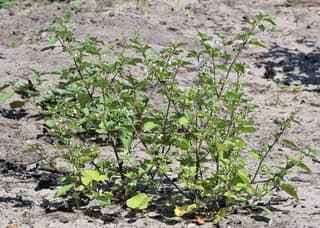
Black Nightshade
Solanum nigrum
Black nightshade (Solanum nigrum) is a fast-growing cosmopolitan herbaceous weed in the Solanaceae family. Found worldwide in disturbed soils, roadsides, and gardens, it produces small white star-shaped flowers with yellow anthers and clusters of berries that ripen from green to shiny black. All green parts and unripe berries contain solanine, a toxic glycoalkaloid; ripe berries are consumed cautiously in some traditional cultures.
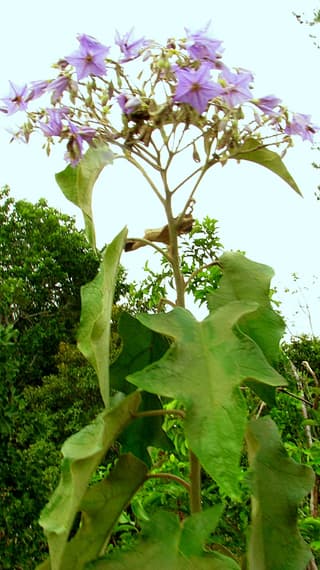
Jurubeba
Solanum paniculatum
Solanum paniculatum, called jurubeba in Brazil, is a shrub in the nightshade family (Solanaceae), the same family as tomato and potato. It is native to tropical America and grows across all regions of Brazil and in Paraguay. It usually reaches 1 to 3 meters, sometimes more, and the stems carry curved prickles. The leaves are large and lobed. The flowers come in branched clusters and range from white to lilac, pale blue or violet, with a yellow center. The fruits are small, bitter green berries. It comes up on its own in pastures, roadsides and vacant lots, often as a weed. The name comes from the Tupi language, and in northeastern Brazil the fruit is known for jurubeba-flavored liquor and pickles.

Red Nightshade
Solanum villosum
Solanum villosum, commonly called red nightshade or hairy nightshade, is a fast-growing annual herb in the tomato and potato family (Solanaceae). Native to Eurasia and now naturalized worldwide, it typically reaches 40-60 cm tall, with soft, hairy, toothed leaves and small clusters of white, star-shaped flowers. The flowers give way to round berries that ripen from green to red or yellow. In many parts of Africa and Asia, the young leaves and shoots are cooked and eaten as a nutritious leafy vegetable, but every part of the plant - especially the unripe green berries and raw foliage - contains the toxic glycoalkaloid solanine and should never be eaten raw or before fully ripe. Because it thrives in disturbed soil with minimal care, red nightshade is often treated as a fast-cycling kitchen-garden crop rather than a long-term ornamental.
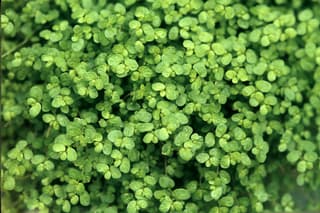
Baby's Tears
Soleirolia soleirolii
Soleirolia soleirolii, commonly known as Baby's Tears, is a low-growing, mat-forming perennial native to the western Mediterranean islands of Corsica and Sardinia. It produces a dense carpet of tiny, rounded leaves on delicate, thread-like stems, creating a lush, moss-like appearance. Its dainty white flowers appear in spring and summer. Popular as a ground cover, terrarium plant, and houseplant, it thrives in high humidity and consistent moisture.
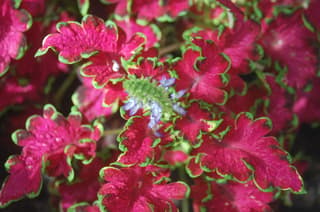
Painted Nettle
Solenostemon scutellarioides
Coleus (Solenostemon scutellarioides) is a vibrant tropical foliage plant native to Southeast Asia, belonging to the mint family Lamiaceae. Renowned for its spectacular multicolored leaves featuring combinations of red, purple, orange, yellow, green, and pink, it is one of the most popular ornamental plants for both indoor and outdoor settings. Modern cultivars have been developed for sun or shade tolerance, making coleus incredibly versatile.
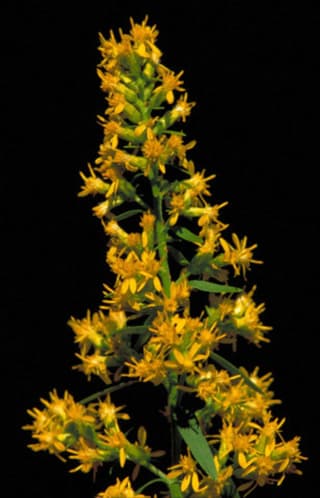
Goldenrod
Solidago
Solidago, commonly known as goldenrod, is a genus of herbaceous perennial plants in the daisy family (Asteraceae), native mainly to North America. It forms upright clumps with stiff stems and dense golden-yellow flower clusters that bloom in late summer through fall, making it a favorite of bees, butterflies, and other pollinators.
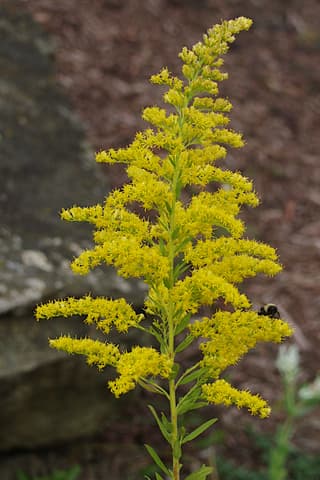
Tall Goldenrod
Solidago altissima
Tall Goldenrod (Solidago altissima) is a vigorous, rhizomatous perennial wildflower native to North America and a member of the aster family (Asteraceae). From late summer into autumn it produces dense, plume-like clusters of small golden-yellow flowers atop upright, downy stems reaching 60-180 cm tall. Highly attractive to bees, butterflies, and other pollinators, it spreads readily by creeping rhizomes and self-seeding, forming bold colonies in meadows, borders, and naturalized gardens. Despite its reputation, it is not the culprit behind hay fever - its heavy, sticky pollen is carried by insects, not wind.
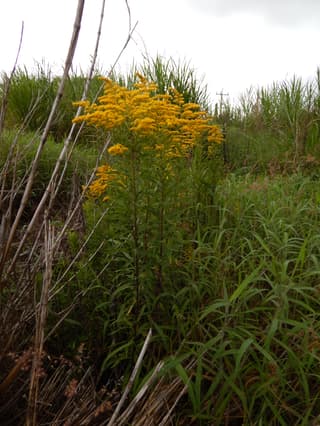
Canada Goldenrod
Solidago canadensis
Solidago canadensis, commonly known as Canada Goldenrod, is a robust native North American perennial wildflower belonging to the Asteraceae family. It produces striking arching plumes of bright yellow flowers from late summer through fall, creating a spectacular display in meadows, prairies, and naturalized gardens. Fast-spreading via rhizomes and self-seeding, it is beloved by pollinators including bees, butterflies, and birds.
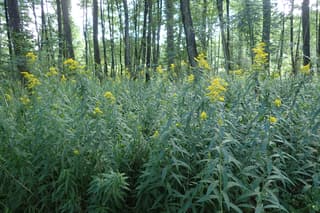
giant goldenrod
Solidago gigantea
Giant goldenrod (Solidago gigantea) is a vigorous herbaceous perennial in the Asteraceae family, native to North America. It grows up to 7 feet tall and produces large plumes of tiny golden-yellow flowers from late summer through fall. Widely cultivated as an ornamental and valued for its medicinal properties, it is also known as an aggressive spreader outside its native range.
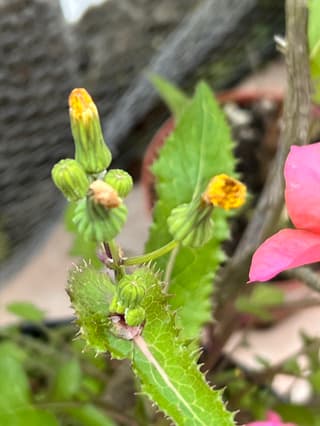
Sow Thistle
Sonchus
Sonchus is a genus of fast-growing annual, biennial and occasionally perennial herbs in the daisy family (Asteraceae), commonly called sow thistles. They form a basal rosette of soft, deeply lobed, spiny-edged leaves and send up hollow, milky-sapped stems topped with small, dandelion-like yellow flowerheads. Widespread as a garden and field weed on every continent, sow thistles are edible, fast to establish, and remarkably tolerant of poor soil and disturbance.
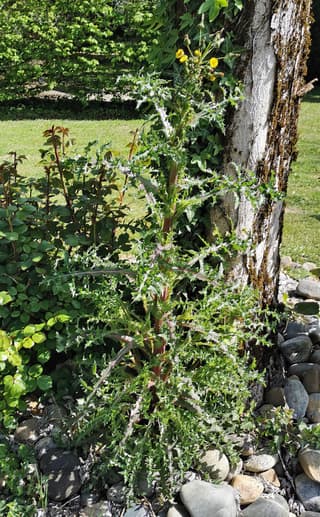
Spiny Sowthistle
Sonchus asper
Annual to biennial herbaceous plant in the Asteraceae family, native to the Mediterranean region and naturalized throughout Europe, Asia, and Africa. Sonchus asper is a common edible weed with considerable nutritional and medicinal value. It grows 30-150 cm tall with erect, hollow stems, deeply lobed leaves with prickly spiny margins, and yellow flowers resembling dandelions. Young tender leaves and shoot tips are edible raw or cooked, providing fiber, proteins, vitamins (niacin, ascorbic acid, thiamine, riboflavin), and minerals (calcium, iron, zinc, potassium, magnesium).
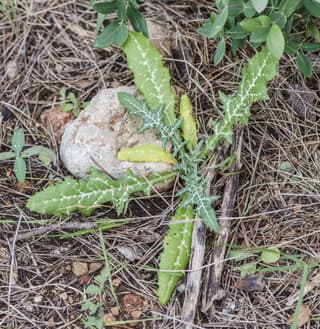
Common Sowthistle
Sonchus oleraceus
Common sowthistle (Sonchus oleraceus) is a fast-growing annual herb in the Asteraceae family, native to Europe and Western Asia and now naturalized worldwide. It thrives in disturbed soils, roadsides, and gardens, reaching up to 1.4 m tall. Its yellow daisy-like flowers attract bees and flies, and its young leaves are edible and rich in vitamin C.
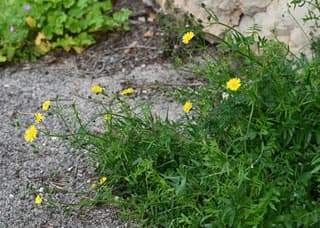
Slender Sowthistle
Sonchus tenerrimus
Sonchus tenerrimus is an annual or biennial herb in the daisy family, sometimes a short-lived perennial, 10 to 80 cm tall. It is native to most of the Mediterranean region and Macaronesia and has naturalized in the Azores, California and Australia. It grows on coastal rocks and walls, dunes, roadsides, fields and disturbed ground. The upper leaves are deeply cut into narrow lobes, and the yellow flower heads have a white, cottony base, which helps tell it apart from other sowthistles. It flowers from spring to autumn. In southeastern Spain the tender leaves are among the most eaten wild greens.
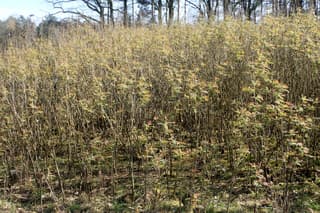
Ural False Spirea
Sorbaria sorbifolia
Sorbaria sorbifolia is a vigorous, suckering deciduous shrub in the rose family (Rosaceae), native to the temperate forests of Siberia, the Russian Far East, northern China, Korea, and Japan. It forms an upright, multi-stemmed mound of fern-like, pinnately compound leaves that resemble mountain ash foliage, topped in early-to-mid summer by dense, pyramidal panicles of small white flowers that attract bees and other pollinators. Extremely cold-hardy and adaptable, it is prized in northern gardens for erosion control, mass plantings, and informal hedges, though its spreading root suckers mean it needs room to roam or regular edging.

Sorbaronia
Sorbaronia fallax
× Sorbaronia fallax is a deciduous, cold-hardy intergeneric hybrid shrub or small tree — a cross between black chokeberry (Aronia melanocarpa) and European mountain ash / rowan (Sorbus aucuparia). It typically grows 2.5-4 m tall with a similar spread, showing broader leaves and noticeably larger fruit than wild Aronia. In spring it bears clusters of pinkish-white flowers, followed by dark reddish-purple to blue berries that ripen in late summer to autumn; foliage turns red, orange and yellow before falling. The plant is tetraploid and self-fertile, so a single specimen can set fruit without a pollinator partner. It was widely cultivated in the former Soviet Union, reputedly from early-20th-century breeding work by the Russian pomologist Ivan Michurin.
Easy Care Easy Care
Our selection of 2795 easy easy care combines the characteristics of this category with reduced care needs. Perfect for beginners who love this category.
Why Choose Easy Easy Care?
Combining the beauty of easy care with easy difficulty level lets you enjoy this category without excessive maintenance worries. Each plant was selected to offer the best characteristics of the category at the care level you are looking for.