Complete Plant Guide
Explore plants by difficulty, season and more. Find the perfect plant for you.
Difficulty
Categories
Plants by City
🗺️ Plants by City3454 plants found
Showing 433-468 of 3454
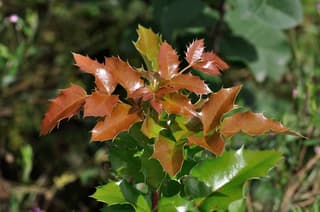
Oregon Grape
Berberis aquifolium
The Oregon grape (Berberis aquifolium) is a robust, evergreen shrub native to western North America, reaching heights of 1 to 1.5 meters. Its glossy, spiny-toothed pinnate leaves resemble holly leaves and often take on an attractive purplish-red hue in winter. In early spring (March–May), it produces bright yellow, lightly fragrant flower panicles that serve as a valuable food source for early insects. These are followed in summer by blue-black, glaucous berries that are rich in vitamin C and can be processed into jelly or juice. Thanks to its tolerance for shade, drought, and urban conditions, it is one of the easiest evergreen shrubs to maintain in temperate gardens.
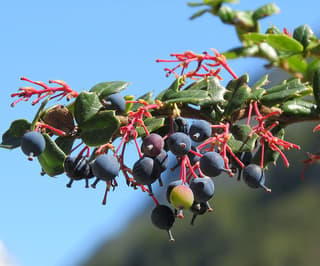
Darwin's barberry
Berberis darwinii
Darwin's barberry (Berberis darwinii) is a dense, spiny evergreen shrub native to Chile and Argentina, named after Charles Darwin who collected it during the voyage of the Beagle. In spring it produces a profusion of small, deep orange, bell-shaped flowers followed by edible dark blue-purple berries. It is a popular hedging and ornamental plant, holding the RHS Award of Garden Merit.
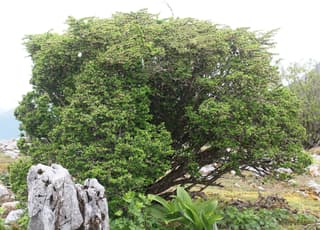
Japanese Barberry
Berberis thunbergii
Berberis thunbergii, or Japanese barberry, is a compact, deciduous shrub native to Japan prized for its dense thorny branching, small oval leaves (green, purple, or gold depending on cultivar), and bright red berries that persist into winter. Clusters of pale yellow flowers appear in mid-spring before the foliage fully unfurls. While it is a tough, low-maintenance landscape plant valued for hedging and erosion control, it has become invasive across parts of the northeastern and midwestern United States and eastern Canada, where it escapes cultivation, crowds out native understory plants, and creates humid microhabitats favored by ticks; several states restrict or ban its sale and planting.
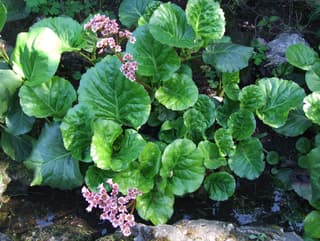
Heart-leaved Bergenia
Bergenia crassifolia
Bergenia crassifolia is a perennial evergreen plant native to Siberia, Mongolia, and Central Asia. It is recognized by its large, leathery, glossy leaves that turn reddish or bronze in winter. The plant blooms in early spring with beautiful pink, purple, or white flower clusters. It is extremely hardy and can survive temperatures as low as –30 °C.
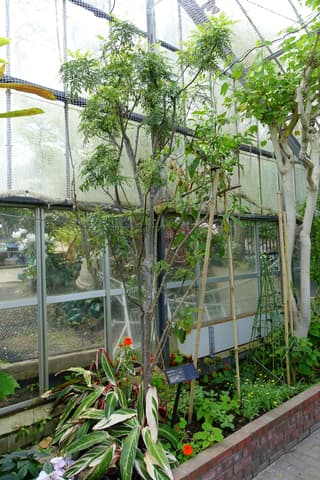
Curry Leaf Tree
Bergera koenigii
The curry leaf tree (Bergera koenigii, synonym Murraya koenigii) is an aromatic shrub or small tree in the citrus family Rutaceae, native to South Asia. Its glossy, pinnately compound leaves are intensely fragrant and are a staple seasoning in Indian and Southeast Asian cooking, typically fried fresh in oil at the start of a dish. The plant bears small fragrant white flowers followed by ornamental black berries. It has a medium growth rate, tolerates drought once established, but is sensitive to frost.
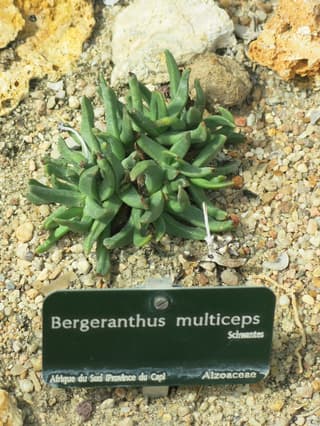
Gold-flowered Bergeranthus
Bergeranthus multiceps
A low-growing, compact succulent native to the sandstone outcrops of the Eastern Cape in South Africa, belonging to the Aizoaceae (mesembs) family. It forms dense clumps of triangular, fleshy, and sub-erect leaves, alluding to its name 'multiceps' (multiple heads). In spring and summer, it produces striking yellow daisy-like flowers that only open in direct sunlight and close at night or on cloudy days.
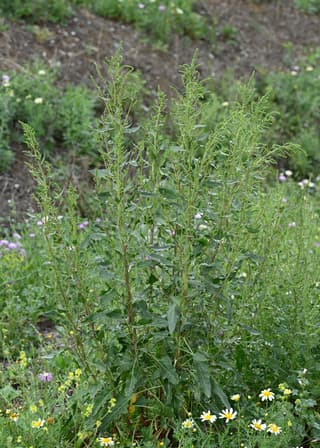
Beetroot
Beta vulgaris
Beta vulgaris is a versatile plant species in the Amaranthaceae family, native to Europe, Western Asia, and the North African coast. It includes several cultivar groups: table beet (edible root), Swiss chard (edible leaves and stems), sugar beet, and mangelwurzel. It is a biennial vegetable grown worldwide for its nutritional value and ease of cultivation.
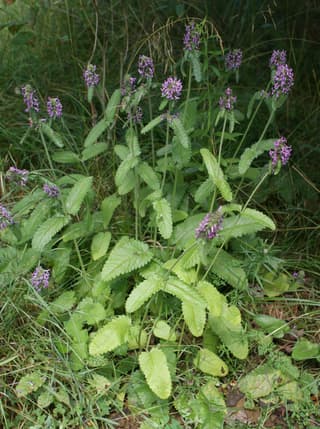
Wood Betony
Betonica officinalis
Wood betony (Betonica officinalis, syn. Stachys officinalis) is a perennial herb in the mint family (Lamiaceae), native to Europe, where it grows wild in grasslands, along hedgerows, and in open woodlands. The plant forms a dense rosette of heart-shaped, rough basal leaves and an upright, slightly hairy stem reaching 30-70 cm in height. From June to August, it bears dense spikes of purple-red to pink tubular flowers, which are highly attractive to bees and other pollinators. Wood betony has a long history as a medicinal plant and was considered in the Middle Ages to be able to cure almost anything—hence the old proverb 'sell your cow and buy betony'.
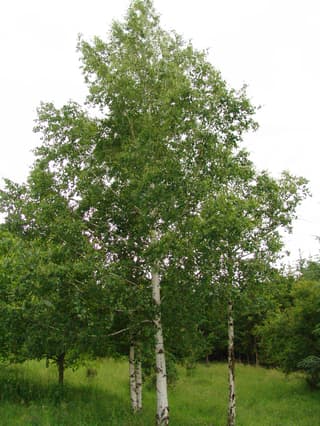
Birch
Betula
Betula, commonly known as birch, is a genus of about 30-60 species of deciduous hardwood trees and shrubs native to cool temperate and boreal regions of the Northern Hemisphere. Birches are best known for their thin, often peeling bark, which ranges from silvery-white to golden-bronze depending on the species, and for the slender catkins that dangle from bare branches in early spring before the leaves emerge. Fast-growing and relatively short-lived, birches are pioneer trees that quickly colonize open or disturbed ground, and they are widely planted as ornamental specimens for their striking bark, graceful form, and brilliant yellow autumn foliage.
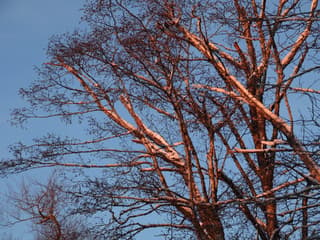
Paper Birch
Betula papyrifera
The paper birch is a fast-growing deciduous tree native to northern North America, prized for its brilliant white bark that peels away in thin, papery layers to reveal a warm orange-brown inner layer. Its bright green, oval leaves turn golden yellow in autumn, and slender brown catkins appear in spring. Reaching 15 to 21 meters at maturity, it makes a striking focal point in cold-climate gardens and naturalized woodland plantings.

Silver Birch
Betula pendula
The Silver Birch (Betula pendula) is an elegant, fast-growing deciduous tree and one of Europe's most light-demanding forest trees. It reaches heights of up to 25 meters and is known for its characteristic white, peeling bark and its fine, drooping branches. As a pioneer species, it colonizes open spaces and disturbed sites as one of the first tree species. In autumn, its diamond-shaped leaves turn a vibrant yellow. The birch thrives in sandy, moderately dry to fresh soils with a slightly acidic pH and tolerates harsh winters down to -40 °C.
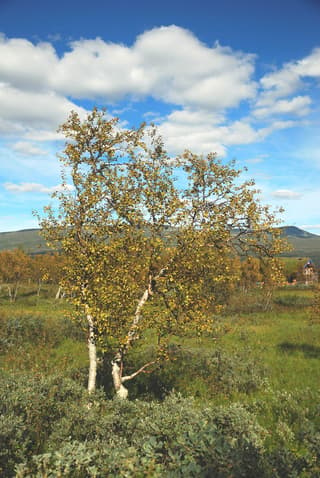
Downy Birch
Betula pubescens
Betula pubescens, known as downy birch or moor birch, is a fast-growing deciduous tree native to northern Europe and Asia. It features smooth, dull grey-white bark marked with dark lenticels, and small serrated, diamond-shaped leaves that turn golden yellow in autumn. As one of the most cold-hardy broadleaf trees in the world, it thrives in cool, moist climates and is often the first tree species to colonize open ground after disturbance.
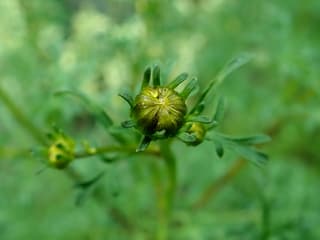
Bidens
Bidens
The Bidens genus consists of extremely versatile and resilient plants belonging to the Asteraceae family. In Brazil, Black-jack (Bidens pilosa) is widely known for its medicinal properties, while Bidens ferulifolia is a garden favorite for its bright yellow flowers that attract pollinators. Its seeds have characteristic hooks that attach to surfaces, facilitating dispersal.
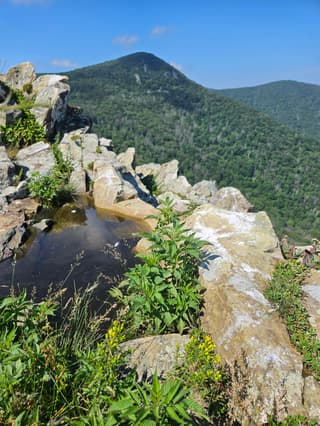
Devil's Beggarticks
Bidens frondosa
Bidens frondosa, commonly known as Devil's Beggarticks or Devil's Pitchfork, is a fast-growing annual wildflower native to North America. It belongs to the Asteraceae family and thrives in moist, sunny environments such as riverbanks, ditches, and disturbed grounds. The plant produces small golden-yellow to orange disc flowers from late summer through fall, followed by distinctive barbed seed heads that cling to clothing and animal fur — giving rise to its colorful common names.
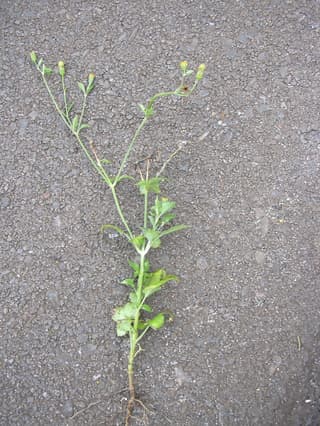
Blackjack
Bidens pilosa
Bidens pilosa, commonly known as blackjack or hairy beggarticks, is an annual herb in the Asteraceae family, native to tropical America and now naturalized as a common weed across the globe. It grows up to 1.8 m tall, with white-and-yellow daisy-like flowers and barbed seeds that cling easily to clothing and animal fur. It is widely valued in traditional medicine and also eaten as a wild leafy vegetable.
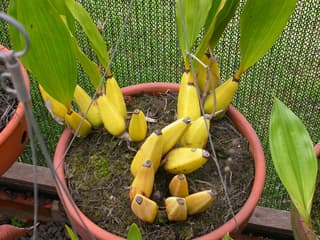
Harrison's Bifrenaria
Bifrenaria harrisoniae
Bifrenaria harrisoniae, commonly known as Harrison's Bifrenaria, is a striking epiphytic orchid endemic to Brazil. Found in the Atlantic Forest and Cerrado biomes at elevations between 200 and 1,200 meters, it produces large, waxy, fragrant flowers — predominantly white with a pink-to-burgundy labellum and dark veining — up to 8 cm across. The robust pseudobulbs store water and nutrients, enabling the plant to withstand seasonal dry periods.
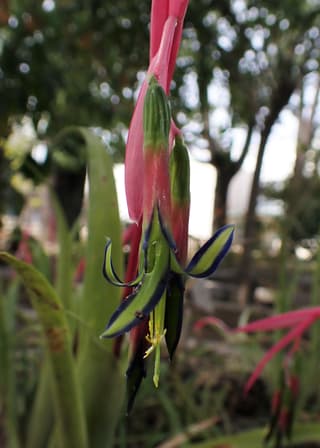
Billbergia (genus)
Billbergia
Billbergia is a genus of bromeliads native primarily to South America, widely cultivated as ornamental plants for their evergreen rosettes and colorful tubular flowers. The most popular species, B. nutans, is commonly known as Queen's Tears.
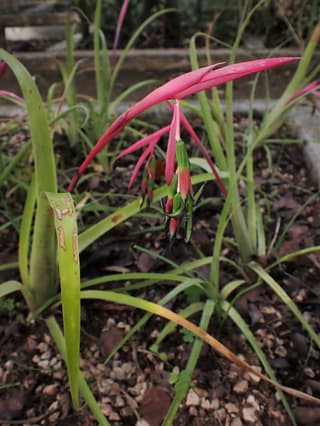
Queen's Tears
Billbergia nutans
Billbergia nutans, commonly known as Queen's Tears or Friendship Plant, is an epiphytic bromeliad native to Brazil, Argentina, Uruguay, and Paraguay. It forms tubular rosettes of arching grey-green leaves with serrated margins, producing pendant flower spikes with vivid rose-pink bracts and petals combining blue-violet, green, and yellow. It is considered one of the easiest bromeliads to grow and thrives both indoors and outdoors in mild climates.
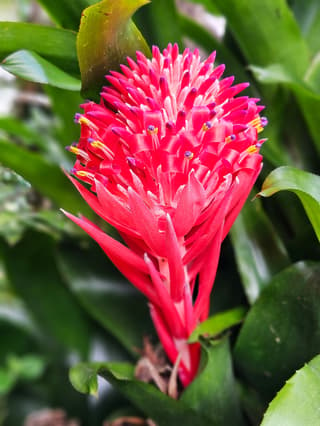
Flaming Torch
Billbergia pyramidalis
Billbergia pyramidalis, commonly called flaming torch or foolproof plant, is an epiphytic or terrestrial bromeliad native to northern South America and the Caribbean. It forms a compact rosette of glossy green leaves and produces a pyramidal scarlet-red inflorescence with violet and yellow highlights, typically in late summer or early autumn. It is a tough, low-maintenance plant popular in tropical gardens and decorative pots.
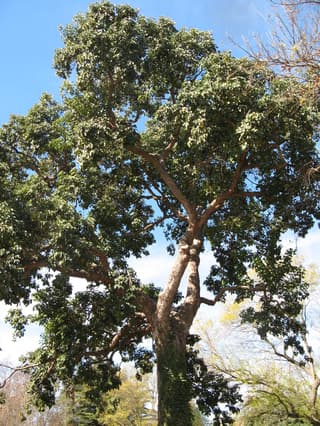
Bishopwood
Bischofia javanica
Bischofia javanica, known as bishopwood, is a fast-growing evergreen tree native to tropical and subtropical Asia, Australia, and the Pacific. It features trifoliate leaves that emerge bronze-red and mature to glossy green, small greenish-yellow flowers in hanging clusters, and round berry-like fruits that turn brownish-orange. In its native range it can exceed 30 m in height, though cultivated specimens are usually smaller. It is valued as a fast shade tree but has become invasive in some regions such as Florida and Pacific islands.
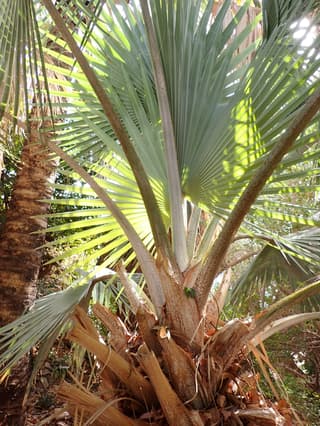
Bismarck Palm
Bismarckia nobilis
Bismarckia nobilis, commonly known as the Bismarck Palm, is one of the most majestic and sculptural palms in the world. Native to Madagascar, it stands out for its massive fan-shaped leaves with a unique silvery-blue hue. It is a slow-to-moderate growing plant that becomes the focal point of any garden due to its imposing stature and dense foliage.
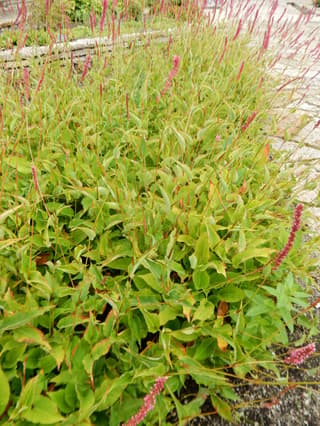
Red Bistort
Bistorta amplexicaulis
Bistorta amplexicaulis (syn. Persicaria amplexicaulis), commonly called red bistort or mountain fleece, is a clump-forming herbaceous perennial in the buckwheat family (Polygonaceae), native to the Himalayan region from Afghanistan to China. It forms bushy mounds of pointed, heart-shaped leaves that clasp the stem (the epithet 'amplexicaulis' means 'stem-clasping'), topped from midsummer to early autumn by narrow, bottlebrush-like spikes of tiny red, pink or white flowers that are highly attractive to bees and butterflies. Fully hardy and easy-going, it is a mainstay of cottage gardens, borders, pond margins and bog gardens.
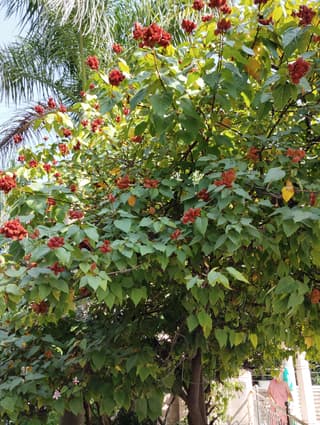
Annatto
Bixa orellana
Bixa orellana, commonly known as annatto or the lipstick tree, is a fast-growing tropical shrub or small tree native to Brazil and tropical America. It is prized for its spiny reddish seed pods containing bixin-rich seeds, a natural orange-red pigment widely used as a food coloring and in cosmetics. The plant produces beautiful pink flowers and is equally valued as an ornamental and as a commercial crop.
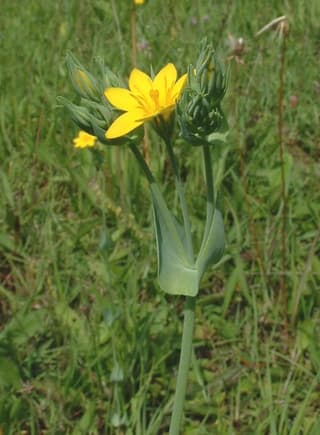
Yellow-wort
Blackstonia perfoliata
Yellow-wort (Blackstonia perfoliata) is a low-growing annual wildflower in the gentian family, native to the Mediterranean Basin and extending into northwestern Europe, including Britain, Ireland and Iberia. It grows 10-50cm tall on stiff, branching stems, with distinctive bluish-green waxy leaves that fuse together in opposite pairs to form a shallow saucer around the stem. From June to October it produces clusters of bright yellow, star-shaped flowers with 6-8 pointed petals that close in the afternoon. It is a classic indicator of chalk and limestone grassland, thriving on sunny, lime-rich, nutrient-poor soils where it self-sows freely.
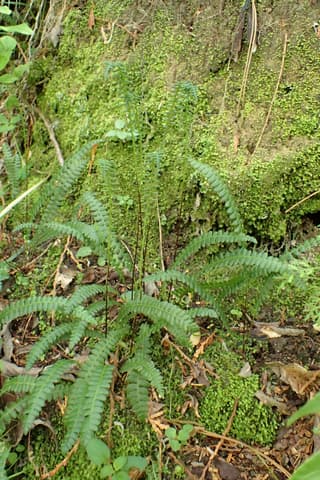
Membranous Hard Fern
Blechnum membranaceum
Blechnum membranaceum, commonly known as the Membranous Hard Fern, is a small Neotropical fern in the family Blechnaceae. Native to Central and South America, it produces delicate, thin fronds with a distinctive membranous texture, thriving in humid, shaded forest understories. Now reclassified as Austroblechnum membranaceum, it retains its historic trade name in horticulture.
Soft Water Fern
Blechnum minus
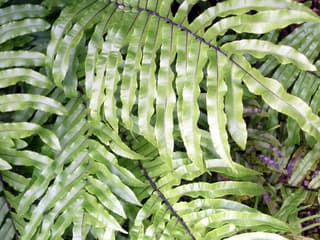
Blechnum minus, commonly known as the Soft Water Fern, is a beautiful shade-loving terrestrial fern native to Australia, New Zealand, and Tasmania. It thrives in moist, riparian environments along creek banks and sheltered forest floors, forming dense, bushy clumps of glossy green fronds that reach 40–70 cm in length. As a member of the Blechnaceae family (synonyms: Lomaria minus, Parablechnum minus), it is a slow-growing evergreen fern prized for its graceful, arching fronds and adaptability to shaded garden positions.
Pine-pink Orchid
Bletia purpurea
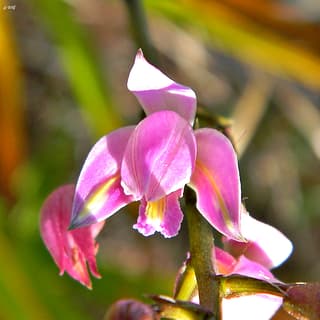
Bletia purpurea, commonly known as Pine-pink Orchid, is a terrestrial orchid native to the Caribbean, Florida, Mexico, and Central and South America. It produces oval pseudobulbs and elegant linear leaves, with impressive flower spikes carrying up to 80 pink-purple blooms on stems reaching 180 cm tall. The plant is deciduous, going dormant in winter before blooming in spring and summer.
Chinese Ground Orchid
Bletilla striata
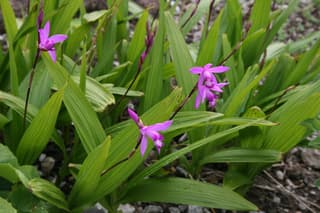
Bletilla striata, known as the Chinese ground orchid or hyacinth orchid, is a hardy deciduous terrestrial orchid native to China, Japan, and Korea. Unlike tropical orchids, it grows directly in garden soil, producing pleated, lance-shaped leaves and upright spikes of purple-pink, hyacinth-like flowers in spring and early summer.
Red Spiderling
Boerhavia diffusa
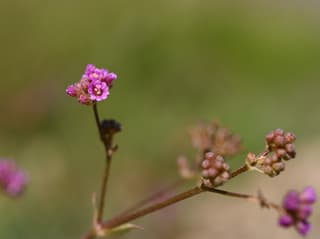
Boerhavia diffusa is a sprawling, pantropical perennial herb with prostrate to semi-erect, much-branched stems and fleshy taproots. Tiny pink flowers, only about 5mm across, appear in loose clusters almost year-round wherever moisture is adequate. Best known by its Sanskrit name "punarnava" ("that which renews"), it is one of the most widely used plants in Ayurvedic medicine, and its tender young leaves are cooked as a leafy green vegetable across India and the tropics.
Porcini and Allies
Boletus
Boletus is a genus of mushroom-producing fungi, including the famous King Bolete (Boletus edulis). These fungi are mycorrhizal, meaning they form a symbiotic relationship with the roots of specific trees, primarily in temperate forests. They are characterized by a fleshy cap and a pore surface instead of gills on the underside.
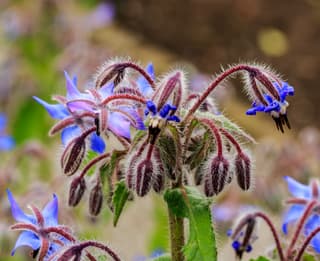
Borage
Borago officinalis
Borage is a fast-growing, hardy annual herb in the Boraginaceae family, prized for its coarse, hairy leaves and vivid star-shaped blue flowers. Native to the Mediterranean region, it has been grown for centuries as a culinary, medicinal, and ornamental plant, and is one of the best bee and pollinator plants for the vegetable garden.
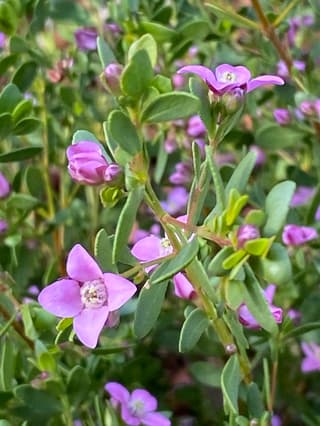
Aniseed Boronia
Boronia crenulata
Aniseed Boronia is an evergreen Australian shrub in the citrus family (Rutaceae), native to southwestern Western Australia, where it grows in sandy and rocky heathlands and open woodlands. It typically reaches 25–120 cm (10–47 inches) in height with an open, slightly pendulous growth habit. The small, serrated (crenulate) leaves release a distinct anise-like fragrance when crushed. From late winter to autumn—peaking in spring—the plant produces numerous small, four-petaled flowers in shades of pink to reddish-purple, appearing singly or in small clusters at the tips of the branches.
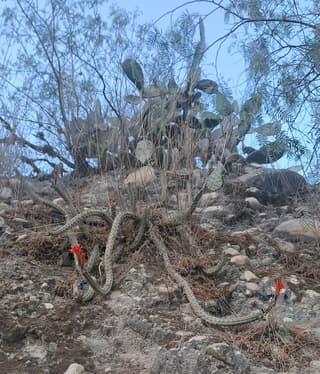
Cleistocactus
Borzicactus
Borzicactus is a genus of columnar or prostrate cacti native to the Andes of South America (Peru, Bolivia, Ecuador, Argentina), often treated as a synonym of Cleistocactus or included within Loxanthocereus. Its stems, densely covered with fine spines, can grow upright or form hanging clumps. It produces very showy tubular flowers - usually red, orange, or pink - adapted for hummingbird pollination. It is a long-lived, drought-resistant, slow-growing plant, highly valued in cactus collections for its sculptural form.
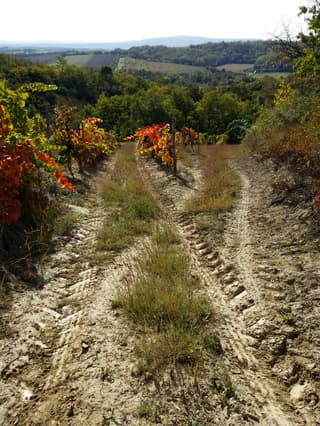
Yellow Bluestem
Bothriochloa ischaemum
Yellow bluestem (Bothriochloa ischaemum) is a perennial, bunch-forming grass belonging to the Poaceae family. Originally native to the dry steppes of Southern Europe and Western Asia, it has since spread globally and is considered an invasive species in many regions. It grows in loose tufts with erect stems reaching 30–100 cm in height, featuring grayish-green foliage that turns a distinctive brownish-red in the fall. Thanks to its strong, deep-reaching root system, it is exceptionally drought-tolerant and resistant to trampling, making it a frequent choice for roadside embankments and erosion control. During summer and autumn, it produces yellowish inflorescences followed by reddish-brown seed heads.
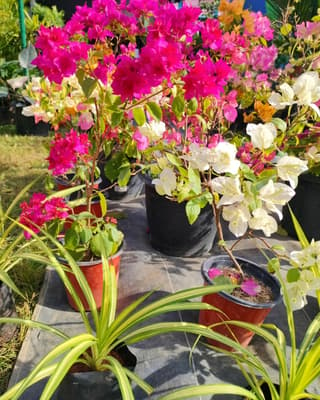
Garden Bougainvillea
Bougainvillea × buttiana
Garden Bougainvillea (Bougainvillea × buttiana) is a vigorous, thorny climbing hybrid celebrated for its vividly colored bracts surrounding small, inconspicuous flowers. Native to South America, it thrives in tropical and subtropical gardens thanks to its prolific blooming and drought tolerance.
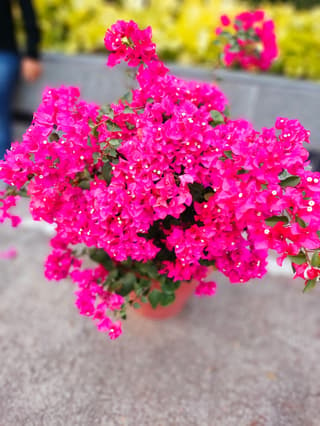
Bougainvillea
Bougainvillea glabra
Bougainvillea glabra, commonly known as Paperflower or Bougainvillea, is a vigorous woody climber native to Brazil. It is famous for its vibrant colors, which are actually bracts (modified leaves) surrounding its small, inconspicuous white flowers. It is an extremely resilient plant that thrives in full sun and is ideal for covering walls, fences, and pergolas, bringing a lush, tropical look to the garden.
Find the Perfect Plant
Our plant guide helps you find ideal species for your experience level and time of year.
Browse by Difficulty, Season & More
Use the filters below to narrow this catalog by care difficulty, season, environment, or search directly by name. Each filter leads to a focused list tailored to your specific growing conditions.