Complete Plant Guide
Explore plants by difficulty, season and more. Find the perfect plant for you.
Difficulty
Categories
Plants by City
🗺️ Plants by City3478 plants found
Showing 2017-2052 of 3478
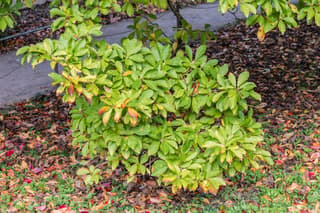
Kobus Magnolia
Magnolia kobus
Kobus Magnolia (Magnolia kobus) is a deciduous flowering tree native to Japan and Korea, prized for its fragrant, cup-shaped white flowers that appear on bare branches in early spring before the leaves emerge. It grows into a pyramidal shape when young, maturing into a broad, rounded canopy 8-12m tall. Trees can take 15-25 years to reach full flowering maturity, but reward patient growers with a spectacular annual display.
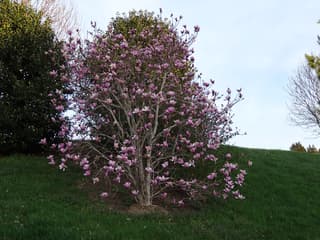
Lily Magnolia
Magnolia liliiflora
Magnolia liliiflora, commonly known as Lily Magnolia or Mulan Magnolia, is a deciduous flowering shrub native to southwestern China (Sichuan and Yunnan). It grows as a bushy, multi-trunked shrub up to 4 meters tall, producing large, goblet-shaped pink-to-purple flowers with a light citrus fragrance in early spring, before its leaves emerge. It is one of the parent species behind the widely planted Saucer Magnolia hybrid.
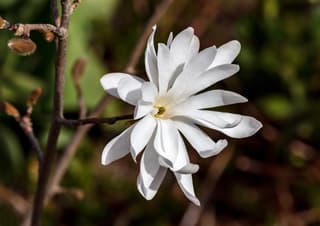
Star Magnolia
Magnolia stellata
Star Magnolia (Magnolia stellata) is a small, deciduous tree or large shrub native to Japan. Renowned for its stunning star-shaped white flowers that bloom in early spring before the leaves emerge, it is one of the first ornamental plants to bloom each season, creating a breathtaking display of delicate petals even in late winter conditions.
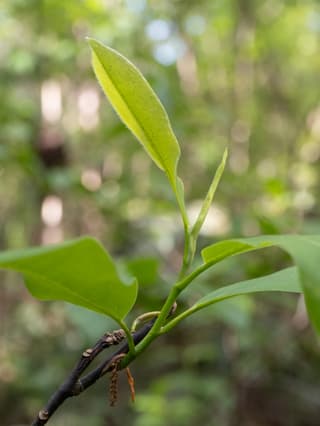
Sweetbay Magnolia
Magnolia virginiana
Sweetbay magnolia is a semi-evergreen to deciduous small tree native to wetlands and swampy woods of the eastern United States. It produces fragrant, lemon-scented creamy-white flowers from late spring through summer and glossy dark green leaves with silvery undersides that shimmer in the breeze.

Beale's Barberry
Mahonia bealei
Beale's barberry (Mahonia bealei, syn. Berberis bealei) is a stiffly upright, evergreen shrub native to China, prized for its bold, leathery, holly-like leaflets and fragrant, lemon-yellow flower spikes that open in winter and early spring. The blooms are followed in summer by dusty blue-black, grape-like berries. Once a popular shade-garden ornamental in the West, it has escaped cultivation and naturalized throughout much of the southeastern United States, where it is now classified as an invasive species: it tolerates deep shade, spreads readily by bird-dispersed seed, and can form dense thickets that crowd out native understory plants. Gardeners in that region are generally advised to avoid planting it and to choose a native alternative instead.
Soft Caress Mahonia
Mahonia eurybracteata
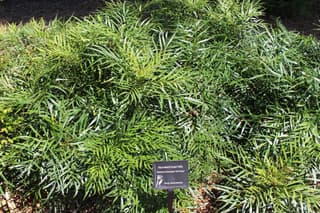
Mahonia eurybracteata 'Soft Caress' is an evergreen ornamental shrub native to China, known for its soft, thornless, narrow leaves that grow in rosettes and resemble ferns. From late summer to early spring, it blooms with lemon-yellow, sweetly scented flower spikes, which are later followed by blue berries that birds enjoy. The shrub has a compact, upright growth habit and rarely exceeds one meter in height, making it suitable as a groundcover or a specimen plant in shade gardens.
False Lily of the Valley
Maianthemum
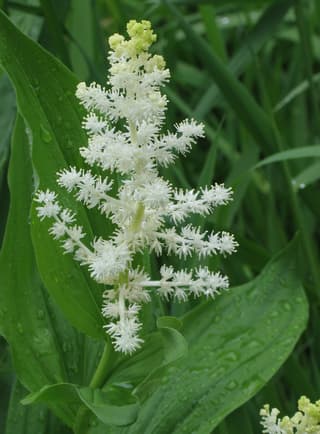
Maianthemum is a genus of 35+ rhizomatous woodland perennials in the asparagus family (Asparagaceae, subfamily Nolinoideae), native across North America, Europe, and East Asia. This is a GENUS-level profile covering multiple species -- including M. racemosum (False Solomon's Seal, North America) and M. bifolium (May Lily, Europe/Asia) -- rather than a single species. Plants spread slowly into colonies via thick creeping rhizomes, bearing heart-shaped to lance-shaped leaves and clusters of small white star-shaped flowers followed by red berries in fall.

Copper Ice Plant
Malephora crocea
Malephora crocea is a low-growing, evergreen succulent groundcover from the Aizoaceae family, native to South Africa. Its fleshy, triangular leaves range in color from grayish-green to reddish, turning a distinct copper-red during periods of drought. From spring to fall, it produces multi-petaled flowers in shades of yellow, orange, or red that only fully open in bright sunlight. Its woody, trailing stems root wherever they touch the ground, forming a dense, spreading carpet.
Barbados cherry
Malpighia emarginata
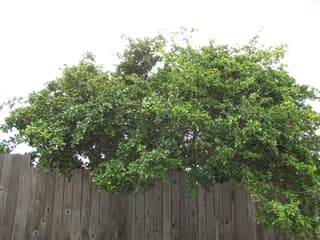
Malpighia emarginata, commonly known as Barbados cherry or acerola, is an evergreen tropical shrub or small tree native to the Lesser Antilles, Central America, and northern South America. Prized worldwide for its small red drupes containing extraordinary concentrations of vitamin C — roughly 1,677 mg per 100 g, making it one of the richest natural sources on earth — the plant also bears delicate pink or lavender flowers multiple times a year, providing nearly year-round ornamental interest alongside its exceptional nutritional value.
Barbados Cherry
Malpighia glabra
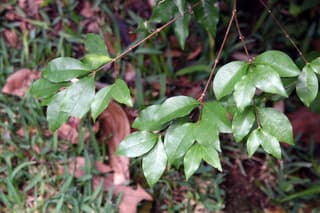
Malpighia glabra, commonly known as Barbados Cherry or Acerola, is a tropical fruit shrub native to the Caribbean and Central and South America. It is celebrated worldwide for producing one of the richest natural sources of vitamin C — small red cherries with a sweet-tart flavor that ripen multiple times per year. Equally valued as an ornamental and edible plant.
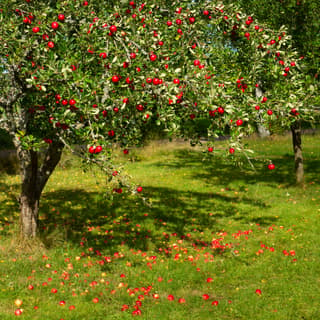
Apple Tree
Malus
Malus is a genus of small to medium deciduous trees and shrubs in the Rosaceae family, native to temperate regions of the Northern Hemisphere. It encompasses cultivated apple trees grown for their edible fruit as well as ornamental crabapples prized for their spring blossoms and colorful fall fruit.
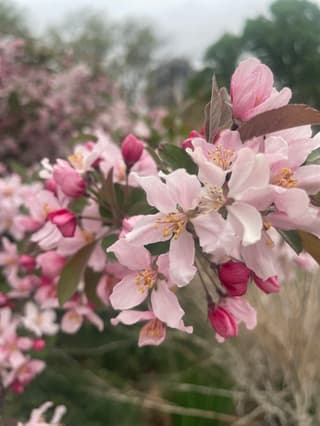
Japanese Flowering Crabapple
Malus × floribunda
The Japanese Flowering Crabapple (Malus × floribunda) is a small deciduous ornamental tree in the Rosaceae family, celebrated for its spectacular spring bloom. Deep pink buds open into white to pale pink flowers that smother the arching branches before the leaves emerge. In autumn it bears small yellow-red pome fruits that are a favorite of birds.
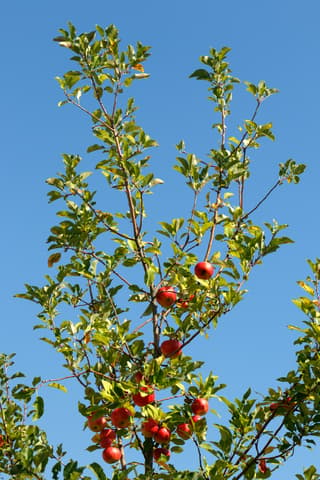
Apple Tree
Malus domestica
The apple tree (Malus domestica) is one of the most widely cultivated and economically significant fruit trees in the world, belonging to the rose family (Rosaceae). Native to the mountainous regions of Central Asia, it has been cultivated for over 4,000 years and today grows in temperate climates across every inhabited continent. Apple trees produce fragrant white and pink blossoms in spring and edible fruits in late summer to autumn. They are deciduous trees that can reach 9 meters in natural growth, though grafted dwarf varieties are typically much more compact.

European Crab Apple
Malus sylvestris
Malus sylvestris, the European Crab Apple, is a small to medium deciduous tree native to Europe and parts of western Asia. It belongs to the Rosaceae family and grows up to 10 metres tall, producing clusters of delicate white to pale pink blossoms in spring, followed by small, hard, greenish-yellow fruits (2–4 cm) with a characteristically sour and astringent flavour. One of the ancestors of the cultivated apple, this species is of great ecological importance, supporting over 90 associated insect species and providing food for birds and mammals. Its bark becomes rough and fissured with age, and the dense, thorny branching offers excellent wildlife habitat.
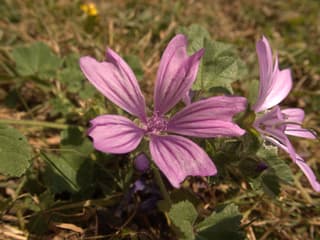
Mallow
Malva
Malva is a genus of herbaceous plants in the family Malvaceae, widely distributed across Europe, Asia, and the Americas. Known for their delicate five-petaled flowers in shades of lilac, pink, and white with dark purple veins, mallows are valued both as ornamental plants and for their long-standing medicinal properties. They thrive in well-drained soils in full sun, producing abundant flowers from summer through fall.
Tree Mallow
Malva arborea
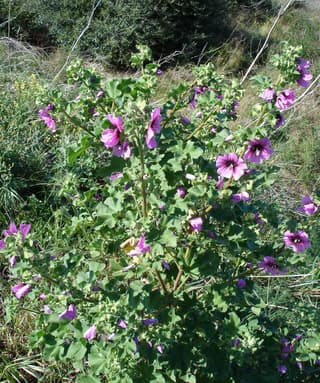
Malva arborea, commonly known as tree mallow, is a fast-growing biennial shrub native to the rocky coastlines of western Europe and the Mediterranean, from Ireland and Britain south to North Africa and east to Greece. Reaching 1-2 m in height on a thick, woody-based stem, it forms bold rosettes of large, velvety, palmately lobed leaves up to 18 cm across. From early summer into autumn it produces clusters of funnel-shaped, dark pink to purple flowers, 3-4 cm wide, that draw bees and other pollinators. Remarkably salt-tolerant, tree mallow thrives on wind-battered cliffs and small islands, excreting excess salt through glands on its leaves so it can survive direct sea spray. In some regions outside its native range it has become an aggressive coastal coloniser.
Musk Mallow
Malva moschata
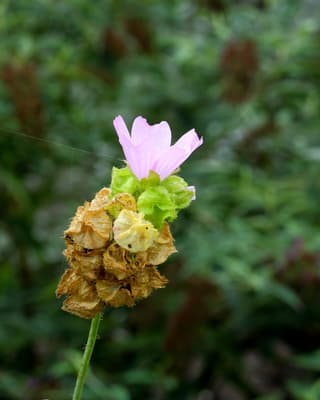
A tall, airy European wildflower prized in cottage gardens for its finely cut, musk-scented foliage and abundant rose-pink, saucer-shaped blooms held on slender stems from early summer into fall. Naturalized across much of North America, it self-seeds readily in meadows, hedgebanks, and sunny borders, attracting bees and butterflies all season long.
Common mallow
Malva neglecta
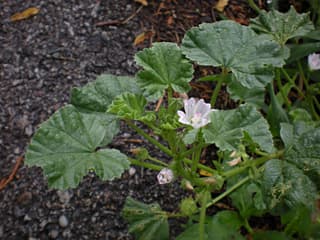
Common mallow (Malva neglecta) is a low-growing, creeping annual herb in the Malvaceae family. It features kidney-shaped to round, shallowly lobed leaves with long petioles and bears abundant pale pink to white flowers with violet veins from June to September. Originally from Europe and Western Asia, the species is now widely distributed as a synanthrope on ruderal land, field margins, and in gardens. The entire plant—leaves, flowers, fruits, and seeds—is edible and rich in mucilage, vitamins, and minerals.
Low Mallow
Malva pusilla
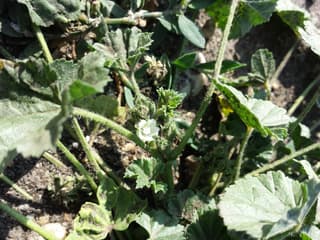
Malva pusilla, commonly known as Low Mallow or Small Mallow, is a fast-growing annual herb in the Malvaceae family. Native to temperate Eurasia, it produces small pale pink to white five-petalled flowers from spring through autumn. Its rounded, lobed leaves and creeping stems make it a distinctive ground-cover plant found in gardens, roadsides, and disturbed ground.
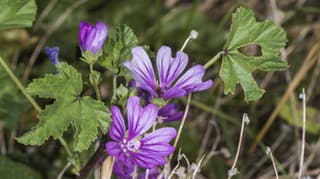
High mallow
Malva sylvestris
Malva sylvestris, commonly known as high mallow or common mallow, is a biennial or short-lived perennial herb native to Europe, North Africa, and Western Asia. A member of the Malvaceae family, it is easily recognised by its distinctive pinkish-purple flowers with dark veining, blooming from late spring through autumn. The plant has a rich history of culinary and medicinal use across Mediterranean and European cultures, prized for its emollient and anti-inflammatory properties.
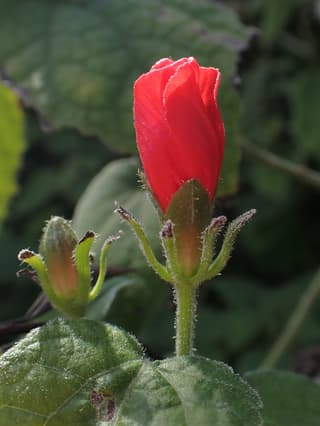
Turk's Cap
Malvaviscus arboreus
Malvaviscus arboreus, commonly known as Turk's Cap or Sleeping Hibiscus, is a vigorous perennial shrub native to Mexico and Central America. Its vibrant red flowers feature petals that remain furled, resembling a bud that never fully opens. This unique characteristic makes the nectar primarily accessible to hummingbirds, making it essential for gardens aiming to attract wildlife.
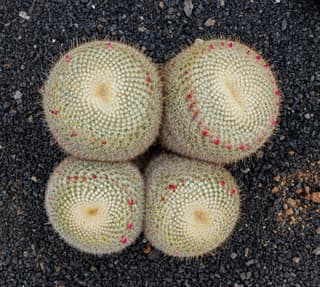
Pincushion Cactus / Nipple Cactus (genus)
Mammillaria
Mammillaria is one of the largest genera in the cactus family Cactaceae, comprising over 200 species native primarily to Mexico. Recognized by their distinctive nipple-shaped tubercles and crown-like rings of flowers, they are compact, ornamental plants beloved by collectors and beginners alike.
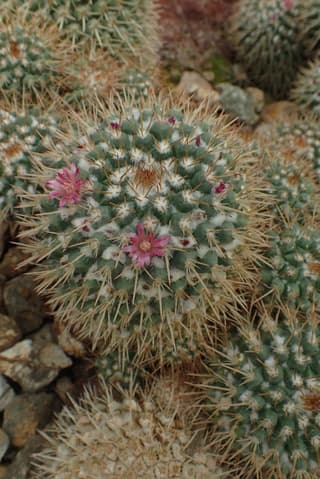
Backeberg's Pincushion Cactus
Mammillaria backebergiana
Mammillaria backebergiana is a small, globular-to-columnar cactus native to cliffs and rocky slopes in Guerrero, Michoacan and the State of Mexico. Its clear green stem, covered in spirally arranged tubercles tipped with golden-yellow to reddish hooked spines, grows slowly to about 30 cm tall and 6 cm in diameter, often forming offsets that build dense clumps over time. In spring, a striking ring of small magenta-pink flowers with green stigmas crowns the growing tip, followed by slender red fruits. It is a popular compact potted cactus that thrives on bright light and minimal water.

Powder Puff Cactus
Mammillaria bocasana
Mammillaria bocasana, commonly known as the powder puff cactus or snowball cactus, is a small globular cactus native to central Mexico, belonging to the Cactaceae family. It is characterized by its compact, rounded stems densely covered in fine, silky white hairs resembling cotton, interspersed with reddish-yellow hooked central spines. Over time, it forms clusters of multiple stems, creating a soft, cushion-like mound. In spring and summer, it produces a ring of small, funnel-shaped flowers in shades of creamy white to pink, followed by rosy-pink to red fruits.
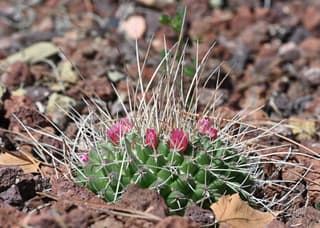
Mother of Hundreds
Mammillaria compressa
Mammillaria compressa, commonly known as Mother of Hundreds, is a clustering globular cactus native to central and northern Mexico, belonging to the Cactaceae family. It forms dense mounds of cylindrical stems covered in pale spines and produces a ring of purplish-pink flowers around the crown in late winter and early spring. This slow-growing, low-maintenance cactus is ideal for sunny windowsills, cactus gardens, and containers.
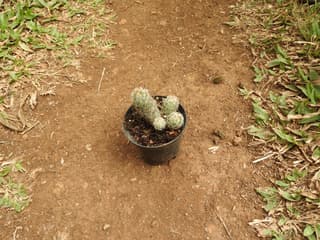
Ladyfinger Cactus
Mammillaria elongata
Mammillaria elongata is a small cactus native to central Mexico, valued for its clustered cylindrical stems that form dense, compact mounds. Its golden or copper-colored spines give it a bright, decorative appearance. Ideal for beginners due to its resilience and easy care.
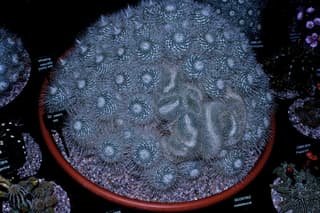
Twin-spined Cactus
Mammillaria geminispina
Mammillaria geminispina, commonly known as the twin-spined cactus, is a clustering globular cactus native to central Mexico, found in the states of Hidalgo, Queretaro and San Luis Potosi. Its spherical stems, roughly 8 cm in diameter, are covered in white wool and long white spines that emerge in distinctive pairs at the tip of each conical tubercle, giving the species its name. Over the years it forms dense colonies that can spread well beyond 50 cm across. In spring and summer, a crown of small carmine-pink flowers appears around the top of each stem.
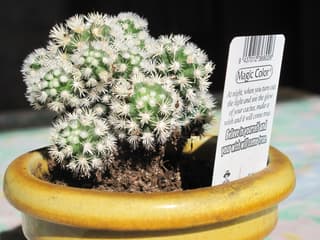
Thimble Cactus
Mammillaria gracilis
Mammillaria gracilis, commonly known as the Thimble Cactus, is a small clustering cactus from the Cactaceae family, native to central Mexico. It forms compact clumps of cylindrical stems densely covered in white, silky spines that resemble a sewing thimble. It is one of the most widely cultivated Mammillaria species, admired for its delicate beauty, ease of care, and generous blooming.
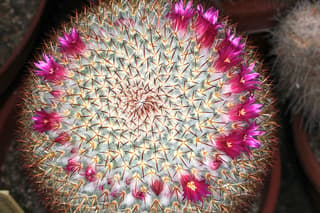
Haage's Pincushion Cactus
Mammillaria haageana
Mammillaria haageana is a small, spine-covered cactus native to the highlands of central and southern Mexico, where it grows wild among oak forests, pine woodlands, and volcanic lava flows at elevations between 450 and 2,600 meters. Its stem is globular when young and becomes more cylindrical with age, reaching up to 15 cm tall and 3-10 cm in diameter, often forming dense clusters as it produces offsets around its base. The stem is covered in small, cone-shaped tubercles called mammillae (the trait that gives the genus its name), each topped with an areole bearing 8 to 30 fine white radial spines and a handful of darker central spines that fade from black or reddish-brown to grey with age. In late winter and early spring the plant rewards patient growers with a crown of funnel-shaped flowers in shades of deep magenta-pink to pale pink, each only 8-20 mm across but often appearing in a ring around the growing tip. Slow-growing and undemanding, it is a favorite among beginner cactus collectors for its compact size and reliable, colorful blooms.
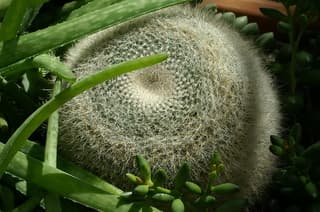
Old Lady Cactus
Mammillaria hahniana
The Old Lady Cactus (Mammillaria hahniana) is a small globose cactus native to Mexico, famous for the long white hairs that cover its entire body, resembling an elderly lady. It produces a crown of small pink-purple flowers in spring, making it highly decorative. One of the most popular cacti for collections and indoor growing.
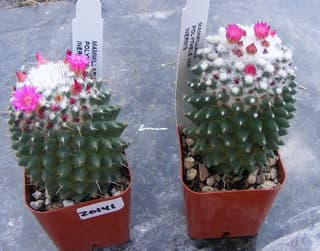
Mammillaria polythele
Mammillaria polythele
Mammillaria polythele is a solitary, cylindrical cactus native to the highlands of central Mexico, from Jalisco to Veracruz, where it grows among rocky desert and dry shrubland at 1,700-2,400 m elevation. Its dark green to bluish-green stem can reach up to 60 cm tall and 10 cm in diameter, densely covered in pyramidal tubercles tipped with spine clusters and woolly axils. In spring and summer it produces a ring of small deep pink to magenta flowers near the crown.
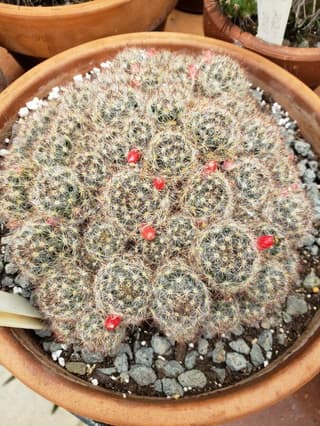
Little Candles
Mammillaria prolifera
Mammillaria prolifera is a small, clustering globular cactus native to Mexico, Texas, Cuba, the Dominican Republic, and Haiti. It readily produces offsets around the mother plant, forming dense cushion-like colonies covered in fine, hair-like spines. In spring and summer it produces small yellowish-white, cream, or pinkish-yellow flowers around the crown. It is a slow-growing, drought-tolerant, and easy-care cactus, well suited for beginners.
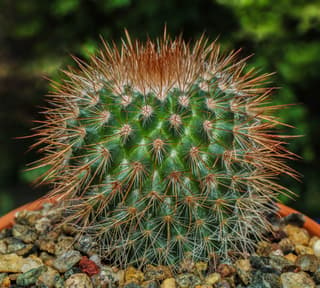
Spiny Pincushion Cactus
Mammillaria spinosissima
Mammillaria spinosissima, the Spiny Pincushion Cactus, is a cylindrical cactus endemic to the states of Guerrero and Morelos in central Mexico. It thrives at elevations between 1,600 and 1,900 meters in dry tropical forests and xerophilous scrub. It is celebrated for its dense bristly red-brown spines and rings of carmine-pink flowers that appear in spring.
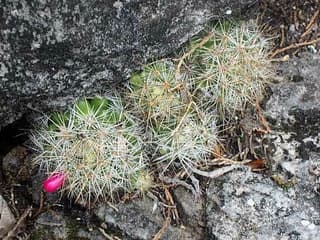
Golden Stars Cactus
Mammillaria vetula
Mammillaria vetula is a small, clustering cactus native to central Mexico (Hidalgo, Guanajuato and Queretaro), prized in cultivation as the popular subspecies gracilis. It forms dense mounds of cylindrical, bluish-green stems covered in fine white radial spines, topped in spring and summer with tiny pale-yellow, funnel-shaped flowers. It readily produces offsets that detach easily, making it one of the easiest cacti to propagate and share.
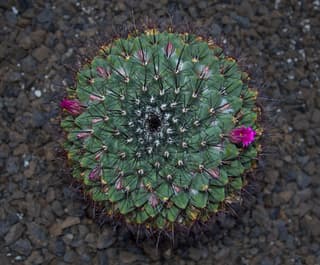
Saltillo Pincushion Cactus
Mammillaria winterae
The Saltillo pincushion cactus (Mammillaria winterae) is a slow-growing, globular cactus native to the mountains of Nuevo León and Coahuila, Mexico, where it grows among limestone rocks at high elevation. It typically has a solitary, flattened stem covered in radial spines and produces yellowish-white or greenish-yellow flowers in spring.
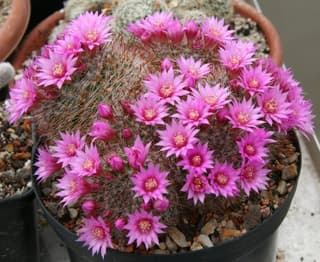
Rose Pincushion Cactus
Mammillaria zeilmanniana
Mammillaria zeilmanniana, commonly known as the Rose Pincushion Cactus, is a small, clustering cactus native to central Mexico. It forms compact, globular stems covered in dense, hooked white-to-yellow spines and produces abundant rosy-purple flowers in spring and summer. Popular as a compact houseplant, it is prized for its easy care and prolific blooming even in small pots.
Find the Perfect Plant
Our plant guide helps you find ideal species for your experience level and time of year.
Browse by Difficulty, Season & More
Use the filters below to narrow this catalog by care difficulty, season, environment, or search directly by name. Each filter leads to a focused list tailored to your specific growing conditions.