Complete Plant Guide
Explore plants by difficulty, season and more. Find the perfect plant for you.
Difficulty
Categories
Plants by City
🗺️ Plants by City3454 plants found
Showing 3241-3276 of 3454
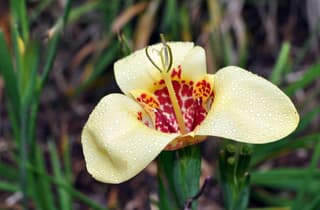
Tiger Flower
Tigridia
Tigridia pavonia is a striking summer bulb from the Iris family (Iridaceae), native to Mexico and Central America. It is characterized by showy, brightly colored flowers with distinctive spotted centers resembling a tiger's or peacock's eye. Each individual flower blooms for only one day, but the plant continuously produces new flowers over 2-4 weeks in summer. The leaves are sword-shaped, pleated, with prominent longitudinal veins, and they die back in the fall.

Common lime
Tilia × europaea
The Common lime (Tilia x europaea) is a large, deciduous hybrid between the large-leaved lime and the small-leaved lime. This stately tree can reach heights of up to 35 meters and features a broad, dome-shaped canopy of heart-shaped leaves. In July, the tree bears clusters of small, yellowish flowers with a sweet, honey-like fragrance that attracts bees and other insects. Traditionally, the lime tree has been widely planted in the Netherlands along avenues, in squares, and as a village tree, symbolizing community and protection.
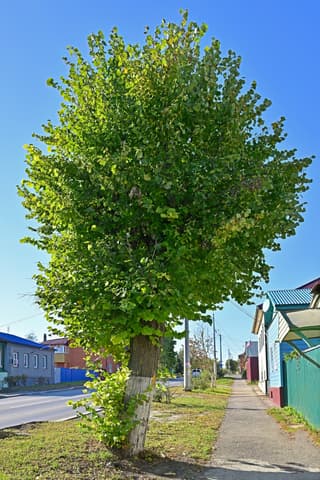
Little-leaf Linden
Tilia cordata
The Little-leaf Linden (Tilia cordata) is a long-lived deciduous tree in the Malvaceae family, native to Europe and western Asia. It reaches a height of up to 30 m with a broad, rounded crown spreading up to 12 m. In summer (June–July), it produces small, creamy-yellow flowers with an intense, sweet fragrance that attracts bees, making it highly valuable for beekeeping. Its heart-shaped, dark green leaves turn golden in autumn. The linden is a long-lived tree (living over 1,000 years), exceptionally frost-resistant (down to -34°C), and relatively tolerant of urban conditions.
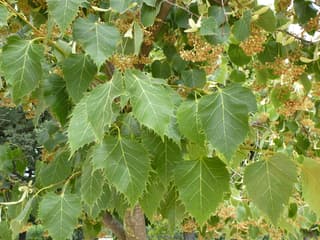
Henry's lime
Tilia henryana
Henry's lime (Tilia henryana) is a deciduous tree native to the mountain forests of central China (Anhui, Hubei, Hunan, Shaanxi, Zhejiang...), introduced to the West by Ernest Wilson in 1901. More compact than the common lime, it reaches 30 to 50 ft in height in cultivation (up to 80 ft in its native habitat), with a rounded, spreading habit and pale gray bark that fissures with age. Its heart-shaped leaves, coppery when budding then glossy green, are distinguished by a ciliate margin of long silky bristles reminiscent of a carnivorous plant's eyelashes, before turning golden yellow in autumn. The late flowering (late August-September) produces abundant clusters of highly fragrant, nectar-rich creamy white flowers, among the last of the Tilia genus to open.

Large-leaved Lime
Tilia platyphyllos
The large-leaved lime (Tilia platyphyllos) is a large deciduous tree native to Europe, in the family Malvaceae. It grows up to 25 m tall with a dense, pyramidal crown. Its fragrant pale-yellow flowers, highly attractive to bees, are traditionally harvested to brew linden tea.
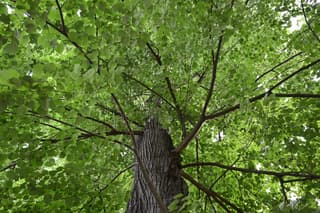
Silver Linden
Tilia tomentosa
Silver Linden (Tilia tomentosa) is a large deciduous shade tree native to southeastern Europe and western Asia, including Albania, Bulgaria, Greece, Hungary, Romania, and Turkey. A member of the Malvaceae family, it is widely planted as a street, park, and specimen tree thanks to its dense, broad-pyramidal canopy and outstanding tolerance of urban pollution, heat, and road salt. Its heart-shaped leaves are dark green above and covered with a fine silvery-white down beneath, creating a shimmering effect when stirred by the wind — the source of its common name. From late spring into summer the tree produces hanging clusters of small, creamy-yellow, intensely fragrant, nectar-rich flowers that are highly attractive to bees and other pollinators. It typically reaches 50-70 ft (15-21 m) tall, occasionally up to 100 ft (30 m), with a spread of 30-50 ft (9-15 m), and grows at a rapid rate.
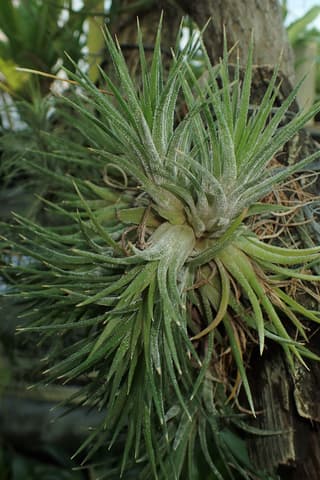
Air Plant
Tillandsia
Tillandsia is a genus of approximately 650 epiphytic plants in the Bromeliaceae family, native from the southern United States to Argentina. They require no soil, instead absorbing water and nutrients directly through their leaves via specialized structures called trichomes. Famous species include T. ionantha, T. xerographica, and Spanish Moss (T. usneoides).

Air plant
Tillandsia aeranthos
Tillandsia aeranthos is an epiphytic air plant from South America that lives without soil, clinging to branches, rocks or mounts. It forms clumps of stiff, silvery leaves and produces pink bracts with blue-violet flowers in spring.
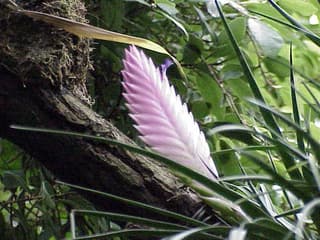
Pink Quill
Tillandsia cyanea
Tillandsia cyanea, known as the Pink Quill, is an epiphytic air plant native to Ecuador prized for its long-lasting bright pink flattened bract that rises from a rosette of narrow, arching green leaves. Unlike soil-grown houseplants, it has no true roots for absorbing nutrients -- instead it draws water and nutrients through specialized trichomes on its leaves. Small tubular violet-blue flowers emerge one at a time from the pink bract, which itself can stay colorful for two to three months.
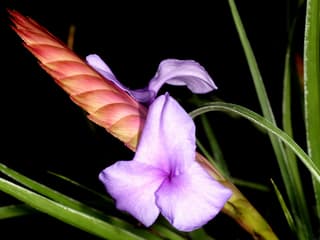
Guatemalan Air Plant
Tillandsia guatemalensis
Tillandsia guatemalensis is an epiphytic bromeliad native to forests from Mexico to Panama. It forms a rosette of silvery-grey leaves and produces a striking flower spike with deep rose-pink bracts and tubular violet-blue flowers. As a true air plant, it absorbs water and nutrients directly from the air through specialized leaf scales called trichomes.

Sky Plant
Tillandsia ionantha
Tillandsia ionantha is a fascinating epiphytic plant from the bromeliad family, native to Central America and Mexico. Known as the air plant, it does not need soil to grow, absorbing water and nutrients directly from the air through its silver trichome-covered leaves. During flowering, its central leaves turn vivid red, contrasting with the delicate purple flowers.
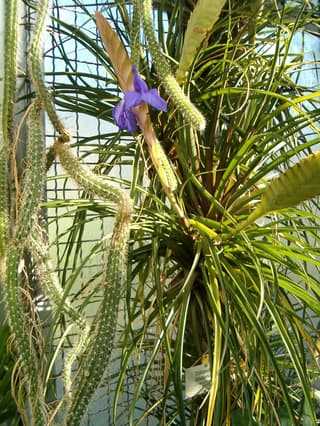
Blue-flowered Torch
Tillandsia lindenii
Tillandsia lindenii, commonly called the Blue-flowered Torch, is an eye-catching epiphytic bromeliad native to the cloud forests of Ecuador and Peru. It forms a compact rosette of arching, dark green, strap-like leaves from which rises a flattened, sword-shaped bract in shades of green, pink, or rose. From this striking bract emerge a succession of large, deep violet-blue flowers with white throats, each lasting only a few days while the colorful bract itself persists for months. Grown as a houseplant, it thrives mounted on bark or lightly potted in a well-aerated, soil-free medium, needing no traditional soil since it absorbs water and nutrients through specialized leaf scales called trichomes.
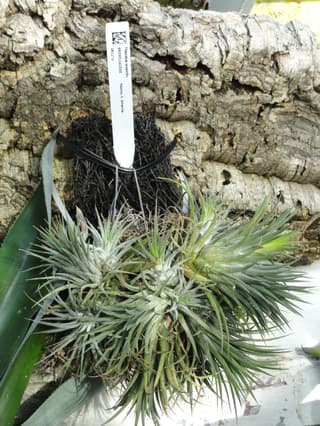
Air Plant
Tillandsia sp
Tillandsias, commonly known as air plants, belong to the Bromeliaceae family and represent its largest genus with over 660 species. Native to the tropical and subtropical Americas, from the southern United States to Argentina, these fascinating epiphytes require no soil to thrive. Instead, they absorb water and nutrients directly from the air through specialized leaf structures called trichomes. Their ability to adapt to diverse environments—from tropical rainforests and cloud forests to arid deserts and rocky mountainsides—makes them among the most versatile and unique plants in the world.
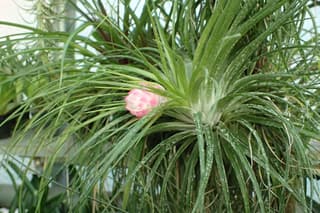
Upright Air Plant
Tillandsia stricta
Tillandsia stricta, commonly known as the Upright Air Plant, is an epiphytic bromeliad native to eastern South America, ranging from Venezuela to northern Argentina. Unlike most plants, it requires no soil to thrive — it absorbs water and nutrients directly through its silvery trichome-covered leaves. It produces stunning blooms in shades of red, pink, blue, and purple in spring and summer, making it one of the most ornamental air plants available.
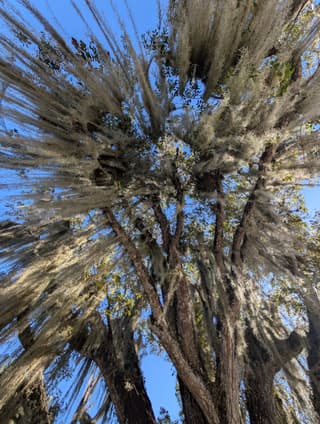
Spanish Moss
Tillandsia usneoides
Spanish moss is a flowering epiphytic bromeliad, not a true moss and not parasitic, native to the southeastern United States, Mexico, Central America, and South America. It forms long, silvery-grey strands that drape over host trees such as live oaks and bald cypress, absorbing water and nutrients from the air through specialized scales (trichomes) on its leaves rather than through roots in soil.
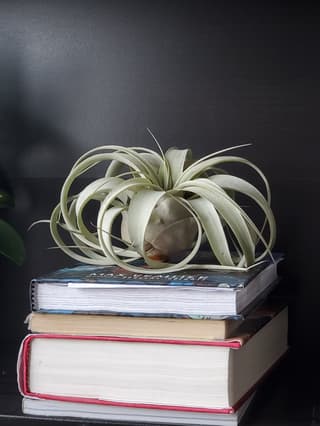
King of Air Plants
Tillandsia xerographica
Tillandsia xerographica is known as the "King of Air Plants" due to its impressive size and beautifully curled silvery-green leaves. This epiphytic plant is native to southern Mexico, Guatemala, and El Salvador. It can reach up to 90 cm in diameter and is highly prized for its sculptural rosette shape. Like all tillandsias, it doesn't need soil to grow and absorbs water and nutrients through its leaves. It is protected under CITES due to past overharvesting in the wild.
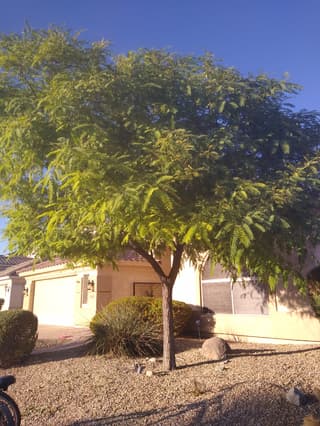
Tipu tree
Tipuana tipu
The Tipu tree (Tipuana tipu) is a majestic, fast-growing tree native to South America. Known for its broad, leafy umbrella-shaped canopy, it provides dense and refreshing shade. During spring and early summer, the tree is covered in clusters of vibrant yellow flowers that, when they fall, create a beautiful golden carpet on the ground. Its leaves are compound and light green, and its fruits are winged samaras, similar to those of a maple.
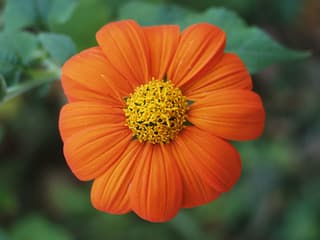
Mexican Sunflower
Tithonia
Tithonia is a genus of flowering plants in the family Asteraceae, native to Mexico and Central America, widely grown as a garden ornamental worldwide. The most popular species, Tithonia rotundifolia, is celebrated for its brilliant orange daisy-like blooms that attract butterflies, bees, and hummingbirds. Fast-growing and highly heat- and drought-tolerant, it is an outstanding choice for sunny summer gardens.
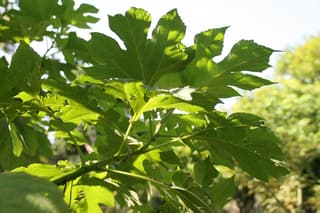
Mexican Sunflower
Tithonia diversifolia
Mexican Sunflower (Tithonia diversifolia) is a fast-growing shrub in the Asteraceae family, native to Mexico and Central America. It reaches up to 4 meters tall and produces vivid orange and yellow flowers from summer through fall. Widely naturalized across the tropics, it is prized as an ornamental, green manure crop, and medicinal plant.
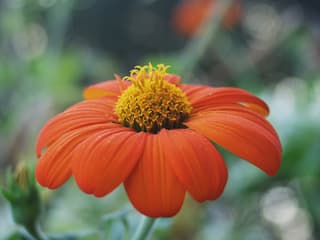
Mexican Sunflower
Tithonia rotundifolia
Mexican Sunflower (Tithonia rotundifolia) is a fast-growing annual native to Mexico and Central America, celebrated for its bold orange, red, and yellow daisy-like blooms. Growing up to 8 feet tall, it is a magnet for butterflies, hummingbirds, and bees throughout summer and fall.
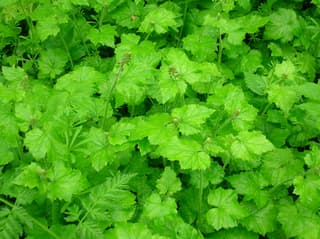
Piggyback Plant
Tolmiea menziesii
Tolmiea menziesii, commonly known as the Piggyback Plant, is a charming evergreen perennial native to the moist, shady forests of the Pacific Northwest coast of North America. It earns its whimsical name from its unique ability to produce tiny plantlets directly at the base of its mature leaves — babies riding "piggyback" on the parent leaf. With soft, hairy, maple-like leaves and a lush mounding habit, it makes an attractive ground cover outdoors and a delightful cascading houseplant indoors.
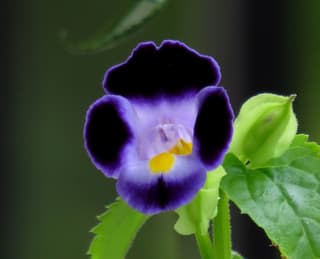
Wishbone flower
Torenia fournieri
Torenia fournieri, commonly known as the Wishbone flower, is a compact and charming herbaceous plant. Its trumpet-shaped flowers feature vibrant colors, usually with a contrasting yellow blotch on the throat. Unlike traditional pansies, this species is highly heat and humidity tolerant, making it ideal for tropical and subtropical gardens.
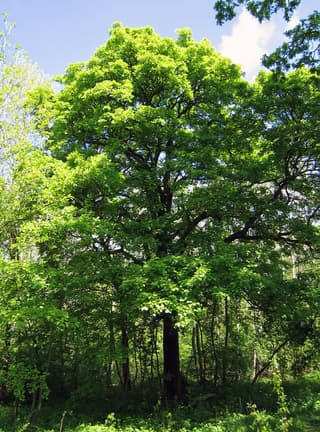
Wild Service Tree
Torminalis glaberrima
The wild service tree (Torminalis glaberrima, formerly Sorbus torminalis) is a medium-to-large deciduous tree in the rose family (Rosaceae), native to Europe and Western Asia. Its distinctive lobed foliage, reminiscent of maple leaves, turns a vibrant red-bronze in the fall. Its white flowers bloom in loose panicles during May and June, followed by small, brown, speckled pomes. Due to their tart flavor, they are only edible when overripe (bletted, or softened after frost), at which point they become a vitamin C-rich treat. It grows at a moderate rate but is exceptionally long-lived, reaching heights of up to 20 meters, and tolerates drier, calcareous soils well, becoming drought-tolerant once established.

California nutmeg
Torreya californica
The California nutmeg (Torreya californica) is an evergreen, dioecious conifer in the yew family (Taxaceae), endemic to the California Coast Ranges and the western slopes of the Sierra Nevada. In its native habitat, it can reach heights of 15–27 meters with a broad, open, roughly conical crown; in the milder climates of the Carpathian Basin, it typically remains a slow-growing tree or large shrub of 5–15 meters. Its glossy, olive-green, 3–8 cm long, sharp-pointed needles emit a strong, spicy fragrance when crushed. Its plum-like, 3–4 cm seeds resemble nutmeg, which gives the species its common name. It develops as a shade-tolerant understory tree, and due to historical logging, its population has significantly declined, leading the IUCN to list it as a Vulnerable species.
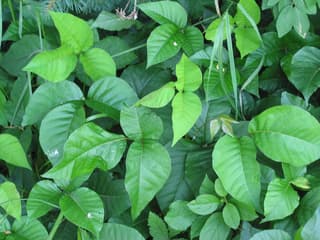
Poison Ivy
Toxicodendron
Toxicodendron is a genus of approximately 29 species of flowering plants, shrubs, vines, and trees in the family Anacardiaceae. Native to North America and Asia, the genus includes the notorious poison ivy (T. radicans), poison oak (T. diversilobum, T. pubescens), poison sumac (T. vernix), and the Asian lacquer tree (T. vernicifluum). All species produce urushiol, an oily resin found in all plant parts that causes severe allergic contact dermatitis in most humans and animals. The plants are typically deciduous, displaying spectacular autumn foliage in shades of red, orange, and yellow before leaf drop.
Poison ivy
Toxicodendron radicans
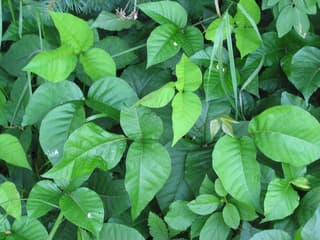
Toxicodendron radicans, commonly known as eastern poison ivy, is a deciduous woody vine or shrub famous for its ability to produce urushiol. This oily organic compound causes an allergic reaction, leading to an itchy, irritating, and painful rash in most humans. The plant is easily identified by its compound leaves consisting of three leaflets, often described by the mnemonic 'leaves of three, let it be.' It is highly adaptable, growing as a trailing vine, a shrub, or a climbing vine that uses aerial rootlets to scale trees and structures.
Asian Jasmine
Trachelospermum asiaticum
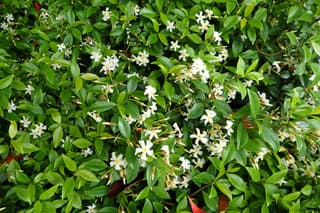
Asian Jasmine (Trachelospermum asiaticum) is a vigorous, evergreen woody vine native to China, Japan and Korea. Grown low and dense, it is one of the most popular groundcovers in warm climates, forming a glossy dark-green carpet studded with small cream-to-yellow star-shaped flowers in late spring and early summer. Left to climb, it will scale trellises, walls and fences with twining stems.
Star Jasmine
Trachelospermum jasminoides
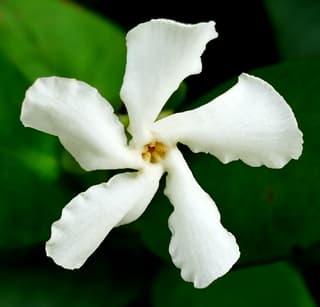
Trachelospermum jasminoides, commonly known as star jasmine or Confederate jasmine, is a vigorous evergreen climbing vine native to eastern and southeastern Asia (China, Japan, Korea, and Vietnam). It produces clusters of intensely fragrant, star-shaped white flowers in summer. The glossy dark green leaves are oval and leathery, often taking on attractive bronze-red tones in winter. Widely grown as an ornamental climber on fences, trellises, walls, and pergolas, it also performs well as a groundcover. Mildly toxic if ingested.
Windmill Palm
Trachycarpus fortunei
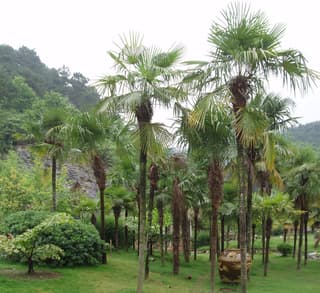
Trachycarpus fortunei, known as the Windmill Palm, is one of the most cold-hardy palms in the world. Native to the mountainous regions of China and Japan, it features a characteristic trunk covered in a dense layer of brown fibers that resemble hemp. Its fan-shaped leaves are a vibrant dark green and can withstand heavy snow and temperatures well below freezing, making it a popular choice for gardens in temperate climates.
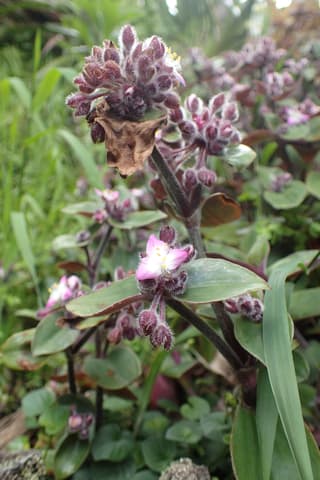
Flowering Inch Plant
Tradescantia cerinthoides
Tradescantia cerinthoides is a fast-growing trailing tropical plant native to southeastern Brazil and northeastern Argentina. It features attractive green-purple foliage and produces delicate white flowers with pink-tipped petals. It is highly popular as a hanging basket plant and ground cover, valued for its colorful, low-maintenance nature.
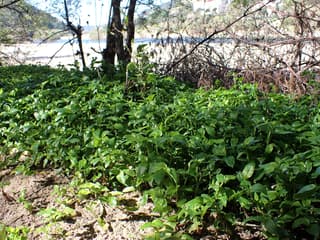
Small-leaf Spiderwort
Tradescantia fluminensis
Tradescantia fluminensis is a fast-growing trailing groundcover native to Brazil and Argentina, belonging to the family Commelinaceae. It produces succulent stems with glossy green oval leaves and small white three-petaled flowers in spring and summer. Widely grown as a houseplant in hanging baskets and as outdoor ground cover in frost-free regions.
Small-leaf Spiderwort
Tradescantia mundula
Tradescantia mundula, commonly known as small-leaf spiderwort, is a trailing groundcover plant with small glossy leaves, native to southeastern and southern Brazil down to northeastern Argentina. It belongs to the Commelinaceae family and is popular as a hanging basket plant or shaded ground cover thanks to its fast growth and easy care.
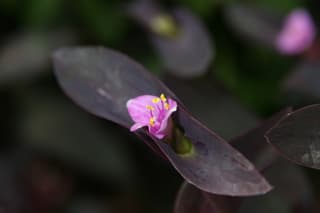
Purple Heart
Tradescantia pallida
Purple Heart (Tradescantia pallida) is a fast-growing, trailing herbaceous perennial native to eastern Mexico, prized for its striking deep purple foliage and stems. It is equally at home as a houseplant, hanging basket specimen, or ground cover in warm-climate gardens.
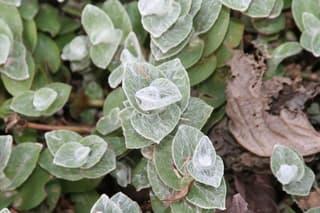
White Velvet
Tradescantia sillamontana
Tradescantia sillamontana, commonly known as White Velvet or Cobweb Spiderwort, is a trailing succulent native to the arid regions of northeastern Mexico. It is beloved for its distinctive densely white-hairy stems and leaves that give it a silvery, velvety appearance. In summer it produces striking magenta three-petaled flowers that contrast beautifully with the silvery foliage. Excellent for containers, hanging baskets, and rock gardens.
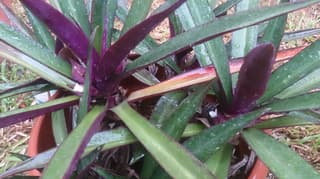
Moses in the Cradle
Tradescantia spathacea
Tradescantia spathacea, commonly known as Moses in the Cradle or Oyster Plant, is a striking tropical perennial native to Mexico. It features bold, sword-shaped leaves that are deep green on top and rich purple underneath, forming dense, compact rosettes. Tiny white flowers nestled within boat-shaped bracts give rise to its charming common names.
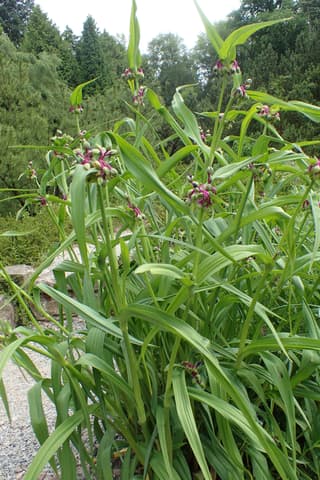
Virginia Spiderwort
Tradescantia virginiana
Tradescantia virginiana, commonly known as Virginia Spiderwort, is a hardy native perennial from Eastern North America. It produces clumps of arching grass-like foliage and bears charming 3-petaled flowers in shades of blue, purple, pink, or white that open in the morning and close by afternoon. A resilient groundcover perfect for naturalized gardens, shade gardens, rain gardens, and pollinator-friendly spaces.
Find the Perfect Plant
Our plant guide helps you find ideal species for your experience level and time of year.
Browse by Difficulty, Season & More
Use the filters below to narrow this catalog by care difficulty, season, environment, or search directly by name. Each filter leads to a focused list tailored to your specific growing conditions.