237 Hard Plants | 2026 Guide - Page 6
Discover 237 hard plants for your garden. Complete care guide.
237 Hard Plants
Showing 181-216 of 237
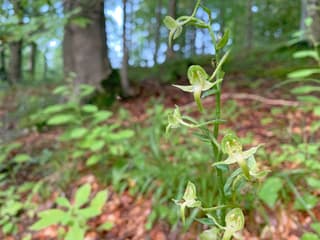
Greater Butterfly-orchid
Platanthera chlorantha
The Greater Butterfly-orchid (Platanthera chlorantha) is a tuberous orchid native to European forests, calcareous meadows, and marshy areas. Growing 30-60 cm tall, it features two shiny, elliptical basal leaves and smaller, oblong stem leaves. Its greenish-white, vanilla-scented flowers are arranged in a sparse inflorescence and feature a long spur adapted for pollination by nocturnal moths, such as noctuids and hawkmoths. Unlike the closely related Platanthera bifolia, its pollinaria attach between the pollinator's eyes rather than to the proboscis. The plant is specialized for calcareous and neutral soils and depends on mycorrhizal fungi for both germination and growth.
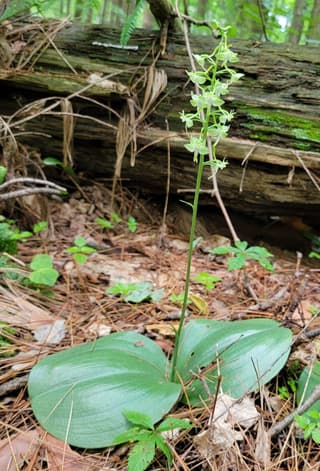
Large Round-leaved Orchid
Platanthera orbiculata
A native North American terrestrial orchid found in moist coniferous and deciduous forests from Canada down to the eastern and northern United States. Easily recognized by its pair of large, glossy, rounded basal leaves lying flat on the forest floor and a tall spike of up to 30 greenish-white flowers with long spurs, pollinated mainly by noctuid moths.
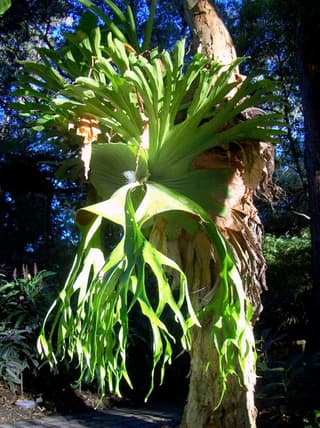
Giant Staghorn Fern
Platycerium superbum
Platycerium superbum, the Giant Staghorn Fern, is a majestic epiphytic fern native to subtropical and tropical eastern Australia. It grows anchored to tree trunks and rocks, producing spectacular antler-shaped fertile fronds up to 2 meters long and circular shield fronds reaching 1 meter across. It is one of the largest and most impressive ferns in the world.
Pleated Pluteus
Pluteus longistriatus
Pluteus longistriatus, commonly known as the Pleated Pluteus, is a small, delicate mushroom characterized by its deeply radial striations on the cap. The cap is typically brownish to grey-brown, often with a darker center. It is a saprobic fungus, meaning it derives nutrients from decaying wood, particularly hardwood logs and debris in forest ecosystems.
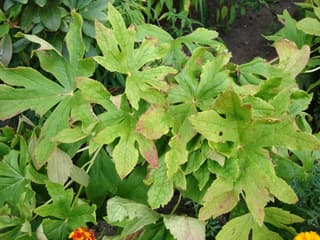
Himalayan Mayapple
Podophyllum hexandrum
The Himalayan Mayapple (Podophyllum hexandrum, synonym Sinopodophyllum hexandrum) is a perennial herbaceous plant in the barberry family (Berberidaceae), native to the Himalayan mountains at altitudes of 2,400–4,500 m in China, Afghanistan, Bhutan, India, Kashmir, Nepal, and Pakistan. In spring, the plant produces two deeply lobed leaves and a single white to pink flower, followed by a red, berry-like fruit. The plant is extremely toxic—the roots and rhizomes contain podophyllotoxin, which is used to produce cancer drugs (such as etoposide)—therefore, it must be handled with great care and kept far away from children and pets.
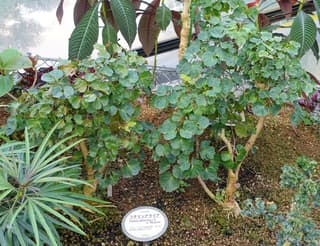
Balfour Aralia
Polyscias balfouriana
Polyscias balfouriana is an elegant tropical evergreen shrub from the Araliaceae family, native to New Caledonia and the Pacific Islands. Known for its glossy, rounded leaves with scalloped edges that resemble dinner plates, it makes a stunning indoor specimen plant. With its slow, upright growth habit and twisting stems speckled in gray, the Balfour Aralia brings a refined tropical aesthetic to any interior space.
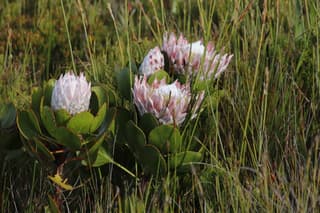
King Protea
Protea cynaroides
Protea cynaroides, the King Protea, is an evergreen shrub native to the fynbos of South Africa's Western and Southern Cape, where it thrives in nutrient-poor, well-drained sandy soils under a Mediterranean climate of hot, dry summers and cool, wet winters. It produces the largest flower head in the genus - a goblet-shaped inflorescence of tightly packed silky florets ringed by large, stiff bracts that range from creamy white to deep crimson, with soft silvery pink being the most prized form. Below the flowers, the plant carries tough, leathery, dark green leaves adapted to withstand drought and wind. Slow-growing and long-lived, it resprouts vigorously from a woody underground rootstock after wildfires, a trait central to its status as South Africa's national flower.
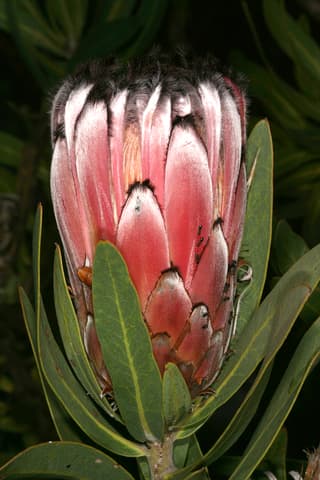
Oleander-leaf protea
Protea neriifolia
Protea neriifolia, commonly known as the Oleander-leaf protea, is a majestic evergreen shrub native to South Africa. It is famous for its cup-shaped inflorescences, composed of colorful bracts ranging from soft pink to cream, ending in distinct velvety black tips. Its leaves are narrow and leathery, resembling those of the oleander, which gives it its specific name.
Stinking Squid
Pseudocolus fusiformis
Pseudocolus fusiformis, commonly known as the 'Squid Stinkhorn', is a fascinating saprophytic fungus. It emerges from a white underground 'egg' to form a structure with 3 to 4 arms joined at the top, which separate at maturity, resembling tentacles. The inner part of the arms is covered by a foul-smelling greenish-brown gleba that attracts flies for spore dispersal.
Psilocybe angulospora
Psilocybe angulospora
Psilocybe angulospora is a species of agaric fungus in the family Hymenogastraceae. It is characterized by its small, brownish-to-yellowish caps that often exhibit a bluing reaction when bruised, indicating the presence of psilocybin. The species is notable for its angulate (angular) spores, which distinguish it from many other members of the genus. It is typically found growing in wood chips, mulch, or rich organic debris in temperate and subtropical regions.
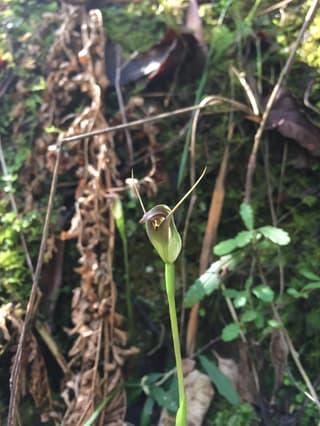
Maroonhood
Pterostylis pedunculata
Pterostylis pedunculata, the maroonhood, is a small terrestrial orchid endemic to south-eastern Australia. From an underground tuber it produces a rosette of stalked leaves and a single hooded flower that is white and green at the base and stained deep reddish-brown to maroon over the hood, or galea. It is a winter-growing, colony-forming greenhood of forests and woodlands, sometimes even growing on the fibrous trunks of tree ferns.
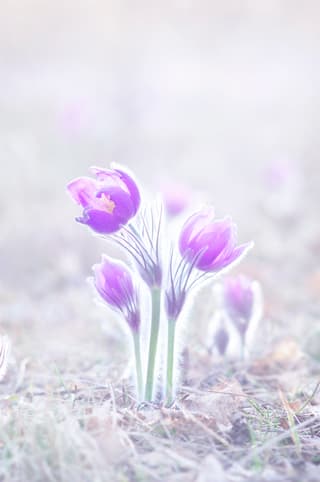
eastern pasqueflower
Pulsatilla patens
Pulsatilla patens, commonly known as the eastern pasqueflower, is a hardy perennial herb native to North America, Europe, and Asia. It is famous for being one of the first flowers to bloom in early spring, often emerging through the snow. The plant is characterized by its bell-shaped, silky-haired purple flowers and deeply divided, feathery foliage. After the flowers fade, they are replaced by striking, plume-like seed heads that remain decorative for weeks.
Pyronema omphalodes
Pyronema omphalodes
Pyronema omphalodes, commonly known as the charcoal cushion or bonfire fungus, is a pyrophilous ascomycete fungus. It typically appears as bright orange to salmon-colored, cushion-like masses on recently burned soil or sterilized substrates. It is a pioneer species that thrives in the alkaline, nutrient-rich environment created by fire, often appearing within weeks of a burn.

Oak
Quercus
Quercus is a genus of approximately 500 species of oaks native to the northern hemisphere, spanning Europe, Asia, and the Americas. These majestic, slow-growing trees are among the most ecologically important in the world — a single mature oak can support over 500 species of insects, birds, and mammals. They produce iconic acorns and can live for hundreds or even thousands of years.
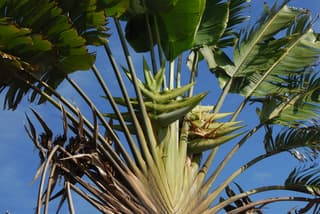
Traveller's Palm
Ravenala madagascariensis
Ravenala madagascariensis, known as the Traveller's Palm, is a striking evergreen plant native to Madagascar, prized for its enormous paddle-shaped leaves that unfurl in a dramatic fan reminiscent of a peacock's tail. Despite its common name, it is not a true palm but a close relative of the bird-of-paradise and banana, belonging to the family Strelitziaceae. Mature specimens can reach 9 to 15 meters tall and are iconic in tropical landscaping.
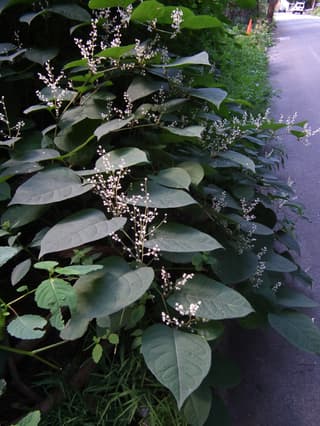
Bohemian knotweed
Reynoutria × bohemica
Reynoutria × bohemica, commonly known as Bohemian knotweed, is a highly invasive hybrid perennial resulting from the natural cross between Japanese knotweed (R. japonica) and giant knotweed (R. sachalinensis). First identified in Bohemia (Czech Republic) in the late 19th century, it has since spread aggressively across Europe, North America, New Zealand, and beyond. The plant produces hollow, bamboo-like canes reaching 3–5 m in height and an underground rhizome network extending up to 7 m laterally and 3 m deep. These rhizomes can penetrate building foundations, drainage systems, flood defences, and road surfaces. Bohemian knotweed is listed among the world's 100 worst invasive species and is subject to legal controls in the UK, EU, and several US states. It outcompetes all native vegetation through rapid canopy closure and allelopathic root exudates that suppress surrounding plant growth.
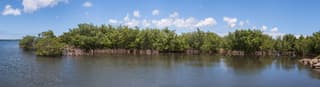
Mangrove
Rhizophora
Rhizophora is a genus of tropical "true mangrove" trees and shrubs in the family Rhizophoraceae, famous for their tangled, arching prop roots that anchor them in shifting, waterlogged coastal mud. Found across intertidal zones in the tropics and subtropics, these evergreen trees tolerate daily tidal flooding and high salinity, forming dense mangrove forests that protect shorelines from erosion and storm surge.
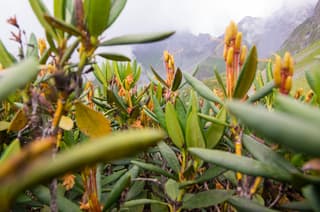
Caucasian Snow Rose
Rhododendron caucasicum
Rhododendron caucasicum, commonly known as the Caucasian Snow Rose, is a slow-growing evergreen shrub native to the subalpine and alpine zones of the Caucasus Mountains. It produces clusters of white to pale pink flowers in spring and forms dense, compact mounds of leathery dark green leaves. This species is highly toxic due to the presence of grayanotoxins, which can cause serious poisoning in humans and animals if ingested in significant quantities. It is a challenging plant to cultivate, demanding acidic, peaty, well-draining soil and consistent moisture in a partially shaded position sheltered from harsh winds.
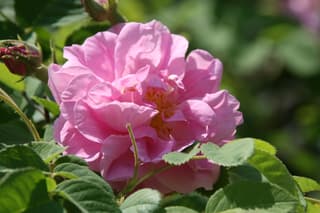
Damask Rose
Rosa × damascena
The Damask Rose (Rosa × damascena) is an ancient hybrid shrub, likely a cross between Rosa gallica and Rosa moschata. Cultivated for millennia across the Middle East, Turkey, Bulgaria, and Iran, it is the primary source of precious rose oil (attar of roses) and rose water. Its semi-double to double flowers emit an intense, sweet fragrance. It grows up to 7 feet tall with arching, thorny canes and deciduous mid-green foliage.
Smoky Russula
Russula adusta
Russula adusta is a basidiomycete fungus notable for its color transition. Initially whitish, its cap turns grayish-brown and eventually black as it matures. It is a mycorrhizal species that plays a crucial role in the health of coniferous forests, aiding in nutrient exchange with tree roots. Its flesh is firm but can cause gastrointestinal discomfort if ingested.
Vittadini's Amanita
Saproamanita vittadinii
Saproamanita vittadinii, commonly known as Vittadini's Amanita, is a saprotrophic fungus characterized by its white, scaly cap and stem. Unlike many Amanita species that form mycorrhizal relationships with trees, this species breaks down organic matter in grasslands and meadows. It features prominent pyramidal warts on the cap and a ringed stem covered in recurved scales.
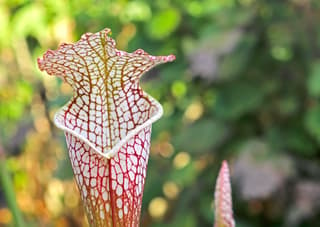
North American Pitcher Plant
Sarracenia
Sarracenias are fascinating carnivorous plants native to North America. They feature modified leaves shaped like pitchers or trumpets, which they use to attract, capture, and digest insects. Their colors range from vibrant green to deep reds, often with contrasting veins that guide prey into the trap.
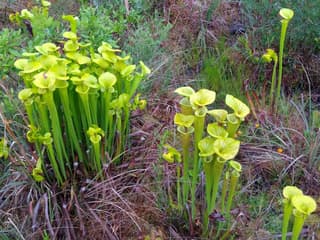
Yellow Pitcher Plant
Sarracenia flava
Sarracenia flava, known as the yellow pitcher plant or trumpet pitcher, is a carnivorous perennial native to the bogs and wet pine savannas of the southeastern United States, from Virginia to Florida and Alabama. It produces tall, slender, trumpet-shaped pitchers in yellow-green tones topped with an erect, hood-like lid, reaching up to 90cm in height. In spring, before new pitchers emerge, it produces striking nodding yellow flowers on long stalks. Like other Sarracenia species, it lures, traps, and digests insects to supplement the scarce nutrients of its boggy, nutrient-poor habitat.

Crimson Pitcherplant
Sarracenia leucophylla
A striking carnivorous bog plant native to the longleaf pine savannas of the southeastern US Gulf Coast. Tall, tubular pitchers rise to nearly a meter, topped with a wavy hood marked by reddish-purple veins on a white background. In spring, nodding, brownish-red flowers appear on tall stalks before the pitchers fully develop. Like all Sarracenia, it traps and digests insects to supplement the poor nutrients of its native peaty soil.
Parrot Pitcher Plant
Sarracenia psittacina
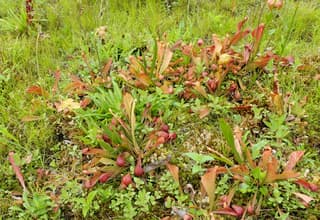
Sarracenia psittacina, the Parrot Pitcher Plant, is a fascinating carnivorous plant native to the Gulf Coast of the southeastern United States. Its unique pitchers resemble a parrot's beak and employ a lobster-trap mechanism — prey wander in following inward-pointing hairs and cannot find their way back out. It is one of the smallest Sarracenia species and demands specialized care including distilled water and acidic peat soil.
Sweet Pitcher Plant
Sarracenia rubra
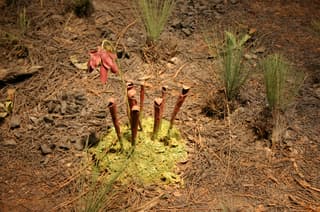
Sarracenia rubra is a clump-forming carnivorous perennial native to the acidic, nutrient-poor bogs and seepage slopes of the southeastern United States, from the Florida Panhandle and Alabama through Georgia to the coastal plains of the Carolinas. Its narrow, upright pitchers -- usually under 65 cm tall -- lure insects with nectar and a sweet scent, then trap them using downward-pointing hairs and a slick, waxy inner wall. In spring the plant sends up striking maroon-red, umbrella-shaped flowers with long, dangling petals before the summer flush of taller pitchers appears. Because it evolved in soils too poor to support ordinary plants, it depends on trapped insects rather than fertilizer for nitrogen and phosphorus, and it requires a genuine winter dormancy to thrive long-term.
Luminous moss
Schistostega pennata
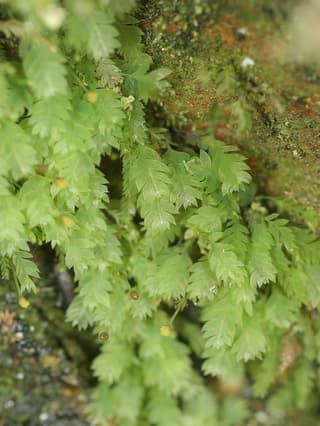
Schistostega pennata is a unique and fascinating moss from the Schistostegaceae family. This bryophyte is famous for its luminescent property: in low-light conditions, its protonema emits a soft golden-green glow. This occurs because specialized spherical cells in the protonema act as biological lenses, concentrating weak light onto the chloroplasts. The plant is small, with gametophytes of only 1.5 cm, featuring opposite leaves with a simple structure. It is native to temperate regions of the Northern Hemisphere (Europe, Asia, and North America).
Comb Fern (genus)
Schizaea
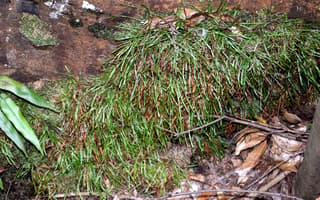
Schizaea is a genus of primitive ferns in the family Schizaeaceae, characterized by grass-like sterile fronds and distinctive comb-shaped fertile segments. Native to tropical and subtropical humid regions worldwide, they are rarely seen outside specialist collections and greenhouses.
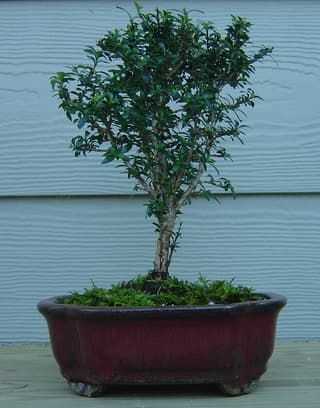
Tree of a Thousand Stars
Serissa foetida
Serissa foetida, known as the Tree of a Thousand Stars or Snow Rose, is a compact evergreen shrub native to warm, humid regions of Southeast Asia including India, China, and Japan. It is prized for its dainty star-shaped white or pink flowers that bloom nearly year-round, making it one of the most beloved subjects for bonsai cultivation. Its delicate foliage and gnarled trunk on mature specimens give it a distinguished, ancient appearance.
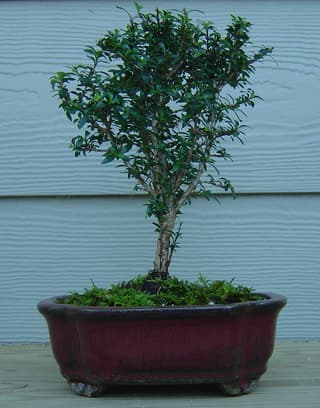
Snow Rose
Serissa japonica
Serissa japonica, commonly known as Snow Rose or Tree of a Thousand Stars, is a small evergreen to semi-evergreen shrub native to Southeast Asia. It is beloved in bonsai culture for its delicate star-shaped white or pink flowers, fine branching structure, and rough grey bark. Despite its elegant appearance, it is considered a challenging plant due to its sensitivity to environmental changes.
Hairy Wild Tomato
Solanum habrochaites
Solanum habrochaites is a wild relative of the cultivated tomato, native to the western, arid slopes of the Peruvian and Ecuadorian Andes, where it grows at elevations up to 3,300 m. Unlike the smooth-leaved garden tomato, its entire stem and foliage are covered in dense, soft glandular trichomes (hairs) that give the species its name — "habrochaites" roughly means "soft bristles." These trichomes exude strong-smelling terpenes, such as zingiberene, that repel insects and deter pathogens, making the species a prized source of pest and disease resistance genes for tomato breeding programs worldwide. It produces small, star-shaped yellow flowers and small green, fuzzy fruit that typically stays green and is not eaten. As with all Solanum species, the foliage, stems and unripe fruit contain glycoalkaloids and are toxic if ingested.
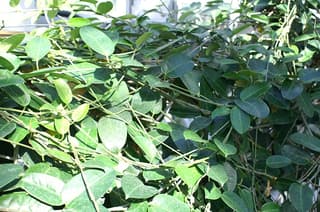
Madagascar Jasmine
Stephanotis floribunda
Stephanotis floribunda (Madagascar jasmine) is an evergreen climbing plant in the Apocynaceae family, native to the tropical rainforests of Madagascar. It is characterized by star-shaped, snow-white, waxy flowers with an intense, sweet fragrance that appear in spring and summer. The plant's strong vines can climb 4–6 meters with the help of a support structure. It gained worldwide fame as a bridal flower—Grace Kelly even decorated her wedding bouquet with it. Indoor cultivation is challenging: it is sensitive to temperature fluctuations, direct sunlight, and watering errors.
Old-man-of-the-woods
Strobilomyces strobilaceus
Strobilomyces strobilaceus, commonly known as Old-man-of-the-woods, is a distinctive mycorrhizal fungus found in deciduous forests. It is easily recognized by its cap, which is covered in large, dark, woolly scales resembling a pine cone. The flesh stains pinkish then black when cut, and the underside features a greyish pore surface rather than gills.
Larch bolete
Suillus grevillei
The larch bolete is an edible and highly flavorful mushroom from the Suillaceae family. It is characterized by its bright yellow to orange cap, which becomes very slimy when wet. It grows exclusively in symbiosis (mycorrhiza) with larch trees, making it a species that cannot be commonly cultivated at home without the presence of a host tree. It features a yellow stem with a ring and pores that are covered by a veil when young.
Velvet bolete
Suillus variegatus
Suillus variegatus, known as the velvet bolete or variegated bolete, is an edible mushroom from the Suillaceae family. It is characterized by a sandy-yellow or olive cap with a granular, felt-like surface that, unlike other Suillus species, is not slimy. It forms a mycorrhizal relationship primarily with pine trees, preferring sandy and acidic soils.
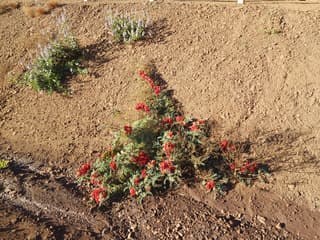
Sturt's Desert Pea
Swainsona formosa
Sturt's Desert Pea is one of Australia's most striking wildflowers, a low, sprawling groundcover native to the arid interior of every mainland state except Victoria. Its trailing stems of soft grey-green, pinnate leaves are studded with large, waxy blood-red blooms, each marked with a glossy black boss at the base of the standard petal. Adopted as the official floral emblem of South Australia in 1961, it thrives in harsh, sun-baked, well-drained conditions and is famously difficult to keep alive in humid or overly generous garden settings.
What are Hard Plants?
Hard Plants are challenging and reward experienced gardeners. They require specific light, humidity, and temperature conditions, plus constant attention. Perfect for enthusiasts seeking a challenge.
Tips for Growing Hard Plants
For hard plants, success is in the details. Monitor air humidity, use filtered water when needed, maintain stable temperature, and be ready to adjust care as the plant responds.