634 Medium Pet Safe | 2026 Guide - Page 17
Find 634 medium pet safe. Complete guide for your garden.
634 Pet Safe with medium level
Showing 577-612 of 634
Stromanthe
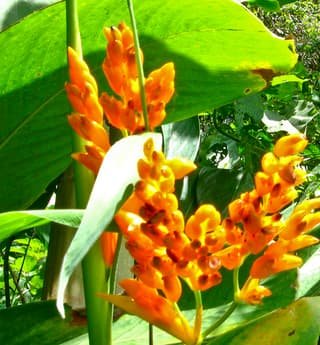
Stromanthe
Stromanthe is a genus of approximately 13 tropical plant species in the family Marantaceae, native to the rainforests of South America, particularly Brazil. Celebrated for their stunning variegated foliage in shades of green, white, pink, and red, they are among the most visually spectacular houseplants available. The most famous species is Stromanthe sanguinea 'Triostar', whose tricolored leaves make it a standout specimen. Like other prayer plants, Stromanthe leaves move throughout the day in response to light.
Tricolor Stromanthe
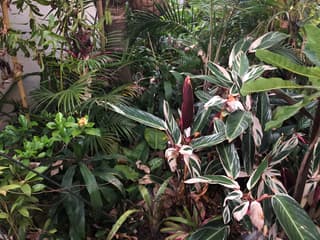
Stromanthe sanguinea
Stromanthe sanguinea, commonly known as the Tricolor Stromanthe or Triostar, is a stunning tropical plant native to the rainforests of Brazil. Its long, lance-shaped leaves display a breathtaking palette of dark green, pink, cream, and deep burgundy on the undersides, making it one of the most visually striking houseplants available. A member of the Marantaceae family and relative of Calathea and Maranta, this species exhibits nyctinastic leaf movements — folding its leaves upward at dusk in response to changing light conditions.
Tricolor Stromanthe
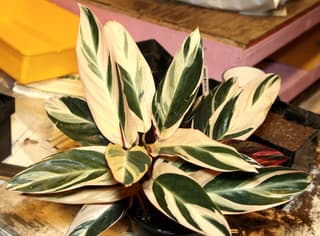
Stromanthe thalia
Tricolor Stromanthe (Stromanthe thalia) is a stunning Brazilian tropical plant from the Marantaceae family, celebrated for its spectacular tricolor foliage in shades of green, pink, and cream with deep magenta-purple undersides. As a prayer plant, its leaves fold upward at dusk and reopen at dawn. It thrives indoors with bright indirect light and high humidity.
Cape Sprays
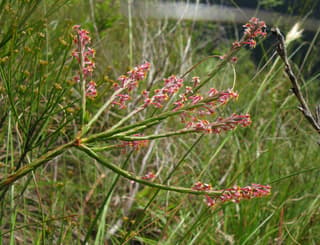
Struthiola
Struthiola is a genus of approximately 31 species of ericoid shrubs in the family Thymelaeaceae, native to the fynbos biome of South Africa's Cape Floral Region. These evergreen shrublets are renowned for their sweetly scented tubular flowers at dusk and their remarkable drought tolerance in sandy, well-drained soils.
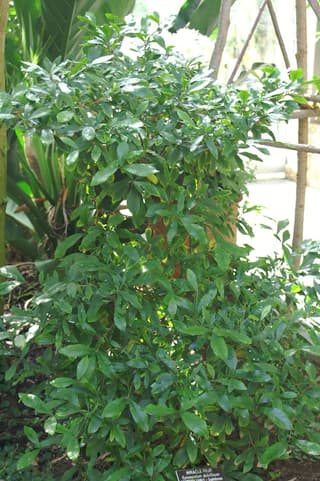
Miracle Berry
Synsepalum dulcificum
Synsepalum dulcificum, known as the Miracle Berry, is an evergreen shrub native to West Africa. Its most notable feature is the production of small red berries containing miraculin. This glycoprotein temporarily alters taste buds, causing sour or bitter foods to be perceived as extremely sweet. The plant has glossy dark green leaves and exhibits slow, elegant growth.
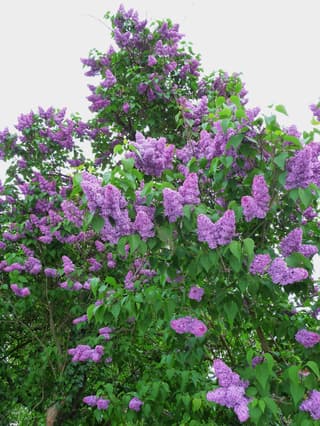
Common Lilac
Syringa vulgaris
Syringa vulgaris, the common lilac, is a hardy deciduous shrub native to the Balkans and widely cultivated for its spectacular spring display of highly fragrant flower clusters. Growing up to 5 meters tall, it produces dense panicles in shades ranging from classic purple-lavender to white, pink, and magenta. It is a beloved garden staple in temperate climates and thrives in cold winters with full sun exposure.
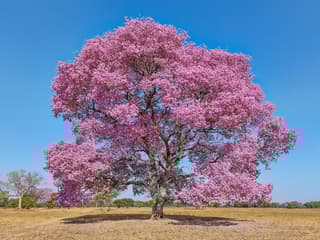
Pink Trumpet Tree
Tabebuia impetiginosa
Tabebuia impetiginosa, commonly known as the Pink Trumpet Tree or Pau d'Arco, is one of South America's most spectacular flowering trees. Native to the tropical and subtropical forests of Brazil and neighboring countries, it produces breathtaking displays of purple to pink trumpet-shaped flowers in late winter and early spring, typically when the tree is leafless. A member of the Bignoniaceae family, it can reach up to 30 meters tall in the wild and is widely planted as an ornamental street and garden tree in warm climates worldwide.
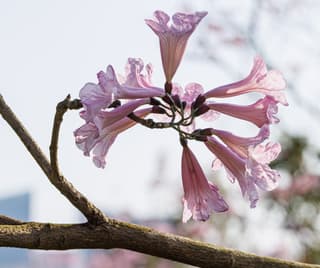
Pink Trumpet Tree
Tabebuia rosea
The Pink Trumpet Tree (Tabebuia rosea) is a majestic tropical tree native from Mexico to Colombia and Venezuela.
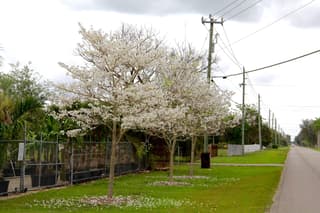
White Ipe
Tabebuia roseoalba
Tabebuia roseoalba is a Brazilian ornamental flowering tree native to the Cerrado and Pantanal biomes, in the family Bignoniaceae. It grows 7-16 m tall with a 40-50 cm trunk diameter and fissured, cork-like bark. Leaves are compound and trifoliate, with a blue-green tone. In late winter to early spring (roughly August-October in its native Southern Hemisphere range), the tree drops its leaves entirely and bursts into a canopy of white to pale-pink trumpet-shaped flowers with yellow markings in the throat -- a striking but brief display that lasts only a few days. It is a hardy, drought-tolerant pioneer species widely planted along streets and used in the restoration of degraded land.
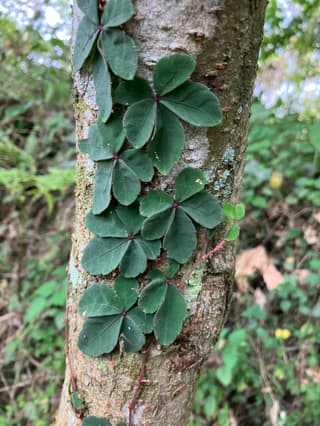
Lizard Vine
Tetrastigma obtectum
Tetrastigma obtectum, known as the lizard vine or Chinese tetrastigma, is a lush evergreen climbing vine from the Vitaceae family. It is native to southern China and parts of Southeast Asia, where it grows on forest edges, along riverbanks, and on cool, moist mountain slopes at altitudes up to 2,000 meters. The plant features characteristic palmate leaves with five lanceolate leaflets and produces small greenish-white flowers in the summer, followed by spherical, grape-like black berries. It is particularly popular as a terrarium plant and indoor ornamental due to its ability to thrive in low light and high humidity.
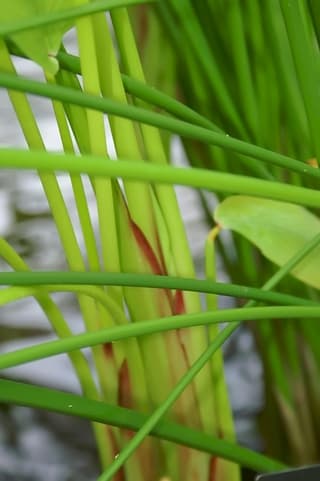
Bent Alligator-flag
Thalia geniculata
Thalia geniculata, commonly known as Bent Alligator-flag, is a majestic perennial aquatic plant. Its large, light green oval leaves resemble those of the Maranta but grow on long, erect stems that can reach impressive heights. Its most striking feature is the zigzag inflorescence, which supports delicate small purple flowers, attracting pollinators such as butterflies and hummingbirds.

Mysore Trumpetvine
Thunbergia mysorensis
Thunbergia mysorensis, commonly known as the Mysore Trumpetvine or Indian Clock Vine, is a spectacular evergreen climbing plant native to the tropical regions of southern India, particularly Karnataka. It belongs to the family Acanthaceae and is celebrated for its dramatic pendulous racemes of bicolored flowers—vivid yellow with maroon-red rims—that cascade like strings of exotic jewels. A recipient of the Royal Horticultural Society's Award of Garden Merit, this fast-growing vine can reach up to 6 meters and is a favorite in tropical and subtropical gardens worldwide.
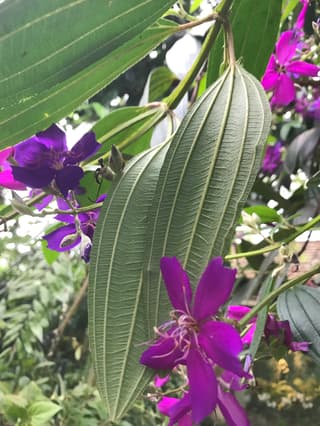
Princess Flower
Tibouchina granulosa
Tibouchina granulosa, commonly known as the Princess Flower or Glory Bush, is a medium-sized tree native to the Brazilian Atlantic Forest. It is notable for its rounded crown and dark green foliage with a velvety texture. Its most striking feature is its exuberant flowering, which typically occurs twice a year, covering the tree with vibrant shades of purple or pink flowers.
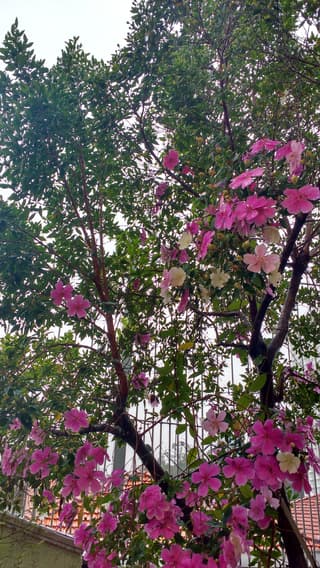
Glory Bush
Tibouchina mutabilis
The Brazilian glory tree (Tibouchina mutabilis), known in Brazil as manacá-da-serra, is an evergreen ornamental tree native to the Brazilian Atlantic Forest, especially the coastal mountain ranges of São Paulo, Rio de Janeiro, Paraná and Santa Catarina. A member of the Melastomataceae family, it can reach up to 12 meters in height with an open, spreading crown. Its most striking trait is its flowering display: blossoms open white, turn pink, then deepen to purple, giving the tree a multicolored look as old and new flowers bloom together.
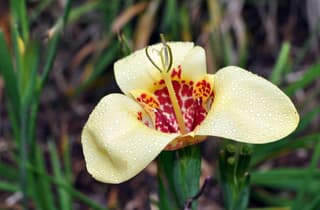
Tiger Flower
Tigridia
Tigridia pavonia is a striking summer bulb from the Iris family (Iridaceae), native to Mexico and Central America. It is characterized by showy, brightly colored flowers with distinctive spotted centers resembling a tiger's or peacock's eye. Each individual flower blooms for only one day, but the plant continuously produces new flowers over 2-4 weeks in summer. The leaves are sword-shaped, pleated, with prominent longitudinal veins, and they die back in the fall.
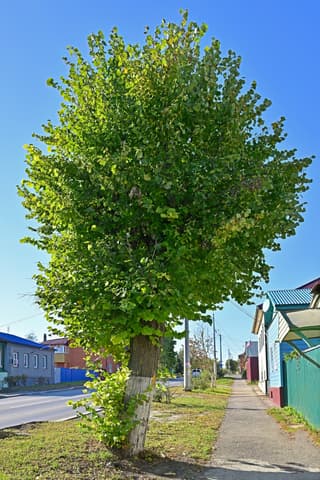
Little-leaf Linden
Tilia cordata
The Little-leaf Linden (Tilia cordata) is a long-lived deciduous tree in the Malvaceae family, native to Europe and western Asia. It reaches a height of up to 30 m with a broad, rounded crown spreading up to 12 m. In summer (June–July), it produces small, creamy-yellow flowers with an intense, sweet fragrance that attracts bees, making it highly valuable for beekeeping. Its heart-shaped, dark green leaves turn golden in autumn. The linden is a long-lived tree (living over 1,000 years), exceptionally frost-resistant (down to -34°C), and relatively tolerant of urban conditions.
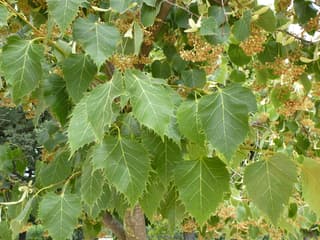
Henry's lime
Tilia henryana
Henry's lime (Tilia henryana) is a deciduous tree native to the mountain forests of central China (Anhui, Hubei, Hunan, Shaanxi, Zhejiang...), introduced to the West by Ernest Wilson in 1901. More compact than the common lime, it reaches 30 to 50 ft in height in cultivation (up to 80 ft in its native habitat), with a rounded, spreading habit and pale gray bark that fissures with age. Its heart-shaped leaves, coppery when budding then glossy green, are distinguished by a ciliate margin of long silky bristles reminiscent of a carnivorous plant's eyelashes, before turning golden yellow in autumn. The late flowering (late August-September) produces abundant clusters of highly fragrant, nectar-rich creamy white flowers, among the last of the Tilia genus to open.
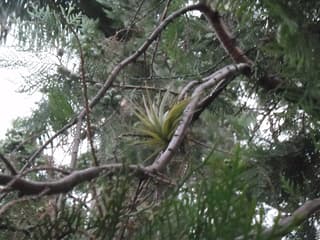
Blushing Bride
Tillandsia brachycaulos
Tillandsia brachycaulos is a small epiphytic air plant native to Mexico and Central America, prized for its dense rosette of narrow, silvery-green leaves that dramatically flush deep red to scarlet in the weeks before flowering, the trait behind its common name, "Blushing Bride." It thrives without soil, drawing water and nutrients through specialized leaf scales called trichomes, and produces violet-to-purple tubular flowers rising from red or orange bracts.
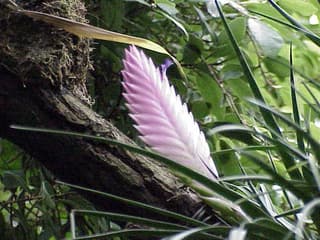
Pink Quill
Tillandsia cyanea
Tillandsia cyanea, known as the Pink Quill, is an epiphytic air plant native to Ecuador prized for its long-lasting bright pink flattened bract that rises from a rosette of narrow, arching green leaves. Unlike soil-grown houseplants, it has no true roots for absorbing nutrients -- instead it draws water and nutrients through specialized trichomes on its leaves. Small tubular violet-blue flowers emerge one at a time from the pink bract, which itself can stay colorful for two to three months.
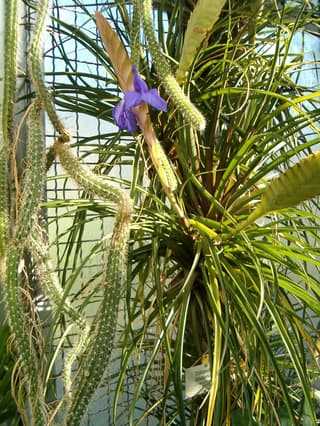
Blue-flowered Torch
Tillandsia lindenii
Tillandsia lindenii, commonly called the Blue-flowered Torch, is an eye-catching epiphytic bromeliad native to the cloud forests of Ecuador and Peru. It forms a compact rosette of arching, dark green, strap-like leaves from which rises a flattened, sword-shaped bract in shades of green, pink, or rose. From this striking bract emerge a succession of large, deep violet-blue flowers with white throats, each lasting only a few days while the colorful bract itself persists for months. Grown as a houseplant, it thrives mounted on bark or lightly potted in a well-aerated, soil-free medium, needing no traditional soil since it absorbs water and nutrients through specialized leaf scales called trichomes.
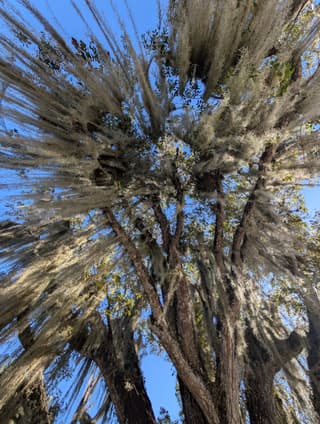
Spanish Moss
Tillandsia usneoides
Spanish moss is a flowering epiphytic bromeliad, not a true moss and not parasitic, native to the southeastern United States, Mexico, Central America, and South America. It forms long, silvery-grey strands that drape over host trees such as live oaks and bald cypress, absorbing water and nutrients from the air through specialized scales (trichomes) on its leaves rather than through roots in soil.
Wild Service Tree
Torminalis glaberrima
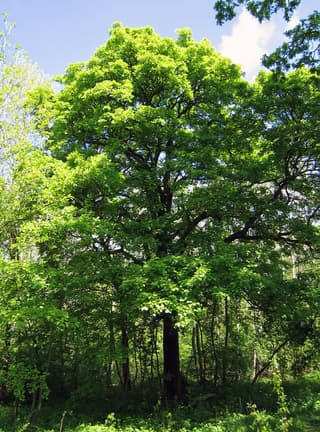
The wild service tree (Torminalis glaberrima, formerly Sorbus torminalis) is a medium-to-large deciduous tree in the rose family (Rosaceae), native to Europe and Western Asia. Its distinctive lobed foliage, reminiscent of maple leaves, turns a vibrant red-bronze in the fall. Its white flowers bloom in loose panicles during May and June, followed by small, brown, speckled pomes. Due to their tart flavor, they are only edible when overripe (bletted, or softened after frost), at which point they become a vitamin C-rich treat. It grows at a moderate rate but is exceptionally long-lived, reaching heights of up to 20 meters, and tolerates drier, calcareous soils well, becoming drought-tolerant once established.
Windmill Palm
Trachycarpus fortunei
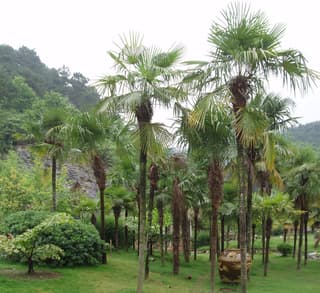
Trachycarpus fortunei, known as the Windmill Palm, is one of the most cold-hardy palms in the world. Native to the mountainous regions of China and Japan, it features a characteristic trunk covered in a dense layer of brown fibers that resemble hemp. Its fan-shaped leaves are a vibrant dark green and can withstand heavy snow and temperatures well below freezing, making it a popular choice for gardens in temperate climates.

Water Chestnut
Trapa natans
Trapa natans, commonly known as water chestnut or water caltrop, is a floating annual aquatic plant native to Eurasia and Africa. It is recognized by its diamond-shaped floating leaves arranged in a rosette and its distinctive four-horned spiny nuts, which are edible and have been consumed by humans for over 3,000 years. It is considered an invasive species in North America.
Catuaba
Trichilia
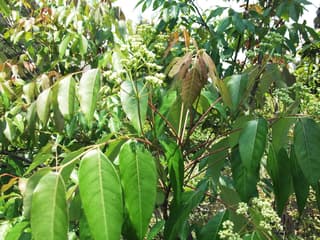
Trichilia is a genus of over one hundred tropical tree species in the mahogany family (Meliaceae), distributed across tropical America, Africa, and Madagascar. Representative species like Trichilia catigua (catuaba) grow as understory trees in the Atlantic Forest and South American rainforests, reaching up to 10 meters tall, with compound leaves of 5-7 leaflets and yellow-whitish flowers blooming in spring. The genus is valued both as ornamental foliage plants and, in the case of catuaba, as a traditional Brazilian tonic herb.
Trichoderma
Trichoderma
Trichoderma is a genus of fungi that is present in all soils, where they are the most prevalent culturable fungi. Many species in this genus can be characterized as opportunistic avirulent plant symbionts. They are widely used in agriculture as biocontrol agents due to their ability to parasitize other fungi and stimulate plant growth.
African Bonsai
Trichodiadema bulbosum
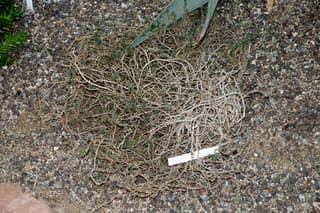
Trichodiadema bulbosum is a small caudiciform succulent from the Aizoaceae family, native to South Africa. It forms a tuberous, bulbous caudex that is often partially buried, from which erect, branched stems emerge in a shrub-like habit, giving it an appearance similar to a miniature bonsai. Its leaves are covered with bristle-like papillae and topped by a 'diadem' of stiff hairs, a characteristic that gives the genus its name. In spring and summer, it produces striking pink flowers with yellow centers. It is a slow-growing plant, highly valued in cultivation as an ornamental succulent and for indoor or outdoor bonsai.
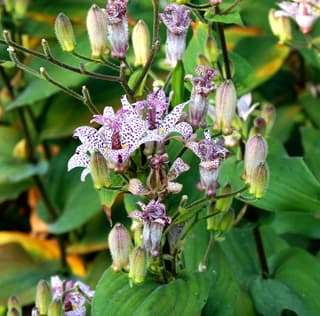
Toad lily
Tricyrtis formosana
Tricyrtis formosana, the Taiwan toad lily, is a hardy perennial native to the woodland understories of Taiwan. In late summer and autumn, it produces small, star-shaped white flowers with prominent purple spots and yellow throats, reminiscent of exotic orchids. The glossy, lance-shaped dark green leaves remain attractive throughout the growing season, and the plant eventually forms dense clumps via creeping rhizomes. It is a shade-loving plant resistant to both diseases and pests, making it ideal for woodland gardens, shaded borders, and pond margins.
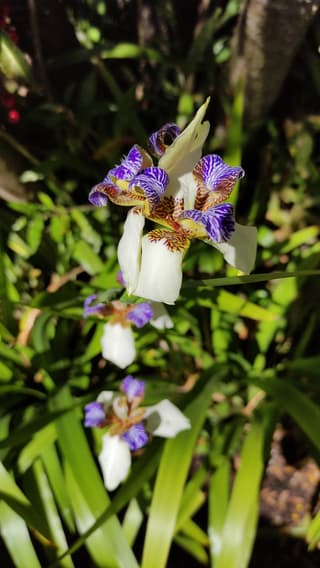
Yellow Walking Iris
Trimezia gracilis
Trimezia gracilis, commonly called yellow walking iris, is a rhizomatous perennial in the Iridaceae family, native to west-central and southeastern Brazil through Paraguay. It forms upright fans of sword-shaped leaves and produces short-lived yellow flowers marked with brown-purple blotches at the base of the petals. Each bloom lasts only a day, but flowering continues from spring through fall. The common name refers to the plantlets that form at the tips of spent flower stalks, which root where they touch the ground, making the clump appear to "walk."

Common wheat
Triticum aestivum
Common wheat (Triticum aestivum) is the most widely cultivated cereal grain in the world and is among humanity's oldest cultivated plants. Domesticated over 9,000 years ago in the Near East, it is now grown on every continent. This annual grass reaches a height of up to 120 cm and forms characteristic spikes that ripen in summer. Its grains are the foundation for bread, flour, pasta, and a variety of other foods. Common wheat has relatively high demands for soil, water, and climate, preferring sunny locations with nutrient-rich, well-drained soils.

Dutch Elm
Ulmus × hollandica
Ulmus × hollandica, commonly known as the Dutch Elm, is a natural hybrid between the Wych Elm (Ulmus glabra) and the Field Elm (Ulmus minor) that arose spontaneously across Europe wherever the ranges of its two parent species overlap. A large, fast-growing deciduous tree, it was historically planted in vast numbers as a street and canal-side tree throughout the Netherlands and the rest of the Low Countries, prized for its tolerance of urban conditions and its elegant, broadly spreading crown. Its leaves are intermediate in shape between the two parent species, and inconspicuous reddish flowers appear in early spring before the foliage, followed by winged samara fruits. The hybrid became infamous during the 20th century for its role in the Dutch elm disease epidemics, though some clones show moderate resistance and continue to be bred for improved tolerance.
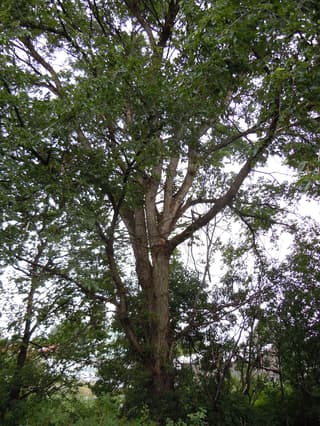
American elm
Ulmus americana
The American elm (Ulmus americana) is a fast-growing, deciduous tree from the elm family (Ulmaceae), originally native to eastern North America. The tree is known for its characteristic vase-shaped crown and can reach heights of up to 24 meters in the wild with a correspondingly wide canopy. From the mid-20th century, Dutch elm disease decimated large portions of the wild population in North America, but disease-resistant cultivars have since been developed. The species produces small, inconspicuous greenish-red flowers in early spring before the leaves emerge, and features coarse, dark green foliage that turns golden in the fall.
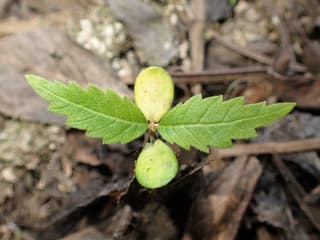
Field Elm
Ulmus minor
Ulmus minor, known as the field elm, is a majestic deciduous tree native to Europe, North Africa, and Western Asia. It is distinguished by its robust stature, deeply fissured bark in mature specimens, and alternate leaves with a markedly asymmetrical base. It is a keystone species in riparian forests, although its populations have been drastically reduced in recent decades due to Dutch elm disease, a devastating fungal infection.

Leafy Bladderwort
Utricularia foliosa
Utricularia foliosa is an aquatic carnivorous plant in the Lentibulariaceae family, native to tropical and subtropical regions of the Americas and Africa. It floats freely or remains submerged in the still waters of ponds, marshes, and slow-moving rivers, forming dense mats of thin, branched stems that can reach several meters in length. Its filiform leaves, up to 30 cm long, support small bladder-like traps (utricles) that suck in and capture microcrustaceans, mosquito larvae, and other small aquatic invertebrates. During the reproductive period, it produces an erect flower stalk that rises above the water, up to 40 cm high, displaying several yellow flowers similar to small snapdragons.
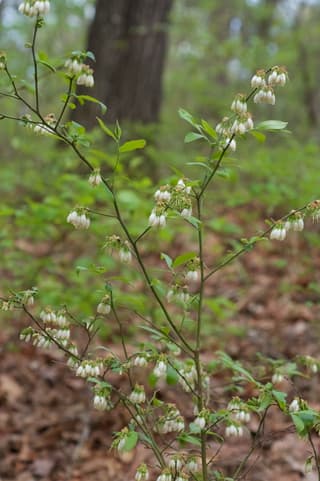
Rabbiteye Blueberry
Vaccinium ashei
The Rabbiteye Blueberry (Vaccinium ashei) is a deciduous shrub native to the southeastern United States, prized for its exceptional heat and drought tolerance. It produces abundant blue berries in summer and stunning fall foliage in shades of orange and scarlet.
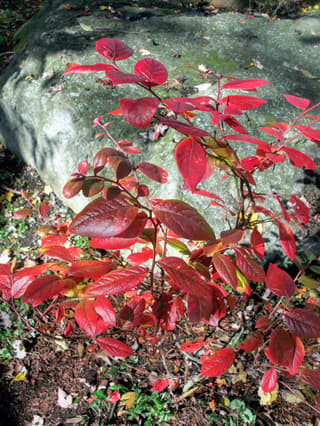
Highbush Blueberry
Vaccinium corymbosum
Highbush blueberry (Vaccinium corymbosum) is a deciduous, fruit-bearing shrub native to eastern North America and a member of the Ericaceae (heath) family, related to azaleas and rhododendrons. It is the primary species cultivated commercially for blueberry production worldwide. Plants form upright clumps 1.8-3.7 m tall, with green foliage that turns brilliant red-orange in fall, small white or pink bell-shaped flowers in spring, and sweet, nutrient-dense blue-purple berries in summer.
Medium Care Pet Safe
Our selection of 634 medium pet safe combines the characteristics of this category with moderate care needs. Ideal for those with basic experience.
Why Choose Medium Pet Safe?
Combining the beauty of pet safe with medium difficulty level lets you enjoy this category with a balanced care commitment. Each plant was selected to offer the best characteristics of the category at the care level you are looking for.