1160 Medium Plants | 2026 Guide - Page 5
Discover 1160 medium plants for your garden. Complete care guide.
1160 Medium Plants
Showing 145-180 of 1160
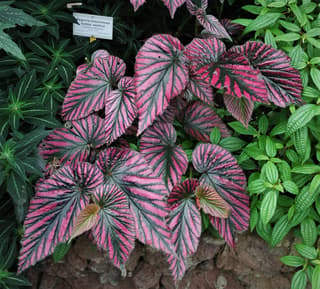
Exotica Begonia
Begonia brevirimosa
Begonia brevirimosa is a striking rhizomatous species native to the rainforest understories of Papua New Guinea, prized for its large, elliptic leaves splashed with iridescent bands of fuchsia pink and deep olive green. Grown mainly as a foliage houseplant, it produces small pink flowers on terminal clusters when light and humidity are ample. Its shrub-like habit and vividly patterned leaves make it a standout in humid terrariums, greenhouses, and bright indoor spaces.
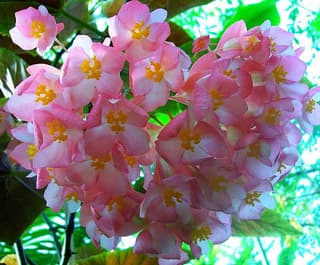
Scarlet Begonia
Begonia coccinea
The Scarlet Begonia (Begonia coccinea) is a cane-type begonia native to the Atlantic Forest of Brazil. It grows in upright clumps of woody, knobby stems resembling miniature bamboo, reaching up to 1 m (3.3 ft) tall. Its asymmetrical, leathery leaves are grayish-green on top with reddish margins and wine-red undersides. From early summer to mid-fall, it produces pendulous clusters of waxy, coral-red flowers, giving the plant its common name. It is a popular ornamental houseplant, valued both for its decorative foliage and its showy blooms.
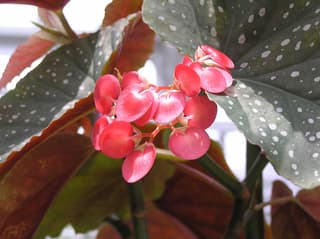
Angel Wing Begonia
Begonia corallina
The Angel Wing Begonia (Begonia corallina) is a tall, upright cane-type begonia with bamboo-like jointed stems. Its asymmetrical, wing-shaped leaves are olive-green, sometimes speckled with silver, and it produces pendulous clusters of coral, pink, or red flowers mainly in spring and summer. It is a classic houseplant prized for both its ornamental foliage and generous blooms.
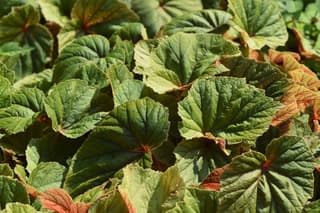
Hardy Begonia
Begonia grandis
Begonia grandis, commonly known as Hardy Begonia, is a tuberous perennial native to China and Japan. It stands out among begonias for its exceptional cold hardiness, surviving frost when its tuber is protected underground. From midsummer through early fall, it produces loose, drooping clusters of delicate pink flowers that attract pollinators, making it a prized ornamental for shaded gardens in temperate climates.
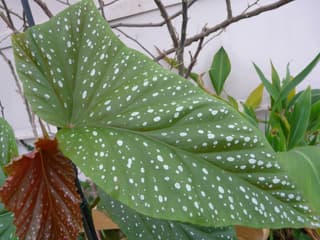
Polka Dot Begonia
Begonia maculata
Begonia maculata is a tropical plant native to Brazil, famous for its dark green leaves adorned with silvery-white polka dots and striking red undersides. It is one of the most popular begonias for indoor cultivation, adding an elegant and exotic touch to any space.
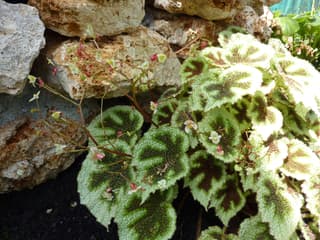
Iron Cross Begonia
Begonia masoniana
Begonia masoniana, commonly known as the Iron Cross Begonia, is a striking rhizomatous begonia native to southern China and northern Vietnam. Its most distinctive feature is the bold, dark brown cross-shaped marking at the center of each leaf, which closely resembles the German Iron Cross symbol. The leaves are large, puckered, and textured with a brilliant chartreuse-green color. While primarily grown for its dramatic foliage, it occasionally produces small greenish-white flowers in spring and summer.
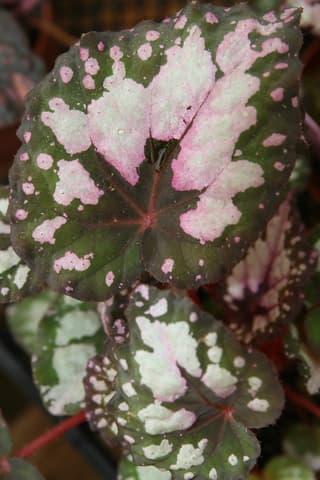
Rex Begonia
Begonia rex-cultorum
Rex Begonia (Begonia rex-cultorum) is a cultivated hybrid group prized for its extraordinary ornamental foliage — displaying stunning patterns in silver, purple, red, green, and pink. A cross between Begonia rex and other species, it is grown exclusively as an indoor plant due to its need for stable humidity and temperature. WARNING: contains calcium oxalate crystals, making it toxic to cats, dogs, and humans if ingested.
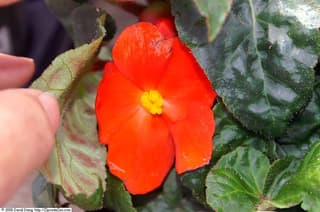
Tuberous Begonia
Begonia x tuberhybrida
Begonia x tuberhybrida is a perennial herbaceous plant prized for its lush and varied flowers, which can be single or double, resembling roses or camellias. They grow from fleshy tubers and are famous for their ability to brighten shaded garden areas or interiors with vibrant colors. As a tuberous plant, it undergoes a mandatory dormancy period during the winter months, when the aerial part dies back and the tuber must be stored in a dry place.
Beilschmiedia
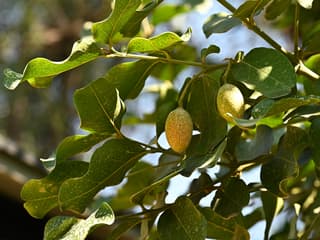
Beilschmiedia
Beilschmiedia is a genus of approximately 268 species of evergreen tropical and subtropical trees in the family Lauraceae. Distributed across the rainforests of Africa, Asia, Oceania, Central America, and South America, these trees are notable for their impressive canopy stature, dark leathery foliage, and significant ecological roles as dominant forest species. Notable members include B. tawa and B. tarairi from New Zealand and B. pendula (Pau de remo) from Brazil.
Golden Snake Cactus
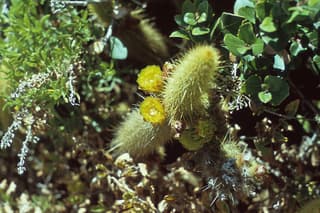
Bergerocactus emoryi
Bergerocactus emoryi is a shrubby cactus in the Cactaceae family, native to the coast of Southern California and northwestern Baja California. It forms dense thickets of cylindrical branches with 12 to 18 ribs, covered in golden-yellow spines that appear velvety when backlit by the sun. Stems are typically less than 6 feet (2 m) long. It blooms in spring with diurnal yellow flowers featuring reddish tips and produces globular, reddish, and spiny fruits. It is rare in cultivation and highly valued as an ornamental plant.
Paper Birch
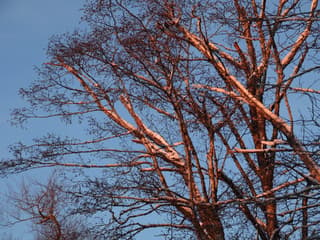
Betula papyrifera
The paper birch is a fast-growing deciduous tree native to northern North America, prized for its brilliant white bark that peels away in thin, papery layers to reveal a warm orange-brown inner layer. Its bright green, oval leaves turn golden yellow in autumn, and slender brown catkins appear in spring. Reaching 15 to 21 meters at maturity, it makes a striking focal point in cold-climate gardens and naturalized woodland plantings.
Harrison's Bifrenaria
Bifrenaria harrisoniae
Bifrenaria harrisoniae, commonly known as Harrison's Bifrenaria, is a striking epiphytic orchid endemic to Brazil. Found in the Atlantic Forest and Cerrado biomes at elevations between 200 and 1,200 meters, it produces large, waxy, fragrant flowers — predominantly white with a pink-to-burgundy labellum and dark veining — up to 8 cm across. The robust pseudobulbs store water and nutrients, enabling the plant to withstand seasonal dry periods.
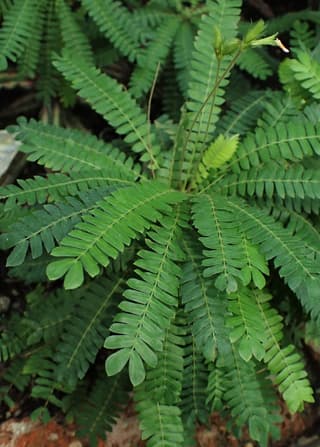
Little Tree Plant
Biophytum sensitivum
A small tropical herb from Asia with a palm-like rosette of feathery leaflets and tiny yellow star-shaped flowers. Its leaflets fold inward when touched, like the sensitive plant. It usually grows 15 to 30 cm tall.
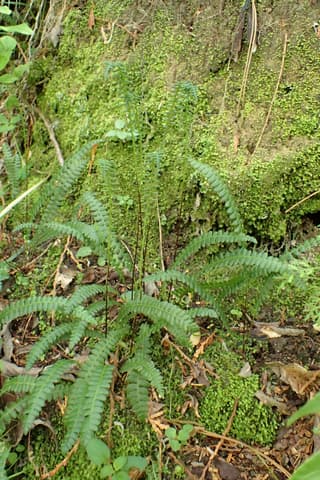
Membranous Hard Fern
Blechnum membranaceum
Blechnum membranaceum, commonly known as the Membranous Hard Fern, is a small Neotropical fern in the family Blechnaceae. Native to Central and South America, it produces delicate, thin fronds with a distinctive membranous texture, thriving in humid, shaded forest understories. Now reclassified as Austroblechnum membranaceum, it retains its historic trade name in horticulture.
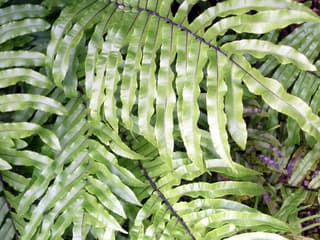
Soft Water Fern
Blechnum minus
Blechnum minus, commonly known as the Soft Water Fern, is a beautiful shade-loving terrestrial fern native to Australia, New Zealand, and Tasmania. It thrives in moist, riparian environments along creek banks and sheltered forest floors, forming dense, bushy clumps of glossy green fronds that reach 40–70 cm in length. As a member of the Blechnaceae family (synonyms: Lomaria minus, Parablechnum minus), it is a slow-growing evergreen fern prized for its graceful, arching fronds and adaptability to shaded garden positions.
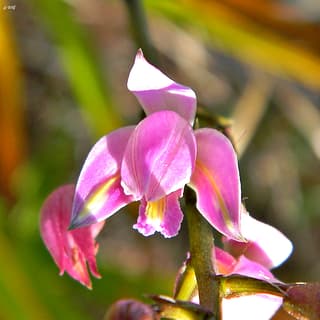
Pine-pink Orchid
Bletia purpurea
Bletia purpurea, commonly known as Pine-pink Orchid, is a terrestrial orchid native to the Caribbean, Florida, Mexico, and Central and South America. It produces oval pseudobulbs and elegant linear leaves, with impressive flower spikes carrying up to 80 pink-purple blooms on stems reaching 180 cm tall. The plant is deciduous, going dormant in winter before blooming in spring and summer.
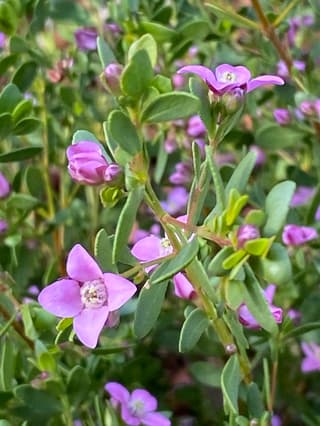
Aniseed Boronia
Boronia crenulata
Aniseed Boronia is an evergreen Australian shrub in the citrus family (Rutaceae), native to southwestern Western Australia, where it grows in sandy and rocky heathlands and open woodlands. It typically reaches 25–120 cm (10–47 inches) in height with an open, slightly pendulous growth habit. The small, serrated (crenulate) leaves release a distinct anise-like fragrance when crushed. From late winter to autumn—peaking in spring—the plant produces numerous small, four-petaled flowers in shades of pink to reddish-purple, appearing singly or in small clusters at the tips of the branches.
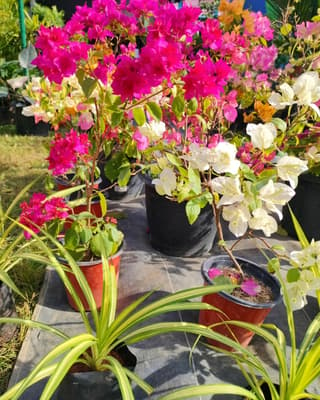
Garden Bougainvillea
Bougainvillea × buttiana
Garden Bougainvillea (Bougainvillea × buttiana) is a vigorous, thorny climbing hybrid celebrated for its vividly colored bracts surrounding small, inconspicuous flowers. Native to South America, it thrives in tropical and subtropical gardens thanks to its prolific blooming and drought tolerance.
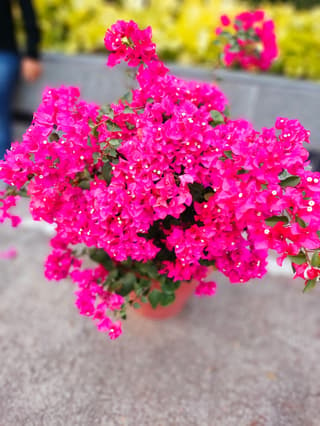
Bougainvillea
Bougainvillea glabra
Bougainvillea glabra, commonly known as Paperflower or Bougainvillea, is a vigorous woody climber native to Brazil. It is famous for its vibrant colors, which are actually bracts (modified leaves) surrounding its small, inconspicuous white flowers. It is an extremely resilient plant that thrives in full sun and is ideal for covering walls, fences, and pergolas, bringing a lush, tropical look to the garden.

Bougainvillea
Bougainvillea peruviana
Bougainvillea peruviana is a vigorous climbing shrub native to Peru and northern South America, belonging to the family Nyctaginaceae. Its spectacular display comes not from its true flowers — which are small, white, and inconspicuous — but from the brilliantly colored bracts that surround them in shades of magenta, pink, white, and purple. A champion of warm, sunny climates, it thrives in gardens, on trellises, walls, and pergolas, producing abundant color from spring through summer and beyond when given sufficient light.
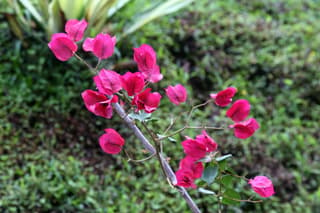
Great Bougainvillea
Bougainvillea spectabilis
Bougainvillea spectabilis, commonly known as Great Bougainvillea or Paper Flower, is a vigorous thorny climbing shrub native to the eastern coast of Brazil. Celebrated for its spectacular papery bracts in shades of magenta, pink, orange, purple, red, and white, it is one of the most widely cultivated ornamental plants in tropical and subtropical regions worldwide. The true flowers are small and white, surrounded by three showy bracts that provide all the visual drama. Once established, it is exceptionally drought-tolerant and fast-growing, thriving in full sun and warm climates.
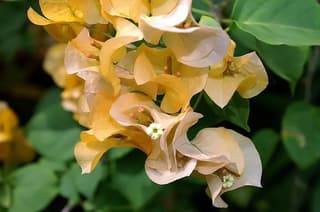
Bougainvillea
Bougainvillea x buttiana
Bougainvillea × buttiana, commonly called Paper Flower or simply Bougainvillea, is a vigorous ornamental climbing shrub and one of the world's most popular tropical plants. A natural hybrid between Bougainvillea glabra and Bougainvillea peruviana, it was originally developed in South African gardens in the 19th century. The spectacular display comes not from the plant's true flowers — which are small and white — but from the vivid papery bracts that surround them, available in shades of pink, red, purple, orange, white, magenta, and yellow. Armed with stiff thorns, this fast-growing climber can reach up to 12 meters and is widely used on walls, fences, trellises, and pergolas across tropical and subtropical regions worldwide.
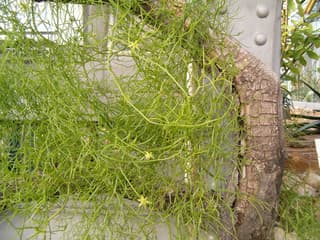
Climbing Onion
Bowiea volubilis
Bowiea volubilis is a succulent bulbous plant (caudiciform) native to southern and eastern Africa. Instead of traditional leaves, it produces thin, climbing green stems from a large, partially exposed green bulb that perform the function of photosynthesis. These stems can twine around supports and grow several meters long in warm climates. In spring, small star-shaped greenish-yellow flowers with an unpleasant scent appear. The plant is highly toxic, containing cardiac glycosides (bufadienolides).
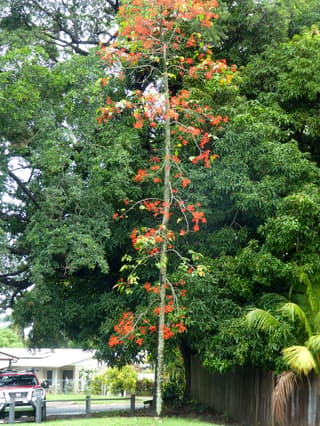
Illawarra Flame Tree
Brachychiton acerifolius
A spectacular large deciduous tree of the Malvaceae family, native to the east coast of Australia from southern New South Wales to far north Queensland. Renowned for its striking display of bright scarlet, bell-shaped flowers that appear in dense panicles on a leafless tree in late spring to early summer, creating a dramatic visual effect resembling a tree on fire. Reaches 15-18 meters in cultivation and up to 35 meters in natural habitat. Features deep lobed glossy leaves and a pyramidal growth habit. Once established, this tree is highly drought-tolerant and low-maintenance.
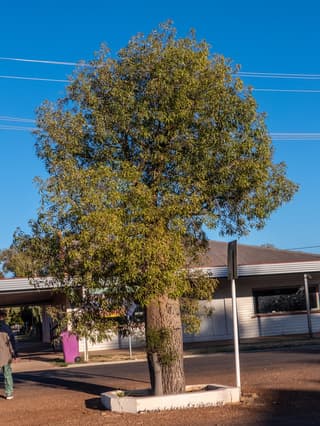
Queensland bottle tree
Brachychiton rupestris
Native to central Queensland, Australia, the Queensland bottle tree is a caudiciform species in the Malvaceae family, prized for the dramatically swollen, bottle-shaped trunk that stores water and carbohydrates to help it survive long droughts. In the wild it can grow 10-20+ m tall, though cultivated and bonsai specimens stay far more compact. It is deciduous, dropping its leaves in the dry season before producing cream-colored, red-marked flower panicles.
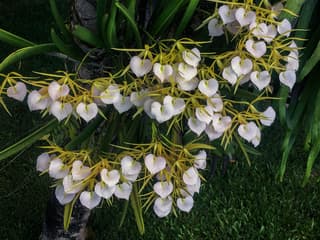
Lady of the Night
Brassavola nodosa
Brassavola nodosa, known as the Lady of the Night, is a medium-sized epiphytic orchid native to coastal regions of Central and South America, from Mexico to Brazil, where it grows on trees and even mangrove roots near the sea. Its cylindrical, succulent leaves produce stems with greenish-white flowers up to 6 inches (15 cm) wide, which release an intense, sweet fragrance at dusk to attract pollinating moths.
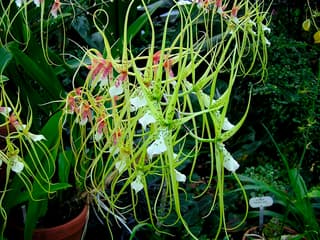
Spider Orchid
Brassia
Brassia is a genus of epiphytic orchids native to the tropical and subtropical forests of Central and South America, popularly known as spider orchids due to their long, thin petals and sepals that resemble spider legs. Their flower spikes can display up to 20 blooms in shades of yellow, cream, greenish, or reddish-brown, usually speckled with dark spots. It is a genus appreciated by both collectors and commercial hybridizers, valued for its exuberant flowering and exotic floral shape.
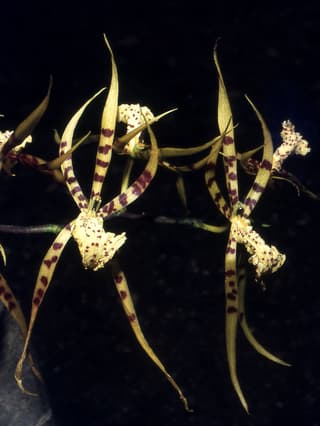
Spider Orchid
Brassia arachnoidea
Brassia arachnoidea, known as the spider orchid, is an epiphytic orchid native to the humid tropical forests of Central and South America, including Ecuador. It is named after the shape of its flowers—long, thread-like, greenish-yellow sepals and petals spotted with chocolate brown, reminiscent of a spider's legs. The leaves are broad and pleated, attached to ovoid pseudobulbs, and the flowering stems can bear up to 8 fragrant flowers, each with a diameter of 10-12 cm.
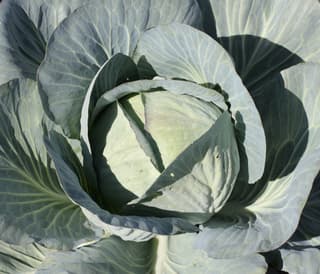
Wild Cabbage
Brassica oleracea
Brassica oleracea is the wild ancestor of many of the world's most important vegetables, including cabbage, kale, broccoli, cauliflower, Brussels sprouts, kohlrabi, and collard greens. Native to the coastal cliffs of the Mediterranean and Atlantic Europe, this biennial or perennial herb has been cultivated for over 2,000 years and selectively bred into an extraordinary array of cultivar groups. In its wild form it produces wavy blue-green leaves, a sturdy erect stem, and clusters of small yellow flowers. As the parent species of all these major cultivar groups, Brassica oleracea represents one of humanity's greatest achievements in plant domestication — transforming a coastal weed into the world's most important leafy edible crop.
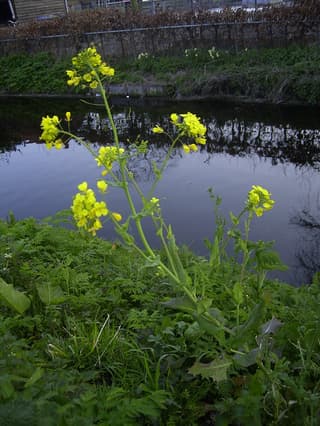
Turnip
Brassica rapa
Turnip (Brassica rapa) is a biennial vegetable from the Brassicaceae family, cultivated for thousands of years for its edible roots and nutritious leaves. Native to Central Asia, it thrives in temperate climates worldwide. The plant produces bright yellow flowers in spring and summer, and its swollen taproot is packed with vitamins C and K.
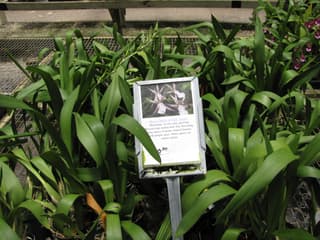
Miltassia orchid
Bratonia Charles M. Fitch
Bratonia Charles M. Fitch is a popular intergeneric orchid hybrid, a cross between Brassia verrucosa and Miltonia spectabilis. It is celebrated for its large, star-shaped flowers that resemble spiders, featuring striking lavender and purple hues with olive-green or brown spotting. The plant produces long, arching sprays of blooms that can last for several weeks, emerging from pseudobulbs with strap-like evergreen leaves.
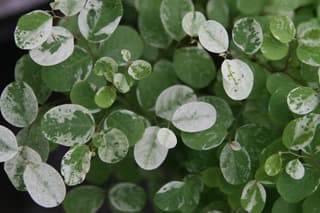
Snow Bush
Breynia
Breynia is a genus of around 35 evergreen shrubs in the Phyllanthaceae family, native to Southeast Asia, Australia and the western Pacific islands. The most widely grown ornamental species, Breynia disticha (snow bush), is prized for its small oval leaves splashed with white, pink and green in a mottled, almost hand-painted pattern. Grown as a houseplant, patio shrub, or clipped hedge in warm climates, it produces tiny inconspicuous flowers that are rarely the main attraction — the variegated foliage does all the work. It suckers and grows quickly, so regular pruning keeps it tidy and encourages the brightest new leaf color.
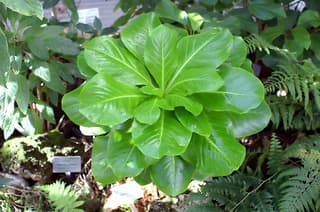
Hawaiian Palm
Brighamia insignis
Brighamia insignis, commonly known as the Hawaiian Palm or Vulcan Palm, is one of the world's most critically endangered plants. Native to the rocky sea cliffs of Kauaʻi and Niʻihau in Hawaii, this remarkable succulent features a bulbous, tapered trunk topped with a rosette of glossy green leaves. In autumn it produces clusters of fragrant, tubular yellow flowers. Now extinct in the wild, it survives only in cultivation, making it a living symbol of conservation.
Breadnut
Brosimum alicastrum
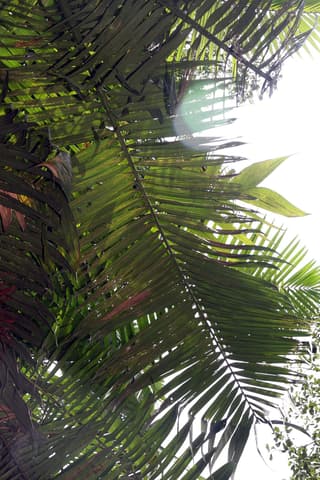
Breadnut (Brosimum alicastrum) is a large, evergreen tropical tree in the family Moraceae, native to Central America, southern Mexico, the Caribbean, and northern South America. It can reach up to 45 metres tall with a straight trunk and wide, globose crown. One of the most ecologically and culturally important trees of Mesoamerica, it was a dietary staple for the ancient Maya civilization. Its highly nutritious seeds, leaves, and latex have sustained communities for millennia.
Angel's Trumpet
Brugmansia
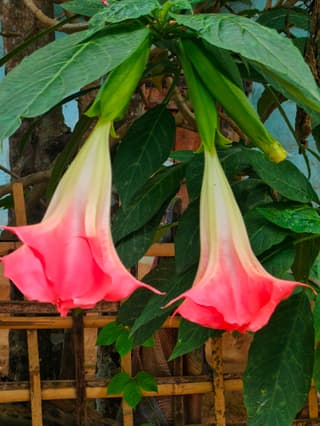
Brugmansia is a genus of tropical shrubs and small trees in the Solanaceae family, native to the Andean regions of South America (Ecuador, Colombia, Peru, Bolivia, Chile). Renowned for its spectacular, pendulous trumpet-shaped flowers up to 50 cm long with an intoxicating fragrance that intensifies at dusk. All parts of the plant are highly toxic due to tropane alkaloids (scopolamine, hyoscyamine, atropine). Brugmansia is extinct in the wild — every known specimen is cultivated.
White Angel's Trumpet
Brugmansia arborea
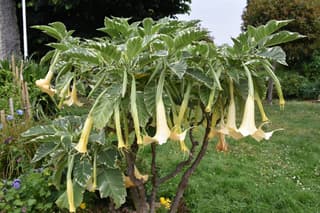
Brugmansia arborea, the white angel's trumpet, is an evergreen shrub or small tree native to the Andes from southern Colombia to northern Chile, where it grows in dry montane valleys between 2,000 and 3,000 m elevation. Its ovate leaves and young shoots are covered in fine velvety white down, and it bears pendulous, trumpet-shaped white to cream flowers 12–17 cm long with an intense fragrance that peaks in the evening. It is considered the hardiest Brugmansia species to both cold and drought, and is classified as Extinct in the Wild by the IUCN, surviving today only in cultivation.
What are Medium Plants?
Medium Plants require a bit more attention and basic gardening knowledge. These plants thrive with regular care and some cultivation experience. Ideal for those who already master the basics.
Tips for Growing Medium Plants
medium plants need a balance between attention and freedom. Keep a regular care routine, watch leaves to identify problems early, and adjust watering by season.